Quote Of The Day By Hypatia: ‘Reserve Your Right To Think, For Even To Think Wrongly Is Better Than Not to Thank at All’


By Lauren Waters Aug. 17, 2026 (thelist.com)

Bettmann/Getty Images

When thinking about the most famous philosophers over the course of history, the majority of the well-known figures are men. Some women’s voices managed to emerge despite the odds being stacked against them. One of those voices was Hypatia, a famous philosopher, as well as an astronomer, mathematician, and teacher during the Roman Empire. Hypatia was born around 355 CE in Alexandria, Egypt and was the daughter of fellow famous philosopher and mathematician Theon of Alexandria.

The importance of every individual’s right to think freely and form unique opinions was a core tenet of Hypatia’s philosophy. This influenced her take on religion and spirituality, which she believed were best pursued through reasoning, logic, and thought. At the time, Christianity was increasingly taking hold in Alexandria. Hypatia was popular with many followers who would attend her lectures. Yet, her way of thinking threatened organized religion. Receiving backlash for her opinions didn’t prompt her to shy away from speaking them. It is believed that a mob of religious extremists ultimately attacked and murdered Hypatia. Today, the shocking tragedy is thought of as the final act that brought the classical era of Greek philosophy to its end. That’s why Hypatia’s trailblazing way of thinking gave us today’s quote of the day.

“Reserve your right to think, for even to think wrongly is better than not to think at all.” Some attribute this quote directly to Hypatia, while Elbert Hubbard’s 1916 book, “Little Journeys to the Homes of Great Teachers,” attributes the quote to her father, Theon of Alexandria, while discussing her life story. In either case, this quote is perfectly aligned with Hypatia’s passion for free thinking and the importance of taking nothing at face value.

Deeper Meaning of Hypatia’s Quote — Trust your own ability to reflect and evaluate over the ability of others
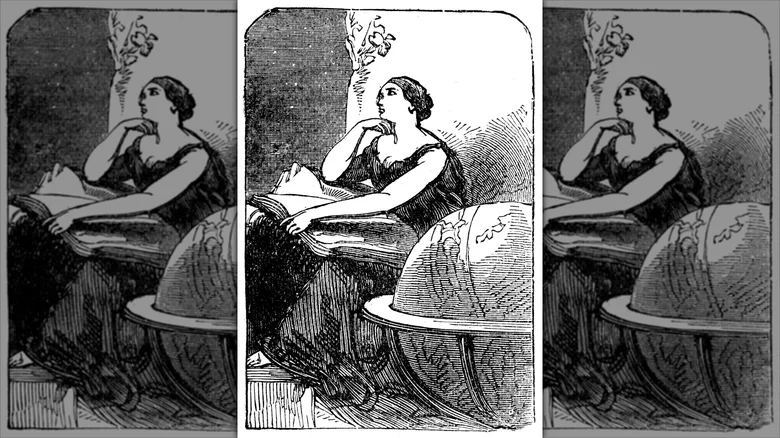
Print Collector/Getty Images

We’ve all heard the expression “perfect is the enemy of good.” This is precisely how Hypatia thought we should view our own ability to think. You don’t have to be a famous philosopher to be able to parse out truths about the world around you. Don’t let self-doubt prompt you to outsource your thinking to someone else. Always retain your ability to think through things, rather than simply assuming that what you others tell you is true.

This belief was fundamental to Hypatia’s way of thinking. She was vehemently against notions that weren’t proven being taught or treated as established facts. She encouraged people to use their own analysis, rather than falling prey to superstition or religious beliefs that relied on suspension of disbelief over reason. 

From political figures, advertising, and the internet, in our society these days, propaganda and misinformation are rampant. Yet, just because folks who are meant to be authority figures tell us something doesn’t make it a fact. Falsehoods are sometimes shared to the public for ulterior motives. In some ways, it’s more important now than ever to hold onto your ability to reason and think critically about what you see or hear.

More Quotes From Hypatia
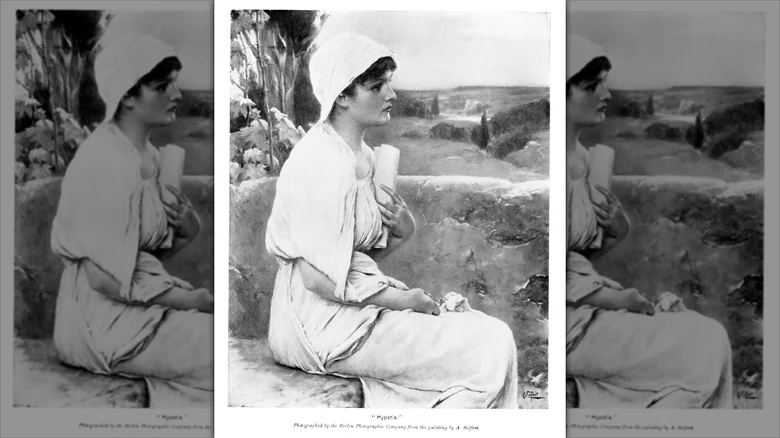
Christine_kohler/Getty Images

“All formal dogmatic religions are fallacious and must never be accepted by self-respecting persons as final.”

“Fables should be taught as fables, myths as myths, and miracles as poetic fancies. To teach superstitions as truths is a most terrible thing. The child mind accepts and believes them, and only through great pain and perhaps tragedy can he be in after years relieved of them.”

“In fact human beings will fight for a superstition quite as quickly as for a living truth — often more so, since a superstition is so intangible you cannot get at it to refute it, but truth is a point of view, and so is changeable.”

“Life is an unfoldment, and the further we travel the more truth we can comprehend. To understand the things that are at our door is the best preparation for understanding those that lie beyond.”

Read More: https://www.thelist.com/2235792/quote-of-the-day-hypatia-right-to-think/

(Contributed by Janet Cornwell, H.W., m.)

Hypatia[a] (born c. 350–370 – March 415 AD)[1][4] was a Neoplatonist philosopher, astronomer, and mathematician who lived in Alexandria, at that time in the province of Egypt and a major city of the Roman Empire. In Alexandria, Hypatia was a prominent thinker who taught subjects including philosophy and astronomy,[5] and in her lifetime was renowned as a great teacher and a wise counselor. Not the only fourth century Alexandrian female mathematician, Hypatia was preceded by Pandrosion.[6] However, Hypatia is the first female mathematician whose life is reasonably well recorded.[7] She wrote a commentary on Diophantus‘s thirteen-volume Arithmetica, which may survive in part, having been interpolated into Diophantus’s original text, and another commentary on Apollonius of Perga‘s treatise on conic sections, which has not survived. Many modern scholars also believe that Hypatia may have edited the surviving text of Ptolemy‘s Almagest, based on the title of her father Theon‘s commentary on Book III of the Almagest. (Wikipedia.org)

Angélica Dass Humanae Project

  • Google AI Overview

The official online home for Humanae—the acclaimed chromatic skin-color photography project by artist Angélica Dass—can be viewed directly at the Angélica Dass Humanae Portfolio. [1, 2, 3, 4]

About the Project

  • Concept: A global photographic inventory matching human skin tones to Pantone® color swatches.
  • Goal: Challenge racial stereotypes and highlight human diversity.
  • Method: Portrait backgrounds are color-matched to an 11×11 pixel sample from each subject’s nose. [1, 2]

Word-built world: dividual

  • Google AI

Dividual is an adjective that primarily means divisible, divided, or shared in common with others. While traditionally classified as an archaic linguistic term, it has experienced a modern resurgence in philosophy and anthropology to describe social identity and data tracking. [1, 2, 3, 4]

Core Definitions

  • Archaic Definition: Capable of being divided, separate, or distributed among multiple entities (e.g., John Milton famously wrote of the moon holding its “dividual” reign with lesser lights). [1, 2]
  • Philosophical & Digital Definition: An entity that is not an indivisible whole (unlike an individual), but is instead constantly split, quantified, and reduced into data points, tracked behaviors, or component parts. [1, 2]
  • Anthropological Definition: A person whose identity is interlinked with and inseparable from their community relationships, obligations, and shared responsibilities. [1]

Key Differences: Individual vs. Dividual

FeatureIndividualDividual
Core MeaningIndivisible; a single autonomous unit.Divisible; split into parts or networks.
Modern ContextA unique human being with personal rights.A user profile broken into tracking data points.
Social FocusIndependence and self-reliance.Interdependence and shared connection.

The metaphysical implications of the dividual challenge the foundational Western assumption of the “individual” as a solid, indivisible, and autonomous substance. Instead of viewing existence as a collection of isolated “things,” a dividual metaphysics views reality as a fluid network of relations, flows, and constant transformations. [1, 2, 3]

Here are the primary metaphysical implications of the dividual concept:

1. Relational Ontology (Being-as-Relation)

  • The Shift: Traditional metaphysics (from Aristotle to Descartes) is based on substance ontology, where a thing exists independently on its own. Dividual metaphysics uses relational ontology. [1, 2, 3, 4, 5]
  • Implication: A person or object does not have relationships; they are the sum of their relationships. Existence is not a collection of separate dots, but the lines connecting them. You do not exist prior to your interactions; you are continuously produced by them. [1, 2]

2. The Illusion of the Boundless Self

  • The Shift: It dissolves the strict metaphysical boundary between the “inside” (the mind, soul, or self) and the “outside” (the world, others, and nature). [1]
  • Implication: The skin is no longer a hard metaphysical border. Thoughts, emotions, and bodily states are seen as porous, constantly absorbing and transmitting elements from the environment. The self is an open ecosystem, not a closed fortress. [1]

3. Process Philosophy (Becoming vs. Being)

  • The Shift: It aligns heavily with process philosophy (such as the work of Alfred North Whitehead). It prioritizes becoming over static being. [1]
  • Implication: Because a dividual is constantly being divided, distributed, and recombined, identity is never fixed. You are not a permanent noun; you are a continuous verb. Change is the fundamental reality, while stability is just a temporary plateau. [1, 2, 3]

4. Distributed Agency

  • The Shift: Traditional metaphysics places “agency” (the power to act and choose) squarely inside the individual consciousness.
  • Implication: Dividualism implies that agency is distributed across networks. A choice is never purely your own; it is co-produced by your biology, your cultural tools, your digital algorithms, and your physical environment. Human and non-human elements fuse to create action. [1]

5. Multiplicity and Assemblages

  • The Shift: It replaces the metaphysical ideal of the “One” (unity, purity, wholeness) with the reality of the “Many” (multiplicity, fragmentation). [1, 2, 3]
  • Implication: As philosophers like Gilles Deleuze argued, entities are “assemblages”—temporary collections of heterogeneous parts. A human being is a dividual assemblage of organs, bacteria, digital data profiles, ancestral memories, and social roles, all operating simultaneously without needing a single, central “core.” [1, 2, 3]

Summary of Metaphysical Shifts

ConceptIndividual MetaphysicsDividual Metaphysics
Fundamental UnitSubstance (The thing itself)Relation (The space between things)
IdentityFixed, permanent, unifiedFluid, temporary, multiple
RealityBeing (Static)Becoming (Dynamic process)
BoundariesClosed, independentPorous, interdependent

The concept of the dividual aligns profoundly with Eastern metaphysics. While Western philosophy historically prioritized the independent “substance” of the self, Eastern traditions have spent millennia mapping reality as a fluid, interconnected web.

Here is how the metaphysical implications of the dividual manifest across major Eastern traditions:

1. Buddhism: Anatta (Non-Self) and Pratītyasamutpāda

Buddhism offers perhaps the most direct metaphysical parallel to the dividual by explicitly denying the existence of a permanent, indivisible individual soul.

  • The Five Skandhas (Aggregates): Buddhism teaches that what we call the “self” is actually a temporary assemblage of five constantly changing parts: form, sensation, perception, mental formations, and consciousness. You are a dividual process, split into these fluctuating components.
  • Dependent Origination (Pratītyasamutpāda): Nothing exists in isolation. Everything arises in dependence upon multiple causes and conditions. The individual is an illusion; reality consists entirely of relational links.

2. Hinduism: Advaita Vedanta and Indra’s Net

While certain schools of Hinduism affirm an ultimate soul (Atman), its relationship to the universe mirrors dividual metaphysics through radical interconnectedness.

  • Indra’s Net: This famous metaphor describes a vast cosmic web where every knot contains a jewel. Each jewel reflects all other jewels in the net. No single jewel possesses independent identity; its very existence is a reflection of the whole. [1]
  • The Illusion of Separation (Maya): The belief that you are a separate, autonomous individual is considered cosmic ignorance (Maya). Metaphysically, your boundaries are porous, and your true nature is seamlessly integrated with the absolute whole (Brahman).

3. Daoism: The Flow of Qi and Yin-Yang

Daoism rejects static categories of “being” in favor of constant transformation, viewing humans not as fixed individuals but as knots in a cosmic current.

  • The Self as a Vortex: In Daoism, a human being is a temporary concentration of cosmic energy (Qi). Just like a whirlpool in a river, it has a recognizable shape for a moment, but it is never separate from the water flowing through it.
  • Dynamic Interdependence: The Yin-Yang shows that opposites are not separate entities but mutually constituting parts of a single process. You cannot define the self without the “other.”

4. Confucianism: The Relational Self

While less focused on cosmic metaphysics and more on social metaphysics, Confucianism defines a human being entirely by their social location.

  • Identity as a Matrix: In Confucian thought, you do not exist prior to your roles as a child, parent, sibling, or citizen. You are the intersection of your obligations. If you strip away all relationships, there is no hidden “individual” left underneath; the relations are the essence of the person.

Comparison: Western Dividualism vs. Eastern Metaphysics

DimensionModern Western Dividualism (Deleuze/Data)Eastern Metaphysics (Buddhism/Daoism)
The Cause of DivisionExternal forces (Algorithms, capital, tracking).Internal and cosmic reality (Nature of existence).
View of FragmentationOften alienating or a mechanism of control.Liberating; the key to breaking suffering.
Ultimate GoalResistance, political awareness.Enlightenment, harmony, alignment with the Dao.

Book: “How God Becomes Real: Kindling the Presence of Invisible Others”

How God Becomes Real: Kindling the Presence of Invisible Others

T.M. Luhrmann

The hard work required to make God real, how it changes the people who do it, and why it helps explain the enduring power of faith

How do gods and spirits come to feel vividly real to people–as if they were standing right next to them? Humans tend to see supernatural agents everywhere, as the cognitive science of religion has shown. But it isn’t easy to maintain a sense that there are invisible spirits who care about you. In How God Becomes Real, acclaimed anthropologist and scholar of religion T. M. Luhrmann argues that people must work incredibly hard to make gods real and that this effort–by changing the people who do it and giving them the benefits they seek from invisible others–helps to explain the enduring power of faith.

Drawing on ethnographic studies of evangelical Christians, pagans, magicians, Zoroastrians, Black Catholics, Santeria initiates, and newly orthodox Jews, Luhrmann notes that none of these people behave as if gods and spirits are simply there. Rather, these worshippers make strenuous efforts to create a world in which invisible others matter and can become intensely present and real. The faithful accomplish this through detailed stories, absorption, the cultivation of inner senses, belief in a porous mind, strong sensory experiences, prayer, and other practices. Along the way, Luhrmann shows why faith is harder than belief, why prayer is a metacognitive activity like therapy, why becoming religious is like getting engrossed in a book, and much more.

A fascinating account of why religious practices are more powerful than religious beliefs, How God Becomes Real suggests that faith is resilient not because it provides intuitions about gods and spirits–but because it changes the faithful in profound ways.

About the author

T.M. Luhrmann

Tanya Marie Luhrmann is currently the Watkins University Professor in the Anthropology Department at Stanford University. She has been elected to the American Academy of Arts and Sciences, and has been the recipient of a John Simon Guggenheim Fellowship.

Tanya Marie Luhrmann (born 1959) is an American psychological anthropologist best known for her studies of modern-day witches, charismatic Christians, and psychiatrists. She received her AB summa cum laude in Folklore and Mythology from Harvard-Radcliffe in 1981, working with Stanley Tambiah. She then studied Social Anthropology at Cambridge University, working with Jack Goody and Ernest Gellner. In 1986 she received her PhD for work on modern-day witches in England, later published as Persuasions of the Witch’s Craft (1989). In this book, she described the ways in which magic and other esoteric techniques both serve emotional needs and come to seem reasonable through the experience of practice.

Her second research project looked at the situation of contemporary Parsis, a Zoroastrian community in India. The Parsi community enjoyed a privileged position under the British Raj; although by many standards, Parsis have continued to do quite well economically in post-colonial India, they have become politically marginal in comparison to their previous position, and many Parsis speak pessimistically about the future of their community. Luhrmann’s book The Good Parsi (1996) explored the contradictions inherent in the social psychology of a post-colonial elite.

Her third book, and the most widely acclaimed, explored the contradictions and tensions between two models of psychiatry, the psychodynamic (psychoanalytic) and the biomedical, through the ethnographic study of the training of American psychiatry residents during the health care transition of the early 1990s. Of Two Minds (2000) received several awards, including the Victor Turner Prize for Ethnographic Writing and the Boyer Prize for Psychological Anthropology (2001).

Her fourth book, When God Talks Back: Understanding the American Evangelical Relationship with God (March 2012), examines the growing movement of evangelical and charismatic Christianity, and specifically how practitioners come to experience God as someone with whom they can communicate on a daily basis through prayer and visualization.

Other projects she is working on include a NIMH-funded study of how life on the streets (chronically or periodically homeless) contributes to the experience and morbidity of schizophrenia.

(Goodreads.com)

Pete Hegseth’s Obsession With Manhood Is Nuts

Pete Hegseth, testifies, Senate Armed Services Committee, hearing
Secretary of Defense Pete Hegseth testifies during the Senate Armed Services Committee hearing on the Defense Department’s budget request on April 30, 2026. Photo credit: © Bill Clark/CQ Roll Call via ZUMA Press

US Politics

Milicent Cranor 08/17/26 (WhoWhatWhy.org)

The secretary of war puts the T in toxic masculinity.

Last month, Pete Hegseth, US secretary of war — and I do mean war — further polluted the air already fouled with misinformation: He amplified the false impression circulated by the online manosphere that high testosterone levels make one a better fighter.

This seems to have led many civilian men to seek out sources — legitimate or not — to get this manly hormone into their systems, whether they need it or not. (And if they don’t need it, they may suffer the dreadful effects of its abuse — such as testicle shrinkage!)

As you probably know, Hegseth demanded that all soldiers over the age of 30 have their testosterone levels tested. And look at the language he used:

He wants a “High-T Department of War.”

He wants soldiers on the “leading edge of lethality.”

And if a “warfighter’s” testosterone is found to be deficient, he has the “option” of getting hormone replacement therapy. (Health Secretary Robert F. Kennedy Jr. gets such therapy, and he is definitely lethal, though not as a soldier. His decisions on vaccines have resulted in untold death and misery.) 

Since our soldiers in the Middle East do their killing not by hand-to-hand combat but by operating lethal machinery — the role of “High T” in modern warfare is not clear to me. 

Possibly Hegseth believes a man with high testosterone will be not only physically, but psychologically fit; that is, he should have the right lethal attitude. Kill! Kill! Kill!

Ironically, some of the most lethal, most murderous leaders in history — men who ordered others to kill — apparently had low levels of testosterone themselves. There is some truth in this British World War II song, at least as it applies to Hitler:

Hitler! He only had one ball,

Göring had two but they were very small,

Himmler had something sim’ler

But Herr Goebbels had no balls at all.

Adolf Hitler apparently did have only one ball — although the cause of his condition is still being debated.

And then there’s Napoleon, another killer. He had a condition known as “micropenis.” His doctor surreptitiously removed the organ during his autopsy and, ever since, it has been passed around, unpreserved, in a small presentation box, to various collectors.   

The organ has been described as a “shriveled eel” and “a bit of beef jerky.” Of course in its dried out state, it wouldn’t look its best, but indications are, his equipment was abnormally small.

And there’s other evidence Napoleon’s testosterone levels may have been beneath Hegseth’s standards. According to Napoleon’s doctor, François Antommarchi, after stepping out of his bath, the Emperor said to him (translations vary): 

“See Doctor, what lovely arms, what smooth white skin without a single hair! What rounded breasts — any beauty would be proud of a bosom like mine.” 

In addition to Hitler and Napoleon, there are droll stories about lethal contemporary characters — men you can’t avoid reading about every day — men whose names I shall not mention. 

These stories describe in detail what some would characterize as “embarrassing inadequacies” (not necessarily hormone related), that could be especially triggering to an appearance-obsessed, malignant narcissist. You can guess who they are. Google is gagging over the inquiries.

But what these unmentioned men — with their unmentionable private issues — truly lack is a conscience. And to a degree that is grotesque. Their actions have resulted in countless deaths and ruined lives.

***

I wonder what Hegseth’s own testosterone levels are.

And I wonder if he knows how much alcohol diminishes one’s testosterone levels.

A doctor once told me about all the drunks he’d seen down in the Bowery who had full heads of hair — owing to low levels of testosterone thanks to booze. According to the peer-reviewed medical journal Andrology, which reported the results of multiple analyses involving 10,199 men:

“The meta-analysis showed that alcohol consumption overall is related to significant reduction in circulating concentrations of total testosterone.”

(Note to the technically inclined: Men and women both have testosterone and estrogen, but in different proportions. In a man, low testosterone results in “unopposed estrogen,” which in turn results in nice head hair, but low body hair. On the other hand, if a woman is very low in estrogen, she has “unopposed testosterone” and may have sparse head hair, but a full mustache.)

Pete Hegseth certainly has plenty of hair on his head that is probably his own — and for decades, apparently, he’s had plenty of alcohol in his system.

Whistleblowers from the Concerned Veterans for America (CVA), led by Hegseth until 2016, alleged that he was repeatedly drunk while performing official duties. More recently (December 3, 2024), NBC News published this story, based on interviews with 10 current and former Fox employees: “Pete Hegseth’s Drinking Worried Colleagues at Fox News.” And Hegseth’s former sister-in-law alleged in an affidavit that Hegseth was frequently drunk, during which time he abused his wife.

Hegseth denies these stories. Of course he does. Just as he denied texting overly specific war plans on Signal. (Go here for choice details.) 

In any case, it sounds like he’s had more than a drink or two.

Besides alcohol, recreational drugs like heroin and cocaine affect testosterone levels, which may explain why former drug user Kennedy needs hormone replacement therapy. (He also needs brain replacement therapy, but none is available.)

But there is something far more dangerous to your masculinity and, indeed, to the entire human race and other forms of life on this planet. Namely, petroleum, aka oil.

***

Sooner or later, in one form or another, oil seeps into everything in our lives.  

It seeps into nearly everything around us — in the form of tiny bits of plastic — which are made from fossil fuels. 

Microplastics (MPs) and nanoplastics (NPs), which are even smaller, abound in the air, the soil, the water, our food, and not just from the plastic packaging. MPs have been found in the animals we eat (fish muscle, for example) and in the fibers of fruits and vegetables.

And MP/NPs are in nearly every organ of your body. They are in your brain (7 grams in the frontal cortex, where you do your thinking), in your retinas, in your blood vessels, your heart, liver, and so on. And in your reproductive equipment, male and female.

In this story, I am focusing on males because, according to our secretary of war, males need their testosterone in order to be on the “leading edge of lethality.”

NPs have been found in human semen, in human testicles (and in the testicles of dogs, studied because their lives are deeply intertwined with ours), and in human penises. To see more proof of the danger, go herehere, and here.)

The drop in sperm count in developed countries began approximately 50 years ago. The subject is controversial, and different causes are cited, but I can’t help noticing that 50 years ago happens to be about the same time we started using really humongous amounts of plastics.

And plastics seem to be here to stay. The world is shifting toward renewable power, and to offset declining fuel sales, major oil and gas companies are turning to plastics as “Plan B.” According to the Center for International Environmental Law, “Just as the world begins to realize the dangers of plastic pollution and take action to reduce it, industry is poised to invest billions in expanding plastic production.”  

***

In the meantime, though infested with plastic, we should all try to take good care of ourselves.

Men, if you suspect you have abnormally low testosterone levels — or if you’re an accomplished hypochondriac — you can view this long list of symptoms presented by the Mayo Clinic — but bear in mind that many of these same symptoms are caused by psychological factors. Better to discuss the issue with a urologist. 

Here are some good, up-to-date articles on the safety of testosterone therapy: 

Is Testosterone Therapy Safe? Take a Breath Before You Take the Plunge

Statement on Testosterone Replacement Therapy 

Management of Adverse Effects in Testosterone Therapy

What Men Should Know About Testicular Shrinkage and Testosterone Therapy

Trump, Kennedy, et al. want to make it easier to get prescriptions for testosterone. Given what these people say about vaccines, you should be cautious about accepting anything they say about anything else.

Your lifestyle can greatly affect your hormone levels (as well as everything else) — high stress, inadequate sleep, poor nutrition, lack of exercise, and, as previously mentioned, drugs and alcohol. You’ve heard it all before.

Avoid this book: Manhood: The Masculine Virtues America Needs, by Sen. Josh Hawley (R-MO), who believes “No menace to this nation is greater than the collapse of American manhood, the collapse of masculine strength.”

Avoid using red laser therapy on your groin. See this story in Vanity Fair: “Tucker Carlson: Tan Your Balls If You Want to Be a Real Man.


  • Milicent CranorMilicent Cranor is a senior editor at WhoWhatWhy. She has worked as a creative editor at E.P. Dutton, a comedy ghostwriter, and editor of consequential legal and scientific documents. She has also co-authored numerous peer-reviewed articles for medical journals.

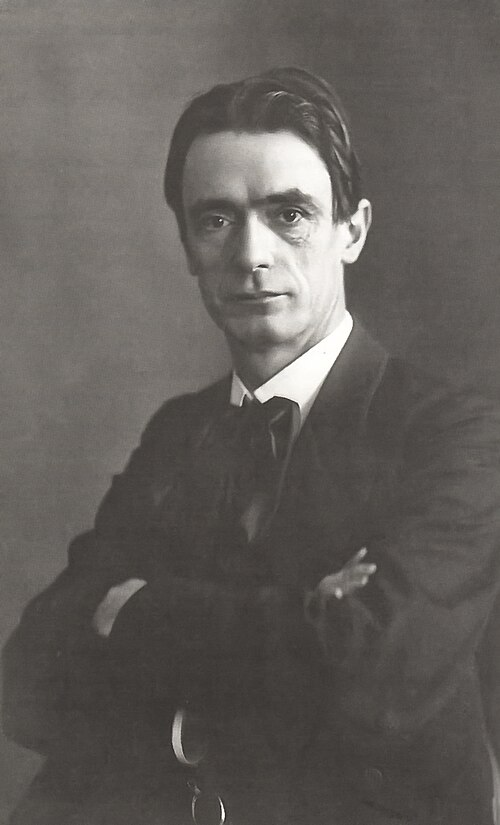
Rudolf Steiner on organs of perception

Steiner circa 1905

“Just as in the body, eye and ear develop as organs of perception, as senses for bodily processes, so does a man develop in himself soul and spiritual organs of perception through which the soul and spiritual worlds are opened to him. For those who do not have such higher senses, these worlds are dark and silent, just as the bodily world is dark and silent for a being without eyes and ears.”

~ Rudolf Steiner

Rudolf Joseph Lorenz Steiner was an Austrian New Age guru, philosopher, occultist, social reformer, architect, esotericist, and claimed clairvoyant and speaker with the dead. Wikipedia

Born February 1861, Donji Kraljevec, Croatia

Died March 30, 1925 (age 64 years), Dornach, Switzerland

Scientists find 3 supermassive black holes on the verge of collision inside a distant galaxy

By Keith Cooper

Published yesterday (Space.com)

A greedy galaxy that existed less than 1.3 billion years after the Big Bang is hoarding supermassive black holes.

A pixelated reddish image. There are three black circles showing where the three black holes are located.
The distant galaxy J0148-4214, seen in the light of ionized hydrogen. The image appears pixelated because of the great distance to the galaxy. The black circles denote the relative locations of the three black holes. (Image credit: Hannah Übler)

A trio of heavyweight black holes are entangled in a dance of death that will quite possibly see them gradually all merge to form an even greater behemoth.

Scientists have discovered the black holes in a galaxy that is so far away its light has taken 12.5 billion years to reach us, meaning we see it as it was less than 1.3 billion years after the Big Bang. And it’s offering strong supporting evidence that one of the ways black holes grew so massive so quickly in the early universe was through mergers.

“This is the first evidence of three active black holes in a single galaxy in the distant universe,” Hannah Übler, an astronomer at the Max Planck Institute for Extraterrestrial Physics in Germany who led the study, said in a statement. “It suggests that processes in the early universe were efficient at bringing massive black holes together, setting the stage for the massive black-hole mergers we expect to detect with future gravitational-wave observatories.”

The galaxy that plays host to the black holes is catalogued as J0148-4214 and is so far away (their redshift is 5.0167) that the James Webb Space Telescope (JWST), which made the discovery, could not see the black holes directly. Instead, the Integrated Field Spectroscopy unit on the JWST’s Near Infrared Spectrometer (NIRSpec) measured the motion of hydrogen gas swirling around at high velocity in the accretion disks encircling each black hole.

“The JWST data allowed us not only to identify the three black holes, but also to estimate their masses, accretion rates and the stellar mass of the galaxy,” Giovanni Mazzolari of the Max Planck Institute for Extraterrestrial Physics said in the statement. “We find a total stellar mass of about 1.3 billion suns, and the black holes represent a significant fraction of that.”You may like

Two of the black holes reside at the center of J0148-4214, separated by 620 light-years. One of these black holes has a huge mass of 80 million times the mass of our sun, while its companion is a relative pipsqueak at 600,000 solar masses. Yet despite its diminutive stature, the smaller black hole is growing at a tremendous rate by accreting gas faster than the Eddington limit. This is the theoretical maximum rate at which material can fall towards a black hole; if the rate is any higher then the accretion disk around the black hole becomes so dense and hot that radiation from the disk blows material back out again, stifling the black hole’s feeding frenzy. This means the smaller black hole will only be able to keep growing at this rate for a short time before negative feedback calls a halt.

The third black hole is 5,500 light-years out from the center of J0148-4214 and has a mass two million times greater than the mass of our sun. This is about half the mass of the supermassive black hole at the center of our Milky Way galaxy, called Sagittarius A*. It’s thought that this third black hole, and quite possibly the second one too, found their way into J0148-4214 via mergers between galaxies.Space

“These results are extremely exciting,” said Roberto Maiolini of the University of Cambridge, who was a participant in the findings. “They suggest that black-hole merging may be an additional, fast route for their rapid growth in the early universe.”

A blobby orange, fuzzy sphere against a dark background.
An image of Sagittarius A*, the supermassive black hole at the heart of the Milky Way. (Image credit: EHT Collaboration)

Mergers between black holes produce bursts of gravitational waves. Current gravitational-wave detectors — including The Laser Interferometer Gravitational-Wave Observatory (LIGO) in the United States, Virgo in Italy and KAGRA in Japan — are able to detect the high frequency, short wavelength gravitational waves from the mergers of stellar-mass black holes, the kind formed in certain supernova explosions. To detect the much longer wavelength, shorter frequency gravitational waves produced by the merger of supermassive black holes such as those in J0148-4214 requires a space-based detector with a baseline many millions of miles long.

To that end, the European Space Agency plans to launch LISA, the Laser Interferometer Space Antenna. If all goes to plan, by the mid-2030s. LISA will feature three spacecraft in triangular formation, each side of the triangle being 1.55 million miles (2.5 million kilometers) long. The three spacecraft will beam lasers at each other, looking for deviations in the travel time of those laser beams as evidence for the passing of a long-wavelength gravitational wave.What to read next

With regards to J0148-4214, however, there is a caveat: The third black hole might not be on a collision course with the other two. Instead, it could be heading out of the galaxy.

It’s the classic three-body problem: How do three objects orbiting one another interact?

The two smaller black holes may have entered J0148-4214 as a binary pair. Then, as they were drawn closer to the 80-million-solar-mass black hole, the more massive black hole could have snatched the 600,000-solar-mass black hole while exchanging angular momentum with the two-million-solar-mass black hole to fling it away at high velocity. We see a similar effect in our galaxy with hypervelocity stars that are racing out of the Milky Way. These speedy stars used to be part of a binary pair of stars that got too close to Sagittarius A*, which is the black hole at the center of our galaxy. One half of the binary was captured by the black hole and the other was flung away.

Currently, there is no way to measure the direction of motion of the third black hole in J0148-4214 and confirm whether it will merge with the other two black holes or escape. If it did escape, it could still be wandering alone and dark in intergalactic space even now, 12.5 billion years later.

The findings are presented in the journal Astronomy & Astrophysics.

Kentucky Middle School Sends Students Home on First Day of Class With AI-Generated Educational Materials Full of Inexcusable Hallucinations, Including a Map Labeled With “North Dahota” and “Olkchoma”

Joe Wilkins

Mon, August 17, 2026 (Futurism via Yahoo.com)

A garbled AI-generated map of the United States that was handed out to middle school children.
Jefferson County Public Schools / Futurism

Key takeaways powered by Yahoo Scout. Yahoo is using AI to generate key points from this article. This means the info may not always match what’s in the article. Reporting mistakes helps us improve the experience.

Kentucky parents are outraged after discovering that horribly inaccurate educational materials handed out to their middle school students were generated with AI.

According to local station WDRB, students at Farnsley Middle School in Southwest Louisville were sent home with a packet chock full of AI hallucinations on their first day of the school year. The most obvious tell was a map of North America, which contained some jaw dropping misspellings of state names, misplaced cities, and hallucinated territories that don’t actually exist.

Kentucky, for example, was mislabeled “Venecky,” while states like Texas and Louisiana were reimagined as “Taxas” and “Lookoong.” Though South Dakota made it out unscathed, its northern counterpart was branded “North Dahota.” Other notable entries are Arizona and New Mexico, which became “Arizone” and “New Mizone,” while Oklahoma degenerated into “Olkchoma.”

Even when the AI render got its names right, the locations are horribly mangled, in one instance pinpointing Cuba’s capital city of Havana as situated on Mexico’s Yucatan peninsula.

Some states like Michigan and California didn’t merit any names at all, while others are split into imaginary realms. South of Vancouver (spelled “Venneouer”), for example, is the mythical land of “Beehie,” which according to the map shares its borders with Washington state.

“Arizona is Arizone. Illinois starts with a V,” Stacey Morris, a Kentucky mom whose son brought home one of the packets told WDRB. “I mean, it’s crazy.”

Images shared on social media show other parts of the packet with similar problems, like a periodic table of the elements showing Magnesium with an impossible atomic mass of -3.08, and a map of the solar system where Mars has been labeled “Marc.”

“Planetary distance are temporatory earth, equater the elenonts and regnestiom org toed dishligns,” the packet declares, verbatim. “Net to scale.”

A parent discovered that her daughter’s middle school in Kentucky has been having their students use agendas that are ai generated pic.twitter.com/7ToGyTwLFQ

— Michael (@TheMG3D) August 15, 2026

In a statement to WDRB, the school district’s executive officer of communications said they “spoke with the school today about inaccuracies in their agenda, and they are communicating with parents about the issue.” After the discovery, the school admin reportedly emailed teachers about the packet, ultimately advising them to rip out 17 pages of AI-generated material before handing them out to students.

For adults who know better, it might just be another case of silly AI hallucinations. But to present this material to middle school students — who may just be starting to conceptualize the world beyond Kentucky for the first time — is egregious, and the long-term consequences are hard to overstate. While the generative AI tool may have butchered the material, the blame falls squarely on the shoulders of whichever educator hit print without giving the packet even a passing glance.

Last week, we brought you the story of parents homeschooling their kids using AI chatbots to plan lessons and curricula. One parent, the controversial influencer Savannah LaBrant, specifically bragged that she was using ChatGPT to teach her kids “where the states are and how to locate them.”

If this is the quality of material used to educate our kids, it’s no wonder students in the US are performing worse on standardized testing than almost ever before — a metric which is sure to keep plummeting in the years to come.

More on AI and education: Tech Giants Pushing AI Into Schools Is a Huge, Ethically Bankrupt Experiment on Innocent Children That Will Likely End in DisasterView comments(294)

(Contributed by Janet Cornwell, H.W., m.)

Sonnet 29: When, in disgrace with fortune and men’s eyes

(Image from Wikipedia.org)

By William Shakespeare

When, in disgrace with fortune and men’s eyes,
I all alone beweep my outcast state,
And trouble deaf heaven with my bootless cries,
And look upon myself and curse my fate,
Wishing me like to one more rich in hope,
Featured like him, like him with friends possessed,
Desiring this man’s art and that man’s scope,
With what I most enjoy contented least;
Yet in these thoughts myself almost despising,
Haply I think on thee, and then my state,
(Like to the lark at break of day arising
From sullen earth) sings hymns at heaven’s gate;
       For thy sweet love remembered such wealth brings
       That then I scorn to change my state with kings.

Can Empathy Be An Organizing Principle For Civilization? Yes or No

Edwin Rutsch Aug 14, 2026 Empathy Expert Interviews Edwin Rutsch and Tim meet to explore whether empathy can function as an organizing principle for civilization. Edwin argues from a secular perspective that mutual (“wholistic”) empathy and deep listening can serve as the foundational bedrock for societal conflict resolution and governance. Tim contends that while empathy is an essential moral virtue, civilization also requires objective truth, moral value judgments, and structural frameworks to function effectively. Tim Orr is an ordained Evangelical minister, seasoned academic, and passionate advocate for interreligious dialogue. He serves as a Research Fellow with the Institute for the Study of Global Antisemitism and Policy (ISGAP), where his scholarship focuses on the intersections of religion, ideology, contemporary antisemitism, and public life. Dedicated to fostering understanding across divides, his digital ministry and platform are centered on building bridges, uniting hearts, and helping faith flourish. A contributing writer for The Times of Israel, his published essays include “Beyond the Red-Green Alliance: Empathy and Structural Asymmetry” and “Toxic Empathy is Not Love – and It’s Dangerous.” https://blogs.timesofisrael.com/autho…  / tim-orr-a0959524   Edwin Rutsch is the Founding Director of The Empathy Center, as well as a leading organizer in the global Empathy Movement. Over nearly two decades, he has dedicated his work to bridging social, cultural, and political divides by establishing mutual active listening as a foundational social practice. Edwin is the developer and primary advocate of the Empathy Circle framework—a structured, highly scalable dialogue practice used worldwide across educational, community, and conflict-resolution settings. Through his initiatives, including the public-dialogue Empathy Tent project, global Empathy Summits, and hundreds of recorded interviews with scholars and thought leaders, he works to foster empathy as a primary social value and everyday skill. Building the Empathy Movement

Consciousness, spirituality, biography, sexuality, androgyny, futurism, space, the arts, science, astrology, democracy, humor, books, movies and more