John Allyn Smith, Jr. was eleven when, early one morning in the interlude between two world wars, not long after his parents had filed for divorce, he was awakened by a loud bang beneath his bedroom window. He looked to see his father dead by his own gun. Within months, his mother had remarried, changing her last name and that of her son, who became John Berryman (October 25, 1914–January 7, 1972). He would spend the rest of his life trying to comprehend the incomprehensible. Art being the best instrument we have invented for our suffering, he would become a poet. “I cannot read that wretched mind, so strong & so undone,” he would write about his father in a poem, not realizing he was writing about himself.
Berryman tried to medicate his deepening depression with alcohol and religion, but writing remained his most effective salve. He wrote like the rest of us draw breath — lungfuls of language and feeling to keep himself alive: ten poetry collections, numerous essays, thousands of letters, and a long biography of his favorite writer.
John Berryman
Early one morning in the pit of his fifty-eighth winter — having won a Pulitzer Prize, a National Book Award, and a $10,000 grant from the newly founded National Endowment for the Arts, having dined with the President at the White House, having nurtured the dreams of a generation of poets as a teacher and mentor and unabashed lavisher with praise, and having finally quit drinking — John Berryman jumped from the Washington Avenue Bridge in Minneapolis to his death, slain by the meaning confluence of biochemistry and trauma that can leave even the strongest of minds “so undone.”
Several months earlier, Berryman had written a long letter to his former teacher Mark Van Doren, who had emboldened him to make a life in poetry and who would lovingly remember him as “an overflowing man, a man who was never self-contained, a man who would have been multitudes had there been time and world enough for such a miracle.” Despite reporting a routine of astonishing vitality — studying theology before breakfast, keeping up “a fancy exercise-programme” in the afternoon, reading a canon of medical lectures as research for a novel he was writing, responding to a dozen letters a day, and “and supporting with vivacity & plus-strokes & money various people, various causes” — Berryman placed at the center of the letter a self-flagellating lament about his “lifelong failure to finish anything,” which he attributed to his twenty four years of alcoholism. (This may be the grimmest symptom of depression — a punitive hyperfocus on one’s perceived deficiencies, to the total erasure of one’s talents and triumphs.)
Art by Staffan Gnosspelius from Bear — a wordless picture-book for grownups about life with and liberation from depression.
1. some bone-laziness but mostly DOLDRUMS, proto-despair, great-poets-die-young or at least unfulfilled like Coleridge & Co., all that crap.
2. the opposite, fantastic hysterical labor, accumulation, proliferation…
3. over-ambitiousness. Part of this is temperamental grandiosity but more of it — unless of course I am wrong — is legitimate self-demand on the largest conceivable scale.
Elizabeth Barrett Browning, who went on to become one of the most celebrated and influential poets of the nineteenth century not because of but despite the uncommon share of suffering she was dealt, had an antidote to the first.
As we often give others the advice we most need ourselves, Berryman himself offered an antidote to the third — which he considered his “greatest problem” — in his answer to a student’s question. That student would go on to become a great poet himself, immortalizing his mentor’s advice in a poem that remains the finest blueprint I know to staying sane as an artist:
BERRYMAN by W.S. Merwin
I will tell you what he told me in the years just after the war as we then called the second world war
don’t lose your arrogance yet he said you can do that when you’re older lose it too soon and you may merely replace it with vanity
just one time he suggested changing the usual order of the same words in a line of verse why point out a thing twice
he suggested I pray to the Muse get down on my knees and pray right there in the corner and he said he meant it literally
it was in the days before the beard and the drink but he was deep in tides of his own through which he sailed chin sideways and head tilted like a tacking sloop
he was far older than the dates allowed for much older than I was he was in his thirties he snapped down his nose with an accent I think he had affected in England
as for publishing he advised me to paper my wall with rejection slips his lips and the bones of his long fingers trembled with the vehemence of his views about poetry
he said the great presence that permitted everything and transmuted it in poetry was passion passion was genius and he praised movement and invention
I had hardly begun to read I asked how can you ever be sure that what you write is really any good at all and he said you can’t
you can’t you can never be sure you die without knowing whether anything you wrote was any good if you have to be sure don’t write
“Let everything happen to you,” wrote Rilke, “Beauty and terror.”
It is not easy, this simple surrender. The courage and vulnerability it takes make it nothing less than an act of heroism. Most of our cowardices and cruelties, most of the suffering we endure and inflict, stem from what we are unwilling to feel, and there is nothing we cower from and rage against more than our own incoherence — that intolerable tension between the poles of our capacities, which Maya Angelou so poignantly addressed in one of the greatest poems ever written, urging us to “learn that we are neither devils nor divines.”
We have been great inventors but poor students of ourselves: The religions we invented, helpful though they have been to our moral development, split us further into angels and demons destined for heaven or hell; the psychotherapy we invented, helpful though it has been to allaying our inner turmoil, secularized original sin in its pathology model of the psyche, treating us as problems to be solved rather than parts to be harmonized. Both have sold us the alluring illusion that a state of permanent happiness can be attained — in Eden, or across the finish line of our self-improvement project — ultimately denying our fulness of being, denying the oscillation of “beauty and terror” that makes life alive.
When a man he encounters wonders why “nobody can stay in the garden of Eden,” the narrator is stopped up short. With an eye to the banality of the question as a fractal of the banality of life — like the banality of evil, like the banality of survival — Baldwin writes:
The question is banal but one of the real troubles with living is that living is so banal. Everyone, after all, goes the same dark road — and the road has a trick of being most dark, most treacherous, when it seems most bright — and it’s true that nobody stays in the garden of Eden.
Considering the difficulty of reconciling our own darkness with our light, our innocence with our pain, he adds:
Perhaps everybody has a garden of Eden, I don’t know; but they have scarcely seen their garden before they see the flaming sword. Then, perhaps, life only offers the choice of remembering the garden or forgetting it. Either, or: it takes strength to remember, it takes another kind of strength to forget, it takes a hero to do both. People who remember court madness through pain, the pain of the perpetually recurring death of their innocence; people who forget court another kind of madness, the madness of the denial of pain and the hatred of innocence; and the world is mostly divided between madmen who remember and madmen who forget. Heroes are rare.
“The only important elements in any society are the artistic and the criminal, because they alone, by questioning the society’s values, can force it to change.”
–SAMUEL R. DELANY
Samuel R. “Chip” Delany (born 1942) is an American writer and literary critic. His work includes fiction, memoir, criticism, and essays on science fiction, literature, sexuality, and society. Wikipedia
A celebration of 2025 as the International Year of Quantum Mechanics and Science would be remiss without a look at how the carrier of electricity finally yielded its secrets — paving the way to the quantum era
Support sound science and smart stories Help us make scientific knowledge accessible to all Donate today
It’s pretty hard to imagine a world without electrons. With no electrons, there would be no TV, no radio, no internet. No smartphones, no computers, no electricity. Not to mention no chemicals, no food, no life. No atoms.
Of course, electrons have in fact always been around, in abundance. They have permeated the universe since the earliest instants after the Big Bang. But despite their ubiquity, no human knew very much about them until nearly the 20th century. Before then, only the foggiest clues existed about what caused the curiosities of static electricity and electric currents.
Pursuing those clues proceeded slowly for centuries. But once the quarry was captured, and its identity established, the electron enabled the magic of modern technology and fathered new fields of science. It was the electron that led scientists into the wild and weird world of quantum mechanics, which is marking its centennial this year. Knowledge of the electron’s behavior and its quantum powers transformed civilization in ways that defied anything the ancients could have imagined.
Ancient Greek philosophers did have an inkling that something mysterious was afoot in matter’s interactions. It was well known that amber rubbed with silk or fur acquired the ability to attract small, light objects — an example of what now is known as static electricity. Thales of Miletus, active around 600 B.C.E., even speculated that amber’s power and the attraction of iron to the mineral magnetite had something in common.
In ancient times, humans discovered that amber rubbed with a cloth would gain the power to attract small, lightweight objects like the bits of paper shown here, but the reason for this power — static electricity — remained mysterious for millennia.CREDIT: NTV / SHUTTERSTOCK
Progress during antiquity and through the Middle Ages was limited. But around the end of the 16th century in England, Queen Elizabeth’s physician, William Gilbert, noted that many substances, including glass rods, acquired attractive powers similar to amber’s when rubbed with silk. Gilbert referred to such rods as “electric bodies” or “electrics” from elektron, the Greek word for amber.
A deeper pursuit of electricity’s mysteries came in the mid-18th century from Benjamin Franklin. Famous for proving that lightning is a form of electricity, Franklin also adduced the basic concepts and provided much of the terminology for future electrical science research.
“He introduced into the language of scientific discourse relating to electricity such technical words as plus and minus, positive and negative, charge, and battery,” wrote the science historian I.B. Cohen.
Franklin believed in a single electrical fluid — or “electrical fire” — that existed independently of other material substances. Glass rubbed with human hands, for example, did not create electrical fire; rather, bits of preexisting electrical fire were transferred from the hands to the glass during the rubbing. The glass, in other words, acquired what Franklin called a positive electric charge; silk’s deficit of electrical fire left it with a negative charge.
The electrical fire acquired by glass turned out to be nothing other than electrons. (Alas, later terminological conventions required assigning electrons a negative charge. But that wasn’t Franklin’s fault.)
Franklin surmised that his electrical fire, or fluid, “consists of particles extremely subtile” that “can permeate common matter” with ease. If anyone doubted electrical fire’s ability to pass through bodies, Franklin remarked that “a shock from an electrified large glass jar … will probably convince him.”
In the 18th century, Benjamin Franklin performed a suite of electrical experiments leading to his deduction that some sort of “electrical fluid” could be transferred from one object to another. That fluid turned out to be composed of what scientists now know to be electrons.CREDIT: SCIENCE HISTORY IMAGES / ALAMY STOCK PHOTO
Electrical research flourished in the 19th century, leading to the eventual understanding of a mutual relationship between electricity and magnetism, manifested in the electromagnetic waves that would later make radio, TV and Wi-Fi possible. But the nature of Franklin’s electrical fire remained obscure.
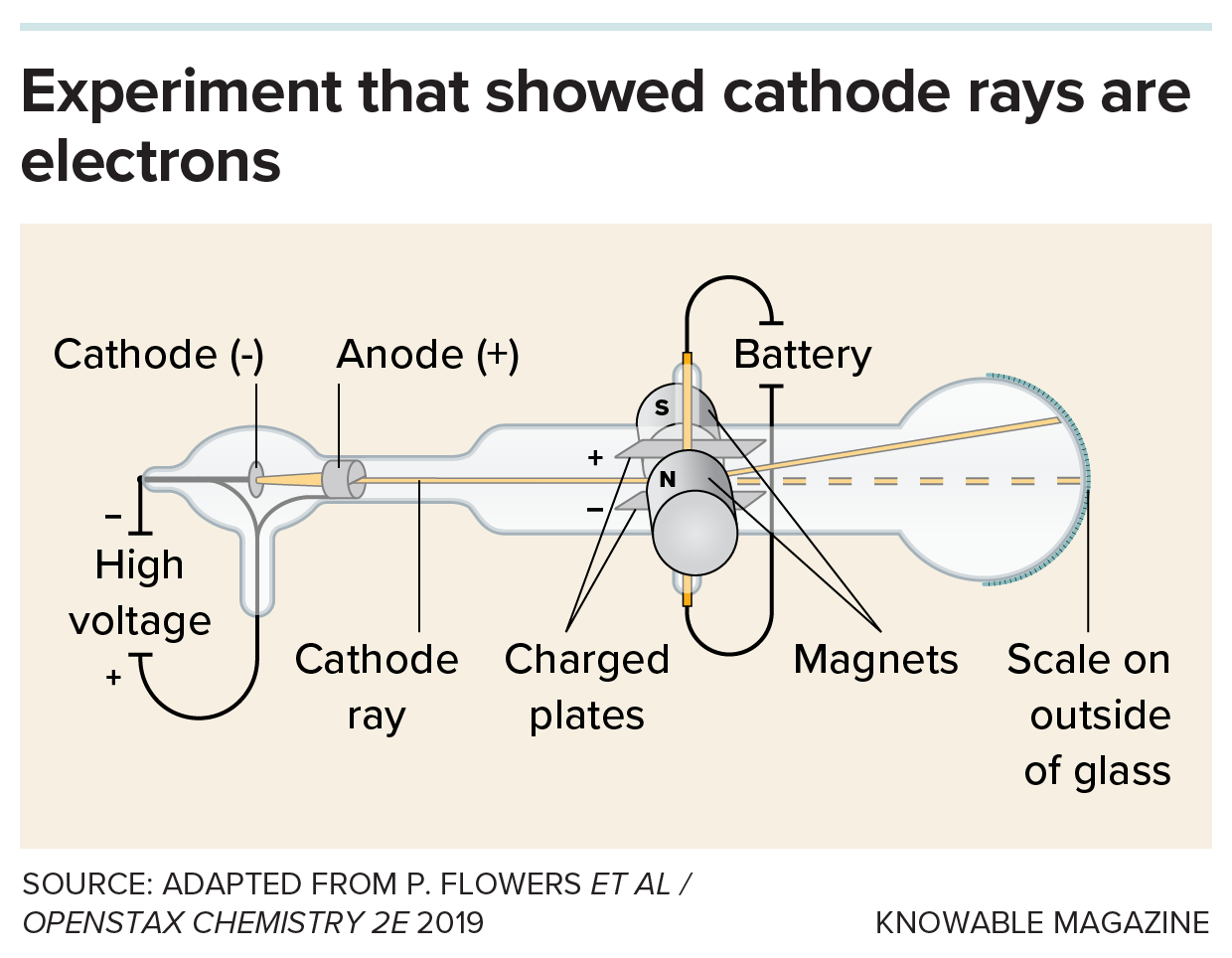
A key development came with the discovery that a glass tube containing a low-pressure gas could conduct an electric current. When wires from a battery were connected to electrodes sealed inside each end of the tube, a green glow appeared to emanate from the negative electrode. Since the negative electrode was called the cathode, the green glow became known as cathode rays.
Experiments by the British physicist William Crookes showed that cathode rays traveled in a straight line, suggesting they were a form of light. But Crookes then showed that a magnet bent the rays’ path, ruling light out. A debate then swirled among Europe’s leading physicists over whether the rays consisted of waves or tiny particles.
As the end of the 19th century neared, the cathode ray debate merged with two other electrical issues: whether a fundamental unit of electric charge existed, and if so, was there a particle that carried that charge — a fundamental particle smaller than an atom.
At the forefront of investigating those questions was the British physicist J.J. Thomson. Thomson was trained as a mathematician but took up physics at the famous Cavendish Laboratory in Cambridge, working under the esteemed Lord Rayleigh. In 1884 Thomson succeeded Rayleigh as head professor at the Cavendish.
In 1897 Thomson showed that the electric charge in the cathode rays was associated with a definite mass, establishing the electron as a particle. The ratio of this mass to the electric charge indicated that the unit of charge — the atom of electricity — was carried by a mass less than a thousandth the mass of the hydrogen atom.
“The assumption of a state of matter more finely subdivided than the atom of an element is a somewhat startling one,” Thomson admitted in announcing his findings in a lecture at the Royal Institution. Yet that was exactly what his experiment had demonstrated.
What’s more, Thomson showed that this particle was the same mass no matter what gas was used in the tube and no matter what element the cathode was made of.
“After that no reasonable person could really refuse belief that there were particles smaller than atoms, or lighter than atoms at least, and that these particles played a fundamental part in the constitution of matter,” wrote J.J.’s son, George.
In 1897, J.J. Thomson subjected cathode rays (produced in a cathode ray tube) to electric and magnetic fields. By analyzing the response to those fields, Thomson showed that whatever carried the charge had a specific mass, no matter the element used in the tube. He deduced that cathode rays consisted of small electrically charged particles that he called corpuscles, now known as electrons.
Hence Thomson (the father) earned credit for the discovery of the electron, the first subatomic particle to be identified. He called his discovery “corpuscles.”
But oddly enough, the particle had previously been christened the electron in 1891, years before its discovery, by the Irish physicist George Johnstone Stoney. Stoney coined the term (from the Greek word for amber, remember) to refer to the fundamental unit of electricity, even though nobody yet knew what it was. Soon after Thomson identified the particle, electron became the popular term.
Inside the atom
Coming shortly after the discovery of X-rays and radioactivity, the electron’s arrival further accelerated the frenzied efforts to figure out what was going on inside atoms.
A particular problem was how atoms, known to be electrically neutral in ordinary circumstances, could contain charged particles. To offset the electron’s negative charge, positive electric charge of some sort must also reside within the atom. But nobody knew the proper architecture that permitted such cohabitation.
Thomson proposed that the negatively charged electrons embedded themselves in a pudding of positive charge, electrons playing the role of plums. No evidence for such an arrangement existed, though, and the whole idea was shattered in 1911, when Ernest Rutherford announced the discovery of the atomic nucleus. Each atom contained a tiny core, like a positively charged stage of a theater in the round, with the negatively charged electrons relegated to the cheap seats.
Rutherford’s discovery of the nucleus was a surprise that seemed impossible. Even Ben Franklin would have been befuddled. Everything physicists had discovered about electric charge required the negatively charged electron to spiral into a positively charged nucleus in a fraction of a second, releasing electromagnetic energy in the process.
But soon the Danish physicist Niels Bohr rescued the electron from its death spiral, invoking the novel rules of quantum physics.
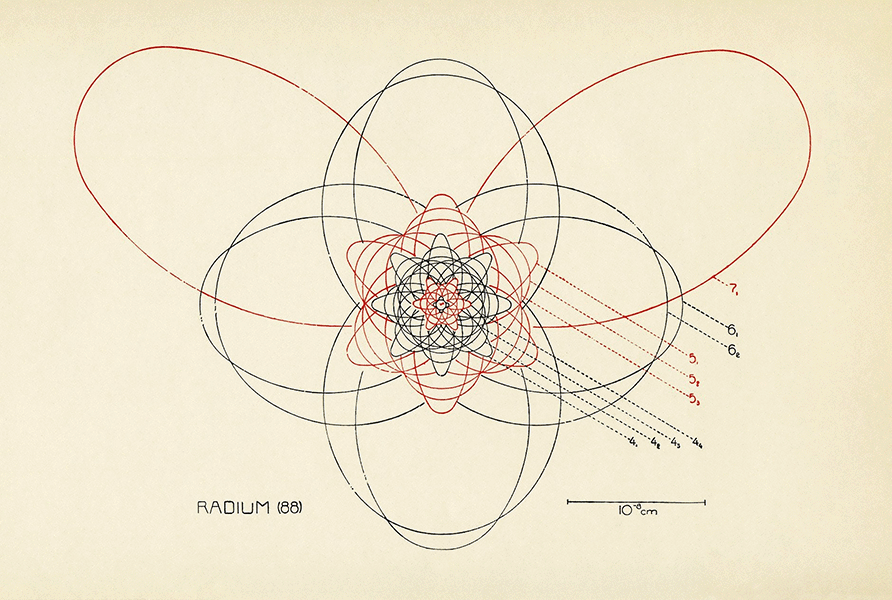
Bohr’s atom pictured electrons circling the nucleus in certain allowed orbits, preventing them from releasing energy by traveling into the nucleus. (Energy was released or absorbed only when an electron jumped from one allowed orbit to another.)
The Danish physicist Niels Bohr attempted to explain the electron’s role in atomic structure as a set of orbiting trajectories around a central nucleus, as with the element radium shown here in this vintage drawing. After the introduction of quantum mechanics a century ago, precise orbits were replaced by electron energy levels without specific trajectories.CREDIT: H. HOLST ET AL / THE ATOM AND THE BOHR THEORY OF ITS STRUCTURE 1923
Bohr’s idea (as he well knew) was preliminary. His math didn’t work for atoms more complicated than hydrogen. But a more complex approach, initiated by the German physicist Werner Heisenberg in 1925, established quantum mechanics as the rule book for electron behavior. Soon thereafter chemists began to apply quantum math to explain how electrons mediated the bonding between atoms to make chemical compounds.
But the electron was not done with surprises. Even before Heisenberg constructed his picture of the atom with electrons as particles, French physicist Louis de Broglie suggested that electrons might actually travel through space as waves. Soon after Heisenberg’s work appeared, Austrian physicist Erwin Schrödinger devised an electron wave model of the atom. Schrödinger’s wave math gave precisely the same results as Heisenberg’s particle picture.
Experimental verification of the wave picture soon came from Clinton Davisson and colleagues at Bell Labs and independently from George Thomson at the University of Aberdeen in Scotland. Both showed that electron beams sent through a crystal deviated from their path to form a diffraction pattern, something only waves could produce.
Davisson and Thomson were awarded the Nobel Prize in physics in 1937. It was one of the great ironies in physics history: J.J. Thomson won the 1906 Nobel for proving electrons are particles; his son George won the 1937 Nobel for proving electrons are waves.
A way out of the conundrum was proposed in 1927 by Bohr. He argued that both the wave and particle pictures were correct, but they applied only to mutually exclusive experimental arrangements. You could devise an experiment showing the electron to be a wave, or you could design one showing it to be a particle, but you could not construct an experiment that would reveal both wave and particle at the same time.
Bohr’s solution, called complementarity, solved the problem for the moment, but it birthed a century’s worth of debate about how the math of quantum mechanics should be interpreted.
Stay in the Know Sign up for the Knowable Magazine newsletter today
Despite continuing interpretational controversy, quantum physics eventually matured into a driver of exotic technology relying on the electron. As electronic circuitry miniaturized, from its origins in bulky vacuum tubes to tidy transistors and tiny integrated circuits, society witnessed a flood of technological revolutions, along with a deeper understanding of the natural world.
Electron behavior permeates all realms of nature, from the chemical properties of individual atoms to the complexities of biological molecules. Understanding the electron enabled the era of designer materials, consumer electronics and prodigious computational power. From email to electron microscopes, solar-electric cells to lasers, electrons have been the key ingredient in making the modern world modern.
As Benjamin Franklin foresaw, his “electrical fluid” would someday offer humankind ample reward for pursuing its properties. “The beneficial uses of this Electrical Fluid we are not yet well acquainted with,” he wrote, “tho’ doubtless such there are and great ones.”
Tom Siegfried is a science journalist in Avon, Ohio. His book The Number of the Heavens, about the history of the multiverse, was published in 2019 by Harvard University Press.
“Warriors appear at certain historic moments, when something valuable is being threatened and needs protection. It could be clans, communities, kings, lands—something is being imperiled by outside forces. This situation of extreme threat demands exceptional protectors. This is when the Warriors arise.”
In my book, The Warrior’s Journey Home: Healing Men, Healing the Planet, I said that we must separate the life of the warrior from the destruction of war and quoted meditation master Chögyam Trungpa.
“Warriorship here does not refer to making war on others,” says Trungpa. “Aggression is the source of our problems not the solution. Here the word ‘warrior’ is taken from the Tibetan pawo which literally means ‘one who is brave.’ Warriorship in this context is the tradition of human bravery, or the tradition of fearlessness.” Trungpa concludes by saying, “Warriorship is not being afraid of who you are.”
I experienced my first warrior calling on November 21, 1969. My wife was pregnant with our first child and I had spent the last nine hours coaching her through the Lamaze breathing techniques we had been taught in the child-birth classes with other expectant parents to be. When we began the classes, I wasn’t sure I wanted to be part of the birth process, even if I was allowed, afraid I might pass out at the sight of blood or become overly concerned with my wife’s pain and be more of a hindrance than a help.
When the time had arrived for her to go to the delivery room, the nurse said,
“Well, your job is done here Mr. Diamond. You can go to the waiting room now.”
I felt a mixture of sadness and relief. We had been given the rules of Kaiser hospital at the outset. Whichever doctor was there when the baby was ready to be born would decide if the father would be allowed in the delivery room. So I kissed my wife goodbye and wished her well. She was wheeled through the doors toward the delivery room and I walked down the long hallway toward the exit sign leading to the waiting room to sit with the other expectant fathers.
Yet, in the eternity of those few moments it took to make the short walk, something shifted in me. I felt a call from my unborn child that could not be denied telling me I don’t want a waiting-room father. Your place is here with us.
I turned around and walked back into the delivery room and took my place at the head of the table. There was no question of asking permission, no chance I would leave if directed. I was simply there. I felt a wonderful sense of calm come over me and quite soon, amid tears of joy, my son, Jemal, arrived in the world. He was handed to me and as I looked into his eyes, I made a vow that I would be a different kind of father than my father was able to be for me and to do everything I could to create a world where fathers were fully involved with their children throughout their lives.
When my wife and I were in college after we had met and fallen in love, we agreed we both wanted children. But we also felt that there were children already born who needed loving parents. We decided we would have a child then adopt a child. After Jemal was born, we began the adoption process for a little girl. Two years later we adopted a two-and-a-half-month old African-American little girl who we named Angela.
As I write this our son Jemal, is 54 and has a child of his own. Angela is 52 and has four children. My wife, Carlin, and I now have six grown children, seventeen grandchildren, three great grandchildren, and one on the way. Before I had children, I thought my purpose as a man was centered outside the home, with the work I did in the world. I still do work outside the home, but over the years I have come to see my most important role has been as a hands-on caregiver.
Father Time: A Natural History of Men and Babies
Dr. Sarah Hrdy is an anthropologist and primatologist and one of the world’s leading experts on the evolutionary basis of female behavior in both nonhuman and human primates. She has recently turned her attention to men.
“It has long seemed self-evident that women care for babies and men do other things,” says Hrdy. “When evolutionary science came along, it rubber-stamped this venerable division of labor: mammalian males evolved to compete for status and mates, while females were purpose-built to gestate, suckle, and otherwise nurture the victors’ offspring.”
In her recent book, Father Time: A Natural History of Men and Babies, Hrdy set out to trace the deep history of male nurturing and explain a surprising departure from everything she had assumed to be “normal.” She offers a sweeping account of male nurturing, explaining how and why men are biologically transformed when they care for babies.
“Under the right circumstances,” she says, “males of our species are as well-equipped as women to tenderly nurture babies and develop caring priorities. Gestation, giving birth, and breast-feeding are not nature’s sole pathways to parental involvement and intense devotion.”
This was certainly my experience when Jemal and Angela were babies. Once I brought my wife and new-born son home from the hospital, I took three weeks off from work to help with the immediate caregiving. I assumed that mothers were born with some genetically driven knowledge of how to care for babies but soon learned that was not the case. She had breasts for the baby, but breastfeeding was an art she and the baby had to learn together.
I knew that changing diapers was not a sex-specific skill and I soon learned to get as good at it as was my wife. After three weeks I went back to work and my wife soon moved into the role of full-time caregiver, with me as the support team. That lasted a year until my wife announced one day that she needed a break and was doing to take a three-week trip with a girlfriend and that I would assume full-time care duties while she was away.
The idea sounded reasonable. I could tell she was exhausted even with the help I supplied when I came home from work. But the truth was I was scared as hell. All my fears came to the surface. What will I do when I don’t know what to do? What if he starts crying and I can’t make him stop? We didn’t have any other family who lived close to us and most of our friends were either single or were overwhelmed with their own family challenges.
My wife was reassuring and said I could call her if I needed advice. She kissed me goodbye and off she went. I’m a long way from those fearful days, but the truth was it was one of the greatest gifts of my life. Jemal and I worked things out together. Each hour of each day we were together, I gained confidence. My wife had left enough breast milk (using one of those handpumps popular at the time) and I learned how to heat and serve. We played together and I carried him around on my back.
My wife got worried when I hadn’t called and when she phoned me she was relieved to learn that we were going well. My confidence as a man has grown through the years as I learned new skills in caring for our daughter.
Dr. Hrdy discovered some of the reasons that men can become as good at nurturing infants as women.
“Early in my career, back in the 1970s while still focused on infanticide, the antithesis of nurturing,” says Hrdy, “I learned about a phenomenon called ‘sensitization.’ Even in species of animals whose males ordinarily ignore, attack, or cannibalize pups they encounter, males might, given the right circumstances, switch to gently tending them instead. What it took was repeated exposure. Time in intimate proximity somehow ‘flipped a switch’ in the deepest recesses of the male brain, whether a rodent’s or a monkey’s.”
Dr. Hrdy went on to say,
“Time in intimate proximity to babies could have surprising effects on males including surges in oxytocin (known as a ‘bonding’ hormone).”
I didn’t know it at the time, but being in intimate contact with my children triggered the brain chemicals that are present in both males and females and can be stimulated if given enough time together. Dr. Hrdy concludes,
“For men, it turns out, have a different birthright from the one that I and many of my evolutionary colleagues have so long assigned them.”
In standing up to a system that would deny fathers in the delivery room, I learned that it takes strength with heart, as my colleague Dr. Daniel Ellenberg describes it or being a compassionate warrior as another friend, Sean Harvey discusses in his book, Warrior Compassion: Unleashing the Healing Power of Men. It’s time for more men to stand up and embrace our birthright. We are needed now more than ever.
I look forward to hearing from you. What are you own experiences nurturing young children? What support have your received? What resistance have you found from others or from your own early conditioning about what is “natural” for men?
The Lord of Wealth is a card which talks about the manifestation of the fruits of our labours, in whatever area they have been directed. When we have aimed all our energies in a single stream of force toward one end, there comes a point, inevitably, where we shall attain our objective. And that is what the Ten of Disks indicates.Often, commentaries on this card warn that once sufficient wealth has been attained, you should make sure you distribute excess fairly and generously. This is because energy which remains unused eventually corrupts and dissipates.But there’s another aspect to the right use of energy which is not so often addressed. This is to do with the way the Will works. There’s a common misunderstanding about the use of Will among us – we tend to think that applying Will is something that we only do consciously. This is incorrect. The human Will works all the time. It runs around happily creating whatever seems most pressing in your mind.This has a rather unfortunate side effect. For many people, the most pressing emotions and responses in their minds are connected to fear, pain, unhappiness or deprivation. Once seized by feelings such as these, it can be very difficult indeed to keep your mind off them, and engage in positive thoughts, affirmations and actions.You know the feeling – something comes along and hurts you. Then you suffer. You keep circling the issue in your mind. You build up a nice collection of fears. You make a lot of (often wildly illogical) painful associations. And you do not find a relevant affirmation and repeat it with extraordinary fervour until you have your feelings back under control. You do not go and do something nice for yourself. You do not deliberately force your thoughts and feelings onto a more positive track.All the time that cycle is taking place, your Will is wildly scampering after all those negative feelings and channelling your energy out into life, attempting to create the things it thinks you want!DOH!!! Dissipation of power causing chaos!The Lord of Wealth teaches us the invaluable lesson… by bringing our thoughts and emotions to a conscious level, and by making positive choices about how we direct those energies, we create our world. So we need to decide what we what, and then think about that… not linger on the things that we don’t want. And we need to trust our own energy to fly out into the Universe and come back to us completed.Then we are endlessly wealthy.
Amanpour and Company • Mar 26, 2025 • Trump’s America has started to challenge and redefine academic freedom, and Yale Professor Jason Stanley is sounding the alarm. He is the author of “Erasing History: How Fascists Rewrite the Past to Control the Future.” Stanley joins the show to discuss how new teaching guidelines are stoking a culture of fear, and why he’s taking drastic measures as a result. Originally aired on March 26, 2025
However entitled you already thought these people were, they’re more so, according to Sarah Wynn-Williams in her memoir “Careless People.”
By Lily Janiak,Theater criticUpdated March 23, 2025 (SFChronicle.com)
Facebook Chief Operating Officer Sheryl Sandberg addresses a crowd at Facebook Headquarters in Menlo Park in 2014. The memoir “Careless People” claims Sandberg coerced employees into “sleepovers.”Alison Yin/Invision for Facebook/AP Images
The first thing a tell-all needs is juicy things to tell, and Sarah Wynn-Williams at least has those.
In her memoir “Careless People,” which gets its name from a line in “The Great Gatsby” describing how Tom and Daisy “let other people clean up the mess they had made,” the former director of global public policy at Facebook has a chapter called “Lean in and Lie Back.” Here, Facebook Chief Operating Officer Sheryl Sandberg; a young assistant named Sadie whom Sandberg treats as a “little doll” or “lady-in-waiting,” complete with hair-petting and lap-sitting duties; Wynn-Williams and others are in a private jet flying back from Davos, Switzerland. A pouty Sandberg repeatedly tells Wynn-Williams to “come to bed” — the single large bed in the craft — for a sleepover.
Wynn-Williams really doesn’t want to and tries to pawn the job off on Sadie, whose last name isn’t given. Then, in a move that combines “Mean Girls” and a toddler having a bedtime tantrum, Sandberg says, “Sadie’s slept over lots of times and I’m not asking Sadie. I’m asking you.”
The best revelations in the book peek behind the smooth digital facades of Sandberg and Mark Zuckerberg to the actual people warped by increasingly infinite power, money and isolation — and they’re jaw-dropping enough that on Wednesday, March 12, Facebook parent company Meta won a temporary legal injunction to halt promotion and distribution of the book.
More Information
Careless People: A Cautionary Tale of Power, Greed, and Lost Idealism By Sarah Wynn-Williams (Flatiron Books; 400 pages; $32.99)
Meta claimed Wynn-Williams violated a non-disparagement clause in her 2017 severance agreement, which resulted in the emergency ruling in the social media company’s favor effectively prohibiting Wynn-Williams’ ability to market the book. But her publisher, Flatiron Books, has moved forward with distribution, and the memoir has taken off.
The content more than backs up the commotion surrounding its release. However entitled you already thought these overlords were, they’re more so, according to the author.
Wynn-Williams, who worked at the company from 2011 to 2017, details decisions about unstable regimes or vulnerable youths that lead to preventable deaths, with responses that aren’t even blinks. There’s the meeting about an organ donation initiative when an oblivious Sandberg asks, “Do you mean to tell me that if my four-year-old was dying and the only thing that would save her was a new kidney, that I couldn’t fly to Mexico and get one and put it in my handbag?”
Elsewhere, she praises Filipina nannies as “service-oriented” and expects her Facebook employees — the female ones, naturally — to do unpaid labor promoting her 2013 book “Lean In.”
Facebook CEO Mark Zuckerberg speaks during a joint hearing of the Senate Commerce, Science and Transportation Committee and the Senate Judiciary Committee in Washington, D.C., in 2018. Facebook parent company Meta won a temporary legal injunction this week to halt promotion and distribution of the memoir “Careless People,” which alleges bad behavior by the company’s leaders. Saul Loeb/AFP via Getty Images
In Wynn-Williams’ telling, Zuckerberg is so used to his sycophants letting him win at board games that he just thinks he’s amazing at them, and when she challenges him for real, his short-circuited brain can only conclude she’s cheating. He’s the kind of person who believes “something more important might come up” than being present for the birth of his child, or who, when one of his employees gets jailed in a foreign country, doesn’t work to free that person but uses the situation to draft a self-aggrandizing Facebook post — one that could put the jailed employee at even more risk.
Such leaders create a workplace culture, in Wynn-Williams’ telling, where moms get critical performance reviews when co-workers can hear babies during Zoom meetings or when they’re insufficiently responsive on email when in a coma on maternity leave.
“The expectation at Facebook is that mothering is invisible, and the more skilled you are, the more invisible it is,” she writes.
“Lean In” author and former Facebook Chief Operating Officer Sheryl Sandberg speaks at the Fortune Global Forum conference in San Francisco in 2015. A new memoir by a former Facebook employee describes Sandberg and other company leadership as being warped by power, money and isolation.Liz Hafalia/S.F. Chronicle
It’s an office where women with “director” in their title are expected to get on their hands and knees to look for items their male superiors have dropped or get fired after they complain about their boss’ sexual harassment.
It’s a place of moral turpitude — that enables human rights violations in Asia, that grants China surveillance power over all Facebook users, that targets ads to teens based on their emotional state and is proud of doing so. “We shout this from the rooftops,” an advertising exec tells the author.
“Careless People” author Sarah Wynn-Williams.Flatiron Books
But if Wynn-Williams has dishy “all” in her tell-all, her telling often muddies it. Her overreliance on sentence fragments makes for a choppy ride through a paragraph. It’s like getting continuously kicked off the back of a horse and having to remount.
And not only does she tell instead of show — abstracting instead of supplying the detail that could empower you to draw conclusions yourself — she repeats points as if speaking to a remedial class. Does a single page need to inform us both that Sandberg and others “ruthlessly manage their own labor, extracting as much work out of each day as humanly possible” and that “her ferocious work ethic and endurance are astounding”?
A tell-all about a toxic workplace needs still another ingredient to succeed, and that’s a teller who strikes a tricky balance. We seek a narrator far enough outside of the cult to truly see and critique it, but not one so intent on settling scores that we can’t trust her. At the same time, she can’t oversell her virtues, and this is where Wynn-Williams, who worked in diplomacy before joining Facebook, falters. The subtext of chapter after chapter — whether the subject is China, Myanmar, U.S. elections or teen users’ mental health — is: “If only Facebook had listened to Sarah!”
It’s also been speculated that fact-checking of these accounts, which are based on memories of the author’s experiences from years past, was sparse.
Mark Zuckerberg delivers the keynote address at the Facebook F8 developers conference in San Jose in 2018. A memoir by a former Facebook employee claims the company culture included women being fired if they complain about sexual harassment. Paul Chinn/S.F. Chronicle
You might object that maybe Wynn-Williams really was the lone person farsighted enough to predict how Facebook could become as powerful as nation-states, guided only by the caprices of some ill-informed, callous billionaires accountable to no one. Even so, it doesn’t always make for great reading. The book, instead, reads less as memoir than as cover letter for her next gig.
The closest she gets to sounding sinful like the rest of us is when she admits, “When a woman I work with closely expresses surprise upon learning I have a child, she tells me, ‘Good job! ’ — openly admiring of the fact that she’d had no idea — and I feel a flush of pride.”
Yet perhaps this tightrope that exposé authors must walk is just like the impossible demands we place on female corporate managers: Be relatable but also respectable. Be a feminist, but only at the right times. Hype yourself, but don’t be pushy.
About Opinion
Guest opinions in Open Forum and Insight are produced by writers with expertise, personal experience or original insights on a subject of interest to our readers. Their views do not necessarily reflect the opinion of The Chronicle editorial board, which is committed to providing a diversity of ideas to our readership.
If the goal of all those unwritten rules is to get more women to become like Zuckerberg and Sandberg, “Careless People” paints the apex of digital power as a lonely, unhappy, dehumanizing place. With any luck, some readers will choose to lean away.
Correction: An earlier version of this review misstated the date Meta won the temporary legal injunction to halt promotion and distribution of the book. It was Wednesday, March 12, the day after the memoir’s release.
Lily Janiak joined the San Francisco Chronicle as theater critic in May 2016. Previously, her writing appeared in Theatre Bay Area, American Theatre, SF Weekly, the Village Voice and HowlRound. A Michigan native whose childhood also took her to Tennessee and Texas, she holds a BA in theater studies from Yale and an MA in drama from San Francisco State. She served on the jury for the 2024 Pulitzer Prize in Drama.
New Thinking • Mar 29, 2025 Gary Lachman is the author of twenty-one books on topics ranging from the evolution of consciousness to literary suicides, popular culture and the history of the occult. He has written a rock and roll memoir of the 1970s, biographies of Aleister Crowley, Rudolf Steiner, C. G. Jung, Helena Petrovna Blavatsky, Emanuel Swedenborg, P. D. Ouspensky, and Colin Wilson, histories of Hermeticism and the Western Inner Tradition, studies in existentialism and the philosophy of consciousness, and about the influence of esotericism on politics and society. Here he points out that the Corpus Hermeticum originated in Alexandria, Egypt, during a period of fusion among Greek and Egyptian traditions. Hermes Trismegistus represents an amalgamation of the Egyptian god Thoth and the Greek god Hermes. The original literature is of unknown authorship and focuses on the attainment of higher stats of consciousness. Hermeticism serves as the backbone of the western esoteric tradition that also includes astrology, tarot, alchemy, and ceremonial magick. Hermeticism was particularly influential during the Renaissance. New Thinking Allowed host, Jeffrey Mishlove, PhD, is author of The Roots of Consciousness, Psi Development Systems, and The PK Man. Between 1986 and 2002 he hosted and co-produced the original Thinking Allowed public television series. He is the recipient of the only doctoral diploma in “parapsychology” ever awarded by an accredited university (University of California, Berkeley, 1980). He is also the Grand Prize winner of the 2021 Bigelow Institute essay competition regarding the best evidence for survival of human consciousness after permanent bodily death. He is Co-Director of Parapsychology Education at the California Institute for Human Science. (Recorded on March 20, 2019)
Autogynephilia is a term used in psychology to describe a sexual interest in oneself as a woman. It is a paraphilia, which means an unusual or atypical sexual interest.
Individuals with autogynephilia may experience:
Sexual arousal when imagining or dressing as a woman
A desire to have a female body
Gender dysphoria, or a feeling of discomfort or distress with their assigned gender
It is important to note that autogynephilia is not a diagnosis of gender dysphoria, but rather a possible contributing factor. Not all individuals with gender dysphoria experience autogynephilia.
Generative AI is experimental.
Consciousness, spirituality, biography, sexuality, androgyny, futurism, space, the arts, science, astrology, democracy, humor, books, movies and more


1. some bone-laziness but mostly DOLDRUMS, proto-despair, great-poets-die-young or at least unfulfilled like Coleridge & Co., all that crap.