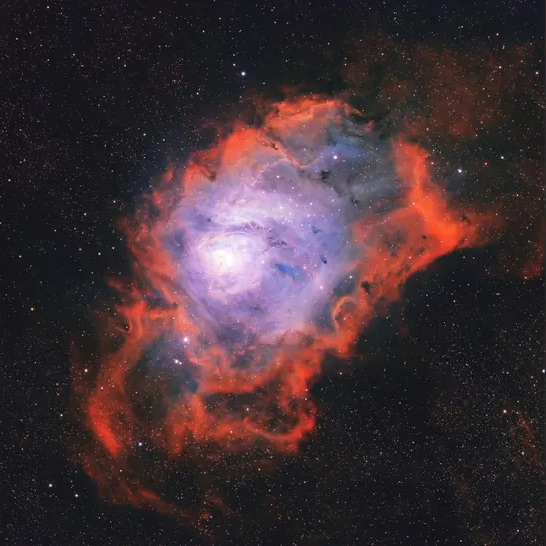
Five thousand two hundred light-years away, the Lagoon Nebula glows as ultraviolet radiation from young, massive stars ionizes surrounding clouds of hydrogen, transforming an immense region of interstellar matter into a luminous tapestry of gas and dust. Within its sculpted forms, stellar radiation, gravity, and turbulent flows continually reshape the boundary between illuminated plasma and the dark molecular clouds from which new structures emerge. (New Thinking Allowed)
The tiny planet hides big mysteries that scientists can’t wait to tackle.
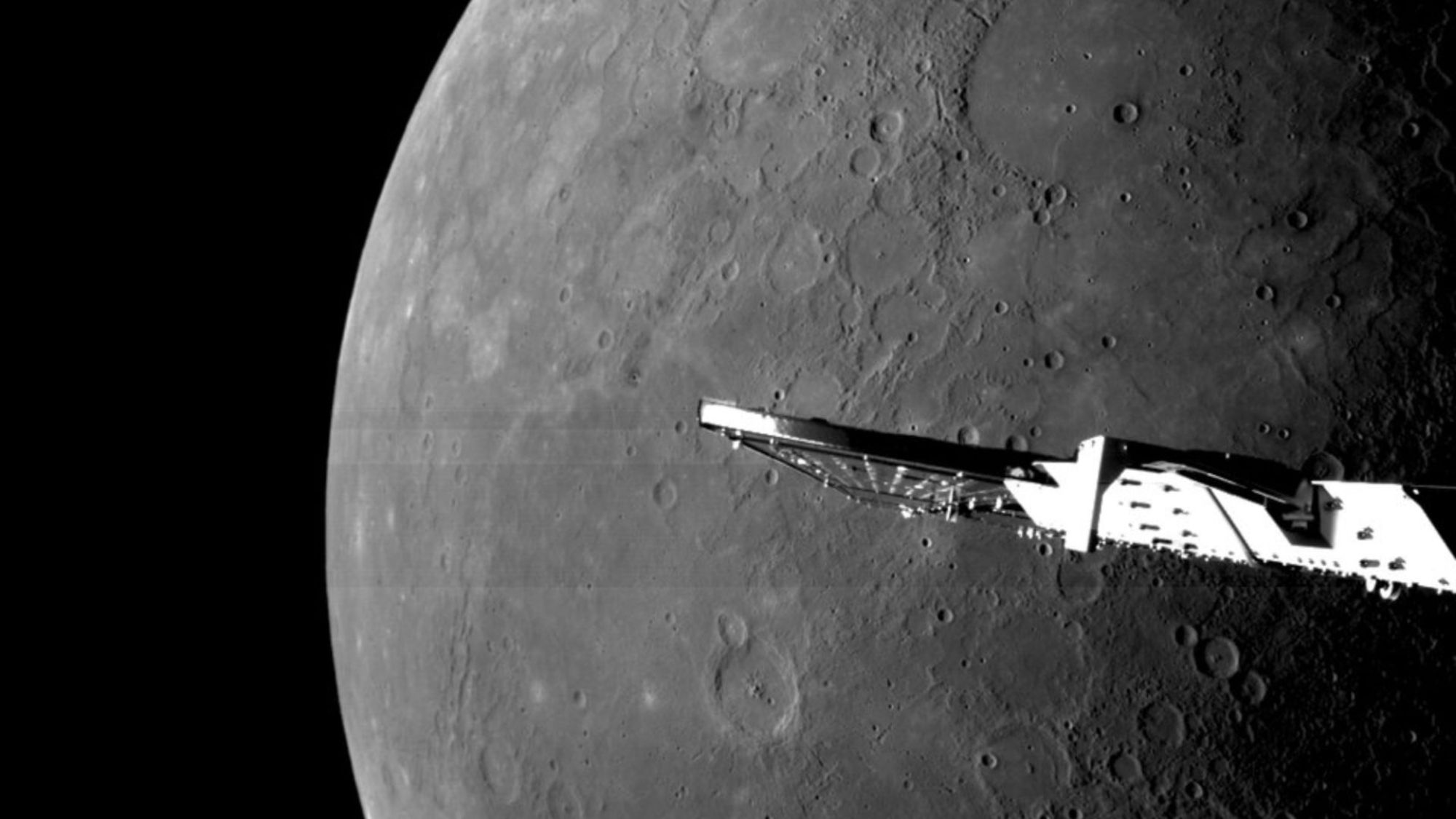
This image was taken by the BepiColombo mission on Jan. 8, 2025 as the spacecraft sped by Mercury for its sixth and final gravity assist at the planet. (Image credit: ESA/BepiColombo/MTM)
Mercury, the tiniest and least-explored planet in the inner solar system, is hiding mysteries far larger than itself — and finally, scientists will soon be getting not one but two spacecraft designed to decode the strange world.
That’s thanks to the BepiColombo mission, a joint project of the European Space Agency (ESA) and Japan Aerospace Exploration Agency (JAXA) that launched in October 2018. After a harrowing journey through the inner solar system, the mission istackling a crucial maneuver on Thursday (Sept. 3): separating its science equipment from the transport that carried it all that way. By April 2027, scientists hope the mission’s two instrument-heavy probes will be gathering a slew of observations that could help solve puzzles about Mercury — and maybe even the solar system we call home.
“I think being able to see new data come out about Mercury is going to be so fantastic,” Rachel Klima, a planetary geologist at the Johns Hopkins University Applied Physics Laboratory, told Space.com. The planet, she says, is “just so weird and beautiful and interesting.”
An enigmatic planet
For now, Mercury holds the dubious honor of being the least-explored planet in the inner solar system, visited by only two missions to date. NASA’s Mariner 10 spacecraft made a trio of zippy flybys in 1974 and 1975, giving scientists their first glimpses of the planet’s cracked and cratered surface, as well as confirming the world has both a very tenuous atmosphere and a magnetic field.
“It really gave us our first close-up view of Mercury,” Sean Solomon, a planetary scientist at Columbia University, told Space.com. “But it left a lot of pages blank.”You may like
And for decades, that was it. Scientists didn’t return to Mercury until 2011, when NASA’s MESSENGER spacecraft, with Solomon as its principal investigator, arrived at the tiny world. (Mercury has a radius of 1,516 miles, or 2,440 kilometers, meaning its width is just over a third of Earth’s.) The spacecraft was packed with tools tailored to the job, such as spectrometers tuned to gamma-rays, X-rays and neutrons, and instruments to sniff out the atmosphere and measure the magnetic field, and it was there to stay. Four years of observations with MESSENGER showed scientists Mercury’s complete surface for the first time, and by late in its mission, the spacecraft was passing just 15.5 miles (24.9 km) above the planet’s surface.
But even MESSENGER wasn’t sophisticated enough to crack Mercury’s puzzles or unveil the strange planet’s beginnings. “I think the jury’s still out on exactly how Mercury got assembled,” Solomon said.
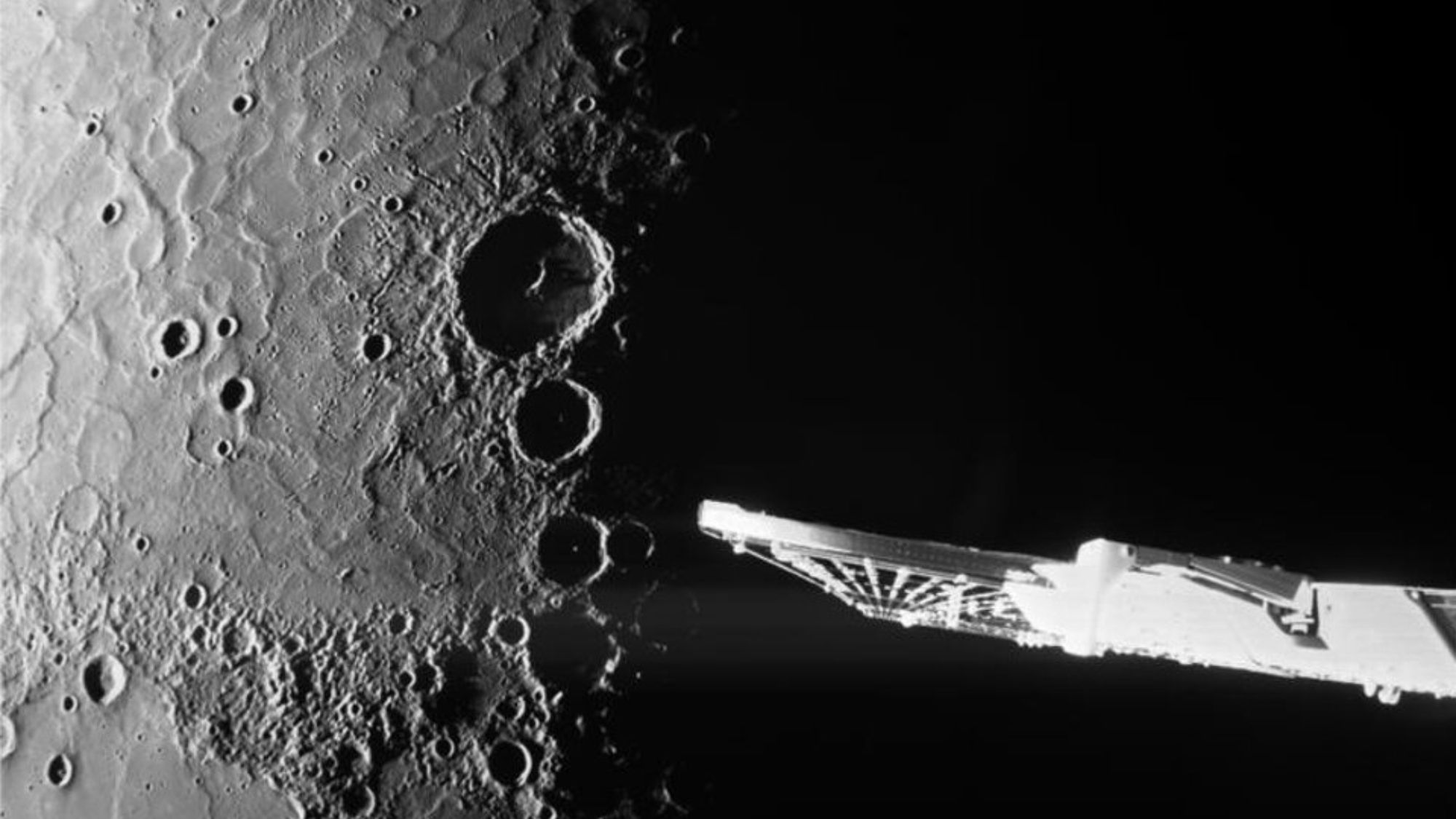
Flying over Mercury’s north pole gave BepiColombo’s monitoring camera 1 (M-CAM 1) a unique opportunity to peer down into the shadowy polar craters on Jan. 8, 2025. (Image credit: ESA/BepiColombo/MTM)
MESSENGER opened up some smaller mysteries, too. It discovered bright, steep-sided pits that scientists dubbed “hollows.” It found a suite of elements — that planetary scientists call “volatiles” for their tendency to slip free of rock — somehow more prevalent in Mercury’s surface than Earth’s. It calculated that the center of the planet’s magnetic field is wildly offset from the planet’s core. Plus, MESSENGER’s tricky orbit also meant the spacecraft never saw the southern half of the planet as sharply as the northern half, leaving one side shadowed in doubt.
The arrival of BepiColombo
It’s these mysteries that the ambitious BepiColombo mission hopes to tackle. By April, if all goes well, the mission will consist of two separate spacecraft gathering independent but coordinated data about Mercury.
Europe’s Mercury Planetary Orbiter, or MPO, will focus on the planet proper. It’s packed with 11 science instruments that will map the terrain, minerals in the crust, and the gravity field, investigate the hollows and volcanic deposits, and observe how the barrage of charged particles from the sun affects this innermost planet.What to read next
Japan’s Mercury Magnetospheric Orbiter, or Mio, meanwhile, will focus on the planet’s surroundings — its magnetosphere and wispy atmosphere, as well as the dust cluttering up its neighborhood.
Both spacecraft also carry instruments to measure the planet’s magnetic field, offering simultaneous observations of different parts of the field to scientists who typically make do with data gathered from just one location at a time.
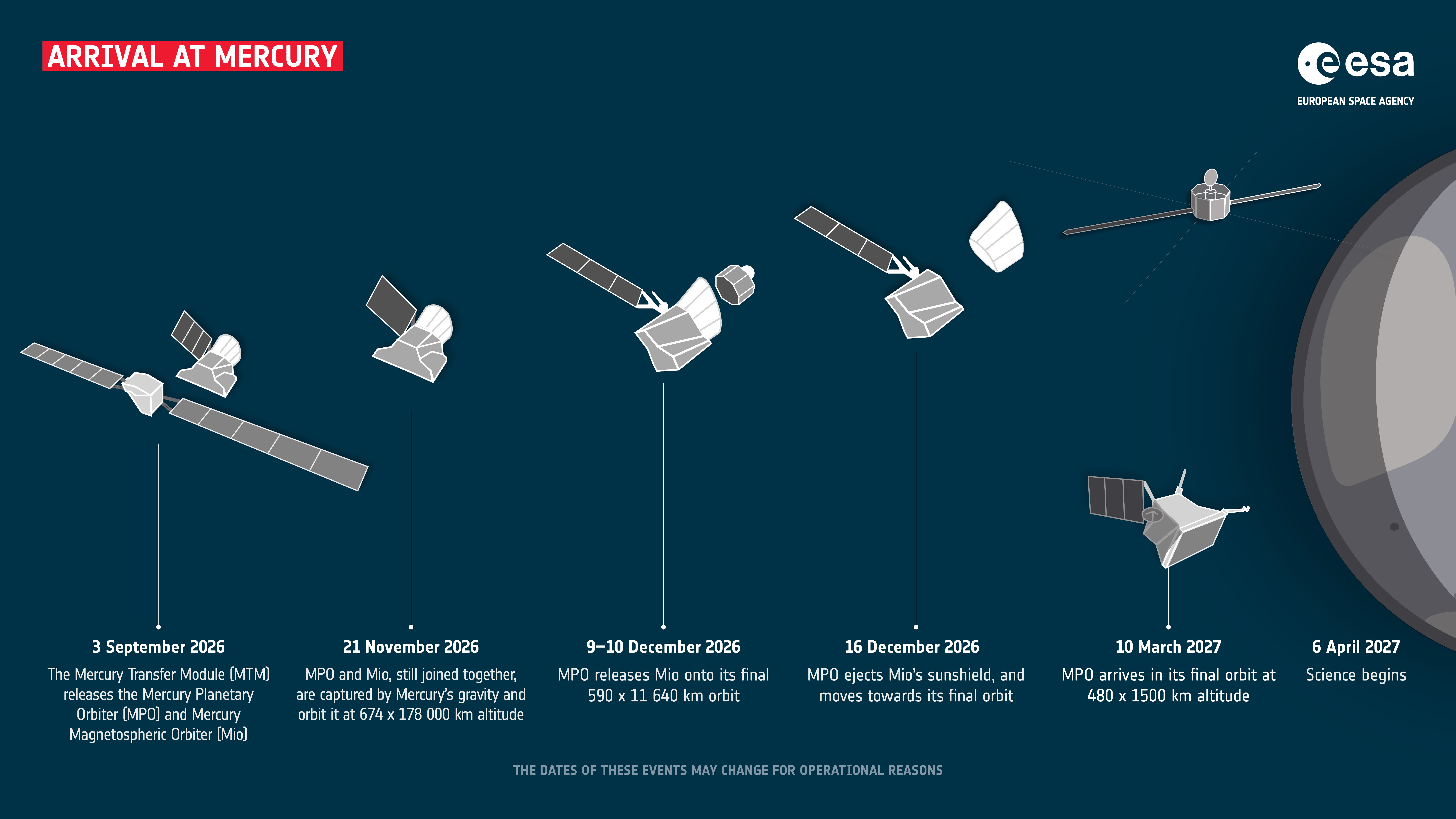
In fact, some of these instruments have been able to gather observations during BepiColombo’s long trek to Mercury and its six quick flybys of the planet so far. But because of how the spacecraft were configured for the journey, most of the instruments have not — and will not — get to work until after MPO and Mio have separated. That is expected to happen in December.
The mission’s science, then, has begun only in dribbles, while the bulk of its promise still lies ahead. “There is a growing literature of new results that have come from the BepiColombo flybys, but I expect that will explode once they go into orbit,” Solomon said.
A diagram showing BepiColombo’s path to getting near Mercury. (Image credit: ESA)
He’s especially excited to see the spacecraft’s sharp views of the southern hemisphere, and particularly find hidden deposits of water ice across the area. These deposits would exist in deep craters that never feel the sun’s heat. In examining this region of the planet, scientists will be able to reduce the northerly bias of MESSENGER’s data and better see Mercury’s complete picture.
Meanwhile, Klima is most eagerly awaiting MPO’s work to map elements and minerals in the planet’s surface. This work eluded MESSENGER, which used a technique that relied on these rocks being rich in iron and similar materials — but as it turned out, those elements were absent, leaving scientists stymied. MPO carries different technology that will be able to read rocks on the world even without iron, which Klima said could help reveal how Mercury — and our whole solar system, as a matter of fact — formed.
Klima says she hopes BepiColombo can get people excited about Mercury, the overlooked terrestrial planet of the solar system: “It certainly doesn’t get the love and attention that Mars and Venus and everywhere else gets.”
Meghan Bartels is a freelance science journalist based in New York City who worked on staff for Space.com from 2018 to 2023. Her writing has also appeared in outlets including Scientific American, Science News, Wired, Newsweek and Audubon.
The powerful observatory has a long journey ahead of it.
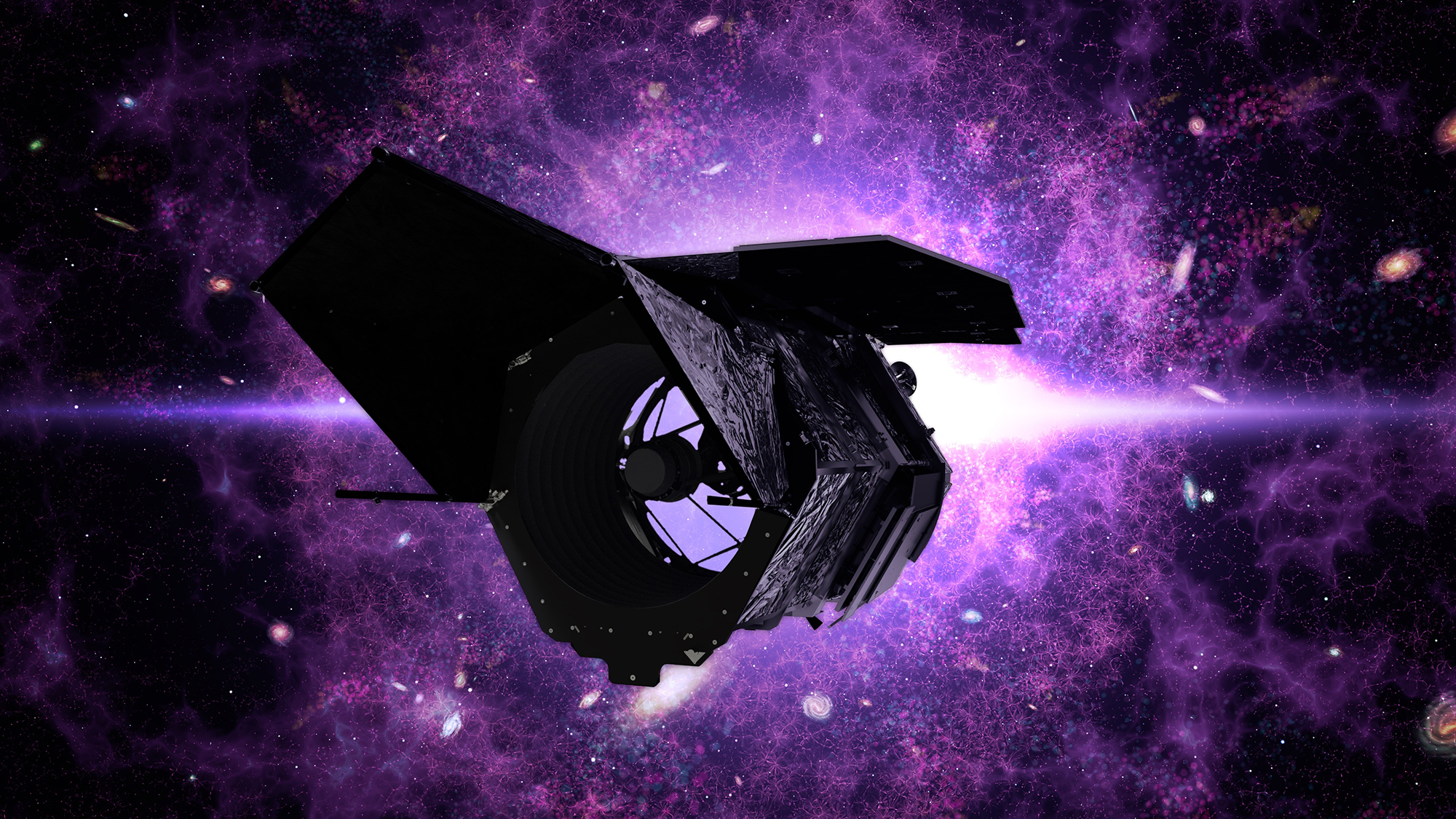
The Nancy Grace Roman Space Telescope separates from its SpaceX Falcon Heavy rocket about 30 minutes after launch on Aug. 30, 2026. (Image credit: NASA)
NASA’s next big space telescope has left Earth, but it’s not ready to start observing the heavens just yet.
The Nancy Grace Roman Space Telescope launched yesterday (Aug. 30), riding a SpaceX Falcon Heavy rocket into the heavens. Astronomers are very excited about Roman, for it’s expected to discover thousands of new exoplanets and shed light on mysterious dark energy and dark matter, among other accomplishments.
Such science work is a few months off, however. Here’s a brief rundown of the next steps for the Roman team.
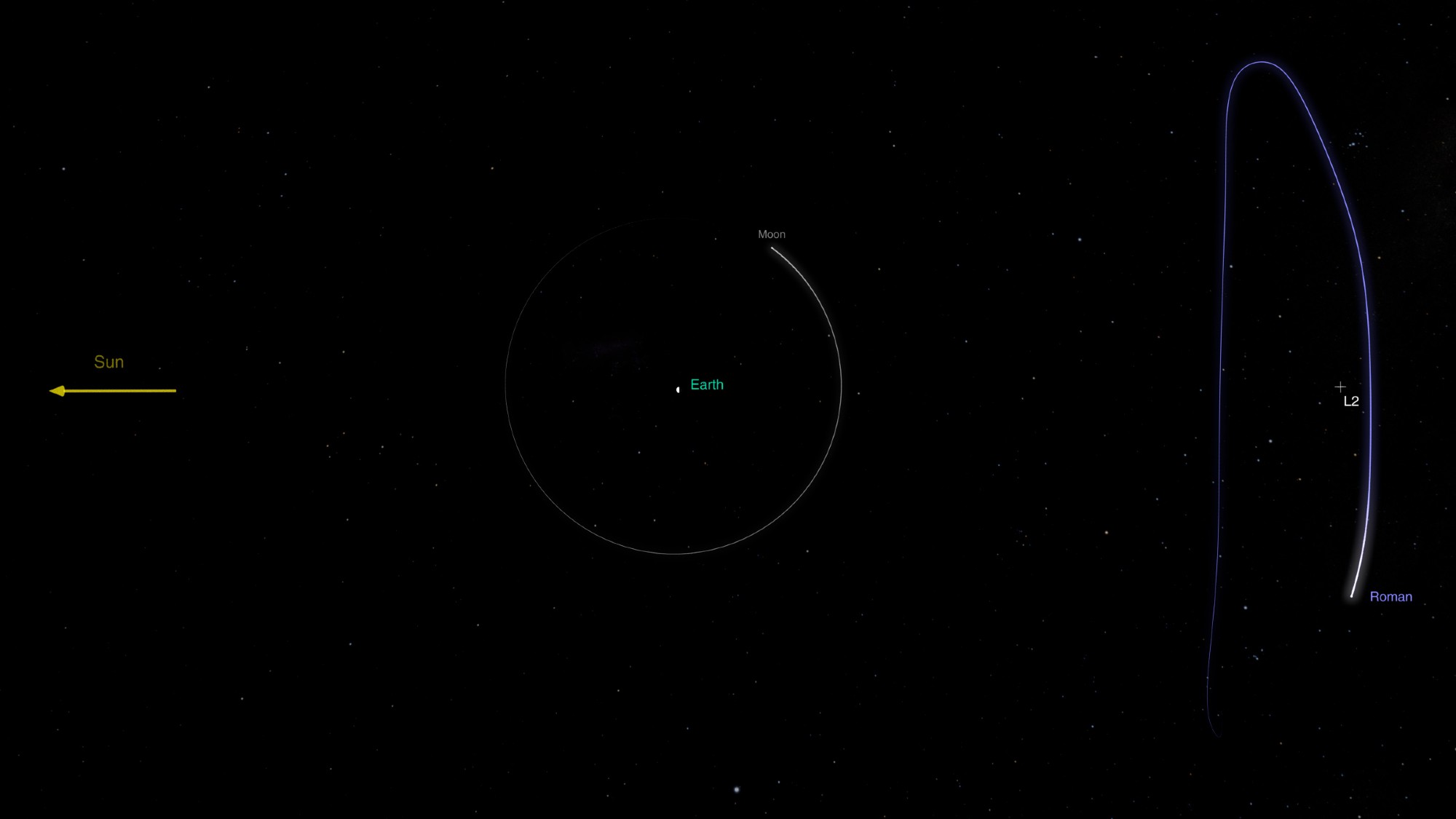
A diagram showing Roman at Lagrange point 2, between Earth and Mars. (Image credit: NASA SVS)
A long journey
The first order of business is getting Roman to its destination. The 42-foot-long (12.7 meters) scope isn’t staying in Earth orbit; it’s headed to the sun-Earth Lagrange Point 2 (L2), which lies about 930,000 miles (1.5 million kilometers) from our planet in the Marsward direction.
There are multiple reasons to target L2, which also hosts NASA’s James Webb Space Telescope (JWST) and Europe’s Euclid probe.You may like
“At this special place in space,” NASA officials wrote in a Roman explainer, “gravitational forces balance to keep objects in steady orbits with very little assistance.”
“Roman’s barrel-like shape will help block out unwanted light from the sun, Earth and moon, and the spacecraft’s distant location will help keep the instruments cool,” they added. “The thermal stability of an observatory at L2 will provide a ten-fold improvement beyond Hubble in much of the data Roman will gather.”
And don’t worry about Roman and JWST bumping heads; though their cosmic addresses will be the same, they won’t actually share space.
“Like Webb, Roman will trace out a large orbit around the actual L2 point — much larger than the moon’s orbit around Earth — and the two will easily be kept far apart,” NASA wrote in a different Roman piece.
It’ll take Roman about 30 days to fly out to L2 and settle into its looping orbit there. A new round of work will then begin for the Roman team.What to read next
That work is “commissioning” — making sure that all of Roman’s systems and subsystems are working properly, as is its science gear, which consists of the Wide Field Instrument (WFI) and the Coronagraph Instrument (CGI).
WFI “is a 300-megapixel infrared camera that will allow scientists to look very far back in time,” NASA officials wrote in the explainer. “Seeing the universe in its early stages will help unravel how it has expanded throughout its history, which will hint at how it may continue to evolve.”
CGI is a technology demonstration that will block the light of distant stars, allowing Roman to spot a wealth of previously unknown alien worlds.
“It will be far more powerful than any other coronagraph ever flown, seeing planets that are almost a billion times fainter than their host star,” NASA officials wrote.
Roman should be ready to begin its science work in early 2027, according to the nonprofit Planetary Society. Its science life is slated to last five years, but astronomers are doubtless hoping for more. And there’s precedent for such optimism; after all, NASA’s Hubble Space Telescope is still going strong today, more than 36 years after its launch.
Hubble is a special case, given that astronauts repaired and upgraded it over the course of five servicing missions between 1993 and 2009. But other NASA space telescopes have far outlasted their warranties without such help. For example, the Chandra X-ray Observatory is operational in Earth orbit today, more than 25 years after its launch — and it has overcome budget issues along the way.
Michael Wall is the Spaceflight and Tech Editor for Space.com and joined the team in 2010. He primarily covers human and robotic spaceflight, military space, and exoplanets, but has been known to dabble in the space art beat. His book about the search for alien life, “Out There,” was published on Nov. 13, 2018. Before becoming a science writer, Michael worked as a herpetologist and wildlife biologist. He has a Ph.D. in evolutionary biology from the University of Sydney, Australia, a bachelor’s degree from the University of Arizona, and a graduate certificate in science writing from the University of California, Santa Cruz. To find out what his latest project is, you can follow Michael on Twitter.
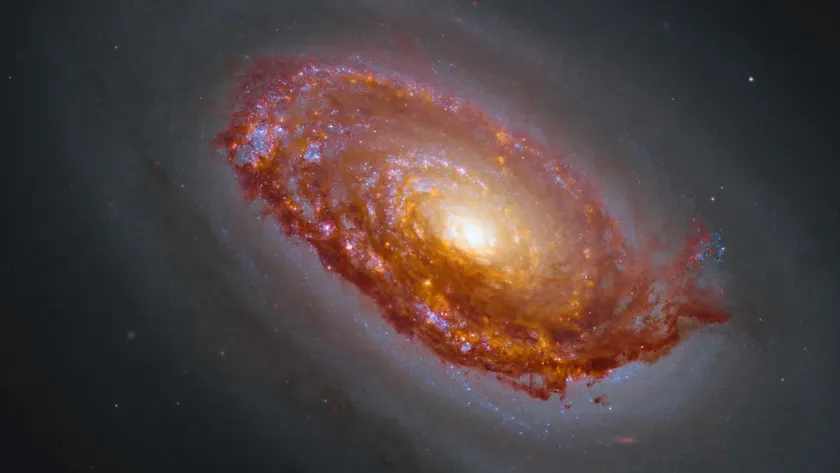
Seventeen million light-years away, the Black Eye Galaxy turns with a rare internal counterpoint, where outer clouds of gas revolve against the motion of the inner galaxy, preserving the dynamic memory of an ancient cosmic encounter. By combining the complementary vision of the Hubble Space Telescope and the James Webb Space Telescope, astronomers have revealed luminous dust, star-forming regions, and a radiant core with remarkable depth, allowing different wavelengths of light to compose a richer portrait than either observatory could achieve alone. (Featured Image from New Thinking Allowed)
The debate as to whether Pluto is a dwarf planet, or a fully fledged planet, continues to rage.
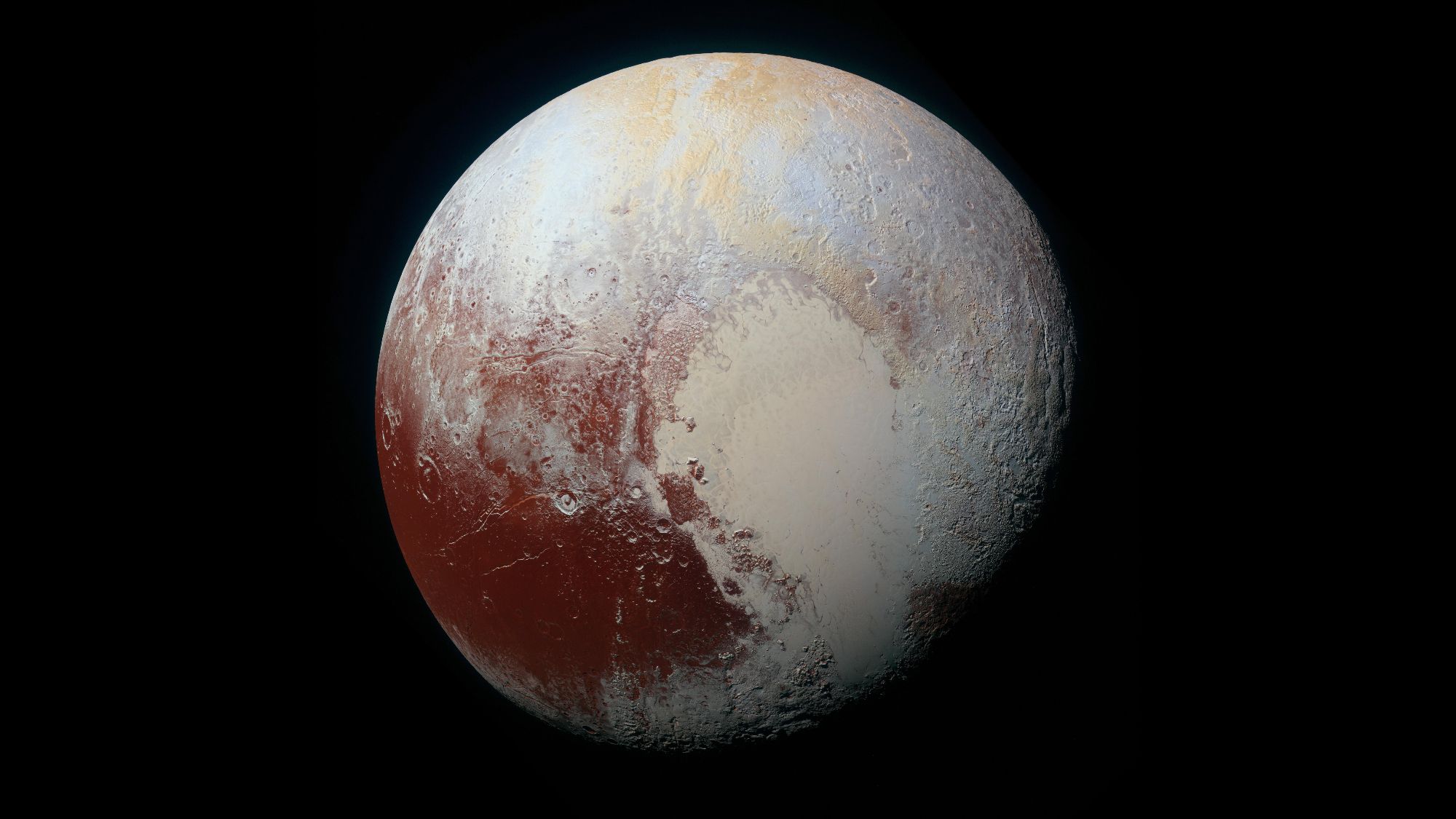
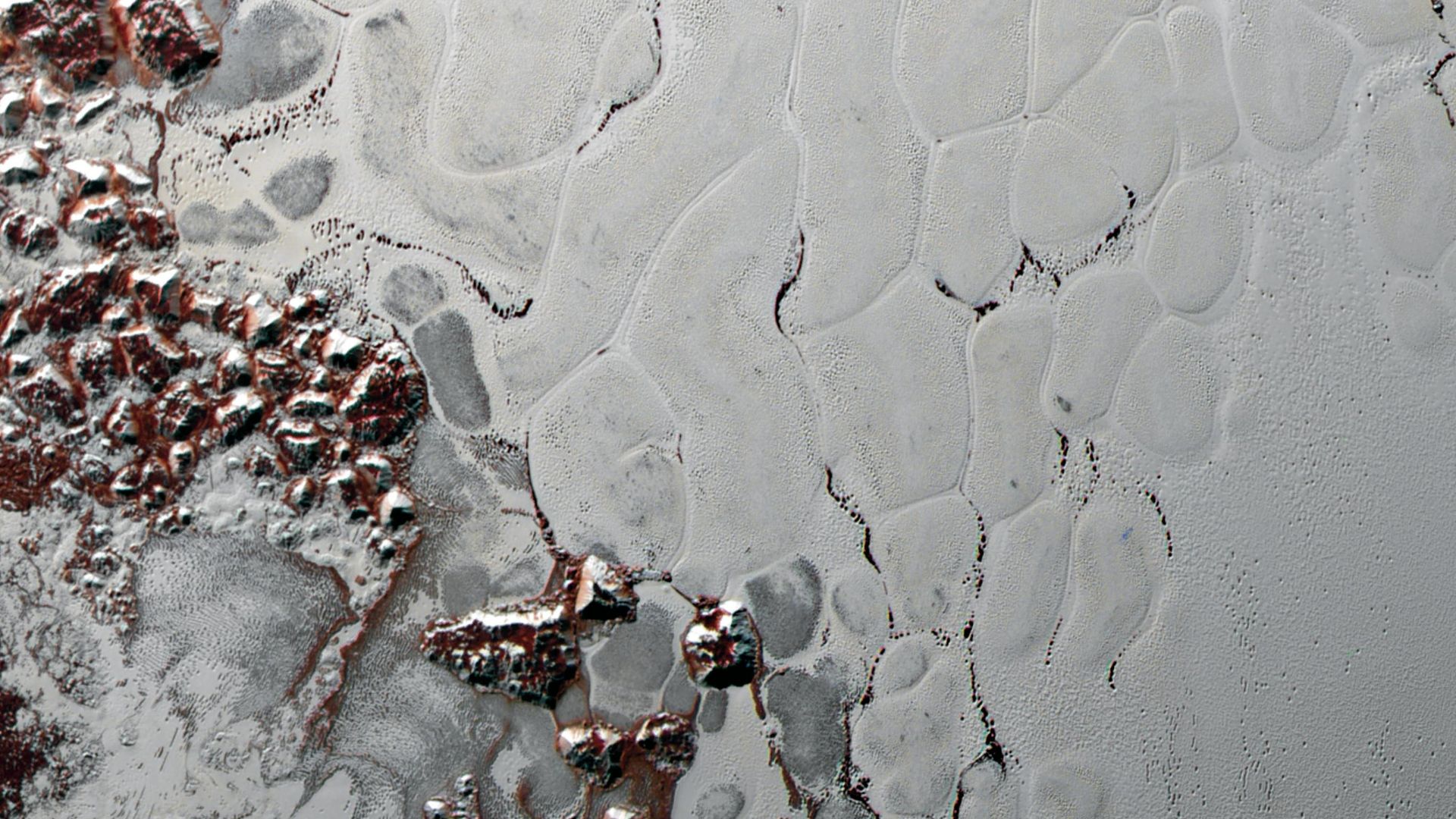
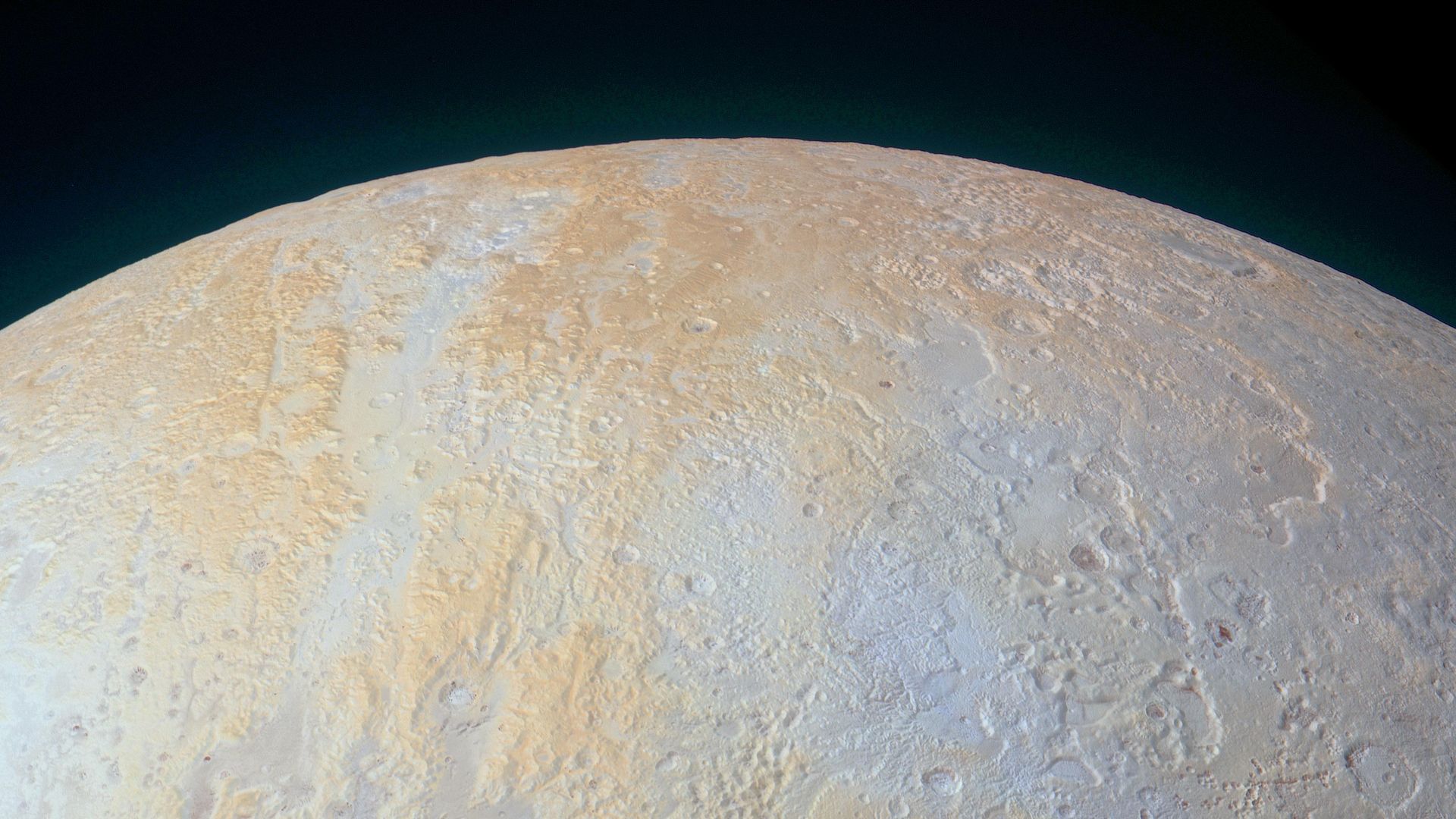
Is Pluto really a planet? (Image credit: NASA/JHUAPL/SwRI)
In August of 2006, astronomers at the International Astronomical Union (IAU) democratically voted to reclassify Pluto as a dwarf planet — but 20 years later, with our greater knowledge and understanding of planetary systems, is it time to revisit the controversial decision? Should Pluto be called a planet again?
For several years before the IAU vote, there had been agitators among the astronomical community lobbying for our solar system’s nine worlds to become eight, and for Pluto‘s planetary status to be revoked. In 2000, Neil DeGrasse Tyson even went as far as to remove Pluto from the planets display at the Hayden Planetarium in New York. The questioning of Pluto’s status began even earlier, in the 1990s, with the discovery of distant objects in the Kuiper belt beyond Neptune which had similar orbits to Pluto.
It all came to a head in July of 2005 with the discovery of Eris, which is a Pluto-size body even further from the sun than Pluto is. Was Eris the 10th planet? If it was not a planet, then how could we still call Pluto a planet? A year later, the issue was debated at a meeting of the IAU, where astronomers from all over the world convened to discuss various conundrums. Numerous proposals and counter-proposals were put forward, some of which even increased the number of recognized planets to as many as 14. But in the end, Pluto became a dwarf planet.
Though Pluto was officially “reclassified,” to many in the public it seemed as though Pluto had experienced a demotion. This viewpoint was the one promoted by those scientists who were against the decision such as Alan Stern, who was the principal investigator on the New Horizons mission to Pluto. Stern’s spacecraft would launch in 2005 on a journey to a planet, but arrive at a dwarf planet in 2015.
Some argued that Pluto was still a kind of planet, just a small one. This argument is undermined somewhat by the IAU giving Pluto a minor planet number — 134340 — which is typically reserved for asteroids. Nationalistic arguments from some in the United States said Pluto should remain a planet because it was discovered by an American astronomer, Clyde Tombaugh, at Arizona’s Lowell Observatory in 1930. And when New Horizons reached Pluto, it revealed not a minor body, but rather a complex world in its own right.You may like
Nevertheless, for 20 years, Pluto has remained a dwarf planet, but on the anniversary of that fateful IAU vote, is it time to revisit that decision? Paul Byrne, a planetary astronomer at the University of Washington in St Louis, certainly thinks so.
“Yes, Pluto is a planet,” he told Space.com. And not just Pluto, but the other dwarf planets too: Ceres, Eris, Makemake and Haumea, not to mention the likes of Sedna and Quaoar that are dwarf planets in all but name.
“Ultimately I think they are all planets and I don’t think there’s any benefit to not including Pluto as a planet,” Byrne said.
To a point this entire debate is semantics, and Byrne accepts this viewpoint, reminding us that: “Nature doesn’t care what we call Pluto.”
However, perception is another matter, which is where Byrne thinks that the IAU’s 2006 decree ultimately failed us. Byrne describes how, when he gives public talks about the planets, members of the audience don’t ask questions about Pluto’s amazing active nitrogen glaciers or what formed its giant heart-shaped feature. Instead, they want to know why it was demoted. The entire issue has got in the way of presenting the science to the public.What to read next
“We’ve done a massive disservice to the public from a science communication perspective,” Byrne said. “The messaging has got in the way of trying to understand what Pluto is.”
Pluto’s active nitrogen glaciers are typical of planetary processes. (Image credit: NASA/JHUAPL/SwRI)
One of the arguments in 2006 was that models of the solar system‘s formation predict that there could be hundreds of objects like Pluto and Eris that remain undiscovered in the Scattered Disk and the Oort Cloud, which is a vast unexplored region that could extend up to a light-year from the sun.
“One of the issues people brought up was, how would kids remember the names of 200 planets?” said Byrne. “But just look at how many Pokémon there are that kids know the names of. If ultimately there are 200 planets in the solar system, then so what?”
The IAU definition of a planet
Semantics or not, how we categorize celestial objects has to be grounded in some kind of scientific thinking. In 2006, the IAU came up with a three-point plan on what makes a planet.
First, a planet had to be in hydrostatic equilibrium, meaning that its gravity has pulled it into a spherical shape. Furthermore, its interior will have become differentiated, with the heavier elements sinking to the core. Everyone seems to agree with this part of the planetary definition.
Pluto’s gravity has shaped it into a spherical object. (Image credit: NASA/JHUAPL/SwRI)
Second was that it must be in orbit around the sun, so a moon isn’t a planet because a moon doesn’t orbit the sun, it orbits a planet instead (though Byrne notes that if he had his way, he’d call the large moons planets too). Strictly speaking, this rules out exoplanets because they don’t orbit our sun, but common sense dictates that they’re fine because they orbit their own star instead. However, what about rogue planets that wander interstellar space alone? Astronomers are now beginning to discover very many of these free-floating worlds. It could be argued that most of these did indeed form in orbit around a star only to be ejected, so it’s okay to still call them planets, but some rogue planets seem to have formed directly from the collapse of a gas cloud without having a parent star. Such planets fall through the gaps in the IAU’s definition.
It’s the third point that draws the critics’ ire the most. It states that to be a planet, an object must have cleared its neighborhood. In other words, it must be dominant in the region around its orbit, its gravity having swept away any other bodies. Pluto fails at this because its orbit actually crosses Neptune’s, and it’s accompanied by other Kuiper belt objects in neighboring orbits. But then you could say Neptune mustn’t be a planet because it has Pluto infringing on its orbital realm. And what about the existence of near-Earth asteroids? Does their existence mean that Earth isn’t a planet because it hasn’t cleared those away yet? There certainly does seem to be some sloppiness in this part of the definition of a planet, perhaps resulting from the somewhat rushed nature of the vote 20 years ago.
Planetary processes
But if the IAU decision were to be rejected, what should replace it? How should we classify planets? Byrne has some ideas.
“Being round and having some amount of differentiation makes a lot of sense to me,” he said. “Geophysically, if they are big enough to pull themselves into balls, then they are big enough to have undergone some kind of internal chemical processing and are capable of having some kind of active geology, in terms of the outgassing of volatiles to form an atmosphere, volcanism, surface geomorphological processes, even a short-lived magnetic field. That’s why I count the moon as a planet because it has had these planetary processes.”
Byrne acknowledges that gas giants don’t have these properties since they have no solid surface, but no one is doubting Jupiter‘s planetary credentials, and when it comes to Uranus and Neptune we don’t actually know whether or not there is some sort of super-Earth itself lurking deep within them.
The moniker “dwarf” doesn’t impress Byrne either. To him, it sounds like it implies there is a hierarchy of planets with the gas giants at the top and the dwarf planets at the bottom.
The New York Times article from when Pluto was discovered. (Image credit: The New York Times Archive)
“There is no natural hierarchy; they don’t form according to one,” he said. And although Pluto, Eris and the other dwarf planets are made from detritus left over from the construction of the solar system, they still coalesced in the same way as the other planets, in the sense that building blocks came together to form these larger objects.
A counterargument to Pluto being a planet, however, is that if it is just one of 200, then it is nothing special; it would become forgotten and ultimately treated almost incidentally. As a dwarf planet, it is the standard bearer of its kind, the guardian of an entire realm of similarly sized worlds. It’s a choice between being a big fish in a little pond, or a little fish in a big pond.
The other 200 planets?
The real test will come when astronomers begin to discover some of these purported 200 or so planets far from the sun. As long as they are all roughly Pluto-size, there will be no debate — but what happens when astronomers discover one the size of Mars, or one even as large as Earth? We would surely think of an object so large as a planet. Perhaps this world would have formed closer to the sun but was kicked out through gravitational interactions with one of the giant planets, but on the other hand perhaps it formed out there in the outer solar system from the same detritus as Pluto did.
“By the IAU definition it would fail to be defined as a planet because it wouldn’t have cleared its neighborhood,” said Byrne. “If we did find such a planet it would be another nail in the coffin of trying to distinguish these things solely on the basis of where they are and not what they are.”
Whatever the case, if Pluto is to be a planet again, it must deserve to be so scientifically. Nostalgia, or nationalistic pride, or giving kids names of planets to remember aren;t sufficient reasons to revoke the original IAU decision. Revisiting the name “dwarf planet” and finding a more appropriate category could be the way to go instead.
Or, perhaps we just don’t have the words to describe the things that we are discovering. Concepts such as planets are rooted in history going back millennia when there was no understanding what these wandering “stars” really were, so perhaps it is not surprising that we are now running into difficulty when trying to apply the term “planet” to our modern understanding of the different types of worlds. If there is no way of categorizing these objects that is consistent and satisfactory to everyone, then perhaps we ought to stop worrying so much about it.
Whatever we decide to call it, Pluto will always be Pluto.
Keith Cooper is a freelance science journalist and editor in the United Kingdom, and has a degree in physics and astrophysics from the University of Manchester. He’s the author of “The Contact Paradox: Challenging Our Assumptions in the Search for Extraterrestrial Intelligence” (Bloomsbury Sigma, 2020) and has written articles on astronomy, space, physics and astrobiology for a multitude of magazines and websites.
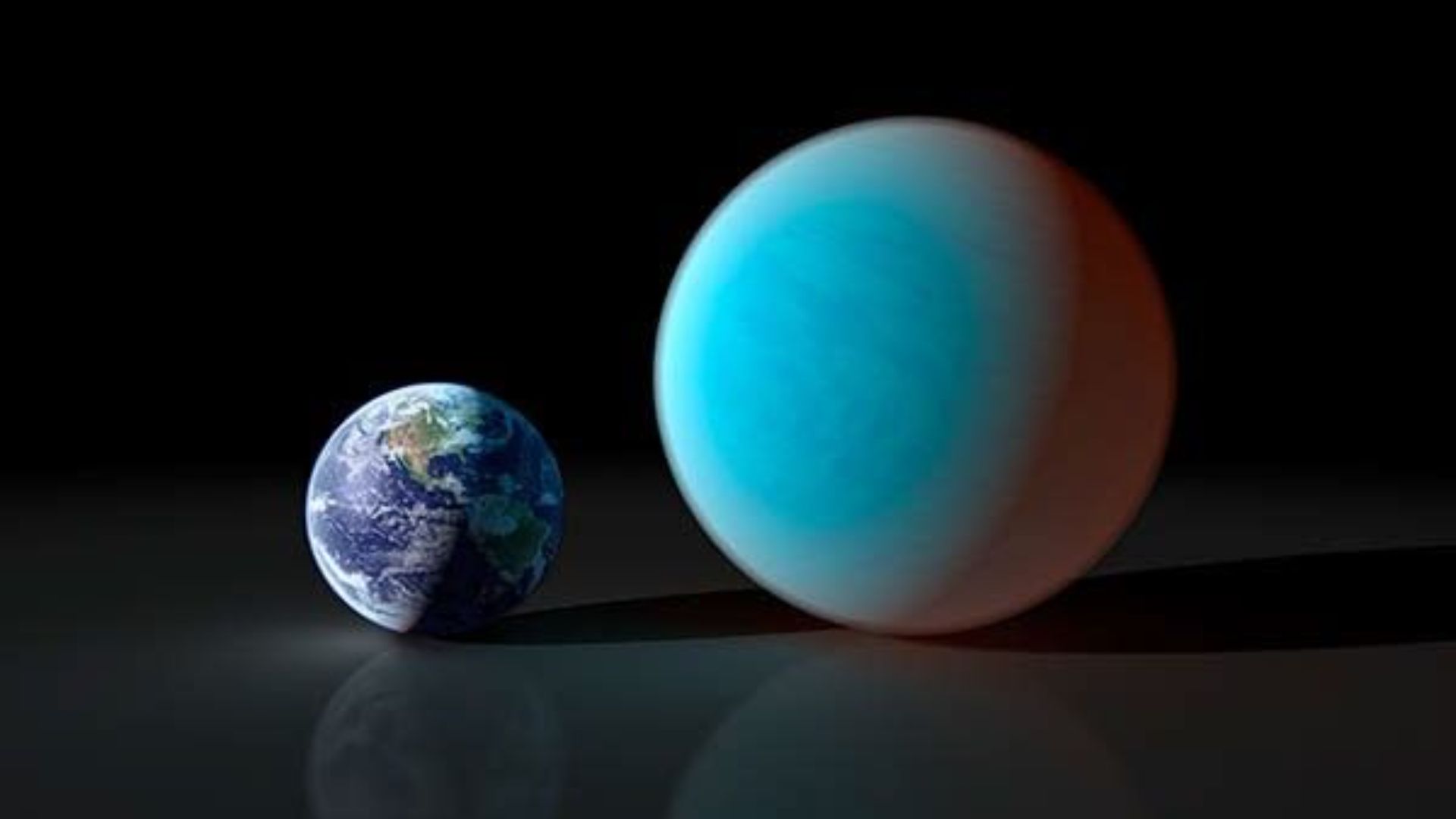
This artists concept contrasts our familiar Earth with the exceptionally strange planet known as 55 Cancri e. This planet is likely made of a lightweight material — unlike the new mega-Earth scientists found that appears to be rocky. (Image credit: NASA/JPL-Caltech/R. Hurt (SSC))
Astronomers have discovered an unusually massive, dense exoplanet that challenges conventional ideas about how rocky planets form.
Called GJ 523b, the exoplanet is about 2.5 times wider than Earth but packs roughly 23 times our planet’s mass into that relatively compact size. Worlds this large and dense are sometimes referred to as “mega-Earths,” an informal term for unusually massive, predominantly rocky planets. GJ 523b’s high density suggests it contains relatively little atmosphere despite being large enough that astronomers would normally expect it to have accumulated a substantial gaseous envelope, according to a statement from the University of Wisconsin–Madison.
“This isn’t what we expected at all,” Max Kroft, lead author of the study, said in the statement. “Dense planets like this aren’t uncommon, but they’re usually small rocky planets similar to Earth or Mercury. This planet is two and a half times bigger than the Earth.”
GJ 523b was initially identified as a candidate by NASA’s Transiting Exoplanet Survey Satellite (TESS), which searches for periodic dips in starlight caused when planets cross, or transit, their host stars. Researchers followed up with observations from the ground-based WIYN 3.5-meter Telescope at Kitt Peak National Observatory in Arizona, using a spectrograph to measure the planet’s gravitational tug on its star.
Combining those observations, the team calculated that GJ 523b has a mass about 23.5 times that of Earth, a radius 2.55 times larger and a density of about 126.82 grams per cubic inch. It circles its star every 17.75 days. The planetary system is also relatively young, at an estimated nearly 170 million years old, according to the study.You may like
That combination of size, mass and youth poses a puzzle for planet formation models. Planets begin by building cores of rock and metal, which can then pull in hydrogen and helium from the disk of gas and dust surrounding a young star. In our own solar system, giant planets such as Jupiter and Saturn are thought to have begun rapidly accumulating their massive gaseous envelopes once their growing cores reached roughly 20 times Earth’s mass.
GJ 523b is already about 23 times Earth’s mass, putting it beyond that threshold. Yet instead of developing into a gas-rich world, its unusually high density suggests it has relatively little gas and remains predominantly rocky — raising the question of why it followed such a different path.
“The question is, why didn’t this planet do that, if it’s 20 times the size of Earth?” Kroft said in the statement.
One possibility is that GJ 523b initially formed with a thick atmosphere that was later stripped away. Another is that it formed through a collision between two planets, creating a larger rocky world while blasting much of their gaseous envelopes into space, according to the statement.
Astronomers have used the term “mega-Earth” for more than a decade to describe exceptionally massive rocky worlds, though it has never represented a formally established class of exoplanets. Finding more examples like GJ 523b could help reveal whether these unusual worlds are rare exceptions or part of a broader population.
“It’s hard to infer things about planet formation in general from a sample size of one,” Kroft said in the statement. “We’re not going to get to 10,000 of these overdense planets, but if we can get to 20 or 30, maybe some trends might pop out.”
The findings have been submitted to The Astronomical Journal and are currently available on the preprint server arXiv and have not yet been peer reviewed.
A greedy galaxy that existed less than 1.3 billion years after the Big Bang is hoarding supermassive black holes.
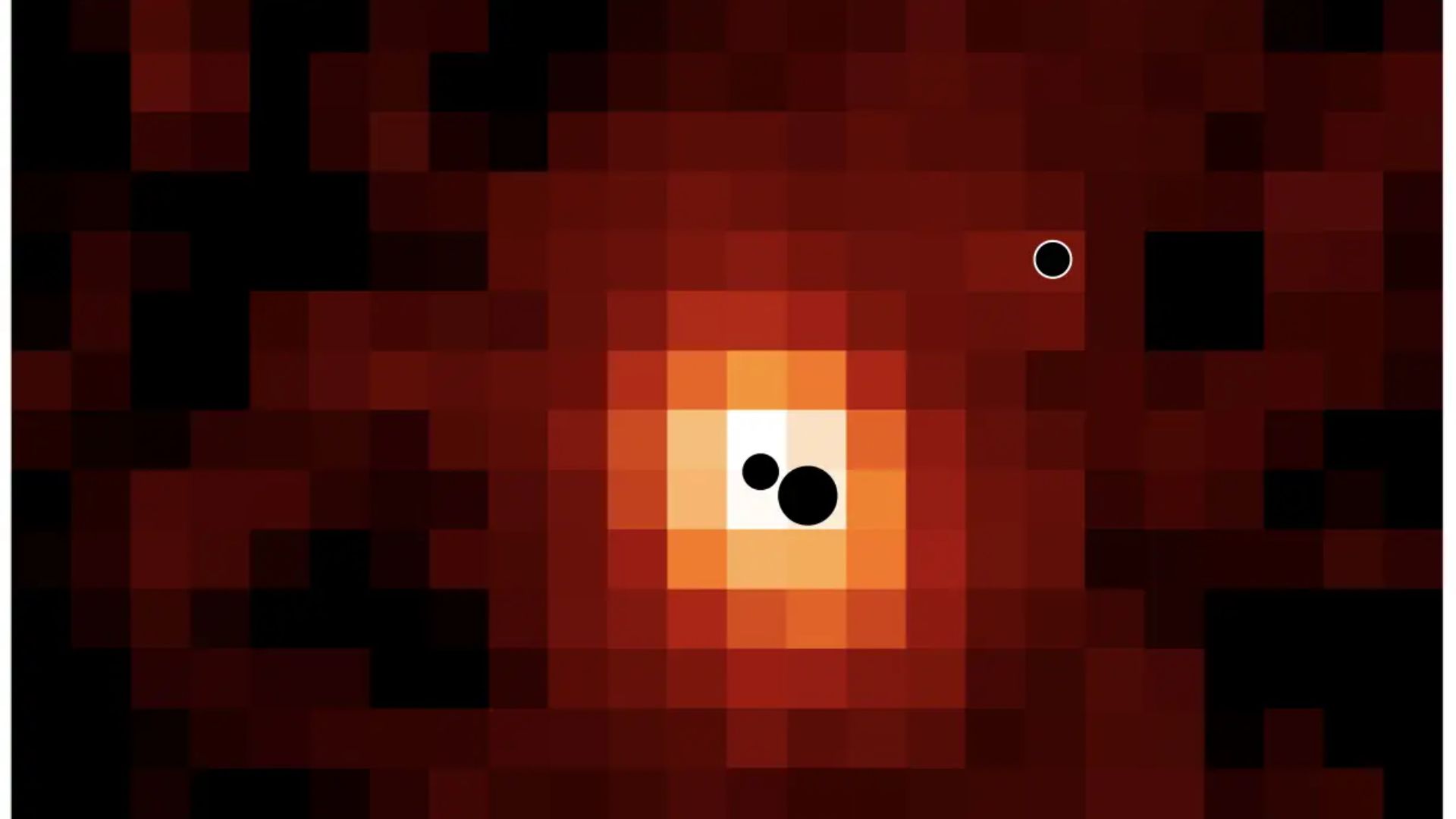
The distant galaxy J0148-4214, seen in the light of ionized hydrogen. The image appears pixelated because of the great distance to the galaxy. The black circles denote the relative locations of the three black holes. (Image credit: Hannah Übler)
A trio of heavyweight black holes are entangled in a dance of death that will quite possibly see them gradually all merge to form an even greater behemoth.
Scientists have discovered the black holes in a galaxy that is so far away its light has taken 12.5 billion years to reach us, meaning we see it as it was less than 1.3 billion years after the Big Bang. And it’s offering strong supporting evidence that one of the ways black holes grew so massive so quickly in the early universe was through mergers.
“This is the first evidence of three active black holes in a single galaxy in the distant universe,” Hannah Übler, an astronomer at the Max Planck Institute for Extraterrestrial Physics in Germany who led the study, said in a statement. “It suggests that processes in the early universe were efficient at bringing massive black holes together, setting the stage for the massive black-hole mergers we expect to detect with future gravitational-wave observatories.”
The galaxy that plays host to the black holes is catalogued as J0148-4214 and is so far away (their redshift is 5.0167) that the James Webb Space Telescope (JWST), which made the discovery, could not see the black holes directly. Instead, the Integrated Field Spectroscopy unit on the JWST’s Near Infrared Spectrometer (NIRSpec) measured the motion of hydrogen gas swirling around at high velocity in the accretion disks encircling each black hole.
“The JWST data allowed us not only to identify the three black holes, but also to estimate their masses, accretion rates and the stellar mass of the galaxy,” Giovanni Mazzolari of the Max Planck Institute for Extraterrestrial Physics said in the statement. “We find a total stellar mass of about 1.3 billion suns, and the black holes represent a significant fraction of that.”You may like
Two of the black holes reside at the center of J0148-4214, separated by 620 light-years. One of these black holes has a huge mass of 80 million times the mass of our sun, while its companion is a relative pipsqueak at 600,000 solar masses. Yet despite its diminutive stature, the smaller black hole is growing at a tremendous rate by accreting gas faster than the Eddington limit. This is the theoretical maximum rate at which material can fall towards a black hole; if the rate is any higher then the accretion disk around the black hole becomes so dense and hot that radiation from the disk blows material back out again, stifling the black hole’s feeding frenzy. This means the smaller black hole will only be able to keep growing at this rate for a short time before negative feedback calls a halt.
The third black hole is 5,500 light-years out from the center of J0148-4214 and has a mass two million times greater than the mass of our sun. This is about half the mass of the supermassive black hole at the center of our Milky Way galaxy, called Sagittarius A*. It’s thought that this third black hole, and quite possibly the second one too, found their way into J0148-4214 via mergers between galaxies.
“These results are extremely exciting,” said Roberto Maiolini of the University of Cambridge, who was a participant in the findings. “They suggest that black-hole merging may be an additional, fast route for their rapid growth in the early universe.”
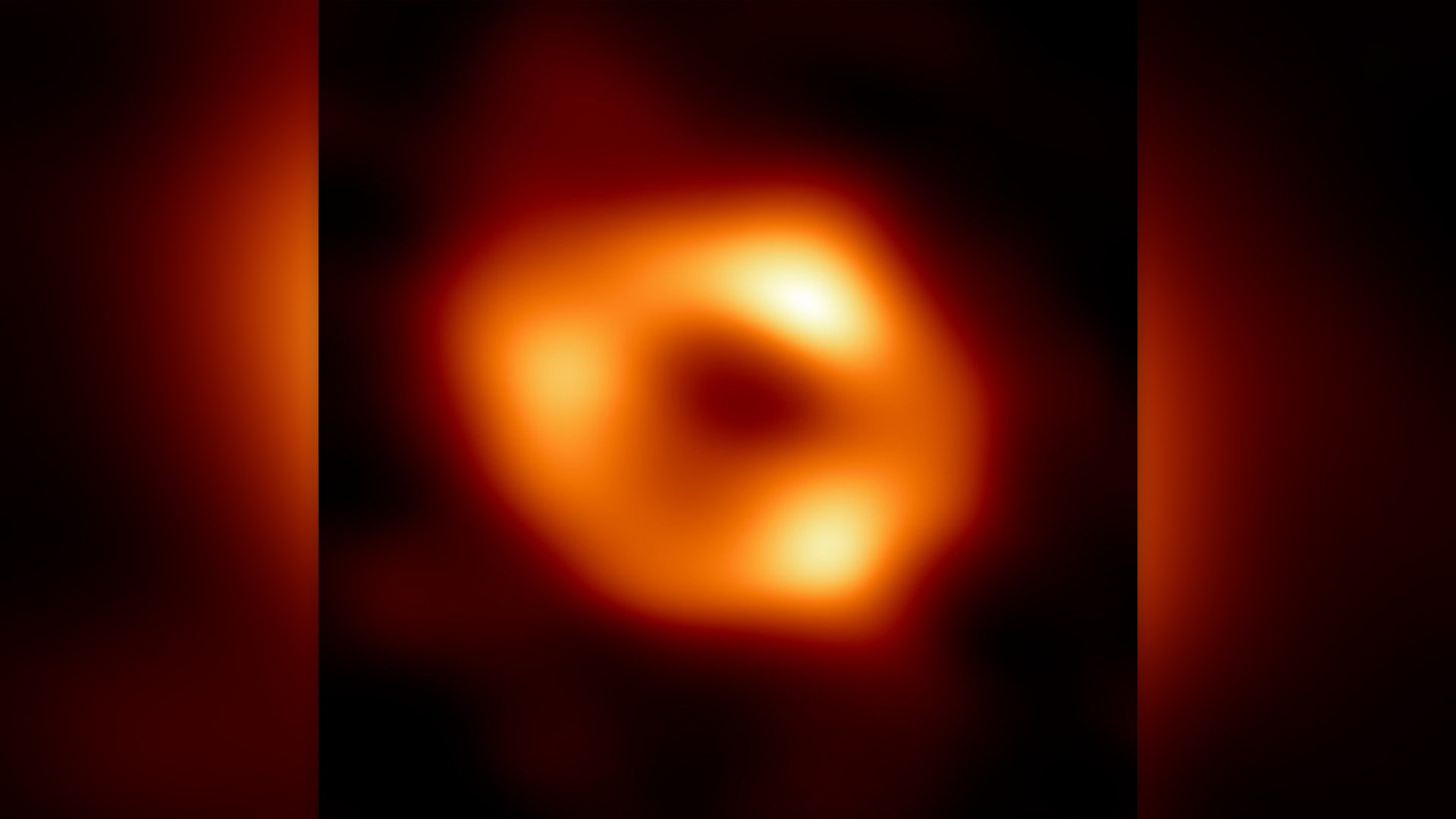
An image of Sagittarius A*, the supermassive black hole at the heart of the Milky Way. (Image credit: EHT Collaboration)
Mergers between black holes produce bursts of gravitational waves. Current gravitational-wave detectors — including The Laser Interferometer Gravitational-Wave Observatory (LIGO) in the United States, Virgo in Italy and KAGRA in Japan — are able to detect the high frequency, short wavelength gravitational waves from the mergers of stellar-mass black holes, the kind formed in certain supernova explosions. To detect the much longer wavelength, shorter frequency gravitational waves produced by the merger of supermassive black holes such as those in J0148-4214 requires a space-based detector with a baseline many millions of miles long.
To that end, the European Space Agency plans to launch LISA, the Laser Interferometer Space Antenna. If all goes to plan, by the mid-2030s. LISA will feature three spacecraft in triangular formation, each side of the triangle being 1.55 million miles (2.5 million kilometers) long. The three spacecraft will beam lasers at each other, looking for deviations in the travel time of those laser beams as evidence for the passing of a long-wavelength gravitational wave.What to read next
With regards to J0148-4214, however, there is a caveat: The third black hole might not be on a collision course with the other two. Instead, it could be heading out of the galaxy.
It’s the classic three-body problem: How do three objects orbiting one another interact?
The two smaller black holes may have entered J0148-4214 as a binary pair. Then, as they were drawn closer to the 80-million-solar-mass black hole, the more massive black hole could have snatched the 600,000-solar-mass black hole while exchanging angular momentum with the two-million-solar-mass black hole to fling it away at high velocity. We see a similar effect in our galaxy with hypervelocity stars that are racing out of the Milky Way. These speedy stars used to be part of a binary pair of stars that got too close to Sagittarius A*, which is the black hole at the center of our galaxy. One half of the binary was captured by the black hole and the other was flung away.
Currently, there is no way to measure the direction of motion of the third black hole in J0148-4214 and confirm whether it will merge with the other two black holes or escape. If it did escape, it could still be wandering alone and dark in intergalactic space even now, 12.5 billion years later.
Today in the Space World Jul 1, 2026 Explore the icy Pluto surface and its moon Charon through artistic renderings. See how the James Webb telescope observes space. In this video: 0:00 – The World We Got Wrong 1:02 – A Farm Boy, a Blinking Star, and a Demotion 2:35 – Ten Minutes That Changed a Dead World Into a Living One 4:29 – A Telescope That Doesn’t Photograph. It Interrogates 5:24 – The Sky That Refrigerates Itself 6:44 – A Sky That Rains Down the Chemistry of Life 8:41 – A Planet That Is Slowly Bleeding Onto Its Moon 10:54 – If You Stood There 12:15 – A Belt of Frozen Blades and a Continent-Sized Stain 13:29 – Mountains That Shouldn’t Be There 14:48 – The Ocean Nobody Can Reach 16:26 – A Single Data Point From a Trillion Silent Worlds
The recent map released by DESI Legacy Imaging Surveys combines more than 260,000 telescope exposures and was collected by more than 160 scientists.DESI Legacy Imaging Surveys | Courtesy
DESI Legacy Imaging Surveys, assisted by researchers from Lawrence Berkeley National Laboratory, produced the world’s largest 2D color map of the universe. The map contains almost 4 billion celestial objects.
The project has been in development for 13 years, during which the team at Legacy Surveys released 10 datasets before the map reached its current and largest form. The latest and 11th data release expands the map to 5.6 trillion pixels.
The map combines more than 260,000 telescope exposures from three different sky surveys: the Beijing-Arizona Sky Survey, the Dark Energy Camera Legacy Survey and the Mayall z-band Legacy Survey. The data was collected by more than 160 scientists.
According to project co-lead David Schlegel, a senior physicist at Berkeley Lab, the project began in 2013 in the interest of studying dark energy.
In studying dark energy, researchers were required to know where the Dark Energy Spectroscopic Instrument should be directed. The team set out to create a 3D map of the universe and its observable objects. The 3D model — of which the team has published smaller iterations since — needed a 2D map to serve as a foundation.
“We had just started collecting data. Our analysis was just being developed,” Schlegel said. “So while we’ve been accumulating data over all these years, we’ve also been accumulating knowledge and our sophistication of those images as well.”
Schlegel said the newest version of the map encompasses the entire extragalactic sky, which is the expanse of sky not blocked by the Milky Way.
Dustin Lang, a DESI Imaging Survey scientist, helped build code used in the project that reconciles information across images of different qualities. The computer is then able to predict the appearance of stars and galaxies above the atmosphere by compositing and comparing the blurriness across multiple images of each portion of the sky.
Different iterations of the data from DESI Legacy Imaging Surveys have been referenced in more than 1,800 published scientific papers. Schlegel said undergraduates at UC Berkeley have not only participated in the project but used the map in their own research — including using it as a reference to discover rare gravitational lensing systems.
Schlegel met his project co-lead Arjun Dey when they were both graduate students at UC Berkeley. Dey was the first person to take Schlegel to see a telescope, which pulled Schlegel into the world of observational astronomy.
Schlegel said seeing all of the research initiatives that use DESI Legacy Imaging Surveys’ data has given him a “warm fuzzy feeling.”
“We’ve gotten what we need out of the data,” Schlegel said. “But then every day I see in the literature other researchers making use of the data, and it’s a validation every day.”