When, in disgrace with fortune and men’s eyes, I all alone beweep my outcast state, And trouble deaf heaven with my bootless cries, And look upon myself and curse my fate, Wishing me like to one more rich in hope, Featured like him, like him with friends possessed, Desiring this man’s art and that man’s scope, With what I most enjoy contented least; Yet in these thoughts myself almost despising, Haply I think on thee, and then my state, (Like to the lark at break of day arising From sullen earth) sings hymns at heaven’s gate; For thy sweet love remembered such wealth brings That then I scorn to change my state with kings.
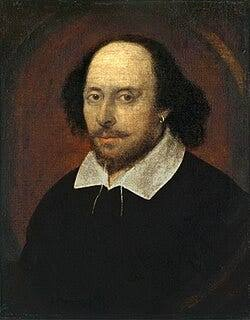
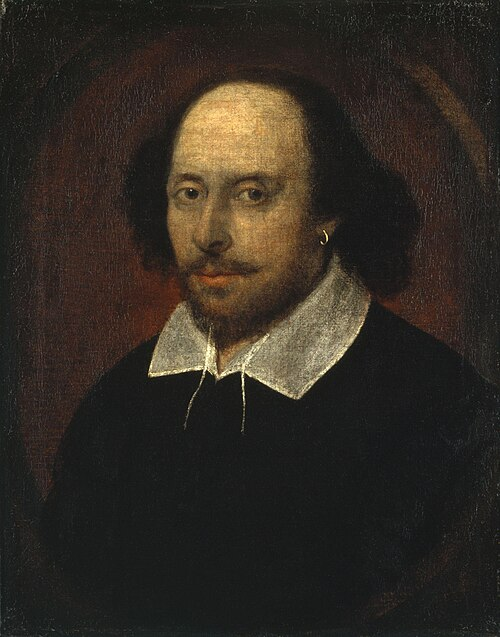
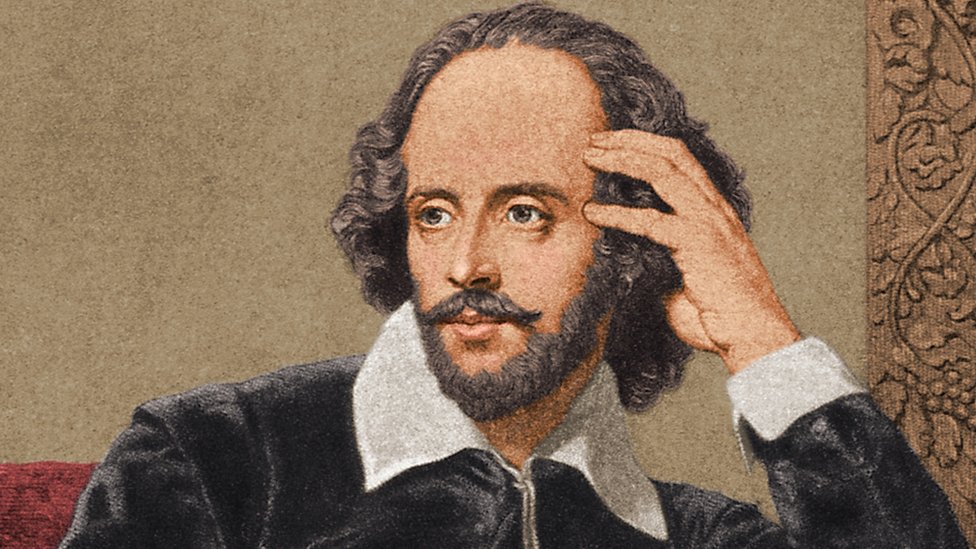
William Shakespeare was an English playwright, poet, and actor who is widely regarded as the greatest writer in the English language. He’s often called England’s national poet and “The Bard of Avon”. Shakespeare’s works include comedies, tragedies, and historical pieces, written in both poetry and prose. His four major tragedies are Hamlet, Othello, Macbeth, and King Lear. Wikipedia.org
I have been studying how I may compare This prison where I live unto the world; And, for because the world is populous And here is not a creature but myself, I cannot do it. Yet I’ll hammer’t out. My brain I’ll prove the female to my soul, My soul the father, and these two beget A generation of still-breeding thoughts; And these same thoughts people this little world, In humours like the people of this world, For no thought is contented. The better sort, As thoughts of things divine, are intermixed With scruples and do set the word itself Against the word , as thus: ‘Come, little ones’; And then again: ‘It is as hard to come as for a camel To thread the postern of a small needle’s eye.’ Thoughts tending to ambition, they do plot Unlikely wonders – how these vain weak nails May tear a passage through the flinty ribs Of this hard world, my ragged prison walls, And, for they cannot, die in their own pride. Thoughts tending to content flatter themselves That they are not the first of Fortune’s slaves, Nor shall not be the last, like seely beggars Who sitting in the stocks refuge their shame That many have and others must sit there; And in this thought they find a kind of ease, Bearing their own misfortunes on the back Of such as have before endured the like. Thus play I in one person many people, And none contented. Sometimes am I king; Then treasons make me wish myself a beggar, And so I am. Then crushing penury Persuades me I was better when a king; Then am I kinged again, and by and by Think that I am unkinged by Bolingbroke, And straight am nothing. But whate’er I be, Nor I nor any man that but man is With nothing shall be pleased till he be eased With being nothing.
Unfamiliar Words/Phrases
As always in our monologues unpacked I start by listing the unfamiliar words and giving you a simple modern definition:
hammer: ponder, think hard beget: give rise to humours: moods, temperaments (based on the idea of mood coming from bodily fluids: sanguine, choleric, melancholic, phlegmatic still-breeding: constantly breeding, continually breeding (like thoughts that won’t stop coming) little world: the prison cell scruples: doubts, reservations, qualms set the word itself / Against the word: find passages of scripture that contradict other scriptures. “come little ones”: Bible verse Matthew 19: 14 “It is as hard to come as for a camel/ To thread the postern of a small needle’s eye.”: Bible verse Matthew 19:24 postern: entrance, side gate needle’s eye: very narrow opening at the end of a needle flinty: hard fortune’s slaves: unlucky people seely: frail (in some versions it is “silly” which works as well) refuge: shelter from, take refuge from penury: extreme poverty
In this episode of the Read Smart podcast, host Razia Iqbal will be speaking to James Shapiro, who won the prize in 2006 with 1599: A Year in the Life of William Shakespeare. Iqbal and Shapiro explore life in Elizabethan England, how Shakespeare managed to produce four great works (including Hamlet) in just one year and why the rumors that Shakespeare was in fact more than one person are false. Hear more to find out how and why Shakespeare became one of the greatest writers who ever lived.
James Shapiro: It was an eventful year, I suppose, for everyone. Every year seems to be eventful, but looking back, this seems to be an extraordinarily complex one. On the political and foreign front, the Elizabethans were sending out an army 16,000 strong to crush an Irish rebellion.
They were fearing yet another armada threat from Spain, an invasion that would destroy the country and turn it Catholic. They were establishing the East India Company, which would transform England’s place in the world, globally, and with Queen Elizabeth, aging and childless and unmarried. They were waiting to see who would succeed her. So for Elizabethans, these are really quite traumatic experiences.
And one of the things that I was trying to do in 1599 was to look at the ways in which Shakespeare used his plays, used his theatre as a site for engaging the issues that people cared about and were anxious about.
On how historical events shaped Hamlet
James Shapiro: I realized I knew almost nothing that I needed to know about a playwright who was so engaged with the social and the economic and the political crises of his time. And it set me in motion.
I’ll give one tiny bit from Hamlet simply because it comes to mind. And that is the opening scene when men are preparing against invasion.
And it’s a scene often enough cut in productions of the play. But if you were in England in 1599, in the summer of 1599, anticipating another Spanish armada landing on the shores, an opening scene in which men are standing guard against invasion would have been extremely, extremely real and vivid. So, yes, that is not set in England. The play is set in Scandinavia in a different time as well.
But that’s the kind of thing that Shakespeare would do to give an edge to his plays
On earlier versions of Hamlet
James Shapiro: When Shakespeare came to London, there was a play called Hamlet on the boards, and we hear traces of it as late as 1596, when the play’s being performed and this play is now lost. They call it the murder Hamlet or earlier Hamlet.
And you can imagine Shakespeare as a young actor watching this play. Maybe he’s standing as a messenger in his first role. And we don’t know. Thinking, I can do something with this. This play is stale. It’s past sell by date. Why don’t I put into Hamlet‘s mouth soliloquies, long speeches in which he reveals what he’s thinking and how he’s thinking.
And you can start to see Shakespeare, who didn’t really like creating plots. He liked doing court renovations on somebody else’s story that needed fixing up. And he had a brilliant facility for how to transform a work that had been popular and make it ever more so. And it’s extraordinary what he does.
_________________________
The podcast is generously supported by the Blavatnik Family Foundation. Follow @BGPrize on Instagram, Facebook, Twitter, TikTok and YouTube.
BBC Select • Apr 17, 2023 How much is the personality of England intertwined with the visions of Shakespeare? Acclaimed historian Simon Schama tries to get beneath the skin of the playwright and understand why his stories are so relevant today. In this insightful documentary we are shown how Shakespeare knew the importance of not just reflecting the lives of the kings and queens who peppered his plays, but ordinary people too – including thieves, clowns and prostitutes.
Consciousness, spirituality, biography, sexuality, androgyny, futurism, space, the arts, science, astrology, democracy, humor, books, movies and more