Kevin Phillips

“The whole secret of politics is knowing who hates who.”

–Kevin Phillips
(Image from WGBH.org)

From Wikipedia, the free encyclopedia

Kevin Phillips
BornNovember 30, 1940
New York City, U.S.
DiedOctober 9, 2023 (aged 82)
Naples, Florida, U.S.
Alma materColgate University (B.A., 1961)University of Edinburgh (1959–60)[citation needed]Harvard University (J.D., 1964)
OccupationsAuthorcolumnistpundit
SpouseMartha Henderson ​(m. 1968)​
Children3

Kevin Price Phillips (November 30, 1940 – October 9, 2023) was an American writer and commentator on politics, economics, and history. He emerged as a Republican Party strategist who helped devise its Southern Strategy in the 1960s. Phillips became disaffected with the party by the 1990s, subsequently leaving it to become an independent and staunch critic of the Republicans. He was a regular contributor to the Los Angeles TimesHarper’s Magazine, and National Public Radio, and was a political analyst on PBS‘s NOW with Bill Moyers.

Early life

Phillips was born in Manhattan in 1940, and grew up in the Bronx, raised by a family of Irish, Scottish, and English descent. He was drawn to the Republican Party from an early age, supporting Dwight D. Eisenhower for president in 1952 and 1956.[1] He attended the Bronx High School of Science before earning a bachelor’s degree in political science from Colgate University and a juris doctor from Harvard Law School; he also studied at the University of Edinburgh.[1]

Early career

Phillips began his political career as an aide to Republican Representative Paul A. Fino.[1] He worked as a strategist on voting patterns for Richard Nixon‘s 1968 campaign, which was the basis for a book, The Emerging Republican Majority, which predicted a conservative political realignment in national politics and is widely regarded as influential in the field of American political science.[1]

Southern strategy

Phillips told a journalist during the 1968 presidential election that “the whole secret of politics is knowing who hates who”.[1] After Nixon was elected, Phillips wrote a book on what has come to be known as the “Southern strategy” of the Republican Party. Entitled The Emerging Republican Majority, it argued that the southern states of the US would keep the Republicans winning presidential elections and more than offset the decline in Republican support in Northeast states, based on the racial resentment of white voters.[1][2]

As he stated to the New York Times Magazine in 1970,

All the talk about Republicans making inroads into the Negro vote is persiflage. Even ‘Jake the Snake’ [liberal Republican Senator Jacob Javits of New York] only gets 20 percent. From now on, Republicans are never going to get more than 10 to 20 percent of the Negro vote, and they don’t need any more than that… but Republicans would be shortsighted if they weakened the Voting Rights Act. The more Negroes who register as Democrats in the South, the sooner the Negrophobe whites will quit the Democrats and become Republicans. That’s where the votes are. Without that prodding from the blacks, the whites will backslide into their old comfortable arrangement with the local Democrats.[2]

The book however was not used in the campaign itself, Phillips notes in the preface to the Princeton Edition,

Some observers concluded that The Emerging Republican Majority was the emerging Republican strategy. Newsweek labelled the book “The political bible of the Nixon Era.” Not quite. The book was not a blueprint of the GOP’s “Southern Strategy” as some claimed,. … Richard Nixon had read memos based on the book’s analyses during the week before the November 1968 election, but in mid-1969 he truthfully said he had not read the actual book. He read it a few months later.[3]

His predictions regarding shifting voting patterns in presidential elections proved accurate, though they did not extend “downballot” to Congressional elections until the Republican revolution of 1994.

Political commentary

Phillips briefly worked in the Department of Justice during the Nixon administration, but later left to embark on a career as an author and commentator.[1] In his books, he coined the term Sun Belt to refer to the southern states. During this time, he was associated with the New Right.[1]

Later career

As time went on, Phillips grew increasingly disillusioned with the Republican Party. Claiming that the Watergate scandal had dealt a fatal blow to his vision for a perpetual Republican majority, he was a critic of expanding wealth inequality under the presidency of Ronald Reagan, and was a staunch opponent of George W. Bush‘s administration, which he extensively criticized in his 2006 book American Theocracy.[1]

American Theocracy (2006)

Main article: American Theocracy

Rev. Dr. Allen Dwight Callahan [4] states the book’s theme is that the Republican Party (GOP), religious fundamentalism, petroleum, and borrowed money are an “Unholy Alliance.”[5]

The last chapter, in a nod to his first major work, is titled “The Erring Republican Majority”. American Theocracy, “presents a nightmarish vision of ideological extremism, catastrophic fiscal irresponsibility, rampant greed and dangerous shortsightedness.”[6]

The New York Times wrote:

He identifies three broad and related trends — none of them new to the Bush years but all of them, he believes, exacerbated by this administration’s policies — that together threaten the future of the United States and the world. One is the role of oil in defining and, as Phillips sees it, distorting American foreign and domestic policy. The second is the ominous intrusion of radical Christianity into politics and government. And the third is the astonishing levels of debt — current and prospective — that both the government and the American people have been heedlessly accumulating. If there is a single, if implicit, theme running through the three linked essays that form this book, it is the failure of leaders to look beyond their own and the country’s immediate ambitions and desires so as to plan prudently for a darkening future.[7]

Phillips uses the term financialization to describe how the U.S. economy has been radically restructured from a focus on production, manufacturing and wages, to a focus on speculation, debt, and profits. Since the 1980s, Phillips argues in American Theocracy,

the underlying Washington strategy… was less to give ordinary Americans direct sums than to create a low-interest-rate boom in real estate, thereby raising the percentage of American home ownership, ballooning the prices of homes, and allowing householders to take out some of that increase through low-cost refinancing. This triple play created new wealth to take the place of that destroyed in the 2000-2002 stock-market crash and simultaneously raised consumer confidence.

Nothing similar had ever been engineered before. Instead of a recovery orchestrated by Congress and the White House and aimed at the middle- and bottom-income segments, this one was directed by an appointed central banker, a man whose principal responsibility was to the banking system. His relief, targeted on financial assets and real estate, was principally achieved by monetary stimulus. This in itself confirmed the massive realignment of preferences and priorities within the American system….

Likewise, huge and indisputable but almost never discussed, were the powerful political economics lurking behind the stimulus: the massive rate-cut-driven post-2000 bailout of the FIRE (finance, insurance, and real estate) sector, with its ever-climbing share of GDP and proximity to power. No longer would Washington concentrate stimulus on wages or public-works employment. The Fed’s policies, however shrewd, were not rooted in an abstraction of the national interest but in pursuit of its statutory mandate to protect the U.S. banking and payments system, now inseparable from the broadly defined financial services sector.

Critical reception

American Theocracy was reviewed widely. The New York Times Book Review wrote “It is not without polemic, but unlike many of the more glib and strident political commentaries of recent years, it is extensively researched and frighteningly persuasive…”[8]

The Chicago Sun-Times wrote “Overall, Phillips’ book is a thoughtful and somber jeremiad, written throughout with a graceful wryness… a capstone to his life’s work.”[9]

Bad Money (2008)

Phillips examines America’s great shift from manufacturing to financial services. He also discusses America’s petroleum policies and the tying of the dollar to the price of oil. Phillips suggests that the Euro and the Chinese Yuan/Renminbi are favourites to take the dollar’s place in countries hostile towards America, such as Iran. He then tackles the lack of regulatory oversight employed in the housing market and how the housing boom was allowed to run free under Alan Greenspan. The book concludes with the proposal that America is employing bad capitalism and extends Gresham’s law of currency to suggest that their good capitalism will be driven out by the bad.[10]

More at: https://en.wikipedia.org/wiki/Kevin_Phillips_(political_commentator)

Are Immigrants More Creative?

Studies show that creativity flourishes when people cross borders — and when those borders blur through deep, human connection.

By: Keith Sawyer

(thereader.mitpress.mit.edu)

Why do so many great ideas seem to come from people far from home?

I’ve long been fascinated by how creativity crosses borders. Immigrants, research shows, are statistically more likely to generate exceptionally creative works. Indeed, there’s a long list of immigrant geniuses: W. H. Auden, Vladimir Nabokov, Nikola Tesla, Marie Curie, Sigmund Freud, Albert Einstein. The list could go on and on. Of course, anecdotes only take us so far. What does the data say?

In 2016, Eric Weiner published some numbers in the Wall Street Journal:

An awful lot of brilliant minds blossomed in alien soil. That is especially true of the U.S., where foreign-born residents account for only 13 percent of the population but hold nearly a third of all patents and a quarter of all Nobel Prizes awarded to Americans.

Those are some pretty convincing numbers — suggesting that immigrants contribute disproportionately to creative and innovative output.

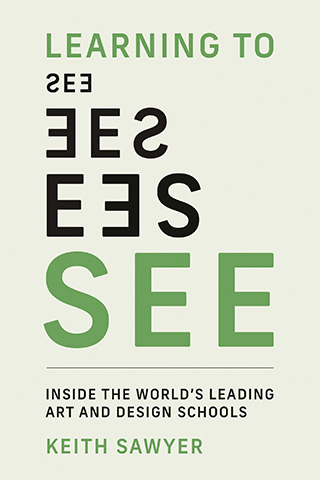
Keith Sawyer is the author of “Learning to See.”

Creativity research offers an explanation: Psychologists have shown that bigger creative insights result from distant associations — connections between ideas drawn from widely different experiences or domains of knowledge. Associations between similar conceptual material also spark creative insights, but those tend to yield the ordinary, incremental kind that improve on what already exists. It’s the distant associations that lead to radical, breakthrough innovation. Weiner makes a similar argument based on recent research, citing studies showing that “schema violations” lead to greater “cognitive flexibility,” which in turn is linked to creativity.

I probably won’t have trouble convincing you that immigration to the U.S. is great for the immigrants. But do immigrants enhance the creativity of the American citizens who already live here? In October 2025, I interviewed creativity researcher and social psychologist Adam Galinsky, who teaches at Columbia Business School. For 20 years, Galinsky has been studying how cross-cultural connections contribute to creativity. In one study, he and Will Maddux, who studies organizational behavior, looked at whether traveling overseas makes you more creative. They asked people whether they’d traveled abroad or not, and then they gave them a creativity test. They found that travel abroad has no effect on creativity. But the people who had lived in another country scored higher on a creativity test. What’s more, the people who’d lived overseas longer scored higher.

When you really get to know someone, you start to see the world through their eyes — and it’s not always the way that you imagined.

In another study, Galinsky and his colleagues examined the careers of fashion directors at the top fashion houses in Milan, Paris, London, and New York. They found a clear pattern: The more time these designers had spent living abroad, the more original their work tended to be.

Galinsky then turned to personal relationships. Were you more creative if you dated someone from another country? A brief romance didn’t seem to matter. However, being in a long-term romantic relationship with someone from another culture did affect creativity. The same was true of friendship — close cross-cultural friendships predicted greater creativity, while superficial acquaintances did not. The lesson is that creativity comes from deeper connections, not superficial contact. When you really get to know someone, you start to see the world through their eyes — and it’s not always the way that you imagined.

Deep cultural engagement benefits creativity everywhere, not only in the United States. In another study, Galinsky looked at non-U.S. citizens who had lived in America on J-1 visas, a program that allows non-U.S. citizens to stay in the U.S. from six months up to five years before returning home. Galinsky wondered whether that experience abroad made them more entrepreneurial when they returned to their home countries. The answer was yes: The longer they had lived in the U.S., the more creative they were when they went back home.

In August 2025, the Trump administration proposed a new rule that would limit the time foreign students, professors, physicians, and other visa holders may remain in the United States without additional screening and vetting. That might sound like a bureaucratic adjustment, but research suggests it comes at a cost. Deep cultural engagement — the kind that fosters creativity — takes time. Immigrants can enhance the creativity of the Americans they live and work with, but only if they form close relationships. If they remain isolated among people from their own country, speaking their own language, the creative benefits never spread. The key is the depth of a relationship, not mere proximity.

If you want to be more creative, seek out difference — and engage with it deeply.

There’s another body of research suggesting that the universities that immigrants work for produce more scientific breakthroughs and spin off more businesses. It’s hard to design rock-solid causal studies, but leaders of the top universities certainly believe in the importance of having immigrants working there. It’s not because they’re woke; it’s because they want to generate the innovations that improve the U.S. economy.

Creativity research strongly suggests that having relationships with people from other countries enhances your creativity. The lesson for everyone is: If you want to be more creative, seek out difference — and engage with it deeply. Get to know people from other cultures, and go beyond surface interactions. This is what drives the cognitive connections that lead to more surprising creative ideas. Meet people very different from you. Travel to a very different place and consider staying a while. Read magazines that you’ve never looked at before. Date someone from another culture. Fill your mind with variety.

Living abroad may be the most direct route to greater creativity, but even if you can’t do that, you can learn from creativity research: Creativity flourishes when your mind is open to worlds beyond your own.


Keith Sawyer is one of the world’s leading creativity researchers. He has published 20 books, including “Group Genius,” “Zig Zag,” and, most recently, “Learning to See.” Sawyer is the Morgan Distinguished Professor in Educational Innovations at the University of North Carolina at Chapel Hill. A version of this article first appeared on Sawyer’s Substack, The Science of Creativity.

Posted on Oct 30


The MIT Press is a mission-driven, not-for-profit scholarly publisher. Your support helps make it possible for us to create open publishing models and produce books of superior design quality.

Trump’s armed force to take over Democratic cities is nearly ready to deploy

(Prospect.org)

Meyerson on TAP

Courts will now consider whether he needs any actual justification for sending them in.On Tuesday, the Ninth Circuit Federal Appeals Court voted to hear the case of the Trump administration’s attempted deployment of the National Guard to Portland, Oregon. Also on Tuesday, that case became even more important, as the globetrotting Trump told U.S. troops stationed in Japan that he was prepared to deploy “more than the National Guard” into American cities (well, those where elected Democrats govern) to combat crime and undocumented immigration. He followed up yesterday, telling the press, “I could send the Army, Navy, Air Force, Marines. I could send anybody I wanted. But I haven’t done that because we’re doing well without it.”

Not coincidentally, our Department of War (more accurately, our Department of Government-Instigated-and-Waged Civil War) yesterday ordered the National Guard to complete its civil unrest mission training in the next couple of months so that it had a ready armed force, numbering in the tens of thousands, that it could send into cities at a moment’s notice. As if seeking to validate the apprehensions of the No Kings demonstrators, Trump prefaced his remarks to the press about his ability to deploy the Army, Navy, Air Force, and Marines to our cities with the words “The courts wouldn’t get involved. Nobody would get involved.”

Which makes the case that 11 judges of the Ninth Circuit will hear en banc all the more important. It concerns the ruling of Federal District Judge Karin Immergut, a 2019 Trump appointee to the federal bench, to block his deployment of the National Guard to Portland. As I noted in a 

Prospect piece just after she issued her ruling, the lawyers from Trump’s Justice Department argued that the president had the legal authority to send in the Guard to suppress rebellions and repel invasions. Immergut agreed that the courts must provide “significant deference” to the president’s authority to do just that—provided there actually was a rebellion or invasion. As I wrote at the time, the judge had looked and looked and looked some more, but found no rebellion. There had been scattered resistance to ICE agents, but, she wrote, Trump’s lawyers “have not proffered any evidence that those episodes of violence were part of an organized attempt to overthrow the government.” The court, she continued, did owe the president, any president, significant deference, but “‘a great level of deference’ is not equivalent to ignoring the facts on the ground.”Trump’s attorneys appealed her ruling to the circuit’s appellate court, where a three-judge panel ruled that Trump’s authority effectively overrode the facts on the ground. They split two-to-one on their ruling, with the two Trump-appointed judges saying it was entirely up to Trump to decide whether or not there was reason to send in the troops, while the third judge, a Bill Clinton appointee, argued that the president’s authority in so grave a matter required some link to reality, and recommended that the case should go up to a full en banc hearing. Now, it will.

That hearing will address what is turning out to be the most crucial particular of Trump’s attempt to quell any and all opposition to his reign by the use of military force. Based on his deployments to date, both those of the Guard to cities and of election monitors to California and New Jersey to protest and delay the effects of the expected Democratic electoral victories there next Tuesday, and based on his comments this week and the War Department’s order to speed the creation of a national urban intervention force, it looks highly likely that there will be troops in any number of Democratic cities come Election Day 2026, sent there in the hope that they’ll suppress Democratic voting. If the courts rule that his authority to send in troops cannot be challenged in court on the grounds that there’s no rebellion or insurrection for his troops to suppress, then Trump’s statement of Wednesday—“the courts wouldn’t get involved”—would turn out to be true, if amended to “the courts couldn’t get involved.”

That’s why Immergut’s ruling, at least for now, is the sine qua non of preserving American democracy, and why the appellate court’s consideration of that ruling—and ultimately, the Supreme Court’s consideration of that ruling—is so existentially important to the future of our democratic republic.
– HAROLD MEYERSON Follow Harold Meyerson on Twitter

Translation Saturday Meeting November 1

Translation Saturday Meeting


November 1st

11:00 AM – 12:00 PM PST Mike Zonta, H.W., M.

In a crisis — any crisis — The Prosperos offers Translation.  Translation Saturday Meetings is a weekly series of Translation presentations by veteran Translators, live and up to date on the issues of the day.

It is not a Translation workshop,  It is not a Translation class.  It is not a group Translation, though group participation is encouraged.

It is, however, restricted to those who have taken Translation class. So if you have never taken Translation class, check the calendar tab on The Prosperos website (TheProsperos.org) or get in touch with us and we will schedule a class.

– – – – – – – – – – – – – – – – -Dare to join us!!!- – – – – – – – – – – – – – – – –

Here’s the link:  https://us02web.zoom.us/j/81749347119

For more info and link to join please Email Mike Zonta at:

zonta1111@aol.com

Weekly Invitational Translation: Pain can be a memory (like phantom pain), a way of communicating illness or danger, a “reminder factor” or a way of diverting one from self-confrontation, or a psychic attack or hex.

Translation is a 5-step process of “straight thinking in the abstract” comparing and contrasting what seems to be truth with what you can syllogistically, axiomatically and mathematically (using word equations) prove is the truth. It is not an effort to change, alter or heal anything. It is a sort of prayer. It is a salute to the answer already arrived.

The claims in a Translation may seem outrageous, but they are always (or should always be) based on self-evident syllogistic reasoning. Here is one Translation from this week. 

1)    Truth is that which is so.  That which is not truth is not so. Therefore Truth is all that is.  Truth being all is therefore total, therefore whole, therefore complete, therefore completed, therefore done, therefore a “Finished Kingdom.”  I think therefore I am. Since I am and since Truth is all that is, therefore I, being, am Truth.  Since I, being, am Truth, therefore I, being, have all the attributes of Truth.  Therefore I, being, am total, whole, complete, completed, done, a “Finished Kingdom.”  Since I am mind (self-evident) and since I (being) am Truth, therefore Truth is Mind.  (Euclid’s axiom:  Things equal to the same thing are equal to each other.)  Since Truth is Mind, therefore Mind has all the attributes of Truth.  Therefore Mind is total, whole, complete, completed, done, a “Finished Kingdom.” 

2)    Pain can be a memory (like phantom pain), a way of communicating illness or danger, a “reminder factor” or a way of diverting one from self-confrontation, or a psychic attack or hex.

Word-tracking:
pain:  stress, punishment for wrongdoing
memory:  of a painful past
danger:  peril, attempt, trial
illness:  evil, bad health, worthless, vain
ruse:  trick, trickster
confrontation:  to bring face to face
reminder:  not to forget, lack of mindfulness
instruct:  teach
hex: curse, black magic, evil, devil, accuser

3)    Truth being Mind and Truth being all that is, therefore Truth is all-knowing. Truth being all-knowing doesn’t need reminder factors or gentle slaps, therefore Truth reminds Itself automatically and painlessly. Truth being all-knowing doesn’t need to trick Itself to avoid Self-confrontation because Truth, being one, has only one Face.  Therefore Truth doesn’t need Self-confrontation because Truth is not two-faced. Truth being all is therefore whole, therefore hale, therefore hearty, therefore healthy, therefore full.  That which is vain, ill, empty is not so.Therefore fullness begets wellness.  Truth being done, finished, where’s the danger, where’s the peril, what’s to attempt?  Therefore Truth has attempted everything and succeeded.  Since Truth is true, therefore right, therefore not wrong, how can there be wrong doing if there is no wrong? Since there is no wrong-doing, there is no pain (punishment for wrong-doing or wrong-being) therefore there is no penalty in right-doing, right-being.  Truth being all that is, there can be nothing other than truth, therefore Truth is One.  Since Truth is one, there is nothing other than truth to attack or hex or curse or accuse, therefore Truth is blameless.

4)    Truth is all-knowing.
        Truth reminds Itself automatically and painlessly.|
        Truth doesn’t need Self-confrontation because Truth is not two-faced.
        Fullness begets wellness.
        Truth has attempted everything and succeeded.
        There is no penalty in right-doing, right-being.
        Truth is blameless.

5)    Truth is the painless, blameless dissolution of vanity, illness and accusation.

Weekly Invitational Translation Group invites your participation.  If you would like to submit a Translation on any subject, feel free to send your weekly Translation to  zonta1111@aol.com and we will anonymously post it on the Bathtub Bulletin on Friday.

For information about Translation or other Prosperos classes go to: https://www.theprosperos.org/teaching.

Free Will Astrology: Week of October 30, 2025

by Rob Brezsny | October 28, 2025

Photo: Morgan von Gunten

ARIES (March 21-April 19): On the outskirts of a village in Ghana, a healer gathers plants only when the moon says yes. She speaks the names of each leaf aloud, as if to ask permission, and never picks more than needed. She trusts that each herb has its own wisdom that she can learn from. I invite you to emulate her approach, Aries. Now is a good time to search for resources you need to heal and thrive. The best approach is to be receptive to what life brings you, and approach with reverence and gratitude. Halloween costume suggestion: herbalist, traditional healer, sacred botanist.

TAURUS (April 20-May 20): A well-cut ship’s sail is not a flat sheet. It has a gentle curve that the sailmaker crafts stitch by stitch so the wind will catch and convert invisible pressure into forward motion. Too taut, and the cloth flaps, wasting energy; too loose, and power dissipates. The miracle lies in geometry tuned to an unseen current. I invite you to be inspired by this approach, Taurus. Build curvature into your plans so that optimism isn’t an afterthought but a structural feature. Calibrate your approaches to natural processes so movement arises from alignment rather than brute effort. Make sure your progress is fueled by what you love and trust. Halloween costume suggestion: Wear a sail.

GEMINI (May 21-June 20): All of us can benefit from regular phases of purification: periods when we dedicate ourselves to cleansing, shedding and simplifying. During these intense times of self-healing, we might check our integrity levels to see if they remain high. We can atone for mistakes, scrub away messy karma, and dismantle wasteful habits. Here’s another essential practice: disconnecting ourselves from influences that lower our energy and demean our soul. The coming weeks will be a perfect time to engage in these therapeutic pleasures, Gemini. Halloween costume suggestion: purifier, rejuvenator, cleanser, refiner.

CANCER (June 21-July 22): Deep in the Pacific Ocean, male humpback whales sing the longest, slowest, most intricate love songs ever. Their bass tones are loud and strong, sometimes traveling for miles before reaching their intended recipients. The coming weeks will be an excellent time to compose and unleash your own ultimate love songs, Cancerian. Your emotional intelligence is peaking, and your passionate intensity is extra refined and attractive. Meditate on the specific nature of the gifts you want to offer and receive in return. Halloween costume suggestion: singer of love songs.

LEO (July 23-Aug. 22): Between 1680 and 1725, Italy’s Antonio Stradivari and his family made legendary violins that are highly valued today. They selected alpine spruce trees and Balkan maple, seasoned the wood for years, and laid varnish in painstaking layers that produced sublime resonance. Their genius craftsmanship can be summed up as the cumulative magic of meticulousness over time. I recommend their approach to you, Leo. Be in service to the long game. Commune with people, tools and commitments that age well. Act on the theory that beautiful tone is perfected in layers. Halloween costume suggestion: a fine craftsperson.

VIRGO (Aug. 23-Sept. 22): Trained women dancers in Rajasthan, India, perform the ancient art of bhavai. As folk music plays, they balance on the dull edge of a sword and hold up to twenty clay pots on their head. They sway with elegance and artistry, demonstrating an ultimate embodiment of “grace under pressure.” I don’t foresee challenges as demanding as that for you, Virgo. But I suspect you will have the poise and focus to accomplish the metaphorical equivalents of such a feat. Halloween costume suggestion: regal acrobat or nimble dancer.

LIBRA (Sept. 23-Oct. 22): In 1968, researchers at Stanford conducted the “marshmallow test.” Children were offered a single sweet treat immediately. But if they didn’t quickly gobble down the marshmallow, thus postponing their gratification, they were awarded with two candies later. The kids who held out for the double reward didn’t do so by sheer willpower alone. Rather, they found clever ways to distract themselves to make the wait more bearable: making up games, focusing their attention elsewhere, and adjusting their surroundings. I advise you to learn from their approach, Libra. Cultivate forbearance and poise without dimming your passion. Harness small triumphs of willpower into generating big, long-term gains. Diligent, focused effort invested now will almost certainly lead to satisfying outcomes. So please prioritize incremental, systematic grunt work over stunts and adrenaline. Halloween costume trick: carry two marshmallows.

SCORPIO (Oct. 23-Nov. 21): In the late eighteenth century, Balloonomania came to Paris. Large crowds gathered to watch inventors and impresarios send hot air balloons into the sky. Spectators were astonished, fearful and filled with wonder. Some wept, and some fainted. I suspect you’re due for your own exhilarating lift-off, Scorpio—a surge of inspiration that may bewilder a few witnesses but will delight those with open minds. Halloween costume prop: wings.

SAGITTARIUS (Nov. 22-Dec. 21): Don’t be too shocked by my unusual list of raw materials that might soon turn out to be valuable: grime, muck, scuzz, scum, slop, bilge, slime and glop. Amazingly, this stuff may conceal treasures or could be converted into unexpected building materials. So I dare you to dive in and explore the disguised bounty. Proceed on the assumption that you will find things you can use when you distrust first impressions and probe beneath surfaces. Halloween costume suggestions: sacred janitor, recycling wizard, garbage genius.

CAPRICORN (Dec. 22-Jan. 19): In the tidepools of America’s Pacific Northwest lives the ochre starfish, a keystone species that keeps mussel populations in check. Remove the starfish, and the ecosystem collapses into imbalance. Let’s make this creature your power symbol, Capricorn. The visible effect of your presence may not be flashy or vivid, but you will hold a stabilizing role in a group, project or relationship. Your quiet influence can keep things harmonious. Your gift is not to dominate the scene, but to keep the whole system alive and diverse. Halloween costume suggestion: ochre starfish (More info: tinyurl.com/OchreStarfish).

AQUARIUS (Jan. 20-Feb. 18): For hundreds of years, the Blackfoot people of North America built buffalo jumps. These were steep cliffs where herds of bison could be guided and driven over the edge during a hunt. It required elaborate cooperation. Scouts tracked the herd, decoys lured them toward the drop, and prep teams waited below to process the meat, hides, and bones for the whole community’s sustenance. I hope you will engage in smaller versions of this project. Now is an excellent time to initiate, inspire and foster shared efforts. Make it a high priority to work with allies you trust. Halloween costume suggestions: shepherd, sheep dog, cowboy, vaquero.

PISCES (Feb. 19-March 20): In the ancient Greek world, oracles spoke in riddles. This was not because they were coy, but because they understood that truth must often arrive obliquely. Directness is overrated when the soul is in motion. Mythic modes of perception don’t obey the laws of logic. In this spirit, Pisces, I invite you to make riddles and ambiguities be your allies. A dream, an overheard conversation, or a misheard lyric may contain an enigmatic but pithy code. You should be alert for messages that arrive sideways and upside down. Tilt your head. Read between the flames. You will understand when your heart recognizes what your mind can’t name. Halloween costume suggestion: oracle or fortune-teller.

Homework: This Halloween, maybe pretend to be your secret self. Newsletter.FreeWillAstrology.com

Neptune Is Back In Pisces – One Last Drift 2025-2026

(Astrobutterfly.com)

On October 22nd, 2025, Neptune went back to Pisces, back to the last degree of the zodiac. 

Neptune will stay in Pisces until January 26th, 2026, when it will move into Aries for good. 

With Neptune’s recent dip into Aries (March–October 2025), we got a glimpse of the dreams and visions that will define the next chapter of our lives. 

But before we move fully forward, Neptune in Pisces invites us to revisit the story we’ve emerged from – to reflect on an entire 165-year Neptune cycle that began even before our birth, even before we got the chance to dream our own dreams.

In some ways, we needed this reminder; we needed the unmistakable contrast between Aries and Pisces to realize what’s truly concluding, and to sense the scale of what we’re about to step into. 

neptune in pisces

Neptune’s return to Pisces is like one final breath underwater – a chance to look back, dissolve the last remnants of the old dream, and feel the full weight of an era closing out.

When Neptune moves into Aries, it’s not just another sign ingress. It’s a complete reset, the ignition of a brand new 165-year cycle.

In the new hero – or heroine’s – journey, we won’t have the comfort blanket of the domicile sign. Neptune is at home in Pisces. Neptune’s home is the ocean: a world with no hard edges, no clear borders, a realm that operates by its own rules.

Its own. 

Not ours. 

Neptune In Pisces – The Matrix

Neptune in Pisces’ laws make perfect sense if you’re a fish, a whale, a mermaid – or any creature built for those depths. 

And while this 14-year stay in its home sign has allowed us access to the ocean’s vastness – with all its metaphorical gifts: compassion, intuition, the blurred edges between dream and reality – it doesn’t mean we have to stay here forever.

While the ocean can lull us into feeling comfortably numb, there comes a time when we just know: we’ve had enough sleep.

It’s time to wake up from the simulation, time to unplug from the matrix. At some point, the only option left is to take the red pill. 

This is the moment to recognize: we’ve been floating all this time, living on an empty island – close enough to hear the distant hum of life on the mainland, yet always cushioned by a buffer zone. Safe, simply by virtue of not being in the middle of the action. 

Neptune in Pisces has let us linger at the edge, suspended between worlds, with just enough distance to feel protected, but also just out of reach of real engagement.

Neptune’s return into Pisces lets us finally see this whole long journey for what it was: a necessary immersion, yet one that became so entangled and diffuse, it was no longer ours.

The good news is that throughout these last months in Pisces (October 2025–February 2026), Neptune forms a supportive trine to Jupiter in Cancer, offering a rare opportunity to heal our dreams and restore a deeper sense of meaning.

We’re basically being handed a magic wand to clear away old illusions, and to finally make sense of this long, winding journey.

Neptune In Pisces, Neptune in Aries – What’s Next

When Neptune eventually moves into Aries in early 2026, there’s no turning back. What we glimpsed during these past months will set a new trajectory. This time for real.

Everything we knew to be true will no longer hold; the landscape will shift beneath our feet.

Neptune in Aries is so much more than Neptune entering a new sign – it’s the birth of an entirely new 165-year Neptune cycle.

And in February 2026, just as Neptune begins its journey in Aries, Neptune and Saturn will meet in an epochal, once-in-an-era conjunction at 0° Aries – the very first degree of the zodiac.

This is not a once-in-a-lifetime event. It’s much more. The last time Saturn and Neptune conjuncted at 0° Aries is believed to have occurred more than 9,000 years ago, around 7,000 BC – a period that coincided with the birth of agriculture and the rise of settled human life.
THAT’s the magnitude of this moment. We are witnessing a true turning of the ages.

Everything will change. 

Neptune In Pisces – One Last Drift

But until then, there’s one last stroll through the mists.

One final walk with Neptune in its home waters – a chance to make peace with the past and to truly understand where we’ve come from before we step into the unknown.

For a long time, we’ve lived inside dreams shaped by those before us – our parents, grandparents, and great-grandparents, whose own visions were shaped by the spirit and struggles of their eras. 

We might have believed we were chasing our own desires, when in fact, we were responding to epigenetic programming, fulfilling inherited dreams, or completing unfinished missions.

That’s not to say those dreams were wrong or unworthy – they mattered, and everything unfolded as it needed to in the larger story. 

But we also need to acknowledge that our generation – you and I – chose to be born at the turning of the threshold.

We still carry memories of ancient dreams, AND we’re also being invited to pursue dreams that are truly our own.

We hold the wisdom of ages AND – for the first time in centuries, the dream ahead belongs to us.
Beneath the tides of history, a new note is rising.
Which part of the dream will you choose to carry forward, and which part is finally ready to be transformed?

Bill Gates says climate change ‘will not lead to humanity’s demise’

  • David Gelles | © 2025 The New York Times Company
  • Oct 28, 2025 (SFExaminer.com)
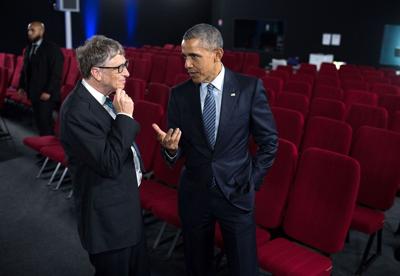
Bill Gates and Barack Obama Wikimedia
President Barack Obama talks with philanthropist and co-founder of Microsoft, Bill Gates following the mission innovation event at the United Nations Framework Convention on Climate Change (COP21), at the Parc des Expositions du Bourget in Le Bourget, Paris, France, Nov. 30, 2015. Photo: Pete Souza, Public domain, via Wikimedia Commons

Bill Gates, the Microsoft co-founder who has spent billions of his own money to raise the alarm about the dangers of climate change, is now pushing back against what he calls a “doomsday outlook” and appears to have shifted his stance on the risks posed by a warming planet.

In a lengthy memo released Tuesday, Gates sought to tamp down the alarmism he said many people use to describe the effects of rising temperatures. Instead, he called for redirecting efforts toward improving lives in the developing world.

“Although climate change will have serious consequences — particularly for people in the poorest countries — it will not lead to humanity’s demise,” he wrote. “People will be able to live and thrive in most places on Earth for the foreseeable future.”

Coming just four years after he published a book titled “How to Avoid a Climate Disaster,” Tuesday’s memo appears to amount to a major reframing of how Gates, who is worth an estimated $122 billion, is thinking about the challenges posed by a rapidly warming world.

Michael Oppenheimer, a professor of geosciences and international affairs at Princeton University, said Gates was setting up a false dichotomy “usually propagated by climate skeptics” that pits efforts to tackle climate change against foreign aid for the poor.

“Despite his efforts to make clear that he takes climate change seriously, his words are bound to be misused by those who would like nothing more than to destroy efforts to deal with climate change,” Oppenheimer said in an email.

In May, Gates announced plans to wind down the Gates Foundation, which has spent billions on climate-related issues, including a $1.4 billion commitment to help farmers in poor countries adapt to a hotter planet.

As the Trump administration has slashed foreign aid budgets and shuttered the U.S. Agency for International Development, Gates has redirected much of his charitable giving to fill the void left by the U.S. government and focus on health and poverty in the developing world.

“He saw the USAID situation as more pressing, and something where he could be more effective,” said Johannes Ackva, who leads climate work at Founders Pledge, an organization that advises philanthropists.

This article originally appeared in The New York Times.