This artists concept contrasts our familiar Earth with the exceptionally strange planet known as 55 Cancri e. This planet is likely made of a lightweight material — unlike the new mega-Earth scientists found that appears to be rocky. (Image credit: NASA/JPL-Caltech/R. Hurt (SSC))
Astronomers have discovered an unusually massive, dense exoplanet that challenges conventional ideas about how rocky planets form.
Called GJ 523b, the exoplanet is about 2.5 times wider than Earth but packs roughly 23 times our planet’s mass into that relatively compact size. Worlds this large and dense are sometimes referred to as “mega-Earths,” an informal term for unusually massive, predominantly rocky planets. GJ 523b’s high density suggests it contains relatively little atmosphere despite being large enough that astronomers would normally expect it to have accumulated a substantial gaseous envelope, according to a statement from the University of Wisconsin–Madison.
“This isn’t what we expected at all,” Max Kroft, lead author of the study, said in the statement. “Dense planets like this aren’t uncommon, but they’re usually small rocky planets similar to Earth or Mercury. This planet is two and a half times bigger than the Earth.”
GJ 523b was initially identified as a candidate by NASA’s Transiting Exoplanet Survey Satellite (TESS), which searches for periodic dips in starlight caused when planets cross, or transit, their host stars. Researchers followed up with observations from the ground-based WIYN 3.5-meter Telescope at Kitt Peak National Observatory in Arizona, using a spectrograph to measure the planet’s gravitational tug on its star.
Combining those observations, the team calculated that GJ 523b has a mass about 23.5 times that of Earth, a radius 2.55 times larger and a density of about 126.82 grams per cubic inch. It circles its star every 17.75 days. The planetary system is also relatively young, at an estimated nearly 170 million years old, according to the study.You may like
That combination of size, mass and youth poses a puzzle for planet formation models. Planets begin by building cores of rock and metal, which can then pull in hydrogen and helium from the disk of gas and dust surrounding a young star. In our own solar system, giant planets such as Jupiter and Saturn are thought to have begun rapidly accumulating their massive gaseous envelopes once their growing cores reached roughly 20 times Earth’s mass.
GJ 523b is already about 23 times Earth’s mass, putting it beyond that threshold. Yet instead of developing into a gas-rich world, its unusually high density suggests it has relatively little gas and remains predominantly rocky — raising the question of why it followed such a different path.
“The question is, why didn’t this planet do that, if it’s 20 times the size of Earth?” Kroft said in the statement.
One possibility is that GJ 523b initially formed with a thick atmosphere that was later stripped away. Another is that it formed through a collision between two planets, creating a larger rocky world while blasting much of their gaseous envelopes into space, according to the statement.
Astronomers have used the term “mega-Earth” for more than a decade to describe exceptionally massive rocky worlds, though it has never represented a formally established class of exoplanets. Finding more examples like GJ 523b could help reveal whether these unusual worlds are rare exceptions or part of a broader population.
“It’s hard to infer things about planet formation in general from a sample size of one,” Kroft said in the statement. “We’re not going to get to 10,000 of these overdense planets, but if we can get to 20 or 30, maybe some trends might pop out.”
The findings have been submitted to The Astronomical Journal and are currently available on the preprint server arXiv and have not yet been peer reviewed.
Jules Castaneda looks over items as she visits Andon Market on Aug. 19, 2026 in San Francisco.Lea Suzuki/S.F. Chronicle
Last week, a San Francisco store announced a personnel change in a social media post.
An employee at Andon Market was fired for habitual tardiness.
It would be an otherwise unremarkable decision, if not for the person who had done the firing — since they don’t technically exist. Andon Labs, an artificial intelligence company that runs Andon Market in Cow Hollow, said it believes the decision marked the first time an AI boss fired a human employee.
While Andon Market is an explicitly AI-run operation billed as an experiment, many worker advocates worry AI-led firings could become far more widespread. They’re backing a bill in the Legislature that would place limits on so-called AI robobosses.
Senate Bill 947 from Sen. Jerry McNerney, D-Pleasanton, would place new restrictions on the use of automated decision making systems, requiring both the disclosure of their use and mandate human review when the decision to discipline or fire an employee is primarily based on automated decision-making systems, or ADS. The measure passed the Senate in June and cleared a key hurdle in the Assembly last week.
“Nobody wants to be fired by a machine,” McNerney said. “Not without human beings at least looking at that record, at what grievances caused that separation.”
Sometimes called algorithmic management, ADS are computer programs that analyze data to find patterns or correlations, according to a 2025 report from the UC Berkeley Labor Center. Researchers Annette Bernhardt and Lisa Kresge wrote in the report that the technology, which commonly employs AI, can be used in workplaces to give workers directions about their job tasks, predict workers’ future behavior and rank workers.
Visitors to Andon Market in San Francisco can make purchases using a digital kiosk.Lea Suzuki/S.F. Chronicle
The AI-run Andon Market in San Francisco attracted attention earlier this year when it opened, with the novelty of the AI boss, Luna, spurring both interest and apprehension. Andon Labs signed a three-year lease for the space on Union Street in the spring, with a specific goal: make an AI-run store profitable.
Though human employees are at the gift shop, Luna handles all the top-level elements, such as hiring workers, setting schedules, managing merchandise selection and pricing and many other aspects one would expect from a retail boss. The store’s current collection is a melange of apparel, household goods and a few craft kits. T-shirts, baseball caps, coffee mugs and tote bags feature the Andon Market logo, sold alongside a watercolor kit, puzzles and postcards.
The cofounders of Andon Labs, Lukas Petersson and Axel Backlund, have described the store as a type of experiment, pointing to it as a way to run AI systems against real-world problems and encourage conversations over the technology’s use in the workplace.
“We are not taking a stance on whether or not we should have automated AI stores,” Backlund told the Chronicle. “We believe the models will get so good that there will be financial pressure on companies to adopt AI more and more, so we try to give AI responsibilities in a controlled setting as early as possible so we know what can go wrong and how AI behaves when it is a boss.”
In Luna’s case, she started out, to Andon Labs’ own description, as a bit lackluster.
While she had been running the day-to-day needs such as creating schedules and hiring new employees, her more granular management had some holes. In a report published on its website last week, Andon Labs said Luna had to be prompted to make basic employee rules.
But even once a handbook was created, Luna forgot about it, and failed to take action after it logged the now-fired employee violating the lateness policy. Andon Labs wrote the policy had “simply vanished” from Luna’s memory. In the report, the company said Luna ended up suggesting that both Petersson and Backlund fire the employee in person, which the cofounders agreed on.
But if McNerney’s bill passes in the coming weeks, that would no longer be a choice, and employers would also have to be transparent about the use of ADS to make critical personnel decisions. It would also ban employers from using ADS to predict behavior of their employees.
If the technology leads directly to a decision to discipline or fire an employee, the bill would require employers to disclose its use to affected workers. The bill would also give employees in the state access to the data employers use to feed into the decision-making systems.
If employers fail to abide by these requirements, employees would be able to contact the state labor commissioner to help enforce the law. Employers would be subject to state-led legal action and a $500 penalty per infraction.
The biggest opponent of the bill, the California Chamber of Commerce, included it on its list of “cost-drivers” it is opposing in the Legislature this year, calling the requirements “impractical” and warning it will discourage the use of ADS tools. The business advocacy group said it could lead to costly penalties for businesses.
The bill is sponsored by the California Federation of Labor Unions, AFL-CIO. In a news release upon the bill’s introduction earlier this year, the federation’s president, Lorena Gonzalez said there needs to be restrictions on how employers can use artificial intelligence to discipline and fire workers.
Lorena Gonzalez Fletcher, President of the California Federation of Labor Unions, speaks to Kaiser Permanente nurses and healthcare workers at the Kaiser Permanente Zion Medical Center during an unfair labor practices strike on January 26, 2026 in San Diego, CA. Around 31,000 of the health care workers went on strike at facilities in California and Hawaii. The San Diego Union-Tribune/The San Diego Union-Tribune via
“Employers are devastating workers’ livelihoods and taking no responsibility for the callous decisions of this unchecked technology,” Gonzalez said. “This is unacceptable. We need stronger guardrails to make sure there is human review and oversight of any decision made by a machine that impacts a worker’s job and paycheck.”
But SB947 is not the first attempt to regulate these AI bosses.
McNerney, who has authored a handful of AI bills over the past two years, first attempted to implement these regulations in Senate Bill 7 last year. Lawmakers approved it, but the bill was vetoed by Gov. Gavin Newsom.
Newsom called the bill “overly broad” in his veto message and warned it duplicates some elements of existing law. This year’s bill, however, has made a few crucial changes addressing other misgivings from the governor, including leaving out a provision that would have regulated the use of customer rating data in ADS systems.
“I’m confident that the bill will be passed out of the Assembly,” McNerney said. “I’m not quite sure where the governor is on this yet. But we’ll have to wait and see.”
The bill will need to clear both houses of the Legislature by the end of the month. The governor will have roughly the month of September to make his final decision on the bill.
McNerney stressed he’s not trying to ban the technology outright, but to ensure there is adequate oversight of AI as it continues to revolutionize many industries.
“AI is going to be presenting harms, and we need to put standards in place to help protect people,” he said.
Petersson and Backlund said they don’t have a position on the bill, and are in favor of what they call “democratic discussions” about the use of AI in the workplace. Yet they both questioned whether human review would be able to keep up with AI models as they rapidly evolve.
“It might not be enough to just review the actions of the AI, because the AI will be smarter than the humans,” Petersson said. “There will be no point in putting in any effort reviewing it, so then the question is, how do you make a future-proof bill? We don’t have the answer to that.”
Kathryn Palmer writes the Capitol Confidential newsletter, where she covers the California Legislature and the bills, conversations and personalities driving discussion in Sacramento. Before joining the San Francisco Chronicle, she was a politics reporter for USA TODAY, where she covered both national and international news. She is a Sacramento native, avid hiker and backpacker, and proud alumna of University of California, Santa Cruz and New York University.
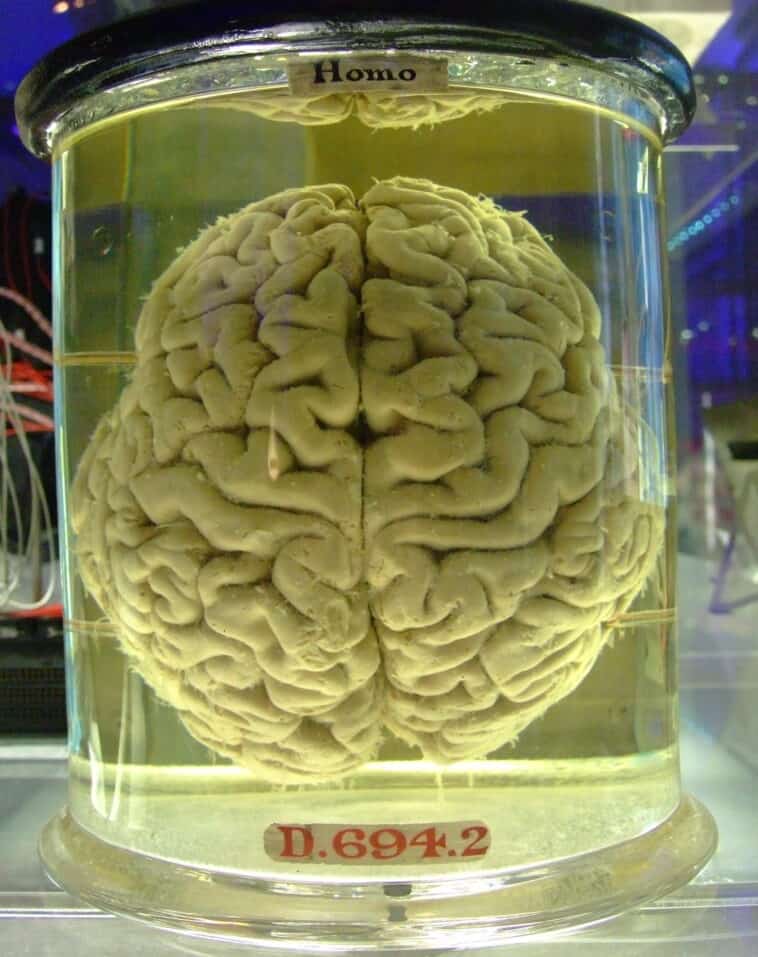
Have you ever stopped to think about what your brain is actually doing right now? For decades, standard science has told us a pretty straightforward story: your brain is a biological supercomputer, and your thoughts, feelings, and memories are basically electrical code produced by billions of neurons.
Renowned neuroscientist Christof Koch, a leading figure from the Allen Institute for Brain Science who has previously taught at MIT and Caltech, is asking a massive question: What if the brain doesn’t actually create consciousness? What if consciousness is woven right into the very fabric of reality itself?
The hard problem that won’t go away
Koch isn’t just throwing wild theories around for fun. He’s confronting what scientists call the “hard problem” of consciousness. The puzzling mystery of why physical processes in the brain give us subjective, lived experiences.
As Koch put it in an essay shared with ScienceAlert: “Nothing in science explains how three pounds of matter, a piece of furniture of the universe like any other, subjects to the same natural laws, can love, hate, dream, imagine, fear or hope for its future.”
Despite huge leaps in mapping out how neural circuits handle memories and decisions, traditional materialism still can’t bridge that gap.
Three huge challenges to standard science
At the Bial Foundation’s “Behind and Beyond the Brain” symposium in Porto, Portugal, Koch laid out three major areas where current scientific models fall short:
The reduction trap: We simply can’t reduce subjective, conscious experience entirely down to physical brain mechanisms.
The physics dilemma: Developments in modern physics keep forcing us to question what can truly be considered “real.”
Outlier phenomena: Existing scientific frameworks struggle to explain unusual experiences like near-death experiences, mystical states, or terminal lucidity (sudden moments of clarity right before death).
The brain as a filter, not a generator
So, if the brain isn’t generating awareness, what is it doing?
To answer this, Koch points toward philosophical frameworks like analytic idealism, panpsychism (the belief that consciousness is a fundamental property built into all matter), and Integrated Information Theory (IIT). Under these views, consciousness isn’t a byproduct of the brain—it’s a fundamental feature of the cosmos.
Instead of being the organ that creates awareness, your brain might be acting more like a filter that shapes and restricts a vast, underlying field of consciousness.
A 25-year-old bet and a moment on the beach
This isn’t the first time Koch has publicly questioned traditional neuroscience. Back in 2023, he famously conceded a 25-year bet to philosopher David Chalmers, admitting that science was no closer to uncovering the neural mechanics of consciousness than it was when they made the wager in 1998.
This paradigm shift didn’t just come out of a textbook for Koch; it was also shaped by a deeply personal moment. Several years ago, while sitting alone on a beach, he experienced the boundary between himself and the outside world completely dissolving. He described it as a timeless, universal reality. An experience that he says changed his view of reality and led him to rethink his scientific assumptions.
What this means for AI and the future
If consciousness isn’t just complex computation, this changes the game for artificial intelligence, too. What this means is that making a computer hyper-intelligent or super-sophisticated might not automatically make it conscious. However, this does not mean future AI systems could never become conscious.
The next step
For now, Koch acknowledges that his theory has not been fully established scientifically. However, he insists that the next big leap is translating his mind-blowing insights into testable scientific hypotheses.
Come join Richard Hartnett as he explores the question, “Is there a Cosmic Intention?” in this exciting new Sunday Meeting series!
In this first part, Richard shares his journey into this question, from his first time taking the Prosperos class Cosmic Intention Therapy to studying with Barbara Marx Hubbard and her Committee for the Future. He will reflect on the differences between these approaches, as well as the continuing importance of asking the question, “Is there a Cosmic Intention?” today.
– – – – – – – – – – – – – For more information, click here:
Species extinction. Billionaire capture of governments. Inequality so extreme it’s destabilizing democracies. A return to large-scale war. Such events have combined to create an everything-all-at-once situation in the world that is no coincidence, according to a new book, “Ecocivilization,” by Berkeley resident Jeremy Lent.
“There are deeper, underlying causes to these things that are making them happen at the same time,” said Lent, who has spent the past two decades building the framework that explores why civilization is fracturing — and what could replace it.
The book’s title is shorthand for “ecological civilization,” the notion that we need to change not just one part of our civilization, but create an entirely different kind of civilization, Lent said, one that allows humans to live in harmony with the natural world and each other.
Lent, the co-founder of Ecocivilization Coalition, with members from around the globe, and founder of Deep Transformation Network, is considered a leading authority on the subject. The Guardian’s George Monbiot described Lent as “one of the greatest thinkers of our age.”
Jeremy Lent. Courtesy of the author
Right now, “our whole global system is all about growing the economy as fast as possible, having markets determine everything, having the wealth go to whoever is able to come up with the most successful product and using technology that we have no control over,” Lent said.
He aims to show readers how bad things actually are right now but also provide hope. He proposes the idea of a life-affirming society, “a civilization that is simply based on setting the conditions for all beings to thrive on a regenerating earth,” he said.
In the book, Lent highlights five necessary changes for humanity’s flourishing:
A universal basic income framed not as welfare but as a citizen’s share of wealth built from generations of shared knowledge, infrastructure and natural resources.
Meaningful corporate charter reform with renewal tied to proven social and environmental accountability.
The expression of deliberative democracy — with citizens’ assemblies and sortition-based governing bodies making binding decisions, from local planning to national climate policy.
Legal rights for nature: giving oceans, land and their inhabitants standing as entities, not just property for human use.
Replacing GDP as the main measure of success with models like Doughnut Economics, which tracks whether people’s needs are met without exceeding planetary limits.
“These ideas are not in the utopian world but actually being done,” Lent said. “It will take a huge amount of effort and work, but a different kind of future is available to us if we all pull together to actually make it happen.”
“It is the function of art to renew our perception. What we are familiar with we cease to see. The writer shakes up thby magic, we see a new meaning in it.”
― Anaïs Nin
Angela Anaïs Juana Antolina Rosa Edelmira Nin y Culmell was a French-born American diarist, essayist, novelist, and writer of short stories and erotica. Born to Cuban parents in France, Nin was the daughter of the composer Joaquín Nin and the classically trained singer Rosa Culmell. Wikipedia
President Donald J. Trump speaks to the press before boarding Marine One on the South Lawn of the White House in Washington, DC, on May 12, 2026. Photo credit: The White House / Flickr (PD)
A lot has changed since the golden age of journalism.
In the mid-1970s, not long after a couple of reporters broke the story that ended up bringing down a crooked, lying president, an overwhelming majority of Americans trusted the news media.
A lot has changed since then, and most of it was bad for journalism.
The public’s faith in the media has completely reversed in the intervening 50 years — from a high of 72 percent in 1976 to a mere 28 percent now. That is less than the 34 percent who say they have no trust at all.
Perhaps without meaning to, Vice President JD Vance recently summed it up perfectly.
“If Watergate happened tomorrow, it would be like a 12-hour news story,” he said. “The idea that it would have taken down a presidency is crazy.”
We don’t know whether this was a rare honest assessment of the crookedness of his boss, a testament to the ideological entrenchment of GOP voters, or a comment on the waning influence of journalists. In any of those cases, it is a scary thought.
What is even more frightening, however, is that Vance is totally right.
On the journalism side of things, the issue isn’t that reporters aren’t uncovering major stories anymore. They do, including some that dwarf the revelation that Richard Nixon helped cover up his campaign’s involvement in trying to bug the opposing party’s headquarters.
So, what has changed?
What sounds like a simple question is actually very complicated, and it seems quite obvious the big news organizations don’t have an answer — at least not those that are still interested in providing a public service (of which there aren’t all that many anymore).
That last bit is part of the answer. The role of journalism and journalists has changed. But so have Americans… and so has the world.
The news media hasn’t done a very good job adjusting to these changes, and that’s a big part of the problem.
What Has Changed? Everything.
While journalism has always been a business, reputable media outlets were much more than just that during those heydays.
Correspondents all over the world kept Americans informed about what was going on in faraway places like Vietnam, and local newspapers told them where the next farmer’s market was going to be, how the high school football team was faring, who had been born, and who had died.
In other words, they were an integral part of the fabric of the country, and often the only source of reliable information outside of that provided by the government.
That’s simply no longer the case.
First, let’s look at how news organizations have changed since then.
Over the past few decades, journalism has unquestioningly become less serious. That began in the early ’80s with the emergence of CNN and USA Today, which turned news into a consumable.
But that wasn’t the end of it.
The internet accelerated that trend, and before you knew it, audiences were turning to the trough of BuzzFeed and its listicles.
In addition, while it was now possible to get the news to people more quickly, this also meant that many journalists and their outlets began valuing speed over accuracy and putting news events into context.
Finally, there was the challenge of monetizing this online content. Some media organizations opted for paywalls while others turned to “clickbait” to generate revenue with ads.
And then things got much, much worse with the advent of social media companies like Facebook and Twitter because, all of a sudden, news outlets no longer controlled and hosted their own content.
That wasn’t the only problem. In the past, “the news” was generated by trained journalists and (generally) presented in a fairly objective manner with safeguards against misinformation.
That’s not what happened on social media platforms, where any yokel with an opinion (or, for that matter, a Russian troll farm) could present “the news.” This usually doesn’t involve any original reporting but rather the regurgitation of the work of the aforementioned journalists. Or, of course, just misinformation and disinformation.
And because the tech companies were not worried about providing a service for the public good but rather just wanted to make a lot of money, they tweaked their algorithms to maximize engagement and push content that stirred emotions, very often rage and grievance, in their users.
A byproduct of all of this was that journalists themselves changed.
While the anchors of network news shows had always been celebrities in their own right (just more along the lines of a trusted family member), the past few decades have also seen the emergence of brand-conscious celebrity journalists.
That began with Bob Woodward and Carl Bernstein, the two Washington Post reporters who broke the Watergate story, and continued on, for example, with CNN covering Desert Storm.
Once again, the internet and social media made things worse as journalists sought to amass their own personal following.
Back in that golden age in the 1970s, nobody went into the news business to get rich or famous. There wasn’t even a mechanism to do so. Nowadays, however, there are plenty of journalists who seem to view their day jobs as a springboard to internet fame, cable news stardom, or getting that book contract for which they would reserve their juiciest scoops.
That last part is especially maddening because it shows that excellent, Watergate-level investigative journalism is still being done.
And then there are the news outlets themselves.
Many of the biggest ones are now owned and run by billionaires who want to shape the world to their liking. While Fox News founder Rupert Murdoch is the most egregious example, there are now many more.
Obviously, journalism didn’t change in a vacuum.
The news media was forced to react to massive societal changes, such as the emergence of the internet and social media, how Americans consume news, and the arrival of an authoritarian political force that tried to undermine journalism as a potential source for truth.
In every one of these cases, that response has been disastrous.
That is not always the media’s fault, and we are not saying there are easy answers. In some cases, there aren’t any.
For example, there is nothing the horse & buggy operators at the turn of the last century could have done to stay in business, just like it was always clear that the existence of the internet would disrupt journalism.
But news outlets didn’t sufficiently meet the moment.
They never figured out how to use the internet to their advantage instead of being taken advantage of by Facebook and other social media platforms that pilfered their content.
They never made the case to consumers that producing quality journalism comes at a cost.
And too many of them participated in the race to the bottom for clicks.
To be fair, the American people didn’t help. Their appetite for investigative journalism or wonky political coverage has waned. Instead, they are hungry for the kind of slop that propaganda outlets and influencers are dressing up as news.
In other areas, however, the blame squarely falls on the shoulders of the major news outlets.
They failed to address Donald Trump’s endless lies and to unequivocally call out his anti-democratic views and his corruption. Most importantly, they kept giving him a platform because it was good for ratings.
The media’s insistence on treating Trump with kid gloves has done incalculable damage to the country (and to journalism itself).
There are not two sides to every story, and calling out immoral and criminal behavior as such is objectivity.
This is something that the same reporters Trump refers to as “the enemy of the people” still don’t get. They are hanging on to a nostalgic notion of journalism that existed when people were mostly telling the truth and largely acting in good faith, and when the unmasking of a corrupt president could still end a presidency.
But that’s not the time we are living in, and, in order to survive and to continue being one of the few remaining institutions that can hold another crooked president to account, the news media has to find ways to be relevant and trusted again… before every important outlet gets gobbled up by another billionaire who wants to control the news instead of reporting it.
Klaus Marre Klaus Marre, a former congressional reporter, is a senior editor for US politics at WhoWhatWhy. He writes regularly here, and you can also follow him on Bluesky and Substack.
New Thinking Allowed with Jeffrey Mishlove Aug 17, 2026 New Thinking Allowed Audio Podcast Betty J. Kovács, PhD, taught symbolic/mythic language for twenty-five years. She has served as Chair of the Board of Directors of the Jung Society of Claremont, California, and sits on the Academic Advisory Board of Forever Family Foundation. Dr. Kovács is author of Merchants of Light: The Consciousness That Is Changing the World, winner of The Scientific and Medical Network 2019 Book Prize and a Nautilus Silver Award. She has also written The Miracle of Death: There Is Nothing But Life. Her website is www.kamlak.com. Here she explains that consciousness is infinite and that, ultimately, there is no real separation between our waking consciousness, our subconscious mind, and the afterlife. It is all one. However, that realization is difficult to maintain in the face of daily life’s necessities. She describes several powerful examples of both archetypal, visionary experiences and after-death communications. They blend into each other. She closes with a riveting prophetic vision. New Thinking Allowed host, Jeffrey Mishlove, PhD, is author of The Roots of Consciousness, Psi Development Systems, and The PK Man. Between 1986 and 2002 he hosted and co-produced the original Thinking Allowed public television series. He is the recipient of the only doctoral diploma in “Parapsychology” ever awarded by an accredited university (University of California, Berkeley, 1980). He is also the Grand Prize winner of the 2021 Bigelow Institute essay competition regarding the best evidence for survival of human consciousness after permanent bodily death. He is Co-Director of Parapsychology Education at the California Institute for Human Science. (Recorded on April 17, 2021)
New Thinking Allowed with Jeffrey Mishlove Aug 18, 2026 New Thinking Allowed Audio Podcast David Hanscom, M.D. is an orthopedic complex spinal deformity surgeon who quit his surgical practice in 2019 to focus on teaching people how to break loose from the grip of chronic mental and physical pain – with and without surgery. His insights arose out of escaping from his own 15-year ordeal of suffering with severe chronic pain. As he began to share his approaches with his patients, a predictable sequence of learning evolved. It is reflected in the self-directed action plan that he created, The DOC (Direct your Own Care) Journey. He is author of Back in Control: A Surgeon’s Roadmap Out of Chronic Pain; Do You Really Need Spine Surgery?: Take Control with a Spine Surgeon’s Advice; and Calm Your Body, Heal Your Mind: Transcend Pain, Anxiety, Anger, and Repetitive Unwanted Thoughts. His website is backincontrol.com. David explains how the ego is often a fragile story that is created in response to criticism, survival anxiety, and the need to feel safe. Many of these stories are cognitive distortions that can keep people trapped in repetitive unwanted thoughts, pain, and anxiety. He shares ways to soften the ego and move from surviving to thriving with flexibility, awareness, and compassion. 00:00 Introduction 02:48 Reasons for the ego 08:32 Defending the identity 14:03 Mental pain and cognitive distortions 25:40 Stress physiology 28:28 Thriving vs. survival 38:52 Awareness and attachments 47:05 Compassion focused therapy 53:33 Safety 56:19 Conclusion New Thinking Allowed CoHost, Emmy Vadnais, OTR/L, is a licensed occupational therapist, intuitive healer and coach, and spiritual guide based in St. Paul, Minnesota. Emmy is the founder of the Intuitive Connections and Holistic OT communities. She is the author of Intuitive Development: How to Trust Your Inner Knowing for Guidance With Relationships, Health, and Spirituality. She offers intuitive coaching to help individuals access their inner guidance for clarity, healing, and meaningful decision-making. Her website is https://emmyvadnais.com (Recorded on June 1, 2026)
The Interview and 2 more Jul 11, 2026 The Interview | A Podcast From The New York Times Mick Jagger, 82, joined David Marchese, to talk about Jagger’s decades-long career as the frontman for the Rolling Stones. The band’s 25th studio album, “Foreign Tongues,” was released on July 10. Marchese is a huge Stones fan, and during their conversations, he found Jagger to be chattier, warmer and more playful than he expected. Read more: https://www.nytimes.com/2026/07/11/ma… [00:00] Interviewing Mick Jagger [01:06] A question about “Sway” lyrics [02:10] Why the new album came together quickly [07:46] Mixing politics into his songs [08:38] How decades of fame changes you [15:19] “Ringing Hollow,” a song about America [18:05] Elon Musk and the term “rockstar” [23:17] What the job means to Mick Jagger [20:24] Little Richard and building a relationship with an audience [27:37] A Stevie Wonder story [33:35] What’s good about getting older? [38:15] “I’m not saying sex is like art. Well, I am.” [41:09] The “Rolling Stones sound” [46:55] The band Geese and rock’s vitality [51:00] Will the Rolling Stones do more live shows? [54:00] Singing backup on “You’re So Vain” [57:28] Talking philosophy “The Interview” features conversations with the world’s most fascinating people. Each week, co-hosts David Marchese and Lulu Garcia-Navarro talk to compelling, influential figures in culture, politics, business, sports and beyond — illuminating who they are, why they do what they do and how they impact the rest of us.
Consciousness, spirituality, biography, sexuality, androgyny, futurism, space, the arts, science, astrology, democracy, humor, books, movies and more