
 SUNDAY MEETING — AUGUST 23 |
 “Exploring Cosmic Intention” with Richard Hartnett, H.W., M. Come join Richard Hartnett as he explores the question, “Is there a Cosmic Intention?” in this exciting new Sunday Meeting series! In this first part, Richard shares his journey into this question, from his first time taking the Prosperos class Cosmic Intention Therapy to studying with Barbara Marx Hubbard and her Committee for the Future. He will reflect on the differences between these approaches, as well as the continuing importance of asking the question, “Is there a Cosmic Intention?” today. – – – – – – – – – – – – – For more information, click here: https://www.theprosperos.org/prosperos-events/cosmos-part1-yn4a7 SUNDAY MEETING August 23, 2026 11:00 am Pacific / Noon Mountain / 1:00 pm Central / 2:00 pm Eastern PLEASE CLICK ON THE JOIN BUTTON BELOW FOR MEETING Join Sunday Meeting By contribution. Please click here to contribute: Contribute! Call In Information:One tap mobile +16699006833,,85882863391# US (San Jose) +16694449171,,85882863391# US — Meeting ID: 858 8286 3391 Find your local number: https://us02web.zoom.us/u/kdTAYZq0XQ |
| Copyright © 2026 The Prosperos, All rights reserved. |
Book: “Ecocivilization: Making a World that Works for All”
“Ecocivilization: Making a World that Works for All” by Jeremy Lent
Melville House, 400 pages, $33

Species extinction. Billionaire capture of governments. Inequality so extreme it’s destabilizing democracies. A return to large-scale war. Such events have combined to create an everything-all-at-once situation in the world that is no coincidence, according to a new book, “Ecocivilization,” by Berkeley resident Jeremy Lent.
“There are deeper, underlying causes to these things that are making them happen at the same time,” said Lent, who has spent the past two decades building the framework that explores why civilization is fracturing — and what could replace it.
The book’s title is shorthand for “ecological civilization,” the notion that we need to change not just one part of our civilization, but create an entirely different kind of civilization, Lent said, one that allows humans to live in harmony with the natural world and each other.
Lent, the co-founder of Ecocivilization Coalition, with members from around the globe, and founder of Deep Transformation Network, is considered a leading authority on the subject. The Guardian’s George Monbiot described Lent as “one of the greatest thinkers of our age.”

Right now, “our whole global system is all about growing the economy as fast as possible, having markets determine everything, having the wealth go to whoever is able to come up with the most successful product and using technology that we have no control over,” Lent said.
He aims to show readers how bad things actually are right now but also provide hope. He proposes the idea of a life-affirming society, “a civilization that is simply based on setting the conditions for all beings to thrive on a regenerating earth,” he said.
In the book, Lent highlights five necessary changes for humanity’s flourishing:
- A universal basic income framed not as welfare but as a citizen’s share of wealth built from generations of shared knowledge, infrastructure and natural resources.
- Meaningful corporate charter reform with renewal tied to proven social and environmental accountability.
- The expression of deliberative democracy — with citizens’ assemblies and sortition-based governing bodies making binding decisions, from local planning to national climate policy.
- Legal rights for nature: giving oceans, land and their inhabitants standing as entities, not just property for human use.
- Replacing GDP as the main measure of success with models like Doughnut Economics, which tracks whether people’s needs are met without exceeding planetary limits.
“These ideas are not in the utopian world but actually being done,” Lent said. “It will take a huge amount of effort and work, but a different kind of future is available to us if we all pull together to actually make it happen.”
Anaïs Nin on art

“It is the function of art to renew our perception. What we are familiar with we cease to see. The writer shakes up thby magic, we see a new meaning in it.”
― Anaïs Nin
Angela Anaïs Juana Antolina Rosa Edelmira Nin y Culmell was a French-born American diarist, essayist, novelist, and writer of short stories and erotica. Born to Cuban parents in France, Nin was the daughter of the composer Joaquín Nin and the classically trained singer Rosa Culmell. Wikipedia
Born: February 21, 1903, Neuilly-sur-Seine, France
Died: January 14, 1977
~ Anais Nin
The Media Is Licking Its Wounds, Many of Which Are Self-Inflicted

Klaus Marre 08/18/26 (WhoWhatWhy.org)
A lot has changed since the golden age of journalism.

In the mid-1970s, not long after a couple of reporters broke the story that ended up bringing down a crooked, lying president, an overwhelming majority of Americans trusted the news media.
A lot has changed since then, and most of it was bad for journalism.
The public’s faith in the media has completely reversed in the intervening 50 years — from a high of 72 percent in 1976 to a mere 28 percent now. That is less than the 34 percent who say they have no trust at all.
Perhaps without meaning to, Vice President JD Vance recently summed it up perfectly.
“If Watergate happened tomorrow, it would be like a 12-hour news story,” he said. “The idea that it would have taken down a presidency is crazy.”
We don’t know whether this was a rare honest assessment of the crookedness of his boss, a testament to the ideological entrenchment of GOP voters, or a comment on the waning influence of journalists. In any of those cases, it is a scary thought.
What is even more frightening, however, is that Vance is totally right.
On the journalism side of things, the issue isn’t that reporters aren’t uncovering major stories anymore. They do, including some that dwarf the revelation that Richard Nixon helped cover up his campaign’s involvement in trying to bug the opposing party’s headquarters.
So, what has changed?
What sounds like a simple question is actually very complicated, and it seems quite obvious the big news organizations don’t have an answer — at least not those that are still interested in providing a public service (of which there aren’t all that many anymore).
That last bit is part of the answer. The role of journalism and journalists has changed. But so have Americans… and so has the world.
The news media hasn’t done a very good job adjusting to these changes, and that’s a big part of the problem.
What Has Changed? Everything.
While journalism has always been a business, reputable media outlets were much more than just that during those heydays.
Correspondents all over the world kept Americans informed about what was going on in faraway places like Vietnam, and local newspapers told them where the next farmer’s market was going to be, how the high school football team was faring, who had been born, and who had died.
In other words, they were an integral part of the fabric of the country, and often the only source of reliable information outside of that provided by the government.
That’s simply no longer the case.
First, let’s look at how news organizations have changed since then.
Over the past few decades, journalism has unquestioningly become less serious. That began in the early ’80s with the emergence of CNN and USA Today, which turned news into a consumable.
But that wasn’t the end of it.
The internet accelerated that trend, and before you knew it, audiences were turning to the trough of BuzzFeed and its listicles.
In addition, while it was now possible to get the news to people more quickly, this also meant that many journalists and their outlets began valuing speed over accuracy and putting news events into context.
Finally, there was the challenge of monetizing this online content. Some media organizations opted for paywalls while others turned to “clickbait” to generate revenue with ads.
And then things got much, much worse with the advent of social media companies like Facebook and Twitter because, all of a sudden, news outlets no longer controlled and hosted their own content.
That wasn’t the only problem. In the past, “the news” was generated by trained journalists and (generally) presented in a fairly objective manner with safeguards against misinformation.
That’s not what happened on social media platforms, where any yokel with an opinion (or, for that matter, a Russian troll farm) could present “the news.” This usually doesn’t involve any original reporting but rather the regurgitation of the work of the aforementioned journalists. Or, of course, just misinformation and disinformation.
And because the tech companies were not worried about providing a service for the public good but rather just wanted to make a lot of money, they tweaked their algorithms to maximize engagement and push content that stirred emotions, very often rage and grievance, in their users.
A byproduct of all of this was that journalists themselves changed.
While the anchors of network news shows had always been celebrities in their own right (just more along the lines of a trusted family member), the past few decades have also seen the emergence of brand-conscious celebrity journalists.
That began with Bob Woodward and Carl Bernstein, the two Washington Post reporters who broke the Watergate story, and continued on, for example, with CNN covering Desert Storm.
Once again, the internet and social media made things worse as journalists sought to amass their own personal following.
Back in that golden age in the 1970s, nobody went into the news business to get rich or famous. There wasn’t even a mechanism to do so. Nowadays, however, there are plenty of journalists who seem to view their day jobs as a springboard to internet fame, cable news stardom, or getting that book contract for which they would reserve their juiciest scoops.
That last part is especially maddening because it shows that excellent, Watergate-level investigative journalism is still being done.
And then there are the news outlets themselves.
Many of the biggest ones are now owned and run by billionaires who want to shape the world to their liking. While Fox News founder Rupert Murdoch is the most egregious example, there are now many more.
Obviously, journalism didn’t change in a vacuum.
The news media was forced to react to massive societal changes, such as the emergence of the internet and social media, how Americans consume news, and the arrival of an authoritarian political force that tried to undermine journalism as a potential source for truth.
In every one of these cases, that response has been disastrous.
That is not always the media’s fault, and we are not saying there are easy answers. In some cases, there aren’t any.
For example, there is nothing the horse & buggy operators at the turn of the last century could have done to stay in business, just like it was always clear that the existence of the internet would disrupt journalism.
But news outlets didn’t sufficiently meet the moment.
They never figured out how to use the internet to their advantage instead of being taken advantage of by Facebook and other social media platforms that pilfered their content.
They never made the case to consumers that producing quality journalism comes at a cost.
And too many of them participated in the race to the bottom for clicks.
To be fair, the American people didn’t help. Their appetite for investigative journalism or wonky political coverage has waned. Instead, they are hungry for the kind of slop that propaganda outlets and influencers are dressing up as news.
In other areas, however, the blame squarely falls on the shoulders of the major news outlets.
They failed to address Donald Trump’s endless lies and to unequivocally call out his anti-democratic views and his corruption. Most importantly, they kept giving him a platform because it was good for ratings.
The media’s insistence on treating Trump with kid gloves has done incalculable damage to the country (and to journalism itself).
There are not two sides to every story, and calling out immoral and criminal behavior as such is objectivity.
This is something that the same reporters Trump refers to as “the enemy of the people” still don’t get. They are hanging on to a nostalgic notion of journalism that existed when people were mostly telling the truth and largely acting in good faith, and when the unmasking of a corrupt president could still end a presidency.
But that’s not the time we are living in, and, in order to survive and to continue being one of the few remaining institutions that can hold another crooked president to account, the news media has to find ways to be relevant and trusted again… before every important outlet gets gobbled up by another billionaire who wants to control the news instead of reporting it.
- Klaus Marre Klaus Marre, a former congressional reporter, is a senior editor for US politics at WhoWhatWhy. He writes regularly here, and you can also follow him on Bluesky and Substack.
The Afterlife and the Unconscious with Betty Kovács
New Thinking Allowed with Jeffrey Mishlove Aug 17, 2026 New Thinking Allowed Audio Podcast Betty J. Kovács, PhD, taught symbolic/mythic language for twenty-five years. She has served as Chair of the Board of Directors of the Jung Society of Claremont, California, and sits on the Academic Advisory Board of Forever Family Foundation. Dr. Kovács is author of Merchants of Light: The Consciousness That Is Changing the World, winner of The Scientific and Medical Network 2019 Book Prize and a Nautilus Silver Award. She has also written The Miracle of Death: There Is Nothing But Life. Her website is www.kamlak.com. Here she explains that consciousness is infinite and that, ultimately, there is no real separation between our waking consciousness, our subconscious mind, and the afterlife. It is all one. However, that realization is difficult to maintain in the face of daily life’s necessities. She describes several powerful examples of both archetypal, visionary experiences and after-death communications. They blend into each other. She closes with a riveting prophetic vision. New Thinking Allowed host, Jeffrey Mishlove, PhD, is author of The Roots of Consciousness, Psi Development Systems, and The PK Man. Between 1986 and 2002 he hosted and co-produced the original Thinking Allowed public television series. He is the recipient of the only doctoral diploma in “Parapsychology” ever awarded by an accredited university (University of California, Berkeley, 1980). He is also the Grand Prize winner of the 2021 Bigelow Institute essay competition regarding the best evidence for survival of human consciousness after permanent bodily death. He is Co-Director of Parapsychology Education at the California Institute for Human Science. (Recorded on April 17, 2021)
Mental Rigidity and the Hidden Ego with David Hanscom
New Thinking Allowed with Jeffrey Mishlove Aug 18, 2026 New Thinking Allowed Audio Podcast David Hanscom, M.D. is an orthopedic complex spinal deformity surgeon who quit his surgical practice in 2019 to focus on teaching people how to break loose from the grip of chronic mental and physical pain – with and without surgery. His insights arose out of escaping from his own 15-year ordeal of suffering with severe chronic pain. As he began to share his approaches with his patients, a predictable sequence of learning evolved. It is reflected in the self-directed action plan that he created, The DOC (Direct your Own Care) Journey. He is author of Back in Control: A Surgeon’s Roadmap Out of Chronic Pain; Do You Really Need Spine Surgery?: Take Control with a Spine Surgeon’s Advice; and Calm Your Body, Heal Your Mind: Transcend Pain, Anxiety, Anger, and Repetitive Unwanted Thoughts. His website is backincontrol.com. David explains how the ego is often a fragile story that is created in response to criticism, survival anxiety, and the need to feel safe. Many of these stories are cognitive distortions that can keep people trapped in repetitive unwanted thoughts, pain, and anxiety. He shares ways to soften the ego and move from surviving to thriving with flexibility, awareness, and compassion. 00:00 Introduction 02:48 Reasons for the ego 08:32 Defending the identity 14:03 Mental pain and cognitive distortions 25:40 Stress physiology 28:28 Thriving vs. survival 38:52 Awareness and attachments 47:05 Compassion focused therapy 53:33 Safety 56:19 Conclusion New Thinking Allowed CoHost, Emmy Vadnais, OTR/L, is a licensed occupational therapist, intuitive healer and coach, and spiritual guide based in St. Paul, Minnesota. Emmy is the founder of the Intuitive Connections and Holistic OT communities. She is the author of Intuitive Development: How to Trust Your Inner Knowing for Guidance With Relationships, Health, and Spirituality. She offers intuitive coaching to help individuals access their inner guidance for clarity, healing, and meaningful decision-making. Her website is https://emmyvadnais.com (Recorded on June 1, 2026)
Mick Jagger Can’t Name One Good Thing About Getting Older | The Interview
The Interview and 2 more Jul 11, 2026 The Interview | A Podcast From The New York Times Mick Jagger, 82, joined David Marchese, to talk about Jagger’s decades-long career as the frontman for the Rolling Stones. The band’s 25th studio album, “Foreign Tongues,” was released on July 10. Marchese is a huge Stones fan, and during their conversations, he found Jagger to be chattier, warmer and more playful than he expected. Read more: https://www.nytimes.com/2026/07/11/ma… [00:00] Interviewing Mick Jagger [01:06] A question about “Sway” lyrics [02:10] Why the new album came together quickly [07:46] Mixing politics into his songs [08:38] How decades of fame changes you [15:19] “Ringing Hollow,” a song about America [18:05] Elon Musk and the term “rockstar” [23:17] What the job means to Mick Jagger [20:24] Little Richard and building a relationship with an audience [27:37] A Stevie Wonder story [33:35] What’s good about getting older? [38:15] “I’m not saying sex is like art. Well, I am.” [41:09] The “Rolling Stones sound” [46:55] The band Geese and rock’s vitality [51:00] Will the Rolling Stones do more live shows? [54:00] Singing backup on “You’re So Vain” [57:28] Talking philosophy “The Interview” features conversations with the world’s most fascinating people. Each week, co-hosts David Marchese and Lulu Garcia-Navarro talk to compelling, influential figures in culture, politics, business, sports and beyond — illuminating who they are, why they do what they do and how they impact the rest of us.
Quote Of The Day By Hypatia: ‘Reserve Your Right To Think, For Even To Think Wrongly Is Better Than Not to Thank at All’
By Lauren Waters Aug. 17, 2026 (thelist.com)
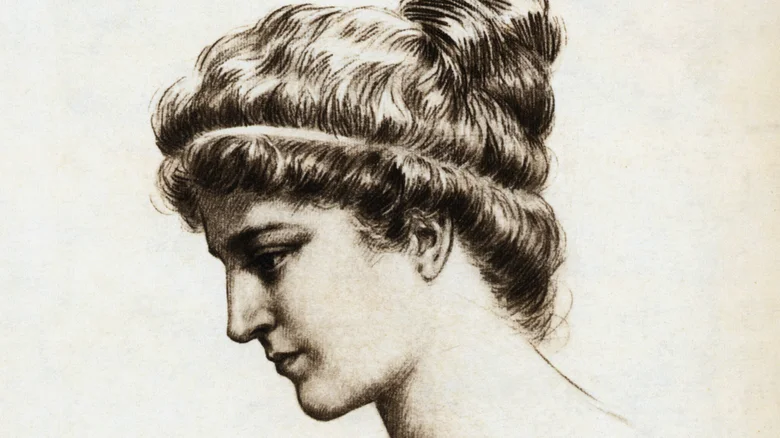
Bettmann/Getty Images
When thinking about the most famous philosophers over the course of history, the majority of the well-known figures are men. Some women’s voices managed to emerge despite the odds being stacked against them. One of those voices was Hypatia, a famous philosopher, as well as an astronomer, mathematician, and teacher during the Roman Empire. Hypatia was born around 355 CE in Alexandria, Egypt and was the daughter of fellow famous philosopher and mathematician Theon of Alexandria.
The importance of every individual’s right to think freely and form unique opinions was a core tenet of Hypatia’s philosophy. This influenced her take on religion and spirituality, which she believed were best pursued through reasoning, logic, and thought. At the time, Christianity was increasingly taking hold in Alexandria. Hypatia was popular with many followers who would attend her lectures. Yet, her way of thinking threatened organized religion. Receiving backlash for her opinions didn’t prompt her to shy away from speaking them. It is believed that a mob of religious extremists ultimately attacked and murdered Hypatia. Today, the shocking tragedy is thought of as the final act that brought the classical era of Greek philosophy to its end. That’s why Hypatia’s trailblazing way of thinking gave us today’s quote of the day.
“Reserve your right to think, for even to think wrongly is better than not to think at all.” Some attribute this quote directly to Hypatia, while Elbert Hubbard’s 1916 book, “Little Journeys to the Homes of Great Teachers,” attributes the quote to her father, Theon of Alexandria, while discussing her life story. In either case, this quote is perfectly aligned with Hypatia’s passion for free thinking and the importance of taking nothing at face value.
Deeper Meaning of Hypatia’s Quote — Trust your own ability to reflect and evaluate over the ability of others
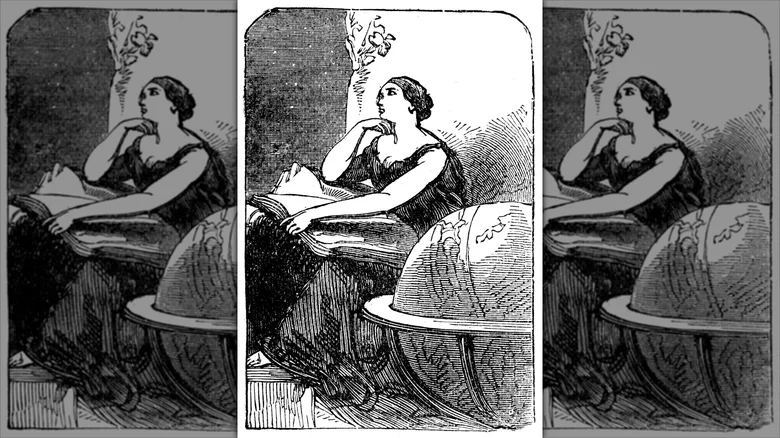
Print Collector/Getty Images
We’ve all heard the expression “perfect is the enemy of good.” This is precisely how Hypatia thought we should view our own ability to think. You don’t have to be a famous philosopher to be able to parse out truths about the world around you. Don’t let self-doubt prompt you to outsource your thinking to someone else. Always retain your ability to think through things, rather than simply assuming that what you others tell you is true.
This belief was fundamental to Hypatia’s way of thinking. She was vehemently against notions that weren’t proven being taught or treated as established facts. She encouraged people to use their own analysis, rather than falling prey to superstition or religious beliefs that relied on suspension of disbelief over reason.
From political figures, advertising, and the internet, in our society these days, propaganda and misinformation are rampant. Yet, just because folks who are meant to be authority figures tell us something doesn’t make it a fact. Falsehoods are sometimes shared to the public for ulterior motives. In some ways, it’s more important now than ever to hold onto your ability to reason and think critically about what you see or hear.
More Quotes From Hypatia
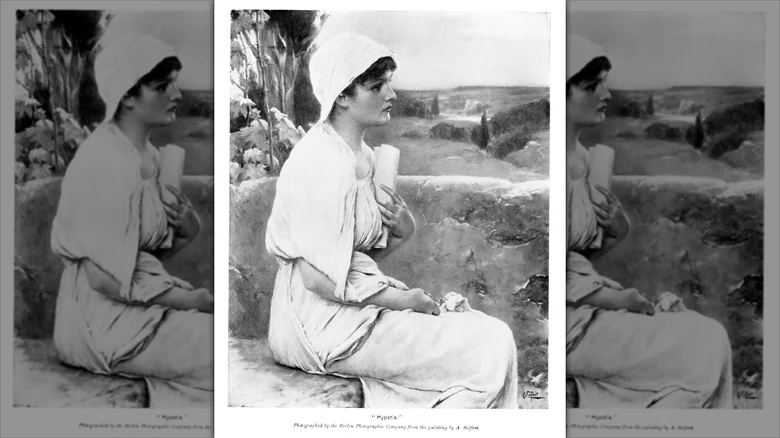
Christine_kohler/Getty Images
“All formal dogmatic religions are fallacious and must never be accepted by self-respecting persons as final.”
“Fables should be taught as fables, myths as myths, and miracles as poetic fancies. To teach superstitions as truths is a most terrible thing. The child mind accepts and believes them, and only through great pain and perhaps tragedy can he be in after years relieved of them.”
“In fact human beings will fight for a superstition quite as quickly as for a living truth — often more so, since a superstition is so intangible you cannot get at it to refute it, but truth is a point of view, and so is changeable.”
“Life is an unfoldment, and the further we travel the more truth we can comprehend. To understand the things that are at our door is the best preparation for understanding those that lie beyond.”
Read More: https://www.thelist.com/2235792/quote-of-the-day-hypatia-right-to-think/
(Contributed by Janet Cornwell, H.W., m.)
Hypatia[a] (born c. 350–370 – March 415 AD)[1][4] was a Neoplatonist philosopher, astronomer, and mathematician who lived in Alexandria, at that time in the province of Egypt and a major city of the Roman Empire. In Alexandria, Hypatia was a prominent thinker who taught subjects including philosophy and astronomy,[5] and in her lifetime was renowned as a great teacher and a wise counselor. Not the only fourth century Alexandrian female mathematician, Hypatia was preceded by Pandrosion.[6] However, Hypatia is the first female mathematician whose life is reasonably well recorded.[7] She wrote a commentary on Diophantus‘s thirteen-volume Arithmetica, which may survive in part, having been interpolated into Diophantus’s original text, and another commentary on Apollonius of Perga‘s treatise on conic sections, which has not survived. Many modern scholars also believe that Hypatia may have edited the surviving text of Ptolemy‘s Almagest, based on the title of her father Theon‘s commentary on Book III of the Almagest. (Wikipedia.org)
Angélica Dass Humanae Project
- Google AI Overview
The official online home for Humanae—the acclaimed chromatic skin-color photography project by artist Angélica Dass—can be viewed directly at the Angélica Dass Humanae Portfolio. [1, 2, 3, 4]
About the Project
Word-built world: dividual
- Google AI
Dividual is an adjective that primarily means divisible, divided, or shared in common with others. While traditionally classified as an archaic linguistic term, it has experienced a modern resurgence in philosophy and anthropology to describe social identity and data tracking. [1, 2, 3, 4]
Core Definitions
- Archaic Definition: Capable of being divided, separate, or distributed among multiple entities (e.g., John Milton famously wrote of the moon holding its “dividual” reign with lesser lights). [1, 2]
- Philosophical & Digital Definition: An entity that is not an indivisible whole (unlike an individual), but is instead constantly split, quantified, and reduced into data points, tracked behaviors, or component parts. [1, 2]
- Anthropological Definition: A person whose identity is interlinked with and inseparable from their community relationships, obligations, and shared responsibilities. [1]
Key Differences: Individual vs. Dividual
| Feature | Individual | Dividual |
|---|---|---|
| Core Meaning | Indivisible; a single autonomous unit. | Divisible; split into parts or networks. |
| Modern Context | A unique human being with personal rights. | A user profile broken into tracking data points. |
| Social Focus | Independence and self-reliance. | Interdependence and shared connection. |
The metaphysical implications of the dividual challenge the foundational Western assumption of the “individual” as a solid, indivisible, and autonomous substance. Instead of viewing existence as a collection of isolated “things,” a dividual metaphysics views reality as a fluid network of relations, flows, and constant transformations. [1, 2, 3]
Here are the primary metaphysical implications of the dividual concept:
1. Relational Ontology (Being-as-Relation)
- The Shift: Traditional metaphysics (from Aristotle to Descartes) is based on substance ontology, where a thing exists independently on its own. Dividual metaphysics uses relational ontology. [1, 2, 3, 4, 5]
- Implication: A person or object does not have relationships; they are the sum of their relationships. Existence is not a collection of separate dots, but the lines connecting them. You do not exist prior to your interactions; you are continuously produced by them. [1, 2]
2. The Illusion of the Boundless Self
- The Shift: It dissolves the strict metaphysical boundary between the “inside” (the mind, soul, or self) and the “outside” (the world, others, and nature). [1]
- Implication: The skin is no longer a hard metaphysical border. Thoughts, emotions, and bodily states are seen as porous, constantly absorbing and transmitting elements from the environment. The self is an open ecosystem, not a closed fortress. [1]
3. Process Philosophy (Becoming vs. Being)
- The Shift: It aligns heavily with process philosophy (such as the work of Alfred North Whitehead). It prioritizes becoming over static being. [1]
- Implication: Because a dividual is constantly being divided, distributed, and recombined, identity is never fixed. You are not a permanent noun; you are a continuous verb. Change is the fundamental reality, while stability is just a temporary plateau. [1, 2, 3]
4. Distributed Agency
- The Shift: Traditional metaphysics places “agency” (the power to act and choose) squarely inside the individual consciousness.
- Implication: Dividualism implies that agency is distributed across networks. A choice is never purely your own; it is co-produced by your biology, your cultural tools, your digital algorithms, and your physical environment. Human and non-human elements fuse to create action. [1]
5. Multiplicity and Assemblages
- The Shift: It replaces the metaphysical ideal of the “One” (unity, purity, wholeness) with the reality of the “Many” (multiplicity, fragmentation). [1, 2, 3]
- Implication: As philosophers like Gilles Deleuze argued, entities are “assemblages”—temporary collections of heterogeneous parts. A human being is a dividual assemblage of organs, bacteria, digital data profiles, ancestral memories, and social roles, all operating simultaneously without needing a single, central “core.” [1, 2, 3]
Summary of Metaphysical Shifts
| Concept | Individual Metaphysics | Dividual Metaphysics |
|---|---|---|
| Fundamental Unit | Substance (The thing itself) | Relation (The space between things) |
| Identity | Fixed, permanent, unified | Fluid, temporary, multiple |
| Reality | Being (Static) | Becoming (Dynamic process) |
| Boundaries | Closed, independent | Porous, interdependent |
The concept of the dividual aligns profoundly with Eastern metaphysics. While Western philosophy historically prioritized the independent “substance” of the self, Eastern traditions have spent millennia mapping reality as a fluid, interconnected web.
Here is how the metaphysical implications of the dividual manifest across major Eastern traditions:
1. Buddhism: Anatta (Non-Self) and Pratītyasamutpāda
Buddhism offers perhaps the most direct metaphysical parallel to the dividual by explicitly denying the existence of a permanent, indivisible individual soul.
- The Five Skandhas (Aggregates): Buddhism teaches that what we call the “self” is actually a temporary assemblage of five constantly changing parts: form, sensation, perception, mental formations, and consciousness. You are a dividual process, split into these fluctuating components.
- Dependent Origination (Pratītyasamutpāda): Nothing exists in isolation. Everything arises in dependence upon multiple causes and conditions. The individual is an illusion; reality consists entirely of relational links.
2. Hinduism: Advaita Vedanta and Indra’s Net
While certain schools of Hinduism affirm an ultimate soul (Atman), its relationship to the universe mirrors dividual metaphysics through radical interconnectedness.
- Indra’s Net: This famous metaphor describes a vast cosmic web where every knot contains a jewel. Each jewel reflects all other jewels in the net. No single jewel possesses independent identity; its very existence is a reflection of the whole. [1]
- The Illusion of Separation (Maya): The belief that you are a separate, autonomous individual is considered cosmic ignorance (Maya). Metaphysically, your boundaries are porous, and your true nature is seamlessly integrated with the absolute whole (Brahman).
3. Daoism: The Flow of Qi and Yin-Yang
Daoism rejects static categories of “being” in favor of constant transformation, viewing humans not as fixed individuals but as knots in a cosmic current.
- The Self as a Vortex: In Daoism, a human being is a temporary concentration of cosmic energy (Qi). Just like a whirlpool in a river, it has a recognizable shape for a moment, but it is never separate from the water flowing through it.
- Dynamic Interdependence: The Yin-Yang shows that opposites are not separate entities but mutually constituting parts of a single process. You cannot define the self without the “other.”
4. Confucianism: The Relational Self
While less focused on cosmic metaphysics and more on social metaphysics, Confucianism defines a human being entirely by their social location.
- Identity as a Matrix: In Confucian thought, you do not exist prior to your roles as a child, parent, sibling, or citizen. You are the intersection of your obligations. If you strip away all relationships, there is no hidden “individual” left underneath; the relations are the essence of the person.
Comparison: Western Dividualism vs. Eastern Metaphysics
| Dimension | Modern Western Dividualism (Deleuze/Data) | Eastern Metaphysics (Buddhism/Daoism) |
|---|---|---|
| The Cause of Division | External forces (Algorithms, capital, tracking). | Internal and cosmic reality (Nature of existence). |
| View of Fragmentation | Often alienating or a mechanism of control. | Liberating; the key to breaking suffering. |
| Ultimate Goal | Resistance, political awareness. | Enlightenment, harmony, alignment with the Dao. |