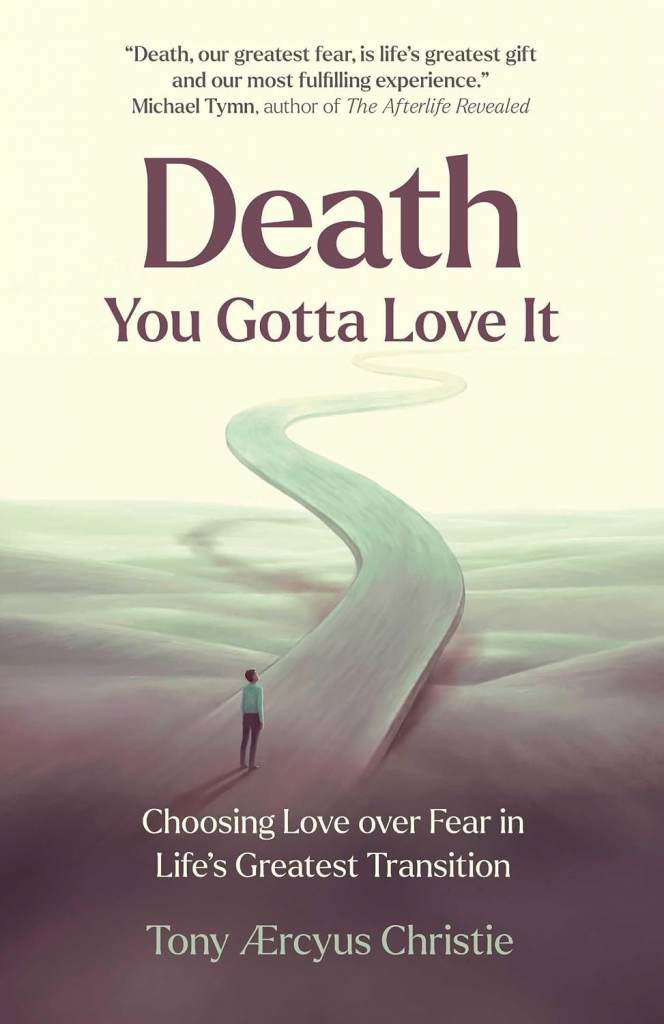
Death – You Gotta Love It brings a new approach to death, whereby the reader takes ownership of their own mortality and, in so doing, frees oneself from negative thinking and emotions about their pending death. It is part of a great shift into higher consciousness, moving you from fear to love and taking you on a journey of exploration so that, when your time comes, you’ll be well prepared and ready for – perhaps even looking forward with excitement to – the adventure of death.
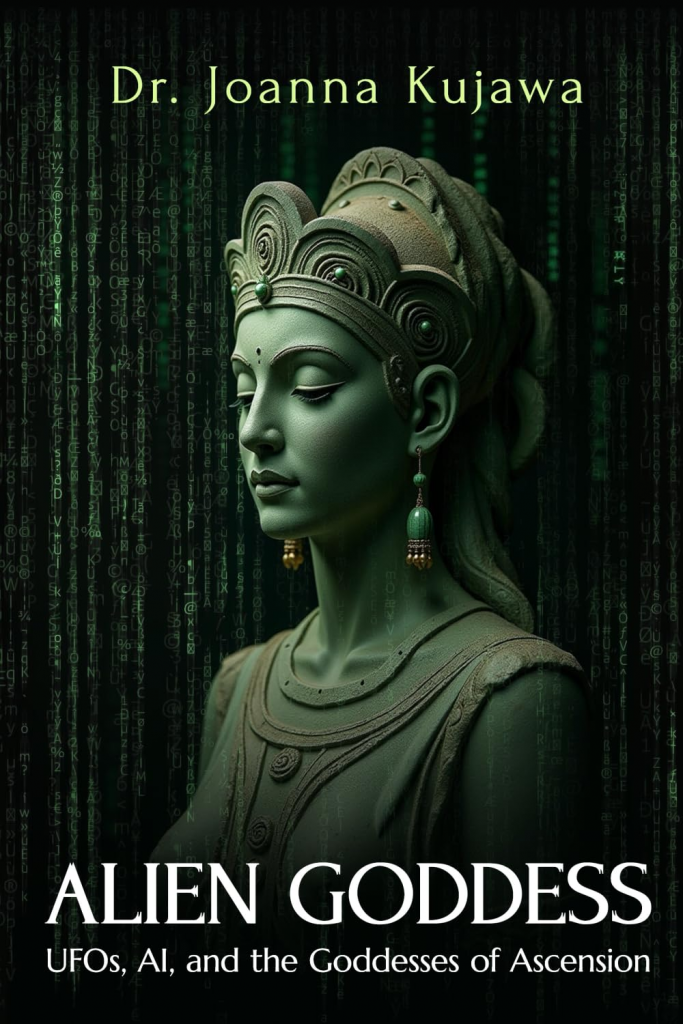
What if the beings we call “aliens” are not invaders from other worlds, but messengers from higher realms of consciousness, warning us against the dead-end path we are currently racing toward? What if the true threat to humanity is not an alien invasion, but rather our surrender to machines? And what if the antidote to both challenges resides not in technology, but in wisdom we abandoned long ago? Alien Goddess enters this urgent conversation with a perspective no one else is offering. Drawing on contemporary accounts of contact phenomena, esoteric texts, and ancient mythologies, it asks what happens when a civilization replaces the sacred with the synthetic.
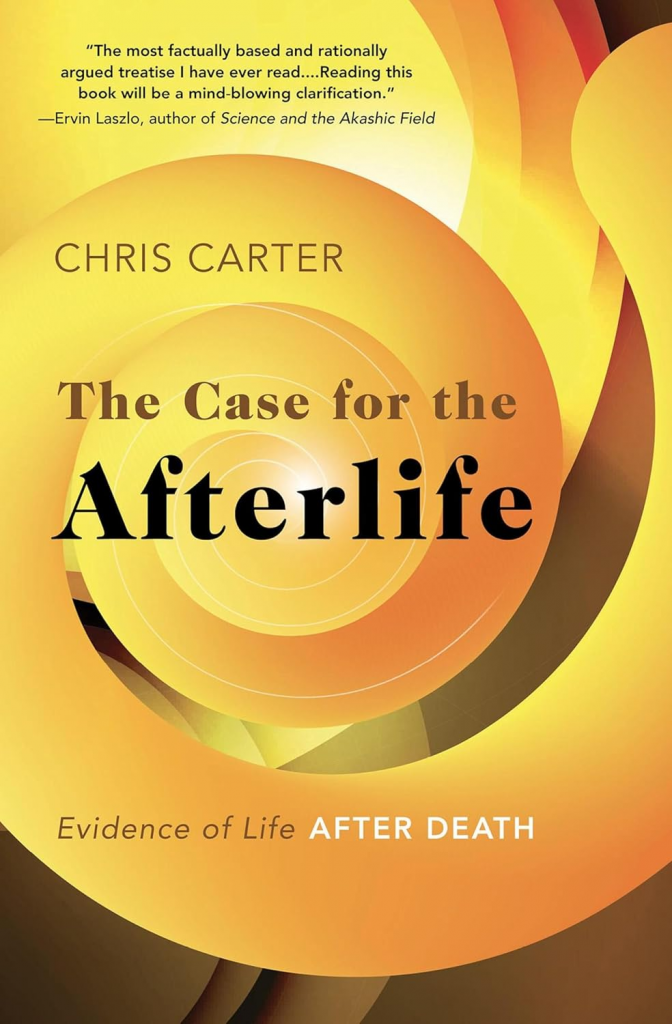
Equipping you with a tool kit drawn from science, philosophy, and legal reasoning, Oxford-educated philosopher Chris Carter facilitates a thorough examination of the evidence and its corresponding counterarguments. Explore compelling case studies of near-death experiences, deathbed visions, apparitions, children who remember a previous life, and communications from the deceased.
Species extinction. Billionaire capture of governments. Inequality so extreme it’s destabilizing democracies. A return to large-scale war. Such events have combined to create an everything-all-at-once situation in the world that is no coincidence, according to a new book, “Ecocivilization,” by Berkeley resident Jeremy Lent.
“There are deeper, underlying causes to these things that are making them happen at the same time,” said Lent, who has spent the past two decades building the framework that explores why civilization is fracturing — and what could replace it.
The book’s title is shorthand for “ecological civilization,” the notion that we need to change not just one part of our civilization, but create an entirely different kind of civilization, Lent said, one that allows humans to live in harmony with the natural world and each other.
Lent, the co-founder of Ecocivilization Coalition, with members from around the globe, and founder of Deep Transformation Network, is considered a leading authority on the subject. The Guardian’s George Monbiot described Lent as “one of the greatest thinkers of our age.”
Jeremy Lent. Courtesy of the author
Right now, “our whole global system is all about growing the economy as fast as possible, having markets determine everything, having the wealth go to whoever is able to come up with the most successful product and using technology that we have no control over,” Lent said.
He aims to show readers how bad things actually are right now but also provide hope. He proposes the idea of a life-affirming society, “a civilization that is simply based on setting the conditions for all beings to thrive on a regenerating earth,” he said.
In the book, Lent highlights five necessary changes for humanity’s flourishing:
A universal basic income framed not as welfare but as a citizen’s share of wealth built from generations of shared knowledge, infrastructure and natural resources.
Meaningful corporate charter reform with renewal tied to proven social and environmental accountability.
The expression of deliberative democracy — with citizens’ assemblies and sortition-based governing bodies making binding decisions, from local planning to national climate policy.
Legal rights for nature: giving oceans, land and their inhabitants standing as entities, not just property for human use.
Replacing GDP as the main measure of success with models like Doughnut Economics, which tracks whether people’s needs are met without exceeding planetary limits.
“These ideas are not in the utopian world but actually being done,” Lent said. “It will take a huge amount of effort and work, but a different kind of future is available to us if we all pull together to actually make it happen.”
The hard work required to make God real, how it changes the people who do it, and why it helps explain the enduring power of faith
How do gods and spirits come to feel vividly real to people–as if they were standing right next to them? Humans tend to see supernatural agents everywhere, as the cognitive science of religion has shown. But it isn’t easy to maintain a sense that there are invisible spirits who care about you. In How God Becomes Real, acclaimed anthropologist and scholar of religion T. M. Luhrmann argues that people must work incredibly hard to make gods real and that this effort–by changing the people who do it and giving them the benefits they seek from invisible others–helps to explain the enduring power of faith.
Drawing on ethnographic studies of evangelical Christians, pagans, magicians, Zoroastrians, Black Catholics, Santeria initiates, and newly orthodox Jews, Luhrmann notes that none of these people behave as if gods and spirits are simply there. Rather, these worshippers make strenuous efforts to create a world in which invisible others matter and can become intensely present and real. The faithful accomplish this through detailed stories, absorption, the cultivation of inner senses, belief in a porous mind, strong sensory experiences, prayer, and other practices. Along the way, Luhrmann shows why faith is harder than belief, why prayer is a metacognitive activity like therapy, why becoming religious is like getting engrossed in a book, and much more.
A fascinating account of why religious practices are more powerful than religious beliefs, How God Becomes Real suggests that faith is resilient not because it provides intuitions about gods and spirits–but because it changes the faithful in profound ways.
Tanya Marie Luhrmann is currently the Watkins University Professor in the Anthropology Department at Stanford University. She has been elected to the American Academy of Arts and Sciences, and has been the recipient of a John Simon Guggenheim Fellowship.
Tanya Marie Luhrmann (born 1959) is an American psychological anthropologist best known for her studies of modern-day witches, charismatic Christians, and psychiatrists. She received her AB summa cum laude in Folklore and Mythology from Harvard-Radcliffe in 1981, working with Stanley Tambiah. She then studied Social Anthropology at Cambridge University, working with Jack Goody and Ernest Gellner. In 1986 she received her PhD for work on modern-day witches in England, later published as Persuasions of the Witch’s Craft (1989). In this book, she described the ways in which magic and other esoteric techniques both serve emotional needs and come to seem reasonable through the experience of practice.
Her second research project looked at the situation of contemporary Parsis, a Zoroastrian community in India. The Parsi community enjoyed a privileged position under the British Raj; although by many standards, Parsis have continued to do quite well economically in post-colonial India, they have become politically marginal in comparison to their previous position, and many Parsis speak pessimistically about the future of their community. Luhrmann’s book The Good Parsi (1996) explored the contradictions inherent in the social psychology of a post-colonial elite.
Her third book, and the most widely acclaimed, explored the contradictions and tensions between two models of psychiatry, the psychodynamic (psychoanalytic) and the biomedical, through the ethnographic study of the training of American psychiatry residents during the health care transition of the early 1990s. Of Two Minds (2000) received several awards, including the Victor Turner Prize for Ethnographic Writing and the Boyer Prize for Psychological Anthropology (2001).
Her fourth book, When God Talks Back: Understanding the American Evangelical Relationship with God (March 2012), examines the growing movement of evangelical and charismatic Christianity, and specifically how practitioners come to experience God as someone with whom they can communicate on a daily basis through prayer and visualization.
Other projects she is working on include a NIMH-funded study of how life on the streets (chronically or periodically homeless) contributes to the experience and morbidity of schizophrenia.
Four billion years ago, in the hydrothermal vents at the bottom of the world where serpentine is forged, chemistry trembled with the promise of consciousness and matter began its long metabolic pilgrimage toward mind. Perhaps our saline cells remember it: how we, pilgrims of the possible, crawled out of the tide pools to climb the trees, then came down from the trees to live under a canopy of one hundred trillion synapses animated by the oceanic yearning to make meaning of our mortality. Perhaps the ocean, with its primeval drama of life and death, will always remind us of where we came from and where we are going. Rachel Carson knew this when she contemplated the peculiar effect of facing the open ocean, the way it fills us with “an uneasy sense of the communication of some universal truth that lies just beyond our grasp… the ultimate mystery of Life itself.”
Alan Watts (January 6, 1915–November 16, 1973) captures this with uncommon poignancy in a 1960 talk titled “Love of Waters,” found in the posthumously compiled lecture collection Zen Rascal.
Writing from his studio — a floating library on an old ferryboat tied to the waterfront of Sausalito just north of San Francisco — Watts begins with a fine contribution to the canon of literature’s best reckonings with time:
Although the rhythm of the waves beats a kind of time, it’s not clock or calendar time. It has no urgency. It’s timeless time. Because I know I’m listening to a rhythm which has been just the same for millions of years. And it takes you out of the world of relentlessly ticking clocks. Clocks, for some reason or other, always seem to be marching, and armies never march to anything but doom. But there’s no marching rhythm in the motion of waves. It harmonizes with the breath. It does not count our days. Its pulse is not in the stingy spirit of measuring, of marking out how much still remains. It’s the breathing of eternity, like the Brahmā of Indian mythology, who inhales and exhales, manifests and dissolves the worlds endlessly, for ever. As a mere conception, that sounds appalling and monotonous — until you listen to the breaking and washing of waves.
Observing how all the waste and want of our civilization are “transformed in the beneficent presence of the sea,” he considers the mysterious mechanism of the transformation in what reads like a prose poem:
Perhaps it’s the quality of the light, especially early in the morning and towards the evening, when the distinction of sky and water becomes uncertain, when the whole of space becomes opalescent; the sort of pearly, luminous grey, and the rising or setting moon is straw yellow. In this light, all the rambling mess of sheds and junkyards is magical, blessed with the white cries of gulls, and with the patterns of masts and ropes and boats at anchor which put me in mind of landfalls a long way away, and of all the voyages of which one has dreamed.
And yet in the ocean, this poetic dimension of life coexists with the teeming brutality of predator and prey, the merciless drama of death. In a stirring reminder that the evolutionary is inseparable from the existential, Watts writes:
This is the paradox of the ocean. Sand, flying spray, pebbles and shells, driftwood, sparkling water, space incredibly luminous, with cloud banks along horizons underlying skies into which one’s imagination can reach forever. But under the surface of both sky and water there’s the grim business of preying. Men and birds against fish, fish against fish. The torturous process of life continuing by the painful transformation of one form into another.
[…]
There’s no way of getting around it, is there? The gull isn’t rapacious or greedy. It’s just that his being alive at all is the same thing as eating crabs. Sea birds are transformations of fish. Men are transformations of wheat, chickens, and steers. And a love for the food is the agony of the food. To object to this inseparability of pleasure and pain, life and death, is simply to object to existence. But, of course, we cannot help objecting when the time comes. Objecting to pain is pain.
The Great Wave off Kanagawa by Japanese artist Hokusai, 1831. (Available as a print.)
With an eye to the price of consciousness, Watts observes that the human animal, with its ability to stand outside of itself and think about itself — that is, “to comment on life” — has curled into a profound confusion about its own existence: By standing aside from life in order to think about it, we evicted ourselves from it and, as Watts puts it, “found it alien.” A generation before Ursula K. Le Guin wrote so movingly about subject vs. object in the meaning of life, Watts invites us out of this dualistic self-expatriation from the living world:
Perhaps thinking about the world and objecting to its whole principle are simply two aspects of the same mechanism. The very words suggest, don’t they: perhaps we must object to everything that becomes an object. But aren’t there also times when we speak of something that we know as a subject — the subject of this book, the subject I am now studying? Would it be possible to subject to life instead of objecting to it? Is this playing with words, or does it possibly mean something? Now, if the gulls and the fish don’t philosophize, they have no consciousness of life being either good as a whole or bad as a whole. So when we philosophize and pity the poor fish, that’s just our problem. From its own standpoint, the world of animals and insects doesn’t find itself problematic at all. There’s not the slightest evidence to suggest it. On the contrary. I’m inclined to feel that all these creatures really swing and go on living up to the very moment when the game is no longer worth the candle. I’m quite sure they don’t lecture each other about their duties or worry about where they’re going when they’re dead.
[…]
To be human is precisely to have that extra circuit of consciousness which enables us to know that we know, and thus to take an attitude to all that we experience. The mistake that we’ve made — and this, if anything, is the fall of man — is to suppose that that extra circuit, that ability to take an attitude to life as a whole, is the same as actually standing aside and being separate from what we see. We seem to feel that the thing which knows that it knows is one’s essential self. That, in other words, our personal identity is entirely on the side of the commentator. We forget that self-consciousness is simply a subordinate part and instrument of our being; a sort of mental counterpart to the finger-thumb opposition of the human hand.
And which is you, the finger or the thumb? Look at the stages of differentiation. First: the organism from its environment — and with this, knowledge of the environment. Second: the distinction of knowing knowledge from knowledge itself. But all this, like the finger-thumb opposition, is a difference which does not divide. The thumb isn’t floating in the air alongside the rest of the hand. At their roots they’re joined. And at our roots we are joined to the whole subject of nature.
Watts ends with a mighty corrective for the far-reaching damage Descartes has done and does us still:
Of course, you may say that nature or the universe is just a big abstraction. But tell me: is an orange just an abstraction from its component molecules?
I think our difficulty is that our consciousness is too superficial, as if all our sensation were in the tips of the fingers and not in the palm. Our comments on life are insufficiently balanced by the clear sensation that what we are talking about as ourselves, and ourselves in a sense far more basic and real than that extra circuit which knows knowing… Were we as spatially distant from the Earth as one atom of an orange from another, I suppose we should be somewhere out by the Moon.
[…]
I think this is why I love the ocean. It’s the most difficult part of nature to mess up with emblems and symptoms of man’s dissociated consciousness. It’s an environment in which the awareness of our roots can awaken, in which space (so real because of the light and color) can be seen to be joining things instead of separating them. Yes. And I’ve just discovered that knocking on the wall of space and consciousness was my own heart beating.
“There is no initiation either into such mysteries. He has to live in the midst of the incomprehensible, which is also detestable. And it has a fascination, too, that goes to work upon him.” –Heart of Darkness
On the final day of April 1774, the Minerva was plying the waters of the Atlantic Ocean, headed for Boston. On board were London newspapers bearing the first news of England’s response to the Tea Party. Bostonians would soon learn that, as punishment, the Crown had decided to close the port, a step that would spark a civil war in the British empire. Hours before the Minerva’s lookout spied Boston Harbor, seven Native people crossed a smaller body of water as they traveled to a meeting that they hoped would prevent a similar breakdown in relations with colonial settlers. The party knew the trip put them in mortal danger and yet they went anyway; it’s what their family had done for more than four decades.
That family had negotiated relationships between Natives and colonists since the 1730s. So despite whatever apprehensions they might have had, they climbed into their canoes and let a tributary called Yellow Creek carry them about a mile down to the Ohio River. Today, they would have passed under Ohio Route 7 and a graffiti-covered railroad trestle right as they caught the big river’s course. Paddling against the current, they soon reached their destination, a small log cabin that sat just up from the eastern shore on a piece of ground known as Baker’s Bottom.
While we can acknowledge that white colonists possessed enormous power, not least in their sheer numbers, that alone does not explain imperial encounter.
The seven Natives—four men, two women, and a baby—were invited into the cabin’s front room, where a few colonists poured them drinks and allegedly launched into a conventional ceremony of keeping peace. Things were tense, but the alcohol helped. The two groups joked with one another. One of the colonial hosts had a British regimental uniform. As they all got a little tipsy, a Native man put on the red coat and paraded around the room. Someone proposed a shooting contest as a diversion and perhaps to further clear the air. Several went outside and identified a target. You go first, the white men told the Natives, and the latter fired, leaving themselves disarmed. The trap was sprung.
There were more than a dozen colonists hiding in the back room of the cabin. When the shooting started, the crouching, silent men leapt into action, running out into the yard, advancing on the unsuspecting Natives, who turned and sprinted for their canoes. Bullets took down one man, then another and another, spilling blood over the ground as acrid gunsmoke rose into the air. An elderly woman also fell. A second Native woman clutched her baby and ran for the water’s edge. When she realized escape was impossible, she turned and begged the men to spare the child’s life. She’s the daughter of a white man, the mother pleaded about her child, hoping that might convince them. They paused and allowed her to hand over the baby before shooting her in the face.
Three more Natives, worried about what might be happening across the way, had come looking for their relations. They were caught in the middle of the river when the colonists fired away, killing two of them, too. One, a woman, survived, but was gravely wounded and barely made it to the other side.
In all, eight Native people would perish in the horror at Yellow Creek on April 30, 1774. In contrast to many stories from America’s history about Native-European encounters, where we know little about the lives of half of the participants, in this case we know several of the victims well. We know their family biography. They were the family of Shickellamy, one of the most significant Iroquois leaders of the mid-eighteenth century.
His importance lay in the role he had played as an ambassador for his people: decades before, the Six Nations tasked him with checking white colonists’ desires for more and more land along a different river, the Susquehanna, east of the Ohio Valley. He befriended the man who was in many respects his opposite, James Logan, Pennsylvania’s agent tasked with satiating colonists’ thirst for land. Shickellamy honored his friend and colleague by giving two of his sons the name Logan.
Those boys would become Native negotiators in their own right. The Shickellamys were one of the most prominent political families in North America in the middle of the eighteenth century. They had tried for a generation to forge deals between colonists and Natives. They had participated in and shaped many of the most consequential events in the history of colonial America. Despite their efforts, they had largely failed and now nearly all of them were dead. Shickellamy’s wife, youngest son, and a daughter were among the slain at Yellow Creek.
*
The interpretative paths we have constructed to help guide us through the baffling, bewildering forests of early America struggle with horrific scenes like these. One of the most prominent of these paths was blazed by a thirty-two-year-old historian named Frederick Jackson Turner. Delivered as an address in 1893 at an exposition commemorating the four hundredth anniversary of Columbus’s voyage to the New World, Turner’s “The Significance of the Frontier to American History” is widely considered to be among the most influential pieces of writing about American history.
How Turner reached his conclusions has become its own legend. As the story goes, Turner gathered the ideas that would become his “frontier thesis” after reading the results of the 1890 census. The bureaucrats in the Census Office proclaimed that the frontier, a line of “settlement” that had steadily advanced across the continent throughout the eighteenth and nineteenth centuries, was now closed; it was a relic of the past. Turner read this report with alarm. It compelled him to investigate what effect the frontier had had on the United States.
In “The Significance of the Frontier,” Turner declared that the process of “perennial rebirth, this fluidity of American life, this expansion westward with its new opportunities … furnish the forces dominating American character.” It was the secret to what made the United States different from and better than every other nation. For Turner, incidents like Yellow Creek were aberrations perpetrated by a “line of scum that the waves of advancing civilization bore before them.” Unfortunate episodes such as these were merely a small part of a larger glory, of a world-historical dynamic that had made America—and Americans—great.
Since the 1940s, scholars have challenged Turner’s thesis. They have pointed out all of the men and women whom Turner left out of his fabulous tale. Critics have especially taken issue with his notion of an advancing frontier line, using other words that emphasized space over time, place over process. Focusing on regional differences, historians have presented evocative and powerful accounts of how colonists and Natives encountered one another on middle grounds, native grounds, borderlands, and bordered lands.
Each of these terms offered a new analysis of Native-colonial encounter, focusing on who dictated political, economic, and cultural terms and how power ebbed and flowed. They contend that geography matters: what happened in the region they are studying could only have done so in that specific spot. This is by design; a rejection of Turnerian meta-narratives.
More recently, scholars looking to interpret encounter between Native peoples and colonists have relied on the concept of “settler colonialism.” Developed largely by Australian scholars writing about what happened to Indigenous peoples there, the concept of settler colonialism has been used to argue that European settlers in the Americas did not simply take land and resources from Indigenous peoples but eliminated them after the fact by destroying their history and discrediting their way of life.
Settler colonialism posits a “double dispossession”: Europeans did more than invade Native lands—they occupied them. For theorists of settler colonialism, incidents like Yellow Creek are all too easy to understand; what happened to the eight Natives at Baker’s Bottom was not only predictable, but an inevitable and unsurprising part of the conquest of North America.
At its core, settler colonialism represents a reversion back to a focus on time. It is another process argument, one that has an oddly Turnerian quality to it. Although its claims come from precisely the opposite track than Turner’s celebration of pioneers, settler colonialism has a logic, a thrust, a teleology, too. Just as Turner’s tale had frontiersmen laying the foundation of American greatness through the trials of taming the West, historians who subscribe to settler colonialism tell us the double dispossession—the destruction of Native America—was also inescapable.
“Invasion is a structure not an event,” Australian historian Patrick Wolfe, the leading theorist of settler colonialism, has argued. It is a process that “pursues a specific end point,” another has written. Advocates of settler colonialism look back from the perspective of the modern world and interpret the past nearly as confidently as Turner did.
The confidence that comes from knowing how things actually did turn out is an inherent hazard on all these interpretive paths. While we can acknowledge that white colonists possessed enormous power, not least in their sheer numbers, that alone does not explain imperial encounter. Either dismissing the horror of Yellow Creek or expecting it doesn’t tell us how that particular event happened, why it mattered, or what legacies it left.
Interpretations that leave little room for contingency, choice, biography, and even irrationality and misperception ultimately do a disservice to all the people who lived through imperial encounter, and to ourselves as we try to make sense of its consequences. Anishinaabe historian Michael Witgen has argued that, even in the twenty-first century, “the settler colonial project of the United States is not complete but remains an ongoing process.” That such uncertainties remain today only underscores the ambiguous nature of power in the bewildering Ohio Valley two hundred fifty years ago.
*
Perhaps the problem is we are “seeing” things wrong. Maybe it would help if we went back to the 1890s and started over again. In that decade there was another writer of Turner’s generation who developed his own vision of imperial encounter. The path he laid might lead toward a better understanding of what happened in the early American backcountry.
Józef Teodor Konrad Korzeniowski was born in 1857, four years before Turner, in what is now Ukraine, to a family of Polish nationalists who had also lived through an imperial conquest. After Russian officials exiled his father for plotting against the czar, the young family fell apart. Both parents died of tuberculosis before Józef was eleven. He eventually fled to the sea, where he signed on with the merchant marine at age sixteen, and began to call himself Joseph Konrad.
Konrad’s years afloat coincided almost exactly with the “scramble for Africa” in the final quarter of the nineteenth century, which saw European powers race to colonize that continent. At age thirty-two, with “large black eyes,” “a determined chin,” and a “thick, well-trimmed, dark brown mustache,” Konrad spent part of 1890 in central Africa, on the Congo River, witnessing imperialism. What he encountered led him to see the process of taming the wilderness vastly different from Turner.
When he escaped from the Congo—he almost didn’t survive, he was so ill—he decided to give up his career as a sailor and become a writer. Anglicizing his last name to Conrad, his first novel, Almayer’s Folly, would appear two years after Turner’s address to the Columbian Exposition. In 1899, Blackwood’sMagazine serialized a story Conrad had written about his harrowing months in central Africa. Three years later, that novella would be published as Heart of Darkness. It would come to be regarded as an essential book about European imperialism and what the exploitation of Africa revealed about human nature.
It is antithetical to the historian’s job—if not simply a heresy—to say that we sometimes cannot confidently sort out what happened in the past.
Conrad’s vision of imperial encounter, on its face, would seem to please a theorist of settler colonialism. There is, after all, no heroic mission in Heart of Darkness; there is no triumph. “The conquest of the earth,” Conrad’s narrator says, “which mostly means the taking it away from those who have a different complexion or slightly flatter noses than ourselves, is not a pretty thing when you look into it too much.” Imperialism is not an intrepid adventure that brings out humanity’s best. It is a horror.
In Heart of Darkness, the reader doesn’t find sturdy Turnerian pioneers but rather haunted white men surrounded by severed heads on pikes. But stopping there would miss much of Conrad’s point. It is not enough to simply describe the violence and exploitation of imperialism. The achievement of Conrad’s novella is not a “thesis” about imperialism but a description of how people caught up in it encountered and experienced the chaos it produced.
It is antithetical to the historian’s job—if not simply a heresy—to say that we sometimes cannot confidently sort out what happened in the past. Although it is the historian’s remit to make sense of the people and events that came before, to delineate causes, explain origins, and measure consequences, there are instances when our imposition of order on the past misleads. Not only that, but historians’ sweeping interpretations can become forces in their own right.
Turner’s thesis is perhaps the best American example of how a proposition about the past can shape the future. “No myth has become more powerful, more invoked by more presidents, than that of pioneers advancing across an endless meridian,” one scholar has recently written. “Onward and then onward again.” Those who came after Turner transformed his thesis into an “ideology of limitlessness,” and used it to justify American power all over the world. Settler colonialism, by contrast, suggests that the United States should reconsider its global ambitions and come to terms with how it became a superpower in the first place: via the conquest of a continent and the people who lived in North America. Turner’s interpretation celebrates; settler colonialism condemns.
Heart of Darkness is useful because it undermines the historians’ project of confidently knowing or being able to account for what happened in confusing places like the ones Conrad saw in the Congo. When he reflected on the consequences of empire, Conrad saw no logic or teleology. He saw mayhem. There is no surety in Heart of Darkness; everything that happens in the novella suggests absurdity and bewilderment. Upon arriving in the Congo, the book’s narrator, Charles Marlow, finds mountains being blasted apart to make room for railroads that go nowhere. He watches “incomprehensible” European gunships lobbing shells at “enemies” who cannot be seen or even identified. He recoils as he stumbles upon a “grove of death,” an idyllic place right next to the deafening Congo rapids where Native people are worked to the edge of life because they have been judged “criminals,” though they have committed no offense.
A Belgian trading company has sent Marlow to find and bring home a man named Kurtz, and he scoffs when he first sees that Kurtz, the German word for “short,” is tall and lanky. Nothing is what it seems in this bizarre world. Marlow’s perception is marred by fog or smoke or flickering shadows, and he can’t believe the things his eyes see. As one literary scholar has stated, “moments of intense bewilderment occur so frequently in Conrad’s fiction that they seem less unusual than customary.” This is especially true of Heart of Darkness.
Marlow becomes an observer of this bewilderment, registering the strangeness around him. His purpose, as a character, is to document and explicate for the reader the senselessness of empire. We are supposed to be put ill at ease by the absurdity and cruelty of the imperial Congo. Bewilderment, for Marlow, is a state of mind; it is a way of existing in this upside-down world.
But imperialism has even more insidious effects on those who fully engaged in it. The man Marlow has been sent to the Congo to find operates on a deeper level of bewilderment. Kurtz is a veteran of empire, and it has turned him into a chaos agent. Marlow is sent to retrieve Kurtz because the latter no longer seems to work for anyone except himself. Kurtz has grasped the power of bewilderment and is now exploiting it to his own benefit. In Kurtz’s hands, it is no longer just a description of what imperial encounter does to the world but rather a weapon to be brandished. Bewilderment, for Kurtz, is a state of play; it is a way of making this upside-down world work to one’s advantage.
In the 1890s, Conrad faced imperialism’s bewildering effects. He watched how some Europeans tried to sow even more confusion to maximize their own rewards, a strategy that further compounded the violence. He tried to render it the best way he knew, through fiction, and the resulting sentences evoked the incomprehension that is inherent to imperial encounter.
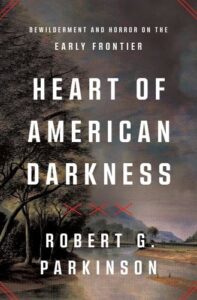
Robert G. Parkinson is associate professor of history at Binghamton University. He is the author of The Common Cause and Thirteen Clocks. He lives in Charles Town, West Virginia.
With the Royal Navy ruling the waves, Queen Victoria safely on her throne, science explaining a confusing world, and British missionaries, explorers, and armies turning the map pink you’d think that the mid-19th-century English (or at least the upper classes) would be a reasonably happy lot. In his superb new book The Boundless Deep Richard Holmes shows that this was not the case. Using Alfred Tennyson as his fulcrum Holmes unpacks the many intellectual currents that began to completely unhinge Victorian optimism and the Whig interpretation of history as one of linear progress.
The Boundless Deep has received rave reviews but it isn’t an entirely new idea. There is a moment in Ian Watt’s brilliant, perhaps now largely forgotten, study of Joseph Conrad, Conrad in the Nineteenth Century (1979), when Watt reveals what he considers to be one of the keys to understanding Heart of Darkness, “Conrad derived from the facts of natural science a view of man’s situation very close to that of modern Existentialism.” Conrad had begun to reject ideas of progress and was deeply troubled by the “New Science.” He was not alone in this view.
Lord Kelvin’s discovery in the early 1850s of the second law of thermodynamics and the unavoidable “heat death of the universe,” together with the publication of Charles Darwin’s Origin of Species in 1859, led to a growing cult of Victorian pessimism that infected many of the society’s poets, politicians and intellectuals. As Watt explains, “the previous century has inferred a divine watchmaker from the perfection of the celestial machine, it was now discovered that not only was there no watchmaker, but the spring was running down.”
In The Boundless Deep Holmes explains how the rapid growth of scientific knowledge reshaped Victorian intellectual and cultural life, in particular the life of the young Alfred Tennyson and his circle. Holmes points out that new discoveries about the natural world, especially the oceans, atmosphere, and unseen forces of nature, expanded the boundaries of human understanding and challenged long held assumptions about humanity’s place in the universe.
Tennyson, who became Poet Laureate in 1850, lived during a period when traditional religious beliefs were increasingly challenged by these new scientific theories. Holmes highlights Tennyson’s personal struggles with grief and doubt after the death of his close friend Arthur Henry Hallam. These experiences shaped Tennyson’s engagement with emerging scientific ideas, particularly debates about geology and evolution. His famous poem In Memoriam A.H.H. reflects the tension between faith and scientific discovery, acknowledging the unsettling implications of nature “red in tooth and claw.”
The Boundless Deep portrays the 19th century as a transformative moment when science profoundly altered both intellectual thought and everyday experience.
Tennyson was deeply curious about contemporary science and maintained friendships with many notable scientists and intellectuals who influenced his thinking. Holmes convincingly articulates Tennyson’s attempts to incorporate these insights into a broader philosophical and poetic vision. Even Tennyson’s mystical, deliberately old fashioned, Arthurian poetry often reflects awe at the vastness and mystery of the natural world, an attitude that paralleled the expanding horizons of Victorian scientific exploration.
Holmes presents the growth of science as a gradual and collaborative process rather than a series of isolated breakthroughs. Advances in fields such as oceanography, meteorology, and geology allowed scientists to explore areas that had previously seemed mysterious or inaccessible. Improved instruments and ambitious expeditions revealed the complexity of ocean currents, weather systems, and marine ecosystems. These discoveries changed how Victorians understood nature: instead of a static creation, the natural world appeared dynamic, interconnected, and governed by discoverable laws. Holmes emphasizes the networks of correspondence, research societies, and public lectures that helped spread these ideas beyond specialist circles. Indeed it was a series of sensational popular penny pamphlets that lamented the coming “heat death of the universe” not William Thomson (Lord Kelvin)’s dry scientific papers.
Holmes’s excels in these sections which collide many of his interests. His portrait of the young Tennyson and his family is delightful and everything we would expect from one of our greatest critics of the English Romantics.
Holmes shows how the New Science shaped literature, public debate, and the emotional life of the period. Victorian society grappled with the implications of new knowledge while still searching for meaning and moral order. Through this interplay between discovery and culture, The Boundless Deep portrays the 19th century as a transformative moment when science profoundly altered both intellectual thought and everyday experience. Even as their missionaries penetrated “darkest Africa” the established church knew that it was in trouble. Attempts to mock and ridicule Darwin failed and he ended up being buried in Westminster Abbey next to Isaac Newton.
In the name of progress the Victorians built railways, bridges, hospitals, roads, sewage systems. They banned children from factories and made schooling mandatory. Life expectancy went up especially after the “hungry forties.” Acceptance of the germ theory of disease likely saved more lives than any other single development in the history of medicine. Throughout Eric Hobsbawm’s so called “Long Nineteenth Century” the British navy pacified the oceans and British diplomacy prevented large European wars. Whiggish optimism and Pax Britannica seemed to herald a steampunk End of History. Yet in London even as child mortality crashed and the River Thames stopped smelling like an open sewer a large clique of intellectuals including Tennyson and Conrad began to have serious doubts about the point of it all.
If Darwin killed God and Kelvin killed any point to doing anything where does that leave the artist or indeed the ordinary human being?
Tennyson was certainly aware of Schopenhauer, and German pessimism was a growing influence in English literature throughout the late 19th century. Conrad read Schopenhauer and Nietzsche and likely Nietzsche’s even more extreme compatriot Philipp Mainländer who cheerfully argued that not only was God dead but that he had committed suicide in disgust at the sorry state of his creation and that our universe had grown like a warped fungus from God’s decaying corpse.
If Darwin killed God and Kelvin killed any point to doing anything where does that leave the artist or indeed the ordinary human being? In a universe where all matter decays, all human achievement is for naught and the universe ends in a long, slow, silent death what should we do? Many Victorian intellectuals worried deeply about this and even today there are no easy answers.
It is a testament to Tennyson’s genius that he did actually come up with a sort of answer. Camus in Myth of Sisyphus suggested that we are to consider Sisyphus happy as he chases that stupid boulder down the hill. But happiness is perhaps too extravagant an emotion. Maybe just saying “fuck it” is enough.
This concept has long legs in our culture. Achilles returning to the fight in the Iliad, Macbeth choosing to go down swinging after he has been betrayed, tricked, and defeated by his own hubris and ambition. Fuck it is a powerful idea of acceptance and a rejection of inertia. You know you’ve lost and you’re gonna die but you’re not going to go out like a punk. Hollywood is replete with this notion, especially in Westerns. When William Holden just looks at Ernest Borgnine and Borgnine laughs at the end of Sam Peckinpah’s The Wild Bunch (1969) we know exactly what Holden and Borgnine are thinking. They are going to attempt to salvage their honour and go to their deaths with dignity.
Tennyson captures this idea in his still very popular poem Ulysses (1842). Odysseus, safely back in Ithaca for decades, is now aged and weary but he is determined to rouse his tired, old shipmates for one last voyage. This is the essence of “fuck it.” Here’s how the poem ends:
Death closes all: but ere the end, Some work of noble note may yet be done, Not unbecoming men that strove with Gods. The lights begin to twinkle from the rocks: The long day wanes: the slow moon climbs: the deep Moans round with many voices. Come, my friends, Tis not too late to seek a newer world. Push off, and sitting well in order smite The sounding furrows; for my purpose holds To sail beyond the sunset, and the baths Of all the western stars, until I die. It may be that the gulfs will wash us down: It may be we shall touch the Happy Isles, And see the great Achilles, whom we knew. Tho’ much is taken, much abides; and tho’ We are not now that strength which in old days Moved earth and heaven, that which we are, we are; One equal temper of heroic hearts, Made weak by time and fate, but strong in will To strive, to seek, to find, and not to yield.
Adrian McKinty
Adrian McKinty was born and grew up in Belfast, Northern Ireland. He is the author of the DI Duffy series of detective novels and the 2020 NYT bestseller, The Chain.
Arthur Young conceived of The Geometry of Meaning as an essay in philosophy, but philosophy in the older sense, encompassing the natural sciences, exploring the implications of science, and dealing with the relationship of the knower and the known. At the heart of this book is what he called the “Rosetta Stone of meaning,” a diagram of relationships based upon the twelve measure formulae of modern physics, which he used to describe the interaction of mind with matter.
Over a period of years Betty J. Kovács, her husband and their son experienced dreams and visions of future events that completely changed their lives. They learned that life and death, sorrow and joy, and matter and spirit are inseparably intertwined. Every page of this testament to life loosens our grip on the imagination and opens us to dimensions of the mind that speak in images, metaphors and symbols.
Dr. David Hanscom explains the physiology of mental pain and presents a unique four-part “dynamic healing” program to help your brain regenerate and repair. The key is learning to regulate your nervous system by cultivating what he calls “safety physiology.”
Sparked by an Internal Family Systems (IFS) client’s lifelong affliction with an unattached burden—something in her mind that was not part of her—Bob Falconer began a decade-long study of the others within us and how they are treated worldwide. This study is important to all of us because what it reveals about the nature of mind holds a key to healing our underlying alienation and isolation.
The Others Within Us
case studiesa detailed description of how to work with unattached burdens from an IFS perspectivean extensive survey of how people have worked with the others within in times past and in many cultures around the world. The journey Bob has taken goes to the farther reaches of human experience. It has revealed insights and understandings that can’t help but cause readers to expand their beliefs about the nature of mind and healing.
Hannah Arendt’s definitive work on totalitarianism and an essential component of any study of twentieth-century political history
The Origins of Totalitarianism begins with the rise of anti-Semitism in central and western Europe in the 1800s and continues with an examination of European colonial imperialism from 1884 to the outbreak of World War I. Arendt explores the institutions and operations of totalitarian movements, focusing on the two genuine forms of totalitarian government in our time—Nazi Germany and Stalinist Russia—which she adroitly recognizes were two sides of the same coin, rather than opposing philosophies of Right and Left. From this vantage point, she discusses the evolution of classes into masses, the role of propaganda in dealing with the nontotalitarian world, the use of terror, and the nature of isolation and loneliness as preconditions for total domination.
Hannah Arendt (1906 – 1975) was one of the most influential political philosophers of the twentieth century. Born into a German-Jewish family, she was forced to leave Germany in 1933 and lived in Paris for the next eight years, working for a number of Jewish refugee organisations. In 1941 she immigrated to the United States and soon became part of a lively intellectual circle in New York. She held a number of academic positions at various American universities until her death in 1975. She is best known for two works that had a major impact both within and outside the academic community. The first, The Origins of Totalitarianism, published in 1951, was a study of the Nazi and Stalinist regimes that generated a wide-ranging debate on the nature and historical antecedents of the totalitarian phenomenon. The second, The Human Condition, published in 1958, was an original philosophical study that investigated the fundamental categories of the vita activa (labor, work, action). In addition to these two important works, Arendt published a number of influential essays on topics such as the nature of revolution, freedom, authority, tradition and the modern age. At the time of her death in 1975, she had completed the first two volumes of her last major philosophical work, The Life of the Mind, which examined the three fundamental faculties of the vita contemplativa (thinking, willing, judging).
Along the spectrum of losses, from the door keys to the love of one’s life, none is more unimaginable, more incomprehensible in its unnatural violation of being and time, than a parent’s loss of a child.
Ernest Hemingway (July 21, 1899–July 2, 1961) was in his twenties and living in France when he befriend Gerald and Sara Murphy. The couple eventually returned to America when one of their sons fell ill, but it was their other son, Baoth, who died after a savage struggle with meningitis.
Upon receiving the news, the thirty-five-year-old writer sent his friends an extraordinary letter, part consolation for and part consecration of a loss for which there is no salve, found in Shaun Usher’s moving compilation Letters of Note: Grief (public library).
Ernest Hemingway
On March 19, 1935, Hemingway writes:
Dear Sara and Dear Gerald:
You know there is nothing we can ever say or write… Yesterday I tried to write you and I couldn’t.
It is not as bad for Baoth because he had a fine time, always, and he has only done something now that we all must do. He has just gotten it over with…
About him having to die so young — Remember that he had a very fine time and having it a thousand times makes it no better. And he is spared from learning what sort of a place the world is.
It is your loss: more than it is his, so it is something that you can, legitimately, be brave about. But I can’t be brave about it and in all my heart I am sick for you both.
Absolutely truly and coldly in the head, though, I know that anyone who dies young after a happy childhood, and no one ever made a happier childhood than you made for your children, has won a great victory. We all have to look forward to death by defeat, our bodies gone, our world destroyed; but it is the same dying we must do, while he has gotten it all over with, his world all intact and the death only by accident.
Art by Charlotte Pardi from Cry, Heart, But Never Break by Glenn Ringtved — a soulful Danish illustrated meditation on love and loss
Very few people ever really are alive and those that are never die; no matter if they are gone. No one you love is ever dead.
With this, echoing Auden’s insistence that “we must love one another or die,” he comes the closest he ever came to formulating the meaning of life. Like David Foster Wallace, who addressed the meaning of life with such exquisite lucidity shortly before he was slain by depression, Hemingway too would lose hold of that meaning in the throes of the agony that would take his life a quarter century later. Now, from the fortunate platform of the prime of life, he writes:
We must live it, now, a day at a time and be very careful not to hurt each other. It seems as though we were all on a boat together, a good boat still, that we have made but that we know will never reach port. There will be all kinds of weather, good and bad, and especially because we know now that there will be no landfall we must keep the boat up very well and be very good to each other. We are fortunate we have good people on the boat.





 Although the rhythm of the waves beats a kind of time, it’s not clock or calendar time. It has no urgency. It’s timeless time. Because I know I’m listening to a rhythm which has been just the same for millions of years. And it takes you out of the world of relentlessly ticking clocks. Clocks, for some reason or other, always seem to be marching, and armies never march to anything but doom. But there’s no marching rhythm in the motion of waves. It harmonizes with the breath. It does not count our days. Its pulse is not in the stingy spirit of measuring, of marking out how much still remains. It’s the breathing of eternity, like the Brahmā of Indian mythology, who inhales and exhales, manifests and dissolves the worlds endlessly, for ever. As a mere conception, that sounds appalling and monotonous — until you listen to the breaking and washing of waves.








 Dear Sara and Dear Gerald: