I sat down on a flat rock ledge and started to do my deep breathing from Aikido. I was hoping it would take the edge off. . . . Somehow, I managed to get so centered that I detached from myself. . . . At that point, a crystal- clear voice comes cutting through all of this chaos and disintegration and says, “You know surrender is in order.” . . . There was a flash of white light. . . . There was an ever so brief revelation into the underling unity of things. . . . It was a tremendous shock to my system to suddenly realize that Someone was running the universe, and running it with exquisite control, awareness, sophistication, and utter fairness. . . . I looked out at some sandpipers that were running around on the beach. I remember feeling so incredibly close to them. . . At that point the voice came again. It was a crystal-clear voice. It once again cut through all the chaos in my mind and said, “It’s time for you to walk in the water.” . . . As soon as the bottoms of my feet touched the water, a feeling of love, energy , and radiance coursed through my entire body. . . . Tears of joy came to my eyes, and at that moment it became pretty clear to me that there really was a God.
–Man in his forties on how he found orthodox Judaism from How God Becomes Real: Kindling the Presence of Invisible Others by T.M. Luhrmann
The hard work required to make God real, how it changes the people who do it, and why it helps explain the enduring power of faith
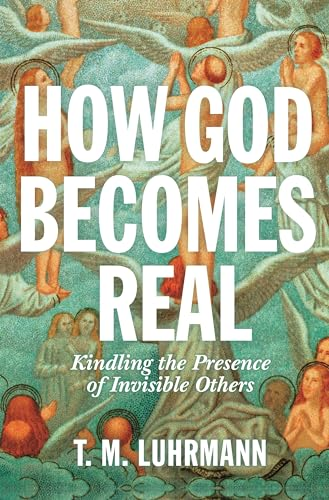
How do gods and spirits come to feel vividly real to people–as if they were standing right next to them? Humans tend to see supernatural agents everywhere, as the cognitive science of religion has shown. But it isn’t easy to maintain a sense that there are invisible spirits who care about you. In How God Becomes Real, acclaimed anthropologist and scholar of religion T. M. Luhrmann argues that people must work incredibly hard to make gods real and that this effort–by changing the people who do it and giving them the benefits they seek from invisible others–helps to explain the enduring power of faith.
Drawing on ethnographic studies of evangelical Christians, pagans, magicians, Zoroastrians, Black Catholics, Santeria initiates, and newly orthodox Jews, Luhrmann notes that none of these people behave as if gods and spirits are simply there. Rather, these worshippers make strenuous efforts to create a world in which invisible others matter and can become intensely present and real. The faithful accomplish this through detailed stories, absorption, the cultivation of inner senses, belief in a porous mind, strong sensory experiences, prayer, and other practices. Along the way, Luhrmann shows why faith is harder than belief, why prayer is a metacognitive activity like therapy, why becoming religious is like getting engrossed in a book, and much more.
A fascinating account of why religious practices are more powerful than religious beliefs, How God Becomes Real suggests that faith is resilient not because it provides intuitions about gods and spirits–but because it changes the faithful in profound ways.
Tanya Marie Luhrmann is currently the Watkins University Professor in the Anthropology Department at Stanford University. She has been elected to the American Academy of Arts and Sciences, and has been the recipient of a John Simon Guggenheim Fellowship.
Tanya Marie Luhrmann (born 1959) is an American psychological anthropologist best known for her studies of modern-day witches, charismatic Christians, and psychiatrists. She received her AB summa cum laude in Folklore and Mythology from Harvard-Radcliffe in 1981, working with Stanley Tambiah. She then studied Social Anthropology at Cambridge University, working with Jack Goody and Ernest Gellner. In 1986 she received her PhD for work on modern-day witches in England, later published as Persuasions of the Witch’s Craft (1989). In this book, she described the ways in which magic and other esoteric techniques both serve emotional needs and come to seem reasonable through the experience of practice.
Her second research project looked at the situation of contemporary Parsis, a Zoroastrian community in India. The Parsi community enjoyed a privileged position under the British Raj; although by many standards, Parsis have continued to do quite well economically in post-colonial India, they have become politically marginal in comparison to their previous position, and many Parsis speak pessimistically about the future of their community. Luhrmann’s book The Good Parsi (1996) explored the contradictions inherent in the social psychology of a post-colonial elite.
Her third book, and the most widely acclaimed, explored the contradictions and tensions between two models of psychiatry, the psychodynamic (psychoanalytic) and the biomedical, through the ethnographic study of the training of American psychiatry residents during the health care transition of the early 1990s. Of Two Minds (2000) received several awards, including the Victor Turner Prize for Ethnographic Writing and the Boyer Prize for Psychological Anthropology (2001).
Her fourth book, When God Talks Back: Understanding the American Evangelical Relationship with God (March 2012), examines the growing movement of evangelical and charismatic Christianity, and specifically how practitioners come to experience God as someone with whom they can communicate on a daily basis through prayer and visualization.
Other projects she is working on include a NIMH-funded study of how life on the streets (chronically or periodically homeless) contributes to the experience and morbidity of schizophrenia.
The hard work required to make God real, how it changes the people who do it, and why it helps explain the enduring power of faith
How do gods and spirits come to feel vividly real to people―as if they were standing right next to them? Humans tend to see supernatural agents everywhere, as the cognitive science of religion has shown. But it isn’t easy to maintain a sense that there are invisible spirits who care about you. In How God Becomes Real, acclaimed anthropologist and scholar of religion T. M. Luhrmann argues that people must work incredibly hard to make gods real and that this effort―by changing the people who do it and giving them the benefits they seek from invisible others―helps to explain the enduring power of faith.
Drawing on ethnographic studies of evangelical Christians, pagans, magicians, Zoroastrians, Black Catholics, Santeria initiates, and newly orthodox Jews, Luhrmann notes that none of these people behave as if gods and spirits are simply there. Rather, these worshippers make strenuous efforts to create a world in which invisible others matter and can become intensely present and real. The faithful accomplish this through detailed stories, absorption, the cultivation of inner senses, belief in a porous mind, strong sensory experiences, prayer, and other practices. Along the way, Luhrmann shows why faith is harder than belief, why prayer is a metacognitive activity like therapy, why becoming religious is like getting engrossed in a book, and much more.
A fascinating account of why religious practices are more powerful than religious beliefs, How God Becomes Real suggests that faith is resilient not because it provides intuitions about gods and spirits―but because it changes the faithful in profound ways.
(Amazon.com)
Consciousness, spirituality, biography, sexuality, androgyny, futurism, space, the arts, science, astrology, democracy, humor, books, movies and more