The hard work required to make God real, how it changes the people who do it, and why it helps explain the enduring power of faith
How do gods and spirits come to feel vividly real to people–as if they were standing right next to them? Humans tend to see supernatural agents everywhere, as the cognitive science of religion has shown. But it isn’t easy to maintain a sense that there are invisible spirits who care about you. In How God Becomes Real, acclaimed anthropologist and scholar of religion T. M. Luhrmann argues that people must work incredibly hard to make gods real and that this effort–by changing the people who do it and giving them the benefits they seek from invisible others–helps to explain the enduring power of faith.
Drawing on ethnographic studies of evangelical Christians, pagans, magicians, Zoroastrians, Black Catholics, Santeria initiates, and newly orthodox Jews, Luhrmann notes that none of these people behave as if gods and spirits are simply there. Rather, these worshippers make strenuous efforts to create a world in which invisible others matter and can become intensely present and real. The faithful accomplish this through detailed stories, absorption, the cultivation of inner senses, belief in a porous mind, strong sensory experiences, prayer, and other practices. Along the way, Luhrmann shows why faith is harder than belief, why prayer is a metacognitive activity like therapy, why becoming religious is like getting engrossed in a book, and much more.
A fascinating account of why religious practices are more powerful than religious beliefs, How God Becomes Real suggests that faith is resilient not because it provides intuitions about gods and spirits–but because it changes the faithful in profound ways.
Tanya Marie Luhrmann is currently the Watkins University Professor in the Anthropology Department at Stanford University. She has been elected to the American Academy of Arts and Sciences, and has been the recipient of a John Simon Guggenheim Fellowship.
Tanya Marie Luhrmann (born 1959) is an American psychological anthropologist best known for her studies of modern-day witches, charismatic Christians, and psychiatrists. She received her AB summa cum laude in Folklore and Mythology from Harvard-Radcliffe in 1981, working with Stanley Tambiah. She then studied Social Anthropology at Cambridge University, working with Jack Goody and Ernest Gellner. In 1986 she received her PhD for work on modern-day witches in England, later published as Persuasions of the Witch’s Craft (1989). In this book, she described the ways in which magic and other esoteric techniques both serve emotional needs and come to seem reasonable through the experience of practice.
Her second research project looked at the situation of contemporary Parsis, a Zoroastrian community in India. The Parsi community enjoyed a privileged position under the British Raj; although by many standards, Parsis have continued to do quite well economically in post-colonial India, they have become politically marginal in comparison to their previous position, and many Parsis speak pessimistically about the future of their community. Luhrmann’s book The Good Parsi (1996) explored the contradictions inherent in the social psychology of a post-colonial elite.
Her third book, and the most widely acclaimed, explored the contradictions and tensions between two models of psychiatry, the psychodynamic (psychoanalytic) and the biomedical, through the ethnographic study of the training of American psychiatry residents during the health care transition of the early 1990s. Of Two Minds (2000) received several awards, including the Victor Turner Prize for Ethnographic Writing and the Boyer Prize for Psychological Anthropology (2001).
Her fourth book, When God Talks Back: Understanding the American Evangelical Relationship with God (March 2012), examines the growing movement of evangelical and charismatic Christianity, and specifically how practitioners come to experience God as someone with whom they can communicate on a daily basis through prayer and visualization.
Other projects she is working on include a NIMH-funded study of how life on the streets (chronically or periodically homeless) contributes to the experience and morbidity of schizophrenia.
The secretary of war puts the T in toxic masculinity.
Last month, Pete Hegseth, US secretary of war — and I do mean war— further polluted the air already fouled with misinformation: He amplified the false impression circulated by the online manosphere that high testosterone levels make one a better fighter.
This seems to have led many civilian men to seek out sources — legitimate or not — to get this manly hormone into their systems, whether they need it or not. (And if they don’t need it, they may suffer the dreadful effects of its abuse — such as testicle shrinkage!)
As you probably know, Hegseth demanded that all soldiers over the age of 30 have their testosterone levels tested. And look at the language he used:
He wants a “High-T Department of War.”
He wants soldiers on the “leading edge of lethality.”
And if a “warfighter’s” testosterone is found to be deficient, he has the “option” of getting hormone replacement therapy. (Health Secretary Robert F. Kennedy Jr. gets such therapy, and he is definitely lethal, though not as a soldier. His decisions on vaccines have resulted in untold death and misery.)
Since our soldiers in the Middle East do their killing not by hand-to-hand combat but by operating lethal machinery — the role of “High T” in modern warfare is not clear to me.
Possibly Hegseth believes a man with high testosterone will be not only physically, but psychologically fit; that is, he should have the right lethal attitude. Kill! Kill! Kill!
Ironically, some of the most lethal, most murderous leaders in history — men who ordered others to kill — apparently had low levels of testosterone themselves. There is some truth in this British World War II song, at least as it applies to Hitler:
And then there’s Napoleon, another killer. He had a condition known as “micropenis.” His doctor surreptitiously removed the organ during his autopsy and, ever since, it has been passed around, unpreserved, in a small presentation box, to various collectors.
The organ has been described as a “shriveled eel” and “a bit of beef jerky.” Of course in its dried out state, it wouldn’t look its best, but indications are, his equipment was abnormally small.
And there’s other evidence Napoleon’s testosterone levels may have been beneath Hegseth’s standards. According to Napoleon’s doctor, François Antommarchi, after stepping out of his bath, the Emperor said to him (translations vary):
“See Doctor, what lovely arms, what smooth white skin without a single hair! What rounded breasts — any beauty would be proud of a bosom like mine.”
In addition to Hitler and Napoleon, there are droll stories about lethal contemporary characters — men you can’t avoid reading about every day — men whose names I shall not mention.
These stories describe in detail what some would characterize as “embarrassing inadequacies” (not necessarily hormone related), that could be especially triggering to an appearance-obsessed, malignant narcissist. You can guess who they are. Google is gagging over the inquiries.
But what these unmentioned men — with their unmentionable private issues — truly lack is a conscience. And to a degree that is grotesque. Their actions have resulted in countless deaths and ruined lives.
***
I wonder what Hegseth’s own testosterone levels are.
And I wonder if he knows how much alcohol diminishes one’s testosterone levels.
A doctor once told me about all the drunks he’d seen down in the Bowery who had full heads of hair — owing to low levels of testosterone thanks to booze. According to the peer-reviewed medical journal Andrology, which reported the results of multiple analyses involving 10,199 men:
“The meta-analysis showed that alcohol consumption overall is related to significant reduction in circulating concentrations of total testosterone.”
(Note to the technically inclined: Men and women both have testosterone and estrogen, but in different proportions. In a man, low testosterone results in “unopposed estrogen,” which in turn results in nice head hair, but low body hair. On the other hand, if a woman is very low in estrogen, she has “unopposed testosterone” and may have sparse head hair, but a full mustache.)
Pete Hegseth certainly has plenty of hair on his head that is probably his own — and for decades, apparently, he’s had plenty of alcohol in his system.
Whistleblowers from the Concerned Veterans for America (CVA), led by Hegseth until 2016, alleged that he was repeatedly drunk while performing official duties. More recently (December 3, 2024), NBC News published this story, based on interviews with 10 current and former Fox employees: “Pete Hegseth’s Drinking Worried Colleagues at Fox News.” And Hegseth’s former sister-in-law alleged in an affidavit that Hegseth was frequently drunk, during which time he abused his wife.
In any case, it sounds like he’s had more than a drink or two.
Besides alcohol, recreational drugs like heroin and cocaine affect testosterone levels, which may explain why former drug user Kennedy needs hormone replacement therapy. (He also needs brain replacement therapy, but none is available.)
But there is something far more dangerous to your masculinity and, indeed, to the entire human race and other forms of life on this planet. Namely, petroleum, aka oil.
***
Sooner or later, in one form or another, oil seeps into everything in our lives.
It seeps into nearly everything around us — in the form of tiny bits of plastic — which are made from fossil fuels.
Microplastics (MPs) and nanoplastics (NPs), which are even smaller, abound in the air, the soil, the water, our food, and not just from the plastic packaging. MPs have been found in the animals we eat (fish muscle, for example) and in the fibers of fruits and vegetables.
And MP/NPs are in nearly every organ of your body. They are in your brain (7 grams in the frontal cortex, where you do your thinking), in your retinas, in your blood vessels, your heart, liver, and so on. And in your reproductive equipment, male and female.
In this story, I am focusing on males because, according to our secretary of war, males need their testosterone in order to be on the “leading edge of lethality.”
NPs have been found in human semen, in human testicles (and in the testicles of dogs, studied because their lives are deeply intertwined with ours), and in human penises. To see more proof of the danger, go here, here, and here.)
The drop in sperm count in developed countries began approximately 50 years ago. The subject is controversial, and different causes are cited, but I can’t help noticing that 50 years ago happens to be about the same time we started using really humongous amounts of plastics.
And plastics seem to be here to stay. The world is shifting toward renewable power, and to offset declining fuel sales, major oil and gas companies are turning to plastics as “Plan B.” According to the Center for International Environmental Law, “Just as the world begins to realize the dangers of plastic pollution and take action to reduce it, industry is poised to invest billions in expanding plastic production.”
***
In the meantime, though infested with plastic, we should all try to take good care of ourselves.
Men, if you suspect you have abnormally low testosterone levels — or if you’re an accomplished hypochondriac — you can view this long list of symptoms presented by the Mayo Clinic — but bear in mind that many of these same symptoms are caused by psychological factors. Better to discuss the issue with a urologist.
Here are some good, up-to-date articles on the safety of testosterone therapy:
Your lifestyle can greatly affect your hormone levels (as well as everything else) — high stress, inadequate sleep, poor nutrition, lack of exercise, and, as previously mentioned, drugs and alcohol. You’ve heard it all before.
Avoid this book: Manhood: The Masculine Virtues America Needs, by Sen. Josh Hawley (R-MO), who believes “No menace to this nation is greater than the collapse of American manhood, the collapse of masculine strength.”
Milicent CranorMilicent Cranor is a senior editor at WhoWhatWhy. She has worked as a creative editor at E.P. Dutton, a comedy ghostwriter, and editor of consequential legal and scientific documents. She has also co-authored numerous peer-reviewed articles for medical journals.
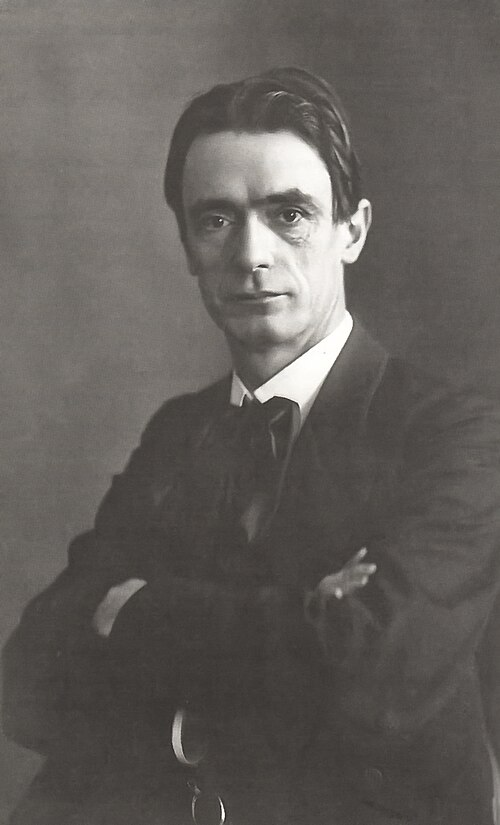
“Just as in the body, eye and ear develop as organs of perception, as senses for bodily processes, so does a man develop in himself soul and spiritual organs of perception through which the soul and spiritual worlds are opened to him. For those who do not have such higher senses, these worlds are dark and silent, just as the bodily world is dark and silent for a being without eyes and ears.”
~ Rudolf Steiner
Rudolf Joseph Lorenz Steiner was an Austrian New Age guru, philosopher, occultist, social reformer, architect, esotericist, and claimed clairvoyant and speaker with the dead. Wikipedia
A greedy galaxy that existed less than 1.3 billion years after the Big Bang is hoarding supermassive black holes.
The distant galaxy J0148-4214, seen in the light of ionized hydrogen. The image appears pixelated because of the great distance to the galaxy. The black circles denote the relative locations of the three black holes. (Image credit: Hannah Übler)
A trio of heavyweight black holes are entangled in a dance of death that will quite possibly see them gradually all merge to form an even greater behemoth.
Scientists have discovered the black holes in a galaxy that is so far away its light has taken 12.5 billion years to reach us, meaning we see it as it was less than 1.3 billion years after the Big Bang. And it’s offering strong supporting evidence that one of the ways black holes grew so massive so quickly in the early universe was through mergers.
“This is the first evidence of three active black holes in a single galaxy in the distant universe,” Hannah Übler, an astronomer at the Max Planck Institute for Extraterrestrial Physics in Germany who led the study, said in a statement. “It suggests that processes in the early universe were efficient at bringing massive black holes together, setting the stage for the massive black-hole mergers we expect to detect with future gravitational-wave observatories.”
The galaxy that plays host to the black holes is catalogued as J0148-4214 and is so far away (their redshift is 5.0167) that the James Webb Space Telescope (JWST), which made the discovery, could not see the black holes directly. Instead, the Integrated Field Spectroscopy unit on the JWST’s Near Infrared Spectrometer (NIRSpec) measured the motion of hydrogen gas swirling around at high velocity in the accretion disks encircling each black hole.
“The JWST data allowed us not only to identify the three black holes, but also to estimate their masses, accretion rates and the stellar mass of the galaxy,” Giovanni Mazzolari of the Max Planck Institute for Extraterrestrial Physics said in the statement. “We find a total stellar mass of about 1.3 billion suns, and the black holes represent a significant fraction of that.”You may like
Two of the black holes reside at the center of J0148-4214, separated by 620 light-years. One of these black holes has a huge mass of 80 million times the mass of our sun, while its companion is a relative pipsqueak at 600,000 solar masses. Yet despite its diminutive stature, the smaller black hole is growing at a tremendous rate by accreting gas faster than the Eddington limit. This is the theoretical maximum rate at which material can fall towards a black hole; if the rate is any higher then the accretion disk around the black hole becomes so dense and hot that radiation from the disk blows material back out again, stifling the black hole’s feeding frenzy. This means the smaller black hole will only be able to keep growing at this rate for a short time before negative feedback calls a halt.
The third black hole is 5,500 light-years out from the center of J0148-4214 and has a mass two million times greater than the mass of our sun. This is about half the mass of the supermassive black hole at the center of our Milky Way galaxy, called Sagittarius A*. It’s thought that this third black hole, and quite possibly the second one too, found their way into J0148-4214 via mergers between galaxies.
“These results are extremely exciting,” said Roberto Maiolini of the University of Cambridge, who was a participant in the findings. “They suggest that black-hole merging may be an additional, fast route for their rapid growth in the early universe.”
An image of Sagittarius A*, the supermassive black hole at the heart of the Milky Way. (Image credit: EHT Collaboration)
Mergers between black holes produce bursts of gravitational waves. Current gravitational-wave detectors — including The Laser Interferometer Gravitational-Wave Observatory (LIGO) in the United States, Virgo in Italy and KAGRA in Japan — are able to detect the high frequency, short wavelength gravitational waves from the mergers of stellar-mass black holes, the kind formed in certain supernova explosions. To detect the much longer wavelength, shorter frequency gravitational waves produced by the merger of supermassive black holes such as those in J0148-4214 requires a space-based detector with a baseline many millions of miles long.
To that end, the European Space Agency plans to launch LISA, the Laser Interferometer Space Antenna. If all goes to plan, by the mid-2030s. LISA will feature three spacecraft in triangular formation, each side of the triangle being 1.55 million miles (2.5 million kilometers) long. The three spacecraft will beam lasers at each other, looking for deviations in the travel time of those laser beams as evidence for the passing of a long-wavelength gravitational wave.What to read next
With regards to J0148-4214, however, there is a caveat: The third black hole might not be on a collision course with the other two. Instead, it could be heading out of the galaxy.
It’s the classic three-body problem: How do three objects orbiting one another interact?
The two smaller black holes may have entered J0148-4214 as a binary pair. Then, as they were drawn closer to the 80-million-solar-mass black hole, the more massive black hole could have snatched the 600,000-solar-mass black hole while exchanging angular momentum with the two-million-solar-mass black hole to fling it away at high velocity. We see a similar effect in our galaxy with hypervelocity stars that are racing out of the Milky Way. These speedy stars used to be part of a binary pair of stars that got too close to Sagittarius A*, which is the black hole at the center of our galaxy. One half of the binary was captured by the black hole and the other was flung away.
Currently, there is no way to measure the direction of motion of the third black hole in J0148-4214 and confirm whether it will merge with the other two black holes or escape. If it did escape, it could still be wandering alone and dark in intergalactic space even now, 12.5 billion years later.
Key takeaways powered by Yahoo Scout. Yahoo is using AI to generate key points from this article. This means the info may not always match what’s in the article. Reporting mistakes helps us improve the experience.
Kentucky parents are outraged after discovering that horribly inaccurate educational materials handed out to their middle school students were generated with AI.
According to local station WDRB, students at Farnsley Middle School in Southwest Louisville were sent home with a packet chock full of AI hallucinations on their first day of the school year. The most obvious tell was a map of North America, which contained some jaw dropping misspellings of state names, misplaced cities, and hallucinated territories that don’t actually exist.
Kentucky, for example, was mislabeled “Venecky,” while states like Texas and Louisiana were reimagined as “Taxas” and “Lookoong.” Though South Dakota made it out unscathed, its northern counterpart was branded “North Dahota.” Other notable entries are Arizona and New Mexico, which became “Arizone” and “New Mizone,” while Oklahoma degenerated into “Olkchoma.”
Even when the AI render got its names right, the locations are horribly mangled, in one instance pinpointing Cuba’s capital city of Havana as situated on Mexico’s Yucatan peninsula.
Some states like Michigan and California didn’t merit any names at all, while others are split into imaginary realms. South of Vancouver (spelled “Venneouer”), for example, is the mythical land of “Beehie,” which according to the map shares its borders with Washington state.
“Arizona is Arizone. Illinois starts with a V,” Stacey Morris, a Kentucky mom whose son brought home one of the packets told WDRB. “I mean, it’s crazy.”
Images shared on social media show other parts of the packet with similar problems, like a periodic table of the elements showing Magnesium with an impossible atomic mass of -3.08, and a map of the solar system where Mars has been labeled “Marc.”
“Planetary distance are temporatory earth, equater the elenonts and regnestiom org toed dishligns,” the packet declares, verbatim. “Net to scale.”
A parent discovered that her daughter’s middle school in Kentucky has been having their students use agendas that are ai generated pic.twitter.com/7ToGyTwLFQ
In a statement to WDRB, the school district’s executive officer of communications said they “spoke with the school today about inaccuracies in their agenda, and they are communicating with parents about the issue.” After the discovery, the school admin reportedly emailed teachers about the packet, ultimately advising them to rip out 17 pages of AI-generated material before handing them out to students.
For adults who know better, it might just be another case of silly AI hallucinations. But to present this material to middle school students — who may just be starting to conceptualize the world beyond Kentucky for the first time — is egregious, and the long-termconsequences are hard to overstate. While the generative AI tool may have butchered the material, the blame falls squarely on the shoulders of whichever educator hit print without giving the packet even a passing glance.
Last week, we brought you the story of parents homeschooling their kids using AI chatbots to plan lessons and curricula. One parent, the controversial influencer Savannah LaBrant, specifically bragged that she was using ChatGPT to teach her kids “where the states are and how to locate them.”
If this is the quality of material used to educate our kids, it’s no wonder students in the US are performing worse on standardized testing than almost ever before — a metric which is sure to keep plummeting in the years to come.
When, in disgrace with fortune and men’s eyes, I all alone beweep my outcast state, And trouble deaf heaven with my bootless cries, And look upon myself and curse my fate, Wishing me like to one more rich in hope, Featured like him, like him with friends possessed, Desiring this man’s art and that man’s scope, With what I most enjoy contented least; Yet in these thoughts myself almost despising, Haply I think on thee, and then my state, (Like to the lark at break of day arising From sullen earth) sings hymns at heaven’s gate; For thy sweet love remembered such wealth brings That then I scorn to change my state with kings.
Edwin Rutsch Aug 14, 2026 Empathy Expert Interviews Edwin Rutsch and Tim meet to explore whether empathy can function as an organizing principle for civilization. Edwin argues from a secular perspective that mutual (“wholistic”) empathy and deep listening can serve as the foundational bedrock for societal conflict resolution and governance. Tim contends that while empathy is an essential moral virtue, civilization also requires objective truth, moral value judgments, and structural frameworks to function effectively. Tim Orr is an ordained Evangelical minister, seasoned academic, and passionate advocate for interreligious dialogue. He serves as a Research Fellow with the Institute for the Study of Global Antisemitism and Policy (ISGAP), where his scholarship focuses on the intersections of religion, ideology, contemporary antisemitism, and public life. Dedicated to fostering understanding across divides, his digital ministry and platform are centered on building bridges, uniting hearts, and helping faith flourish. A contributing writer for The Times of Israel, his published essays include “Beyond the Red-Green Alliance: Empathy and Structural Asymmetry” and “Toxic Empathy is Not Love – and It’s Dangerous.” https://blogs.timesofisrael.com/autho… / tim-orr-a0959524 Edwin Rutsch is the Founding Director of The Empathy Center, as well as a leading organizer in the global Empathy Movement. Over nearly two decades, he has dedicated his work to bridging social, cultural, and political divides by establishing mutual active listening as a foundational social practice. Edwin is the developer and primary advocate of the Empathy Circle framework—a structured, highly scalable dialogue practice used worldwide across educational, community, and conflict-resolution settings. Through his initiatives, including the public-dialogue Empathy Tent project, global Empathy Summits, and hundreds of recorded interviews with scholars and thought leaders, he works to foster empathy as a primary social value and everyday skill. Building the Empathy Movement
Four billion years ago, in the hydrothermal vents at the bottom of the world where serpentine is forged, chemistry trembled with the promise of consciousness and matter began its long metabolic pilgrimage toward mind. Perhaps our saline cells remember it: how we, pilgrims of the possible, crawled out of the tide pools to climb the trees, then came down from the trees to live under a canopy of one hundred trillion synapses animated by the oceanic yearning to make meaning of our mortality. Perhaps the ocean, with its primeval drama of life and death, will always remind us of where we came from and where we are going. Rachel Carson knew this when she contemplated the peculiar effect of facing the open ocean, the way it fills us with “an uneasy sense of the communication of some universal truth that lies just beyond our grasp… the ultimate mystery of Life itself.”
Alan Watts (January 6, 1915–November 16, 1973) captures this with uncommon poignancy in a 1960 talk titled “Love of Waters,” found in the posthumously compiled lecture collection Zen Rascal.
Writing from his studio — a floating library on an old ferryboat tied to the waterfront of Sausalito just north of San Francisco — Watts begins with a fine contribution to the canon of literature’s best reckonings with time:
Although the rhythm of the waves beats a kind of time, it’s not clock or calendar time. It has no urgency. It’s timeless time. Because I know I’m listening to a rhythm which has been just the same for millions of years. And it takes you out of the world of relentlessly ticking clocks. Clocks, for some reason or other, always seem to be marching, and armies never march to anything but doom. But there’s no marching rhythm in the motion of waves. It harmonizes with the breath. It does not count our days. Its pulse is not in the stingy spirit of measuring, of marking out how much still remains. It’s the breathing of eternity, like the Brahmā of Indian mythology, who inhales and exhales, manifests and dissolves the worlds endlessly, for ever. As a mere conception, that sounds appalling and monotonous — until you listen to the breaking and washing of waves.
Observing how all the waste and want of our civilization are “transformed in the beneficent presence of the sea,” he considers the mysterious mechanism of the transformation in what reads like a prose poem:
Perhaps it’s the quality of the light, especially early in the morning and towards the evening, when the distinction of sky and water becomes uncertain, when the whole of space becomes opalescent; the sort of pearly, luminous grey, and the rising or setting moon is straw yellow. In this light, all the rambling mess of sheds and junkyards is magical, blessed with the white cries of gulls, and with the patterns of masts and ropes and boats at anchor which put me in mind of landfalls a long way away, and of all the voyages of which one has dreamed.
And yet in the ocean, this poetic dimension of life coexists with the teeming brutality of predator and prey, the merciless drama of death. In a stirring reminder that the evolutionary is inseparable from the existential, Watts writes:
This is the paradox of the ocean. Sand, flying spray, pebbles and shells, driftwood, sparkling water, space incredibly luminous, with cloud banks along horizons underlying skies into which one’s imagination can reach forever. But under the surface of both sky and water there’s the grim business of preying. Men and birds against fish, fish against fish. The torturous process of life continuing by the painful transformation of one form into another.
[…]
There’s no way of getting around it, is there? The gull isn’t rapacious or greedy. It’s just that his being alive at all is the same thing as eating crabs. Sea birds are transformations of fish. Men are transformations of wheat, chickens, and steers. And a love for the food is the agony of the food. To object to this inseparability of pleasure and pain, life and death, is simply to object to existence. But, of course, we cannot help objecting when the time comes. Objecting to pain is pain.
The Great Wave off Kanagawa by Japanese artist Hokusai, 1831. (Available as a print.)
With an eye to the price of consciousness, Watts observes that the human animal, with its ability to stand outside of itself and think about itself — that is, “to comment on life” — has curled into a profound confusion about its own existence: By standing aside from life in order to think about it, we evicted ourselves from it and, as Watts puts it, “found it alien.” A generation before Ursula K. Le Guin wrote so movingly about subject vs. object in the meaning of life, Watts invites us out of this dualistic self-expatriation from the living world:
Perhaps thinking about the world and objecting to its whole principle are simply two aspects of the same mechanism. The very words suggest, don’t they: perhaps we must object to everything that becomes an object. But aren’t there also times when we speak of something that we know as a subject — the subject of this book, the subject I am now studying? Would it be possible to subject to life instead of objecting to it? Is this playing with words, or does it possibly mean something? Now, if the gulls and the fish don’t philosophize, they have no consciousness of life being either good as a whole or bad as a whole. So when we philosophize and pity the poor fish, that’s just our problem. From its own standpoint, the world of animals and insects doesn’t find itself problematic at all. There’s not the slightest evidence to suggest it. On the contrary. I’m inclined to feel that all these creatures really swing and go on living up to the very moment when the game is no longer worth the candle. I’m quite sure they don’t lecture each other about their duties or worry about where they’re going when they’re dead.
[…]
To be human is precisely to have that extra circuit of consciousness which enables us to know that we know, and thus to take an attitude to all that we experience. The mistake that we’ve made — and this, if anything, is the fall of man — is to suppose that that extra circuit, that ability to take an attitude to life as a whole, is the same as actually standing aside and being separate from what we see. We seem to feel that the thing which knows that it knows is one’s essential self. That, in other words, our personal identity is entirely on the side of the commentator. We forget that self-consciousness is simply a subordinate part and instrument of our being; a sort of mental counterpart to the finger-thumb opposition of the human hand.
And which is you, the finger or the thumb? Look at the stages of differentiation. First: the organism from its environment — and with this, knowledge of the environment. Second: the distinction of knowing knowledge from knowledge itself. But all this, like the finger-thumb opposition, is a difference which does not divide. The thumb isn’t floating in the air alongside the rest of the hand. At their roots they’re joined. And at our roots we are joined to the whole subject of nature.
Watts ends with a mighty corrective for the far-reaching damage Descartes has done and does us still:
Of course, you may say that nature or the universe is just a big abstraction. But tell me: is an orange just an abstraction from its component molecules?
I think our difficulty is that our consciousness is too superficial, as if all our sensation were in the tips of the fingers and not in the palm. Our comments on life are insufficiently balanced by the clear sensation that what we are talking about as ourselves, and ourselves in a sense far more basic and real than that extra circuit which knows knowing… Were we as spatially distant from the Earth as one atom of an orange from another, I suppose we should be somewhere out by the Moon.
[…]
I think this is why I love the ocean. It’s the most difficult part of nature to mess up with emblems and symptoms of man’s dissociated consciousness. It’s an environment in which the awareness of our roots can awaken, in which space (so real because of the light and color) can be seen to be joining things instead of separating them. Yes. And I’ve just discovered that knocking on the wall of space and consciousness was my own heart beating.
“There is no initiation either into such mysteries. He has to live in the midst of the incomprehensible, which is also detestable. And it has a fascination, too, that goes to work upon him.” –Heart of Darkness
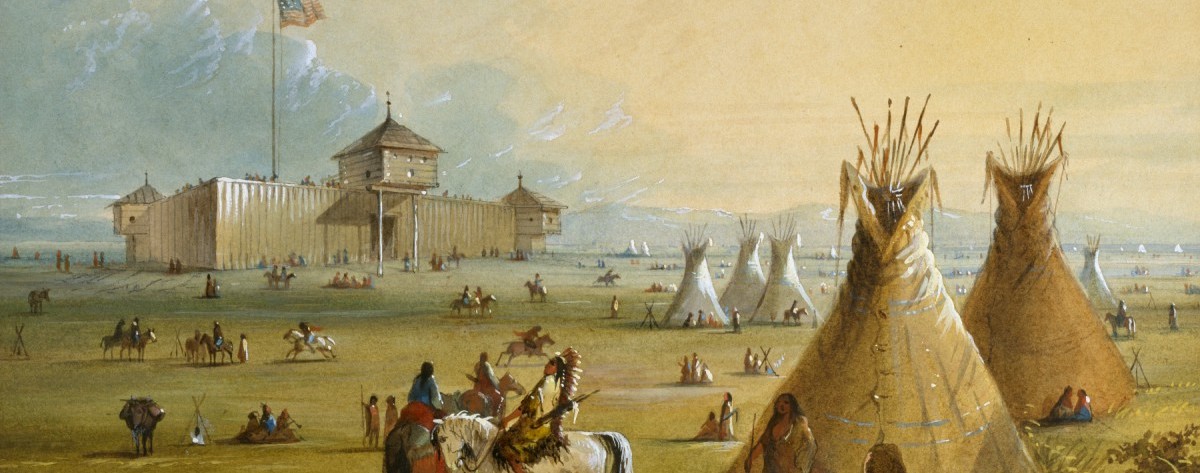
On the final day of April 1774, the Minerva was plying the waters of the Atlantic Ocean, headed for Boston. On board were London newspapers bearing the first news of England’s response to the Tea Party. Bostonians would soon learn that, as punishment, the Crown had decided to close the port, a step that would spark a civil war in the British empire. Hours before the Minerva’s lookout spied Boston Harbor, seven Native people crossed a smaller body of water as they traveled to a meeting that they hoped would prevent a similar breakdown in relations with colonial settlers. The party knew the trip put them in mortal danger and yet they went anyway; it’s what their family had done for more than four decades.
That family had negotiated relationships between Natives and colonists since the 1730s. So despite whatever apprehensions they might have had, they climbed into their canoes and let a tributary called Yellow Creek carry them about a mile down to the Ohio River. Today, they would have passed under Ohio Route 7 and a graffiti-covered railroad trestle right as they caught the big river’s course. Paddling against the current, they soon reached their destination, a small log cabin that sat just up from the eastern shore on a piece of ground known as Baker’s Bottom.
While we can acknowledge that white colonists possessed enormous power, not least in their sheer numbers, that alone does not explain imperial encounter.
The seven Natives—four men, two women, and a baby—were invited into the cabin’s front room, where a few colonists poured them drinks and allegedly launched into a conventional ceremony of keeping peace. Things were tense, but the alcohol helped. The two groups joked with one another. One of the colonial hosts had a British regimental uniform. As they all got a little tipsy, a Native man put on the red coat and paraded around the room. Someone proposed a shooting contest as a diversion and perhaps to further clear the air. Several went outside and identified a target. You go first, the white men told the Natives, and the latter fired, leaving themselves disarmed. The trap was sprung.
There were more than a dozen colonists hiding in the back room of the cabin. When the shooting started, the crouching, silent men leapt into action, running out into the yard, advancing on the unsuspecting Natives, who turned and sprinted for their canoes. Bullets took down one man, then another and another, spilling blood over the ground as acrid gunsmoke rose into the air. An elderly woman also fell. A second Native woman clutched her baby and ran for the water’s edge. When she realized escape was impossible, she turned and begged the men to spare the child’s life. She’s the daughter of a white man, the mother pleaded about her child, hoping that might convince them. They paused and allowed her to hand over the baby before shooting her in the face.
Three more Natives, worried about what might be happening across the way, had come looking for their relations. They were caught in the middle of the river when the colonists fired away, killing two of them, too. One, a woman, survived, but was gravely wounded and barely made it to the other side.
In all, eight Native people would perish in the horror at Yellow Creek on April 30, 1774. In contrast to many stories from America’s history about Native-European encounters, where we know little about the lives of half of the participants, in this case we know several of the victims well. We know their family biography. They were the family of Shickellamy, one of the most significant Iroquois leaders of the mid-eighteenth century.
His importance lay in the role he had played as an ambassador for his people: decades before, the Six Nations tasked him with checking white colonists’ desires for more and more land along a different river, the Susquehanna, east of the Ohio Valley. He befriended the man who was in many respects his opposite, James Logan, Pennsylvania’s agent tasked with satiating colonists’ thirst for land. Shickellamy honored his friend and colleague by giving two of his sons the name Logan.
Those boys would become Native negotiators in their own right. The Shickellamys were one of the most prominent political families in North America in the middle of the eighteenth century. They had tried for a generation to forge deals between colonists and Natives. They had participated in and shaped many of the most consequential events in the history of colonial America. Despite their efforts, they had largely failed and now nearly all of them were dead. Shickellamy’s wife, youngest son, and a daughter were among the slain at Yellow Creek.
*
The interpretative paths we have constructed to help guide us through the baffling, bewildering forests of early America struggle with horrific scenes like these. One of the most prominent of these paths was blazed by a thirty-two-year-old historian named Frederick Jackson Turner. Delivered as an address in 1893 at an exposition commemorating the four hundredth anniversary of Columbus’s voyage to the New World, Turner’s “The Significance of the Frontier to American History” is widely considered to be among the most influential pieces of writing about American history.
How Turner reached his conclusions has become its own legend. As the story goes, Turner gathered the ideas that would become his “frontier thesis” after reading the results of the 1890 census. The bureaucrats in the Census Office proclaimed that the frontier, a line of “settlement” that had steadily advanced across the continent throughout the eighteenth and nineteenth centuries, was now closed; it was a relic of the past. Turner read this report with alarm. It compelled him to investigate what effect the frontier had had on the United States.
In “The Significance of the Frontier,” Turner declared that the process of “perennial rebirth, this fluidity of American life, this expansion westward with its new opportunities … furnish the forces dominating American character.” It was the secret to what made the United States different from and better than every other nation. For Turner, incidents like Yellow Creek were aberrations perpetrated by a “line of scum that the waves of advancing civilization bore before them.” Unfortunate episodes such as these were merely a small part of a larger glory, of a world-historical dynamic that had made America—and Americans—great.
Since the 1940s, scholars have challenged Turner’s thesis. They have pointed out all of the men and women whom Turner left out of his fabulous tale. Critics have especially taken issue with his notion of an advancing frontier line, using other words that emphasized space over time, place over process. Focusing on regional differences, historians have presented evocative and powerful accounts of how colonists and Natives encountered one another on middle grounds, native grounds, borderlands, and bordered lands.
Each of these terms offered a new analysis of Native-colonial encounter, focusing on who dictated political, economic, and cultural terms and how power ebbed and flowed. They contend that geography matters: what happened in the region they are studying could only have done so in that specific spot. This is by design; a rejection of Turnerian meta-narratives.
More recently, scholars looking to interpret encounter between Native peoples and colonists have relied on the concept of “settler colonialism.” Developed largely by Australian scholars writing about what happened to Indigenous peoples there, the concept of settler colonialism has been used to argue that European settlers in the Americas did not simply take land and resources from Indigenous peoples but eliminated them after the fact by destroying their history and discrediting their way of life.
Settler colonialism posits a “double dispossession”: Europeans did more than invade Native lands—they occupied them. For theorists of settler colonialism, incidents like Yellow Creek are all too easy to understand; what happened to the eight Natives at Baker’s Bottom was not only predictable, but an inevitable and unsurprising part of the conquest of North America.
At its core, settler colonialism represents a reversion back to a focus on time. It is another process argument, one that has an oddly Turnerian quality to it. Although its claims come from precisely the opposite track than Turner’s celebration of pioneers, settler colonialism has a logic, a thrust, a teleology, too. Just as Turner’s tale had frontiersmen laying the foundation of American greatness through the trials of taming the West, historians who subscribe to settler colonialism tell us the double dispossession—the destruction of Native America—was also inescapable.
“Invasion is a structure not an event,” Australian historian Patrick Wolfe, the leading theorist of settler colonialism, has argued. It is a process that “pursues a specific end point,” another has written. Advocates of settler colonialism look back from the perspective of the modern world and interpret the past nearly as confidently as Turner did.
The confidence that comes from knowing how things actually did turn out is an inherent hazard on all these interpretive paths. While we can acknowledge that white colonists possessed enormous power, not least in their sheer numbers, that alone does not explain imperial encounter. Either dismissing the horror of Yellow Creek or expecting it doesn’t tell us how that particular event happened, why it mattered, or what legacies it left.
Interpretations that leave little room for contingency, choice, biography, and even irrationality and misperception ultimately do a disservice to all the people who lived through imperial encounter, and to ourselves as we try to make sense of its consequences. Anishinaabe historian Michael Witgen has argued that, even in the twenty-first century, “the settler colonial project of the United States is not complete but remains an ongoing process.” That such uncertainties remain today only underscores the ambiguous nature of power in the bewildering Ohio Valley two hundred fifty years ago.
*
Perhaps the problem is we are “seeing” things wrong. Maybe it would help if we went back to the 1890s and started over again. In that decade there was another writer of Turner’s generation who developed his own vision of imperial encounter. The path he laid might lead toward a better understanding of what happened in the early American backcountry.
Józef Teodor Konrad Korzeniowski was born in 1857, four years before Turner, in what is now Ukraine, to a family of Polish nationalists who had also lived through an imperial conquest. After Russian officials exiled his father for plotting against the czar, the young family fell apart. Both parents died of tuberculosis before Józef was eleven. He eventually fled to the sea, where he signed on with the merchant marine at age sixteen, and began to call himself Joseph Konrad.
Konrad’s years afloat coincided almost exactly with the “scramble for Africa” in the final quarter of the nineteenth century, which saw European powers race to colonize that continent. At age thirty-two, with “large black eyes,” “a determined chin,” and a “thick, well-trimmed, dark brown mustache,” Konrad spent part of 1890 in central Africa, on the Congo River, witnessing imperialism. What he encountered led him to see the process of taming the wilderness vastly different from Turner.
When he escaped from the Congo—he almost didn’t survive, he was so ill—he decided to give up his career as a sailor and become a writer. Anglicizing his last name to Conrad, his first novel, Almayer’s Folly, would appear two years after Turner’s address to the Columbian Exposition. In 1899, Blackwood’sMagazine serialized a story Conrad had written about his harrowing months in central Africa. Three years later, that novella would be published as Heart of Darkness. It would come to be regarded as an essential book about European imperialism and what the exploitation of Africa revealed about human nature.
It is antithetical to the historian’s job—if not simply a heresy—to say that we sometimes cannot confidently sort out what happened in the past.
Conrad’s vision of imperial encounter, on its face, would seem to please a theorist of settler colonialism. There is, after all, no heroic mission in Heart of Darkness; there is no triumph. “The conquest of the earth,” Conrad’s narrator says, “which mostly means the taking it away from those who have a different complexion or slightly flatter noses than ourselves, is not a pretty thing when you look into it too much.” Imperialism is not an intrepid adventure that brings out humanity’s best. It is a horror.
In Heart of Darkness, the reader doesn’t find sturdy Turnerian pioneers but rather haunted white men surrounded by severed heads on pikes. But stopping there would miss much of Conrad’s point. It is not enough to simply describe the violence and exploitation of imperialism. The achievement of Conrad’s novella is not a “thesis” about imperialism but a description of how people caught up in it encountered and experienced the chaos it produced.
It is antithetical to the historian’s job—if not simply a heresy—to say that we sometimes cannot confidently sort out what happened in the past. Although it is the historian’s remit to make sense of the people and events that came before, to delineate causes, explain origins, and measure consequences, there are instances when our imposition of order on the past misleads. Not only that, but historians’ sweeping interpretations can become forces in their own right.
Turner’s thesis is perhaps the best American example of how a proposition about the past can shape the future. “No myth has become more powerful, more invoked by more presidents, than that of pioneers advancing across an endless meridian,” one scholar has recently written. “Onward and then onward again.” Those who came after Turner transformed his thesis into an “ideology of limitlessness,” and used it to justify American power all over the world. Settler colonialism, by contrast, suggests that the United States should reconsider its global ambitions and come to terms with how it became a superpower in the first place: via the conquest of a continent and the people who lived in North America. Turner’s interpretation celebrates; settler colonialism condemns.
Heart of Darkness is useful because it undermines the historians’ project of confidently knowing or being able to account for what happened in confusing places like the ones Conrad saw in the Congo. When he reflected on the consequences of empire, Conrad saw no logic or teleology. He saw mayhem. There is no surety in Heart of Darkness; everything that happens in the novella suggests absurdity and bewilderment. Upon arriving in the Congo, the book’s narrator, Charles Marlow, finds mountains being blasted apart to make room for railroads that go nowhere. He watches “incomprehensible” European gunships lobbing shells at “enemies” who cannot be seen or even identified. He recoils as he stumbles upon a “grove of death,” an idyllic place right next to the deafening Congo rapids where Native people are worked to the edge of life because they have been judged “criminals,” though they have committed no offense.
A Belgian trading company has sent Marlow to find and bring home a man named Kurtz, and he scoffs when he first sees that Kurtz, the German word for “short,” is tall and lanky. Nothing is what it seems in this bizarre world. Marlow’s perception is marred by fog or smoke or flickering shadows, and he can’t believe the things his eyes see. As one literary scholar has stated, “moments of intense bewilderment occur so frequently in Conrad’s fiction that they seem less unusual than customary.” This is especially true of Heart of Darkness.
Marlow becomes an observer of this bewilderment, registering the strangeness around him. His purpose, as a character, is to document and explicate for the reader the senselessness of empire. We are supposed to be put ill at ease by the absurdity and cruelty of the imperial Congo. Bewilderment, for Marlow, is a state of mind; it is a way of existing in this upside-down world.
But imperialism has even more insidious effects on those who fully engaged in it. The man Marlow has been sent to the Congo to find operates on a deeper level of bewilderment. Kurtz is a veteran of empire, and it has turned him into a chaos agent. Marlow is sent to retrieve Kurtz because the latter no longer seems to work for anyone except himself. Kurtz has grasped the power of bewilderment and is now exploiting it to his own benefit. In Kurtz’s hands, it is no longer just a description of what imperial encounter does to the world but rather a weapon to be brandished. Bewilderment, for Kurtz, is a state of play; it is a way of making this upside-down world work to one’s advantage.
In the 1890s, Conrad faced imperialism’s bewildering effects. He watched how some Europeans tried to sow even more confusion to maximize their own rewards, a strategy that further compounded the violence. He tried to render it the best way he knew, through fiction, and the resulting sentences evoked the incomprehension that is inherent to imperial encounter.
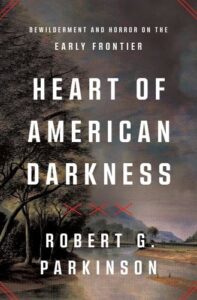
Robert G. Parkinson is associate professor of history at Binghamton University. He is the author of The Common Cause and Thirteen Clocks. He lives in Charles Town, West Virginia.
Consciousness, spirituality, biography, sexuality, androgyny, futurism, space, the arts, science, astrology, democracy, humor, books, movies and more










 Although the rhythm of the waves beats a kind of time, it’s not clock or calendar time. It has no urgency. It’s timeless time. Because I know I’m listening to a rhythm which has been just the same for millions of years. And it takes you out of the world of relentlessly ticking clocks. Clocks, for some reason or other, always seem to be marching, and armies never march to anything but doom. But there’s no marching rhythm in the motion of waves. It harmonizes with the breath. It does not count our days. Its pulse is not in the stingy spirit of measuring, of marking out how much still remains. It’s the breathing of eternity, like the Brahmā of Indian mythology, who inhales and exhales, manifests and dissolves the worlds endlessly, for ever. As a mere conception, that sounds appalling and monotonous — until you listen to the breaking and washing of waves.