
By Maria Popova (themarginalian.org)

Four billion years ago, in the hydrothermal vents at the bottom of the world where serpentine is forged, chemistry trembled with the promise of consciousness and matter began its long metabolic pilgrimage toward mind. Perhaps our saline cells remember it: how we, pilgrims of the possible, crawled out of the tide pools to climb the trees, then came down from the trees to live under a canopy of one hundred trillion synapses animated by the oceanic yearning to make meaning of our mortality. Perhaps the ocean, with its primeval drama of life and death, will always remind us of where we came from and where we are going. Rachel Carson knew this when she contemplated the peculiar effect of facing the open ocean, the way it fills us with “an uneasy sense of the communication of some universal truth that lies just beyond our grasp… the ultimate mystery of Life itself.”
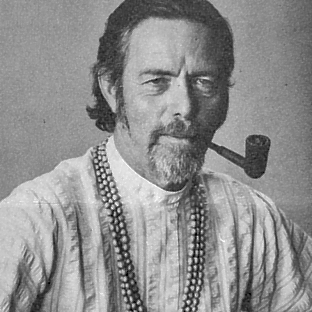
Alan Watts (January 6, 1915–November 16, 1973) captures this with uncommon poignancy in a 1960 talk titled “Love of Waters,” found in the posthumously compiled lecture collection Zen Rascal.
Writing from his studio — a floating library on an old ferryboat tied to the waterfront of Sausalito just north of San Francisco — Watts begins with a fine contribution to the canon of literature’s best reckonings with time:
Although the rhythm of the waves beats a kind of time, it’s not clock or calendar time. It has no urgency. It’s timeless time. Because I know I’m listening to a rhythm which has been just the same for millions of years. And it takes you out of the world of relentlessly ticking clocks. Clocks, for some reason or other, always seem to be marching, and armies never march to anything but doom. But there’s no marching rhythm in the motion of waves. It harmonizes with the breath. It does not count our days. Its pulse is not in the stingy spirit of measuring, of marking out how much still remains. It’s the breathing of eternity, like the Brahmā of Indian mythology, who inhales and exhales, manifests and dissolves the worlds endlessly, for ever. As a mere conception, that sounds appalling and monotonous — until you listen to the breaking and washing of waves.
Spring Moon at Ninomiya Beach, 1931 — one of Hasui Kawase’s stunning vintage Japanese woodblocks. (Available as a print.)
Observing how all the waste and want of our civilization are “transformed in the beneficent presence of the sea,” he considers the mysterious mechanism of the transformation in what reads like a prose poem:
And yet in the ocean, this poetic dimension of life coexists with the teeming brutality of predator and prey, the merciless drama of death. In a stirring reminder that the evolutionary is inseparable from the existential, Watts writes:
[…]
There’s no way of getting around it, is there? The gull isn’t rapacious or greedy. It’s just that his being alive at all is the same thing as eating crabs. Sea birds are transformations of fish. Men are transformations of wheat, chickens, and steers. And a love for the food is the agony of the food. To object to this inseparability of pleasure and pain, life and death, is simply to object to existence. But, of course, we cannot help objecting when the time comes. Objecting to pain is pain.
The Great Wave off Kanagawa by Japanese artist Hokusai, 1831. (Available as a print.)
With an eye to the price of consciousness, Watts observes that the human animal, with its ability to stand outside of itself and think about itself — that is, “to comment on life” — has curled into a profound confusion about its own existence: By standing aside from life in order to think about it, we evicted ourselves from it and, as Watts puts it, “found it alien.” A generation before Ursula K. Le Guin wrote so movingly about subject vs. object in the meaning of life, Watts invites us out of this dualistic self-expatriation from the living world:
[…]
To be human is precisely to have that extra circuit of consciousness which enables us to know that we know, and thus to take an attitude to all that we experience. The mistake that we’ve made — and this, if anything, is the fall of man — is to suppose that that extra circuit, that ability to take an attitude to life as a whole, is the same as actually standing aside and being separate from what we see. We seem to feel that the thing which knows that it knows is one’s essential self. That, in other words, our personal identity is entirely on the side of the commentator. We forget that self-consciousness is simply a subordinate part and instrument of our being; a sort of mental counterpart to the finger-thumb opposition of the human hand.
And which is you, the finger or the thumb? Look at the stages of differentiation. First: the organism from its environment — and with this, knowledge of the environment. Second: the distinction of knowing knowledge from knowledge itself. But all this, like the finger-thumb opposition, is a difference which does not divide. The thumb isn’t floating in the air alongside the rest of the hand. At their roots they’re joined. And at our roots we are joined to the whole subject of nature.
Painting by Oliver Jeffers from his series Measuring Land and Sea
Watts ends with a mighty corrective for the far-reaching damage Descartes has done and does us still:
I think our difficulty is that our consciousness is too superficial, as if all our sensation were in the tips of the fingers and not in the palm. Our comments on life are insufficiently balanced by the clear sensation that what we are talking about as ourselves, and ourselves in a sense far more basic and real than that extra circuit which knows knowing… Were we as spatially distant from the Earth as one atom of an orange from another, I suppose we should be somewhere out by the Moon.
[…]
I think this is why I love the ocean. It’s the most difficult part of nature to mess up with emblems and symptoms of man’s dissociated consciousness. It’s an environment in which the awareness of our roots can awaken, in which space (so real because of the light and color) can be seen to be joining things instead of separating them. Yes. And I’ve just discovered that knocking on the wall of space and consciousness was my own heart beating.
Couple with astronomer Rebecca Elson’s spare and lovely poem “Some Thoughts about the Ocean and the Universe,” then revisit Watts on becoming who you really are, learning not to think in terms of gain and loss, and the only real antidote to fear.


 At the head of all virtues Confucius put not righteousness (i), but human-heartedness (jen), which is not so much benevolence, as often translated, but being fully and honestly human.


