“Behold, now, let my heart tell You what it was seeking there, that I should be gratuitously wanton, having no inducement to evil but the evil itself. It was foul, and I loved it. I loved to perish. I loved my own error – not that for which I erred, but the error itself. Base soul, falling from Your firmament to utter destruction – not seeking anything through the shame but the shame itself!”
~ Augustine of Hippo
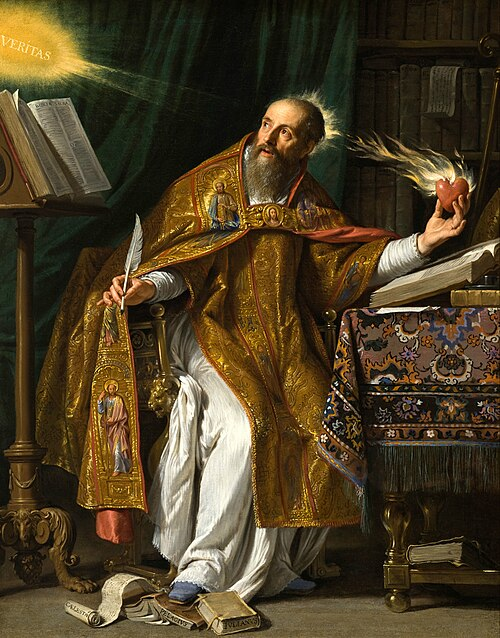
Augustine of Hippo was a Christian theologian and philosopher from Thagaste, Numidia Cirtensis and the Bishop of Hippo Regius. Wikipedia
“Let us, on both sides, lay aside all arrogance. Let us not, on either side, claim that we have already discovered the truth. Let us seek it together as something which is known to neither of us. For then only may we seek it, lovingly and tranquilly, if there be no bold presumption that it is already discovered and possessed.”
~ Augustine of Hippo
Augustine of Hippo was a Christian theologian and philosopher from Thagaste, Numidia Cirtensis and the Bishop of Hippo Regius. Wikipedia
You are referring to St. Augustine’s famous spiritual reflection, where he prays: “Lord, let me know myself, that I may know You.”This profound theme is most prominently found in his Soliloquies (Book 2) and his spiritual masterpiece, Confessions. [1, 2]
In his writings, St. Augustine of Hippo explores the inseparable link between knowing oneself and knowing God. He believed that because God created humanity in His image, looking inward to recognize our own limitations and the “darkness” within ourselves allows us to see how deeply we need God’s light. By accepting our flaws, we open ourselves up to receiving His divine grace and wisdom. [1, 2, 3]
No book except the Bible itself had a greater influence on the Middle Ages than Augustine’s City of God. And since medieval Europe was the cradle of modern Western society, this work is vital for understanding our world and how it came into being.
Early church father and philosopher Saint Augustine served from 396 as the bishop of Hippo in present-day Algeria and through such writings as the autobiographical Confessionsin 397 and the voluminous City of Godfrom 413 to 426 profoundly influenced Christianity, argued against Manichaeism and Donatism, and helped to establish the doctrine of original sin.
An Augustinian follows the principles and doctrines of Saint Augustine.
People also know Aurelius Augustinus in English of Regius (Annaba). From the Africa province of the Roman Empire, people generally consider this Latin theologian of the greatest thinkers of all times. He very developed the west. According to Jerome, a contemporary, Augustine renewed “the ancient Faith.”
The Neo-Platonism of Plotinus afterward heavily weighed his years. After conversion and his baptism in 387, Augustine developed his own approach to theology and accommodated a variety of methods and different perspectives. He believed in the indispensable grace to human freedom and framed the concept of just war. When the Western Roman Empire started to disintegrate from the material earth, Augustine developed the concept of the distinct Catholic spirituality in a book of the same name. He thought the medieval worldview. Augustine closely identified with the community that worshiped the Trinity. The Catholics and the Anglican communion revere this preeminent doctor. Many Protestants, especially Calvinists, consider his due teaching on salvation and divine grace of the theology of the Reformation. The Eastern Orthodox also consider him. He carries the additional title of blessed. The Orthodox call him “Blessed Augustine” or “Saint Augustine the Blessed.”
“Ambition, lustful, narcissistic—I was all of these things. God gave me a mother; she showed me that nothing in this material world is worthy of our ambition. God gave me a woman; she showed me that loving means renouncing oneself. God gave me a son; I started to believe that he was created in my image. God took him away from me to show me that he was created in his image. Ambitious, lustful, narcissistic—I was all these things, and still am, as we all are. As we all are. But not one of us is alone—ever. Not even when we are in desperation, bitterness, darkness. God is close to us. God is more brother than any brother… He is more friend than any friend… More lover than any lover…”
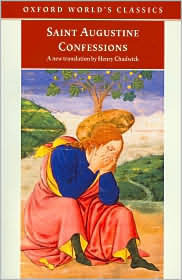
Augustine’s Confessions is one of the most influential and most innovative works of Latin literature. Written in the author’s early forties in the last years of the fourth century A.D. and during his first years as a bishop, they reflect on his life and on the activity of remembering and interpreting a life. Books I-IV are concerned with infancy and learning to talk, schooldays, sexual desire and adolescent rebellion, intense friendships and intellectual exploration. Augustine evolves and analyses his past with all the resources of the reading which shaped his mind: Virgil and Cicero, Neoplatonism and the Bible. This volume, which aims to be usable by students who are new to Augustine, alerts readers to the verbal echoes and allusions of Augustine’s brilliant and varied Latin, and explains his theological and philosophical questioning of what God is and what it is to be human. The edition is intended for use by students and scholars of Latin literature, theology and Church history.
(Goodreads.com)
Consciousness, spirituality, biography, sexuality, androgyny, futurism, space, the arts, science, astrology, democracy, humor, books, movies and more