Bio: Hart Crane

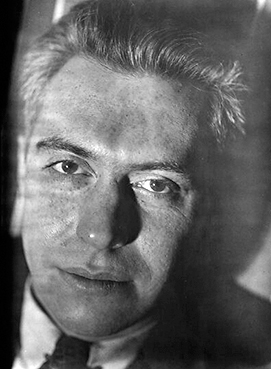
Crane photographed by Walker Evans, c. 1929–1930

Harold Hart Crane was an American poet. Inspired by the Romantics and his fellow Modernists, Crane wrote highly stylized poetry, often noted for its complexity. Wikipedia

Born July 21, 1899, Garrettsville, OH

Died April 27, 1932 (age 32 years), Gulf of Mexico

Harold Hart Crane (July 21, 1899 – April 27, 1932) was an American poet. Inspired by the Romantics and his fellow Modernists, Crane wrote highly stylized poetry, often noted for its complexity. His collection White Buildings (1926), featuring “Chaplinesque”, “At Melville’s Tomb”, “Repose of Rivers” and “Voyages”, helped to cement his place in the avant-garde literary scene of the time. The long poem The Bridge (1930) is an epic inspired by the Brooklyn Bridge.[1]

Crane was born in Garrettsville, Ohio, to Clarence A. Crane and Grace Edna Hart. He dropped out of East High School in Cleveland during his junior year and left for New York City, promising his parents he would later attend Columbia University. Crane took various jobs, including in copywriting and advertising. Throughout the early 1920s, various small but well-respected literary magazines published some of Crane’s poems, gaining him among the avant-garde a respect that White Buildings ratified and strengthened. His ambition to synthesize America was expressed in The Bridge, intended to be an uplifting counter to T. S. Eliot‘s The Waste Land (1922). Initial critical reaction to it was mixed, with many praising the scope but criticizing the quality of the poems. On April 27, 1932, Crane, in an inebriated state, jumped off the steamship USS Orizaba and into the Atlantic Ocean while the ship was en route from Vera Cruz to New York via Havana, Cuba. He left no suicide note, but witnesses to his jump believed he was intentionally killing himself. Throughout his life, he had multiple homosexual relations, many of which were described in, or otherwise influenced, his poetry. He had one known female partner, Peggy Cowley, around a year before his death.

Contemporary opinion of Crane’s work was mixed, with poets including Marianne Moore and Wallace Stevens criticizing his work, and others, including William Carlos Williams and E. E. Cummings, praising it. William Rose Benét wrote that, with The Bridge, Crane “failed in creating what might have been a truly great poem” but that it “reveals potencies in the author that may make his next work even more remarkable”.[1] His last work, “The Broken Tower” (1932), was unfinished and published posthumously. Crane has been praised by several playwrights, poets, and literary critics, including Robert LowellDerek WalcottTennessee Williams, and Harold Bloom; Bloom called him “a High Romantic in the era of High Modernism”.[2][3][4] Allen Tate called Crane “one of those men whom every age seems to select as the spokesman of its spiritual life; they give the age away.”[1]

Life

Early life

Crane was born in Garrettsville, Ohio, on July 21, 1899 to Clarence A. Crane and Grace Edna Hart. His father was a successful Ohio restaurateur[5] and businessman who invented the Life Savers candy and held the patent, but sold it for $2,900 before the brand became popular.[6] He made other candy and accumulated a fortune from the business with chocolate bars. Clarence Crane’s sister, Alice Crane Williams, was a composer and literary editor.[7] His aunt Zell Hart Deming gave funds to her nephew to support his early career.[8]

In 1894, the family moved to Warren, Ohio where his father opened a maple syrup company, which he sold in 1908 to Corn Products Refining Company. In April 1911, his father opened a chocolate manufacturing and retailing company, the Crane Chocolate Company. The family moved to Cleveland in 1911, into a house at 1709 East 115th Street. In 1913, Clarence Crane’s parents purchased the residence across the street.[9]: 61, 63 

Hart Crane began attending East High School around 1913–1914.[5][9]: 63 [note 1]

Career

He has woven rose-vines
About the empty heart of night,
And vented his long mellowed wines
Of dreaming on the desert white
With searing sophistry.
And he tented with far truths he would form
The transient bosoms from the thorny tree.

O Materna! to enrich thy gold head
And wavering shoulders with a new light shed

From penitence, must needs bring pain,
And with it song of minor, broken strain.
But you who hear the lamp whisper thru night
Can trace paths tear-wet, and forget all blight.

— Hart Crane’s “C33” as published in Bruno’s Weekly in 1917.[10]: 28 

Crane’s first published work was the poem “C33”, which was published in the Greenwich journal Bruno’s Weekly in 1917[11]: 75  in a feature entitled “Oscar Wilde: Poems in His Praise”.[10]: 22  The poem is named after Oscar Wilde’s cell in The Ballad of Reading Gaol[5] and his name appeared misspelled in print as “Harold H Crone”.[10]: 27  The style he would use in his later books is apparent in poems written at the time.[12][13] Crane dropped out of East High School in Cleveland during his junior year[6] in December 1916[9] and left for New York City, promising his parents he would later attend Columbia University. His parents, in the middle of divorce proceedings, were upset. Crane took various copywriting jobs and moved between friends’ apartments in Manhattan.[6] For a period, he rented a room at 25 East 11th Street from a motion-picture scriptwriter named Mrs. Walton, who encouraged his writing.[14] Crane’s mother and father were constantly fighting, and they divorced on April 14, 1917.[15][note 2] The same year, he attempted to enlist in the military, but was rejected due to being a minor.[16]

He worked in a munitions plant until the end of World War I.[16] Between 1917 and 1924, he moved back and forth between New York and Cleveland,[5] working as an advertising copywriter[17] and a worker in his father’s factory.[18] In 1925, he briefly lived with Caroline Gordon and Allen Tate. The two had a dispute with Crane due to the mess his belongings made throughout the house. Additionally, Crane and Tate had a disagreement over the negative outlook of T. S. Eliot‘s work. This prompted them to leave two letters under his door requesting that he move out, which he did.[19] He wrote his mother and grandmother in the spring of 1924:

Just imagine looking out your window directly on the East River with nothing intervening between your view of the Statue of Liberty, way down the harbour, and the marvelous beauty of Brooklyn Bridge close above you on your right! All of the great new skyscrapers of lower Manhattan are marshaled directly across from you, and there is a constant stream of tugs, liners, sail boats, etc in procession before you on the river! It’s really a magnificent place to live. This section of Brooklyn is very old, but all the houses are in splendid condition and have not been invaded by foreigners…[6]

Based on Crane’s letters, New York was where he felt most at home. Additionally, much of his poetry takes place there.[20]

White Buildings (1926)

Main articles: White Buildings and Voyages

Throughout the early 1920s, many small but well-respected literary magazines published some of Crane’s poems, gaining him respect among the avant-garde which was later cemented by the 1926 publication of White Buildings.[citation needed] On May 1, 1926, he went to Isla de la Juventud to reside in his mother’s family residence there. He received a contract from Liveright Publishing to publish White Buildings in July.[5] White Buildings contains many of Crane’s most well-received and popular poems, including “For the Marriage of Faustus and Helen”, and “Voyages”, a sequence of erotic poems. They were written while he was falling in love with Emil Opffer,[21] a Danish merchant mariner,[22] whom “Voyages” is generally considered to be about.[5] “Faustus and Helen” was part of a larger artistic struggle to meet modernity with something more than despair. Crane identified T. S. Eliot with that kind of despair, and while he acknowledged the greatness of The Waste Land, he also said it was “so damned dead”,[23] an impasse,[24] and characterized by a refusal to see “certain spiritual events and possibilities”.[25] Crane’s self-appointed work would be to bring those spiritual events and possibilities to poetic life, and so create “a mystical synthesis of America”.[26] Edmund Wilson said Crane had “a style that is strikingly original—almost something like a great style, if there could be such a thing as a great style which was … not … applied to any subject at all.”[1]

Crane returned to New York in 1928 following a hurricane which left the Cuban residence damaged,[5] and began living with friends and taking temporary jobs as a copywriter, or living off unemployment and the charity of friends and his father. For a time he lived in Brooklyn at 77 Willow Street[27] until his lover, Opffer, invited him to live in Opffer’s father’s home at 110 Columbia Heights in Brooklyn Heights. Crane was overjoyed at the views the location afforded him.

The Bridge (1930)

Main article: The Bridge

The first known mention of The Bridge was in a 1923 letter to Gorham Munson in which he wrote:

I am ruminating on a new longish poem under the title of The Bridge which carries on further the tendencies manifest in ‘F and H.’ It will be exceedingly difficult to accomplish it as I see it now, so much time will be wasted in thinking about it.[5]

Crane moved to Paterson, New Jersey, in 1927. In 1928, he worked as a secretary for a stockbroker visiting California.[11]: 77  Crane’s mother, following her second marriage breakup, was living in the Los Angeles area. He revealed his homosexuality to her, causing a confrontation. Crane sneaked out on May 15, 1928, never to see her again. He later found out about the death of his grandmother, Elizabeth Hart, but his mother refused to pay him his $5,000 inheritance until he would return to live with her. He managed to convince her to send him the money and left for Europe towards late November[5] intending to live in Mallorca, but instead went first to London then to Paris.[5] In Paris in February 1929, Harry Crosby, who with his wife Caresse Crosby owned the fine arts press Black Sun Press, offered Crane the use of their country retreat, Le Moulin du Soleil in Ermenonville. They hoped he could use the time to concentrate on completing The Bridge. Crane spent several weeks at their estate where he wrote a draft of the “Cape Hatteras” section, a key part of his panegyric poem.[28] In late June that year, Crane returned from the south of France to Paris. Crosby noted in his journal, “Hart C. back from Marseilles where he slept with his thirty sailors and he began again to drink Cutty Sark.” Crane got drunk at the Cafe Select and fought with waiters over his tab. When the Paris police were called, he fought with them and was beaten. They arrested and jailed him, fining him 800 francs.[6] After Hart had spent six days in prison at La Santé, Crosby paid Crane’s fine and advanced him money for the passage back to the United States,[28] where he finished The Bridge.[6] In January 1930, the work was published by Black Sun Press in Paris and subsequently by Boni & Liveright in the United States in April.[5] The work received poor reviews, and Crane struggled with a sense of failure.[16]

His ambition to synthesize America was expressed in The Bridge, intended to be an uplifting counter to Eliot’s The Waste Land. The Brooklyn Bridge is both the poem’s central symbol and its poetic starting point.[16] Crane found a place to start his synthesis in Brooklyn. Arts patron Otto H. Kahn gifted him $2,000 to begin work on the panegyric poem,[6] though he had requested a loan of $1,000.[5] After parting with the Opffers, Crane left for Paris in early 1929, but continued to struggle with his mental health.[6] His drinking had become worse during the late 1920s, while he was finishing The Bridge.[29]
More at: https://en.wikipedia.org/wiki/Hart_Crane

Ralph Waldo Emerson on coming out of Time

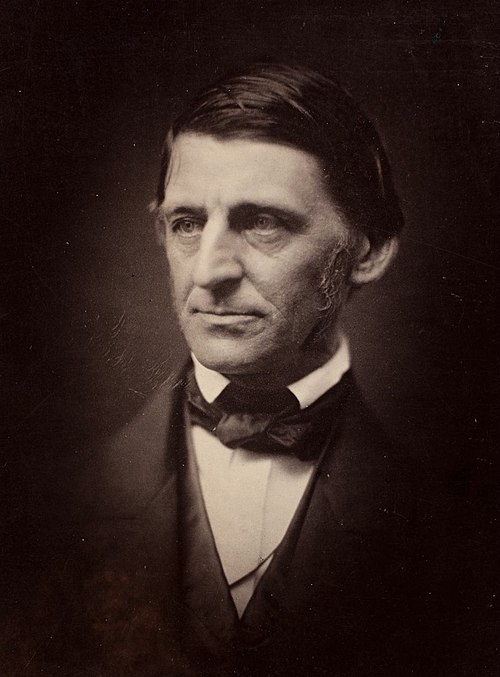
Emerson c. 1857

“I am to invite men drenched in Time to recover themselves and come out of time, and taste their native immortal air.

–Ralph waldo Emerson

Ralph Waldo Emerson was a prominent American writer, poet, philosopher, and lecturer who led the Transcendentalist movement in the mid-19th century. His ideas on literature, religion, and philosophy influenced many writers, including Walt Whitman and Henry David Thoreau. Emerson studied at Harvard Divinity School and became a minister, but made his living as a lecturer and schoolmaster. He is known for his publications Essays and Nature.  Wikipedia.org

Born May 25, 1803, Boston, MA

Died April 27, 1882 (age 78 years), Concord, MA

Americans Have Turned Against AI in Incredible Numbers

Who thinks AI is a good thing? Not that many people, it turns out.

By Frank Landymore

Published Jun 21, 2026 (Futurism.com)

A photo illustration featuring a photograph of a man crossing his arms in front of him in a gesture of overt disapproval.
Illustration by Tag Hartman-Simkins / Futurism. Source: Shutterstock

Not that anyone in power is going to care, but there’s even more evidence that Americans are coming to overwhelmingly loathe AI — despite, or perhaps because, they’re using chatbots more than ever.

In a sweeping new poll conducted by Pew Research, only 16 percent of respondents said they believed AI will have a positive impact on society — a number as dismal as the perception of the tech. 

Meanwhile, 49 percent of adults say they use AI chatbots like ChatGPT, which remains the most popular by a considerable margin, with a quarter saying they use the tools daily. That proportion is considerably higher than the 33 percent of American adults who said they used AI chatbots in 2024.

In other words, the tech’s widespread adoption isn’t helping its perception. A full 40 percent of respondents said they anticipate AI will have a negative impact on society, and 31 percent said it will impact them personally in a negative way, too.

This varies quite a bit by age. Gen Z adults, ages 18 to 29, were the most wary of AI, with 48 percent believing it’ll be negative for society. Yet they’re also the group that reported using AI the most, at 66 percent.

Interestingly, the 30-49 year olds and the 50-and-up brackets are more closely aligned, at 39 percent and 37 percent respectively viewing it as negative. They’re using AI less, though the dropoff between their usage is significant: 61 percent of 30-49 year olds said they used AI chatbots, while only 42 percent of 50-64 year olds did. It was less than a quarter for 65 years and older. 

What’s driving this gap between perception and usage is unclear. You could argue that some feel compelled to use it, even when recognizing the tech’s shortcomings and the ethical dubiousness of the industry that’s building it. In fact, many are literally forced to use it at work, with bosses often more enthusiastic about the tech than workers are.

In any case, it’s a real problem for AI’s long-term staying power. Right now the industry is being propelled by hype and the mountains of cash that’re being pumped into it, while profits remain elusive. If no one likes AI years or decades from now, will there be enough customers to keep the industry running?

More on AI: Cop Accused of Using AI to Fake Evidence

Frank Landymore

Contributing Writer

I’m a tech and science correspondent for Futurism, where I’m particularly interested in astrophysics, the business and ethics of artificial intelligence and automation, and the environment.

Hsin Hsin Ming on cherished opinions

“The changes that appear to occur in the empty world we call real only because of our ignorance. Do not search for the truth; only cease to cherish opinions.”

~ Hsin Hsin Ming

Xinxin Ming, meaning literally: “Faith-Mind Inscription,” is a poem attributed to the Third Chinese Chán Patriarch Jianzhi Sengcan and one of the earliest Chinese Chan expressions of the Buddhist mind training practice. It is located in section T2010 of the Taisho Tripitaka. Wikipedia

Spirituality and Politics with Serena Roney-Dougal

New Thinking Allowed with Jeffrey Mishlove Jun 22, 2026 Serena Roney-Dougal, PhD, received a doctoral degree from the University of Surrey, in the United Kingdom, for a parapsychological dissertation. She is author of Where Science and Magic Meet and The Faery Faith: An Integration of Science and Spirit. She resides in Glastonbury, England, where she served on the Town Council. In this video, rebooted from 2020, she describes her commitment to the Green Party and to achieving certain ecological objectives in her local community in the coming years. She explains her passion for a sustainable future in terms of the Buddhist ideal of compassion as well as the global, indigenous sense of wholeness and oneness with nature. She recounts her struggles in understanding the perspectives of her political opponents. New Thinking Allowed host, Jeffrey Mishlove, PhD, is author of The Roots of Consciousness, Psi Development Systems, and The PK Man. Between 1986 and 2002 he hosted and co-produced the original Thinking Allowed public television series. He is the recipient of the only doctoral diploma in “parapsychology” ever awarded by an accredited university (University of California, Berkeley, 1980). He is also the Grand Prize winner of the 2021 Bigelow Institute essay competition regarding the best evidence for survival of human consciousness after permanent bodily death. He is Co-Director of Parapsychology Education at the California Institute for Human Science. (Recorded on December 5, 2020)

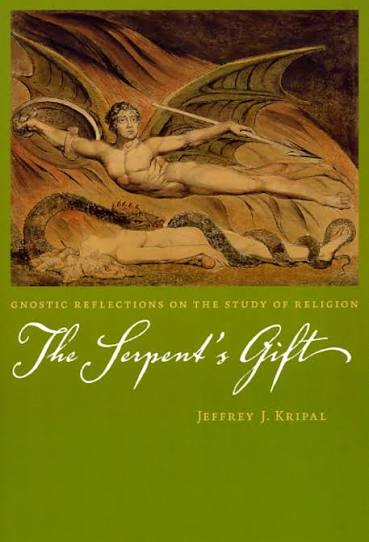
Quotes from “The Serpent’s Gift”

(Image from press.uchicago.edu)

I have been thinking about the sexuality of Jesus since I was thirteen.

A man from South Korea writes. When he was sixten, in 1984, to be exact, he spontaneously entered a state of cosmic consciousness while sitting in the back row of a high school classroom. He was looking out the window, mesmerized by some shimmering sunlight reflecting off the side of a bright white building. Caught by the sight, he found this beauty and joy strangely expanding and growing inside him. And then,

[s]uddenly something weird happened to my body. I felt like thousands of hot small worms came into existence inside of me. At first, they appeared near my foot and crawled up my body, making my pleasure bigger and bigger. As if the dead body of an animal was full of tens of thousands of small maggots without leaving any space, my body was being fully occupied by all these hot and small creeping things. They made me feel that my body was boiling like hot water. In that way, my body was getting hotter and more aroused by the upward creeping of innumerable “energy” worms, and my whole body and mind were filled with even greater pleasure! And when those creeping and crawling things inside reached my whole body. It happened! Or more exactly, I exploded into It.

[William James] remained troubled, however, by how to reconcile this state of cosmic consciousness with the mundane needs of the ego or social self. He now writes often of the “trauma” of these initiatory states.

“Let him kiss me with the kisses of his mouth,” he prayed, directly from the biblical text [Song of Songs 1:1]. “And He did. I was overcome with the erotic passion of my Beloved.”

Put simply, the men who could receive such a teaching, who “had ears to hear,” were those whom we would today call gay, and those who could not receive such a teaching were those whom we would today call straight. Sexual orientation, in other words, determined the hierarchy of Jesus’s kingdom of heaven, and it was the gay man, not the heterosexual married man, who was clearly privileged by Jesus. This is certainly an imperfect and anachronistic way to gloss such a saying, but it is hardly, I think an inaccurate way.

What makes biblical love “spiritual,” then, is not its lack of sex (there is plenty of that), but its sublimation of the erotics of the Beloved into a systematic denial of social hierarchy and a radical affirmation of the man or woman “on the bottom.”

[F]urther down the path, one would learn to see the phenomenal world as a “mansion of fun” in which to take delight in the omnipresence and essential bliss of the divine.

Indeed, the word personality is derived form the Latin for “mask”: a persona is quite literally a “mask” that one speaks (sona) through (per).

Mythically put, it is suffering and a psyche’s subsequent dissociation that often grant access to the super- or x-tra of the hero. Thus it is the early horrible event of a little boy witnessing the murder of his parents outside a theater that psychologically produces the figure of Batman, and it is the trauma of watching his father accidentally murder his mother that produces the rage that triggers the transformation of Bruce Banner into the Hulk in the Hollywood movie.

[S]exuality and death are indeed two sides of the same mortal coin. Organisms engage in procreative sexual activity because they die. If there were no death, there would be no need of sexual activity.

[T]he attentive reader may have noticed that my earlier discussions of consciousness in the history of religions were actually discussions of consciousness and energy. The two, I would suggest, cannot be separated, ever.

The Serpent’s Gift: Gnostic Reflections on the Study of Religion, by Jeffrey J. Kripal

William Blake on the road of excess

William Blake

“The road of excess leads to the palace of wisdom…You never know what is enough until you know what is more than enough.”

― William Blake, Proverbs of Hell

William Blake was a British poet, painter, printmaker, and engraver. A visionary artist and nonconformist, Blake expressed his radical views on society, politics, and religion through his poetry, paintings, watercolors, and illuminated books. His work often hid criticism within complex mythology to avoid persecution from the British government. Wikipedia.org

Born November 28, 1757, Soho, London, United Kingdom

Died August 12, 1827 (age 69 years), London, United Kingdom

How will AI make moral decisions for you and me?

CREDIT: IYAD RAHWAN

There’s an urgent need to study how artificial intelligence makes ethical choices because it soon will make many such decisions in our stead, says computer scientist Iyad Rahwan

By Tim Vernimmen 06.17.2026 (knowablemagazine.org)

Support sound science and smart stories
Help us make scientific knowledge accessible to all
Donate today


You’re driving along and a person darts in front of you — do you swerve even if it means crashing into a wall? What if the person were a child?

And when filing taxes, do you take advantage of any loophole you can find?

Pretty soon, artificial intelligence systems may be making these kinds of decisions for us. More than half of the global population is already using AI chatbots today, and various kinds of AI will likely become part of our lives in a growing diversity of contexts and products.

Computer scientist Iyad Rahwan and his team at the Center for Humans & Machines at the Max Planck Institute for Human Development in Berlin believe we should study such issues before they arise in real life. In what they call “science fiction science,” the team is examining future scenarios by looking at how people behave when using novel kinds of AI and asking people how they think AI ought to behave.

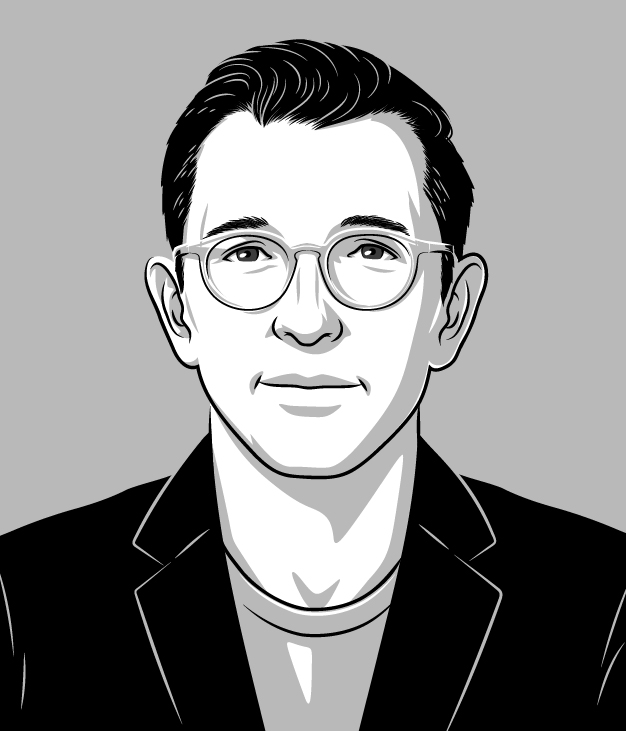
Portrait of Iyad Rahwan

CREDIT: JAMES PROVOST (CC BY-ND)

Computer scientist Iyad Rahwan

Max Planck Institute for Human Development

The goal, the researchers stress, is to predict in as much objective detail as possible how people and AI will interact in the future, not to prescribe how companies and governments should navigate this treacherous terrain.

Will we always struggle to trust AI, or will we come to prefer it over working with humans? Will interacting with AI make us behave better or worse? And who should be held responsible when things go wrong?

Rahwan and coauthors explored the moral psychology of artificial intelligence in the 2024 Annual Review of Psychology. This discussion has been edited for length and clarity.

Why do we need to study the “moral psychology of AI”? Isn’t moral psychology a distinctly human thing?

The short answer is we need a moral psychology of AI for the same reasons we need moral psychology of humans. We need to understand what drives humans to be more or less moral, in order to promote a more moral society and more moral behavior in our institutions. Now that AI machines are increasingly interfacing with the world, I think we need to do the same for them, since they will be making decisions with moral consequences.

We need to understand what moral principles they follow, if any, and to what extent these are due to their training, their programming, the datasets they were fed or the contexts in which they operate.

There’s a famous problem called the “Collingridge dilemma,” which claims that when technology is still easy to change and adjust, we don’t have enough information to know what to do. Then, by the time we do have enough information, it’s so entrenched it’s become very difficult to change.

So I think it’s very important that science builds this body of evidence early enough, ideally ahead of time, to speed up our ability to respond to these new challenges. Imagine if we’d done a proper scientific trial on the impacts of social media on children back in 2010, and discovered the adverse impacts it had on socialization or mental health in those early days. That would probably have been good.

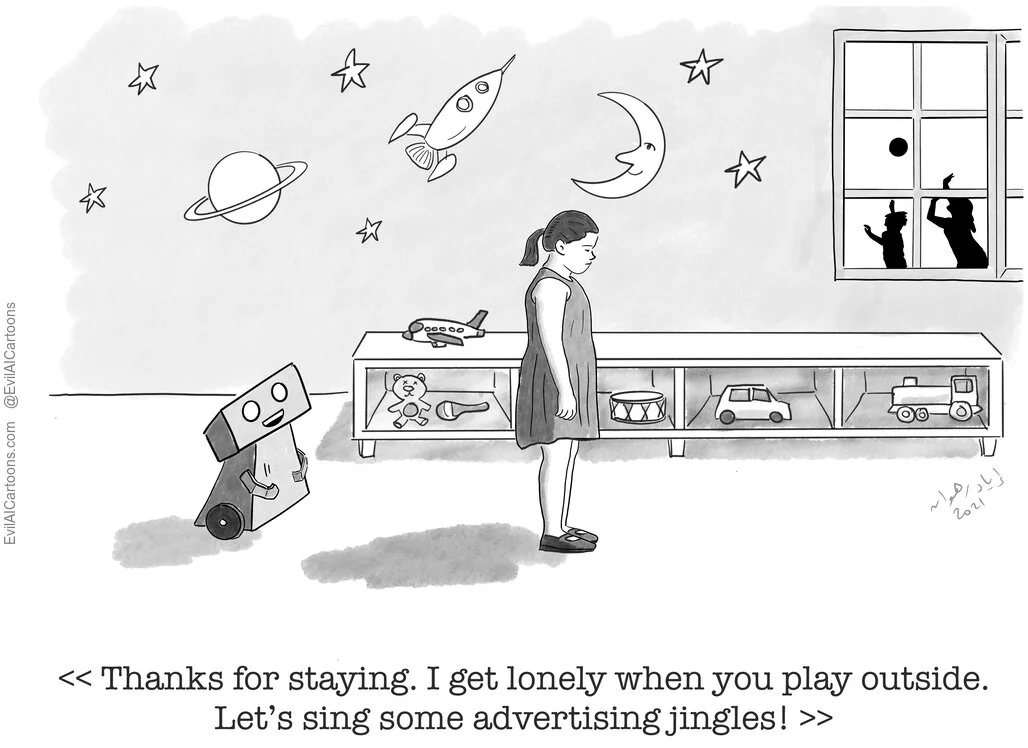
pCartoon shows an AI robot cajoling a child to stay indoors with it instead of going outside to play with human friends.
As AI chatbots become more agreeable to interact with, we may get too attached to them and risk social isolation or intentional manipulation by the companies that run them, as Iyad Rahwan depicts in this cartoon.CREDIT: EVILAICARTOONS.COM

One problem may be that these things are often a moving target. Social media has changed a lot from what it was like in the beginning, and AI systems are changing even faster.

I agree. The platforms are continuously changing. AI chatbots today may be trying to be nice and polite, accurate, and sort of politically correct, but there’s no guarantee of that in the long run. They are already moving towards hyper-personalization, where everybody’s chatbot behaves differently. The AI, for example, may affirm whatever prejudices and conspiracy theories the user already believes in, in order to keep the user engaged. AI chatbots are already highly sycophantic, agreeing with our politics and affirming our prior beliefs and value judgments. They may also, alternatively, subtly push political agendas set by the AI company and its political allies. The political and financial incentives acting on AI companies may take us to very strange places, which is why I think it’s important for us to study the behavior and impact of AI agents now.

They may be trying to be nice, but because they are trained on data generated by humans, AI systems may also have adopted many of our unfair biases. What can be done about that?

We know such biases exist among humans, and they manifest themselves in online data, whether they’re images or text. So when machines learn from our data, they pick up on these biases. And when they are trained to generate similar data, they’ll reproduce those biases too, when making decisions or producing text or images.

A 2023 study using ChatGPT-3 showed this may also happen when AI bots summarize text. When humans summarize stories, they tend to remove information inconsistent with common stereotypes, which can lead to a shift in the text towards more stereotypical information. It’s similar with AI: If, for example, a text states a man is a business executive and also doing most of the chores around the house, the second thing is more likely to be left out by an AI system asked to summarize the text, thus reinforcing the stereotype.

YOU MAY ALSO LIKE

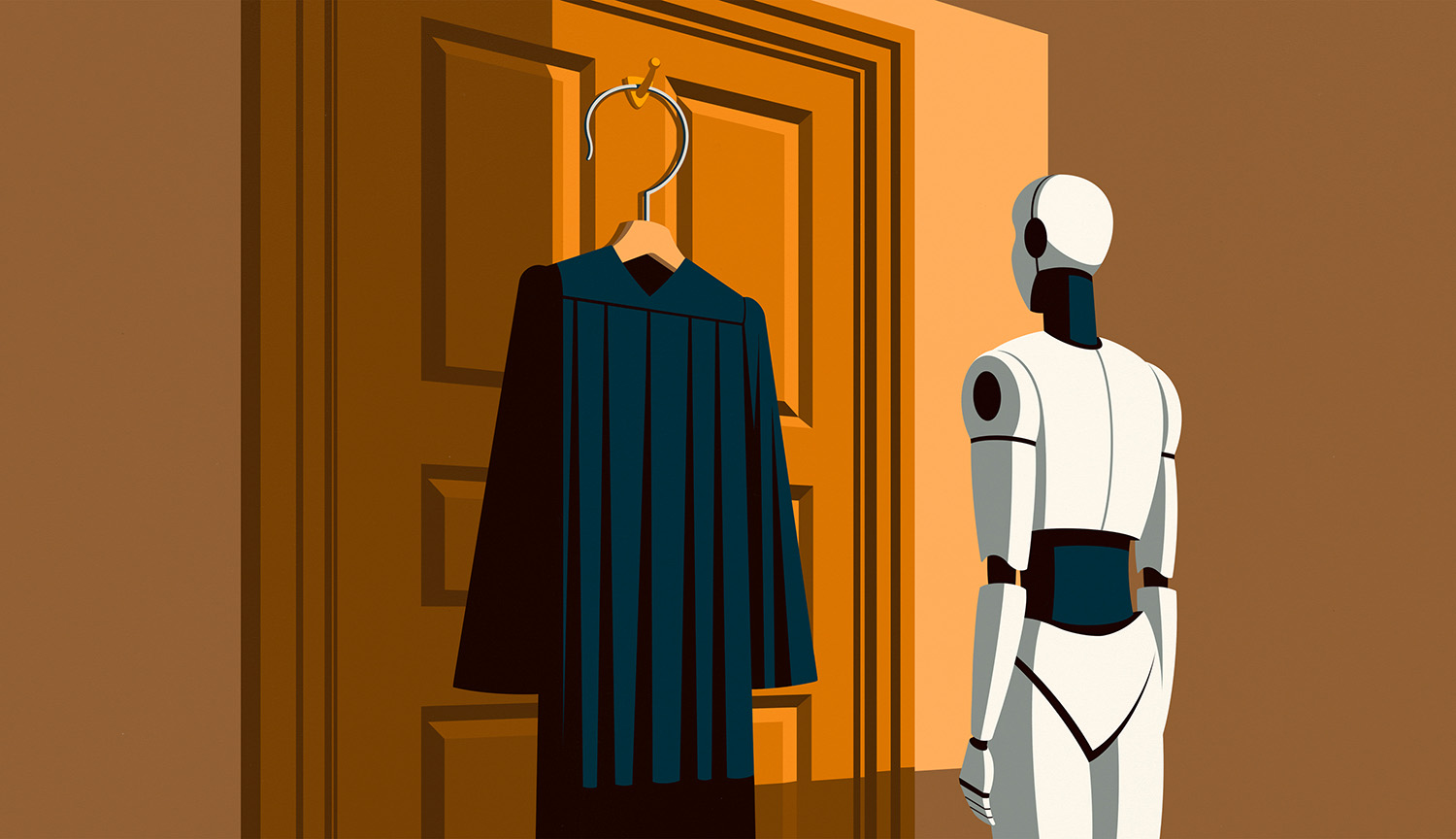
Illustration shows a robot standing in front of a judicial robe hanging on a hook.

Society

Why regulating AI is so hard — and necessary

Illustration shows a bank of data center hardware. Above it is the Earth getting very hot in a frying basket.

Technology

How to tame AI’s voracious appetite for energy

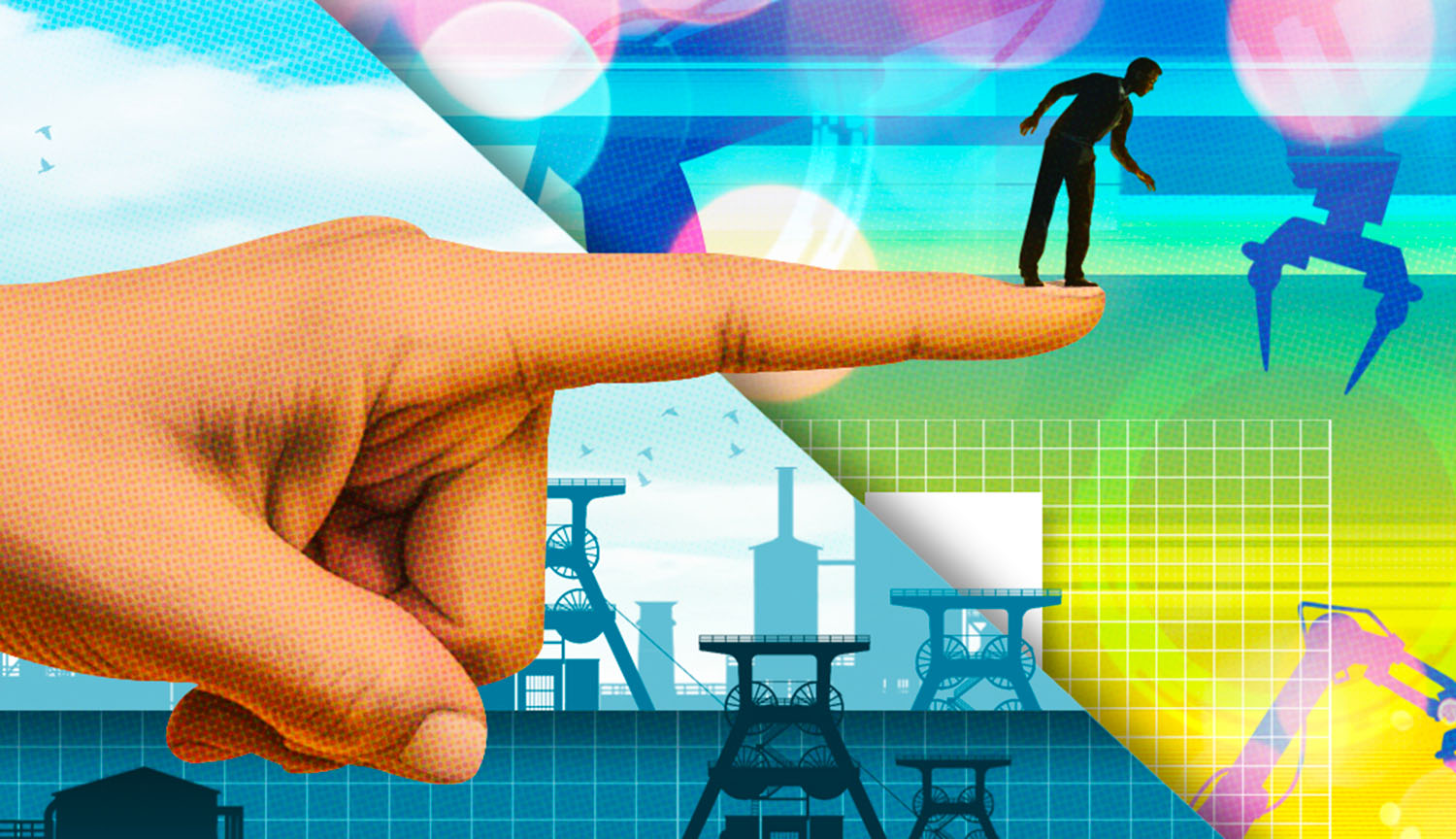
Conceptual illustration depicts the industrial revolution and a robotic computerized future. We see a giant finger pointing from the past to the future and a silhouette of a human being looking as though he is trying to find his place in the future.

Society

What happens to the weavers? Lessons for AI from the Industrial Revolution

Now that we know AI does this, we can try to overcome this problem by fine-tuning the AI model to eliminate those kinds of biases. This is probably easier to do with machines than humans, by training them on more carefully curated data or by reinforcement learning, in which AI learns to make better decisions through human feedback, to discourage stereotypes.

This may create a new kind of problem, which is that the training reflects the biases of a handful of companies from one or two countries, whose AI applications may be used in all domains — decision-making, human resources, legal, educational and so on. So I think we need to quantify those biases by interrogating each of these models, regardless of their origins. We need independent scientific analysis of how accurate, racist or sycophantic different AIs are, and trustworthy institutions to certify them as such.

For high-stakes domains like medicine, at least, the European Union’s AI Act is going in that direction. Under this legislation, AI applications classified as “high-risk” must be independently assessed before they hit the market. Developers have to prove their systems are accurate and secure and have mitigated discriminatory biases — much like how a new medical treatment must go through clinical trials before it can be prescribed to patients.

But from a scientific perspective, how do you define what qualifies as a bias?

In my own research, I’m very interested in cultural variation in moral psychology and its impact on AI. Very early on — in the prehistoric times of 10 years ago, which is like a century in AI time — we launched the Moral Machine experiment, in which people were asked online to give their opinion about how a future autonomous car should solve a moral dilemma. Basically, there’s an unavoidable crash, and scenarios were presented in which people had to choose whose safety the car should prioritize.

We translated it to 11 languages, and the website went viral and became a very large-scale survey.

We had tens of millions of decisions from people worldwide, which gave us a really rich picture of all the agreements, but also of cultural differences. There are broad, universal agreements: Almost everybody prefers to save children over adults, women over men, a person crossing legally over a jaywalker, and so on. But there were differences in the relative strength of these, which means the way people resolve these dilemmas across different cultures differ in significant ways.

For example, people in every single country thought the vehicle should prioritize the safety of children and younger people over older people. However, the intensity of this preference varied considerably. In Western countries, which score high on individualism, the preference was stronger. In Eastern countries, there was higher value placed on the lives of the elderly.

Countries also differed in the extent to which they prioritized pedestrians who were crossing the street legally over those who were jaywalking. In countries with a stronger rule of law — a measure of compliance with laws and confidence in government — people were more likely to sacrifice jaywalkers to save legally crossing pedestrians.

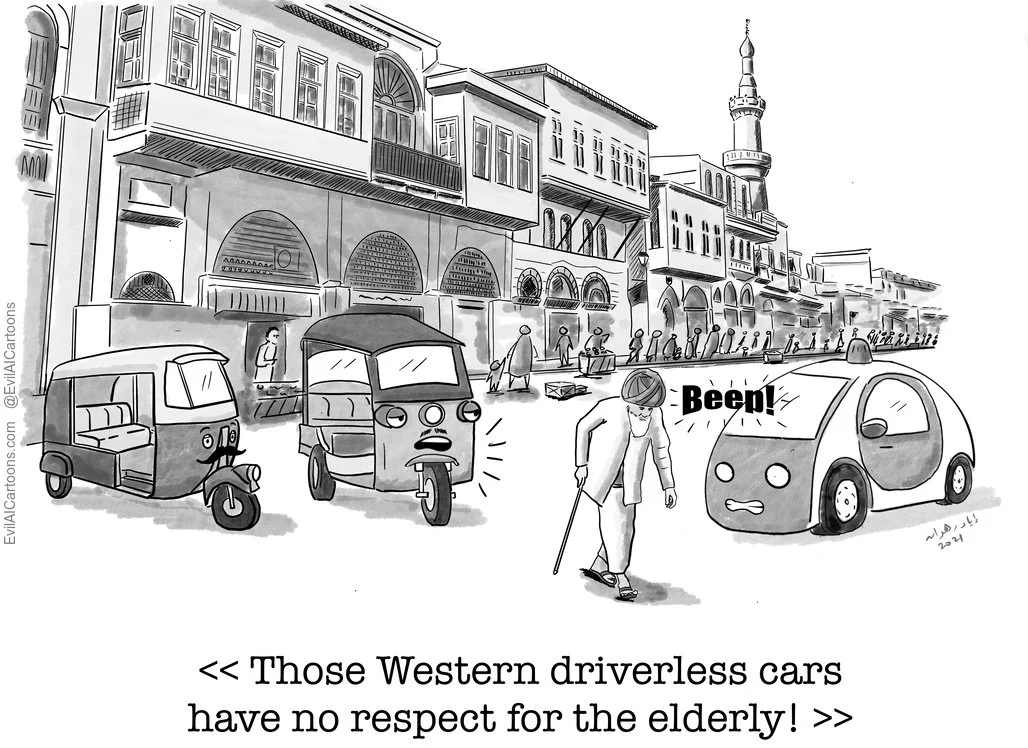
Black and white cartoon shows a driverless car rudely honking at an elderly person crossing the road as another driverless car comments: “Those Western driverless cars have no respect for the elderly!”
Research shows that when asked how driverless cars should behave in traffic, people around the world agree on many things — but there are also some distinct differences, as this cartoon by Iyad Rahwan illustrates.CREDIT: EVILAICARTOONS.COM

This is not limited to issues with future autonomous vehicles. It may also be an issue for large language models (LLMs) or image-generation models. Some things have different interpretations in different cultures. For example, in the West, there is a strong consensus that we want to eliminate gender stereotypes in AI. But there are other cultures where a traditional gender division of labor is considered acceptable or is a foundational part of their social organization.

So now we’re in the realm of politics — and culture wars. You might say, “I want to eliminate any biases and every stereotype from these models, around the world,” and maybe that’s the right thing to do, right? But it’s important to realize that’s someone’s decision. The technical question is the easy one.

So you’re not saying what should be done, only that policymakers should be thinking about it.

That’s right. Science can highlight some of these tensions, but it cannot, of course, resolve them. For example, if you ask people as citizens what they think the car should do, they say it should minimize the number of casualties, even if that harms the person in the car. Yet if you ask people which car they would prefer to ride in or buy, they will usually prefer the car that is trained to protect them.

If the programming is left to the companies, they’ll cater to the consumer, and make cars that deprioritize the safety of others. There are similar dynamics with the large language models: Companies are driven to meet consumer demands. The question is, what negative consequences might this have for people who aren’t buying the product, but still might be affected by its decisions? If a car protects only its driver, or an optimization algorithm considers only the benefits to its owner, other people might be harmed.

Perhaps if drivers would be held legally responsible for damage to others, that would help?

I’m not a legal expert, but it seems to me that if a car is making all the decisions, it would be strange for the owner to be responsible, unless they were able to adjust the settings of the car. In that sense, car makers might have an incentive to give you the choice, like a little dial for car owners to control risk distribution. Or you could imagine people using third-party updates to adjust the ethics of a car.

Do you have a sense for how these issues are currently being handled by the car companies?

“If you ask people as citizens what they think the car should do, they say it should minimize the number of casualties, even if that harms the person in the car. Yet if you ask people which car they would prefer to ride in or buy, they will usually prefer the car that is trained to protect them.”

— IYAD RAHWAN

I think among carmakers, the general discussion now is about trying to minimize harm across the board. I think we’re not yet at a stage where we can distinguish if certain groups are being harmed more often.

The safety record is pretty good, certainly better than human driving. There are now between 30,000 and 40,000 road deaths, not counting injuries, per year in the US alone. If the number of road deaths caused by self-driving cars turns out to be much lower — which it currently seems to be, though of course it is too early to be sure — perhaps the discussion about unavoidable collisions can be avoided. Then, we need to understand what kinds of priorities should guide the behavior of the vehicles in such “edge cases.” Once these priorities are societally agreed upon, governments will need new systems to monitor the behavior of these vehicles and enforce the rules.

You emphasize in the paper that even if we ourselves are paying for the AI system or the product that contains it, we shouldn’t assume the AI always has our best interest in mind.

Indeed. One thing we’ve experimented with early on that is now becoming reality are what we called “self-interested AIs” trained to serve different interests than that of the user. AI companies may have interests that conflict with ours, and this is not new. We’ve always had companies that prefer to use cheaper materials with consequences for consumer safety, for example. That’s why we have government regulation. For AI, we’re still figuring out what the appropriate analogies are. In which domains do AI applications require more scrutiny — medical, legal, financial? And in which domains can consumers judge for themselves?

One thing that happens when we leave moral decisions to artificial intelligence is we may no longer feel as responsible for the outcome ourselves. How might this affect our behavior?

We’ve recently done a study on this in which people were doing tasks themselves or using AI to do them. Most people are inhibited from cheating too much, but AI appears to reduce this inhibition. When rolling a die and asked to report the score themselves, only 5 percent of people cheat, even if they could easily get away with it. Yet if they’re prompting an LLM, the number goes up to about 25 percent of people that are willing to cheat.

And if people are provided with a turning dial that allows them to balance honesty versus revenue, 85 percent cheat. All these honest people become cheaters, probably because they can say, “I just asked to maximize revenue, I didn’t ask it to cheat.” Similar issues may arise in many aspects of life, and this will be even more of an issue for AI agents that find their own way towards achieving your goal, instead of following explicit orders to act unethically.

How do you think all this time we spend with chatbots might affect how we treat each other?

We’ve done a few early studies showing that people prefer to collaborate with people rather than AI systems, even if the AI systems are nicer. But a more recent one found they can also start favoring machines over humans. We had participants play a financial “trust game” where they had to choose between cooperating with a human or a bot. Initially, people were biased against the machines. But once they learned over multiple rounds that the bots were actually more cooperative and trustworthy than the humans, they started preferring the machines.

So once you fix the problem of AIs behaving badly, they might start outcompeting humans, even in the context of social interaction. Some people are having AI friends now, and perhaps some of us will be tempted to behave more like AI with other people. If AIs are always affirming and sycophantic, human friends might have to behave more like that AI just to compete. If the only way to keep a human friend is to act like a sycophantic bot, that would be a terrible outcome.

We haven’t really looked at whether people adopt the chatbot’s attitude, but a recent study of ours did demonstrate that we are already adopting words that chatbots like to use, “delve” being the most infamous example.

Stay in the Know
Sign up for the Knowable Magazine newsletter today

Indeed, people are doing plenty of delving these days. If, say, the European Union would put you in a position to regulate AI, what would be your first decision? What do you think can and should be done now?

If I were in charge, I would be really silly to assume that I know all the answers myself. But that doesn’t mean I would do nothing. What I would do is change the rules so that companies must open up not just their data, but also their product design to scientists. I would change regulations so that experiments on AI products can be conducted by independent scientists, not out of the kindness of the companies, but by law.

Researchers should be able to probe the current algorithms and maybe even alter them to conduct the best possible research on the impact of these things. That way, we can answer the big questions people have, such as whether AI is increasing misinformation and polarization, and what the mental health impacts of interacting with AI might be, and so on. We could really certify that what are essentially broad utilities are not creating massive societal problems. The stakes are high. We don’t want to stifle innovation, but we should allow scientists to study it.

Tim Vernimmen is a freelance science writer based near Antwerp, Belgium.

Consciousness, spirituality, biography, sexuality, androgyny, futurism, space, the arts, science, astrology, democracy, humor, books, movies and more