A Traveller’s Guide to Anomalies on Mars: Evidence of Lost  Civilisations?

By George J. Haas (NewDawnMagazine.com)
From New Dawn Special Issue Vol 18 No 6 (Dec 2024)

I am the founder and premier investigator of the Mars research group known as The Cydonia Institute and a member of the Society for Planetary SETI Research (SPSR). My research encompasses over 30 years of study and analysis of NASA and ESA images of the planet Mars.

I have coauthored two books and six peer-reviewed science papers that discuss anomalous formations on the surface of Mars. Over the past two decades, I have attended various science conferences and seminars as an invited speaker and appeared on numerous radio, podcasts and television programs, such as Beyond Belief and Coast to Coast with George Noory. I also appeared on the History Channel’s Ancient AliensThe Proof is Out There and The UnXplained with William Shatner.
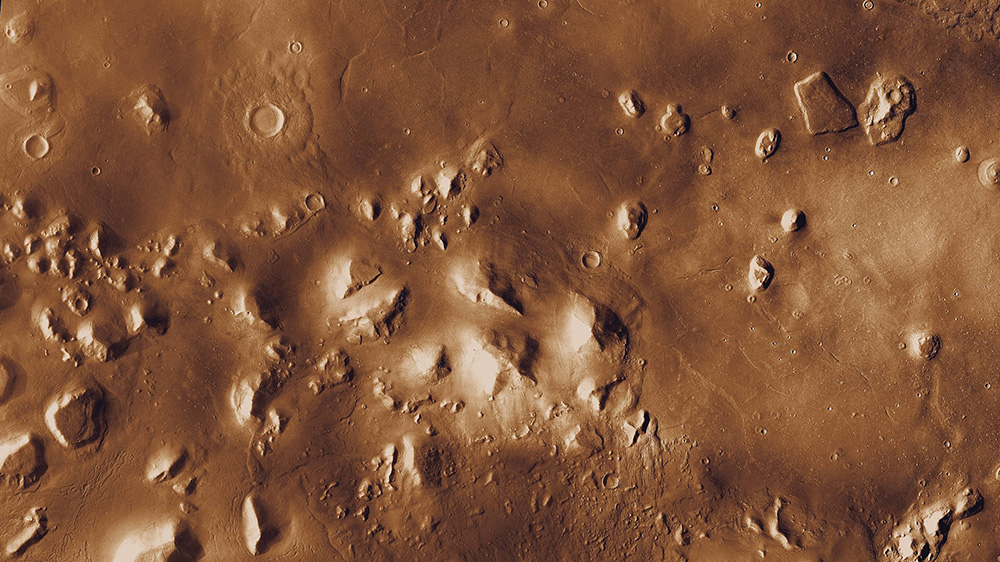
Discussion of artificial objects on Mars first began with the discovery of the “Face on Mars” back in 1976. Later, other intriguing and anomalous objects in the same region were found to display geometrically interesting characteristics. The above picture of the Cydonia region shows the famous “Face on Mars” top centre. The landscape is scattered with other intriguing images including pyramid shapes.

From Artist to Investigator: A Journey into Mars’ Anomalies

Before I continue, I would like to make a very clear point. I am not a scientist. I am an artist. My early schooling was in the visual arts. I am a sculptor, painter, art instructor, writer, curator, and the former director of the Sculptors’ Association of New Jersey. I have exhibited extensively throughout the New Jersey and New York area and was represented by the Grace Harkin Gallery in New York’s East Village. By the close of the 1980s, my work was recognised by one of the most influential art dealers of the twentieth century, Ivan Karp, and I had a one-man show at his gallery, the OK Harris Gallery of Art in SoHo. I was on top of the world.

Outside my short art career, I had a great interest in archaeology and studied the artwork of the Olmec, Maya, Aztec and Native American cultures. I attended glyph workshops at the University of Pennsylvania and learned to read Maya hieroglyphs. I also joined the Pre-Columbian Society, holding membership with the University of Pennsylvania and its affiliate in Washington D.C.

After finding a book by Randolfo Pozos titled The Face on Mars, Evidence for a Lost Civilization? my studies quickly turned to Mars. The structural formations presented in his book were truly remarkable. Around this time, a friend informed me about a new video by Richard C. Hoagland featuring his UN Briefings titled The Moon/Mars Connection. Hoagland was one of the first researchers to promote the discovery of the famous Face on Mars and expose evidence of artefacts on the moon.

Moving forward with the eyes of an artist, over the next thirty years, I acquired a vast collection of images from the ever-growing NASA archives. I found numerous formations with a high degree of geometric form and symmetry and others with pictographic design. Shuffling through my best-of-list, I decided to present some of these discoveries as a traveller’s guide to these anomalous structures on Mars.

My investigation opens with a short history of aerial photography, from the innovative use of hot air balloons and aeroplanes to the current use of high-tech satellites and LiDAR. I scrutinise its ‘bird’s eye view” advantage for military reconnaissance and explore the creation of Google Earth, which has enabled armchair archaeologists to travel the world. They have discovered everything from giant bird and deer geoglyphs to the ruins of long-lost ancient cities submerged by the sands of time.

Exploring Elysium Planitia: The Pyramids of Mars

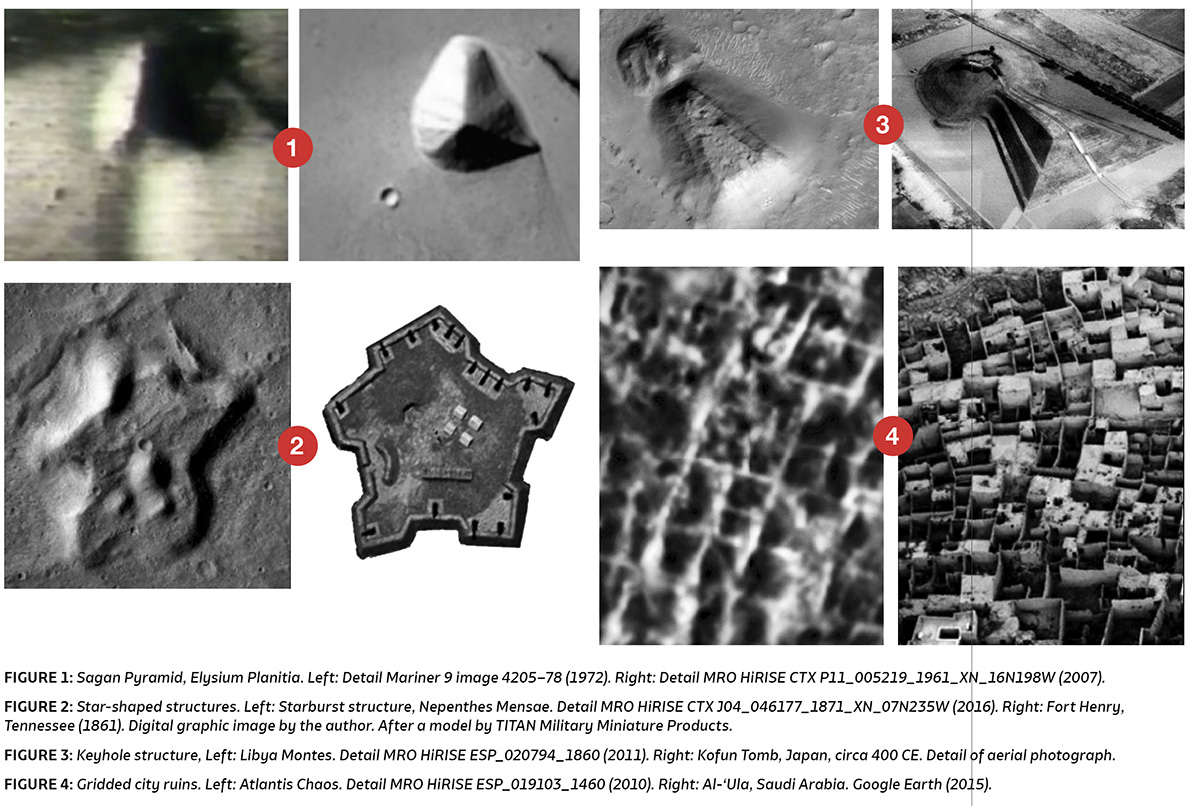
My tour of Martian structures begins in the northeastern quadrant of the red planet in an area known as Elysium Planitia. There, I provide the reader with the opportunity to take another look at a set of enormous pyramidal formations that were once made famous by the world-renowned astronomer Carl Sagan (Figure 1). He was so intrigued by one of these pyramidal formations that he included it in his early lectures and his 1980 book and television series Cosmos. Unfortunately, Sagan never had the opportunity to examine better images. Five years after his death, the European Space Agency released a high-resolution image of the area that showed the pyramids to be real and captured an entire complex of additional pyramidal structures.
Mysteries of Nepenthes Mensae: The City of Symbols

From there, the reader travels to west and is confronted with a pair of city complexes occupying the planet’s Nepenthes Mensae region. The pair of settlements includes over 20 pictographic and geometrically shaped structures nestled within a small and condensed area. The first settlement consists of a small group of highly symmetrical and geometrically shaped structures that include a Hexagonal Pyramid, a U-shaped Delta, and a Five-sided Star formation (Figure 2). The complex also features pictographic formations representing a full-bodied Dove, Killer Whale and the head of a Bulldog Bat. The second Nepenthes Mensae settlement consists of a connective train of four aligning platforms, each containing an assortment of highly symmetrical and geometric structures such as ovals, squares, triangles and rectangles.

Another mysterious feature is below this pair of city settlements within the same area of the Nepenthes Mensae region of Mars. Both NASA and The European Space Association (ESA) released a set of images showing an elongated hexagonal structure that is highly symmetrical. The six-sided structure has a thick, relatively flat platform with a central mound formation. After doing a quick Google search of ancient ruins around the world, much to my amazement, I found the remains of an identical elongated hexagonal mound in the southern region of central Turkey. Known as Araban Hoyuk, the six-sided mound has a similar flat platform design with a central mound formation, just like the structure on Mars. I sat staring at the screen in disbelief; I was looking at its terrestrial companion, a true doppelganger.

Libya Montes and the Keyhole Enigma

Continuing my tour on a westward trek, I take the reader to a well-known area of the planet just above Isidis Planitia known as Libya Montes. It is here that NASA proudly proclaimed to have photographed an odd formation that resembles an “exclamation mark” on the surface of Mars. The isolated formation appears to sit alone in the middle of nowhere. Although the highly symmetrical structure can also be seen as a keyhole and screams of artificiality, NASA scientists quickly dismissed it as a natural phenomenon.

Taking on the challenge, my colleagues and I delved into a comprehensive analysis of the keyhole-shaped structure and produced a science paper which shows this geometrically precise structure to not only be highly symmetrical but also match the design of the keyhole-shaped tombs found in Japan (Figure 3).

As a result of our studies, the Martian Keyhole structure can now be found all over the World Wide Web in news reports, blog articles and YouTube videos. It was also featured on the History Channel’s Ancient Aliens and the UnXplained program with William Shatner.

Pushing further west, across this once thriving planet, the reader travels down below Valles Marineris and into the Atlantis Chaos region of Mars. Once there, the reader is exposed to an extensive investigation of the remains of an ancient city nestled along the vast edge of a dead lake. The city consists of a gridded network of broken walls and shattered foundations that bring to mind the compartmentalised city of Al-‘Ula in Saudi Arabia (Figure 4) or the shell-shocked remains of Dresden after World War II.

Directly below the remains of this gridded city in Atlantis Chaos are two neighbouring settlements. Both settlements contain a set of five large geometrically shaped formations that include squares, triangles, and other polygonal forms. They are all very similar in size and have almost identical dimensions.
Parrotopia: A City Under the Wings

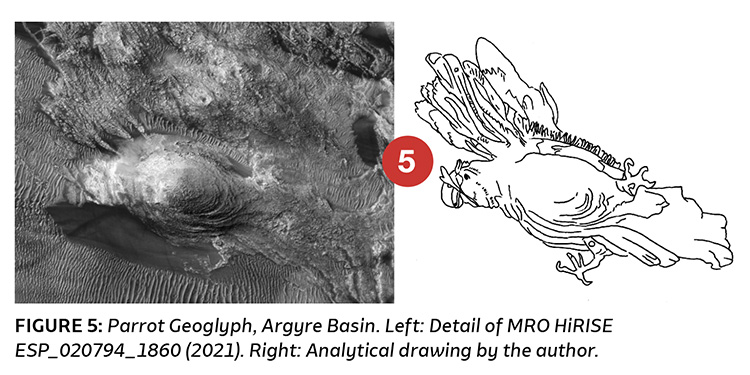
The tour concludes in a large-impact crater located within the southwestern quadrant of the planet known as Argyre Basin. Setting on the western side of this massive basin, the reader will experience a real “bird’s eye view” of a parrot-shaped formation over a mile long (Figure 5). The sculpted parrot formation has clear and recognisable features in the appropriate size and shape of a real parrot. It has a head, eye, beak, body, and wing. Additional anatomical components include two legs with feet and toes. When two geologists and four veterinarians examined the formation, they all confirmed that this parrot geoglyph on Mars has over twenty-two points of anatomical correctness. Yes, that’s right, over twenty-two points of anatomical correctness!

Beyond the mind-blowing accuracy of the parrot formation, the wing area above the main body contains the remains of an entire city. Dubbed Parrotopia, the city includes a port jetty, a towering lighthouse and other shoreline-related structures. Hidden within the wings streets and gridded infrastructure, we find the pictographic imprints of the Maya Rain God in his various mythological incarnations.

Before the Parrot geoglyph’s inclusion in my new book, it was the subject of two papers published in peer-reviewed science journals. It featured on the History Channel’s Ancient Aliens and The Proof is Out There programs. It was also mentioned on the front page of the Wall Street Journal and, most importantly, as a “tip of the hat” to its discover Wil Faust, an anthropologist and city planner from Pennsylvania, NASA officially titled the area Parrotopia.
Get the issue this article appears in

Ancient Wars Between Mars & Earth?

The reader is left with a little-known Mayan story that records what archaeologists read as a Star-War. The conflict was between the ancient cities of Naranjo and Tikal with the occupants of the planet Mars. Maya records show that Naranjo was founded around 896,000 years ago by a group of unknown people related to Mars and worshipped a primordial creature known as the Zip Monster, the patron god of Mars (Figure 6). It appears that just as the 13 colonies of America fought a revolutionary war with their homeland, England, to acquire independence 22,000 years ago, the colonies of Naranjo and Tikal fought a similar battle for independence with the occupants of Mars.
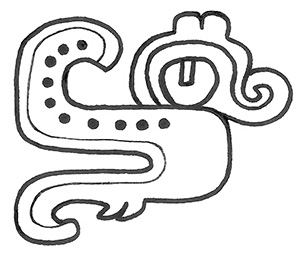
Figure 6: Zip Monster. Detail of page from the Dresden Codex. Drawing by the author.

This New World story sounds quite similar to the Sumerian stories of the Anunnaki wars between Earth and Mars with Enlil and Marduk, as interpreted by Zecharia Sitchin. In both versions, all life on Mars is extinguished by some kind of nuclear war. This dim scenario is supported by NASA’s detection of high levels of Xenon 129 within the Martian atmosphere, which was recently revealed by theoretical plasma physicist and astrophysicist Dr. John Brandenburg.

The current evidence of structures and ruined cities presented in official NASA and ESA images of Mars suggests that they were built after their original occupants were destroyed. Therefore, it is speculated that what we see today are the abandoned remains of that second occupation, which was only partially destroyed.

When this collection of structures is examined, you will find that they exhibit a direct correlation between the architecture and iconography of many of the cultures found on Earth, most notably within North and South America. These findings are supported by image specialist James S. Miller, geomorphologist William R. Sanders and geologist Michael Dale. They offer pro and con arguments for the artificial and natural origins of these unusual formations. Side-by-side comparisons of Martian structures are presented with their terrestrial counterparts, offering evidence of a shared aesthetic achieved in two opposing worlds.

In the foreword to The Great Architects of Mars, Dr John Brandenburg says that the evidence presented would appeal to anyone interested in the mysteries of Mars and our ancient past or if we entertain the idea that Mars and the Earth share a common point of origin. He states: “This is a unique and extremely important book, which provides the clearest and most precise evidence, ever compiled, to support the existence of artificial structures on the surface of Mars.”

As an artist, I have an eye for art and architecture, and my book, The Great Architects of Mars, results from those observations. I invite you to take another look at Mars with clear eyes and remember that through NASA’s own pictures, the truth will be revealed. 

George J. Haas’s book The Great Architects of Mars: Evidence for the Lost Civilizations on the Red Planet (with a foreword by John E. Brandenburg, PhD) is available from Inner Traditions.

This article was published in New Dawn Special Issue Vol 18 No 6.

If you appreciate this article, please consider subscribing to help maintain this website.

© New Dawn Magazine and the respective author.
For our reproduction notice, click here.

Support New Dawn

No Paywall. No Clickbait. Only Truth.
This website exists because a few choose to give back for what they receive. If New Dawn has enriched your vision or sparked insight, let your gratitude flow. Help sustain the work that awakens the world. Your contribution matters more than you know.

About the Author
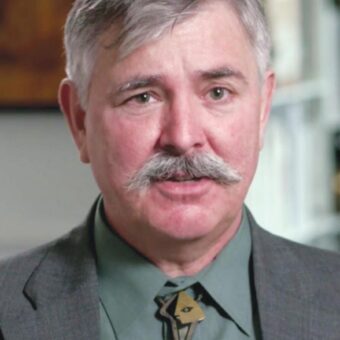
George J. Haas is the founder and premier investigator of the Mars research group known as The Cydonia Institute. A member of the Society for Planetary SETI Research, he has co-authored two books and six peer-reviewed science papers related to anomalous formations on the surface of Mars. He has appeared on Coast to Coast AM with George Noory and on the History Channel’s Ancient Aliens, The Proof is Out There, and The UnXplained with William Shatner. He lives in Waterford, Virginia.

© Copyright New Dawn Magazine, https://www.newdawnmagazine.com. Permission granted to freely distribute this article for non-commercial purposes if unedited and copied in full, including this notice.

The Meaning of Maturity: Ursula K. Le Guin on What It Really Takes to Grow Up

By Maria Popova (themarginalian.org)

It is not merely a matter of growing bones and growing responsibilities, this business of growing up, this unfinishable project of becoming ourselves. It is less like the evolutionary diagram of the upright ape than like a Russian nesting doll, our prior selves not outgrown but integrated, forever dwelling inside the person walking this world today.

One measure of maturity — perhaps the purest measure — may be the courage to put our arms around those former selves and pull them close, to take tender responsibility for their missteps and confusions, refusing denial, refusing despair. Without compassion for who we used to be, we can never fully own who we are or open to who we can become. This compassion is the fulcrum of maturity, and if imagination the fulcrum of compassion, then maturity is not a point we reach along the vector of intellectual development but an ongoing process of the active imagination.

That is what Ursula K. Le Guin (October 21, 1929–January 22, 2018) explores in a fragment of her wholly fantastic 1979 essay collection The Language of the Night: Essays on Writing, Science Fiction, and Fantasy (public library), which also gave us her abiding wisdom on the meaning of life.

Ursula K. Le Guin by Benjamin Reed

Long before Maurice Sendak insisted that “the child is the best part of the human self” and that the measure of a well-formed adult is “having your child self intact and alive and something to be proud of,” Le Guin writes:

I believe that maturity is not an outgrowing, but a growing up: that an adult is not a dead child, but a child who survived. I believe that all the best faculties of a mature human being exist in the child, and that if these faculties are encouraged in youth they will act well and wisely in the adult, but if they are repressed and denied in the child they will stunt and cripple the adult personality. And finally, I believe that one of the most deeply human, and humane, of these faculties is the power of imagination: so that it is our pleasant duty, as librarians, or teachers, or parents, or writers, or simply as grown-ups, to encourage that faculty of imagination in our children, to encourage it to grow freely, to flourish like the green bay tree, by giving it the best, absolutely the best and purest, nourishment that it can absorb. And never, under any circumstances, to squelch it, or sneer at it, or imply that it is childish, or unmanly, or untrue.
For fantasy is true, of course. It isn’t factual, but it is true. Children know that. Adults know it, too, and that is precisely why many of them are afraid of fantasy. They know that its truth challenges, even threatens, all that is false, all that is phony, unnecessary, and trivial in the life they have let themselves be forced into living. They are afraid of dragons because they are afraid of freedom.

There is no greater freedom than the self-permission to be entirely ourselves, an entirety we must go on embracing as it goes on expanding, goes on revealing its edges and its shadows. In consonance with Joan Didion’s searing assertion that “character — the willingness to accept responsibility for one’s own life — is the source from which self-respect springs,” Le Guin writes:

Our job in growing up is to become ourselves. We can’t do this if we feel the task is hopeless, nor if we’re led to think there isn’t any work to it. Growth will be stunted or perverted if a child is forced to despair or encouraged in false security, terrified or coddled. What we need to grow up is reality, the wholeness which exceeds human virtue and vice. We need knowledge; we need self-knowledge. We need to see ourselves and the shadows we cast. For we can face our own shadow; we can learn to control it and to be guided by it; so that when we grow into our strength and responsibility as adults in society, we will be less inclined, perhaps, either to give up in despair or to deny what we see, when we must face the evil that is done in the world, and the injustices and grief and suffering that we all must bear, and the final shadow at the end of all.

This is the paradox we must live with as we go on dying: that we are finite but unfinished, that maturity is not the prelude to mortality but the discovery of the immortal in us.

Card from An Almanac of Birds: 100 Divinations for Uncertain Days.

Couple with beloved Italian storyteller Cristina Campo on the work of knowing who you are and the meaning of maturity, then revisit Le Guin on how to live fully and the art of growing older.

Forward to a friend/Read Online/
Every month, I spend hundreds of hours and thousands of dollars keeping The Marginalian going. For twenty years, it has remained free, ad-free, AI-free, fully human and alive thanks to patronage from readers. I have no staff, no interns, not even an assistant — a thoroughly one-woman labor of love that is also my life and my livelihood. If it makes your own life more livable in any way, please consider aiding its sustenance with a one-time or loyal donation. Your support makes all the difference.monthly donationYou can become a Sustaining Patron with a recurring monthly donation of your choosing, between a cup of tea and a Brooklyn lunch. one-time donationOr you can become a Spontaneous Supporter with a one-time donation in any amount.Partial to Bitcoin? You can beam some bit-love my way: 197usDS6AsL9wDKxtGM6xaWjmR5ejgqem7
Need to cancel an existing donation? (It’s okay — life changes course. I treasure your kindness and appreciate your support for as long as it lasted.) You can do so on this page.
Continue reading The Meaning of Maturity: Ursula K. Le Guin on What It Really Takes to Grow Up

The Force and the Flower: Poet and Potter M.C. Richards on Creativity

By Maria Popova (themarginalian.org)

In a recent conversation with my poetic physicist friend Alan Lightman, sparring over whether the creative spirit can be usefully divided into complementary arts and science (Alan’s view) or whether these are simply different side doors to our ongoing yearning to bridge matter and mystery in order to make meaning (my view), I was reminded of a forgotten speech by one of the most original minds and brightest spirits of the past century.

On Valentine’s Day 1971, a year after the publication of her classic Centering, the poet and potter M.C. Richards (July 13, 1916–September 10, 1999) was invited to speak at an arts festival in Maine. Going “from horticulture to alchemy to the history of consciousness, with a few poems sprinkled in, and relying heavily on paradox,” the address she delivered, later included in The Crossing Point: Selected Talks and Writings (public library), is one of the most honest, imaginative, and articulate investigations of creativity I have encountered — a bold defiance of the fracturing of culture anchored in the passionate insistence that “the center is everywhere,” that it is “made up of differences, uniquenesses, in a tissue of relationships, interactions, interpenetrations.”

Mary Caroline Richards at Black Mountain College (Getty Research Institute. Photographer unknown.)

At the center of her cosmogony of creativity are the connections between the life of the individual human being and the life of the universe; between the inner invisible realm, which she calls “the force,” and the outer visible realm of its manifestation, which she calls the “the flower”; between the different fields of study and work through which we explore these realms. She writes:

Artists are sometimes particularly attuned to these connections, scientists too, mystics too… There may be a message in this way of working. Maybe that’s what a subject is, a gathering of ideas as set in motion by a central impulse. Like a magnetic field. Start the field going, and elements begin to swarm. By what logic? By attraction. By resonance. Maybe that’s what relevance is: the feeling of attraction and resonance between ideas and people.

This feeling, Richard observes, is what we call creativity — the mystery to which we try to give shape in matter — and it begins not in the mind but in the heart. She considers the force by which the cabbage flowers:

Cabbage… grows a big heart. Out of this heart come leaves. As the leaves grow, the heart grows. The cabbage gets its leaves from the inside, where there aren’t any. Cabbages grow from the inside, from the heart. And by growing they create their hearts.

A neurophysiologist from Yale says that brains too are created in this way: from un-brain forces. He says that the human brain is created by thinking, that ideas and values create chemical reactions in tissue. Like a cabbage, somehow the physical form grows from an invisible realm.

This invisible realm must be a powerfully creative region. It furnishes us not only with cabbages and brains, but with our scientific hypotheses, religious experiences, and works of art.

With the recognition that works of art begin with “a feeling for things, a feeling which is a way of knowing about things,” she adds:

We tend to call any undertaking an art when it seems to be drawing upon the fullness of inner feeling and upon careful regard for physical expression. To live and to work in the world mindful of the processes which are necessary to infuse matter with soul forces, to use techniques on behalf of living forms, is a great art.

In this sense, she observes, living itself is an art — the art of connection. Just as Erich Fromm was formulating the ideas that would become The Art of Being, Richards writes:

Life is best understood and practiced as an art, the way that art is understood and practiced. We rely on inspiration, feeling for materials, knowledge of how to put things together well, patience, physical strength and awareness that we are part of a process which we don’t know much about yet but which we live within and are sustained by. The verbal arts we practice, or visual arts, or graphic arts, or theater arts, or musical arts, or liberal arts, are part of something. They are not the whole story. And they are interconnected at the center with all the other parts.

1573 painting by the Portuguese artist Francisco de Holanda, a student of Michelangelo’s. (Available as a print and as stationery cards.)

Pulsating beneath this interconnected totality is the essence of all creative work. While the young Jane Goodall was contemplating the indivisibility of art and science, Richards considers what creativity in all its forms asks of us and what it gives us:

Total concentration, total focus, enjoyment, discovery, inner effort, creating something, feeling secure in the process yet not knowing or demanding to know how it will come out. Many of the things we do may have this quality. Take gardening, for example, or making lab experiments, or working out a new equation, or cooking supper, or having a child, or teaching a class, or running a college, or praying, or going for a walk, or getting married, or dying.

This feeling of generative not-knowing — something the artist Ann Hamilton so beautifully articulated a generation after Richards — is also our best path to knowledge, integral to the creative process of science:

When we live in the spirit of science, we live in a quality of inquiry, of wonder. We put one foot in front of the other, standing firmly balanced on the earth, finding our way on. Each step is both an answer and a question. We both know and don’t know what we are doing… We need to learn to hear the yesin the no; the no in the yes. To hear what is not said. To see what is not visible.

This, of course, is why poetry and science so naturally meet, why openness to wonder may be the best measure and the deepest meaning of our aliveness, the wellspring from which everything that is creative springs.

Why We Keep Dating The Wrong Person & How You Can Find The Right Life Partner Now 

 June 15, 2026 (Menalive.com)

By  Jed Diamond

                I have been a marriage and family counselor for more than fifty years. It was more than embarrassing to be helping others but finding my own love life in constant crisis.  When people visit me at MenAlive you will see my welcome video, “Confessions of a Twice-Divorced Marriage Counselor.”

                It took me a long time to take my own advice and get help. That’s the bad news. The good news is that I finally found a good therapist and found the right life partner. Carlin and I have been joyfully married for 46 years and more in love now than ever. The even better news is that I can help you if would like to find your right partner and stop looking for love in all the wrong places, the title of one of my most popular and best-selling books.

                If you are interested in working with me on these issues, drop me a note (Jed@Menalive.com).

               Continue reading, if you’d like to learn more about why we get hooked on relationships that are bad for us. 

                The truth is that things have changed a great deal from the time when I was looking for love. With the advent of social media and an on-line world of endless possibilities along with a real-life world of broken promises, dating has become more difficult than ever. More people are acting like porcupines in the snow that are hungry for love and affection. Yet as soon as they get close their prickly spines wound each other and they distance themselves.

                According to a recent article in Forbes magazine article by Emily Phares,

               “Most single men and women between the ages of 18 and 34 (53% and 68%, respectively) say they want a romantic relationship, according to a 2024 study commissioned by dating platform Tinder, which surveyed 8,000 heterosexual participants in the U.S., U.K., Australia and Canada. However, nearly all respondents — including 91% of men and 94% of women — say they think the current dating environment is more difficult than ever.”

                There are unique challenges that people face, regardless of age, but I have found that we never stop wanting love and often the dating difficulties faced by men and women in their 40s, 50s, 60s, and beyond can even more stressful.

                In my book, The Enlightened Marriage: The 5 Transformative Stages of Relationships and Why the Best is Still to Come, I share what Carlin and I have learned. Iyanla Vanzant author and former host of Iyanla Fix My Life on the Oprah Winfred Network (OWN) had this to say after reading my book:

               “There are some skills you must have, some ways you must be, and some things you must learn or unlearn if you want to have a healthy, fulfilling, and loving relationship. Jed Diamond’s work in The Enlightened Marriage covers all of the ‘musts’ and then some. What a blessing!”

Are You Looking For Love in All the Wrong Places?

                Here are some questions I had to address in my own life and which I help my clients explore in their lives:

  1. Am I truly satisfied with my love life?
  2. Do I find that the people I am attracted to turn out later to be wrong for me?
  3. Even when tell myself, “I won’t make that mistake again,” do I find myself in another bad situation?
  4. If I look at my dating history and look honestly at those I’ve been drawn to, is there a pattern?
  5. What role models did I have growing up? What kind of marriage did my parents have and how might that have influenced my love life?
  6. Did I experience “adverse childhood experiences” growing up that included physical, emotional, or sexual abuse or neglect?
  7. Was my father physically or emotionally absent when I was growing up?
  8. Was my relationship with my father too distant or inappropriately close?
  9. Was my mother physically or emotionally absent when I was growing up?
  10.  Was my relationship with my mother too distant or inappropriately close?
  11. Deep down how safe do I feel being vulnerable and intimate with a mate?
  12. How loving do I feel toward myself? How comfortable do I feel with my physical, emotional, and sexual self?

A Few Important Things I Have Learned Over the Years

  1. It is never too early or too late to improve your mental, emotional, and relational love life.
  2. At the end of our lives, people rarely feel regret because they didn’t make enough money or achieved great success in their work lives. Most people wish they had learned to love more deeply and well.
  3. Even those of us who were raised with a healthy family with parents who loved us and loved each other, we all suffer wounds to our love lives.
  4. Since much of the wounding comes when we are young and impacts all of us to some degree, we often block out the painful memories which slip into our subconscious.
  5. What remains unconscious tends to rule our lives since we continue to repeat old patterns without recognizing their subconscious origins.
  6. Each dysfunctional date, love affair, or marriage adds a little bit to our addictive behavior of repeating old patterns.
  7. The opposite of addiction is healthy connection.
  8. We are not stupid or crazy, though at times our behavior makes us feel we have lost our minds. There is actually a positive desire underlying our dysfunctional love lives.
  9. I believe that unconsciously we are hoping that by re-creating the dysfunctional relationships from our past, we believe that this time things will be different. This time I will fix things and get the love I have been missing all my life.
  10. Sometimes we can do the healing ourselves and fix things on our own. Most times we can benefit from working with a therapist, counselor, or guide who knows the territory, has been there themselves, and has helped themselves and others to heal.
  11. It is never too late to heal old wounds and have a relationship of your dreams.

               I hope you find my articles helpful. Drop me a note (Jed@MenAlive.com) and let me know. I read every personal email I receive from people. If I can help you, I would be pleased to connect.

Author Image

Best Wishes,

Jed Diamond

Founder and VHS (Visionary Healer Scholar) of MenAlive

Inside Turkey’s Democratic Crisis

Since winning Turkey’s 2023 national election, President Erdoğan and the ruling AK Party have seen their popularity plummet. In response, they’ve ramped up their repression of the main opposition party — most notably, jailing its presidential candidate, Istanbul mayor Ekrem İmamoğlu and removing party leader Özgür Özel.

Don’t miss Özel’s recent Journal of Democracy essay outlining his vision for restoring democracy in Turkey, along with our coverage of the country’s hard turn toward autocracy in the last year. 
How We Restore Turkey’s Democracy

President Erdoğan’s rule has grown more repressive as he realizes he has no democratic path to power. But we are united in our resolve and determined to make Turkey a democratic republic worthy of its people.

By Özgür Özel
How to Fight Turkey’s Authoritarian Turn

As President Erdoğan’s grip on power is slipping, his regime is turning more repressive. But Turkey may still avoid becoming a full-blown autocracy. The opposition is increasingly popular, and there remains a way to tilt the playing field to their advantage.

By Berk Esen and Sebnem Gumuscu
Turkey’s Hard Road to Democratic Renewal

Turkey’s democratic future hinges on its opposition parties doing something few expected: winning elections in unfair conditions. Yet the opposition’s strong performance in local elections suggests that they may be putting together a winning formula for Turkey and beyond.

By Ayça Alemdaroğlu, Toygar Sinan Baykan, Ladin Bayurgil, and Aytuğ Şaşmaz
Secularism, Islamism, and the Future of Turkey

The political struggle between President Erdoğan and opposition leader Ekrem İmamoğlu is a fierce battle for the country’s democracy. But it goes deeper than that. It is also a struggle between Islamist and secularist visions of Turkey.

By Ahmet T. Kuru
After Crackdown, Is Turkey an Autocracy?

Turkey’s president would rather turn his country into a full autocracy than give up power. But the Turkish people are clinging to what remains of their democracy, and they are ready to fight for it.

By Berk Esen and Sebnem Gumuscu

The Journal of Democracy is published quarterly in January, April, July, and October. Subscribe now for full access to the Journal of Democracy archives.

Book: “On Religion: Speeches to its Cultured Despisers”

On Religion: Speeches to its Cultured Despisers

Friedrich SchleiermacherRichard Crouter (Editor)

Schleiermacher’s On Religion: Speeches to its Cultured Despisers is a classic of modern Protestant religious thought that powerfully displays the tensions between the Romantic and Enlightenment accounts of religion. This edition presents the original 1799 text in English for the first time. Richard Crouter’s introduction places the work in the milieu of early German Romanticism, Kant criticism, the revival of Spinoza and Plato studies, and theories of literary criticism and of the physical sciences. This fully annotated edition also contains a chronology and notes on further reading.

About the author

Friedrich Schleiermacher

Friedrich Daniel Ernst Schleiermacher was a German theologian and philosopher known for his impressive attempt to reconcile the criticisms of the Enlightenment with traditional Protestant orthodoxy. He also became influential in the evolution of Higher Criticism. His work also forms part of the foundation of the modern field of hermeneutics. Because of his profound impact on subsequent Christian thought, he is often called the “Father of Modern Protestant Theology”, and is considered an early leader in liberal Christianity. The neo-orthodoxy movement of the twentieth century, typically (though not without challenge) seen to be spearheaded by Karl Barth, was in many ways an attempt to challenge his influence.

(Goodreads.com)

Book: “Omens of Millennium”

Omens of the Millennium: The Gnosis of Angels, Dreams & Resurrection

Harold Bloom

In this impassioned, erudite, and provocative work, Harold Bloom, bestselling author and America’s foremost literary and cultural critic, examines society’s “New Age” obsessions: angels, prophetic dreams, and near-death experiences. Omens of Millennium traces these cultural phenomena from their ancient and traditional origins to their present-day, millennial manifestations. In addition, it is a personal account of Bloom’s Gnosticism. Certain to educate, challenge, and entertain, Omens of Millennium is as fascinating as it is timely.

About the author

Harold Bloom

Harold Bloom was an American literary critic and the Sterling Professor of Humanities at Yale University. In 2017, Bloom was called “probably the most famous literary critic in the English-speaking world.” After publishing his first book in 1959, Bloom wrote more than 50 books, including over 40 books of literary criticism, several books discussing religion, and one novel. He edited hundreds of anthologies concerning numerous literary and philosophical figures for the Chelsea House publishing firm. Bloom’s books have been translated into more than 40 languages. He was elected to the American Philosophical Society in 1995.

Bloom was a defender of the traditional Western canon at a time when literature departments were focusing on what he derided as the “school of resentment” (multiculturalists, feminists, Marxists, and others). He was educated at Yale University, the University of Cambridge, and Cornell University.

(Goodreads.com)

Book: “The American Religion”

The American Religion

Harold Bloom

In this fascinating work of religious criticism, Harold Bloom examines a number of American-born faiths: Pentecostalism, Mormonism, Seventh-day Adventism, Christian Science, Jehovah’s Witnesses, Southern Baptism and Fundamentalism, and African-American spirituality. He traces the distinctive features of American religion while asking provocative questions about the role religion plays in American culture and in each American’s concept of his or her relationship to God. Bloom finds that our spiritual beliefs provide an exact portrait of our national character.

About the author

Harold Bloom

Harold Bloom was an American literary critic and the Sterling Professor of Humanities at Yale University. In 2017, Bloom was called “probably the most famous literary critic in the English-speaking world.” After publishing his first book in 1959, Bloom wrote more than 50 books, including over 40 books of literary criticism, several books discussing religion, and one novel. He edited hundreds of anthologies concerning numerous literary and philosophical figures for the Chelsea House publishing firm. Bloom’s books have been translated into more than 40 languages. He was elected to the American Philosophical Society in 1995.

Bloom was a defender of the traditional Western canon at a time when literature departments were focusing on what he derided as the “school of resentment” (multiculturalists, feminists, Marxists, and others). He was educated at Yale University, the University of Cambridge, and Cornell University.

(Goodreads.com)

Consciousness, spirituality, biography, sexuality, androgyny, futurism, space, the arts, science, astrology, democracy, humor, books, movies and more