
Marianne Williamson Aug 23, 2026 An Introduction to the Fifty Miracle Principles Recorded Live Sunday, August 23, 2026 There are objective, discernible laws of inner experience just as there are objective, discernible laws of the outer world. While most of us know enough about how the material world operates to navigate it effectively, we’re usually far less aware of the power of our own minds. In this powerful hour, Marianne introduces the 50 Miracle Principles that are the beginning of A Course in Miracles. There is only one Truth with a capital T, and A Course in Miracles is only one expression of it. But if it’s for you, you know it. And if it’s time for you to study it, your life will never be the same. You’ll also learn how to go deeper with Marianne daily. Get the details here: https://marianne.com/acim/
Category Archives: Spirituality
“Resist Not Evil” with Paul Chek
New Thinking Allowed with Jeffrey Mishlove Aug 16, 2026 Paul Chek is a holistic health practitioner, wellness coach, corrective exercise specialist and educator. His journey began when he served on the US Army boxing team. He is the author of How to Eat, Move, and Be Healthy. He is the creator of the Spirit Gym and host of the Spirit Gym with Paul Chek podcast. Paul explores Jesus’ teaching to “resist not evil,” examining how trauma, consciousness, forgiveness, and spiritual maturity shape our response to conflict rather than retaliation. Drawing on his experience as a therapist, holistic health educator, former Army boxing trainer, and founder of Spirit Gym, Chek argues that true strength comes through healing wounded parts of ourselves instead of becoming what we oppose. Chek touches on psychology, Jung, Rudolf Steiner, nonviolent resistance, forgiveness, mythology, and practical spiritual development as pathways toward greater wisdom. 00:00:00 Introduction 00:02:13 Paul’s background and spiritual journey 00:07:19 Responding to evil without becoming it 00:13:02 Trauma, boxing and healing childhood wounds 00:20:05 Spirit Gym and holistic spiritual development 00:27:51 Can evil serve human growth? 00:35:21 Humanity as a school for evolving souls 00:43:01 Religion, consciousness and unconditional love 00:52:07 Nonviolent resistance and forgiveness 01:00:45 Conclusion New Thinking Allowed host, Jeffrey Mishlove, PhD, is author of The Roots of Consciousness, Psi Development Systems, and The PK Man. Between 1986 and 2002 he hosted and co-produced the original Thinking Allowed public television series. He is the recipient of the only doctoral diploma in “parapsychology” ever awarded by an accredited university (University of California, Berkeley, 1980). He is also the Grand Prize winner of the 2021 Bigelow Institute essay competition regarding the best evidence for survival of human consciousness after permanent bodily death. He is Co-Director of Parapsychology Education at the California Institute for Human Science. (Recorded on Tuesday, July 30, 2026)
Google AI on Wetiko
- Google AI
Wetiko (also spelled windigo or wendigo) is an Algonquian-rooted concept describing an evil, cannibalistic spirit or destructive force driven by insatiable greed, selfish consumption, and a total disconnect from community and nature. In modern psychological and spiritual contexts, it is widely interpreted as a contagious “mind-virus” or collective psychosis that compels humans to act against their own best interests. [1, 2, 3, 4, 5]
Traditional Origin
- Cannibalistic Spirit: In Algonquin, Cree, and Ojibwe traditions, wetiko represents a monster or spirit embodying greed, excess, and a literal or figurative “heart of ice”. [1, 2, 3, 4]
- Behavioral Warning: Legends warned that individuals who gave in to extreme selfishness, gluttony, or harm toward their tribe could become possessed or transformed by the wetiko force. [1]
Modern Psychospiritual Interpretation
- The Mind-Virus: Authors like Paul Levy and indigenous scholars like Jack Forbes describe wetiko as an invisible, contagious psychic parasite. [1, 2, 3]
- Core Traits: It manifests as consumption for the sake of consumption, systemic exploitation, environmental destruction, and an egocentric illusion of absolute separation from others. [1]
- The Antidote: Writers on the subject emphasize that recognizing wetiko within our own blind spots and unconscious reactions is the first step toward breaking its cycle. [1, 2, 3]
In the context of modern capitalism, scholars and activists use wetiko as a conceptual lens to critique systemic exploitation, viewing hyper-accelerated globalized capitalism not just as an economic structure, but as the ultimate institutionalized manifestation of the wetiko “mind-virus.” [1, 2, 3, 4]
When applied to modern market systems, the concept highlights several structural parallels:
Insatiable Growth
- Endless Accumulation: Capitalism’s core imperative is continuous, infinite growth. This directly mirrors the wetiko monster’s defining curse: the more it consumes, the larger, hungrier, and more desperate it becomes. [1, 2, 3, 4, 5]
- Consumption as Salvation: Culturally, the system encourages consumerism as a fix-all solution for human discontent, equating personal value with material possession. [1, 2]
Commercial “Cannibalism”
- Life as a Commodity: Indigenous scholar Jack Forbes defined cannibalism under wetiko as “the consuming of another’s life for one’s private purpose or profit.” [1, 2]
- Exploitation: Under this framework, transforming natural ecosystems into dead commodities (ecocide) and reducing human time, health, and labor to mere line-item expenses are seen as forms of systemic cannibalism. [1, 2]
Institutionalized Blindness
- Externalized Harms: Modern market mechanics separate consumers from the consequences of their purchases (e.g., hidden environmental degradation or sweatshop labor). This distance numbs social accountability.
- Amputated Empathy: The classic wetiko symptom—an “icy heart”—is institutionalized when corporations are legally obligated to prioritize quarterly profit and shareholder returns over community wellbeing or ecological safety. [1, 2, 3, 4]
The Alternative Vision
Writers like Alnoor Ladha and Paul Levy argue that to fix global crises, we must look beyond policy tweaks. They advocate for: [1, 2]
- “Undreaming” the System: Seeing the global economy as a collective psychological projection rather than an unchangeable law of nature.
- Shifting the Goal: Moving from extractive economics to reciprocal, sustainable systems modeled on Indigenous stewardship. [1]
The Seat of the Soul, Part II, with Gary Zukav
New Thinking Allowed with Jeffrey Mishlove Aug 7, 2026 This video is a special release from the original Thinking Allowed series that ran on public television from 1986 until 2002. It was recorded in about 1989. It will remain public for only one week. Gary Zukav is author of The Dancing Wu-Li Masters, which won the American Book Award for Science in 1979, as well as the national bestseller, The Seat of the Soul. Here he states that we have crossed a major threshold in which we are learning to seek the spiritual empowerment of the soul rather than the superficial rewards of external power. He discusses the role of spirit guides and teachers, as well as intuition, in facilitating the growth of the soul, and suggests that native American peoples have maintained an appreciation for the soul that has largely been lost in modern society. Now you can watch all of the programs from the original Thinking Allowed Video Collection, hosted by Jeffrey Mishlove. Subscribe to the new Streaming Channel (https://thinkingallowed.vhx.tv/) and watch more than 350 programs now, with more, previously unreleased titles added weekly. Free month of the classic Thinking Allowed streaming channel for New Thinking Allowed subscribers only. Use code THINKFREELY.
Rethinking Satanism with Mitch Horowitz
New Thinking Allowed with Jeffrey Mishlove Jul 27, 2026 Mitch Horowitz is the author of many books on esoterica, spirituality, mysticism and the occult. Among his titles are The Seeker’s Guide to the Secret Teachings of All Ages, The Miracle Club, One Simple Idea, Magician of the Beautiful: An Introduction to Neville Goddard, and Occult America. He has edited a selection of writings and lectures by Neville Goddard titled, The Ideal Realized. His website is https://mitchhorowitz.com/. In this video, rebooted from 2021, he describes a very personal journey that has led him to explore and endorse theological Satanism. He makes a point of distinguishing the biblical tradition in Genesis 3, and the writings of John Milton, William Blake, and Percy Bysshe Shelley from the popular accounts of Satanism as depicted in fiction, film, and mass media. He suggests that the contemporary theological writings of Michael Aquino and Anton LaVey belong to the former tradition that portrays the Satanic impulse as rebellious and heroic, rather than evil. He explains his own personal code of ethics. New Thinking Allowed host, Jeffrey Mishlove, PhD, is author of The Roots of Consciousness, Psi Development Systems, and The PK Man. Between 1986 and 2002 he hosted and co-produced the original Thinking Allowed public television series. He is the recipient of the only doctoral diploma in “parapsychology” ever awarded by an accredited university (University of California, Berkeley, 1980). He is also the Grand Prize winner of the 2021 Bigelow Institute essay competition regarding the best evidence for survival of human consciousness after permanent bodily death. He is Co-Director of Parapsychology Education at the California Institute for Human Science. (Recorded on January 11, 2021)
Rumi on what’s comfortable
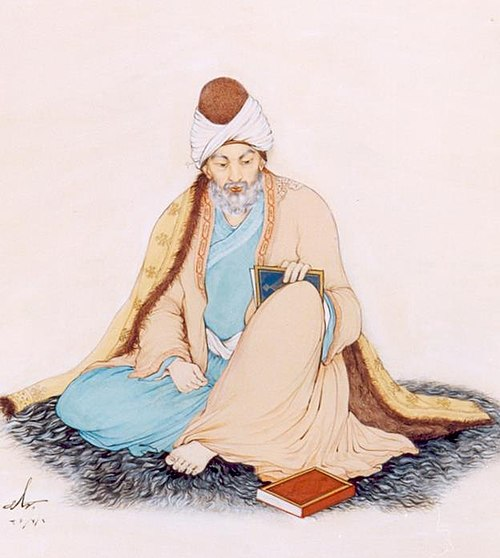
Rumi, by Iranian artist Hossein Behzad (1957)
“Run from what’s comfortable. Forget safety. Live where you fear to live. Destroy your reputation. Be notorious. I have tried prudent planning long enough. From now on I’ll be mad.”
~ Rumi
Jalāl al-Dīn Muḥammad Rūmī, commonly known as Rumi, was a Sufi mystic, poet, and founder of the Islamic brotherhood known as the Mevlevi Order. His family hailed from Balkh. Rumi is an influential figure in Sufism, and his thought and works loom large both in Persian literature and mystic poetry in general. Wikipedia
Born September 30, 1207, Balkh, Afghanistan
Died December 17, 1273 (age 66 years), Konya, Türkiye
North Carolina motto: “To be rather than to seem.”
- Google AI Overview

North Carolina’s state motto is Esse Quam Videri, a Latin phrase that translates to “To be, rather than to seem.” Adopted in 1893, it reflects a commitment to genuine character and integrity over outward appearances. [1, 2, 3]
The motto was adopted by the General Assembly, making North Carolina the last of the original 13 colonies to select one. It was adapted from the Roman philosopher Cicero’s essay on friendship (De Amicitia). [1, 2, 3]
You can find the official text and laws regarding its use on the North Carolina General Assembly Statutes webpage. For more historical context on how it was chosen, visit the NCpedia entry hosted by the State of North Carolina. [1]
Excerpts from Aldous Huxley’s “The Perennial Philosophy”
“Perpetual inspiration is as necessary to the life of goodness, holiness and happiness as perpetual respiration is necessary to animal life.”
–William Law
(Image from Amazon.com)
[H]ow significant it is that in the Indo-European languages . . . the root meaning “two” should connote badness. The Greek prefix dys- (as in dyspepsia) and the latin dis- (as in dishonorable) are both derived from “duo.” The cognate bis-gives a pejorative sense to such modern French words as bévue (“blunder,” literally “two-sight”). Traces of that “second which leads you astray” can be found in “dubious,” “doubt” and Zweifel--for to doubt is to be double-minded. . . . Obscurely and unconsciously wise, our language confirms the findings of the mystics and proclaims the essential badness of division–a word, incidentally, in which our old enemy “two” makes another decisive appearance.
“When Bayazid was asked how old he was, he replied, ‘Four years.’ They said, ‘How can that be?’ He answered, ‘I have been veiled from God by the world for seventy years, but I have seen Him during the last four years. The period during which one is veiled does not belong to one’s life.'”
“For my part, I think the chief reason which prompted the invisible God to become visible in the flesh and to hold converse with men was to lead carnal men, who are only able to love carnally, to the healthful love of his flesh, and afterwards, little by little, to spiritual love.” –St. Bernard
“Your enjoyment of the world is never right till every morning you awake in Heaven; see yourself in your Father’s palace; and look upon the skies, the earth and the air as celestial joys; having such a reverend esteem of all, as if you were among the Angels. The bride fo a monarch, in her husband’s chamber, hath no such causes of delight as you.
“You never enjoy the world aright till the sea itself floweth in your veins, till you are clothed with the heavens and crowned with the stars; and perceive yourself to be the sole heir of the whole world, and more than so, because men are in it who are every one sole heirs as well as you.
“Till you can sing and rejoice and delight in God, as misers do in gold, and kings in sceptres, you can never enjoy the world. Till your spirit filleth the whole world, and the stars are your jewels; till you are as familiar with the ways of God in all ages as with your walk and table; till you are intimately acquainted with that shady nothing out of which the world was made; till you love men so as to desire their happiness with a thirst equal to the zeal of your own; till you delight in God for being good to all; you never enjoy the world.
“Till you more feel it than your private estate, and are more present in the hemisphere, considering the glories and the beauties there, than in your own house; till you remember how lately you were made, and how wonderful it was when you came into it; and more rejoice in the palace of your glory than if it had been made today morning.
“Yet further, you never enjoyed the world aright, till you so love the beauty of enjoying it, that you are covetous and earnest to persuade others to enjoy it. And so perfectly hate the abominable corruption of men in despising it that you had rather suffer the flames of hell than willingly be guilty of their error.” –Thomas Traherne
“Therefore I give you still another thought, which is yet purer and more spiritual. In the Kingdom of Heaven all is in all, all is one, and all is ours.” –Eckhart
“Love is infallible; it has no errors, for all errors are the want of love.”
–William Law
Love is a mode of knowledge.
[M]an’s obsessive consciousness of, and insistence on being, a separate self is the final and most formidable obstacle to the unitive knowledge of God.
“The sect of lovers is distinct from all others; Lovers have a religion and a faith all their own.” –Jalal-uddin Rumi
“Temperance is love surrendering itself wholly to Him who is its object; courage is love bearing all things gladly for the sake of Him who is its object; justice is love serving only Him who is its object, and therefore rightly ruling; prudence is love making wise distinction between what hinders and what helps itself.” –St. Augustine
“Our kingdom go” is the necessary and unavoidable corollary of “Thy kingdom come.”
“The rout and destruction of the passions, while a good, is not the ultimate good; the discovery of Wisdom is the surpassing good. When this is found, all the people will sing.” –Philo
It is by losing the egocentric life that we save the hitherto latent and undiscovered life which, in the spiritual part of our being, we share with the divine Ground. This new-found life is “more abundant” than the other, and of a different and higher kind. Its possession is liberation into the eternal, and liberation is beatitude [happiness].
Continue reading Excerpts from Aldous Huxley’s “The Perennial Philosophy”Uma’s father, Robert Thurman, on the “Supernormal”
Wisdom is Bliss with Robert Thurman (1941-2026) Jul 18, 2026 Psychology and Psychotherapy Robert Thurman, PhD, passed on June 16 of this year. He was a shining light of love and joy, and a friend to the New Thinking Allowed family. We are grateful to have known him and to be touched by his warmth and passion. He was professor emeritus at Columbia University where he was a teaching professor for 50 years on Indo-Tibetan Buddhist Studies. He was the first Westerner Tibetan Buddhist monk, ordained by His Holiness the Dalai Lama. He authored many books, including Why the Dalai Lama Matters: His Act of Truth as the Solution for China, Tibet, and the Whole World and Infinite Life: Awakening to Bliss Within. His most recent book is Wisdom is Bliss: Four Friendly Fun Facts That Can Change Your Life. His website is bobthurman.com. In this video, rebooted from 2023, Robert shares how wisdom is bliss. Ignorance is not bliss and can cause suffering. He describes the four noble truths of Buddhism as four friendly fun facts and encourages you to use your life to become generous, compassionate, and enlightened. New Thinking Allowed CoHost, Emmy Vadnais, OTR/L, is a licensed occupational therapist, intuitive healer and coach, and spiritual guide based in St. Paul, Minnesota. Emmy is the founder of the Intuitive Connections and Holistic OT communities. She is the author of Intuitive Development: How to Trust Your Inner Knowing for Guidance With Relationships, Health, and Spirituality. She offers intuitive coaching to help individuals access their inner guidance for clarity, healing, and meaningful decision-making. Her website is https://emmyvadnais.com (Recorded on February 24, 2023)
Lamed Vav
- Google AI Overview


In Jewish mysticism, the Lamed Vav (Hebrew: ל״ו, meaning 36) refers to the Tzadikim Nistarim (Hidden Righteous Ones). According to tradition, there are 36 humble, anonymous saints in every generation whose purpose is to justify humanity’s existence before God. [1, 2, 3, 4]
The concept originates in the Babylonian Talmud (Sukkah 45b and Sanhedrin 97b), based on a teaching by the sage Abaye that the world always contains at least 36 righteous people who greet the Divine Presence. The number 36 comes from the Hebrew letters Lamed (30) and Vav (6). [1, 2, 3]
Key aspects of the legend include:
- Anonymity: They are completely unaware of their own status. If a Lamed Vavnik’s identity is revealed, or they discover it themselves, they usually pass away, and a successor is born. [1, 2]
- Humbleness: They typically live as ordinary, working-class people—such as laborers, shoemakers, or farmers—masking their spiritual greatness. [1, 2]
- The Burden of the World: They are said to absorb the world’s suffering and keep it from being destroyed by human malice. [1, 2, 3, 4]
The tradition is explored in depth across folklore and literature, most notably in André Schwarz-Bart’s novel The Last of the Just. For further study on the origins of these hidden saints, you can read the comprehensive overview on Chabad.org or explore the historical texts in the Jewish Virtual Library. [1, 2, 3, 4, 5]