The artwork titled “Sülamith,” created by Anselm Kiefer in 1983, is a prominent piece within the New European Painting movement. Measuring 290 by 370 centimeters, it exemplifies the genre of figurative art. The depiction encompasses profound historical and cultural elements, as is characteristic of Kiefer’s artistic approach.
The artwork presents a vast, cavernous interior rendered in dark, somber tones, evoking a sense of monumental architecture. The arches and brickwork dominate the composition, leading the viewer’s eye towards an indistinct, yet profoundly significant focal point at the center. The intricate detailing of the walls and the play of light and shadow emphasize the depth and perspective, creating an immersive environment. The name “Sülamith” inscribed in the top left corner adds a layer of narrative and historical reference, contributing to the artwork’s contemplative and evocative nature. The textures and colors used by Kiefer in this piece lend it a poignant and timeless quality, inviting viewers to explore its layers of meaning and historical resonance.
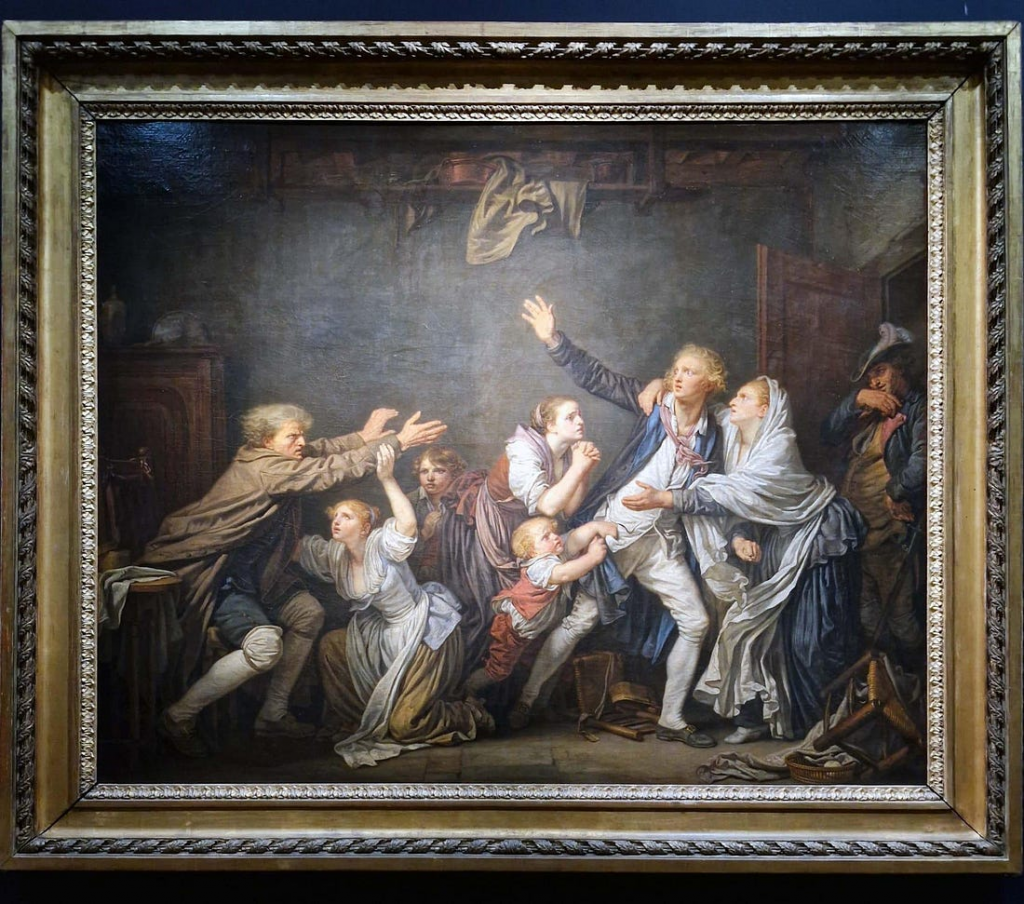
Artwork: Jean-Baptiste Greuze, The Father’s Curse: The Ungrateful Son, 1777, oil on canvas, Musée du Louvre, Paris. Greuze depicts a patriarch who interprets his child’s independence as treachery. The father transforms departure into disobedience, then condemns the son for escaping his authority.
All images courtesy of Helena Minginowicz, shared with permission
July 13, 2026 (thisiscolossal.com)
“Civilizations are remembered through their monuments, but understood through the things they throw away,” says artist Helena Minginowicz, whose sensitive paintings interrogate our understanding of value. Using airbrushed acrylic, which can be built up in lightweight, translucent layers, the artist takes one of the most quotidian household items as a starting point: paper towel.
With its machine-embossed, moisture-wicking patterns, the absorbent paper comprises an instantly recognizable substrate. The precise, textured flourishes are aesthetically pleasing, and yet it’s hard to completely separate them from our associations with mass-produced paper products that are designed for one-time use and disposability. This dichotomy sits at he heart of Minginowicz’s practice, in which she explores “how changing the hierarchy of materials can reshape the way we perceive value, dignity, and the human experience,” she tells Colossal.
Minginowicz’s embossed pieces from everyday domestic material are one facet of a broader multimedia approach to materiality in which she creates paintings on canvas and also painstakingly embosses delicate tissues. The paper towel works, in addition to some that are made on supermarket-style plastic bags, are then presented between thick slabs of acrylic, transforming them into objects with substantial heft and dimensionality.
“Every civilization constructs its own hierarchy of values,” the artist says. “It decides what deserves to be preserved, admired, and passed on to future generations. Monuments, works of art, symbols, and myths preserve an image of humanity as we wish to remember it—strong, beautiful, enduring, and heroic. Yet every monument has its reverse.”
Minginowicz’ imagery draws on the style of Renaissance paintings, especially focusing on expressiveness, intimacy, and the idealized female figure. One might think of Sandro Botticelli’s “The Birth of Venus” or aristocratic portraiture of the era. “For centuries, painting monumentalized what civilizations wished to remember: saints, heroes, gods, victories, myths, and ideals. I use that same language to ask a different question: Who deserves to be remembered with dignity? Not only heroes. Not only the victorious. But every human being.”
Minginowicz is currently working toward a solo exhibition at Galerie Prima in Paris, which is slated to open on October 8. Follow updates and see more on Instagram.
Art, Georgia O’Keeffe believed, springs from “the desire to make the unknown known… and keeping the unknown always beyond you.” We seem to have drifted lightyears away from that motive force, the majority of our epoch’s cultural production aiming to render the market maximally known — its profitably proven preferences, its self-interests, its moral fashions — in order to cater the creation to it, to virtue-signal enough to go viral.
In every era, there are those who do what they do from a place of exuberant creative vitality unconcerned with validation, those who refuse to mistake the conditions of their culture for givens and choose to make what they want to see exist — the singular, the untested, the unexampled — for the world to take or leave. The price is often profound loneliness, the reward profound peace.
Art from Sheila Hicks: Seize, Weave Space, Nasher Sculpture Center.
Sheila Hicks is a living emblem of that defiant, wildly countercultural courage to create rather than cater.
For the better part of a century — since before the splitting of the atom, before the signing of the Civil Rights Act, before the invention of laser and duct-tape and the Internet — she has been making koans out of fiber, material poems that reach something beyond meaning, something that, like nature’s needless beauty, simply is. Although her work has been exhibited in every major museum and she has been profiled by every major magazine, the recognition hover like an afterthought, agreeable and irrelevant as a stranger’s perfume, over her tactile universe of feeling.
I don’t even think about art. People want to pull me into the art thing all the time… Is this art or isn’t this art… What is art? I think people do what they feel like doing, and not authenticating things. These podcasts and these interviews and this reportage and these exhibitions, a lot of it has to do with trying to authenticate things, validate things. Here in Paris, we have a hundred exhibitions opening every week. What are we validating? And if you’re not validated and if you’re not being exhibited, what are you doing? Are you wasting your time or are you just simply doing what you feel like doing and that you like doing?
It is a sentiment not dissimilar to what legendary cellist Pablo Casals, at ninety-three, articulated about the secret of creative vitality and what Rachel Carson advised an spiring writer: “If you write what you yourself sincerely think and feel and are interested in, the chances are very high that you will interest other people as well.”
Holding up a large baton completely covered in an intricate pattern of colorful fabric and thread, Hicks adds:
When I made this, I didn’t make it with any intention that it’s supposed to be craft or art or design or decoration. Or what is it? It just is. Take it or leave it.
Sheila Hicks at her home in Paris. (Photograph: Agathe Karsenti for The Slowdown.)
New Thinking Allowed with Jeffrey Mishlove Jul 7, 2026 James Tunney, LLM, is an Irish Barrister who has lectured on legal matters throughout the world. He is a poet, a scholar, and author of The Mystery of the Trapped Light: Mystical Thoughts in the Dark Age of Scientism plus The Mystical Accord: Sutras to Suit Our Times, Lines for Spiritual Evolution. His paintings have been shown in galleries in Scandinavia and London. In this video, rebooted from 2021, he shares his passion for and knowledge of a fine art painting. This highly illustrated conversation covers the artwork of Hildegard of Bingen, Jean-Michel Basquiat, Andy Warhol, Carl Jung, Francis Bacon, Frank Auerbach, Norman Rockwell, Paul Cézanne, Georgiana Houghton, Édouard Manet, Georges Seurat, Hilma af Klint, Wassily Kandinsky, Francisco Botticini, Leonardo da Vinci, Filippo Brunelleschi, William Blake, Gino Severini, Sir Joshua Reynolds, Jack Yeats, Oskar Kokoschka, Franz Marc, Max Beckmann, Seán Scully, Ian Fairweather, August Macke, Piero della Francesca, and Nicholas Roerich – as well as his own work. Special emphasis is placed on expressionism in painting. New Thinking Allowed host, Jeffrey Mishlove, PhD, is author of The Roots of Consciousness, Psi Development Systems, and The PK Man. Between 1986 and 2002 he hosted and co-produced the original Thinking Allowed public television series. He is the recipient of the only doctoral diploma in “parapsychology” ever awarded by an accredited university (University of California, Berkeley, 1980). He is also the Grand Prize winner of the 2021 Bigelow Institute essay competition regarding the best evidence for survival of human consciousness after permanent bodily death. He is Co-Director of Parapsychology Education at the California Institute for Human Science. (Recorded on January 16, 2021)




 I don’t even think about art. People want to pull me into the art thing all the time… Is this art or isn’t this art… What is art? I think people do what they feel like doing, and not authenticating things. These podcasts and these interviews and this reportage and these exhibitions, a lot of it has to do with trying to authenticate things, validate things. Here in Paris, we have a hundred exhibitions opening every week. What are we validating? And if you’re not validated and if you’re not being exhibited, what are you doing? Are you wasting your time or are you just simply doing what you feel like doing and that you like doing?