In 1859, Harriet Wilson published Our Nig. This forgotten novel was the first book published by a Black woman in the United States. Wilson’s main character, Frado, is parentified too young and then becomes a mother too soon. This traumatic experience is widely caricatured in global literature, but then again misogynoir is older than the so-called democracies of the West.
Across the diaspora, Black women are desexualized and hypersexualized at every age. And as with most anti-Black racism in the United States, it stems from chattel slavery. During this same enslavement, Black midwives pioneered the field of obstetrics and gynecology, yet Black mothers still have the highest mortality rate in the nation, if not the world. With all this and more intersectional and systematic prejudice, the very existence of Black motherhood is a miracle.
Thankfully, more and more Black authors are challenging this dehumanization. They remind us that every Black mother is unique and that each of them has a story worth telling. For some daughters, their mother is their first friend. For some daughters, their mother is their first foe. For others still, their mother is both.
The latter is a pattern in our stories. It is worth noting that most of the authors in this article have experienced or do experience estrangement from their mothers or estrangement from their daughters. What is motherhood if not an act of dismembering; as in putting the whole into separate parts? And what is daughterhood if not an act of remembering; as in putting separate parts of the whole together again?
The tragedy and comedy of it all is that these members, be they mental or physical or spiritual, cannot be truly separate or truly whole again. As I continue to move through the complexities of Black daughterhood, I am grounded in my lifelong love of books. Beginning with the ancestors, these are books that resonate with me on this Mother’s Day.
“I think that being a mother is the cruelest thing in the world.” To describe the two biracial mothers in this 1929 novella as “complicated” is an oversimplification. In theory, both women could be black-presenting and white-presenting, but one makes the fateful choice to be white-passing as an adult. Their tense encounters, complete with homoerotic undertones, are explored against the backdrop of 1920s Harlem.
The 2021 film adaptation was poignantly shot in black-and-white and directed by Rebecca Hall. This controversial second book unjustly ended her career but made Nella Larsen the first Black woman to win a Guggenheim Fellowship.
“My mother’s gifts of courage to me were both large and small. The latter are woven so subtly into the fabric of my psyche that I can hardly distinguish where she stops and I begin.” In this 2013 New York Times bestseller memoir, Maya Angelou graciously offers an intimate portrait of her absent mother.
Much can be made of the mother who sends her children away to protect them from herself. They later reconnect, and this last book of hers is ultimately one of redemption. Maya Angelou was awarded the National Medal of Arts and the Presidential Medal of Freedom before she died in 2014.
“I don’t care what she is. Grown don’t mean a thing to a mother. A child is a child. They get bigger, older, but grown? What’s that supposed to mean? In my heart it don’t mean a thing.” This 1987 ghost story focuses on a formerly enslaved mother who is haunted by her dead daughter and her living daughter. The horrors of motherhood and daughterhood are dissected throughout the book.
This masterpiece was adapted into a 1998 film cast and a 2016 radio series. This novel eventually made Toni Morrison the first Black woman to win the Nobel Prize in Literature.
“all the girls were cheering when i went downstairs. i was / the one who told them to be tough, to stop believing / in their mother’s pain, that poison… / it wouldn’t hurt / like we’d been told. birth was beautiful if we believed / that it was beautiful and right and good!” This vulnerable poetry collection was published in 1983, and it chronicles the author’s experience with unplanned pregnancy and whirlwind marriage.
Toi Derricotte later co-founded Cave Canem in 1996 and won the 2020 Frost Medal from the Poetry Society of America.
“But one day when I was sitting quiet and feeling like a motherless child, which I was, it come to me: that feeling of being part of everything, not separate at all.” This 1982 novel examines a spectrum of relationships between women, including the spectrum of forced motherhood.
This epistolary epic was adapted into a 1985 film, a 2005 stage musical, a 2008 radio series, and a 2023 film musical. This novel made Alice Walker the first Black woman to win the National Book Award in Fiction, and to win the Pulitzer Prize in Fiction.
“All that you touch You Change. All that you Change Changes you.” This New York Times bestseller is arguably the most prophetic science fiction novel for our times. The heart of this novel and the sequel is a hyperempathetic prodigy turned revolutionary, but the sequel is unempathetically narrated by her daughter. Both books also explore adoptive motherhood and other forms of chosen family.
The Parables duology has been adapted into a 2015 opera and a 2020 graphic novel. The sequel won the Nebula Award, and Octavia Butler eventually became the first science-fiction writer to win a MacArthur Fellowship.
“When children arrive, the window closes. Wife, mother, age, and role model—the ‘respect’ that comes with these roles is the water they pour on your fire.” This multigenerational epic offers a sweeping view of the blessings and curses that daughters can inherit from their mothers.
Aside from cementing the author as the greatest writer in Buganda’s history, this 2020 novel is unique in its expansive definitions of family, and its tender affirmation of being raised by multiple mothers. It also happens to be my favorite book title of all time. Dr. Jennifer Nansubuga Makumbi won the Jhalak Prize for this classic.
OF Mans First Disobedience, and the Fruit Of that Forbidden Tree, whose mortal tast Brought Death into the World, and all our woe, With loss of Eden, till one greater Man Restore us, and regain the blissful Seat, Sing Heav’nly Muse, that on the secret top Of Oreb, or of Sinai, didst inspire That Shepherd, who first taught the chosen Seed, In the Beginning how the Heav’ns and Earth Rose out of Chaos: or if Sion Hill Delight thee more, and Siloa’s brook that flow’d Fast by the Oracle of God; I thence Invoke thy aid to my adventrous Song, That with no middle flight intends to soar Above th’ Aonian Mount, while it pursues Things unattempted yet in Prose or Rhime. And chiefly Thou, O Spirit, that dost prefer Before all Temples th’ upright heart and pure, Instruct me, for Thou know’st; Thou from the first Wast present, and with mighty wings outspread Dove-like satst brooding on the vast Abyss And mad’st it pregnant: What in me is dark Illumin, what is low raise and support; That to the highth of this great Argument I may assert Eternal Providence, And justifie the wayes of God to men.
Say first, for Heav’n hides nothing from thy view Nor the deep Tract of Hell, say first what cause Mov’d our Grand Parents in that happy State, Favour’d of Heav’n so highly, to fall off From thir Creator, and transgress his Will For one restraint, Lords of the World besides? Who first seduc’d them to that foul revolt? Th’ infernal Serpent; he it was, whose guile Stird up with Envy and Revenge, deceiv’d The Mother of Mankind, what time his Pride Had cast him out from Heav’n, with all his Host Of Rebel Angels, by whose aid aspiring To set himself in Glory above his Peers, He trusted to have equal’d the most High, If he oppos’d; and with ambitious aim Against the Throne and Monarchy of God Rais’d impious War in Heav’n and Battel proud With vain attempt. Him the Almighty Power Hurld headlong flaming from th’ Ethereal Skie With hideous ruine and combustion down To bottomless perdition, there to dwell In Adamantine Chains and penal Fire, Who durst defie th’ Omnipotent to Arms. Nine times the Space that measures Day and Night To mortal men, he with his horrid crew Lay vanquisht, rowling in the fiery Gulfe Confounded though immortal: But his doom Reserv’d him to more wrath; for now the thought Both of lost happiness and lasting pain Torments him; round he throws his baleful eyes That witness’d huge affliction and dismay Mixt with obdurate pride and stedfast hate: At once as far as Angels kenn he views The dismal Situation waste and wilde, A Dungeon horrible, on all sides round As one great Furnace flam’d, yet from those flames No light, but rather darkness visible Serv’d onely to discover sights of woe, Regions of sorrow, doleful shades, where peace And rest can never dwell, hope never comes That comes to all; but torture without end Still urges, and a fiery Deluge, fed With ever-burning Sulphur unconsum’d: Such place Eternal Justice had prepar’d For those rebellious, here thir prison ordained In utter darkness, and thir portion set As far remov’d from God and light of Heav’n As from the Center thrice to th’ utmost Pole. O how unlike the place from whence they fell! There the companions of his fall, o’rewhelm’d With Floods and Whirlwinds of tempestuous fire, He soon discerns, and weltring by his side One next himself in power, and next in crime, Long after known in Palestine, and nam’d Beelzebub. To whom th’ Arch-Enemy, And thence in Heav’n call’d Satan, with bold words Breaking the horrid silence thus began.
If thou beest he; But O how fall’n! how chang’d From him, who in the happy Realms of Light Cloth’d with transcendent brightness didst out-shine Myriads though bright: If he whom mutual league, United thoughts and counsels, equal hope And hazard in the Glorious Enterprize, Joynd with me once, now misery hath joynd In equal ruin: into what Pit thou seest From what highth fall’n, so much the stronger prov’d He with his Thunder: and till then who knew The force of those dire Arms? yet not for those, Nor what the Potent Victor in his rage Can else inflict, do I repent or change, Though chang’d in outward lustre; that fixt mind And high disdain, from sence of injur’d merit, That with the mightiest rais’d me to contend, And to the fierce contention brought along Innumerable force of Spirits arm’d That durst dislike his reign, and me preferring, His utmost power with adverse power oppos’d In dubious Battel on the Plains of Heav’n, And shook his throne. What though the field be lost? All is not lost; the unconquerable Will, And study of revenge, immortal hate, And courage never to submit or yield: And what is else not to be overcome? That Glory never shall his wrath or might Extort from me. To bow and sue for grace With suppliant knee, and deifie his power, Who from the terrour of this Arm so late Doubted his Empire, that were low indeed, That were an ignominy and shame beneath This downfall; since by Fate the strength of Gods And this Empyreal substance cannot fail, Since through experience of this great event In Arms not worse, in foresight much advanc’t, We may with more successful hope resolve To wage by force or guile eternal Warr Irreconcileable, to our grand Foe, Who now triumphs, and in th’ excess of joy Sole reigning holds the Tyranny of Heav’n.
So spake th’ Apostate Angel, though in pain, Vaunting aloud, but rackt with deep despare: And him thus answer’d soon his bold Compeer.
O Prince, O Chief of many Throned Powers, That led th’ imbattelld Seraphim to Warr Under thy conduct, and in dreadful deeds Fearless, endanger’d Heav’ns perpetual King; And put to proof his high Supremacy, Whether upheld by strength, or Chance, or Fate, Too well I see and rue the dire event, That with sad overthrow and foul defeat Hath lost us Heav’n, and all this mighty Host In horrible destruction laid thus low, As far as Gods and Heav’nly Essences Can perish: for the mind and spirit remains Invincible, and vigour soon returns, Though all our Glory extinct and happy state Here swallow’d up in endless misery. But what if he our Conquerour, (whom I now Of force believe Almighty, since no less Then such could hav orepow’rd such force as ours) Have left us this our spirit and strength intire Strongly to suffer and support our pains, That we may so suffice his vengeful ire, Or do him mightier service as his thralls By right of Warr, what e’re his business be Here in the heart of Hell to work in Fire, Or do his Errands in the gloomy Deep; What can it then avail though yet we feel Strength undiminisht, or eternal being To undergo eternal punishment? Whereto with speedy words th’ Arch-fiend reply’d.
Fall’n Cherube, to be weak is miserable Doing or Suffering: but of this be sure, To do ought good never will be our task, But ever to do ill our sole delight, As being the contrary to his high will Whom we resist. If then his Providence Out of our evil seek to bring forth good, Our labour must be to pervert that end, And out of good still to find means of evil; Which oft times may succeed, so as perhaps Shall grieve him, if I fail not, and disturb His inmost counsels from thir destind aim. But see the angry Victor hath recall’d His Ministers of vengeance and pursuit Back to the Gates of Heav’n: the Sulphurous Hail Shot after us in storm, oreblown hath laid The fiery Surge, that from the Precipice Of Heav’n receiv’d us falling, and the Thunder, Wing’d with red Lightning and impetuous rage, Perhaps hath spent his shafts, and ceases now To bellow through the vast and boundless Deep. Let us not slip th’ occasion, whether scorn, Or satiate fury yield it from our Foe. Seest thou yon dreary Plain, forlorn and wilde, The seat of desolation, voyd of light, Save what the glimmering of these livid flames Casts pale and dreadful? Thither let us tend From off the tossing of these fiery waves, There rest, if any rest can harbour there, And reassembling our afflicted Powers, Consult how we may henceforth most offend Our Enemy, our own loss how repair, How overcome this dire Calamity, What reinforcement we may gain from Hope, If not what resolution from despare.
Thus Satan to his neerest Mate With Head up-lift above the wave, and Eyes That sparkling blaz’d, his other Parts besides Prone on the Flood, extended long and large Lay floating many a rood, in bulk as huge As whom the Fables name of monstrous size, Titanian, or Earth-born, that warr’d on Jove, Briareos or Typhon, whom the Den By ancient Tarsus held, or that Sea-beast Leviathan, which God of all his works Created hugest that swim th’ Ocean stream: Him haply slumbring on the Norway foam The Pilot of some small night-founder’d Skiff,
Deeming some Island, oft, as Sea-men tell, With fixed Anchor in his skaly rind Moors by his side under the Lee, while Night Invests the Sea, and wished Morn delayes: So stretcht out huge in length the Arch-fiend lay Chain’d on the burning Lake, nor ever thence Had ris’n or heav’d his head, but that the will And high permission of all-ruling Heaven Left him at large to his own dark designs, That with reiterated crimes he might Heap on himself damnation, while he sought Evil to others, and enrag’d might see How all his malice serv’d but to bring forth Infinite goodness, grace and mercy shewn On Man by him seduc’t, but on himself Treble confusion, wrath and vengeance pour’d. Forthwith upright he rears from off the Pool His mighty Stature; on each hand the flames Drivn backward slope thir pointing spires, and rowld In billows, leave i’th’midst a horrid Vale. Then with expanded wings he stears his flight Aloft, incumbent on the dusky Air That felt unusual weight, till on dry Land He lights, as if it were Land that ever burn’d With solid, as the Lake with liquid fire; And such appear’d in hue, as when the force Of subterranean wind transports a Hill Torn from Pelorus, or the shatter’d side Of thundring Aetna, whose combustible And fewel’d entrals thence conceiving Fire, Sublim’d with Mineral fury, aid the Winds, And leave a singed bottom all involv’d With stench and smoak: Such resting found the sole Of unblest feet. Him followed his next Mate, Both glorying to have scap’t the Stygian flood As Gods, and by thir own recover’d strength, Not by the sufferance of supernal Power. Is this the Region, this the Soil, the Clime, Said then the lost Arch-Angel, this the seat That we must change for Heav’n, this mournful gloom For that celestial light? Be it so, since he Who now is Sovran can dispose and bid What shall be right: fardest from him is best Whom reason hath equald, force hath made supream Above his equals. Farewel happy Fields Where Joy for ever dwells: Hail horrours, hail Infernal world, and thou profoundest Hell Receive thy new Possessor: One who brings A mind not to be chang’d by Place or Time. The mind is its own place, and in it self Can make a Heav’n of Hell, a Hell of Heav’n. What matter where, if I be still the same, And what I should be, all but less then he Whom Thunder hath made greater? Here at least We shall be free; th’ Almighty hath not built Here for his envy, will not drive us hence: Here we may reign secure, and in my choyce To reign is worth ambition though in Hell: Better to reign in Hell, then serve in Heav’n. But wherefore let we then our faithful friends, Th’ associates and copartners of our loss Lye thus astonisht on th’ oblivious Pool, And call them not to share with us their part In this unhappy Mansion, or once more With rallied Arms to try what may be yet Regaind in Heav’n, or what more lost in Hell?
So Satan spake, and him Beelzebub Thus answer’d. Leader of those Armies bright, Which but th’ Omnipotent none could have foyld, If once they hear that voyce, thir liveliest pledge Of hope in fears and dangers, heard so oft In worst extreams, and on the perilous edge Of battel when it rag’d, in all assaults Thir surest signal, they will soon resume New courage and revive, though now they lye Groveling and prostrate on yon Lake of Fire, As we erewhile, astounded and amaz’d, No wonder, fall’n such a pernicious highth. He scarce had ceas’t when the superiour Fiend Was moving toward the shoar; his ponderous shield Ethereal temper, massy, large and round, Behind him cast; the broad circumference Hung on his shoulders like the Moon, whose Orb Through Optic Glass the Tuscan Artist views At Ev’ning from the top of Fesole, Or in Valdarno, to descry new Lands, Rivers or Mountains in her spotty Globe. His Spear, to equal which the tallest Pine Hewn on Norwegian hills, to be the Mast Of some great Ammiral, were but a wand, He walkt with to support uneasie steps Over the burning Marle, not like those steps On Heavens Azure, and the torrid Clime Smote on him sore besides, vaulted with Fire Nathless he so endur’d, till on the Beach Of that inflamed Sea, he stood and call’d His Legions, Angel Forms, who lay intrans’t Thick as Autumnal Leaves that strow the Brooks In Vallombrosa, where th’ Etrurian shades High overarch’t imbowr; or scatterd sedge Afloat, when with fierce Winds Orion arm’d Hath vext the Red-Sea Coast, whose waves orethrew Busirus and his Memphian Chivalry, While with perfidious hatred they pursu’d The Sojourners of Goshen, who beheld From the safe shore thir floating Carkases And broken Chariot Wheels, so thick bestrown Abject and lost lay these, covering the Flood, Under amazement of thir hideous change. He call’d so loud, that all the hollow Deep Of Hell resounded. Princes, Potentates Warriers, the Flowr of Heav’n, once yours, now lost, If such astonishment as this can sieze Eternal spirits; or have ye chos’n this place After the toyl of Battel to repose Your wearied vertue, for the ease you find To slumber here, as in the Vales of Heav’n? Or in this abject posture have ye sworn To adore the Conquerour? who now beholds Cherube and Seraph rowling in the Flood With scatter’d Arms and Ensigns, till anon His swift pursuers from Heav’n Gates discern Th’ advantage, and descending tread us down Thus drooping, or with linked Thunderbolts Transfix us to the bottom of this Gulfe. Awake, arise, or be for ever fall’n.
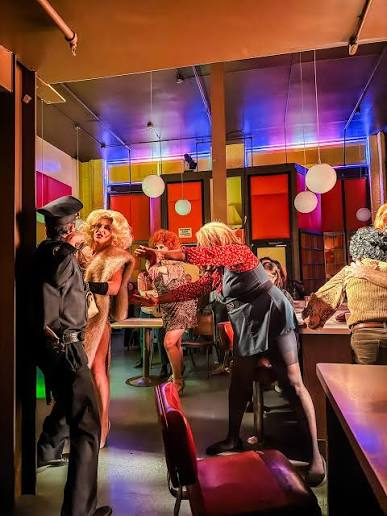
The Compton’s Cafeteria Riot is an immersive theatrical experience directly inspired by the 1966 uprising in San Francisco’s Tenderloin that marked a seminal act of collective resistance in the ongoing fight for transgender rights. The Tenderloin Museum is honored to present an ongoing new production in the heart of the neighborhood that holds the riot’s legacy in its reputation. (tenderloinmuseum.org)
PRESS
“The Compton’s Cafeteria Riot play…isn’t just theater. It’s a time machine, a history lesson, and a punch to the gut in equal measure. [It] isn’t just a show you should see. It’s a space you need to sit in, feel, and carry with you. Because this history isn’t behind us. It’s right here in the room.” — TJ Payne, Broke-Ass Stuart
“One of 2025’s must-see theatrical productions.” — SF Chronicle Datebook
“At a time when queer and trans rights are under siege, The Compton’s Cafeteria Riot is not just relevant, it’s revolutionary” — Joshua Rotter, 48hills
“To younger generations, the ’60s may seem like ancient history. But…[w]e’re lucky that some of the people who lived through [the riot] are still here to tell the tale. With trans rights under attack once again, these elders and their perspectives are precious. We can all learn from them, and Compton’s Cafeteria Riot is the perfect place to start.” — Nastia Voynovskaya, KQED
“The Compton’s Cafeteria Riot is not simply a piece of immersive theatre. It’s a defiant, full-bodied act of historical restoration, and it is a living, breathing act of resistance.” — No Proscenium
New Thinking Allowed with Jeffrey Mishlove Sep 4, 2026 Psychology and Psychotherapy This video is a special release from the original Thinking Allowed series that ran on public television from 1986 until 2002. It was recorded in about 1990. It will remain public for only one week. The late Kathleen Speeth, PhD, was a clinical psychologist and co-editor (with Daniel Goleman) of Essential Psychotherapies. She is author of The Gurdjieff Work and Gurdjieff: Seeker of the Truth. She was a faculty member of the Institute for Transpersonal Psychology in Menlo Park, California. In this video, Dr. Speeth focuses on our tendency to sabotage ourselves – to act against our own best interests. She maintains that a distinction can be drawn between inner weaknesses for which we may forgive ourselves and those inner criminal impulses toward which we must remain forever vigilant. Now you can watch all of the programs from the original Thinking Allowed Video Collection, hosted by Jeffrey Mishlove. Subscribe to the new Streaming Channel (https://thinkingallowed.vhx.tv/) and watch more than 350 programs now, with more, previously unreleased titles added weekly. Free month of the classic Thinking Allowed streaming channel for New Thinking Allowed subscribers only. Use code THINKFREELY.
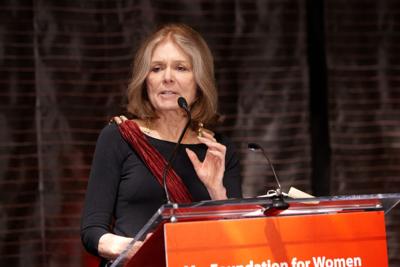
Of the millions of words associated with Gloria Steinem, the pioneering feminist and co-founder of Ms. magazine who died Wednesday, at age 92, perhaps the most famous were those she uttered as a casual aside during a birthday party in 1974.
A reporter observed that she didn’t look her age, Steinem remembered. “This is what 40 looks like,” she retorted. “We’ve been lying for so long, who would know?”
Little wonder Steinem became not just the voice but also the face of feminism, its aviator-wearing avatar who made it her mission to tear down the barriers around women as well as the stereotypes that helped build them. Those bromides included the expectation that age was a problem and thus something to hide, that any interest in appearance indicated an interest in superficiality and that, as National Geographic once characterized it (critically), “only plain women want equal rights because they aren’t hot enough to attract a husband.”
For Steinem, a woman’s agency included not just how she lived her life but also how she looked while she did so. It was part of the right to choose: who you were and where and how you appeared. And from the moment she appeared on the cover of Newsweek in 1971 under the banner “The New Woman,” smiling, her hair parted at the center and teased in back with blond streaks cascading around her face — and with (yes, of course) those aviators — she did it consciously and according to her own rules.
Her early employers may have labeled her a “girl reporter”; critics like Maxine Cheshire may have dismissed her as “the miniskirted pinup girl of the intelligentsia” (and an early connection to the CIA may have suggested her looks were a cover); but the glasses, the hairdo, the bell bottoms, hip-slung belts and bodysuits were merely weapons in her battle, and the troops she inspired were the legions of young women who came after. For her, style was a tool of change and a means of outreach.
“Fashion in the past meant conforming and losing oneself,” she said in “Gloria,” a 2011 HBO documentary, referring to the way designers and society had dictated femininity, with its corsets, crinolines and rules. “Fashion in the present means being unique and finding oneself.”
She did, thanks to the influence of Audrey Hepburn in “Breakfast at Tiffany’s,” whose attitude — a young woman navigating life in the city on her own terms — she could relate to. Also Wonder Woman, whose bullet-busting bangles inspired her own love of jewelry.
Steinem settled on her signature look, she told Teen Vogue, because she was nearsighted. “Growing up, people were always pinching me on the cheek, and so I felt I had a very fat face,” she said. “Those things were undercurrent somewhere, you know, causing me to wear my hair down and wear big glasses.”
What may have started as protective covering turned into a trademark over time, to the point that at a book party for Lena Dunham held at Steinem’s home this year, the guests’ goody bags included Warby Parker versions of her emblematic shades.
As for the clothes that went with them, they stayed similarly consistent. Steinem’s working uniform (she had one long before Steve Jobs) was, she told Dunham’s online newsletter, Lenny Letter, in 2015: “Boots, pants, a sweater or a T-shirt. A concha belt. Something that’s Native American or Indian or something that has a resonance from the past before patriarchy came along.”
The belts, she said in a video interview a few months before she died, were useful because with a belt “you didn’t have to change your clothes or buy new clothes; you could wear the same thing, black pants and a top.” You just changed your accessory.
As for that black, Steinem’s preferred color, she chose it because “it seemed much simpler.”
“You didn’t have to worry about what matched what, and you could wear whatever jewelry,” she said.
All of which meant she could spend her time thinking about the substance of what she wanted to convey since the style was taken care of. It was such an effective dressing formula, she once said, that when she was traveling around the country, she could stow everything — “a change of underwear, corduroy jeans and those turtleneck bodysuits” — in her briefcase.
And it worked in all contexts, including in 2017, when the Council of Fashion Designers of America bestowed a Board of Directors’ Tribute Award on Steinem (along with Cecile Richards of Planned Parenthood and Janelle Monáe). Accepting the honor, Steinem wore black sequined Michael Kors trousers, a black sweater and a black hip belt. She thanked the audience for their activism and Kors for the “great pants.” As far as she was concerned, the clothes enabled the cause rather than undermining it.
As a result, when vintage site What Goes Around Comes Around held an auction of some of Steinem’s wardrobe this year to benefit her foundation, the event was framed not as a fashion sale, but as an opportunity to “own a piece of history.” At that point in her life, as she was happy to admit, she was dyeing her hair, but she had never had plastic surgery. Those were her decisions, and she still believed in modeling them for all to see.
“I think we all choose to dress ourselves according to our taste, to people we admire, a little bit what the fashion is going on,” Steinem said in a video before her auction. But most of all, she continued, “for freedom.” Part of her legacy is showing the world how that might look.
Kathleen Speeth learned at Gurdjieff’s knee as a child and later studied under his successor, Mme. Jeanne de Salzmann. She discusses Gurdjieff’s spiritual teachings, offers a brief profile of the philosopher, and assesses his influence on the modern world.
The Alchemy of Stones presents an inspired breakthrough in Robert Simmons’ thirty-five-year career of exploring and revealing the spiritual qualities and potentials of minerals, crystals, and gemstones. This holistic, Earth-based framework for understanding stones and their energies initiates readers into an alchemical worldview that leads to spiritual healing, transformation, and transcendence.
The late Jean Houston was at the cutting edge of the work on realizing the fullness of our human potential, which is as mainstream and pervasive in our culture as computer technology. A Mythic Life presents Jean Houston’s real, magical story and her true teaching. Here, she draws on her personal history and vast cultural knowledge to show how we can experience in our own lives the greater human story revealed in myths and discover our real potential.
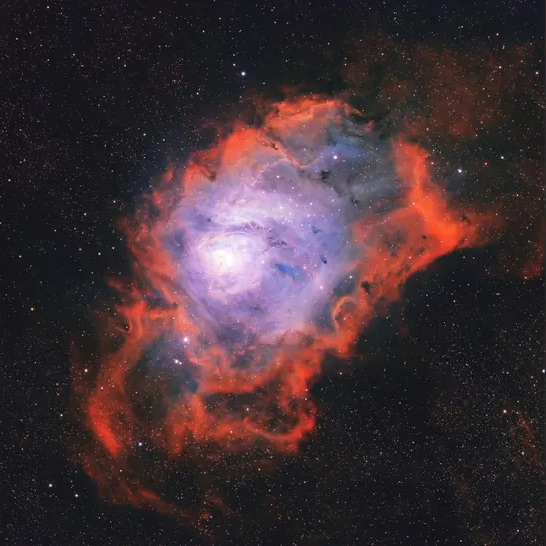
Five thousand two hundred light-years away, the Lagoon Nebula glows as ultraviolet radiation from young, massive stars ionizes surrounding clouds of hydrogen, transforming an immense region of interstellar matter into a luminous tapestry of gas and dust. Within its sculpted forms, stellar radiation, gravity, and turbulent flows continually reshape the boundary between illuminated plasma and the dark molecular clouds from which new structures emerge. (New Thinking Allowed)
Marco Pierre White is an English chef, restaurateur and television personality. In 1995, White became the first British chef and, at age 33, the youngest chef to earn three Michelin stars. He has trained chefs including Gordon Ramsay, Mario Batali, Shannon Bennett, Curtis Stone, Phil Howard and Stephen Terry. Wikipedia
The tiny planet hides big mysteries that scientists can’t wait to tackle.
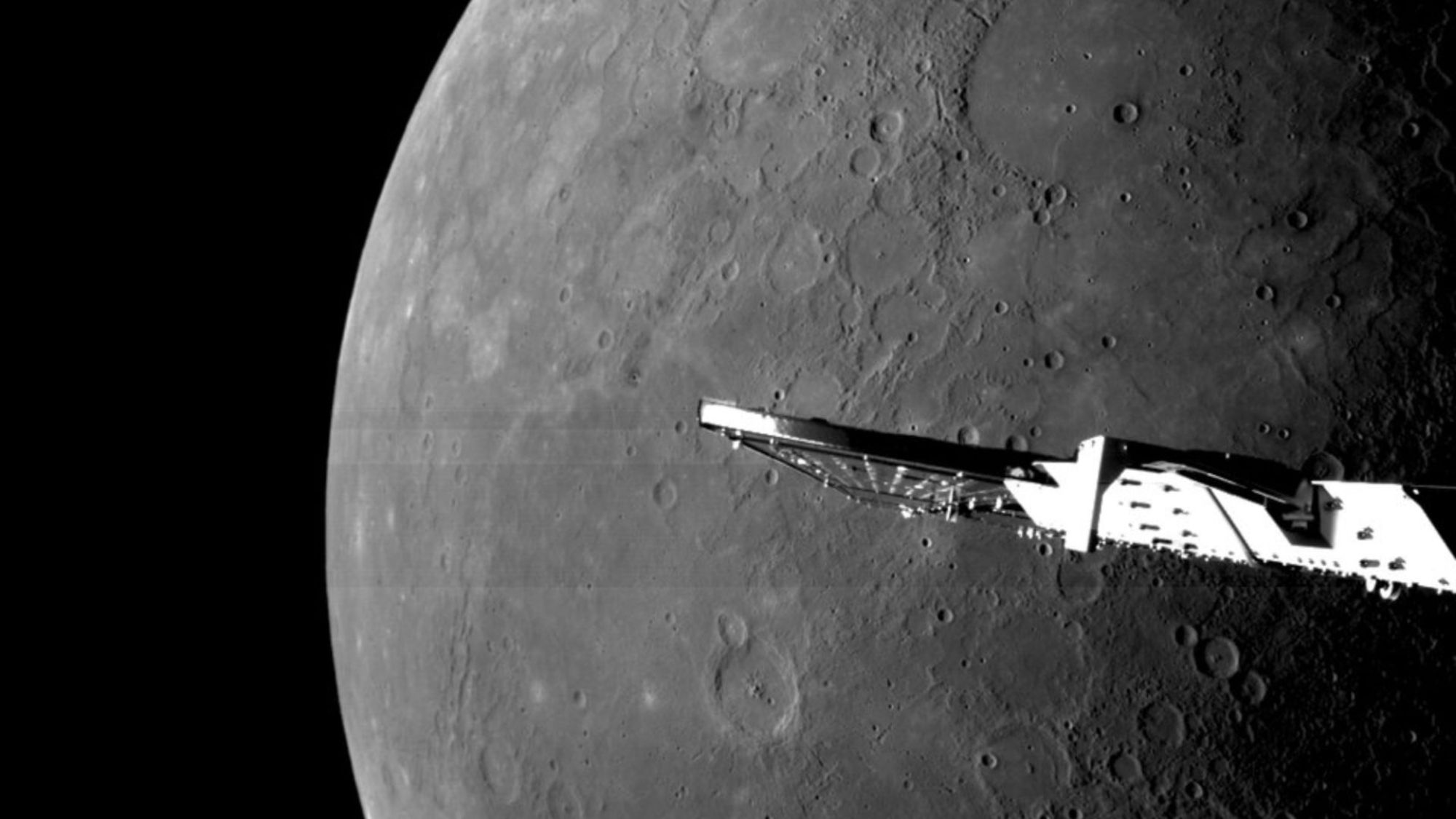
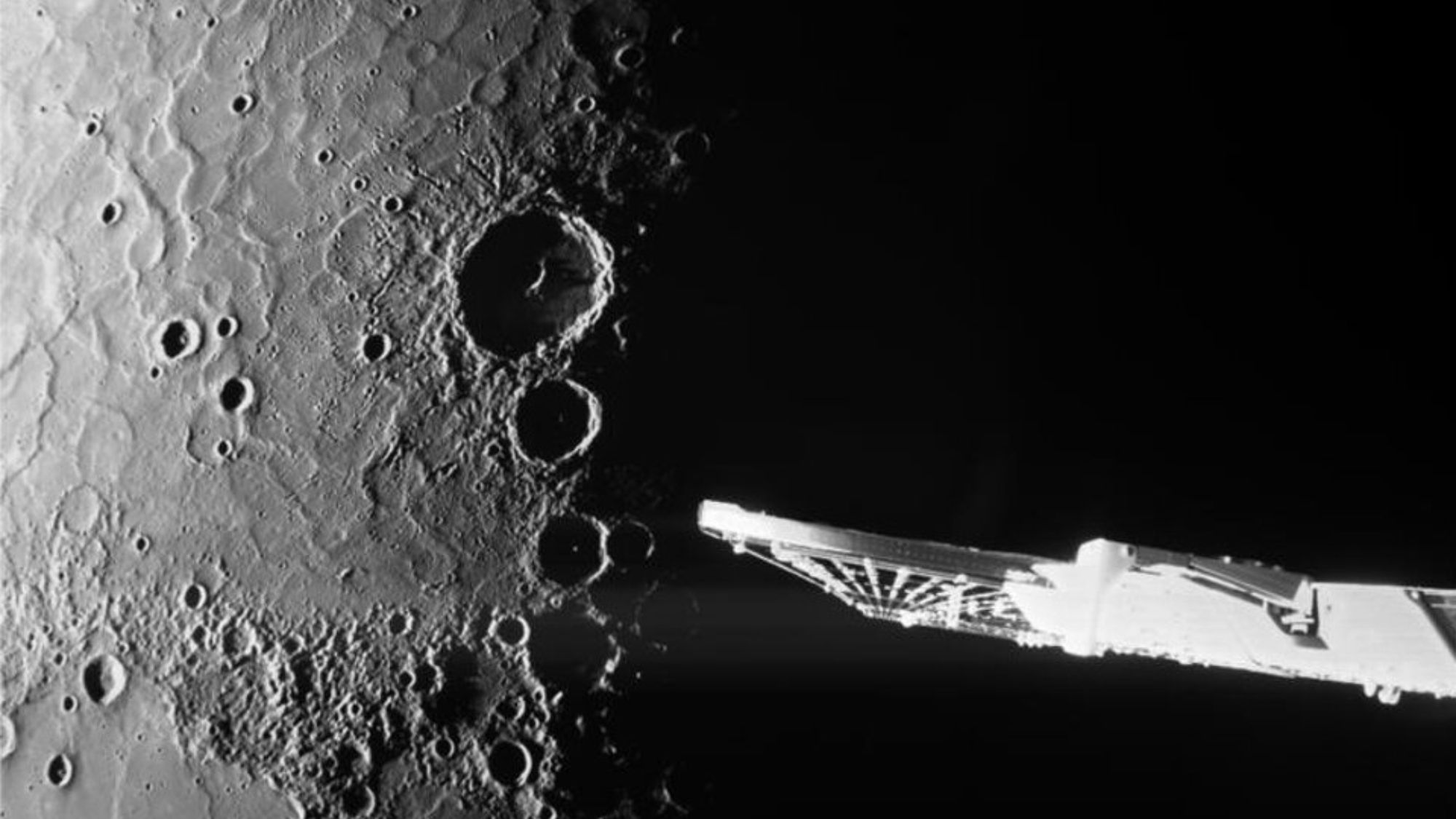
This image was taken by the BepiColombo mission on Jan. 8, 2025 as the spacecraft sped by Mercury for its sixth and final gravity assist at the planet. (Image credit: ESA/BepiColombo/MTM)
Mercury, the tiniest and least-explored planet in the inner solar system, is hiding mysteries far larger than itself — and finally, scientists will soon be getting not one but two spacecraft designed to decode the strange world.
That’s thanks to the BepiColombo mission, a joint project of the European Space Agency (ESA) and Japan Aerospace Exploration Agency (JAXA) that launched in October 2018. After a harrowing journey through the inner solar system, the mission istackling a crucial maneuver on Thursday (Sept. 3): separating its science equipment from the transport that carried it all that way. By April 2027, scientists hope the mission’s two instrument-heavy probes will be gathering a slew of observations that could help solve puzzles about Mercury — and maybe even the solar system we call home.
“I think being able to see new data come out about Mercury is going to be so fantastic,” Rachel Klima, a planetary geologist at the Johns Hopkins University Applied Physics Laboratory, told Space.com. The planet, she says, is “just so weird and beautiful and interesting.”
An enigmatic planet
For now, Mercury holds the dubious honor of being the least-explored planet in the inner solar system, visited by only two missions to date. NASA’s Mariner 10 spacecraft made a trio of zippy flybys in 1974 and 1975, giving scientists their first glimpses of the planet’s cracked and cratered surface, as well as confirming the world has both a very tenuous atmosphere and a magnetic field.
“It really gave us our first close-up view of Mercury,” Sean Solomon, a planetary scientist at Columbia University, told Space.com. “But it left a lot of pages blank.”You may like
And for decades, that was it. Scientists didn’t return to Mercury until 2011, when NASA’s MESSENGER spacecraft, with Solomon as its principal investigator, arrived at the tiny world. (Mercury has a radius of 1,516 miles, or 2,440 kilometers, meaning its width is just over a third of Earth’s.) The spacecraft was packed with tools tailored to the job, such as spectrometers tuned to gamma-rays, X-rays and neutrons, and instruments to sniff out the atmosphere and measure the magnetic field, and it was there to stay. Four years of observations with MESSENGER showed scientists Mercury’s complete surface for the first time, and by late in its mission, the spacecraft was passing just 15.5 miles (24.9 km) above the planet’s surface.
But even MESSENGER wasn’t sophisticated enough to crack Mercury’s puzzles or unveil the strange planet’s beginnings. “I think the jury’s still out on exactly how Mercury got assembled,” Solomon said.
Flying over Mercury’s north pole gave BepiColombo’s monitoring camera 1 (M-CAM 1) a unique opportunity to peer down into the shadowy polar craters on Jan. 8, 2025. (Image credit: ESA/BepiColombo/MTM)
MESSENGER opened up some smaller mysteries, too. It discovered bright, steep-sided pits that scientists dubbed “hollows.” It found a suite of elements — that planetary scientists call “volatiles” for their tendency to slip free of rock — somehow more prevalent in Mercury’s surface than Earth’s. It calculated that the center of the planet’s magnetic field is wildly offset from the planet’s core. Plus, MESSENGER’s tricky orbit also meant the spacecraft never saw the southern half of the planet as sharply as the northern half, leaving one side shadowed in doubt.
The arrival of BepiColombo
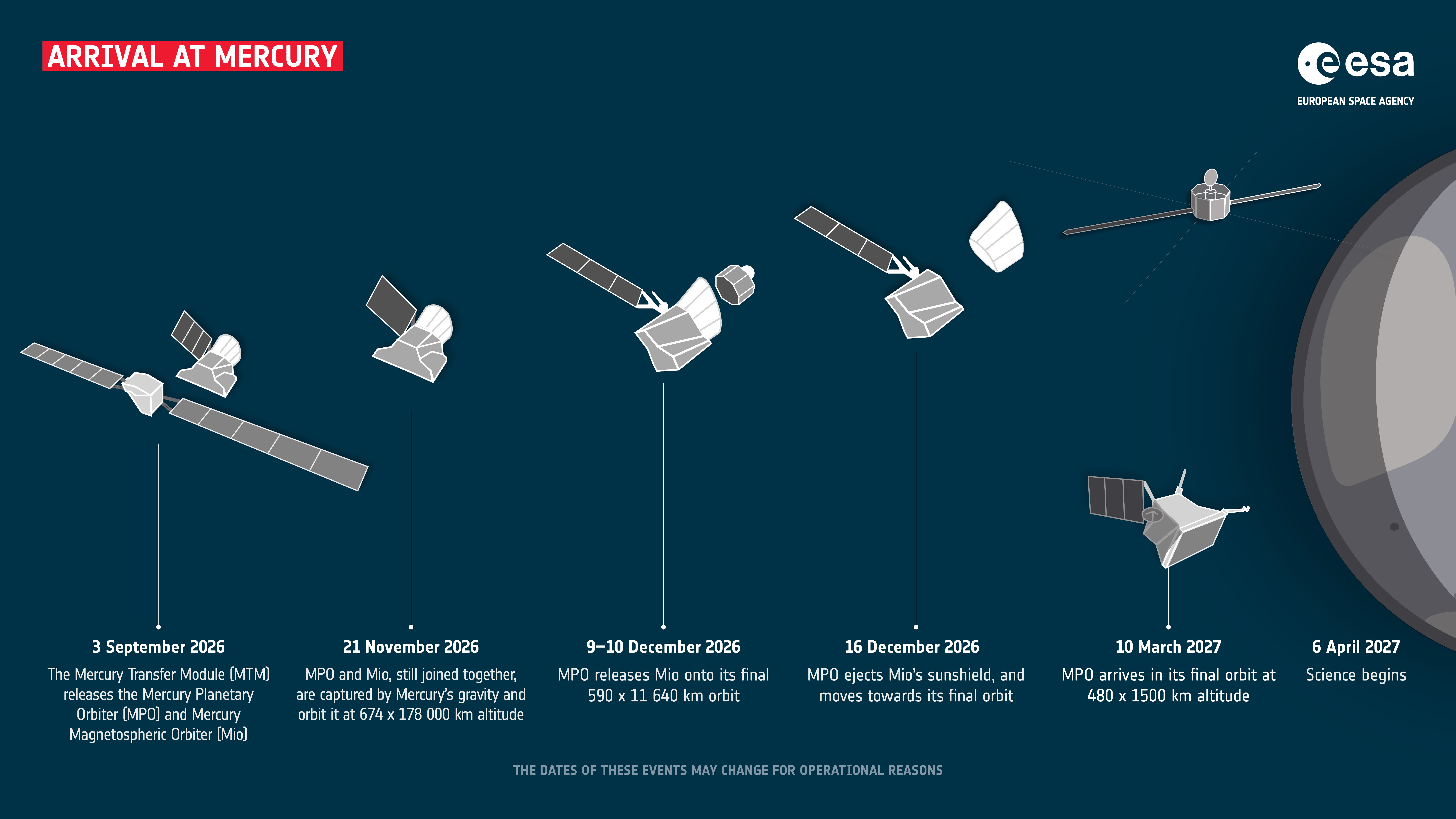
It’s these mysteries that the ambitious BepiColombo mission hopes to tackle. By April, if all goes well, the mission will consist of two separate spacecraft gathering independent but coordinated data about Mercury.
Europe’s Mercury Planetary Orbiter, or MPO, will focus on the planet proper. It’s packed with 11 science instruments that will map the terrain, minerals in the crust, and the gravity field, investigate the hollows and volcanic deposits, and observe how the barrage of charged particles from the sun affects this innermost planet.What to read next
Japan’s Mercury Magnetospheric Orbiter, or Mio, meanwhile, will focus on the planet’s surroundings — its magnetosphere and wispy atmosphere, as well as the dust cluttering up its neighborhood.
Both spacecraft also carry instruments to measure the planet’s magnetic field, offering simultaneous observations of different parts of the field to scientists who typically make do with data gathered from just one location at a time.
In fact, some of these instruments have been able to gather observations during BepiColombo’s long trek to Mercury and its six quick flybys of the planet so far. But because of how the spacecraft were configured for the journey, most of the instruments have not — and will not — get to work until after MPO and Mio have separated. That is expected to happen in December.
The mission’s science, then, has begun only in dribbles, while the bulk of its promise still lies ahead. “There is a growing literature of new results that have come from the BepiColombo flybys, but I expect that will explode once they go into orbit,” Solomon said.
A diagram showing BepiColombo’s path to getting near Mercury. (Image credit: ESA)
He’s especially excited to see the spacecraft’s sharp views of the southern hemisphere, and particularly find hidden deposits of water ice across the area. These deposits would exist in deep craters that never feel the sun’s heat. In examining this region of the planet, scientists will be able to reduce the northerly bias of MESSENGER’s data and better see Mercury’s complete picture.
Meanwhile, Klima is most eagerly awaiting MPO’s work to map elements and minerals in the planet’s surface. This work eluded MESSENGER, which used a technique that relied on these rocks being rich in iron and similar materials — but as it turned out, those elements were absent, leaving scientists stymied. MPO carries different technology that will be able to read rocks on the world even without iron, which Klima said could help reveal how Mercury — and our whole solar system, as a matter of fact — formed.
Klima says she hopes BepiColombo can get people excited about Mercury, the overlooked terrestrial planet of the solar system: “It certainly doesn’t get the love and attention that Mars and Venus and everywhere else gets.”
Meghan Bartels is a freelance science journalist based in New York City who worked on staff for Space.com from 2018 to 2023. Her writing has also appeared in outlets including Scientific American, Science News, Wired, Newsweek and Audubon.
Consciousness, spirituality, biography, sexuality, androgyny, futurism, space, the arts, science, astrology, democracy, humor, books, movies and more