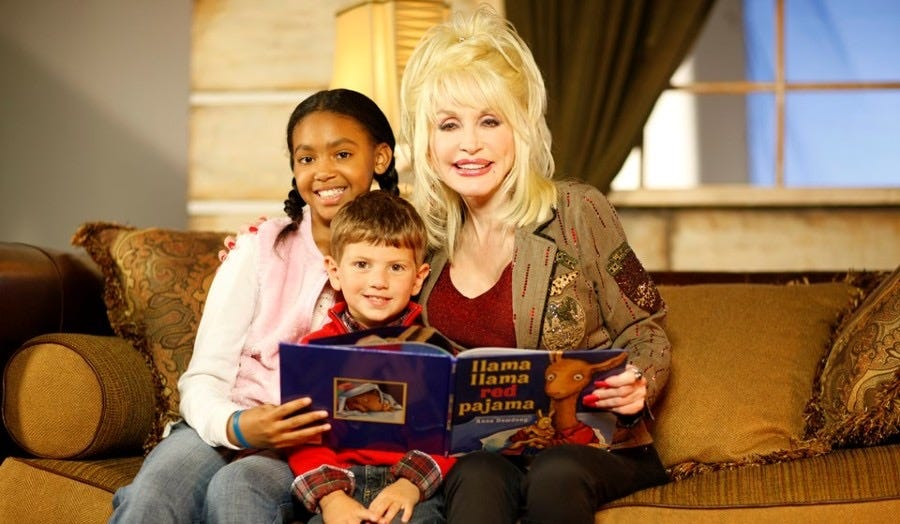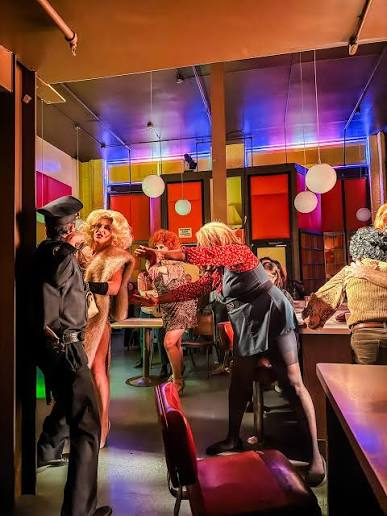
(Image from Instagram.com)
Thank you ABC7 News for featuring The Compton’s Cafeteria Riot theater event in San Francisco on your show – https://www.facebook.com/reel/3330725840437722
(Courtesy of Calvin Harris, H.W., M.)

(Image from Instagram.com)
Thank you ABC7 News for featuring The Compton’s Cafeteria Riot theater event in San Francisco on your show – https://www.facebook.com/reel/3330725840437722
(Courtesy of Calvin Harris, H.W., M.)
He got thrown out of nearly every group he built, but he still has a lot to teach us about the power of queerness.
Oriol Poveda July 22, 2026 (lgbtqnation.com)
 A detail image from the cover of The Trouble with Harry Hay: Founder of the Modern Gay Movement by Stuart Timmons | Alyson Pubns publishing
Harry Hay was one of the founders of American gay activism, got thrown out of nearly every group he built, and never once stopped making trouble. Now, 250 years into the American experiment, the pioneer of gay liberation remains its most necessary irritant. LGBTQ Nation spoke to his caregiver and close friend, Chas Nol, and read Stuart Timmons’ 1990 biography, The Trouble with Harry Hay: Founder of the Modern Gay Movement, to learn more.
In the spring of 1983, in a boulder-strewn stretch of desert east of San Diego, a 25-year-old named Chas Nol arrived at a gathering of about 120 gay men camping in tents. He recognized one of them immediately: a tall, white-haired man he knew from Word Is Out, the documentary that had been circulating for years. Nol was a little starstruck. Harry Hay was not the type to let that linger.
“He introduced himself, and I said that I recognized him from the film, and he immediately began to lecture me, in a very loving way, about queer identity, culture, history,” Nol remembers. What struck him wasn’t the lecturing. It was the lack of distance. “He was completely approachable. He didn’t create these artificial boundaries and expectations about older gay men. He made it very easy to talk to him and become very close friends.”
That was Hay at age 70: still teaching, still recruiting, still convinced the work was unfinished. He had been doing it, by then, for half a century and getting expelled from the organizations he helped create for most of that time.
Henry “Harry” Hay Jr. was born on April 7, 1912, in the English seaside resort of Worthing, into wealth and privilege. His father was a mining engineer who’d made a fortune in South African gold and Chilean copper. The family eventually settled in Los Angeles, where young Harry grew up imperious, bookish, and certain he was different.
For a boy of his class and time, there was no map for his budding feelings and desires. As a teenager working summer jobs, he met an older merchant sailor, his first lover, who told him something that would shape the rest of his life: that men like them were everywhere, a secret, scattered brotherhood. The idea left a deep mark. Decades later, Hay built an entire political philosophy on it.
In the 1930s, Hay threw himself into Los Angeles’ radical Left: anti-fascist rallies, trade-union organizing, the Popular Front coalitions that swept idealists into the Communist Party. It was the great cause of his generation, and Hay was an evangelist, but it came with a brutal catch. The Party forbade homosexuality outright, treating gay members as security risks ripe for blackmail.
So Hay lived in a double closet: hiding his politics from a country where being a Communist could cost you your career and reputation, and hiding his sexuality from the comrades he’d given his life to. In 1938, hoping to “close one book and open another,” as a psychiatrist had promised him he could, he married a fellow Party member, Anita Platky. The marriage lasted 13 years, and Hay never stopped feeling like a stranger inside it. When it finally collapsed, Anita delivered a line that cut to the bone: “You didn’t marry me, you married the Communist Party.”
The marriage was not the only book Hay closed. By 1951, set on organizing gay men openly, he knew he could no longer stay in a Party that treated homosexuals as automatic security risks. He drafted his own case, over a decade as a devoted Marxist weighed against the liability he now posed, and recommended his own expulsion. The Party obliged, but discharged him honorably, saluting him as “a lifelong friend of the people.” Marriage gone, comrades gone, Hay was at last free of both his closets.
By 1950, Hay’s life had already taken a new turn. He had met the young Austrian fashion designer Rudi Gernreich and fallen hard for him. They formed what Hay called a “society of two,” and out of it grew the most consequential gay organization the country had yet seen.
The Mattachine Society, founded in Los Angeles in late 1950, was the first sustained homosexual-rights group in American history. Hay named it after the masked court jesters of medieval France, figures who, costumed and anonymous, could speak truths to power. The structure was borrowed from Freemasonry and Communist cells alike: secret guilds, drawn blinds, telephones smothered under pillows in dresser drawers. None of that was paranoia. In 1950, sodomy was a felony in every state, and the same Cold War machinery driving the Red Scare was fueling its quieter twin, the Lavender Scare — the federal purge of thousands of gay employees from their jobs. Hay sat squarely at the intersection of both panics, twice damned.

His radical contribution was conceptual. Drawing on the Marxist theory of minorities, and explicitly citing Black Americans, Jews, and Mexicans as “fellow minorities,” Hay argued that homosexuals were not sick individuals but an oppressed cultural minority, a people with a shared identity and a claim to rights. It was a staggering reframe for its moment, borrowing the logic of the civil-rights struggle a decade before Stonewall.
But the seed of the movement’s enduring split was already there. As Mattachine exploded in popularity after a landmark 1952 entrapment case, a wave of new members recoiled from its radical founders. They wanted respectability, endorsements from straight doctors and clergy, a “white-glove” image that would foster assimilation into the mainstream. Hay, by contrast, wanted gay people to define themselves on their own terms. In 1953, with McCarthyism at its peak, the conservative faction forced the radical founders out. Hay watched the organization he’d birthed turn against him.
In 1955, the House Un-American Activities Committee subpoenaed him. Abandoned by his comrades in the Communist Party and by the gay movement he had founded, Hay testified anyway, dodging the contempt charge with a torrent of theatrical chatter. He survived, but the wreckage of those years sent him underground for more than a decade.
What pulled him back was love and the dawn of a new era. In the early 1960s, Hay met John Burnside, an inventor of kaleidoscopic optical devices, who became his partner for the next 40 years. Friends saw them as a study in opposites, and Nol describes them almost as yin and yang.
“Harry saw the Nazis, the Joe McCarthys, the Ronald Reagans, the people who dominate our culture today,” he says. “John saw only the good, or preferred to. He was able to find joy in everything.”
When the counterculture detonated in the late 1960s, Hay was ready. He co-founded the Southern California Gay Liberation Front in 1969 and served as its first elected chair, picketing a West Hollywood diner over its misspelled “Fagots Stay Out” sign.
He was characteristically unimpressed by Stonewall. “The East Coast was finally catching up,” he sniffed years later, given all the open organizing L.A. had already done. But his verdict on the riots became one of the most quoted: they had changed the gay pronoun “from ‘I’ to ‘We.’”

In 1970, Hay and Burnside left the city for San Juan Pueblo in northern New Mexico, where they lived for most of the decade. Hay studied Indigenous traditions of gender-variant roles, ran a kaleidoscope workshop meant to bring jobs to the Pueblo, and immersed himself in the community as a friend and ally rather than a tourist.
That distinction matters, because Hay is sometimes accused today of cultural appropriation. One of the central practices he introduced, the “heart circle” with its talking stick passed hand to hand, is read by critics as improperly taken from Native American council traditions. Nol finds the charge weak. Hay spoke of his years among the Pueblo “with utmost respect,” he says, “but also as you would talk about your family members. It wasn’t an anthropologist invading their turf—he was part of it.”
His largest act of organizing there had nothing to do with gay rights at all: Hay became one of the main strategists in a grassroots campaign that stopped the federal government from damming a stretch of the Rio Grande, helping save the farms in one of America’s poorest valleys.

By the late 1970s, Hay had a new target: the gay mainstream itself. The liberated urban “clone” — mustached, muscled, mirror-shaded, a consumer in a leather uniform — struck him as a betrayal, hetero-imitation dressed up as hyper-masculinity. In 1979, he and a small circle issued “A Call to Gay Brothers,” and over Labor Day weekend, roughly 200 men converged on a desert ashram in Arizona for the first gathering of the Radical Faeries.
It was part politics, part spirituality, part summer camp: mud rituals, workshops, Faerie circles, men weeping as they shed what Hay called the “ugly green frogskin of hetero-imitation.” He believed gay people carried a distinct consciousness, a “subject-SUBJECT” way of relating, of meeting one another as equals rather than objects, and that this was a gift the world urgently needed. The movement he sparked has outlived him, with Faerie sanctuaries and gatherings now spread across three continents.
The Faeries’ birth was not without friction for Hay, whose vision clashed with two of his fellow founders, Mitch Walker and Don Kilhefner. The rift ran deep enough that the founding circle fractured, and for a time, rival factions held separate gatherings. It is probably fair to say that the same character that kept Hay at the center of controversy also gave him the thick skin to survive it. He could be, in Nol’s frank words, “imperious, difficult, dictatorial, stubborn, occasionally mean,” the anti-patriarchal patriarch, forever insisting he merely “walked with others” even as he dominated the room.
The softness underneath surfaced rarely. Nol saw it once, during one of Hay’s later Sex Magick workshops, when the old man finally let down his armor and “sobbed with joy” contemplating his life’s work, the creation of a spiritual gay community, come to fruition.
No account of Hay can skip his most difficult episode. At the 1986 Los Angeles Pride parade, after organizers barred the North American Man/Boy Love Association (a pedophile-advocacy group), Hay marched in a homemade sandwich board. One side read “Valerie Terrigno Walks With Me,” for a West Hollywood lesbian politician also forced from the parade after an embezzlement conviction; the other read “NAMBLA Walks With Me.” Police nearly arrested him, until a fellow Faerie tore the sign off his neck. He kept protesting the group’s exclusion for years, boycotting the 1994 Stonewall anniversary march over it.
It remains the hardest thing to reconcile about him, and it shouldn’t be smoothed over. But Nol, who was at that 1986 march, insists the meaning has been distorted. “He completely understood the arguments about NAMBLA and rejected them outright,” Nol says. “He was never endorsing it. He was pointing out that the Pride Committee was pre-censoring.” For Hay, he says, the issue was the principle of who gets silenced. “To equate his sandwich-board protest with him secretly being a pedophile is wrongheaded and a stretch. It was a political statement, not a personal endorsement.”
Critics at the time and since have found that distinction tenuous, and the debate over free speech and its limits is one Hay forced the community to have rather than one he settled. It was, for better and worse, classic Harry: grabbing the issue no one else would touch and daring everyone to look.
He brought the same contrarianism to same-sex marriage, which he initially opposed as “hetero-imitative.” To Hay, it reduced a partner to property and threatened to trade away queer distinctiveness for a seat at the straight table. Later, Nol says, he grudgingly came to see it as “an inevitable incremental step.”

In 1999, too frail to care for themselves, Hay and Burnside were moved to San Francisco, where a circle of younger gay men formed to look after them, bathing them, driving them, or simply sitting with them. It was the literal fulfillment of the “Circle of Loving Companions” Hay had theorized for decades. Even dying, Nol recalls, Harry was thinking about his legacy, gripping each caregiver by the hand and charging them, individually, never as a group, to carry the work forward. “You personally are responsible for carrying this forward!” he’d say.
Harry Hay died on October 24, 2002, at 90. His care circle washed his body, dressed him in silk and velvet and a tiara, and laid him out under rose petals “like the Duchess that he was,” one of his Loving Companions wrote. Burnside died six years later, tended by the same hands.
250 years into the American experiment, Hay belongs in its pantheon of troublemakers, alongside the abolitionists, the suffragists, and the union organizers who insisted the country live up to its own ideals. He gave gay Americans the idea that they were a people, not a pathology. He was also stubborn, domineering, and no stranger to controversy. He had a reputation for kissing younger men unsolicited, Nol among them, a habit his circle largely waved off as an old man reaching for affection, though others took it as a real violation, and one that lands differently in the age of #MeToo. All of it is true at once, and flattening any of it would betray his memory.
Looking at Hay’s legacy from the vantage of today, at least two of his preoccupations remain strikingly alive. One is the tension between those in the LGBTQ+ movement who seek assimilation and respectability, a seat inside the powerful institutions of state and society, and those who carry a more revolutionary spirit, intent on building a new culture free of the inherited baggage of patriarchy and heteronormativity.
The other is a quieter but no less stubborn argument: whether there is, as Hay insisted, a distinct gay identity that transcends time and culture (what some call “gay essentialism”), or whether everything we call gay is socially constructed, bound to shift or even dissolve in a more pansexual, gender-fluid future. Hay staked out his ground on both questions, and on both, the community is still divided. The next 250 years of the American experiment may settle them; Harry Hay would have relished the fight.
Subscribe to the LGBTQ Nation newsletter and be the first to know about the latest headlines shaping LGBTQ+ communities worldwide.
By Mike Zonta, BB editor, and Google AI
Me: Was Troy Perry responsible for the first gay pride parade in hollywood in 1970?
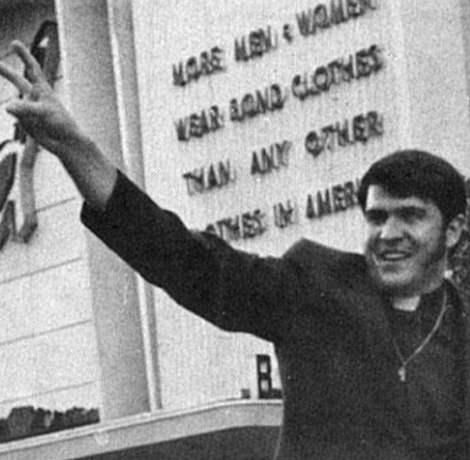
(Image from LosAngelesBlade.com)
Yes, Reverend Troy Perry was one of the co-founders and key organizers responsible for the historic first permitted gay pride parade in Hollywood (and the world), held on June 28, 1970. [1, 2]
Key Details of the 1970 Parade
Me: Didn’t the same parade happen in San Francisco, New York and other cities?
Yes, similar demonstrations took place in New York, San Francisco, and Chicago during that exact same weekend in June 1970. They were all organized to mark the one-year anniversary of the Stonewall Uprising. [1, 2, 3, 4]
However, they were separate events organized by local activist groups, each taking a slightly different format: [1]
What made the Hollywood Parade unique?
While New York and Chicago held political protest “marches,” the Los Angeles event was unique because Troy Perry and his co-organizers insisted on a traditional, permitted street parade with floats, music, and street closures. They had to fight a massive legal battle against the Los Angeles Police Commission to secure the permit, ultimately winning a mandate from the California Supreme Court to let the parade proceed. [1, 2]
Growth and attendance
The growth and attendance of Pride events since their 1970 inception represents one of the most explosive social and cultural expansions in modern history, transforming local, neighborhood-level protests of a few thousand total people into global spectacles that draw millions of attendees annually. [1, 2]
Attendance: 1970 vs. Recent Years
The contrast between the inaugural crowds and modern turnouts illustrates how dramatically these local movements have scaled:
| City | 1970 Attendance / Participants | Modern Estimated Attendance |
|---|---|---|
| New York City | ~2,000 – 5,000 | 5,000,000+ (WorldPride record) |
| San Francisco | ~30 marchers (Saturday); a few hundred at Sunday’s “Gay-In” | 1,000,000+ |
| Los Angeles (Hollywood) | ~1,000 – 2,000 | 175,000+ (festival/parade) |
| Chicago | ~100 – 150 | 1,000,000+ |
Key Historical Growth Triggers
The transition from dangerous political demonstrations to massive celebratory events happened in distinct phases:

Alex Reimer July 1, 2026 (Queerty.com)
On the last day of Pride Month, the New York Times published an op-ed that argues gay people need to whitewash their existences for the comfort of conservative Christians.
Thanks for the offer, but we’re gonna have to decline.
The writer, Matthew Vines, declares that he’s “gay, not queer,” and that “it matters.” The author of a book called God and the Gay Christian: The Biblical Case in Support of Same-Sex Relationships, Vines grew up in a regressive evangelical church in Wichita, Kansas. Now an adult, it’s apparent he still harbors self-shame and resentment.
Like many conservative gay men–and they are almost always men–Vines blames eroding support for same-sex marriage on the LGBTQ+ movement’s alleged excesses. In particular, he fixates on the word “queer.” Vines says “gay” and “queer” are not interchangeable, despite “progressive activists,” organizations and media outlets like this one using “queer” as an umbrella term.
“The broader trend of casting the queer net ever wider has muddled a once-clear public message about who gay people are,” he writes. “Being gay begins to look less like an inborn trait and more like a chosen ideology or aesthetic.”
Related*
People are calling B.S. on that viral poll claiming support for same-sex marriage has plummeted
A new poll shows support for gay marriage is dropping dramatically. But the findings are likely an outlier..
Though Vines prattles on for 1,269 words, his argument can be boiled down to this simplistic thesis: “if we stop calling ourselves queer, then homophobes will like us.”
The problem is, the conservative Christians Vines so desperately wants to win over have never accepted gay people as we are. They came to tolerate a sanitized, hetero-normalized version of queerness that doesn’t challenge their views.
Andrew Sullivan’s conservative case for gay marriage lays out this very point. He says that marriage is a traditional institution, and promotes monogamy opposed to promiscuity. Last Pride season, Sullivan wrote an essay in the Times blaming a “radicalized gay rights movement” for the resurgence in anti-LGBTQ+ sentiments. He claims that advocacy orgs conjured up the issue of gender identity to pad their coffers in the wake of Obergefell. “This huge increase in funding was no longer primarily about gay, lesbian and transgender civil rights,” he writes, “because almost all had already been won.”
Much like Sullivan, Vines seems to believe that marriage equality should represent the end point of the gay rights movement. He refers to marriage as a “core biblical idea” that reflects “God’s self-giving love for humanity through the sacrificial love of spouses for each other.”
While that may be Vines’ idea of marriage, it is a narrow definition. He leaves no room for non-monogamous relationships, or any arrangement that doesn’t embody the 1950s nuclear family ideal.
When recounting his coming out story, Vines says he found great comfort in the idea that there’s “nothing inherently radical or subversive about being gay.” He fails to mention who cleared the way for him to feel so inoffensive: radical queer and trans activists who confronted the country’s indifference towards AIDS.
Due to its adversarial roots, Vines allows that it was appropriate for activists to use the word “queer” during the AIDS epidemic. With the AIDS crisis over, he says the term’s “us-versus-them” nature no longer applies.
Through the entire op-ed, Vines’ privilege shines through. The AIDS crisis may be over for him, and other upscale white men with access to affirming healthcare. But HIV rates for Black and brown men remain disproportionally high, and the Tr*mp admin continues to scale back funding for HIV research.
For Vines, who married his husband at a Baptist church in Texas, the struggle for gay rights is over. Now, he doesn’t want to disrupt the status quo.
In doing so, he ignores all of the LGBTQ+ people who don’t enjoy that luxury.
Sign up for the Queerty newsletter to stay on top of the hottest stories in LGBTQ+ entertainment, politics, and culture.
Alex Reimer is an Assistant Editor at Queerty who writes about sports and fitness, politics and irreverent gay things. In a previous life, he was a talk radio loudmouth in Boston. He currently lives in Chicago.