Of the millions of words associated with Gloria Steinem, the pioneering feminist and co-founder of Ms. magazine who died Wednesday, at age 92, perhaps the most famous were those she uttered as a casual aside during a birthday party in 1974.
A reporter observed that she didn’t look her age, Steinem remembered. “This is what 40 looks like,” she retorted. “We’ve been lying for so long, who would know?”
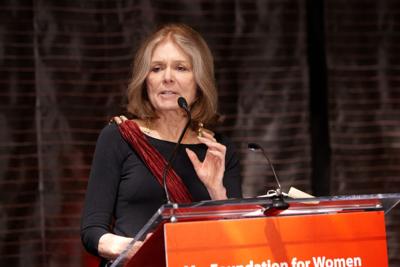
Little wonder Steinem became not just the voice but also the face of feminism, its aviator-wearing avatar who made it her mission to tear down the barriers around women as well as the stereotypes that helped build them. Those bromides included the expectation that age was a problem and thus something to hide, that any interest in appearance indicated an interest in superficiality and that, as National Geographic once characterized it (critically), “only plain women want equal rights because they aren’t hot enough to attract a husband.”
For Steinem, a woman’s agency included not just how she lived her life but also how she looked while she did so. It was part of the right to choose: who you were and where and how you appeared. And from the moment she appeared on the cover of Newsweek in 1971 under the banner “The New Woman,” smiling, her hair parted at the center and teased in back with blond streaks cascading around her face — and with (yes, of course) those aviators — she did it consciously and according to her own rules.
Her early employers may have labeled her a “girl reporter”; critics like Maxine Cheshire may have dismissed her as “the miniskirted pinup girl of the intelligentsia” (and an early connection to the CIA may have suggested her looks were a cover); but the glasses, the hairdo, the bell bottoms, hip-slung belts and bodysuits were merely weapons in her battle, and the troops she inspired were the legions of young women who came after. For her, style was a tool of change and a means of outreach.
“Fashion in the past meant conforming and losing oneself,” she said in “Gloria,” a 2011 HBO documentary, referring to the way designers and society had dictated femininity, with its corsets, crinolines and rules. “Fashion in the present means being unique and finding oneself.”
She did, thanks to the influence of Audrey Hepburn in “Breakfast at Tiffany’s,” whose attitude — a young woman navigating life in the city on her own terms — she could relate to. Also Wonder Woman, whose bullet-busting bangles inspired her own love of jewelry.
Steinem settled on her signature look, she told Teen Vogue, because she was nearsighted. “Growing up, people were always pinching me on the cheek, and so I felt I had a very fat face,” she said. “Those things were undercurrent somewhere, you know, causing me to wear my hair down and wear big glasses.”
What may have started as protective covering turned into a trademark over time, to the point that at a book party for Lena Dunham held at Steinem’s home this year, the guests’ goody bags included Warby Parker versions of her emblematic shades.
As for the clothes that went with them, they stayed similarly consistent. Steinem’s working uniform (she had one long before Steve Jobs) was, she told Dunham’s online newsletter, Lenny Letter, in 2015: “Boots, pants, a sweater or a T-shirt. A concha belt. Something that’s Native American or Indian or something that has a resonance from the past before patriarchy came along.”
The belts, she said in a video interview a few months before she died, were useful because with a belt “you didn’t have to change your clothes or buy new clothes; you could wear the same thing, black pants and a top.” You just changed your accessory.
As for that black, Steinem’s preferred color, she chose it because “it seemed much simpler.”
“You didn’t have to worry about what matched what, and you could wear whatever jewelry,” she said.
All of which meant she could spend her time thinking about the substance of what she wanted to convey since the style was taken care of. It was such an effective dressing formula, she once said, that when she was traveling around the country, she could stow everything — “a change of underwear, corduroy jeans and those turtleneck bodysuits” — in her briefcase.
And it worked in all contexts, including in 2017, when the Council of Fashion Designers of America bestowed a Board of Directors’ Tribute Award on Steinem (along with Cecile Richards of Planned Parenthood and Janelle Monáe). Accepting the honor, Steinem wore black sequined Michael Kors trousers, a black sweater and a black hip belt. She thanked the audience for their activism and Kors for the “great pants.” As far as she was concerned, the clothes enabled the cause rather than undermining it.
As a result, when vintage site What Goes Around Comes Around held an auction of some of Steinem’s wardrobe this year to benefit her foundation, the event was framed not as a fashion sale, but as an opportunity to “own a piece of history.” At that point in her life, as she was happy to admit, she was dyeing her hair, but she had never had plastic surgery. Those were her decisions, and she still believed in modeling them for all to see.
“I think we all choose to dress ourselves according to our taste, to people we admire, a little bit what the fashion is going on,” Steinem said in a video before her auction. But most of all, she continued, “for freedom.” Part of her legacy is showing the world how that might look.
Gloria Marie Steinem (/ˈstaɪnəm/STY-nəm; March 25, 1934 – September 2, 2026) was an American journalist and social movement activist who emerged as a nationally recognized leader of second-wave feminism in the United States in the late 1960s and early 1970s, and who remained particularly prominent in the 1980s and early 1990s.[1][4][2][5]
Steinem was a columnist for New York magazine, and co-founder of Ms. magazine.[2] In 1969, she published “After Black Power, Women’s Liberation”,[6] an article that brought her national attention and positioned her as a feminist leader.[7] In 1971, she co-founded the National Women’s Political Caucus, which provided training and support for women seeking elected and appointed office. Also in 1971, she co-founded the Women’s Action Alliance, which until 1997 supported a network of feminist activists and worked to advance feminist causes and legislation. In the 1990s, Steinem helped establish Take Our Daughters to Work Day, an occasion for young girls to learn about future career opportunities.[8] In 2005, Steinem, Jane Fonda, and Robin Morgan co-founded the Women’s Media Center, an organization that “works to make women visible and powerful in the media”.[9]
She traveled internationally as an organizer and lecturer and was a media spokeswoman on issues of equality.[10] In 2015, Steinem, alongside two Nobel Peace laureates (Mairead Maguire of Northern Ireland and Leymah Gbowee of Liberia[11]) and other prominent women peace activists, undertook a journey from the capital of North Korea, Pyongyang, to South Korea, crossing the Korean Demilitarized Zone, the heavily militarized border on the 38th parallel of the Korean peninsula.
The Steinems lived and traveled in a trailer, from which Leo carried out his trade as a roaming antiques dealer.[16] Before Gloria was born, her mother, Ruth, then age 34, had according to Steinem “a ‘nervous breakdown’, as [Ruth] and everyone else called it” that left her an invalid, trapped in delusional fantasies that sometimes turned violent.[17] Steinem said that Ruth changed “from an energetic, fun-loving, book-loving” woman into “someone who was afraid to be alone, who could not hang on to reality long enough to hold a job, and who could rarely concentrate enough to read a book”.[17] Ruth spent long periods in and out of sanatoriums for the mentally ill.[17] Steinem was ten years old when her parents separated in 1944.[17] Her father went to California to find work, while she and her mother continued to live together in Toledo.[18][17]
Although her parents divorced under the strain of her mother’s illness, Steinem did not attribute it to male chauvinism. She said she “understood and never blamed him for the breakup”.[19] The impact of these events shaped her personality. Her father, a traveling salesman, had never provided financial stability, and his departure aggravated their situation.[20] Steinem concluded that her mother’s inability to hold a job reflected broader hostility toward working women.[20] She also believed that doctors’ apathy toward her mother stemmed from similar anti-woman animus.[20] Years later, Steinem described her mother’s experience as pivotal to her understanding of social injustices.[21]: 129–138 These perspectives convinced Steinem that women lacked social and political equality.[21]
In 1957, Steinem had an abortion. The procedure was performed by Dr. John Sharpe, a British physician, when abortion was still illegal.[25] Years later, Steinem dedicated her memoir My Life on the Road (2015)[26] to him. She wrote, “Dr. John Sharpe of London, who in 1957, a decade before physicians in England could legally perform an abortion for any reason other than the health of the woman, took the considerable risk of referring for an abortion a twenty-two-year-old American on her way to India. Knowing only that she had broken an engagement at home to seek an unknown fate, he said, ‘You must promise me two things. First, you will not tell anyone my name. Second, you will do what you want to do with your life.'”[27]
In the late 1950s, Steinem spent two years in India as a Chester Bowles Asian Fellow.[28] She was influenced by Mahatma Gandhi and later modeled her campaign work after Gandhi’s independence movement.[29][30] After returning to the United States, she served as director of the Independent Research Service, an organization funded in secret by the CIA.[31] She worked to send non-communist American students to the 1959 World Youth Festival.[31] In 1960, she was hired by Warren Publishing as the first employee of Help! magazine.[32]
Esquire magazine features editor Clay Felker gave freelance writer Steinem what she later called her first “serious assignment”, regarding contraception; he didn’t like her first draft and had her re-write the article.[33] Her resulting 1962 article about the way in which women are forced to choose between a career and marriage preceded Betty Friedan‘s book The Feminine Mystique by one year.[33][34]
In 1963, while working on an article for Huntington Hartford‘s Show magazine, Steinem was employed as a Playboy Bunny at the New York Playboy Club.[35] The article, published in 1963 as “A Bunny’s Tale”, featured a photo of Steinem in Bunny uniform and detailed how women were treated at those clubs.[36] Steinem maintained that she was proud of the work she did publicizing the exploitative working conditions of the Bunnies and especially the sexual demands made of them, which skirted the edge of the law.[37][38] For a brief period after the article was published, Steinem was unable to land other assignments; in her words, this was “because [she] had now become a Bunny—and it didn’t matter why”.[37][39] However, after the article was published, the owner of Playboy, Hugh Hefner, wrote a letter stating he would remove requirements for Bunnies to get gynecological exams and STD testing.[40][41]
In the interim, Steinem conducted an interview with John Lennon for Cosmopolitan magazine in 1964.[42] In 1965, she wrote for NBC-TV’s weekly satirical revue, That Was The Week That Was (TW3), contributing a regular segment entitled “Surrealism in Everyday Life”.[43] Steinem eventually landed a job at Felker’s newly founded New York magazine in 1968.[33]
In 1969, Steinem covered for New York Magazine an abortion speak-out which was held in a church basement in Greenwich Village, New York.[44][45] Steinem had had an abortion herself in London at the age of 22.[46] She felt what she called a “big click” at the speak-out, and later said she didn’t “begin my life as an active feminist” until that day.[45] As she recalled, “It [abortion] is supposed to make us a bad person. But I must say, I never felt that. I used to sit and try and figure out how old the child would be, trying to make myself feel guilty. But I never could! I think the person who said: ‘Honey, if men could get pregnant, abortion would be a sacrament’ was right. Speaking for myself, I knew it was the first time I had taken responsibility for my own life. I wasn’t going to let things happen to me. I was going to direct my life, and therefore it felt positive. But still, I didn’t tell anyone. Because I knew that out there it wasn’t [positive].”[46] She also said, “In later years, if I’m remembered at all it will be for inventing a phrase like ‘reproductive freedom’ … as a phrase it includes the freedom to have children or not to. So it makes it possible for us to make a coalition.”[47]
The first issue of Ms., released in 1972
In 1972, Steinem co-founded the feminist magazine Ms. alongside founding editors Letty Cottin Pogrebin, Mary Thom, Patricia Carbine, Joanne Edgar, Nina Finkelstein, Dorothy Pitman Hughes, and Mary Peacock; it began as a special edition of New York, and Clay Felker funded the first issue.[33] Its 300,000 test copies sold out nationwide in eight days.[48][49] Within weeks, Ms. had received 26,000 subscription orders and more than 20,000 reader letters.[49] In 1974, Ms. collaborated with public television to produce the television program Woman Alive!, and Steinem was featured in the first episode in her role as co-founder of Ms. magazine.[50] The magazine was sold to the Feminist Majority Foundation in 2001; Steinem remains on the masthead as one of six founding editors and served on the advisory board.[49]
In 1978, Steinem wrote a semi-satirical essay for Cosmopolitan titled “If Men Could Menstruate” in which she imagined a world where men menstruate instead of women. She concludes in the essay that in such a world, menstruation would become a badge of honor with men comparing their relative sufferings, rather than the source of shame that it had been for women.[53]
On March 22, 1998, Steinem published an op-ed in The New York Times (“Feminists and the Clinton Question”) in which she claimed that Bill Clinton‘s alleged behavior did not constitute sexual harassment, although she did not actually challenge the accounts by his accusers.[54] The op-ed was criticized by various writers, as in the Harvard Crimson[55] and in the Times itself.[56] In 2017, Steinem, in an interview with the British newspaper The Guardian, stood by her 1998 New York Times op-ed, but also said: “I wouldn’t write the same thing now.”[57]
In 1968, Steinem signed the “Writers and Editors War Tax Protest” pledge, vowing to refuse tax payments in protest against the Vietnam War.[58] The following year, her article “After Black Power, Women’s Liberation”[59] brought her to national fame as a feminist leader.[7] As such she campaigned for the Equal Rights Amendment, testifying before the Senate Judiciary Committee in its favor in 1970.[60][61] That same year she published her essay on a utopia of gender equality, “What It Would Be Like If Women Win”, in Time magazine.[62]
This is no simple reform. It really is a revolution. Sex and race because they are easy and visible differences have been the primary ways of organizing human beings into superior and inferior groups and into the cheap labor on which this system still depends. We are talking about a society in which there will be no roles other than those chosen or those earned. We are really talking about humanism.[64]
In 1972, she ran as a delegate for Shirley Chisholm in New York, but lost.[65] In March of the following year, she addressed the first national conference of Stewardesses for Women’s Rights, which she continued to support throughout its existence.[66] Stewardesses for Women’s Rights folded in the spring of 1976.[66]
Steinem, who grew up reading Wonder Woman comics, was also a key player in the restoration of Wonder Woman’s powers and traditional costume, which were restored in issue #204 (January–February 1973).[67] Steinem, offended that the most famous female superhero had been depowered, had placed Wonder Woman (in costume) on the cover of the first issue of Ms. (1972)—Warner Communications, DC Comics’ owner, was an investor—which also contained an appreciative essay about the character.[67][68] In doing so, however, Steinem forced the firing of Samuel R. Delany who had taken over scripting duties with issue #202. Delany was supposed to write a six-issue story arc, which would culminate in a battle over an abortion clinic where Wonder Woman was to defend women trying to use their services. The story outlines and the work already done on the issues were scrapped, something that Steinem was not aware of and made no attempt to rectify.[69]
In 1976, the first women-only Passover seder was held in Esther M. Broner’s New York City apartment and led by Broner, with 13 women attending, including Steinem.[70]




.jpg)
