I think you mean René Girard (1923–2015), the French historian, literary critic, and social theorist.
The central idea: We imitate each other
Girard’s most famous claim is that human desire is mimetic—we learn what to want by seeing what other people want.
For example, you may think you want a particular job, partner, status symbol, or lifestyle because it appeals to you directly. Girard argues that often you want it because someone else values it. We unconsciously copy not only behavior but desire itself.
This creates a triangle:
Subject (the person desiring)
Model or mediator (the person being imitated)
Object (the thing desired)
The object is often less important than the model.
Mimetic rivalry
When two people imitate each other’s desires, they become rivals.
Girard believed that many conflicts begin this way:
Siblings competing for parental attention
Neighbors competing for status
Nations competing for prestige
Political factions mirroring each other’s hostility
Ironically, rivals often become more alike as their conflict intensifies.
The scapegoat mechanism
Girard’s second major idea is that communities under stress often resolve internal conflict by blaming a single person or group.
As tensions rise, everyone unites against a scapegoat:
A stranger
A minority
A heretic
A suspected witch
An outsider
The community experiences relief because violence that had been spreading internally is redirected toward one victim.
Girard argued that many myths and social institutions originated from this process.
Religion and myth
Girard believed that ancient myths often conceal the innocence of the victim. The crowd’s violence appears justified.
He argued that the Judeo-Christian scriptures are unusual because they increasingly reveal the victim’s perspective.
For Girard:
The story of Abel highlights an innocent victim.
The story of Joseph exposes unjust persecution.
The crucifixion of Jesus Christ fully reveals the innocence of the scapegoat and the violence of the crowd.
This was one of his most controversial claims.
His major books
Deceit, Desire and the Novel — introduces mimetic desire through literature.
Violence and the Sacred — develops the scapegoat theory.
The Scapegoat — analyzes victimization in culture and religion.
Things Hidden Since the Foundation of the World — his most comprehensive statement of the theory.
Influence
Girard’s ideas have influenced:
Literary criticism
Anthropology
Theology
Psychology
Political theory
His admirers see him as offering a grand explanation of human conflict. His critics argue that he tries to explain too much with a single theory and sometimes stretches the evidence.
A one-sentence summary of Girard’s work would be:
Human beings learn what to desire by imitating one another; this imitation creates rivalry, rivalry produces social crisis, and societies often restore order by uniting against a scapegoat.
There is no reliable historical evidence that Teresa of Ávila had a sexual life in the ordinary sense of the term. She was a Carmelite nun who took vows of chastity and spent most of her adult life in religious communities.
The question often arises because her writings describe intense mystical experiences that can sound erotic to modern readers. In her autobiography, she recounts a vision in which an angel pierced her heart with a fiery spear, producing both great pain and spiritual ecstasy. This experience inspired the famous sculpture The Ecstasy of Saint Teresa by Gian Lorenzo Bernini.
Some modern scholars, psychologists, and literary critics have interpreted these descriptions through the lens of sexuality, suggesting that mystical ecstasy and bodily sensation may overlap in human experience. Others argue that imposing modern sexual categories on a 16th-century mystic can be misleading, because Teresa herself consistently described the experience as a union with God rather than a physical or sexual event.
What can be said with confidence is:
There is no documented evidence of sexual relationships or sexual activity in her life.
Her writings contain vivid descriptions of spiritual ecstasy that use imagery of love, longing, and union.
Those descriptions have generated centuries of debate about the relationship between mysticism, the body, and sexuality.
If you’re interested, I can also explain how Teresa’s mystical experiences have been interpreted by figures such as Sigmund Freud, Carl Jung, and modern historians of religion.
On May 30th, 2026 (or May 31st, depending on where you live), we have a Full Moon at 9° Sagittarius.
The Full Moon is opposite Uranus in Gemini, trine Saturn and Neptune in Aries, and sextile Pluto in Aquarius.
This Full Moon connects all the outer planets into a rare, coherent configuration that will come to expose, in the way only a Full Moon in Sagittarius does – the truth of the matter.
What is truth?
This is the question that philosophers – and philosophers are ruled by Sagittarius – have wrestled with since the beginning of time.
Seeking answers is the very essence of the fire, mutable nature of Sagittarius. We read the books. We travel the world. We explore different perspectives – all in the hope that somewhere, hidden beneath the complexity of life, there is a principle that makes sense of it all.
At its core, Sagittarius is about trying to find a sense of coherence – the “big picture”, a governing principle that ties it all together.
And this process cannot be rushed.
There’s a reason why Sagittarius is the nomad of the zodiac. The man on a horse – always riding, always looking, always searching – never quite settling.
The constant movement can look like aimless wandering. That’s why it’s tempting to reduce Sagittarius to someone who ‘likes adventure’, ‘cannot commit’. But this misses the sacredness of the process of search, which is the pursuit of truth.
The search is not an escape from commitment – it is a commitment to finding the truth.
The reason the rider cannot stop is that they haven’t found (yet) the truth. So they have to keep going – not from restlessness, but from integrity.
And when the truth is eventually found, then and only then is the rider ready to graduate to the Capricorn, committed, make-things-happen state of consciousness.
Rush the Sagittarius process, and we settle for half answers, or linger into restlessness and a feeling that “I still haven’t found what I’m looking for”. Or simply convince ourselves that the search is exhausting and the road leads to nowhere anyway.
The Full Moon in Sagittarius will challenge that part of our psyche that hasn’t yet graduated in Sagittarius.
Full Moon In Sagittarius – This Is It
At its deepest level, Sagittarius is the realization that there is a deeper coherence to our life, and that we are living the life we are supposed to be living.
It is the moment when we can finally say: “This is it“.
“This is it” is the answer to the Sagittarius search. It’s the moment when the rider gets off the horse because the answer has finally been found, and the search has come to its inevitable end.
“This is it” is not an intellectual exercise. We don’t find it by testing hypotheses, making lists of things we like, ‘being intentional’, asking the experts, or weighing the pros and cons.
It is a deeper knowing that only emerges when everything falls into place, into what feels like an effortless choreography.
Our relationship with this Sagittarius principle reveals whether we live our life with integrity – in alignment with our own personal truth – or not.
In that sense, the Full Moon in Sagittarius can be the “yes or no” answer to the “This is it?” question.
It can be the striking realization that “none of this is really me” and maybe our entire life is built on a version of the truth that no longer applies.
The Full Moon in Sagittarius can also bring the assurance that – at least in some areas of our life – we are doing exactly what we are supposed to be doing. That our search for meaning, the striving, the searching have been worth the effort, and that things are finally clicking into place.
At the Full Moon in Sagittarius, the rider pauses:
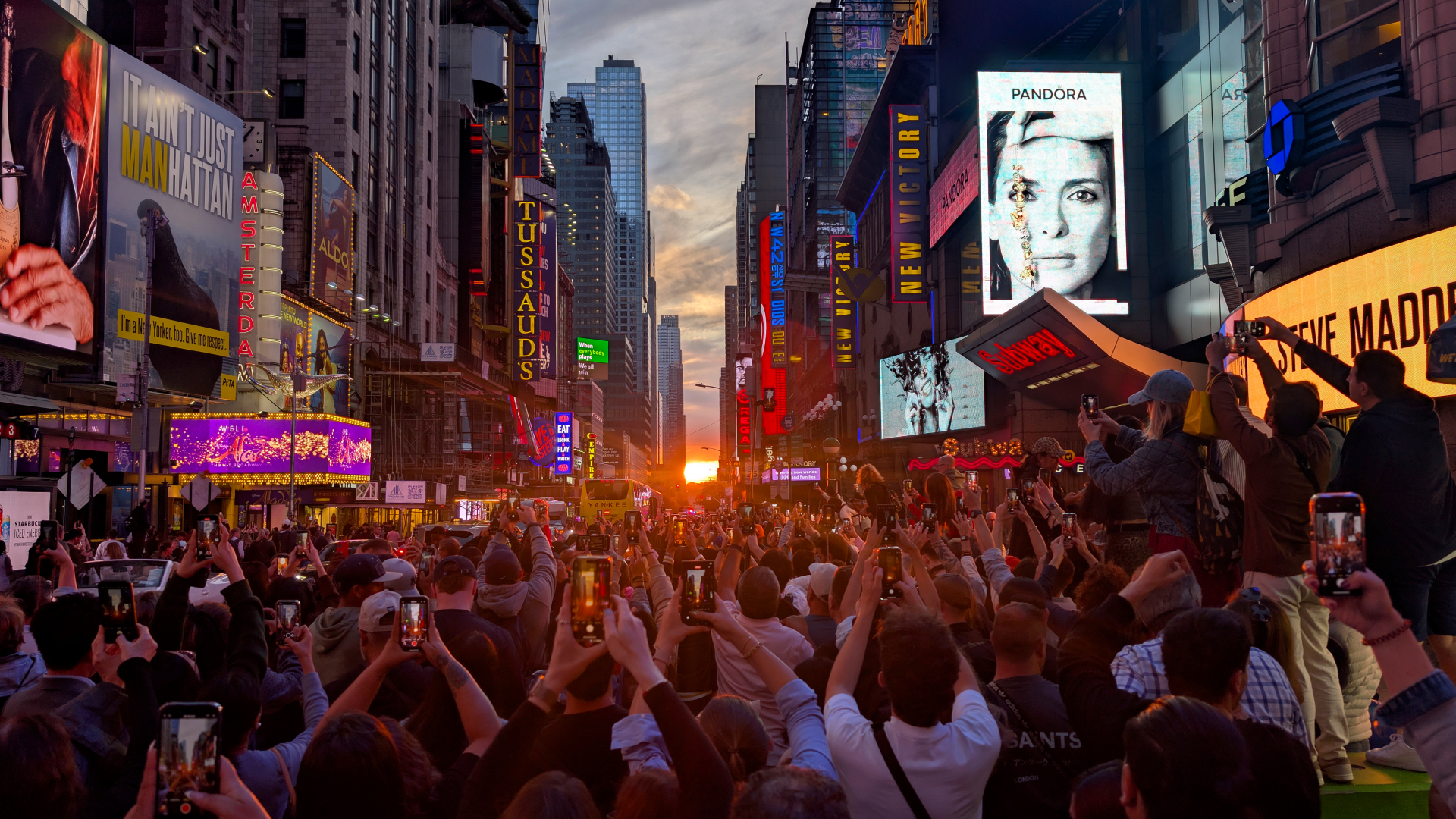
Twice a year, the setting sun perfectly aligns with Manhattan’s street grid, creating one of New York City’s most spectacular skywatching events.
When you purchase through links on our site, we may earn an affiliate commission. Here’s how it works.
Manhattanhenge is a popular spectacle in New York City. This photo captures the May 29, 2025 event unfolding. (Image credit: Gary Hershorn/Getty Images)
Twice each year, New Yorkers gather along Manhattan’s cross streets to watch the setting sun perfectly align with the city’s grid, creating one of the most striking urban skywatching events in the world: Manhattanhenge.
In 2026, Manhattanhenge will occur on May 28-29 and on July 11-12. The best views are typically along 14th, 23rd, 34th, 42nd and 57th Streets looking west toward New Jersey.
On May 28 and July 12, viewers will see a “half sun” resting on the horizon, while May 29 and July 11 feature the dramatic “full sun” effect.
But why does Manhattanhenge happen in the first place?
The answer lies in the unique layout of Manhattan’s streets and the changing position of the setting sun throughout the year.
Let’s face it. If you live in New York City, where light pollution is among the worst in the United States, there aren’t too many celestial sights that you can look forward to seeing. And yet, twice each year, people not only from in and around New York, but from across the country and even perhaps from around the world come to Manhattan to be mesmerized by an uncommon phenomenon that occurs near sunset.
Around Memorial Day and again for a day or two around July 12, New Yorkers become intrigued by an unusual circumstance that allows the setting sun to be seen on many of Manhattan’s east-west cross streets simultaneously, provided you have a clear view down to the New Jersey horizon. Indeed, it is not unusual on those special evenings to see people clustered on the corners of favored cross streets watching the setting sun as it aligns with Manhattan’s canyons of brick, glass and steel, creating dramatic vistas. In recent years, the Manhattanhenge term has become very popular in pop culture, even being used for the title of a 2009 episode of the television series “CSI: NY,” as well as official clips for the TV Land series “Younger” (Season 3).
Enigma of Stonehenge
Of course, there are other places on Earth where the sun aligns with certain landmarks at specific times of the year. The most famous is Stonehenge, the Neolithic monument at Wiltshire in the Salisbury Plain of England, where on the day of the summer solstice, as seen from inside Stonehenge, the sun appears to rise directly above the so-called Heel Stone. It’s an event that attracts thousands each year.
Although we are certain that the massive upright stones that comprise Stonehenge took about 1,500 years to construct and that it probably once served as a burial ground, many mysteries about it still abound. More than half a century ago, British astronomer Gerald S. Hawkins (1928-2003) and co-author John B. White published a book, “Stonehenge Decoded” (Doubleday, 1965), which claimed that Stonehenge was used to predict a wide number of astronomical occurrences. While attracting a large following, the book also attracted some reputable scientific scholars who scoffed at its findings. All these years later, the issue remains a contentious one and the true nature of Stonehenge may forever be a mystery.
The Gridiron of Manhattan
So far as Manhattanhenge is concerned, its origins are not nearly as mysterious. It is based on a design for Manhattan outlined in “The Commissioners’ Plan of 1811” — for a rectilinear grid, or “gridiron” of straight streets and avenues which intersect each other at right angles. This design extends from north of Houston Street in lower Manhattan to just south of 155th Street in upper Manhattan. Most cross streets in between were arranged in a regular right-angled grid that was tilted 30 degrees east of true north to roughly replicate the angle of Manhattan Island.
And it is because of this 30-degree tilt in the grid that the magic moment of the setting sun aligning with Manhattan’s cross streets does not coincide with the June solstice, but rather with specific dates in late May and early July.
While we say that the sun sets in the west, most times that’s not exactly the case! Like the popular axiom, “A broken clock is correct twice a day,” the sun sets precisely due west only twice each year — on the equinox days in March and September. But between the first day of spring and the first day of autumn, the position on the horizon where the sun appears to set (known as the azimuth) occurs somewhat north of due west. The azimuth of the sunset slowly shifts northward until the day of the June solstice; thereafter, it reverses course and shifts back to the south. On June 21, the sun sets at an azimuth of 302 degrees or 32 degrees north of due west.
But for the setting sun to be seen from all of Manhattan’s cross streets, its azimuth must be 300 degrees or 30 degrees north of due west. That happens twice — first as the sun is climbing toward the solstice in late May — and then for a second time after the solstice, as the sun migrates back toward the south in early July.
And that first opportunity in late May is rapidly approaching.
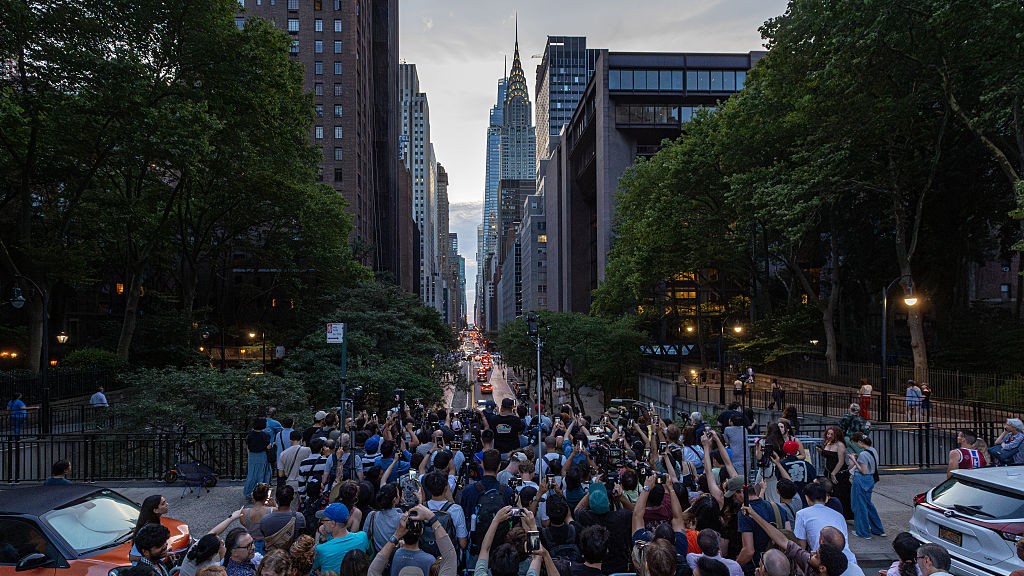
Crowds gather to watch ”Manhattanhenge” at Tubor City Bridge in New York City, NY, on July 12, 2025 (Image credit: Austin DeSisto/NurPhoto via Getty Images)
Dates and times to look
Date 2026
Sun
Time (EDT)
May 28
Half sun
8:14 p.m.
May 29
Full sun
8:13 p.m.
July 11
Full sun
8:20 p.m.
July 12
Half sun
8:21 p.m.
The man who first brought attention to the Manhattanhenge phenomenon nearly 30 years ago is the noted astrophysicist and director of New York’s Hayden Planetarium, Dr. Neil deGrasse Tyson. He has written an interesting blog about the event.
For those who will be in New York City and hoping to get a view of, and maybe even photograph this year’s spectacle, here is a tip: While any cross street will suffice, Dr. Tyson suggests the wider, “two-way” cross streets that ensures the best views of the west-northwest horizon (toward New Jersey) at 14th, 23rd, 34th, 42nd and 57th Streets. “The Empire State Building and the Chrysler Building render (respectively) 34th street and 42nd streets especially striking vistas,” he notes.
Popular viewing locations can become crowded, especially on 34th and 42nd Streets, so arriving at least 30 minutes before sunset is recommended.
We should also note here that the times provided below are not for the exact moment of sunset. Sunset is defined as when the very top of the sun disappears below a “true” astronomical horizon (such as what one might see from a ship out at sea). For the Manhattanhenge effect, allowances must be taken for hills and any landmarks along the distant New Jersey landscape, so the sun’s altitude is assumed to be one degree (or slightly less) above the actual horizon.
In 2026, there are not two, but four possible dates.
For your first opportunity in May, the dates to circle on your calendar are May 28 and May 29. On the first date, at 8:14 p.m. EDT, you will see a “half sun,” that is, half above and half below the landscape. On the following night, at 8:13 p.m. EDT, you will see a “full sun,” with the entire solar disk resting above the horizon.
If you miss out in May, you’ll get a second chance in July, on the 11th and 12th. On the first July date a “full sun” appears at 8:20 p.m. EDT, while on the second date, we get the “half sun” effect at 8:21 p.m. EDT.
Manhattanhenge in the morning?
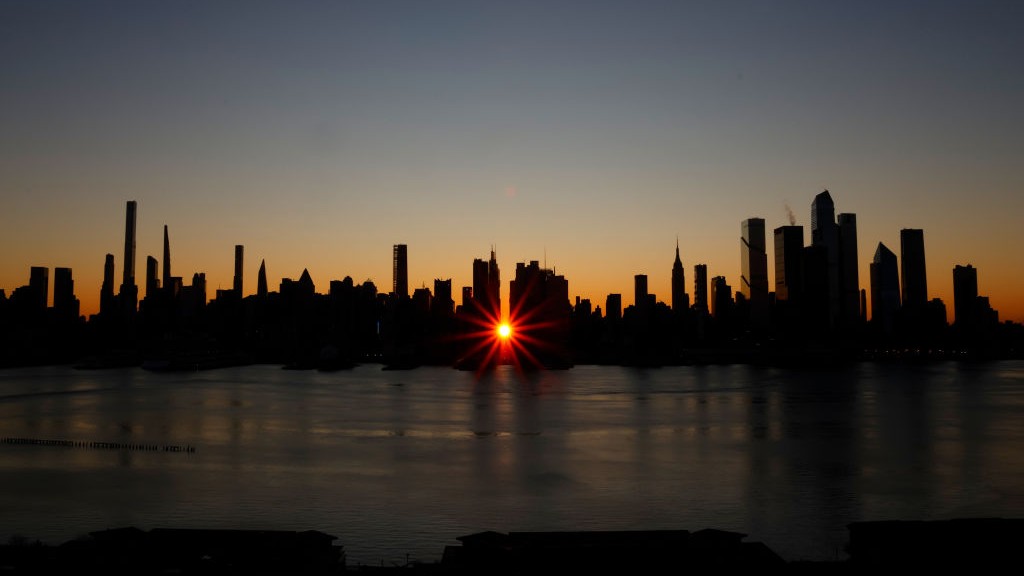
The sun rises over 42nd Street during a sunrise Manhattanhenge on Nov. 30, 2024, as seen from Weehawken, New Jersey. (Image credit: Gary Hershorn/Getty Images)
Some of you might be wondering if Manhattanhenge is visible at sunrise. The answer is yes, but you’ll have to wait until late in the year or at the very start of next year to see it. Once again, there are four opportunities, this time flanking the date of the winter solstice on Dec. 22. We now must look 180 degrees in the opposite direction, toward an azimuth of 120 degrees or 30 degrees south of due east. The first chance comes on Dec. 9 as the sun continues to shift to the south, with a “full sun” at 7:13 a.m. EST, followed by a “half sun” on Dec.10 at 7:12 a.m. EST.
After the solstice, the sun reverses course and begins to shift back to the north. On Jan. 1, we’ll see a “half sun” at 7:26 a.m. EST, followed the next morning by a “full sun” at 7:28 a.m. EST.
Keep in mind, however, that unlike with sunset, there are more likely to be local obstructions to your visibility of the rising sun. Those living in Upper Manhattan and Harlem must contend with buildings and structures rising up from The Bronx; those on the Upper East Side and Midtown will be looking toward Queens, while those in the East Village, down to Houston Street, are facing Brooklyn edifices.
Of course, in attempting to see or photograph Manhattanhenge in the morning, one must also consider that the ambient late fall/early winter morning air temperature is likely to be anywhere from 30 to 60 degrees F. colder compared to late spring/early summer evenings, and there could even be some snow underfoot (especially in January). And lastly, the weather odds for a clear and sunny winter morning are considerably less favorable compared to having a clear and sunny summer evening.
But whenever you attempt to see it, be it summer or winter, evening or morning, we wish you good luck and clear skies!
Across breakthroughs in AI, robotics, genetics, longevity, and consciousness research, the authors reveal a paradox at the heart of progress: as our external power expands, our inner resilience must evolve to match. Abundance without meaning leads to collapse. Intelligence without wisdom leads to extinction. To thrive in a world of everything, everywhere, all the time, we must learn to wield our godlike powers with humility, creativity, and flow.
Using the techniques of imagery, total body wellness can be achieved without prescriptive medicine. With this comprehensive, user-friendly primer, readers will learn just what guided sensory imagery is and how to create powerful images in the mind that direct the body to heal, both emotionally and physically.
With Dreams of Light, Andrew Holecek offers us an in-depth, step-by-step guide to the daytime practices of Tibetan dream yoga. Known as the “illusory form” practices, these teachings include insights, meditations, and actions to help us realize the dreamlike nature of our lives. Through an immersive exploration of the tradition, beginners and seasoned practitioners alike will learn everything they need to deeply transform both their sleeping and waking hours.
“In oneself lies the whole world and if you know how to look and learn, the door is there and the key is in your hand nobody on earth can give you either the key or the door to open except yourself.”
Jiddu Krishnamurti (1895 – 1986) Indian Philosopher and Teacher
AN OPPORTUNITY FOR DAILY REFLECTION BROUGHT TO YOU BY THE SCHOOL OF PRACTICAL PHILOSOPHY
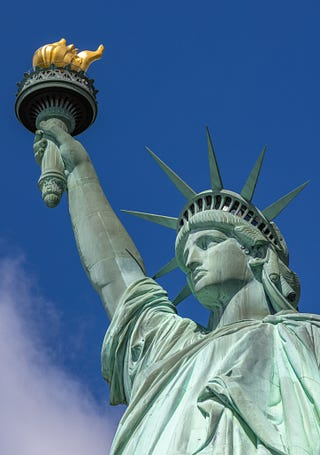
This weekend I’m in Paris, where today I saw an original 1/16-scale bronze version of the Statue of Liberty at the Musee D’Orsay. I felt rather numb gazing at it, thinking of all the memes over the last few year or so of Lady Liberty bent over weeping. With our 250th birthday only weeks away, we have much to consider….about our country….and about ourselves.
Frederic Auguste Bartholdi, the designer and sculptor of the Statue of Liberty, said these words in 1898:
The experience of the old is not a motor: it is only a lamppost, warning against dangers; the light that illuminates the long path ahead is you, the youth, who are holding its torch; it is you who are to illuminate the future and its obscurities.
We’re living in that future now, and to say it’s filled with obscurities is an understatement. Never has there been a more important moment to consider America’s meaning. Not just our policies, our economy, or even our history. Our meaning. That, more than anything else – should we embrace it an understand it – will carry us through this awful hour.
On the base of the Statue of Liberty is inscribed the poem The New Colossus by Emma Lazarus. Poet and activist Lazarus dedicated her poem to the refugees she was aiding at the time, applying for asylum from anti-Semitic pogroms in Eastern Europe. It’s worth reading every word of the poem, slowly and aloud to yourself. I’ll warn you now that it might break your heart.
THE NEW COLOSSUS
Not like the brazen giant of Greek fame, With conquering limbs astride from land to land; Here at our sea-washed, sunset gates shall stand A mighty woman with a torch, whose flame Is the imprisoned lightning, and her name Mother of Exiles. From her beacon-hand Glows world-wide welcome; her mild eyes command The air-bridged harbor that twin cities frame. “Keep, ancient lands, your storied pomp!” cries she With silent lips. “Give me your tired, your poor, Your huddled masses yearning to breathe free, The wretched refuse of your teeming shore. Send these, the homeless, tempest-tost to me, I lift my lamp beside the golden door!”
It’s worth asking, what has happened to us? We have gone from that poem…to concentration camps. Literally. To concentration camps. To Dilley in Texas, and Delaney Hall in New Jersey, and Alligator Alcatraz in Florida. Nothing could be more of a spit in the face to Lady Liberty, to Emma Lazarus, or to every brave American before us who has struggled and sacrificed for this country. Yet the darkness those detainment camps represent – and all the other assaults on our freedom today – will not prevail.
Millions of Americans are making sure Lady Liberty’s torch is held high, and we will continue to. From people protesting in the streets of Minneapolis, to judges all over the country who are standing up to the Administration’s corruption and criminality, to every American who will stand up for our democracy on November 3rd, her light has not gone out. And it will never go out, as long as it lives in us.
“And who understands? Not me, because if I did I would forgive it all.”
~ John Donne
John Donne was an English poet, scholar, soldier and secretary born into a recusant family, who later became a cleric in the Church of England. Under royal patronage, he was made Dean of St Paul’s Cathedral in London. He is considered the preeminent representative of the metaphysical poets. Wikipedia