In bound-to-be-controversial new research, scientists claim they’ve discovered a link between the specific balance of microflora in the gut and psychopathic behavior
As detailed in a yet-to-be-peer-reviewed study, a team of researchers led by University of Porto biomedical scientist Carolina Costa say they’ve found the first-ever evidence of how microbiota could influence traits linked to psychopathy — a controversial personality construct characterized by lack of empathy, poor behavior control, as well as antisocial and in extreme cases criminal behavior.
As Science Alert points out, previous research has found that psychopaths can share similar brain structures, including pathways in the prefrontal cortex. The latest paper, however, suggests those links could even extend into the microbiome.
“We hypothesized that the composition of the gut and oral microbiota may be associated with subclinical psychopathic personality traits,” the researchers wrote in the paper, an “unedited version” of which was shared by the journal Translational Psychiatry. “To our knowledge, this is the first study to explore this association.”
Costa and her colleagues examined the answers of 200 adult participants who filled out a questionnaire that was specifically designed to measure psychopathic traits. They also analyzed blood, saliva, and fecal samples from the participants for bacterial composition.
While the diversity of gut and oral microbes showed no clear links to psychopathic traits in itself, those who showed stronger psychopathic traits had a higher abundance of three kinds of bacteria when compared to those with weaker psychopathic traits.
“Allisonella, Prevotella, and C. evryensis showed significant positive associations with psychopathy scores, while T. vincentii was negatively associated,” the researchers concluded. The roles of these microbacteria range from helping in digestion and other metabolic processes, to assisting in warding off infections.
The team suggests that Allisonella, in particular, has been linked to human diseases and has been found to promote inflammation, a “key factor in psychiatric disorders such as anxiety and depression,” thereby suggesting a “possible link to psychopathy.”
Prevotella has also been linked to “differences in brain regions responsible for emotional, attentional and sensory processing, leading to a deficit in specificity of encoding contextual details of incoming stimuli.”
The claims are certain to be controversial. For one, the sample size was on the smaller side and relied on self-reported findings, which could greatly skew results as they’re susceptible to bias. Results could also vary depending on geographic regions, the researchers point out.
“Finally, as findings are correlational, causality cannot be established, especially given the bidirectionality of microbiota-brain communication,” they concluded.
In other words, it may actually be an inverse relationship, with the balance of the gut microbiome being caused by psychopathic traits instead of the other way around.
“For instance, psychopathy-linked factors, such as eating behaviors and hormonal differences could be responsible for shaping gut microbiota composition,” the researchers wrote.
It’s nonetheless a fascinating investigation into the extremes of human behavior — though plenty of future research is needed to investigate more thoroughly.
I’m a senior editor at Futurism, where I edit and write about NASA and the private space sector, as well as topics ranging from SETI and artificial intelligence to tech and medical policy.
Heraclitus fragments are a collection of over 100 surviving quotes, aphorisms, and philosophical thoughts from the ancient Greek pre-Socratic philosopher Heraclitus (c. 535–475 BC). His original written work has been lost to history; instead, these famous fragments survive today as indirect quotes, critiques, and references preserved by later classical and Christian writers.
This thought comes from Fragment B54 of the pre-Socratic philosopher Heraclitus. It translates in Greek to “ἁρμονία ἀφανὴς φανερῆς κρείττων” (Harmonia aphanês phanerês kreittôn), meaning an unapparent (hidden) connection is stronger/better than an obvious one. [1, 2, 3, 4]
Heraclitus is pointing to the deep unity of opposites. On the surface, the world seems made of separate, warring dualities—day and night, hot and cold, living and dying. But underneath, there is a hidden, underlying harmony and structure (the Logos) that connects them and makes the whole system work. [1, 2, 3, 4, 5]
It suggests that truth, beauty, and wisdom aren’t always visible at first glance. It requires effort and deep thought to see the unseen bonds that unite the universe, and this deeper, hidden truth is always more profound than what we see on the surface.
Modern thinkers across philosophy, psychology, physics, and art frequently return to Heraclitus’ concept of the hidden connection. They use it to explain how complex systems function beneath surface appearances.
Depth Psychology: Carl Jung
Carl Jung heavily adapted Heraclitus’ philosophy into his psychological frameworks.
Enantiodromia: Jung used this Heraclitean term to describe how an excess of one psychological force inevitably turns into its opposite (e.g., repressed emotion bursting out as rage).
The Shadow: Jung argued that our conscious persona (obvious) is deeply bound to our unconscious shadow (hidden), forming a hidden psychological harmony.
Synchronicity: He proposed that meaningful coincidences are connected by an unseen, non-causal principle that binds the inner mind to the outer world. [1, 2, 3, 4]
Quantum Physics: David Bohm
In theoretical physics, the search for the fundamental nature of reality mirrors this ancient fragment.
Implicate Order: Physicist David Bohm proposed that the universe has two layers: the explicate order (the obvious, separate physical objects we see) and the implicate order (a hidden, unbroken wholeness connecting everything). [1, 2, 3]
Quantum Entanglement: Modern physics shows that two particles can remain instantly connected across vast distances. This is a literal, scientifically proven “unapparent connection” ruling physical reality.
Philosophy and Deconstruction: Jacques Derrida
20th-century postmodern thinkers looked at how language and meaning are constructed. [1, 2]
Trace and Différance: Derrida argued that words do not have fixed, obvious definitions.
Absent Meanings: Instead, a word’s meaning relies on its hidden relationships to all the words it is not. The obvious text is entirely dependent on an invisible web of language.
Apple’s Design Philosophy: Steve Jobs
The concept also heavily influences modern technology, design, and user experience. [1, 2]
Complex Simplicity: Jobs famously sought “simplicity on the other side of complexity.”
Invisible Tech: The goal of modern design is often to hide the complex, warring components (circuits, code) behind an elegant, seamless interface, creating a powerful but invisible harmony. [1]
The parallel between quantum physics and ancient mysticism lies in the breakdown of a fragmented world. Both frameworks reveal that the universe is an unbroken, interconnected web where the observer and the observed are inseparable. [1, 2]
During the 1970s, physicists like Fritjof Capra popularized these striking intersections in his landmark book, The Tao of Physics. He argued that the mathematical descriptions of modern physics lead directly to a worldview shared by Eastern mystical traditions like Hinduism, Buddhism, and Taoism. [1, 2, 3, 4, 5]
1. Entanglement and the Web of Reality
In classical physics, objects are independent. In quantum physics, quantum entanglement proves that two subatomic particles can become permanently linked. A change in one instantly dictates the state of the other, even if they are light-years apart. [1, 2, 3, 4, 5]
The Mystical Parallel: This mirrors the Vedic concept of Indra’s Net. In this Buddhist and Hindu metaphor, the universe is a vast net stretching infinitely in all directions. At every node of the net sits a glittering jewel. Each jewel reflects all the other jewels in the cosmos simultaneously.
The Shared Concept: Nothing exists in isolation. Everything is a reflection of the whole. [1, 2]
2. The Observer Effect and the Illusion of Subjectivity
In the quantum realm, a particle exists as a wave of probabilities until it is measured. The act of observation forces the wave function to collapse into a definite particle. The observer creates the reality by looking. [1, 2, 3]
The Mystical Parallel: In Advaita Vedanta and various schools of Mahayana Buddhism, the idea of an objective world independent of mind is an illusion (Maya). Mystics argue that subject (the looker) and object (the looked at) are a single, continuous reality.
The Shared Concept: Consciousness is not a passive bystander. It is actively participating in forming reality. [1, 2, 3, 4, 5]
3. Wave-Particle Duality and the Coexistence of Opposites
Light behaves as both a continuous wave and a localized particle, depending on how you measure it. This fundamental paradox baffled early physicists because it defied traditional logic. [1, 2, 3]
The Mystical Parallel: This is the core engine of Taoism, represented by the Yin and Yang. Taoism states that reality is a fluid flow of opposing forces that appear contradictory but are actually complementary parts of the same underlying truth.
The Shared Concept: Truth cannot be captured by rigid “either/or” categories. It requires an embrace of “both/and” paradoxes. [1]
4. Cosmic Dance and the Quantum Vacuum
To classical eyes, empty space is a void. Quantum field theory reveals that the quantum vacuum is actually a churning, dynamic ocean of energy where particles are constantly flashing into existence and destroying one another in fractions of a second. [1, 2, 3]
The Mystical Parallel: This matches the Hindu concept of the Dance of Shiva (Nataraja). Shiva’s dance symbolizes the continuous cosmic cycle of creation and destruction that sustains the universe.
The Shared Concept: What we perceive as solid matter is actually a dynamic, vibrating pattern of endless energy exchange. [1, 2, 3]
Key Concepts Compared
Quantum Physics Concept
Mystical Counterpart
Core Philosophical Agreement
Quantum Entanglement
Indra’s Net (Buddhism/Hinduism)
All parts of the universe are non-locally interconnected.
The Observer Effect
Neti Neti / Maya (Vedanta)
Subject and object are an undivided, participatory unit.
Wave-Particle Duality
Yin and Yang (Taoism)
Ultimate reality is made of complementary paradoxes.
Quantum Field Vacuum
The Dance of Shiva / The Tao
Form emerges from a dynamic, invisible sea of energy.
NOVA PBS Official Jul 2, 2026 Particles of Thought Steve Brusatte has the dirt on dinosaurs and joins Hakeem to trace the full 100-million-year history of the tyrannosaur dynasty, the asteroid that ended it, and the remarkable truth that dinosaurs never actually disappeared. One small lineage survived to become every bird alive today, and Steve walks through the long and contested scientific history of how we came to understand that connection. He also shares what it was like to serve as the official paleontology consultant on the Jurassic World films, and how to find the balance between science and cinema. Particles of Thought is back for Season 2! ???? Available on your favorite podcast platforms Amazon Music: https://bit.ly/4msqqby Spotify: https://bit.ly/3Hz8rkI Apple Podcasts: https://apple.co/4oB3Ten If you enjoyed this podcast, please consider leaving a rating and review on Apple Podcasts. Your feedback helps new listeners find the show and allows us to continue creating great science content. Thank you for your support! https://podcasts.apple.com/us/podcast… ⭐️⭐️⭐️⭐️⭐️ Steve Brusatte is a paleontologist at the University of Edinburgh, where he leads a research group studying dinosaur evolution and the history of life on Earth. He is the author of several acclaimed books, including The Rise and Fall of the Dinosaurs and The Story of Birds, and has served as a paleontology consultant on the Jurassic World film franchise. He will be featured in NOVA’s upcoming five-part documentary series Evolution, coming fall 2026. Particles of Thought is hosted by Hakeem Oluseyi, an astrophysicist, author, STEM educator, multi-patented inventor, science journalist, TV personality, science communicator, and inspirational speaker. His research is based on “hacking stars” to understand our universe better and develop innovative new technologies. Oluseyi’s work has resulted in 11 patents and more than 100 publications covering contributions to astrophysics, cosmology, and plasma physics and the development of space missions, observatories, focal plane instruments, detectors, semiconductor manufacturing, and ion propulsion. Chapters 00:00:00 T. rex Family Tree 00:30:33 How Dinosaurs Became Birds 00:59:01 Is Jurassic World Scientifically Accurate?
New study argues time may emerge from quantum entanglement rather than exist as a fundamental backdrop. (CREDIT: Shutterstock)
Time has always seemed like the one thing physics could count on. Matter changes, stars die, particles flicker in and out, but time keeps moving. That assumption sits so deep in modern science that it often passes without notice. Now a new theoretical study argues that time may not exist in the way physicists have long treated it.
Instead, the work suggests time could emerge from quantum entanglement, the strange connection that links separate systems at the microscopic level. In this view, time is not a universal stage on which events unfold. It appears only when one quantum system is used to track another.
The paper, published in Physical Review A, revisits the Page and Wootters mechanism, a proposal first introduced in 1983. The idea has hovered for decades at the edges of debates over quantum gravity and the foundations of physics. By building an explicit model, the authors argue that the mechanism can recover both ordinary quantum motion and, in the right limit, the familiar time of classical physics.
That matters because physics still holds two incompatible pictures of time.
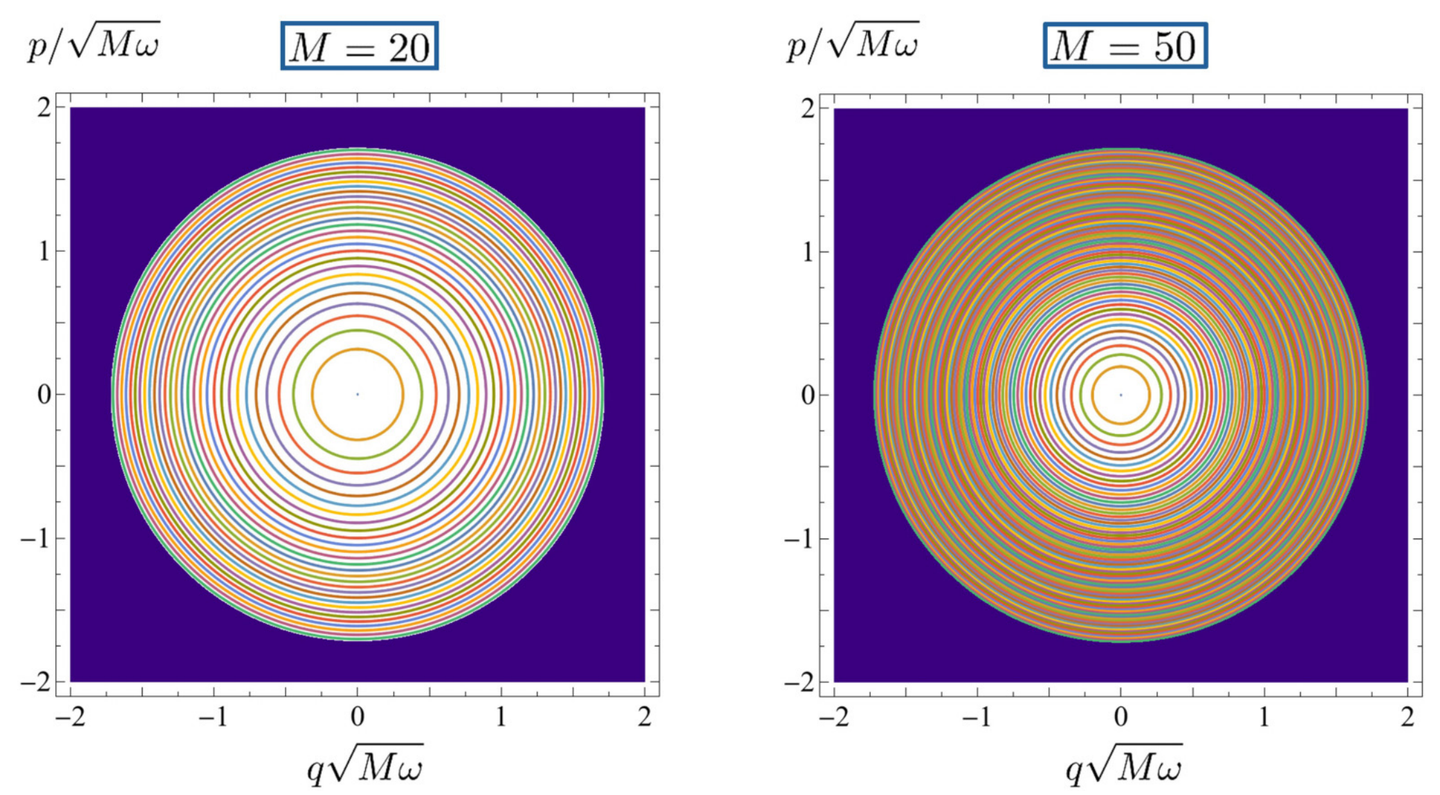
The evolving system phase space with the admitted orbits when cm≠0∀m and κ=3/4, r=2/3 for M=20 (on the left) or M=50 (on the right). (CREDIT: Physical Review A)
In quantum mechanics, time is treated as an external parameter, something imposed from outside the system. It is the ruler used to measure change, but it is not itself an observable inside the theory. General relativity treats time very differently. There, time is woven into spacetime and can stretch or slow depending on gravity and motion.
“It seems there is a serious inconsistency in quantum theory. This is what we call the problem of time,” Alessandro Coppo of Italy’s National Research Council said.
Where time goes missing
The mismatch is more than a technical annoyance. It blocks one of physics’ biggest goals, a theory that can connect the microscopic world of quantum mechanics with the large-scale structure of the universe described by relativity.
The Page and Wootters approach starts with a radical step. It assumes the universe as a whole can sit in a timeless quantum state. Nothing evolves globally. There is no master clock ticking in the background.
What looks like motion appears only inside that frozen whole, through correlations between subsystems. One part serves as a clock, the other is the system whose change gets tracked. If the two are entangled in the right way, the second system appears to evolve relative to the first.
Without that internal relationship, there is no time in any meaningful sense, only a static quantum state.
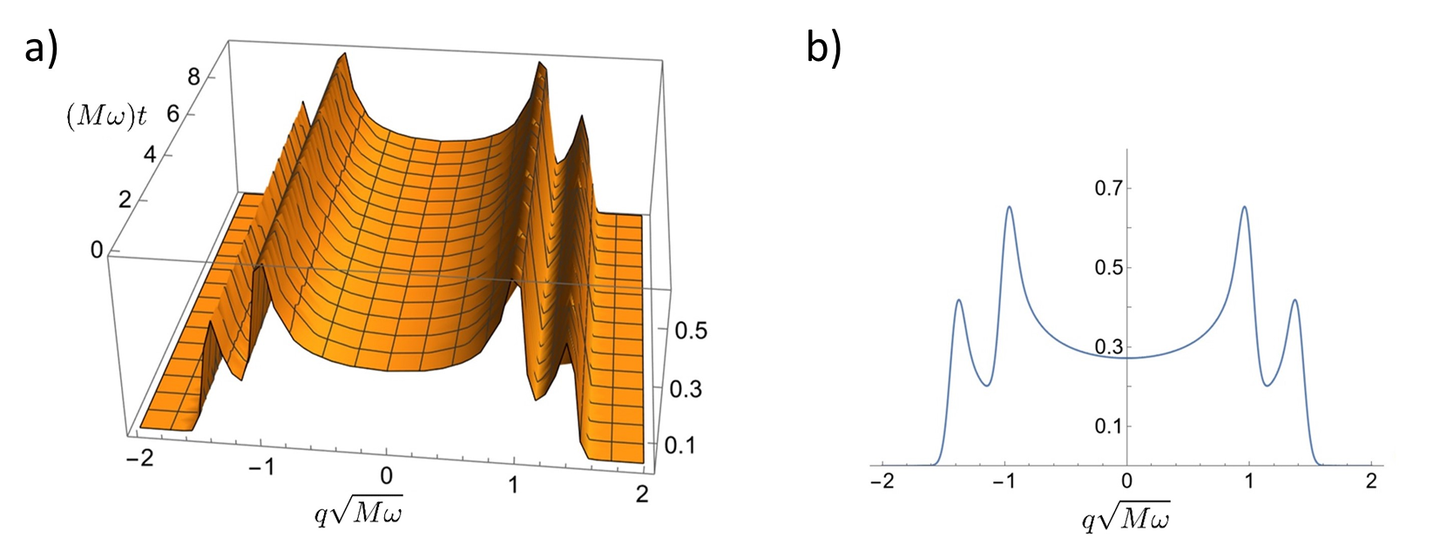
Graphical representation of the marginal probability distribution related to |β|2 w.r.t the space-time coordinates and b) its section at any constant time for the example with κ = 3/4 introduced in the main text. (CREDIT: Physical Review A)
To test the idea in a concrete setting, the authors modeled two noninteracting but entangled systems. One was a harmonic oscillator, a standard physics model for an object that vibrates or swings back and forth. The other was a magnetic spin system that acted as the clock.
The oscillator’s evolution did not come from an outside time variable. It came from its entangled relationship with the clock system. Under those conditions, the dynamics matched the Schrödinger equation, the central equation of quantum mechanics.
That is the heart of the claim. Time, in this picture, is not fundamental. It is relational.
A clock that must earn the job
The paper also found limits on when that picture works.
In the fully quantum version of the model, the clock could only track part of the oscillator’s possible behavior. Because the clock system had a finite structure, it could not label the oscillator’s full infinite range of states. That meant not every quantum clock is good enough to generate the kind of time physics usually assumes.
This turned out to be a key point. For the mechanism to recover ordinary dynamics, the clock has to approach a classical limit. In the model, that meant making the magnetic clock large enough that its behavior could be described more like a classical object than a sharply quantum one.
The study found that once the clock became macroscopic, the usual time parameter of the Schrödinger equation emerged more naturally. The same framework also identified a second parameter tied to the energy of the evolving system.
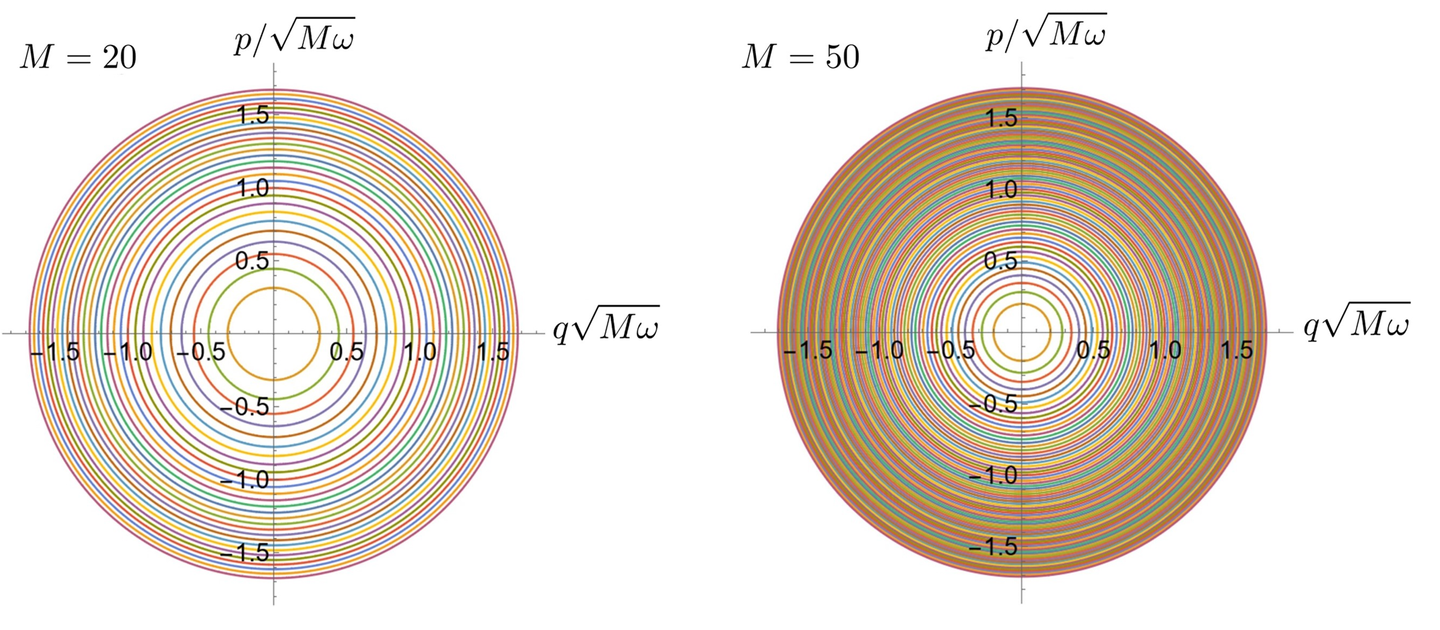
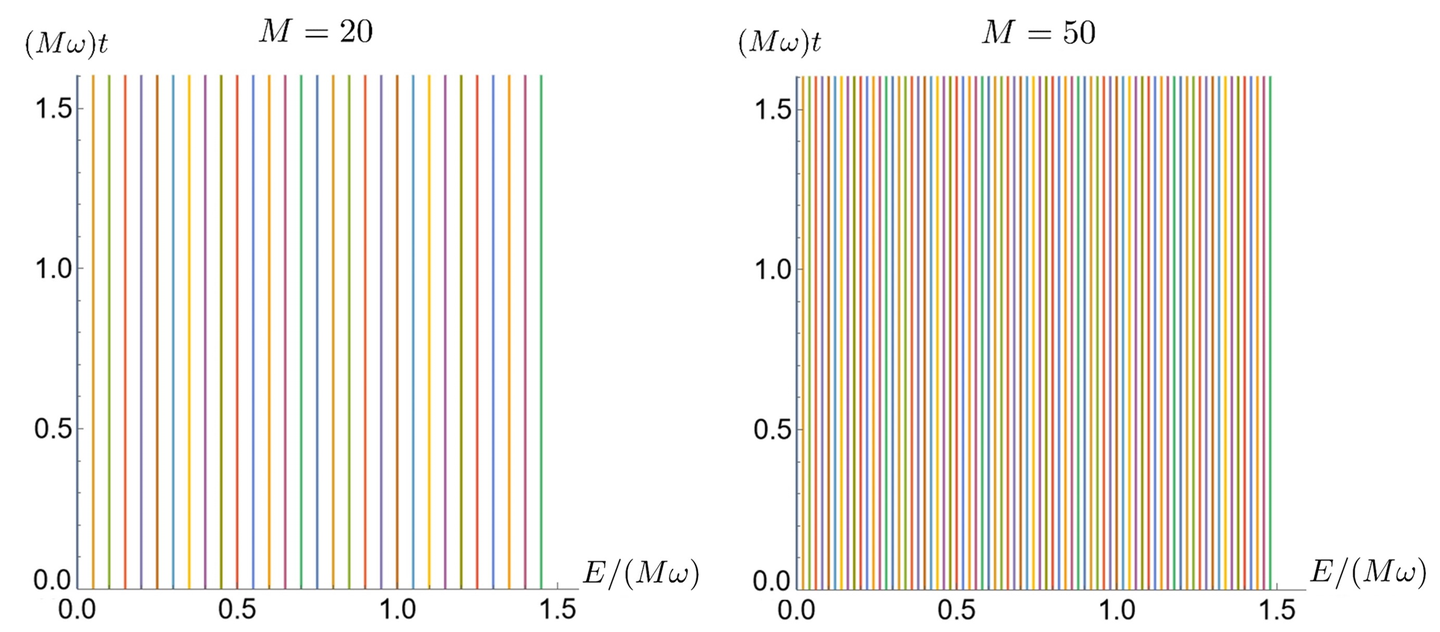
The evolving system phase-space with the admitted orbits when cm= 0∀m and κ = 3/4, r = 2/3 for M = 20 (on the left) or M =50 (on the right). (CREDIT: Physical Review A)
“We strongly believe that the correct and logical direction is to start from quantum physics and understand how to reach classical physics, not the other way around,” Coppo said.
That line captures the broader ambition of the work. Rather than treating classical time as primary, the authors try to show how it could arise from a deeper quantum description.
The model goes even further. When both the clock and the oscillator were pushed into their classical limits, the equations reduced to the standard Hamiltonian equations that describe motion in classical physics. In other words, the familiar flow of time seemed to emerge from the same entangled framework.
From quantum puzzle to physical test
For all its elegance, the idea remains speculative.
“Yes, it is mathematically consistent to think of universal time as the entanglement between quantum fields and quantum states of 3D space,” said Vlatko Vedral, a professor of quantum information science at the University of Oxford. “However, no one knows if anything new or fruitful will come out of this picture, such as modifications to quantum physics and general relativity, and corresponding experimental tests.”
That caution reflects a larger truth in foundational physics. A theory can be logically neat and still fail to describe nature. The Page and Wootters mechanism has drawn renewed interest in recent years, partly because of advances in quantum information theory and work on quantum reference frames. But direct experimental confirmation remains out of reach.
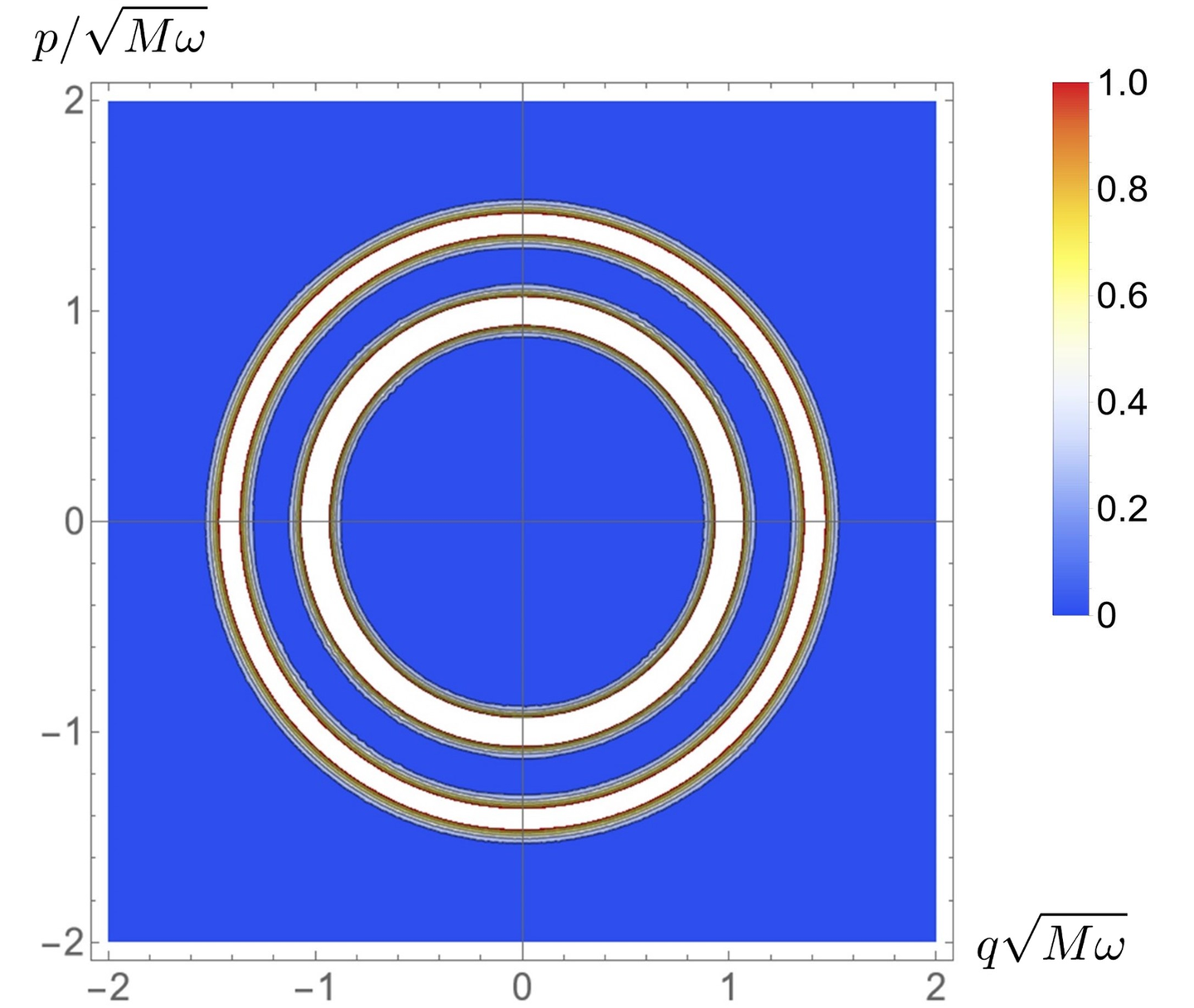
The contour plot of the marginal probability distribution related to |????|2 with respect to the evolving system phase-space coordinates. (CREDIT: Physical Review A)
The new study does not settle that problem. It offers a worked-out example, not proof that the universe actually uses time this way.
Still, the paper sharpens the debate by showing what such a world would require. Time would not be an ingredient poured into the laws of physics from the start. It would be something that appears only under specific conditions, especially where entangled systems can play the roles of clock and observer.
Adam Frank, a theoretical physicist at the University of Rochester, put the issue in more human terms. “Maybe the only way to understand time is not from some God’s-eye perspective, but from the inside, from a perspective of asking what is it about life that manifests such an appearance of the world,” he said.
That thought pushes the question beyond equations. If time is emergent, then the flow people experience may say as much about perspective and relationships as it does about the deep architecture of reality.
The strange cost of a timeless universe
There is something unsettling in that possibility. A timeless universe is not one where clocks stop. It is one where time never existed as a basic feature in the first place.
What we call past, present, and future would then be less like fixed rails and more like patterns arising from quantum correlations. The apparent motion of the world would be real in experience, but not fundamental in the underlying description.
The energy-time phase-space with the admitted orbits when cm= 0 ∀m and κ = 3/4, r = 2/3 for M = 20 (on the left) and M = 50 (on the right). (CREDIT: Physical Review A)
That is a difficult idea to test, and maybe harder to accept.
Practical implications of the research
If this approach holds up, it could help physicists think more clearly about quantum gravity, the long-running effort to unite quantum mechanics with general relativity.
It also gives researchers a more concrete framework for studying quantum clocks, reference frames, and the transition from quantum behavior to classical physics.
For now, its main value is conceptual: it offers a mathematically detailed way to ask whether time is basic to nature or something that only emerges when parts of the universe become entangled in the right way.
Research findings are available online in the journal Physical Review A.
Shy Cohen WriterShy Cohen is a Washington-based science and technology writer covering advances in artificial intelligence, machine learning, and computer science. Having published articles on MSN, AOL News, and Yahoo News, Shy reports news and writes clear, plain-language explainers that examine how emerging technologies shape society. Drawing on decades of experience, including long tenures at Microsoft and work as an independent consultant, he brings an engineering-informed perspective to his reporting. His work focuses on translating complex research and fast-moving developments into accurate, engaging stories, with a methodical, reader-first approach to research, interviews, and verification.
In 1703, the world’s most esteemed scientific journal published a surprising letter from an anonymous correspondent. (At the time, until well into the twentieth century, anonymity often meant the scientist writing was a woman, though the word “scientist” itself was more than a century away, to be coined for a woman.)
The letter reported an astonishing discovery in the roots of pond plants placed under a microscope, still a relative novelty: Adhering to the delicate aquatic stalks were “many pretty branches, compos’d of regular oblongs and exact figures… the longest side not exceeding 1/2 of a hair’s breadth” — mysterious beauties smaller than any life-form anyone had seen, and yet appearing to be more than inert matter. “They may be rather Plants than Salts,” the shy scientist speculated shyly, but concluded that “they being so very minute that no judgment can be made of them but by the Eye,” it is impossible to “determine any thing positively.”
These beguiling marvels — tiny stars and fans and ribbons organized along exquisite radial and lateral symmetries — confused Darwin when he encountered them a century and a half later in the dust of the Cape Verde Islands and in the face paint of the native inhabitants Tierra del Fuego. All he managed was to gasp that “few objects are more beautiful,” seemingly “created that they might be examined and admired under the high powers of the microscope.”
Modern micrograph of diatoms (NOAA)
Today, we know that diatoms — thousands of species of unicellular algae, each a living Noether theorem housed in a shell of opal — are not created for admiration but create the admirer: Every life-form on Earth depends on them. Tiny powerhouses of photosynthesis populating every body of water, these phytoplankton generate close to half of our planet’s oxygen, pillar its biomass, and absorb the atmospheric carbon dioxide that dissolves in the ocean.
To know of this extraordinary power makes the delicate beauty of diatoms all the more beguiling — nowhere more so than in Diatom Atlas by the German naturalist and clergyman Adolf Schmidt (1812–1899), who spent the better part of his life sampling cells from all over the world — Japan to Chile, Java to Barbados — to compose his pioneering portrait these miniature masterpieces of evolution.
Art from Diatom Atlas by Adolf Schmidt, 1890 edition. (Available as a print and more.)
Originally published in 1874 in black and white, the atlas was later reproduced on blue paper — a medium that originated in ancient China, then made its via the Middle East and Spain to Renaissance Italy to be used as a base for drawing and prints, giving two-dimensional artwork a hauntingly beautiful three-dimensional quality.
Art from Diatom Atlas by Adolf Schmidt, 1890 edition. (Available as a print and more.)
Art from Diatom Atlas by Adolf Schmidt, 1890 edition. (Available as a print and more.)
Art from Diatom Atlas by Adolf Schmidt, 1890 edition. (Available as a print and more.)
Art from Diatom Atlas by Adolf Schmidt, 1890 edition. (Available as a print and more.)
Art from Diatom Atlas by Adolf Schmidt, 1890 edition. (Available as a print and more.)
“I died for beauty,” Keats wrote with the requisite melodrama of the Romantics. Diatoms are a dazzling defiance of this aesthetic nihilism, urging us to remember that we are here to live with beauty. They could have remained mere producers of chemical energy no handsomer than a factory, and yet here they are, living jewels of the blue world. Pulsating beneath their shimmering shells and mathematically perfect symmetries is the elemental question: Why did the world have to be beautiful? And beneath that still, the eternal answer: No why; just is.
Art from Diatom Atlas by Adolf Schmidt, 1890 edition. (Available as a print and more.)
New Thinking Allowed with Jeffrey Mishlove Jun 25, 2026 Mark Booth is the author of several comprehensive books including The Sacred History: How Angels, Mystics, and Higher Intelligence Made Our World, The Secret History of Dante: Unearthing the Mysteries of the Inferno, The Secret History of the World, and most recently The Secret History of the Universe: How Ancient Wisdom Made the Modern World. Mark explores the surprising relationship between modern physics, ancient esoteric traditions, and the nature of consciousness. He argues that many of history’s greatest scientists, from Isaac Newton to contemporary physicists, were deeply influenced by mystical ideas and suggests that modern science increasingly points toward an intelligent, interconnected universe. Booth’s discussion ranges from Platonic mathematics and quantum theory to artificial intelligence, spirituality, and humanity’s evolving role within a living cosmos. 00:00:00 Introduction 00:02:30 Newton, mysticism, and science 00:06:00 Childhood experiences and esoteric inquiry 00:10:30 Publishing the secret history 00:14:00 Plato, mathematics, and reality 00:18:00 Physics, idealism, and consciousness 00:22:00 Intelligent universe, and information 00:27:00 Time, space, and interconnectedness 00:31:00 Artificial intelligence, and ethics 00:41:16 Conclusion New Thinking Allowed host, Jeffrey Mishlove, PhD, is author of The Roots of Consciousness, Psi Development Systems, and The PK Man. Between 1986 and 2002 he hosted and co-produced the original Thinking Allowed public television series. He is the recipient of the only doctoral diploma in “parapsychology” ever awarded by an accredited university (University of California, Berkeley, 1980). He is also the Grand Prize winner of the 2021 Bigelow Institute essay competition regarding the best evidence for survival of human consciousness after permanent bodily death. He is Co-Director of Parapsychology Education at the California Institute for Human Science. (Recorded on Friday, May 29, 2026)
Science and Nonduality Jan 25, 2019 http://www.scienceandnonduality.com Bob Thurman delights the audience at SAND 2018 with his lighthearted approach to the wisdom and the message of Buddha. He criticizes materialism, calling it a decision, one which limits our responsibility for our actions, personal and global, by confirming the belief that this is all there is, that there is nothing after life – so it doesn’t matter, because we won’t be here to face the consequences. For more information visit https://www.bobthurman.com
Sylvain Biget and Xavier Demeersman, Contributing Writers – Futura
Stephan: As American science is gutted and unraveled by Trump and his administration, China is becoming the world leader. The Chinese are developing a new energy technology that may change the global future of humanity.
Turning CO2 into energy might sound like science fiction – or at least like a bold climate promise. Yet that is exactly what China has achieved by inaugurating two fully operational power generators that run on carbon dioxide. Before you imagine giant machines vacuuming pollution out of the sky, though, there is a catch. This system does not capture CO2 from the atmosphere, and it does not use just any kind of carbon dioxide.
At a time when CO2 is usually portrayed as the chief villain of global warming, this development flips the script. In this case, carbon dioxide becomes a technical ally rather than a pollutant. The breakthrough comes from the China National Nuclear Corporation, which has connected the world’s first generator powered by supercritical CO2 to its electricity grid.What makes supercritical CO2 so special?
When carbon dioxide is exposed to extremely high temperature and pressure, it reaches what scientists call a supercritical state. At that point, it is no longer quite a gas or a liquid. Instead, […]
Illustration by Tag Hartman-Simkins / Futurism. Source: Shutterstock
AI companies have long relied on armies of data labelers, whose job it is to annotate, tag and classify text, images and videos to train AI models.
It’s not exactly a flashy occupation, with some saying they’re forced to watch privacy-invading footage. Others argue they’re being forced to dig their own graves by training models capable of doing their old jobs.
Other job opportunities in the space could prove more pleasurable. As Business Insider reports, a chatbot companion startup called Joi AI, which offers a NSFW character AI chat service, is hiring ten “mast**bation consultants,” according to a job listing the company posted on social media.
Best of all, chosen candidates will be paid $2,000 a month — not bad for cranking the hog to audio erotica.
These consultants are being asked to spend four weeks writing about their intimate experience while testing the company’s audio feature. Anyone can apply.
Unsurprisingly, Joi AI was quickly drowning in applications, with the company’s head of brand, Julie Levin, telling BI that the company had received over 100,000 applications in a matter of days.
“What are we supposed to do with 100,000 applications?” Levin said. “I should probably call them ‘winners,’ because it’s such a competition.”
It’s an unusual AI gig that will involve chosen candidates delivering weekly reports after completing “daily audio-guided sessions.”
“We expect people to learn something about how mast**bation affects their life in a good way or a bad way,” Levin told BI. “We wanted them to reflect on that.”
Chances are that not everybody signing up was sincerely meaning to help the company fine-tune its new audio feature. In a recent tweet, the company reflected on the types of “cover letter openings” it had received, which ranged from “this is my calling,” to “I’ve been training for this my whole life.” Other openings included “my therapist said I needed a hobby,” and “I applied on behalf of my husband.”
“Time to go pro,” one X user joked. “Ready to contribute extensive data, repeatedly, for science.”
The reality, of course, is that companies offering NSFW chatbot companionship have long been shrouded in controversy, from men creating AI girlfriends and verbally abusing them to teenagers falling in love with their new large language model-powered partners.
I’m a senior editor at Futurism, where I edit and write about NASA and the private space sector, as well as topics ranging from SETI and artificial intelligence to tech and medical policy.