I think you mean René Girard (1923–2015), the French historian, literary critic, and social theorist.
The central idea: We imitate each other
Girard’s most famous claim is that human desire is mimetic—we learn what to want by seeing what other people want.
For example, you may think you want a particular job, partner, status symbol, or lifestyle because it appeals to you directly. Girard argues that often you want it because someone else values it. We unconsciously copy not only behavior but desire itself.
This creates a triangle:
Subject (the person desiring)
Model or mediator (the person being imitated)
Object (the thing desired)
The object is often less important than the model.
Mimetic rivalry
When two people imitate each other’s desires, they become rivals.
Girard believed that many conflicts begin this way:
Siblings competing for parental attention
Neighbors competing for status
Nations competing for prestige
Political factions mirroring each other’s hostility
Ironically, rivals often become more alike as their conflict intensifies.
The scapegoat mechanism
Girard’s second major idea is that communities under stress often resolve internal conflict by blaming a single person or group.
As tensions rise, everyone unites against a scapegoat:
A stranger
A minority
A heretic
A suspected witch
An outsider
The community experiences relief because violence that had been spreading internally is redirected toward one victim.
Girard argued that many myths and social institutions originated from this process.
Religion and myth
Girard believed that ancient myths often conceal the innocence of the victim. The crowd’s violence appears justified.
He argued that the Judeo-Christian scriptures are unusual because they increasingly reveal the victim’s perspective.
For Girard:
The story of Abel highlights an innocent victim.
The story of Joseph exposes unjust persecution.
The crucifixion of Jesus Christ fully reveals the innocence of the scapegoat and the violence of the crowd.
This was one of his most controversial claims.
His major books
Deceit, Desire and the Novel — introduces mimetic desire through literature.
Violence and the Sacred — develops the scapegoat theory.
The Scapegoat — analyzes victimization in culture and religion.
Things Hidden Since the Foundation of the World — his most comprehensive statement of the theory.
Influence
Girard’s ideas have influenced:
Literary criticism
Anthropology
Theology
Psychology
Political theory
His admirers see him as offering a grand explanation of human conflict. His critics argue that he tries to explain too much with a single theory and sometimes stretches the evidence.
A one-sentence summary of Girard’s work would be:
Human beings learn what to desire by imitating one another; this imitation creates rivalry, rivalry produces social crisis, and societies often restore order by uniting against a scapegoat.
René Girard, in response to critics who called his theory an idée fixe, agreed, claiming that he does indeed see evidence of his theory in almost everything:
Send any masterpiece you like my way, literary, cultural or religious, and it will be quite a miracle if I do not come back to you, a month or a year later, with my mimetic desire , my sacrificial crisis and above all — give the Devil his due — that bloody atrocity with which I am infatuated, the primordial, founding act of violence: the collective murder of the deity.
The question is: to what extent is this warranted? Is Girard’s system, as he has asserted, ‘more comprehensive and universal than anything discovered by Marx and Freud’? In this post, we’ll go through it and decide for ourselves…
Mimetic Desire
According to Girard, ‘all desire is a desire for being’, meaning, unlike need (which makes itself felt in our bodies ‘without any help from third parties’), desire is socially determined:
Behind our desires lurks a mediator or model who most often goes unrecognized by others, including the person doing the imitating. As a general rule, we desire what those around us desire. Our models can be real or imaginary, collective or individual. We imitate the desires of those we admire. We want to ‘become like them’, to spirit away their very being.
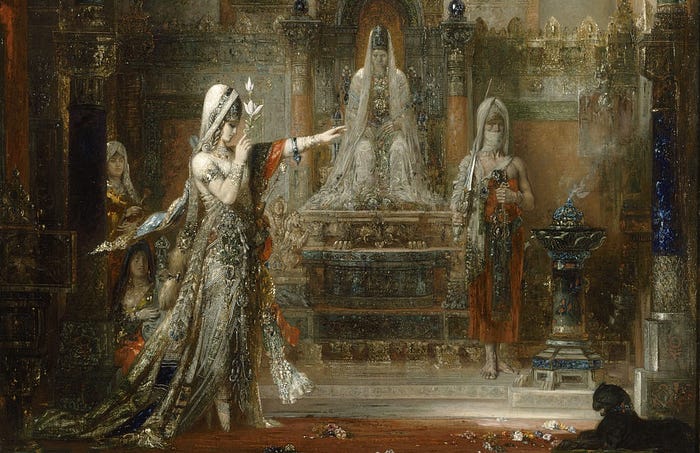
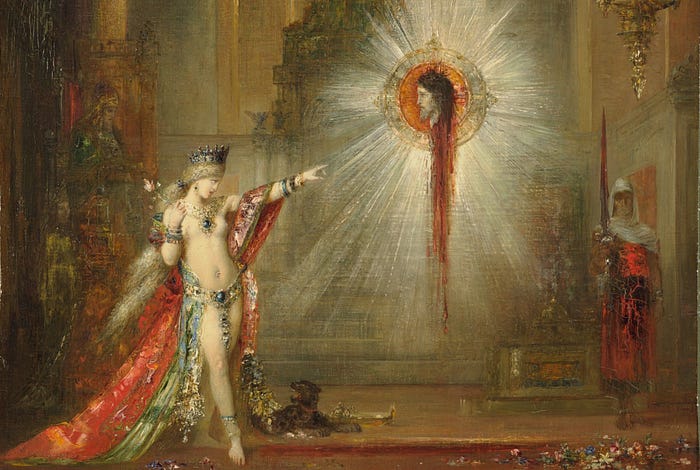
One of Girard’s best examples of this is the story of Salome, who, after dancing for King Herod, is granted one wish, but, unsure of what to choose, asks her mother Herodias, who says she should request the head of John the Baptist. According to Girard, this scene in Mark 6: 21 reveals imitation to be the ‘essence of desire’. Contrary to what we often assume, ‘there is no preordained object of desire’, we have to be told, like Salome, what we want:
It is difficult to imagine a sequence better suited to reveal the mimetic genesis of desire than the passage just quoted: first the girl’s silence in response to the overwhelming offer of the king, then the question to the mother, then the mother’s response, and finally the girl’s espousal of her mother’s desire. The child asks the adult, not to fulfill some desire that would be hers, but to provide her with the desire she lacks.
‘Salome Dancing Before King Herod’ by Gustave Moreau
By its very nature, imitative desire creates ‘mimetic rivalries’, in which desire converges on a single object. Herodias, for instance, has a grudge against John the Baptist for pointing out that Herod stole Herodias from his brother Philip. Thus, according to Girard:
When I imitate the desire of my brother, I desire that which he desires. We prevent one another from satisfying our common desire. The more the resistance increases on both sides, the more desire is reinforced; the more the model is made the obstacle, the more the obstacle is made the model, so that in the last analysis, desire is attracted only when it is thwarted. It focuses on obstacles only.
Salome in ‘The Apparition’ by Gustave Moreau
This is the underlying theme of A Midsummer’s Night Dream, another of Girard’s great examples. Within the play, everyone ‘chooses love by another’s eyes’. Helena, for instance, wishes to beHermia because that is who Demetrious loves. However, Demetrious himself is hardly mentioned:
Desire speaks here, and it is the desire for another’s being. Helena would like to be translated, metamorphosed into Hermia, because Hermia enjoys the love of Demetrius. Demetrius, however, is hardly mentioned. The desire for him appears less pressing than the desire for Hermia’s being.
The chaos that ensues (as each character pursues their imitative desire) is what Girard calls a mimetic crisis, which occurs when mimetic rivalries ‘become so intense and contagious that not only do they lead to murder but they also spread, mimetically, to entire communities’ — which leads us to next part of Girard’s theory.
The Scapegoat
Girard’s concept of the scapegoat begins with a destructive crisis. This crisis may take many forms (a plague, an invasion, etc.), but at a certain point it becomes a Hobbesian ‘war of all against all’, meaning, ‘explosions of rivalry intense enough to destroy communities’. In these situations:
The thirst for revenge is concentrated on an increasingly small number of individuals. In the end, the community is united against one, the one I call the scapegoat. The group reconciles around this one victim, at a cost that seems miraculously low.
According to Girard, this entire process occurs below the level of consciousness, hence Jesus on the Cross saying: ‘Father, forgive them, they know not what they do’. This sentence, according to Girard, must be interpreted literally. ‘For if the myths recognized the facts, the innocence of the scapegoat would become visible, and violence would lose its cathartic efficacy’.
As unfortunate as this may seem, our survival may have been contingent upon such innocent sacrifice. ‘The unanimous mimetic contagion transforms the disastrous violence of all against all into the healing violence of all against one. The community is reconciled at the cost of one victim only’.
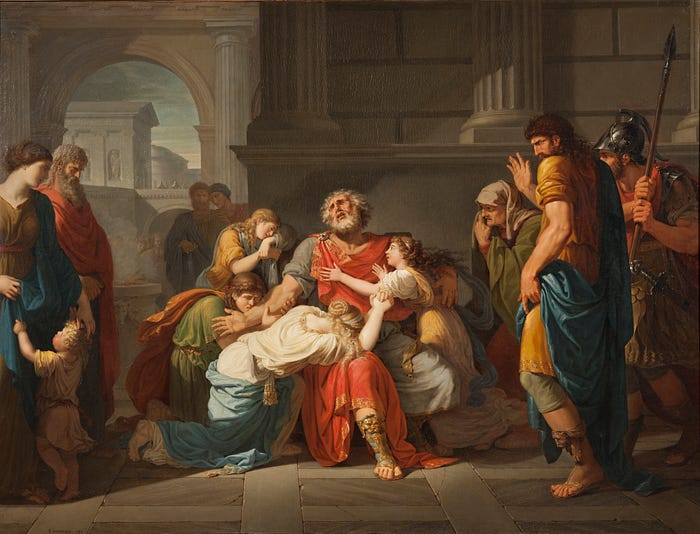
‘The Blind Oedipus Commending his Children to the Gods’ by Bénigne Gagneraux
Again, it was not the discovery of an authentic criminal that reconciled archaic communities, but ‘the illusion of such a discovery’. Thus, Girard may be the first of a thousand critics to point out that Oedipus (in Sophocles’ play) is not the person who killed his father and married his mother, but rather, the person who is accused of killing his father and marrying his mother. His enucleation and later exile were not carefully thought through (how could patricide and incest cause a plague?), but they did end a mimetic crisis which could have, and has, destroyed the communities in the past.
The Collective Murder of the Deity
After the scapegoat has been killed, there is tendency to memorialise (or even deify) the victim (as both the source and the solution to the crisis). Freud describes something similar in Totem and Taboo in the killing of the ‘primal father’. But as Girard points out, something changes with Christianity:
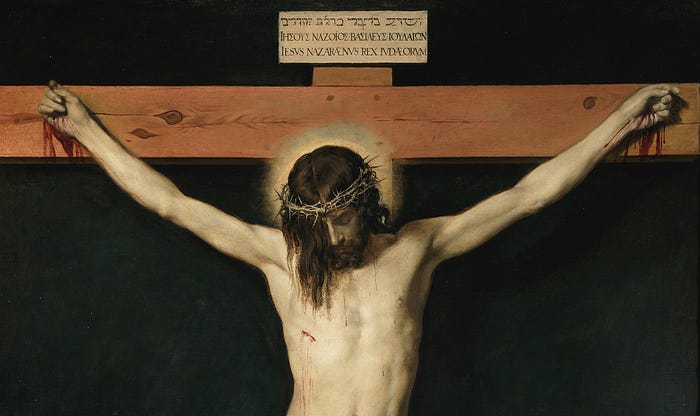
Whereas in myth the victims are believed to have committed the crimes of which they are accused, in biblical and Christian tradition this verdict is often overturned. Many Bible stories condemn the crowd and rehabilitate the victim.
‘The Crucifixion of Jesus’ by Brian Zahnd
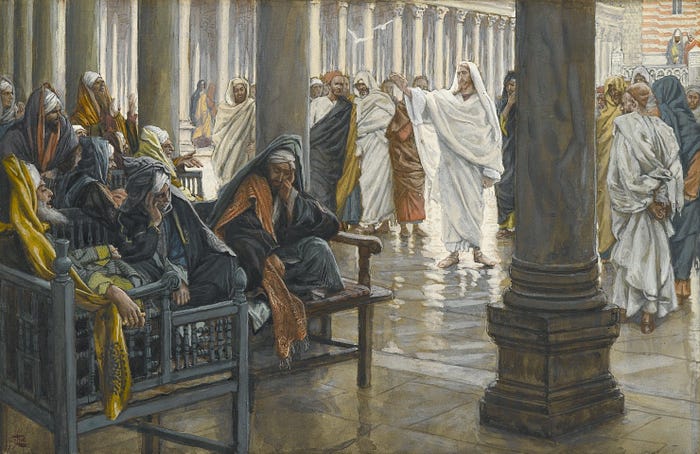
Through this reversal, we have inherited a distrust of mobocracy, which does not mean that we are not susceptible to scapegoating, but that we can no longer do so in complete ignorance. This is what is alluded to in the ‘Curse Against the Pharisees’. The mobs that attacked the Hebrew prophets were no different from those who attacked Jesus himself:
Woe unto you, scribes and Pharisees, hypocrites! Because ye build the tombs of the prophets, and garnish the sepulchres of the righteous, And say, If we had been in the days of our fathers, we would not have been partakers with them in the blood of the prophets. Wherefore ye be witnesses unto yourselves, that ye are the children of them which killed the prophets. Fill ye up then the measure of your fathers (Matthew 23: 29–32).
‘Woe unto You, Scribes and Pharisees’ by James Tissot
An important point that Girard makes in reference to this passage is that ‘when anti-pharisaism is used as a device to crush the Pharisees, it becomes another and more vicious form of pharisaism’. Thus, mimetic escalation — which reminds me of something Judith Shklar says in The Faces of Injustice (something I think is relevant to recent events in the Middle East):
One of our political actualities is that the victims of political torture and injustice are often no better than their tormentors. They are only waiting to change places with the latter […] even at the cost of misanthropy, one cannot afford to pretend that victimhood improves anyone in any way. If we do not remember that anyone can be a victim, and if we allow hatred for torture, or pity for pain, to blind us, we will unwittingly aid the torturers of tomorrow by overrating the victims of today. One may be too easily tempted to think of all victims as equally innocent because there cannot, by definition, be a voluntary victim. That may have the consequence of promoting an endless exchange of cruelties between alternating tormentors and victims.
Girard’s theory of mimetic desire and sacrificial crisis is visible throughout human history. Although many of his examples are literary, it doesn’t take a genius to see these mechanisms at work in, for instance, witch hunts and pogroms — and, to a lesser extent, cancel culture. In fact, the internet (which has facilitated a ‘meme’ industry) provides an unprecedented scale to imitative desire, and thus, to mimetic crises.
Social media teaches us what to desire, from luxury (largely unattainable) lifestyles to specific virtues, which we parade as proof of our righteousness. Often, an individual is singled out as ‘problematic’, and their ‘cancellation’ (their exile) is insisted upon. You can be cancelled at any time, from anywhere. It takes just one or two voices to start, and then there’s a cascade of accusations from people desperate to distance themselves from the accused.
One could argue that cancel culture is different in that it is justified. But this is precisely what all scapegoating groups assume. Girard himself said, ‘you will see the success of my theories when you recognize yourself as a persecutor’. No one is exempt. Awareness of this propensity may be our greatest defence against its execution.
‘Gradually it’s become clear to me what every great philosophy has been: a personal confession of its author and a kind of involuntary and unconscious memoir’
Consciousness, spirituality, biography, sexuality, androgyny, futurism, space, the arts, science, astrology, democracy, humor, books, movies and more