Philomena Cunk May 5, 2026 Is he in a cupboard or not? Twitter: OnCunk Sharing all things Cunk – a fictional character from Charlie Brooker’s Weekly Wipe, Cunk on Britain, Cunk on Shakespeare and Cunk on Earth – Portrayed by the incredible Diane Morgan.
Monthly Archives: May 2026
Featured Books from New Thinking Allowed
This unique study is the first to follow the narrative thread of the dead from Memories, Dreams, Reflections into The Red Book, assessing Jung’s thoughts on their presence, his obligations to them, and their role in his psychological model. It offers the opportunity to examine this previously neglected theme unfolding during Jung’s period of intense confrontation with the unconscious, and to understand active imagination as Jung’s principle method of managing that unconscious content.

With Séance, Taggart offers a series of haunting photographs exploring spiritualist practices in the US, England and Europe. Supported with a commentary on her experiences, a foreword by Dan Aykroyd, creator of Ghostbusters and fourth-generation spiritualist, and illustrated essays from Andreas Fischer and Tony Oursler, Séance examines spiritualism’s relationship with human celebrity and its connections with technology, and concludes with the debate over ectoplasm and how spiritualism can move forward in the 21st century.

This book is about the phenomena and integration of the awakening process inherent in human evolution. The author explores how a fundamental shift in consciousness has the power to change our most deeply held assumptions about culture, health and disease, sexuality, parenting, war, and most importantly, relationships. With The Black Butterfly, Richard Moss has composed a symphony of wonderment and beauty about love and aliveness, while also reclaiming the healing potential of our darker secrets.

William Ellery Channing
‘Becoming a Man’ – Theatrical adaptation of P. Carl’s memoir at Z Space
- by Lou Fancher
- Saturday, May 16, 2026 (ebar.com)

Petey Gibson in ‘Becoming a Man’ (photo: Nile Scott Studios and Maggie Hall)
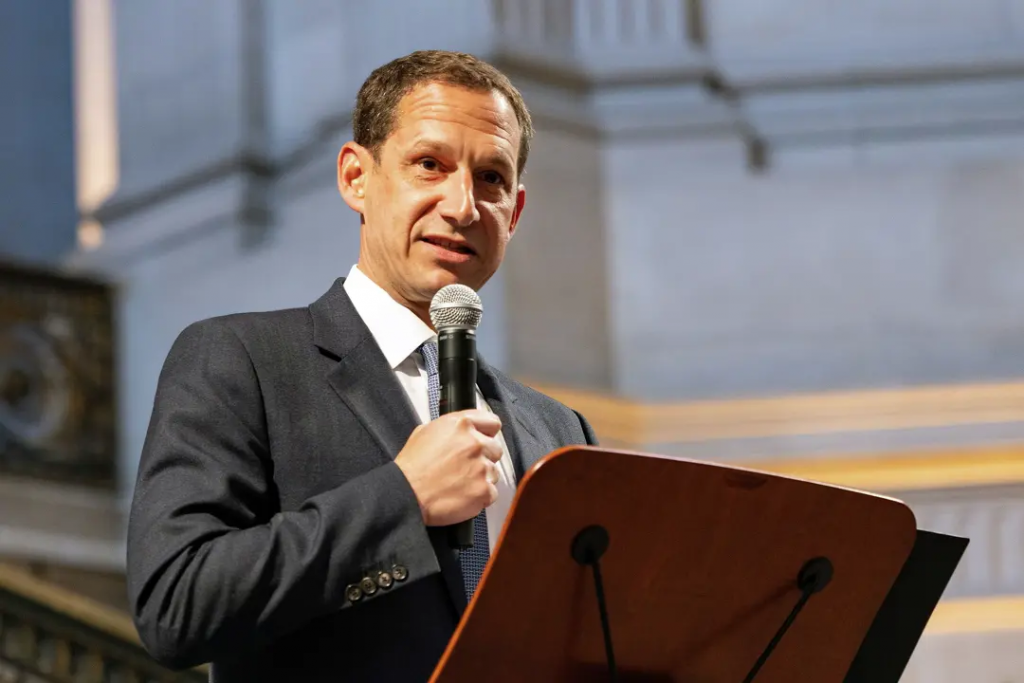
It would be reductive, if not insulting, to say memoirist P. Carl’s play, “Becoming a Man,” is merely one trans man’s story. Following its world premiere at American Repertory Theater (A.R.T.) at Harvard University in 2024, the book-turned-theater production makes its West Coast premiere May 28 at Z Space in San Francisco’s Mission District.
Z Space Executive Director Shafer Mazow, in a press release announcing the play’s pending arrival, wrote that Carl’s story of becoming a man, after living for 50 years as a girl, then as a queer woman, is “much more than a trans narrative.” Rather than presenting a simplistic explanation of gender or a story attempting to colonize all trans lives into singular ownership, the work illuminates the full spectrum of courage, joy, suffering, actual and existential heartbreak, understanding, and forgiveness required of trans people and anyone trying to lead a most authentic life.
Sign up today to receive trusted LGBTQ news in your inbox.Please select the newsletters you’d like to subscribe to:Bay Area Reporter newsletterNews is Out weekly newsletterBay Area Reporter health newsletterSubmit
The play in San Francisco features Petey Gibson as Carl, joined by cast members Laura Domingo, Eric Esquivel-Gutierrez, Erin Gould, Shoana T. Hunt, Casimir Kotarski, and JoAnne Winter. Directed by Lyam B. Gabel, performances continue through June 14.
Entry points
In addition to his award-winning memoir, Carl has written numerous essays, written and directed plays and television, and founded the online journal, HowlRound, in 2011. As a social activist and educator, his presentations and public speaking engagements address white masculinity in America.
More broadly, the story of his marriage to Lynette D’Amico dissolving, reconciling the abuse and transphobia he endured from his own family, and his decades-long battle to live fully–not according to biology but by becoming a man– represent a kind of massive, on-all-fronts breakup. Which means entry points are nearly unlimited. After reaching the teen years or young adulthood, very few people of any race, ethnicity, and, trans, cis-gender, or gender-free have never received or delivered an “I think it’s over.”
In an interview with the Bay Area Reporter, Carl said more about the storytelling risk required of theater for the industry to be healthy.
“The only way I’ve ever known for people to be moved are stories,” he said. “They see their humanity, another person’s humanity, and that their humanities are not so far apart. My play is a trans play now. It did incredibly well at American Repertory Theater. No one has touched it since. What you mostly see now is capitulation. We will have no politics; we will be neutral. If theaters and higher education institutions are not willing to stand up for what’s right, they have no courage. It is not healthy.”
Activist self
Carl’s relationship to the play has evolved and the lessons learned continue to bloom in his consciousness.
“It’s funny, I’m not a person who thinks, ‘Oh gosh, my work is so important it has to be seen. It’s gonna change the world.’ I wasn’t expecting its success at ART. This time, I feel much more invested in the importance of story; not because there’s one story, but because hardly anyone’s doing shows about trans people. We have to feel connection again.”
Carl plans to be In San Francisco for the entire six weeks of rehearsals and first runs. Normally reticent (he calls himself “not super-social”), he is determined to “pull on my activist self” to interact with people in the Bay Area. Part of the motivation comes from trans students he teaches who find him and express the urgency of their lives.
“It’s heartbreaking for me, so it’s now life or death for me,” said Carl. “The goal in 2026 is to erase trans people, not just deny them their rights. I thought the stakes were high in 2024, just to move the needle forward, and now, we’re disappearing. Trans people’s economic and family relationships tend to be precarious. The cruelty factor really gets to me.”
Most formidably, power and cruelty have joined forces.
“That’s not always been the case, Carl said. “There have been people –Joe Biden is not a cruel person– who have had power who do not use cruelty as your tool. Watching the whole Republican Party say if it gets us money, we’ll say whatever we have to say, that’s not been the case for such a large swath of this country’s population.”
Visceral energy
Turning his attention to the play, Carl address the three-dimensionality and visceral energy of live theater and how it has amplified his memoir’s dramatic nuance and possibilities.
“The great thing about telling stories in theater is there are a lot of trans people telling the story,” Carl said. “The nuance, input, and generosity of people feeling under siege that comes from so many collaborators enters people’s bodies more viscerally than laying on the couch and reading the memoir. Being willing to do it in community is risk and vulnerability.”
Act II of “Becoming a Man” is actually a 20-minute public conversation held with the audience. “At the Act II at ART, 500 people would see the show and over 300 would stay. They were vulnerable with each other and left as a community,” he said.
Counter to what might be expected, there has never been a comment during Act II causing Carl to question the work or the complicated, open-ended story it tells.
“It’s hard for anyone to say something more critical than my own mind,” said Carl. “The thing that happened, I expected. There are so few trans stories out there, so I expected some outrage about how this is not how trans people are. That did not happen. Sometimes men saw masculinity different, a trans women had different family connections.
“I feel the team of collaborators pushed me in the writing. It had like 50 drafts from that period. They said, ‘You’re not hearing this because you’re so involved in it.’ It was a weird generosity from the audience. I kept waiting to crumble. People would not always fawn over it, but I’ve always stood by the fact that I’m a totally imperfect being. I wanted to create a play not about trans perfection, but just a human story. I transitioned at 50, so I’m not a young person still figuring it out. I had to hold onto own story and people accepted it.”
Deeper connection
The learning process has branched beyond his experience writing the memoir. In the book, Carl tells the story of the impact his transition had on his wife.
“As I watched it performed, you know, even in writing I could never latch onto why Lynette was so resistant,” said Carl. “I couldn’t feel it. Seeing it, I finally understood what my choice had done to her and her sense of self. Lynette came to the first preview and we found each other and just wept in each other’s arms. It connected us in a deeper way than ever before.”
Carl’s story becomes universal when viewed as an exploration of how life does not follow a planned or expected narrative. Most lives take devastating turns, include joy and humor, involve randomness and luck, and are subject to the social, cultural, and political winds that blow according to time and location.
“I never thought of my play as a trans play,” Carl said. “It has one big thread but are many. It’s that connection when we find each other. The generosity of spirit in the play allows people more to feel more sensitive in how they judge people and their identities.”
By putting his story through different filters, Carl has come to believe people fundamentally do not change. When he was young, he claims to have “delusional thoughts” that people who have been together a long time find making connection and change to adjust to each other’s preferences easier. Instead, he has come to realize long relationships require consistent, hard work; much like writing, or living as a trans person in America in 2026.
P. Carl’s ‘Becoming a Man,’ $35-$75, May 28–June 14, Z Space, 450 Florida St.
http://www.zspace.org
https://pcarl.com/
NASA is updating its Artemis moon base plan. You can find out how on May 26.
By Mike Wall published yesterday (Space.com)
“Leadership will discuss program progress, including new industry partners and mission plans.”
Moon Base News Conference (May 26, 2026) – YouTube
NASA will give an update on Tuesday afternoon (May 26) about its plans to build a moon base, and you can watch it live.
The agency will host a press conference Tuesday at 2 p.m. EDT (1800 GMT) at its headquarters in Washington, D.C. “to share Moon Base plans and highlight progress toward a sustained presence on the lunar surface,” NASA officials wrote in a media advisory on Wednesday (May 20).
You can watch the event here at Space.com, courtesy of NASA.You may like
- NASA announcing update to Artemis moon plans today: Watch it live
- Will Artemis 2 launch toward the moon next month? Watch NASA’s mission update today
- Artemis 3 and beyond: What’s next for NASA after Artemis 2 moon success

During the event, NASA leaders “will discuss program progress, including new industry partners and mission plans,” agency officials added in the advisory.
Those leaders are:
- NASA Administrator Jared Isaacman
- Lori Glaze, acting associate administrator, Exploration Systems Development Mission Directorate
- Carlos García-Galán, program executive, Moon Base
The moon base is a core part of NASA’s Artemis program of crewed lunar exploration. Artemis aims to establish a permanent human presence on and around the moon over the next decade or so, developing knowledge and skills that can help get astronauts to Mars in the not-too-distant future.
We got a big update about NASA’s moon strategy in late March, just a week before Artemis 2 lifted off. In that news drop, the agency revealed that it’s pausing work on Gateway, a small space station planned for lunar orbit that was long a key piece of Artemis’ architecture, to focus on the surface base.
And there was another big change in late February: Isaacman announced that the Artemis 3 mission, which is slated to launch in mid to late 2027, will no longer land astronauts on the moon. Instead, it will test docking operations between the Orion crew capsule and one or both of Artemis’ privately developed lunar landers (SpaceX’s Starship and Blue Origin’s Blue Moon) in Earth orbit.
The first crewed lunar landing since the Apollo days will now take place on Artemis 4, which NASA wants to launch in late 2028. That will help lay the foundation for the moon base, which will be built near the south pole between 2032 and 2036, if all goes to plan.
Chase Reminds Customers To Only Share Banking Information With People Who Seem Nice

Published: May 22, 2026 (TheOnion.com)
NEW YORK—Warning that curt greetings and aggressive demands could be a sign someone was a scammer, JPMorgan Chase officials reminded customers Friday to only share banking information with people who seemed nice. “Fraudsters can use your online passwords and PINs to drain your accounts before you even notice, so always take extra precautions to verify they have kind eyes, a welcoming laugh, and a pleasant demeanor,” said Chase chief information security officer Patrick Opet, advising anyone who had shared their information with someone who didn’t give them a good handshake or ask how their day was going to contact the bank immediately. “People can use this information not only to take your money, but also to steal your identity, so look for signs the person requesting the information has a heart of gold, or at least good vibes. And remember people can hide their identity when contacting you over the phone or email, so only respond to people whose promise that they are who they say they are sounds genuine. Don’t give them your account number if they fail to use terms like ‘please’ and ‘thank you.’ If you are really unsure, use a third-party personality test to see whether this person is a caring and supportive friend before you share any banking info.” Opet added that if you have any suspicions that the person asking for your username and password is untrustworthy, they should at least seem desperate enough and have a good reason for lying to you.
Consciousness Is the Only Thing That Truly Exists, Scientist Says
Danielle Zickl
Sat, May 23, 2026 (Yahoo.com)
“Hearst Magazines and Yahoo may earn commission or revenue on some items through these links.”
Picture this: You’re watching a sunset on the beach during the summer. As the sun sinks down into the ocean, you watch the sky transform into a canvas of warm reds, deep oranges, and pastel violets. You’re warm and happy as memories of childhood vacations come flooding back to you.
Feeling what it’s actually like to be alive in that moment, watching the sunset, is the essence of consciousness—otherwise known as the state of being awake, aware of your surroundings, and able to process experiences. One explanation for consciousness likens your brain to a computer, and consciousness is the software running on it. Neurons fire, signals zip across synapses, and voilà, you experience the world. But what if consciousness is actually a fundamental building block of the universe itself, similar to gravity or mass, rather than something the brain creates?
That’s the crux of a recent presentation from neuroscientist Christof Koch, PhD, a meritorious investigator at the Allen Institute, a multidisciplinary research organization based in Seattle—and the theory could finally answer some of the cosmos’ greatest mysteries.
“The question is whether—and to what extent—the entire physical world is a manifestation of something mental,” Koch says in an interview.
He explains that everything we experience in the external world—from seeing the sun set over the horizon or feeling —is mediated by our conscious experience. To Koch, this implies that only conscious experience truly exists. Everything else, like the material world, is secondary, he says.
Koch explains how previous consciousness theories—like physicalism—fail to explain things like why people have love for their children, why people find Beethoven beautiful, and why we like the sunshine.
Physicalism states every thought, emotion, and experience you have is due to underlying physical and neurobiological processes. But it doesn’t account for the subjective aspect of them. For instance, physicalism explains how your brain registers a sunset, but it doesn’t explain how you actually feel when you see the beautiful mix of colors in the sky.
For Nicco Reggente, PhD—research director of the Institute for Advanced Consciousness Studies, a research lab based in Santa Monica, California—“consciousness” is the capacity for experience. Like Koch, Reggente also believes consciousness is a basic component of reality, rather than something produced solely by the brain.
He compares our working minds to a flying kite, where the kite is the brain and the wind is consciousness as a fundamental part of reality. “The kite has to be built from the right materials in the right configuration with the right tether, but its flight depends entirely on the wind,” Reggente says.
A radio makes another good analogy, Reggente explains.
“[The radio] doesn’t produce the broadcast, it receives and transduces a signal that’s already present,” he says. “But unlike a radio, the brain isn’t merely reproducing that signal with high fidelity—it’s interacting with it. And that interaction is what gives rise to our particular subjective experience.”
So, if consciousness is indeed a fundamental part of the universe, what does this mean for us as people? For starters, it could answer a host of questions we’ve otherwise viewed as impossible, according to Reggente.
He believes that the “hard problem of consciousness”—or how subjective experience could arise from physical matter—is the obvious case.
“If consciousness is fundamental, the question dissolves: You no more need to explain how the mind emerges from matter than a physicist needs to explain how spacetime emerges from something more basic,” Reggente says. “With this view, the ‘hard problem’ is not a problem at all.”
The same logic applies to cosmological puzzles—or other all-encompassing questions that seem impossible to answer—like, “What came before the Big Bang?” or “What is the universe expanding into?” according to Reggente.
“They feel unanswerable because they’re category errors, not because the answers are hidden,” he says. “Instead of asking how matter produces mind, we ask how mind structures itself into the appearance of matter. Many of our hardest problems may turn out to be artifacts of starting from the wrong place.”
That same logic might apply to problems on a much more human level, too. Consciousness is already a consideration in medicine—but if it’s a fundamental part of reality, might that change how medical professionals treat patients, like those in comas or who have been clinically pronounced dead but were successfully resuscitated?
Roughly 10 percent of patients who survive an in-hospital cardiac arrest report having a near-death experience (NDE), in which they temporarily died, according to Koch. Regardless of any metaphysical explanations, those who experience an NDE come back permanently transformed for the better.
Indeed, despite experiencing a massive physical trauma like a heart attack, the vast majority of NDEs are overwhelmingly positive. Patients frequently report that they “encountered the absolute,” Koch says—which, according to his theory, might be some sort of fundamental consciousness.
But Koch says doctors are generally not taught about this in medical school, and as such, will often dismiss these patient experiences. On the other hand, Reggente argues the view of consciousness as fundamental does not substantially alter clinical treatment. The kite can be broken, the radio can be damaged, but the brain remains a necessary receiver for that individual’s consciousness, Reggente says.
Should researchers ever prove Koch and Reggente correct, it would not only decode the mysteries of our minds, but also of our universe. So next time you admire a beautiful sunset lowering toward the horizon, know that your consciousness may be the ultimate stage hand pulling the strings.
(Contributed by Janet Cornwell, H.W., m.)
Book: “Lamed Vav and the Power of Mystical Kindness: Awakening to the Presence of the 36 Hidden Messengers”

About The Book
Explore the Lamed Vav mythos in the Kabbalah, early Hasidism, and Jewish folklore
• Highlights the tradition of the Lamed Vav—36 hidden righteous individuals in every generation who sustain the world with acts of kindness
• Relates the Lamed Vav mythos to topics of positive psychology such as meditation, peak-experiences, synchronicity, and higher consciousness
• Provides activities based on the Kabbalah and early Hasidism to enhance your receptivity to Lamed Vav individuals in your life and become a Lamed Vav for others
If you have ever witnessed an act of extraordinary kindness, the sort that seems to come from beyond everyday human experience, perhaps you had an encounter with one of the Lamed Vav. According to Jewish mysticism, these 36 hidden and righteous individuals keep humanity alive through acts of sublime kindness.
Psychologist and professor Edward Hoffman explores this fascinating mythos from its Talmudic origins through the Kabbalah, early Hasidism, and recent appearance in the contemporary world. He examines the esoteric meaning of the number 36 (literally lamed=30, vav=6) in Kabbalistic lore as well as the Elijah archetype and its importance in the work of Carl Jung and his protégé Erich Neumann.
Hoffman develops the notion of Lamed Vav consciousness—a powerful, inborn force for kindness that exists within each of us. He provides guided visualizations to call forth our Lamed Vav consciousness by drawing on themes from sacred texts like the Zohar and Jewish folklore, such as Miriam’s Well, Solomon’s Ring, and the Tree of Life. He also shares self-reflection exercises to help us recognize hidden Lamed Vav figures in our daily life and become a Lamed Vav to others by boosting our compassion, empathy, simplicity, playfulness, reverence for nature, and joy.
About The Author
Edward Hoffman, PhD, is a licensed psychologist and has been an adjunct associate professor at Yeshiva University in New York City for more than 20 years. An award-winning author, his books include Paths to Happiness, The Wisdom of Maimonides, and The Kabbalah Reader and have been translated into more than a dozen languages. He lectures widely on psychology and Jewish spirituality throughout the United States and abroad.
Lamed Vav and the Power of Mystical Kindness
Awakening to the Presence of the 36 Hidden Messengers
Published by Inner Traditions
Distributed by Simon & Schuster
© 2026 Simon & Schuster, LLC. All rights reserved.
Dick Van Dyke on meditation

Van Dyke in 2024
“When you’re a kid, you lay in the grass and watch the clouds going over, and you don’t have a thought in your mind. It’s purely meditation, and we lose that.”
— Dick Van Dyke
Richard Wayne Van Dyke is an American actor, comedian, singer, dancer, writer, and producer whose career has spanned nearly eight decades. He’s known for his roles in Mary Poppins, Chitty Chitty Bang Bang, and Bye Bye Birdie, as well as the sitcom The Dick Van Dyke Show (1961–1966). Van Dyke’s career began in radio in the late 1940s, and he later toured as part of the comedy duo “The Merry Mutes”.
Born December 13, 1925 (age 100 years), West Plains, MO
(Contributed by Calvin Harris, H.W., M.)
Hearing lips and seeing voices: The science of the McGurk Effect
Language of Mind Aug 16, 2022 Spoken language is all about sound, right? Maybe not! Our brains make use of every bit of information available to figure out what we’re experiencing, but this process can cause us to experience some trippy illusions. Let’s explore the McGurk effect – the visual/auditory illusion where what you see rewrites what you hear! If you’re interested in perception, check out the Perception Census project! You can contribute to the largest study on perceptual diversity in the world! https://perceptioncensus.dreamachine…. 0:00 – Intro 1:10 – The McGurk effect 2:06 – Timing 3:19 – McGurk on the brain 5:53 – Can you McGurk a baby? 7:48 – Tactile McGurk 9:19 – Why do we get McGurked? 10:11 – Outro Sources: McGurk, H., & MacDonald, J. (1976). Hearing lips and seeing voices. https://doi.org/10.1038/264746a0 Van Wassenhove, Grant & Poeppel (2007). Temporal window of integration in auditory-visual speech perception. https://doi.org/10.1016/j.neuropsycho… Colin, Radeau, Soquet, Demolin, Colin & Deltenre (2002). Mismatch negativity evoked by the McGurk–MacDonald effect: a phonetic representation within short-term memory. https://doi.org/10.1016/S1388-2457(02… Kislyuk, Möttönen & Sams (2008). Visual processing affects the neural basis of auditory discrimination. https://doi.org/10.1162/jocn.2008.20152 Rosenblum, Schmuckler & Johnson (1997). The McGurk effect in infants. https://doi.org/10.3758/BF03211902 Burnham & Dodd (2004). Auditory–visual speech integration by prelinguistic infants: perception of an emergent consonant in the McGurk effect. https://doi.org/10.1002/dev.20032 Fowler & Dekle (1991). Listening with eye and hand: cross-modal contributions to speech perception. https://doi.org/10.1037/0096-1523.17….