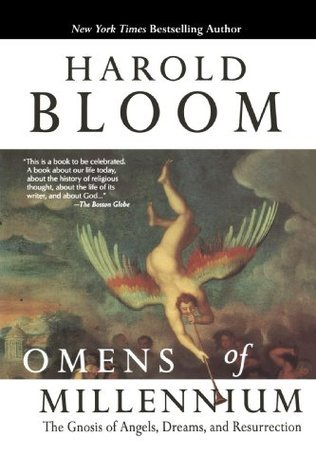
It is both pragmatic and shrewd of the mystics that they affirm the paradox that our dreams are less individual than we are. We die solitary deaths, but dream communal dreams.
What the Gnosis best teaches us, in this matter, is to end our enthusiasm for angels, who according to Gnosticism are not our guardians but our prison wardens.
Quoting Valentinus:
From the beginning you have been immortal, and you are children of eternal life. And you wanted death to be allocated to yourselves so that you might spend it and use it up and that death might die in you and through you. For when you nullify the world and are not yourselves annihilated, you are lord over creation and all corruption.
—Omens of Millennium: The Gnosis of Angels, Dreams, and Resurrection by Harold Bloom
In this impassioned, erudite, and provocative work, Harold Bloom, bestselling author and America’s foremost literary and cultural critic, examines society’s “New Age” obsessions: angels, prophetic dreams, and near-death experiences. Omens of Millennium traces these cultural phenomena from their ancient and traditional origins to their present-day, millennial manifestations. In addition, it is a personal account of Bloom’s Gnosticism. Certain to educate, challenge, and entertain, Omens of Millennium is as fascinating as it is timely.
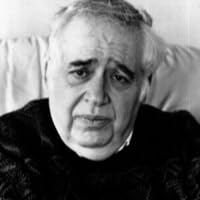
Harold Bloom was an American literary critic and the Sterling Professor of Humanities at Yale University. In 2017, Bloom was called “probably the most famous literary critic in the English-speaking world.” After publishing his first book in 1959, Bloom wrote more than 50 books, including over 40 books of literary criticism, several books discussing religion, and one novel. He edited hundreds of anthologies concerning numerous literary and philosophical figures for the Chelsea House publishing firm. Bloom’s books have been translated into more than 40 languages. He was elected to the American Philosophical Society in 1995.
Bloom was a defender of the traditional Western canon at a time when literature departments were focusing on what he derided as the “school of resentment” (multiculturalists, feminists, Marxists, and others). He was educated at Yale University, the University of Cambridge, and Cornell University.
In this fascinating work of religious criticism, Harold Bloom examines a number of American-born faiths: Pentecostalism, Mormonism, Seventh-day Adventism, Christian Science, Jehovah’s Witnesses, Southern Baptism and Fundamentalism, and African-American spirituality. He traces the distinctive features of American religion while asking provocative questions about the role religion plays in American culture and in each American’s concept of his or her relationship to God. Bloom finds that our spiritual beliefs provide an exact portrait of our national character.
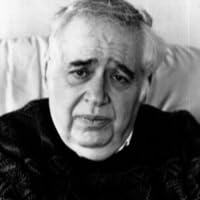
Harold Bloom was an American literary critic and the Sterling Professor of Humanities at Yale University. In 2017, Bloom was called “probably the most famous literary critic in the English-speaking world.” After publishing his first book in 1959, Bloom wrote more than 50 books, including over 40 books of literary criticism, several books discussing religion, and one novel. He edited hundreds of anthologies concerning numerous literary and philosophical figures for the Chelsea House publishing firm. Bloom’s books have been translated into more than 40 languages. He was elected to the American Philosophical Society in 1995.
Bloom was a defender of the traditional Western canon at a time when literature departments were focusing on what he derided as the “school of resentment” (multiculturalists, feminists, Marxists, and others). He was educated at Yale University, the University of Cambridge, and Cornell University.
(Goodreads.com)
Consciousness, spirituality, biography, sexuality, androgyny, futurism, space, the arts, science, astrology, democracy, humor, books, movies and more