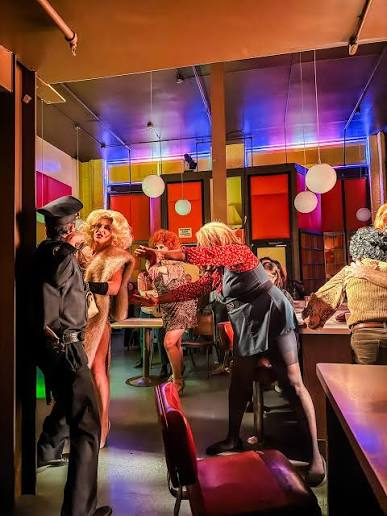
(Image from Instagram.com)
Thank you ABC7 News for featuring The Compton’s Cafeteria Riot theater event in San Francisco on your show – https://www.facebook.com/reel/3330725840437722
(Courtesy of Calvin Harris, H.W., M.)

(Image from Instagram.com)
Thank you ABC7 News for featuring The Compton’s Cafeteria Riot theater event in San Francisco on your show – https://www.facebook.com/reel/3330725840437722
(Courtesy of Calvin Harris, H.W., M.)
New Thinking Allowed with Jeffrey Mishlove Sep 4, 2026 Psychology and Psychotherapy This video is a special release from the original Thinking Allowed series that ran on public television from 1986 until 2002. It was recorded in about 1990. It will remain public for only one week. The late Kathleen Speeth, PhD, was a clinical psychologist and co-editor (with Daniel Goleman) of Essential Psychotherapies. She is author of The Gurdjieff Work and Gurdjieff: Seeker of the Truth. She was a faculty member of the Institute for Transpersonal Psychology in Menlo Park, California. In this video, Dr. Speeth focuses on our tendency to sabotage ourselves – to act against our own best interests. She maintains that a distinction can be drawn between inner weaknesses for which we may forgive ourselves and those inner criminal impulses toward which we must remain forever vigilant. Now you can watch all of the programs from the original Thinking Allowed Video Collection, hosted by Jeffrey Mishlove. Subscribe to the new Streaming Channel (https://thinkingallowed.vhx.tv/) and watch more than 350 programs now, with more, previously unreleased titles added weekly. Free month of the classic Thinking Allowed streaming channel for New Thinking Allowed subscribers only. Use code THINKFREELY.
(Critic’s Notebook)
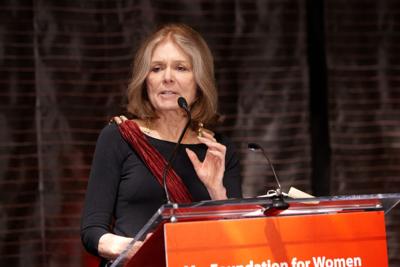
Of the millions of words associated with Gloria Steinem, the pioneering feminist and co-founder of Ms. magazine who died Wednesday, at age 92, perhaps the most famous were those she uttered as a casual aside during a birthday party in 1974.
A reporter observed that she didn’t look her age, Steinem remembered. “This is what 40 looks like,” she retorted. “We’ve been lying for so long, who would know?”
Little wonder Steinem became not just the voice but also the face of feminism, its aviator-wearing avatar who made it her mission to tear down the barriers around women as well as the stereotypes that helped build them. Those bromides included the expectation that age was a problem and thus something to hide, that any interest in appearance indicated an interest in superficiality and that, as National Geographic once characterized it (critically), “only plain women want equal rights because they aren’t hot enough to attract a husband.”
For Steinem, a woman’s agency included not just how she lived her life but also how she looked while she did so. It was part of the right to choose: who you were and where and how you appeared. And from the moment she appeared on the cover of Newsweek in 1971 under the banner “The New Woman,” smiling, her hair parted at the center and teased in back with blond streaks cascading around her face — and with (yes, of course) those aviators — she did it consciously and according to her own rules.
Her early employers may have labeled her a “girl reporter”; critics like Maxine Cheshire may have dismissed her as “the miniskirted pinup girl of the intelligentsia” (and an early connection to the CIA may have suggested her looks were a cover); but the glasses, the hairdo, the bell bottoms, hip-slung belts and bodysuits were merely weapons in her battle, and the troops she inspired were the legions of young women who came after. For her, style was a tool of change and a means of outreach.
“Fashion in the past meant conforming and losing oneself,” she said in “Gloria,” a 2011 HBO documentary, referring to the way designers and society had dictated femininity, with its corsets, crinolines and rules. “Fashion in the present means being unique and finding oneself.”
She did, thanks to the influence of Audrey Hepburn in “Breakfast at Tiffany’s,” whose attitude — a young woman navigating life in the city on her own terms — she could relate to. Also Wonder Woman, whose bullet-busting bangles inspired her own love of jewelry.
Steinem settled on her signature look, she told Teen Vogue, because she was nearsighted. “Growing up, people were always pinching me on the cheek, and so I felt I had a very fat face,” she said. “Those things were undercurrent somewhere, you know, causing me to wear my hair down and wear big glasses.”
What may have started as protective covering turned into a trademark over time, to the point that at a book party for Lena Dunham held at Steinem’s home this year, the guests’ goody bags included Warby Parker versions of her emblematic shades.
As for the clothes that went with them, they stayed similarly consistent. Steinem’s working uniform (she had one long before Steve Jobs) was, she told Dunham’s online newsletter, Lenny Letter, in 2015: “Boots, pants, a sweater or a T-shirt. A concha belt. Something that’s Native American or Indian or something that has a resonance from the past before patriarchy came along.”
The belts, she said in a video interview a few months before she died, were useful because with a belt “you didn’t have to change your clothes or buy new clothes; you could wear the same thing, black pants and a top.” You just changed your accessory.
As for that black, Steinem’s preferred color, she chose it because “it seemed much simpler.”
“You didn’t have to worry about what matched what, and you could wear whatever jewelry,” she said.
All of which meant she could spend her time thinking about the substance of what she wanted to convey since the style was taken care of. It was such an effective dressing formula, she once said, that when she was traveling around the country, she could stow everything — “a change of underwear, corduroy jeans and those turtleneck bodysuits” — in her briefcase.
And it worked in all contexts, including in 2017, when the Council of Fashion Designers of America bestowed a Board of Directors’ Tribute Award on Steinem (along with Cecile Richards of Planned Parenthood and Janelle Monáe). Accepting the honor, Steinem wore black sequined Michael Kors trousers, a black sweater and a black hip belt. She thanked the audience for their activism and Kors for the “great pants.” As far as she was concerned, the clothes enabled the cause rather than undermining it.
As a result, when vintage site What Goes Around Comes Around held an auction of some of Steinem’s wardrobe this year to benefit her foundation, the event was framed not as a fashion sale, but as an opportunity to “own a piece of history.” At that point in her life, as she was happy to admit, she was dyeing her hair, but she had never had plastic surgery. Those were her decisions, and she still believed in modeling them for all to see.
“I think we all choose to dress ourselves according to our taste, to people we admire, a little bit what the fashion is going on,” Steinem said in a video before her auction. But most of all, she continued, “for freedom.” Part of her legacy is showing the world how that might look.
This article originally appeared in The New York Times.
Kathleen Speeth learned at Gurdjieff’s knee as a child and later studied under his successor, Mme. Jeanne de Salzmann. She discusses Gurdjieff’s spiritual teachings, offers a brief profile of the philosopher, and assesses his influence on the modern world.

The Alchemy of Stones presents an inspired breakthrough in Robert Simmons’ thirty-five-year career of exploring and revealing the spiritual qualities and potentials of minerals, crystals, and gemstones. This holistic, Earth-based framework for understanding stones and their energies initiates readers into an alchemical worldview that leads to spiritual healing, transformation, and transcendence.

The late Jean Houston was at the cutting edge of the work on realizing the fullness of our human potential, which is as mainstream and pervasive in our culture as computer technology. A Mythic Life presents Jean Houston’s real, magical story and her true teaching. Here, she draws on her personal history and vast cultural knowledge to show how we can experience in our own lives the greater human story revealed in myths and discover our real potential.


Five thousand two hundred light-years away, the Lagoon Nebula glows as ultraviolet radiation from young, massive stars ionizes surrounding clouds of hydrogen, transforming an immense region of interstellar matter into a luminous tapestry of gas and dust. Within its sculpted forms, stellar radiation, gravity, and turbulent flows continually reshape the boundary between illuminated plasma and the dark molecular clouds from which new structures emerge. (New Thinking Allowed)

White in 2012
“A tree without roots is just a piece of wood.”
~ Marco Pierre White
Marco Pierre White is an English chef, restaurateur and television personality. In 1995, White became the first British chef and, at age 33, the youngest chef to earn three Michelin stars. He has trained chefs including Gordon Ramsay, Mario Batali, Shannon Bennett, Curtis Stone, Phil Howard and Stephen Terry. Wikipedia
Born December 11, 1961 (age 64 years), Leeds, United Kingdom
Published 2 days ago (Space.com)
The tiny planet hides big mysteries that scientists can’t wait to tackle.

Mercury, the tiniest and least-explored planet in the inner solar system, is hiding mysteries far larger than itself — and finally, scientists will soon be getting not one but two spacecraft designed to decode the strange world.
That’s thanks to the BepiColombo mission, a joint project of the European Space Agency (ESA) and Japan Aerospace Exploration Agency (JAXA) that launched in October 2018. After a harrowing journey through the inner solar system, the mission is tackling a crucial maneuver on Thursday (Sept. 3): separating its science equipment from the transport that carried it all that way. By April 2027, scientists hope the mission’s two instrument-heavy probes will be gathering a slew of observations that could help solve puzzles about Mercury — and maybe even the solar system we call home.
“I think being able to see new data come out about Mercury is going to be so fantastic,” Rachel Klima, a planetary geologist at the Johns Hopkins University Applied Physics Laboratory, told Space.com. The planet, she says, is “just so weird and beautiful and interesting.”
For now, Mercury holds the dubious honor of being the least-explored planet in the inner solar system, visited by only two missions to date. NASA’s Mariner 10 spacecraft made a trio of zippy flybys in 1974 and 1975, giving scientists their first glimpses of the planet’s cracked and cratered surface, as well as confirming the world has both a very tenuous atmosphere and a magnetic field.
“It really gave us our first close-up view of Mercury,” Sean Solomon, a planetary scientist at Columbia University, told Space.com. “But it left a lot of pages blank.”You may like
And for decades, that was it. Scientists didn’t return to Mercury until 2011, when NASA’s MESSENGER spacecraft, with Solomon as its principal investigator, arrived at the tiny world. (Mercury has a radius of 1,516 miles, or 2,440 kilometers, meaning its width is just over a third of Earth’s.) The spacecraft was packed with tools tailored to the job, such as spectrometers tuned to gamma-rays, X-rays and neutrons, and instruments to sniff out the atmosphere and measure the magnetic field, and it was there to stay. Four years of observations with MESSENGER showed scientists Mercury’s complete surface for the first time, and by late in its mission, the spacecraft was passing just 15.5 miles (24.9 km) above the planet’s surface.
But even MESSENGER wasn’t sophisticated enough to crack Mercury’s puzzles or unveil the strange planet’s beginnings. “I think the jury’s still out on exactly how Mercury got assembled,” Solomon said.

MESSENGER opened up some smaller mysteries, too. It discovered bright, steep-sided pits that scientists dubbed “hollows.” It found a suite of elements — that planetary scientists call “volatiles” for their tendency to slip free of rock — somehow more prevalent in Mercury’s surface than Earth’s. It calculated that the center of the planet’s magnetic field is wildly offset from the planet’s core. Plus, MESSENGER’s tricky orbit also meant the spacecraft never saw the southern half of the planet as sharply as the northern half, leaving one side shadowed in doubt.
It’s these mysteries that the ambitious BepiColombo mission hopes to tackle. By April, if all goes well, the mission will consist of two separate spacecraft gathering independent but coordinated data about Mercury.
Europe’s Mercury Planetary Orbiter, or MPO, will focus on the planet proper. It’s packed with 11 science instruments that will map the terrain, minerals in the crust, and the gravity field, investigate the hollows and volcanic deposits, and observe how the barrage of charged particles from the sun affects this innermost planet.What to read next
Japan’s Mercury Magnetospheric Orbiter, or Mio, meanwhile, will focus on the planet’s surroundings — its magnetosphere and wispy atmosphere, as well as the dust cluttering up its neighborhood.
Both spacecraft also carry instruments to measure the planet’s magnetic field, offering simultaneous observations of different parts of the field to scientists who typically make do with data gathered from just one location at a time.
In fact, some of these instruments have been able to gather observations during BepiColombo’s long trek to Mercury and its six quick flybys of the planet so far. But because of how the spacecraft were configured for the journey, most of the instruments have not — and will not — get to work until after MPO and Mio have separated. That is expected to happen in December.
The mission’s science, then, has begun only in dribbles, while the bulk of its promise still lies ahead. “There is a growing literature of new results that have come from the BepiColombo flybys, but I expect that will explode once they go into orbit,” Solomon said.

He’s especially excited to see the spacecraft’s sharp views of the southern hemisphere, and particularly find hidden deposits of water ice across the area. These deposits would exist in deep craters that never feel the sun’s heat. In examining this region of the planet, scientists will be able to reduce the northerly bias of MESSENGER’s data and better see Mercury’s complete picture.
Meanwhile, Klima is most eagerly awaiting MPO’s work to map elements and minerals in the planet’s surface. This work eluded MESSENGER, which used a technique that relied on these rocks being rich in iron and similar materials — but as it turned out, those elements were absent, leaving scientists stymied. MPO carries different technology that will be able to read rocks on the world even without iron, which Klima said could help reveal how Mercury — and our whole solar system, as a matter of fact — formed.
Klima says she hopes BepiColombo can get people excited about Mercury, the overlooked terrestrial planet of the solar system: “It certainly doesn’t get the love and attention that Mars and Venus and everywhere else gets.”

Contributing Writer
Meghan Bartels is a freelance science journalist based in New York City who worked on staff for Space.com from 2018 to 2023. Her writing has also appeared in outlets including Scientific American, Science News, Wired, Newsweek and Audubon.
Nonfiction
Food books by chefs and celebrities arrive by the landslide. “Voices From the Kitchen” highlights workers who get far less attention.

Aug. 3, 2026 Buy Book ▾ (NYTimes.com)
When you purchase an independently reviewed book through our site, we earn an affiliate commission.
VOICES FROM THE KITCHEN: Personal Narratives From New York’s Immigrant Restaurant Workers, edited by Marc Meyer
This is a slim and modest book, a volume of oral histories in the vein of Studs Terkel’s “Working” (1974), but everyone who eats out regularly should know about it. Its title is “Voices From the Kitchen: Personal Narratives From New York’s Immigrant Restaurant Workers.” Its editor is Marc Meyer, a chef and a co-owner of the Manhattan restaurants Shuka, Cookshop, Vic’s, Shukette and Rosie’s.
Meyer’s methodology is straightforward. He sat down with 27 of his employees, many of whom have worked in his restaurants for decades, and recorded their stories on his iPhone. He transcribed the interviews and poured them with minimal editing into narratives.
These men and women came from all over the globe — Ecuador, Bangladesh, Peru, Egypt, Mexico, the Ivory Coast, Bosnia, the Dominican Republic, Gambia — and their accounts of getting here, and scratching out lives in New York City, are plucky, harrowing, moving and often very funny. They’ve lately become anonymous political targets, and “Voices From the Kitchen” gives them back their human faces.
It’s possible to be cynical about Meyer’s project, and he’s aware of that. An obvious power dynamic is at play: No one is going to tell the entire gnarly truth about their lives, and especially about their jobs, to their employer. And Meyer is aware of whatever “white savior” vibe might cling to such a project.
It’s possible to hold those things in mind and admire “Voices From the Kitchen.” (All proceeds go to the narrators, and they’ve retained legal ownership over their stories.) Food titles arrive by the landslide in bookstores, yet so few dig into the lives of the immigrants who work in the back of the house as dishwashers, bussers and prep cooks, and increasingly in the front as servers and captains. More than a few by now are head chefs and managers.
Stories like these haven’t gone entirely uncollected. The Southern Foodways Alliance, the American Folklife Center and other organizations have assiduously compiled food-related oral histories you can find online. But it’s good to have these accounts between hard covers. “Voices From the Kitchen” is intrepid and timely enough to make you optimistic that someone will compile a more expansive book in this vein, not limited to the workers in one restaurant group.
Most of the men and women here came from small towns. Many had absent or abusive fathers, and no access to real educations. They fled to America to help support their families back home, to escape gang violence and corrupt governments, and to attempt to seize a part of what can only be called the American dream. Many had relatives who’d already come to New York.
The arrival stories are intense: days in the desert with little food or water, thieving coyotes (human smugglers), random gunmen, terrifying river crossings and long trips while packed “like cookies” into heavy trucks meant for hauling liquids, with few air vents. Many felt they would not survive. One rode to New York from Los Angeles in the back of a watermelon truck.
All started at, or near, the very bottom: cleaning bathrooms, bussing tables, working coat checks. All rose — first to a bit of prep work, then to a salad station, and so on — through hard work, thrift and perseverance. These are what we used to call, long before America’s descent into the ICE age, Horatio Alger stories.
Part of the pleasure of this book is following these men and women as they move between restaurants, assiduously climbing the ladder. There’s a built-in nostalgia factor in clocking the names of these places, some long gone and some standing: Big Kahuna, Ocean Grill, Red Gravy, Le Zoo, Clyde Frazier’s, Jean Georges, Mercer Kitchen, Momofuku Ssam Bar, Ernie’s, Lil’ Frankies, Bayamo, Poiret, Brown Betty, Avanti, Danji, Seventh Avenue Donuts, Charlie Bird, Calle Doa, Veranda, Fraunces Tavern, Sequoia, Maestro’s Steakhouse, Upland, Danube, A Voce Columbus, Aqualis Grill, Bayamo.
Not so long ago, most restaurant work was considered menial labor. Thanks in large part to Anthony Bourdain, it has become admired and cool (if still brutal) work. People want to look and be like chefs: raffish, tattooed, blunt, forearm scorch marks on display. The job offers intense camaraderie. It is a backdoor gateway to all manner of culture, in a way that most other blue-collar professions are not, should one wish to step through that gate.
A not-untypical story here is that of Vico (Meyer uses first names only, and sometimes pseudonyms), who arrived from a small village in Mexico in 1986 and started in restaurants as a porter. He’s now married and has been a United States citizen for eight years. He runs his own well-regarded restaurant, La Flor, in Queens, and oversees more than 20 restaurants in the Bowery restaurant group.
Vico’s daughter graduated from Amherst College. Another interviewee, Angel, also from a small town in Mexico (his father was a truck driver), is now a chef who has a son at Phillips Exeter Academy.

The women in this book express feeling pressure to prove themselves in a male-dominated profession. They feel as squeezed as tubes of tomato paste between work and family. Some have been sexually abused. But more than a few have risen to the top. Carlha, whose father was a fisherman in the Dominican Republic, came here at age 6. She’s a chef and manager at Shuka.
Not all of these stories are happy. Some interviewees are depressed or have other health problems. “This city can give you economic stability, but it cannot give you emotional stability,” one says. Some merely want to go home to places that don’t quite exist any longer. “Why didn’t I stay?” another asks, about his hometown in Mexico. “I think I lost something from the past, and it’s gone forever. I can’t get it back.”
These interviews come most alive when narrators break the harmonious aura, when you sense someone scraping away at the pith. One woman admits that waiting tables too long can burn you out and make you snippy. Another remarks that working in diners sucks because so many are owned by big Greek families. Everyone in the family has an opinion, so you get it coming and going.
Rare comments like these remind you of the limitations of “Voices From the Kitchen.” Because these narrators are speaking to their boss, the underside of kitchen work is rarely on display — the rude customers, billing mistakes, racism, restroom hookups and cleanups, blood blisters on your feet, ego collisions, having to “push” menu items, trips and falls, the flameouts of co-workers, mandatory last-minute shifts, clearing away gross, half-eaten meals, tipping agonistes, cuts and punctures, dealing with celebrities and V.I.P.’s, cramped and noisy environments — everything that goes on below the deceptively smooth front-of-house choreography.
There is a more honest and encompassing oral history project out there, waiting to be compiled. Editors, start your engines.
I know about this book because I had lunch at Cookshop a few months ago, and copies were on the host’s table. It was a good find. Some of these stories are so tangled and involving they could be made into films.
This is not an explicitly political book. It has nothing concrete to say about immigration policy. It does not argue for wide-open borders. But it complicates easy narratives and asks that we see people not merely for what they are but for what they might become.
“They read my name and saw my face and pointed to the dishes,” says the job-seeking narrator of one of the stories in Bryan Washington’s collection, “Lot” (2019). This is surely happening daily in New York City restaurants. “Voices From the Kitchen” is an optimistic book — it reminds you that if many restaurant careers begin that way, they don’t have to end there.
VOICES FROM THE KITCHEN: Personal Narratives From New York’s Immigrant Restaurant Workers | Edited by Marc Meyer | Beacon | 223 pp. | $29.95
Dwight Garner has been a book critic for The Times since 2008, and before that was an editor at the Book Review for a decade.
A version of this article appears in print on Aug. 30, 2026, Page 8 of the Sunday Book Review with the headline: Restaurant Takeaway. Order Reprints | Today’s Paper | Subscribe
(Contributed by Michael Kelly, H.W.)

― Isak Dinesen
Baroness Karen Christentze von Blixen-Finecke was a Danish author who wrote in Danish and English. She is also known under her pen names Isak Dinesen, used in English-speaking countries; Tania Blixen, used in German-speaking countries; Osceola, and Pierre Andrézel. Wikipedia
Born April 17, 1885, Rungsted
Died September 7, 1962 (age 77 years), Rungsted
By Mike Zonta, BB editor, and ChatGPT
Me: The former Hungarian government pretended there was a terrorist attack?
ChatGPT: If you mean Viktor Orbán’s former Hungarian government, there have been accusations along those lines, but we should distinguish several different stories.
One particularly interesting recent case is 2026, when opposition leader Péter Magyar alleged that people inside the Orbán government might stage attacks or other security incidents to create panic before the election. He provided no evidence, and the government rejected the allegation.
There is also a separate 2026 report that Russian intelligence considered staging a fake assassination attempt against Orbán himself to help him politically. That was reportedly a Russian proposal—not evidence that the Hungarian government actually carried it out.
If you’re thinking of an older incident where the Hungarian government actually claimed a terrorist attack had occurred, but it turned out to have been fabricated, tell me roughly what year (or what happened), and I can track down that specific case.
Me: I’m thinking of something Timothy Snyder said about the Hungarian government under Orban.
ChatGPT: Yes — I think that’s exactly what you were remembering. I found the specific incident Snyder was referring to.
In early 2026, shortly before Hungary’s parliamentary election, Viktor Orbán’s government announced that explosives had been discovered on a pipeline supplying Russian gas to Hungary. Orbán then suggested that Ukrainians were behind a terrorist plot, tying the supposed threat to Hungary’s opposition.
Timothy Snyder called this “fake terrorism” and a false-flag provocation. In his account, there was no evidence that an actual terrorist attack had occurred. He says the purpose was to create fear and portray the opposition as allied with dangerous Ukrainian forces.
What’s particularly interesting is that Snyder says the Hungarian opposition had anticipated that Orbán might pull such a stunt and warned people beforehand. Consequently, when the pipeline/explosives story appeared, it largely failed to have the desired effect.
So your original formulation — “the Hungarian government pretended there was a terrorist attack” — is quite close to Snyder’s characterization. The important qualification is that “pretended” and “false flag” are Snyder’s interpretation; the underlying claim by the Hungarian government was that a terrorist plot had been discovered.
