All posts by Mike Zonta

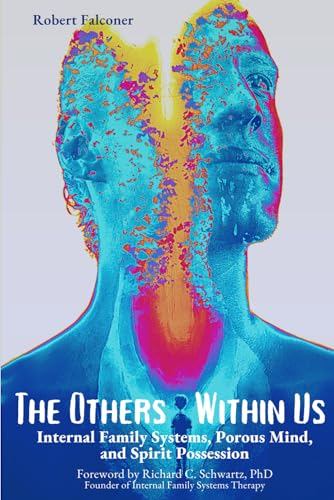
“The Others Within Us: Internal Family Systems, Porous Mind, and Spirit Possession” by Robert Falconer

(Image from AbeBooks.com)

“Nearly every disease could be personified and experienced as possession.”

“This is so like the way of shamans and mediums all over the world. When they resist the calling, they become ill.”

“Look beyond the things and focus on the connections between them.”

“In some of [Daniel] Siegel’s talks, he is much more blunt, saying we have been living a lie and it will destroy us. . . the lie of the separate self. He compares living from the solo-self to a cancer cell that’s only concerned about its own well-being. He also uses a metaphor that I prefer, saying this solo-self idea is an autoimmune disease of the mind. We are nodes in a vast system, not independent beings at war with the world. Siegel states that Indigenous peoples and mystics have known this for a very long time. When we come to live this way, it can have a profound and pervasive healing impact on us and all those around us.”

“Another indicator of the extent and power of the porosity of the human mind is the existence of mass psychogenic illness, also known as both MPI and mass sociogenic illness. My personal favorite example of this is the dancing epidemic of 1518 in Strasburg. It started with one woman dancing uncontrollably all day and into the night. She couldn’t stop and kept dancing even though her feet were bleeding until finally she collapsed in exhaustion. At least fifty people also danced involuntarily for long periods of time; some accounts put the number at over four hundred. Some people danced themselves to death. John Waller (2009) claims over a hundred died in this way. This outbreak continued form July until September, when it seemed to fade away.”

“In Internal Family Systems, we talk about Self as a particle and also as a wave or field. Our Self–the curious, compassionate, creative, clear, light-filled being that we really are–is a particle, and this particle is also part of a wave or field of Self that is far larger and wiser than we are. The idea of Self as both particle and wave, particle and field, is mainstream IFS, and if we start to follow its implications, it leads to deep waters indeed.”

“Underlying this vast swath of ruin our civilization has caused is not human nature but the opposite: human nature denied. This denial of human nature rests in turn upon an illusion, a misconception of self and the world. We have defined ourselves as other than what we are, as discrete subjects separate from each other and separate from the world around us.” (quoting Charles Eisenstein in Ascent of Humanity).

Quoting D.H. Lawrence: “This is what I believe: that I am I. That my soul is a dark forest. That my known self will never be more than a little clearing in the forest. That gods, strange gods, come forth from the forest into the clearing of my known self, and then go back. That I must have the courage to let them come and go. That I will never let mankind put anything over me, but that I will try always to recognize and submit to the gods in me and the gods in other men and women. There is my creed.”

“We relate to everything either as an object or a person. We live on a continuum between these two stances. I-It is objective and monological; I-Thou is immediate, mutual, and dialogical. [Martin] Buber asserts that there is no I taken by itself; I is relational. All real living is a meeting, an encounter. Everything can be related to as a person, even a tree or a rock. We are unable to sustain this. All our Thous become Its (with one exception: Buber indicated that God, The Eternal Thou, is the only being who can never be an it). “

“Nikolai Berdyaev is also a dialogical personalist and is a theologian. He argues that the fall of Adam and Eve occurred when they started seeing their bodies as objects and forgot that they were persons. ‘Objectification is always antipersonalistic, hostile to personality and signifies estrangement of personality (Berd-yaev 2009, 1).'”

“Staretz Silouan (1866–1938) was a Russian Eastern Orthodox Christian monk on Mount Athos who has been sainted in the Orthodox church (Sophrony 2021). He taught that “What is truth?” is the wrong question. The question should be “Who is truth?” He also said that life itself is a person to be related to, not an object to be studied. We need a personal, face-to-face meeting with life and truth.”

“William James was ahead of his time. He wrote that a religious attitude means that we take the universe as a Thou, not an It (James 1956, 278). This personal nature of religious thought is “the one fundamental fact” about religion (ibid., 480–81). He stated that the person is always present in psychology, and the tendency of scientists to ignore this in their search for objectivity is a mistake (James 1950, 221). He argued that a real radical empiricism must include subjectivity as well as objectivity, both the personal and impersonal, because both are present in all our experience.”

Rumi: “Your task is not to seek for love, but merely to seek and find all the barriers within yourself that you have built against it.”

“In Hinduism, there is the tradition of ‘neti, neti,’ which literally means ‘not this, not that.’ This is a key element of jnana yoga and is characteristic of Vedic inquiry. Therefore, it is found in some of the most ancient religious texts on our planet. All worldly experiences and names are negated until all that remains is Self.”

“Brother David honors the apophatic truth that God can’t be named or fixed in place by saying his favorite name for God is Surprise.”

“Let me remind you that most of the greatest crimes in human history were committed by people convinced of their righteousness. Thomas Merton wrote, ‘When one is firmly convinced of his own righteousness and goodness, he can without qualms perpetrate the most appalling evil.’ Mao Tse Tung believed he was fundamentally transforming society, and his regime resulted in the greatest mass murder in human history. Hitler was stridently self-righteous and seemed to deeply believe in the purity and goodness of what he was doing. Pol Pot was trained by the most prominent French leftist academics of his day when he studied at the Sorbonne. He went home to Cambodia, put these idealist ideas into practice, and killed something like one-quarter of his people. Great criminal acts have been performed by churches in the name of God. It’s a very long list. As Rumi said, ‘The Veil of Light which is the barrier brought about by self-righteousness is more dangerous than the Veil of Darkness produced in the mind by vice.’ We are not somehow superior to all these people; we too can delude and deceive ourselves easily and profoundly.”

Thich Nhat Hanh’s long poem “Please Call Me by My True Names”:
“I am the twelve-year-old girl,
Refugee on a small boat,
Who throws herself into the ocean
After being raped by a sea pirate.
And I am the pirate,
My heart not yet capable,
Of seeing and loving.” 

The Bill Wilson–Carl Jung Letters
The twelve steps are a very effective way of dealing with addictions, and they are fundamentally spiritual. Many professional therapists have been pooh-poohing the twelve steps for decades, but the research shows that they are more effective than most therapy. The first three steps are about recognizing a higher power and turning our lives over to it. This is spiritual work, and the neutral phrase “higher power” disguises it enough to allow rationalist-materialist atheists to have spiritual experiences. Bill Wilson, the founder of AA, wrote to Carl Jung in 1961. Shortly before Jung died, he replied that he had to be exceedingly careful about writing about spiritual things because he found that he was “misunderstood in every possible way.” But he did write frankly to Wilson about Roland H., an alcoholic he had treated. Jung wrote, “His craving for alcohol was the equivalent, on a low level, of the spiritual thirst of our being for wholeness, expressed in medieval language: the union with God.” Jung added a footnote here quoting Psalm 42:1, “as the hart panteth after the water brooks, so panteth my soul after thee, O God.”

The last section of the letter is:
I am strongly convinced that the evil principle prevailing in this world leads the unrecognized spiritual need into perdition if it is not counteracted either by real religious insight or by the protecting wall of the human community. An ordinary man not protected by an action from above and isolated in society cannot resist the power of evil which is called, very aptly, The Devil. But the use of such words arouses so many mistakes that one can only keep away from them as much as possible. These are the reasons why I could not give a full and sufficient explanation to Roland H. but I am risking it with you because I conclude from your very decent and honest letter that you have acquired a point of view above the misleading platitudes one usually hears about alcoholism. You see, alcohol in Latin is spiritus and you use the same word for the highest religious experiences as well as for the most depraving poison. The helpful formula, therefore, is: spiritus contra spiritum [the spirit against alcoholic spirits].

Jung could only be this honest very near the end of his life. Bill Wilson wrote him back almost immediately, but Jung died before he could respond. Spirituality — connection to a higher power, to the archetypal depths, to God, to something bigger than our isolated personal lives — is crucial for our health. Our society largely undermines and denies this.

“In science in the outer world, our standard of truth is whether an experiment is reliably replicable. What if this did not apply in the inner world? What if what was really valuable and meaningful in the inner world was what was unique and could not be repeated at all? This is true of art and literature. The great and meaningful works are totally unique. If this were true inside, it would turn our research methods upside down.”

Annie Dillard said, “It is madness to wear ladies’ straw hats and velvet hats to church; we should all be wearing crash helmets. Ushers should issue life preservers…” 

“The Hearing Voices Movement encourages people to dialogue with the voices in their heads, to treat them as people. The mental health establishment considers this heresy — colluding with the delusions of the insane.”

Link to pdf of book: https://dokumen.pub/the-others-within-us-internal-family-systems-porous-mind-and-spirit-possession-9798987858806.html

The Most Incredible Thing

A translation of Hans Christian Andersen’s “Det Utroligste” by Jean Hersholt

(andersen.sdu.dk)

(Image from talesandbedtimestories.blogspot.com)

Whosoever could do the most incredible thing was to have the King’s daughter and half of his kingdom.

The young men, yes, and the old ones too, bent their heads, their muscles, and their hearts upon winning. To do what they thought was the most incredible thing, two ate themselves to death, and one died of overdrinking. Even the boys in the street practiced spitting on their own backs, which they supposed was the most incredible thing anyone could do.

On a certain day there was to be an exhibition of things most incredible and everyone showed his best work. Judges were appointed, ranging from children of three to old men of ninety. It was a grand exposition of things out of the ordinary, but everybody promptly agreed that most incredible of all was a great hall clock – an extraordinary contraption, outside and in.

When the clock struck, out came lifelike figures to tell the hour. There were twelve separate performances of these moving figures, with speaking and singing. People said that nothing so incredible had ever before been seen.

The clock struck one, and there stood Moses on the mountain, writing in the tablets of the law the first great commandment: “There is only one true God.” The clock struck two, and there were Adam and Eve, just as they first met in the Garden of Eden. Were ever two people so lucky! They didn’t own so much as a clothes-closet, and they didn’t need one. At the stroke of three the three Holy Kings appeared. One was as black as a coal, but he couldn’t help that. The sun had blackened him. These kings brought incense and precious gifts. When the stroke of four sounded, the seasons advanced in their order. Spring carried a budding bough of beech, on which a cuckoo sang. Summer had for her sign a grasshopper on a ripening ear of wheat. Autumn had only an empty stork’s nest, for the birds had flown away. Winter’s tame crow perched on the corner of the stove, and told old tales of bygone days. At five o’clock there was a procession of the five senses. Sight was represented by a man who made spectacles. Hearing was a noisy coppersmith. Smell was a flower girl with violets for sale. Taste came dressed as a cook. Feeling was a mourner, with crape down to his heels. As the clock struck six, there sat a gambler, throwing dice for the highest cast of all, and they fell with the sixes up. Then came the seven days of the week, or they might be the seven deadly sins. People could not be sure which they were, for they were not easy to distinguish. Next came a choir of monks, to sing the eight o’clock evensong. At the stroke of nine, the nine muses appeared. One was an astronomer, one kept the books of history, and the others were connected with the theater. Ten o’clock struck, and Moses came forth again, this time with the tables in which were written all ten of God’s commandments. When the clock struck again, boys and girls danced out. They played and sang this song:

“All the way to heaven
The clock struck eleven.”

And eleven it struck. Then came the stroke of twelve. Out marched the night watchman, wearing his cap and carrying his morning star – which is a truncheon tipped with spikes. He sang the old watch song:

“‘Twas at the midnight hour
Our Savior He was born-“

and as he sang the roses about him unfolded into the heads of angels, with rainbow-tinted wings.

It was good to hear. It was charming to see. The whole thing was a work of extraordinary craftsmanship, and everyone agreed that it was the most incredible thing. The artist who had made it was young, generous, and sincere, a true friend, and a great help to his poor father and mother. He was altogether worthy of the Princess and of half the kingdom.

On the day that they were to proclaim who had won, the whole town was bedecked and be-draped. The Princess sat on her throne. It had been newly stuffed with horsehair for the occasion, but it was still far from comfortable or pleasant. The judges winked knowingly at the man they had chosen, who stood there so happy and proud. His fortune was made, for had he not done the most incredible thing!

“No!” a tall, bony, powerful fellow bawled out. “Leave it to me, I am the man to do the most incredible thing,” and then he swung his ax at the craftsman’s clock. Crack, crash, smash! There lay the whole thing. Here rolled the wheels, and there flew the hairsprings. It was wrecked and ruined. “I did that,” said the lout. “My work beat his, and bowled you over, all in one stroke. I have done the most incredible thing.”

“To destroy such a work of art!” said the judges. “Why it’s the most incredible thing we’ve ever seen.” And the people said so too. So he was awarded the Princess and half the kingdom, because a law is a law, even if it happens to be a most incredible one.

They blew trumpets from the ramparts and the city towers, and they announced, “The wedding will now take place.” The Princess was not especially happy about it, but she looked pretty and she wore her most expensive clothes. The church was at its best by candle-light, late in the evening. The ladies of the court sang in processions, and escorted the bride. The lords sung, and accompanied the groom. From the way he strutted and swaggered along, you’d think that nothing could ever bowl him over.

Then the singing stopped. It was so still that you could have heard a pin fall in the street. But it was not quiet for long. Crash! crash! the great church doors flew open, and boom! boom! all the works of the clock came marching down the church aisle and halted between the bride and the groom.

Dead men cannot walk the earth. That’s true, but a work of art does not die. Its shape may be shattered, but the spirit of art cannot be broken. The spirit of art jested, and that was no joke.

. To all appearances it stood there as if it were whole, and had never been wrecked. The clock struck one hour right after another, from one to twelve, and all the figures poured forth. First Moses came, shining as if bright flames issued from his forehead. He cast the heavy stone tablets of the law at the bridegroom’s feet, and tied them to the church floor. “I cannot lift them again,” said Moses, “for you have broken my arms. Stand where you are!”

Then came Adam and Eve, the three Wise Men of the East, and the four Seasons. Each told him the disagreeable truth. “Shame on you!” But he was not ashamed.

All the figures of all the hours marched out of the clock, and they grew wondrous big. There was scarcely room for the living people. And at the stroke of twelve out strode the watchman, with his cap and his many-spiked morning star. There was a strange commotion. The watchman went straight to the bridegroom, and smote him on the forehead with his morning star.

“Lie where you are,” said the watchman. “A blow for a blow. We have taken out vengeance and the master’s too, so now we will vanish.”

And vanish they did, every cogwheel and figure. But the candles of the church flared up like flowers of fire, and the gilded stars under the roof cast down long clear shafts of light, and the organ sounded though no man had touched it. The people all said that they had lived to see the most incredible thing.

“Now,” the Princess commanded, “summon the right man, the craftsman who made the work of art. He shall be my husband and my lord.”

He stood beside her in the church. All the people were in his train. Everyone was happy for him, everyone blessed him, and there was no one who was envious. And that was the most incredible thing.

Life in Afterlife with Stafford Betty

New Thinking Allowed with Jeffrey Mishlove Aug 26, 2026 New Thinking Allowed Audio Podcast Stafford Betty, PhD, is Emeritus Professor of Religious Studies at California State University, Bakersfield. He is author of Heaven and Hell Unveiled, The Afterlife Unveiled, and When Did You Ever Become Less by Dying? He has also written two novels, based on his studies of spiritualism, whose protagonists are deceased figures in the afterlife, The Imprisoned Splendor and The Afterlife Therapist. Here he describes various aspects of his understanding of the afterlife, as portrayed in his novel, The Afterlife Therapist. Some of the recently deceased do not realize that they have died. Many conflicts exist on the astral planes. These are seen as opportunities for soul growth. Reincarnation is also an option. Guides and teachers encourage souls to progress to higher planes of existence. New Thinking Allowed host, Jeffrey Mishlove, PhD, is author of The Roots of Consciousness, Psi Development Systems, and The PK Man. Between 1986 and 2002 he hosted and co-produced the original Thinking Allowed public television series. He is the recipient of the only doctoral diploma in “parapsychology” ever awarded by an accredited university (University of California, Berkeley, 1980). He is also the Grand Prize winner of the 2021 Bigelow Institute essay competition regarding the best evidence for survival of human consciousness after permanent bodily death. He is Co-Director of Parapsychology Education at the California Institute for Human Science. (Recorded on April 20, 2021)

Oliver Sacks on the Three Essential Elements of Creativity

By Maria Popova (themarginalian.org)

“And don’t ever imitate anybody,” Hemingway cautioned in his advice to aspiring writers. But in this particular sentiment, the otherwise insightful Nobel laureate seems to have been blind to his own admonition against the dangers of ego, for only the ego can blind an artist to the recognition that all creative work begins with imitation before fermenting into originality under the dual forces of time and consecrating effort.

Imitation, besides being the seedbed of empathy and our experience of time, is also, paradoxically enough, the seedbed of creativity — not only a poetic truth but a cognitive fact, as the late, great neurologist and poet of science Oliver Sacks (July 9, 1933–August 30, 2015) argues in a spectacular essay titled “The Creative Self,” published in the posthumous treasure The River of Consciousness (public library).

Oliver Sacks captures a thought in his journal at Amsterdam’s busy train station (Photograph by Lowell Handler from On the Move)

In his impressive handwritten notes on creativity and the brain, which became the basis of the essay, Sacks had enthused about — in two colors, underlined — the “buzzing, blooming chaos” of the mind engaged in creative work. But, contrary to the archetypal myth of the lone genius struck with a sudden Eureka! moment, this chaos doesn’t occur in a vacuum. Rather, it coalesces from a particulate cloud of influences and inspirations without which creativity — that is, birthing of something meaningful that hadn’t exist before — cannot come about.

With the illustrative example of Susan Sontag — herself a writer of abiding wisdom on the art of storytelling — Sacks traces the inevitable trajectory of creative development from imitation to originality:

Susan Sontag, at a conference in 2002, spoke about how reading opened up the entire world to her when she was quite young, enlarging her imagination and memory far beyond the bounds of her actual, immediate personal experience. She recalled,

When I was five or six, I read Eve Curie’s biography of her mother. I read comic books, dictionaries, and encyclopedias indiscriminately, and with great pleasure…. It felt like the more I took in, the stronger I was, the bigger the world got…. I think I was, from the very beginning, an incredibly gifted student, an incredibly gifted learner, a champion child autodidact…. Is that creative? No, it wasn’t creative…[but] it didn’t preclude becoming creative later on…. I was engorging rather than making. I was a mental traveler, a mental glutton…. My childhood, apart from my wretched actual life, was just a career in ecstasy.

[…]

I started writing when I was about seven. I started a newspaper when I was eight, which I filled with stories and poems and plays and articles, and which I used to sell to the neighbors for five cents. I’m sure it was quite banal and conventional, and simply made up of things, influenced by things, I was reading…. Of course there were models, there was a pantheon of these people…. If I was reading the stories of Poe, then I would write a Poe-like story…. When I was ten, a long-forgotten play by Karel Čapek, R.U.R., about robots, fell into my hands, so I wrote a play about robots. But it was absolutely derivative. Whatever I saw I loved, and whatever I loved I wanted to imitate — that’s not necessarily the royal road to real innovation or creativity; neither, as I saw it, does it preclude it…. I started to be a real writer at thirteen.

Sontag’s experience, Sacks argues, reflects the common pattern in the natural cycle of creative evolution — we learn our own minds by finding out what we love; these models integrate into a sensibility; out of that sensibility arises the initial impulse for imitation, which, aided by the gradual acquisition of technical mastery, eventually ripens into original creation. He writes:

If imitation plays a central role in the performing arts, where incessant practice, repetition, and rehearsal are essential, it is equally important in painting or composing or writing, for example. All young artists seek models in their apprentice years, models whose style, technical mastery, and innovations can teach them. Young painters may haunt the galleries of the Met or the Louvre; young composers may go to concerts or study scores. All art, in this sense, starts out as “derivative,” highly influenced by, if not a direct imitation or paraphrase of, the admired and emulated models.

When Alexander Pope was thirteen years old, he asked William Walsh, an older poet whom he admired, for advice. Walsh’s advice was that Pope should be “correct.” Pope took this to mean that he should first gain a mastery of poetic forms and techniques. To this end, in his “Imitations of English Poets,” Pope began by imitating Walsh, then Cowley, the Earl of Rochester, and more major figures like Chaucer and Spenser, as well as writing “Paraphrases,” as he called them, of Latin poets. By seventeen, he had mastered the heroic couplet and began to write his “Pastorals” and other poems, where he developed and honed his own style but contented himself with the most insipid or clichéd themes. It was only once he had established full mastery of his style and form that he started to charge it with the exquisite and sometimes terrifying products of his own imagination. For most artists, perhaps, these stages or processes overlap a good deal, but imitation and mastery of form or skills must come before major creativity.

A page from Dr. Sacks’s wild and wondrous handwritten notes on creativity and the brain.

Curiously, Sacks points out, many creators don’t make the leap from mastery to such “major creativity” — something Schopenhauer considered in his incisive distinction between talent and genius. Often, creators — be they artists or scientists — content themselves with reaching a level of mastery, then remaining at that plateau for the rest of their careers, comfortably creating more of what they already know well how to create. Sacks examines what set those who soar apart from those who plateau:

Why is it that of every hundred gifted young musicians who study at Juilliard or every hundred brilliant young scientists who go to work in major labs under illustrious mentors, only a handful will write memorable musical compositions or make scientific discoveries of major importance? Are the majority, despite their gifts, lacking in some further creative spark? Are they missing characteristics other than creativity that may be essential for creative achievement — such as boldness, confidence, independence of mind?

It takes a special energy, over and above one’s creative potential, a special audacity or subversiveness, to strike out in a new direction once one is settled. It is a gamble as all creative projects must be, for the new direction may not turn out to be productive at all.

Much of the gamble, Sacks argues, is a kind of patient gestation at the unconscious level — something Einstein touched upon in explaining how his mind worked. Echoing T.S. Eliot’s insistence on the necessity of “a long incubation” in creative work, Sacks adds:

Creativity involves not only years of conscious preparation and training but unconscious preparation as well. This incubation period is essential to allow the subconscious assimilation and incorporation of one’s influences and sources, to reorganize and synthesize them into something of one’s own…. The essential element in these realms of retaining and appropriating versus assimilating and incorporating is one of depth, of meaning, of active and personal involvement.

Illustration by Maurice Sendak from Open House for Butterflies by Ruth Krauss

He illustrates the detrimental absence of such a gestational period with an example from his own experience:

Early in 1982, I received an unexpected packet from London containing a letter from Harold Pinter and the manuscript of a new play, A Kind of Alaska, which, he said, had been inspired by a case history of mine in Awakenings. In his letter, Pinter said that he had read my book when it originally came out in 1973 and had immediately wondered about the problems presented by a dramatic adaptation of this. But, seeing no ready solution to these problems, he had then forgotten about it. One morning eight years later, Pinter wrote, he had awoken with the first image and first words (“Something is happening”) clear and pressing in his mind. The play had then “written itself” in the days and weeks that followed.

I could not help contrasting this with a play (inspired by the same case history) which I had been sent four years earlier, where the author, in an accompanying letter, said that he had read Awakenings two months before and been so “influenced,” so possessed, by it that he felt impelled to write a play straightaway. Whereas I loved Pinter’s play — not least because it effected so profound a transformation, a “Pinterization” of my own themes — I felt the 1978 play to be grossly derivative, for it lifted, sometimes, whole sentences from my own book without transforming them in the least. It seemed to me less an original play than a plagiarism or a parody (yet there was no doubting the author’s “obsession” or good faith).

In a testament to his uncommon empathic might and his endearing generosity of interpretation in regarding others, Sacks reflects on the deeper phenomena at play:

I was not sure what to make of this. Was the author too lazy, or too lacking in talent or originality, to make the needed transformation of my work? Or was the problem essentially one of incubation, that he had not allowed himself enough time for the experience of reading Awakenings to sink in? Nor had he allowed himself, as Pinter did, time to forget it, to let it fall into his unconscious, where it might link with other experiences and thoughts.

The unfortunate playwright seems to have embodied the lamentation which poet Mary Oliver so beautifully articulated in her meditation on the creative life“The most regretful people on earth are those who felt the call to creative work, who felt their own creative power restive and uprising, and gave to it neither power nor time.”

Sacks points to three essential elements in a creative breakthrough, be it a great play or a deep mathematical insights: time, “forgetting,” and incubation. More than a century after Mark Twain declared that “substantially all ideas are second-hand, consciously and unconsciously drawn from a million outside sources,” Sacks — who had previously written at length about our unconscious borrowings — adds:

All of us, to some extent, borrow from others, from the culture around us. Ideas are in the air, and we may appropriate, often without realizing, the phrases and language of the times. We borrow language itself; we did not invent it. We found it, we grew up into it, though we may use it, interpret it, in very individual ways. What is at issue is not the fact of “borrowing” or “imitating,” of being “derivative,” being “influenced,” but what one does with what is borrowed or imitated or derived; how deeply one assimilates it, takes it into oneself, compounds it with one’s own experiences and thoughts and feelings, places it in relation to oneself, and expresses it in a new way, one’s own.

Complement this fathom of The River of Consciousness, thoroughly resplendent in its totality, with physicist and poet Alan Lightman on the psychology of creative breakthrough in art and science, then revisit Bill Hayes’s loving remembrance of Oliver Sacks and Sacks himself on what the poet Thom Gunn taught him about creativity.

Two Poems for Our Time

(Courtesy of Robert Reich)

One from the ruins of World War I, the other from the gathering storm of World War II

Today I’m again sharing two poems with you. The first was written in the ruins of World War I; the second, in the gathering storm of World War II. To me, both feel appropriate to the dark time we’re now living through, which is why I am sharing them with you again.

Robert Reich Aug 26, 2026

The Second Coming

William Butler Yeats (1919)

Turning and turning in the widening gyre

The falcon cannot hear the falconer;

Things fall apart; the centre cannot hold;

Mere anarchy is loosed upon the world,

The blood-dimmed tide is loosed, and everywhere

The ceremony of innocence is drowned;

The best lack all conviction, while the worst

Are full of passionate intensity.

Surely some revelation is at hand;

Surely the Second Coming is at hand.

The Second Coming! Hardly are those words out

When a vast image out of Spiritus Mundi

Troubles my sight: somewhere in sands of the desert

A shape with lion body and the head of a man,

A gaze blank and pitiless as the sun,

Is moving its slow thighs, while all about it

Reel shadows of the indignant desert birds.

The darkness drops again; but now I know

That twenty centuries of stony sleep

Were vexed to nightmare by a rocking cradle,

And what rough beast, its hour come round at last,

Slouches towards Bethlehem to be born?

***

Leap Before You Look

W. H. Auden (1940)

The sense of danger must not disappear:

The way is certainly both short and steep,

However gradual it looks from here;

Look if you like, but you will have to leap.

Tough-minded men get mushy in their sleep

And break the by-laws any fool can keep;

It is not the convention but the fear

That has a tendency to disappear.

The worried efforts of the busy heap,

The dirt, the imprecision, and the beer

Produce a few smart wisecracks every year;

Laugh if you can, but you will have to leap.

The clothes that are considered right to wear

Will not be either sensible or cheap,

So long as we consent to live like sheep

And never mention those who disappear.

Much can be said for social savoir-faire,

But to rejoice when no one else is there

Is even harder than it is to weep;

No one is watching, but you have to leap.

A solitude ten thousand fathoms deep

Sustains the bed on which we lie, my dear:

Although I love you, you will have to leap;

Our dream of safety has to disappear.

These College Friends Are Bound by Idealism but Divided by Action

This illustration shows two young women collapsed together, one on a couch with her arm draped over the other, who is on the floor. They wear identical outfits or blue jeans and peach-colored T-shirts.
Credit…Gigi Rose Gray

Nonfiction

Claudia Rankine’s latest autobiographical work, “Triage,” asks how best to effect change in the world.

Credit…Gigi Rose Gray

By J Wortham

Aug. 4, 2026 (NYTimes.com)

When you purchase an independently reviewed book through our site, we earn an affiliate commission.

TRIAGE, by Claudia Rankine


Claudia Rankine writes genre-defying books that blend poetry, prose, criticism and narration to raise mirrors to the perversity of social racism, and the subtle, and not-so-subtle, ways the world maintains racial hierarchies.

Many of her books have been celebrated for documenting the toxicity and violence of white surveillance, and the ways it perpetuates Black erasure. Her book “Citizen,” in particular, felt like a revelation when it was published in 2014. It was a relief to read her explicit accounting, someone telling it like it is, and has been, with what seemed like the entire world paying attention and, perhaps, learning something.

Over the years, Rankine’s work has raised crucial cultural questions, most insistently: How much are people actually willing to see themselves, to change?

Her new book has something of an answer for that.

Triage

Save to your reading list:

“Triage” is about a series of awakenings, both personal and political, set against the backdrop of Rankine’s formative college years. The book opens with an unnamed, middle-aged narrator (who seems to be a version of Rankine herself) looking back on her past, beginning with her arrival at an unnamed college (which seems to be Rankine’s own alma mater, Williams College), trying to shed the emotional carapace she developed after a lifetime of trauma passed down in myriad ways. (She describes herself as a “captive” and “dead on my feet.”)

One day in her second semester the narrator sees a student tearing down study abroad posters that feature women in bikinis; the act astonishes her so much so that she later compares it to the American track stars Tommie Smith and John Carlos raising their fists in protest at the 1968 Olympics. This student is identified only as “the theorist.” The theorist’s full identity remains an abstraction, but a few details are meted out: queer, gender-fluid, Palestinian. Soon after meeting, the theorist and the narrator become fast friends, inseparable in that admirable late-adolescent way.

Both are idealists who believe in changing the world, but they have sharply divergent approaches to resistance. The theorist is more direct, occupying campus shantytowns built to protest apartheid South Africa; the narrator’s crowd is more cerebral, focused, for instance, on discussions about the relationship between Yeats and the Irish revolutionary Maud Gonne.

“I remained slow to action,” she explains. She’s hampered by her memories of a series of traumatic events. “All were complex hallways to pass through before knowing when and how to say, I feel, therefore I must do.”

The narrator and the theorist do share one act of symbolic resistance, though: Together, they begin experimenting with collapsing, literally. Whenever they feel compelled, they fall to the ground, signaling their refusal to be complicit in an unjust world and its broken logic. Partly owing to this gesture of physical abandon, there is an undercurrent of tension to their connection so thick that I half wondered whether the third act would reveal a love affair.

The cover of “Triage,” by Claudia Rankine

In Rankine’s previous books, she has slyly relied on the second person to confront readers with her experiences, closing the narrative gap so we can better understand her struggles. Ideally, the reader comes away feeling as humiliated, objectified, assaulted and worn down by the racism she faces as she is. Here, however, Rankine deliberately steps into the first-person role, inhabiting the perspective of someone who may be doing harm, breaking an intimate bond or heart with her ineptitudes.

Most of the book follows Rankine’s narrator as she reflects on her life, her relationship with her mother and her memories of the theorist. She tries to make sense of her privileged yet vulnerable status in the world, weaving in deft art criticism as she analyzes the photographic works she has included throughout in response to escalating global crises. There is, however, disappointingly little discussion of the apt artistic metaphor on the cover, a photograph from Autumn Knight’s brilliant performance piece “La Querelle des Monstres,” in which Knight and a collaborator are bound into a conjoined sweatsuit. Imagine Rankine, or her narrator, yoked in solidarity to the theorist. Or bound to the parasitic presence of white supremacy, which despite her lifelong attempts to exorcise it is a specter that never leaves her side.

In 2022, after arranging a reunion at the Whitney Museum, the narrator and the theorist get into a conversation about the state of the world. The narrator argues that art can be a way to change people’s minds; the theorist insists that urgent matters still require direct action. Only slowly does the narrator realize that her friend is referring to Gaza.

Puzzling through this moment, the narrator revives an old habit: She collapses, intentionally, on the High Line. After a beat, the theorist helps her up. The two continue their debate about wresting back the future of the world. The narrator sees the grind as futile, stillness as significance. The theorist raises example after example of profound movements and micro-movements, even ones that “failed,” that pushed against the tides of genocide and anti-Black violence, the attacks on trans people and immigrants, the rise of fascism and so on.

The culminating conversation between the two is so elaborate, involved and painstakingly transcribed that I wondered if it was an act of autofiction. Their dialogue, even more than the nuggets of daily observations and art criticism, is reason enough to read the book. It reflects diverging world views that seem to summarize at least two positions on the moral angst of being alive today. The position the reader is meant to empathize with felt obvious to me.

In Rankine’s previous works, she interrogated the destructive power of the white imagination. All of the empathy flowed toward Rankine, exposing the costs of her labor, the sheer exhausting extraction of her efforts. In this book, the emotion flows instead toward the theorist. I found myself worrying about how much these conversations were taxing the theorist, if the disbelief, grief, depression, fatigue that Rankine has so famously chronicled were now dragging down the theorist. Perhaps this is part of Rankine’s point, and her most accessible act of protest: to be seen in all of her complications and to live with the consequences. Rankine’s act of vulnerability is powerful, admirable, even as it elicits discomfort and cringe.

The book opens with an epigraph from Rankine’s daughter, Ula: “Any attempt to name and describe our lives will always seem unstable because all language is a form of triage.” Language, the last few years have shown, is a powerful and dangerous tool that can be manipulated to serve any purpose. The book offers a clear warning about what will happen if we rely solely on language to justify or understand ourselves, and permit ourselves to ignore the bleeding emergencies before us.


TRIAGE | By Claudia Rankine | Graywolf Press | 177 pp. | $28

A version of this article appears in print on Aug. 23, 2026, Page 10 of the Sunday Book Review with the headline: Awakenings

(Contributed by Michael Kelly, H.W.)

Word-built world: Uncle Tom

By Mike Zonta, BB editor (and ChatGPT)

Me: Uncle Tom was really (in the book) a very heroic, if not Christ-like figure, wouldn’t you say?

ChatGPT: Yes—I’d say that’s a very defensible reading, especially if you mean Uncle Tom as he actually appears in Harriet Beecher Stowe’s novel, rather than the later stereotype that “Uncle Tom” came to mean.

Tom is extraordinarily heroic. His defining quality is refusal to return evil for evil, even when he is brutally abused. He repeatedly puts his Christian conscience above his own safety. In the final section, when Simon Legree demands that he reveal where Cassy and Emmeline have gone, Tom refuses even though he knows it may cost him his life.

And there is something distinctly Christ-like about Stowe’s presentation of him:

  • He forgives people who mistreat him.
  • He refuses to hate Legree.
  • He suffers rather than betray another person.
  • His faith becomes strongest under persecution.
  • His death is explicitly framed in Christian, almost martyr-like terms.
  • Most importantly, his moral authority is greater than that of the people who legally own him.

Stowe was deliberately constructing Tom as a Christian martyr. His final words and the reactions of those around him make the parallel with Christ quite unmistakable.

The irony is that the cultural meaning of “Uncle Tom” eventually became almost the opposite of Stowe’s character. The phrase came to mean a servile Black person who accommodates white authority. But Stowe’s Tom isn’t servile in the morally important sense: he obeys God rather than men. His refusal to cooperate with Legree is actually an act of profound resistance.

In fact, I think one could argue that Tom’s Christianity is the most radical political element of the novel: Legree possesses Tom’s body legally, but he cannot possess Tom’s conscience.

RHS class September 26-27

presents

Releasing the Hidden SplendourTM

—  A Prosperos Foundation Class  —

Saturday & Sunday, Sept. 26-27
This class will run two full days (11:00 am – 5:00 pm, Pacific Time)
It’s online, so you can attend from wherever you are!

Your Instructor — Heather Williams, H.W., M.


Heather Williams became a Mentor in The Prosperos School of Ontology in 1978. She has taught The Prosperos classes for many years, in many different cities.  

“You will really get a greater awareness regarding Spiritual Truth! Heather sparkles and has such a dynamic, concise delivery.” 
— Dr. Anna Hamilton, late Dean of The Prosperos     

Releasing the Hidden SplendourTM is a simple technique that helps us to free ourselves from old patterns, to know ourselves Truthfully, to LOVE ourselves unconditionally, and to more fully live our unique, individual life purpose.

      In this class we dive into the Old Testament stories of Moses, Joseph, Ruth & Naomi and Job. These people suffered enormous challenges, and by turning within to listen to God, their Higher Self, they awakened to a whole new understanding of their life purpose! This can happen to you, as well — as you practice this technique.

      In this class, and in the workshops that follow, you will learn to “WORK” with a memory that made you feel bad (angry, fearful, hurt, insulted, injured, etc.), using a simple emotional technique that allows you to GIVE up the old pattern FOR a whole, new understanding of your true identity! 

Further Information and Registration
Copyright © 2026 The Prosperos, All rights reserved.

Our mailing address is:
The Prosperos
P.O. Box 4969
Culver City, CA 90231

Free Will Astrology: Week of August 27, 2026

by Rob Brezsny | August 25, 2026 (NewCity.com)

Photo: Andrey Soldatov

ARIES (March 21-April 19): On the sci-fi TV show “Stargate SG-1,” benevolent aliens known as the Asgard visit Earth to seek assistance from a secret U.S. government team. The ultra-advanced, hyper-intelligent Asgard have been unable to defeat their great nemesis, another alien species called the Replicators. Their hope is that their primitive partners, the humans, might stumble onto some basic, straightforward answer that their own sophisticated minds can’t see. The gamble pays off. One of Earth’s leading physicists, who’s a naive amateur by Asgard standards, devises a rough, unsophisticated strategy that works wonderfully. Treat this as your parable, Aries: Put your faith in simple, uncluttered approaches, and don’t underestimate “beginner-level” fixes.

TAURUS (April 20-May 20): During one of my visits to the annual Burning Man festival in the Nevada desert, I encountered a prankster named Mother Very Superior. This nonbinary performer was dressed like a nun and wore a prominent chastity belt. Wielding a toy whip, they gently lashed me on my shoulders and prayed over me, saying, “I absolve you of all your sins. Therefore, you are now free to commit a raucous slew of new sins.” I hope you get a similar dispensation, Taurus. To be fully available for the rollicking delights you’re eligible for, it would be wise to reduce your karmic debt.

GEMINI (May 21-June 20): Archaeologists studying ancient Roman shipwrecks found that sailors deliberately made their vessels heavier by stowing rocks in the hull. This reduced the profitability of their voyages, since it reduced their cargo capacity. On the other hand, it meant they wouldn’t capsize during storms. An excellent trade-off! Let’s use this scenario as a metaphor for your life right now, Gemini. I’m going to suggest that you will benefit from adding more ballast. Seemingly burdensome elements could keep you steady if conditions become unruly. Consider this: Not everything heavy is holding you back. Some of it’s keeping you strong and stable.

CANCER (June 21-July 22): During the Baroque era, Cancerian artist Artemisia Gentileschi painted powerful biblical and historical women who killed tyrants and delivered their people from violent domination. By channeling her creative passion into figures of righteous fury, she transformed her personal trauma into psychological power. I invite you to be inspired by Gentileschi as you reconfigure your own story in the coming weeks, Cancerian. Wouldn’t it be fun and potent to transform the way you imagine both the past and future plot threads of your destiny?

LEO (July 23-Aug. 22): In traditional sourdough baking, a small portion of fermented dough called a starter is saved and refreshed regularly. Some bakeries maintain the same lineage for years. The starter is a living culture of wild yeasts and lactic acid bacteria that feed on flour and water, producing acids and gases that leaven the dough and create bread with complex flavor, aroma and texture. Let’s use this as a metaphor for your life, Leo. What long-running resource can you use to help create situations that will empower you to thrive in interesting ways during the coming months?

VIRGO (Aug. 23-Sept. 22): The coming months could be a legendary turning point you will celebrate in the future: a pivotal time when you finally outsmart an old adversary and untangle a knotted inheritance, clearing the way to pursue your true calling with undiluted devotion. Or, on the other hand, the days ahead could be another round in the long saga of “almost”: a decisive phase when you avoid a challenge that has been begging for your full brilliance, leaving your future without shining clues for how to further decode the ancient riddle. Which destiny will you accomplish, dear Virgo? Will you answer the call to adventure? Or ignore it until it fades away?

LIBRA (Sept. 23-Oct. 22): Some of my most useful revelations arrive in the dark. Once, while hiking in a wooded canyon at dusk, I lost the trail and had to feel my way forward by the sound of the creek. In that blind descent, an insight about a personal riddle I’d been pondering for months appeared unbidden, as if it had been waiting in the shadows for me. As I followed the stream bank to safety, I celebrated by singing Leonard Cohen’s song “Hallelujah.” The moral of the story is that some lessons can be best learned by going down: into the body, into confusing feelings, into the rich compost of mysteries we may be hesitant to explore. How about you, Libra? In my professional opinion, your next pivotal breakthroughs are lurking in the fertile darkness rather than the brilliant heights. I hope you’re brave enough to descend. The treasure is buried, as treasure often is.

SCORPIO (Oct. 23-Nov. 21): In 1912, Scorpio meteorologist Alfred Wegener proposed the theory of continental drift. It’s the idea that Earth’s continents were once joined in a single supercontinent and have gradually drifted apart to their present positions over millions of years. Most scientists initially rejected his hypothesis because he couldn’t explain how the movement occurred. He didn’t live long enough to receive vindication, but decades later, his novel hypothesis was fully accepted. I’m pleased to report that your wait will be far shorter, Scorpio. Please keep your faith in the novel ideas and perceptions that others don’t understand yet. The world’s almost ready for your innovations.

SAGITTARIUS (Nov. 22-Dec. 21): There is a kind of lightning called a “sprite.” It’s a ghostly red discharge that blossoms high above thunderstorms. I suspect you may soon experience your own personal versions of this wonder. Fleeting insights may appear in unexpected places. Emotionally rich revelations could arrive out of nowhere. Because the moments could pass quickly, it will be crucial to notice them when they arrive. They could stimulate major shifts in your understanding. Keep your perceptive powers highly attuned.

CAPRICORN (Dec. 22-Jan. 19): Fertility clinics store frozen human embryos. Numbering in the hundreds of thousands, they are suspended in a long, chilly pause, awaiting instructions from the people who created them. This accumulation of potential life on hold makes me think of you. If you would thaw and reclaim the neglected, untouched regions of your own imagination, you would become an even more formidable generator of focused creative power. The encouraging news is that the coming weeks will be an unusually favorable phase to expedite this process.

AQUARIUS (Jan. 20-Feb. 18): Some earthquakes unleash energy in violent bursts, but others are incremental commotions that unfold gradually over days or even weeks. The way they reorganize the Earth’s crust is kinder and gentler. Let’s regard these slow quakes as an apt metaphor for the initially disruptive but ultimately constructive transformations underway in your beautiful life, Aquarius. You may not see spectacular evidence that change is percolating, but I guarantee that it is. Old structures are in a transitional phase of subtle disarray, creating conditions for new dispensations you can’t imagine yet. My prediction: The rearrangement of your landscape will be healing.

PISCES (Feb. 19-March 20): The Sargasso Sea is the only sea on Earth without a land boundary. It’s defined entirely by four strong Atlantic Ocean currents that circle it. Its edges aren’t solid walls but slowly shifting rivers of water. I think this anomalous body of water is always a vivid symbol of your world, Pisces, and even more so these days. Your boundaries are currents, not coastlines. You hold your shape through movement, not through rigid definition. This is more challenging to maintain than solid borders, but it’s also a great potential strength. Use it with aplomb!

Homework: Write yourself a love letter.  tinyurl.com/FreeStuffFromMeToYou

Alfred North Whitehead on connectedness

Alfred North Whitehead

“Connectedness is of the essence of all things of all types. It is of the essence of types, that they be connected. Abstraction from connectedness involves the omission of an essential factor in the fact considered. No fact is merely itself. The penetration of literature and art at their height arises from our dumb sense that we have passed beyond mythology; namely, beyond the myth of isolation.”

― Alfred North Whitehead, Modes of Thought

  • Google AI Overview

Alfred North Whitehead’s quote means that everything in the universe is deeply connected to everything else, and true art and thought reject the false idea that humans or things exist in total isolation. [1, 2]

Key Ideas in Simple Terms

  • Everything is connected: Nothing in the world stands alone. Every object, event, and idea is shaped by and linked to other things. [1, 2]
  • No fact is by itself: When we try to study or look at something as if it is completely separate from the rest of the world, we miss the most important part of what it really is. [1]
  • The myth of isolation: Old myths and simple thinking taught that humans and things are trapped in separate boxes.
  • Art and literature: Great art and literature succeed because they tap into a deeper truth. They show us that we are part of a shared, living web of existence, moving past the illusion that we are all alone. [1]

Alfred North Whitehead was an English mathematician and philosopher. He created the philosophical school known as process philosophy, which has been applied in a wide variety of disciplines, including ecology, theology, education, physics, biology, economics, and psychology. Wikipedia

Born February 15, 1861, Ramsgate, United Kingdom

Died December 30, 1947 (age 86 years), Cambridge, MA