All posts by Mike Zonta

What if the New Agers Were Right All Along?

By Mitch Horowitz

From New Dawn Special Issue Vol 18 No 6 (Dec 2024)

I believe that some of us dedicated to experimental spirituality and mind metaphysics must attempt to theorise the mechanics and delivery systems behind what we experience and observe. There exist, of course, manifold risks of personal bias toward a favoured thesis. But to limit the wish to “know thyself” to clinical study is to eviscerate the principle itself. This is my effort to describe “what happens” in the process of thought causation or what is popularly, though inadequately, called positive thinking or manifestation.

Everyone hates The Secret. Mainline cultural commentators and “serious” spiritual seekers routinely resurrect the nearly 20-year-old work for excoriation, presumably allowing H.L. Mencken (1880–1956) to sleep undisturbed after writing the first “take down” piece on mind metaphysics more than a century ago. In 1910, the Bard of Baltimore wrote in “Mental Vibrations”:

The New Thought, that fantastic magic, goes marching on… There is, in brief, little if any truth in the belief that good wishes may be transformed into objective phenomena, that mind influences matter – and little, even, in the belief that mind influences mind.

To today’s cutting-edge rationalists who would lift our spiritual blinkers: we’ve been there.

Mapping a Theory of Thought Causation

My task in this article is neither to defend alternative spirituality nor enumerate its flaws – of which I write often – but rather to consider why, from a spiritual or extra-physical perspective, positive thinking, “manifestation,” or the “Law of Attraction” just might work. Before you cry confirmation bias! (materialism’s equivalent of lock her up!), take a beat.
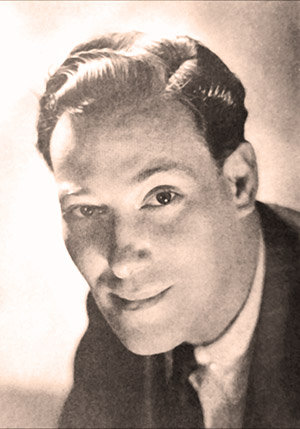
Neville Goddard (1905–1972)

I venture to map a seeker’s theory of mind causation – but one that also stands defensible within parameters of accepted (if not always understood) knowledge. My theory may be wrong. It may be grossly incomplete. But I believe that those of us engaged in the search for practical spirituality must at least attempt to theorise from the intersection of testimony, science, and experience. Each generation owes the labour of verification to the search of the next, which will have its own ideas and critiques.

Indeed, today’s seekers must move beyond inherited decisions and templates. We need our own experiments and results, including failures. Those of us who care about New Thought, or mind causation, owe the spiritual culture – and ourselves – a supportable hypothesis of how it works. We must be equally willing to discard cherished hypotheses. In that vein, I conclude this essay with articles of personal experimentation.

I start by quoting mystic Neville Goddard (1905–1972) from a 1948 series of lectures in Los Angeles:

Scientists will one day explain why there is a serial universe. But in practice, how you use this serial universe to change the future is more important.

It was a striking observation. The mononymous Neville is, I believe, the most penetrating voice to emerge from New Thought tradition – because it was not until years later that quantum physicists began discussing the many-worlds theory, devised by physicist Hugh Everett III (1930–1982) in 1957.

A Short Overview of Quantum Physics

Everett was attempting to make sense of some of the extraordinary findings that had been occurring for about three decades in quantum mechanics. For example, scientists are able to demonstrate, through various interference patterns, that a subatomic particle occupies a wave state or state of superposition – that is, an infinite number of places – until a sentient observer or automatised device takes a measurement: it is only when measurement is taken that the particle collapses, so to speak, from a wave state into a localised state. At that point, it occupies a definite, identifiable, measurable place. Before measurement is taken, however, the localised particle exists only in potential.

Now, I have just about squeezed all of quantum physics into a couple of sentences. I think it is an accurate description, but obviously I am reducing huge complexities into the dimensions of a marble. I believe I am faithfully stating what has been observed in the last ninety-plus years of particle experiments (as well as emerging experiments on larger objects, such as hydrogen molecules). We are seeing that on the subatomic scale matter does not behave as we are conditioned to expect.

Measurement & Observation: The Role of Mind

Starting about twenty years ago, it became fashionable for New Agers and laypeople, like me, to put quantum theory at the back of cherished spiritual principles. It became equally fashionable for professional sceptics and mainstream journalists to pushback, crying B.S. and sophistry. That position, while still heard, has quieted. Not because sceptics have grown more pensive or attenuated to media-speak, but because the proposition of mind-over-matter, strange as it may seem, now resounds in debates on theoretical physics in mainline journals and magazines.

In 2009, I attended a presentation on the “quantum measurement problem” delivered by parapsychologist Dean Radin before an audience of scientists, social thinkers, and scholars of religion. I asked Radin to address the 800-pound gorilla in the room: If observation and perspective alter material on a micro level, in the world of waves and particles, might that say something about the legitimacy of the New Thought or mind-power thesis? “It’s not complete bullshit,” Radin replied. “There may be an inkling of something to it.” Another physicist and longtime military researcher was also present. “As the resident sceptic,” he said, “I concur.”

Our understanding of matter in our macro world generally comes from measuring things through our five senses and experiencing them as singularities. There is one table. It is solid and definable. It is not occupying an infinite number of spaces. But contemporary quantum physicists have theorised that we may not normally see or experience superposition phenomena because of what is sometimes called information leakage.

This means that we gain or lose data based on fineness of measurement. When you measure things with exquisitely well-tuned instruments, like a microscope, you see more and more of what is going on, i.e., actual reality. But when you pan the camera back, so to speak, your measurements coarsen and you see less and less of what is actually happening. To cite the most basic example, to all ordinary appearances, a table is solid. The floor beneath your feet is solid. Where you are sitting is solid. But measuring through atomic-scale microscopes, we realise that if you go deeper and deeper, space appears within these objects. Particles make up the atom and still greater space appears. We do not experience that; we experience solidity. But no one questions that space prevails among particles composing an atom.

Furthermore, we possess decades of data demonstrating that when subatomic particles are directed at a target system, such as a double slit, they appear in infinite places at once until a measurement is made; only then does locality exist. But we fail to see this unless we are measuring things with comparative exactitude. Hence, what I am describing seems unreal based on lived experience – but it is actual.

In any event, my supposition is this: if particles appear in an infinite number of places at once until a measurement is taken; and if, as we know from studying the behaviour and mechanics of subatomic particles, there exists an infinitude of possibilities; and if we know, as we have since the inception of Einstein’s theories, that time is relative, then it is possible to reason – and it is almost necessary to reason – that linearity itself, by which we organise our lives, is illusory.
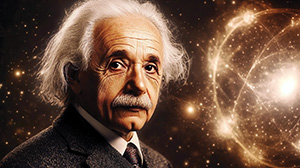
Linearity is a useful and necessary device for five-sensory beings to get through life; but it does not stand up objectively. Linearity is conceptual – a subjective interpretation of what is really going on. It is not reflected in Einstein’s theory of relativity, which demonstrates that time slows for an object approaching the speed of light. (The individual travelling in a metaphorical spaceship at or near light speed experiences time slowing, not from their perspective but in comparison to those not at near light speed. And this is no mere thought exercise: space travellers in our era, although they are obviously approaching nowhere near that velocity, experience minute effects of time reduction.) Nor is linearity reflected in quantum mechanics, where particles appear in an infinitude of places and obey no orderly modality. Linearity is not replicated when measurement of a particle serves to localise the appearance or existence of the object.

This begins to clarify why Einstein famously wrote in a letter of March 1955:

People like us, who believe in physics, know that the distinction between past, present, and future is only a stubbornly persistent illusion.

If we pursue this line of thought further – and this is where Everett’s many-worlds theory comes into play – the very decision to take a measurement (or not take one) not only localises a particle but creates a past, present, and future for that particle. Hence, an observer’s decision to log a measurement creates a multidimensional reality for the particle.

There exists debate over whether a device represents a method of measurement distinct from an observer, as well as whether the “collapse” from wave to particle results from an observer’s individual psyche or “transpersonal mind behaving according to natural laws,” as observed by Bernardo Kastrup, Henry P. Stapp, and Menas C. Kafatos in a May 29, 2018, Scientific American article “Coming to Grips with the Implications of Quantum Mechanics.” This transpersonal mind, the writers continue, “comprises but far transcends any individual psyche,” a description similar to the Hermetic concept of Nous or an over-mind. The authors compellingly argue that even if a device is used for measurement – and thus localisation – perception and intent, either of the individual, the meta-mind, or both, remains the determining force.

Schrödinger’s Cat

Multidimensional reality is implied in the famous thought experiment called Schrödinger’s Cat. 20th-century physicist Erwin Schrödinger (1887–1961) was frustrated with the evident absurdity of quantum theory, which showed objects simultaneously appearing in more than one place at a time. Such an outlook, he felt, violated all commonly observed physical laws. In 1935, Schrödinger sought to highlight this predicament through a purposely absurdist thought experiment, which he intended to force quantum physicists to follow their data to its ultimate degree.

Schrödinger reasoned that quantum data dictates that a sentient being, such as a cat, can be simultaneously alive and dead. Here is a variant of the Schrödinger’s Cat experiment: a cat is placed into one of a pair of boxes. Along with the cat is a collar fitted with a device which, if exposed to an atom, releases a deadly poison. An observer then fires an atom at the boxes. The observer subsequently uses some form of measurement to check which box the atom is in: the empty one or the one with the cat and the poisoning device. When the observer goes to check, the wave function of the atom (the state in which it exists in both boxes) collapses into a particle function (the state in which it is localised to one box). Once the observer takes his measurement, convention says that the cat will be discovered to be dead or alive. But Schrödinger reasoned that quantum physics describes an outcome in which the cat is both dead and alive. This is because the atom, in its wave function, was, at one time, in either box, and either outcome is real.

Of course, all lived experience tells us that if the atom went into the empty box, the cat is alive; and if it went into the box with the cat and the poisoning device, the cat is dead. But Schrödinger, aiming to highlight the frustrations of quantum theory, argued that if the observations of quantum-mechanics experiments are right, you would have to allow for each outcome.

To take it even further, many-worlds theorists in the 1950s posited that if an observer waited some significant length of time – say, eight hours – before checking on the dead-alive cat, he would discover one cat that was dead for eight hours and another that was alive for eight hours (and now hungry). In this line of reasoning, conscious observation effectively manifested the localised atom, the dead cat, and the living cat – and also manifested the past, or in other words, created a history for both a dead cat and a living one. Both outcomes are true.

So, whatever a particle is doing, the very fact that a sentient observer has chosen to take a measurement at that time, place, moment, and juncture creates a whole past, present, and future – an infinitude of outcomes. A divergent set of outcomes would exist if that measurement were never taken. A divergent set of outcomes would also exist if that measurement were taken one second later, or five minutes later, or tomorrow. And what is tomorrow? When particles exist in superposition until somebody takes a measurement, there is no such thing as tomorrow, other than subjectively.

Consider too: the cat, from its perspective, is local; the observer, from its perspective, is local – but both, in fact, are in a wave state or superposition. We can speak of them as concrete, singular beings only from their personal perspective. From the quantum perspective, they are infinite. Expanding on this idea, research physician Robert Lanza, adjunct professor at Wake Forest University School of Medicine, argues that death itself is ultimately a mental phenomenon: we “die” only insofar as an observer perceives demise; the consciousness of the “deceased” branches off into one of Everett’s many worlds. (This begs the question of who experiences these effects if there’s no such thing as “one” person/life. I consider this in my book Daydream Believer.)

And what, finally, are our five senses but a technology by which we measure things? Are our five senses anything other than a biological technology, not necessarily different in intake from a camera, photometer, digital recorder, or microscope? So, it is possible that within reality – within this extra-linear, super-positioned infinitude of possibilities in which we are taking measurements – we experience things based upon our perspective. This is why in considering mind causation I use the term select rather than manifest.

Neville Goddard: Thoughts Have Wings

Here, we return to mystic Neville Goddard. His instinct was, I believe, correct in the schema just considered. Neville taught that you can take a measurement by employing the visualising forces of your imagination. You are taking a measurement within the infinitude of possible outcomes. The measurement localises or actualises the thing itself.

In the 1948 lectures quoted earlier, Neville further noted:

Man can prove the existence of a dimensionally larger world by simply focusing his attention on an invisible state and imagining that he sees and feels it. If he remains concentrated in this state, his present environment will pass away, and he will awaken in a dimensionally larger world where the object of his contemplation will be seen as a concrete objective reality.

I feel intuitively that, were he to abstract his thoughts from this dimensionally larger world and retreat still farther within his mind, he would again bring about an externalisation of time. He would discover that, every time he retreats into his inner mind and brings about an externalisation of time, space becomes dimensionally larger. And he would therefore conclude that both time and space are serial, and that the drama of life is but the climbing of a multitudinous dimensional time block.

Again, note how foresightful Neville’s ideas and language proved of the many-worlds theory.

Aleister Crowley, the confounding and brilliant British occultist and artist, made a statement related to Neville’s. Writing in the introduction to his 1904 channelled text The Book of the Law – later published in a general edition in 1938 – Crowley observed:

Each of us has thus an universe of his own, but it is the same universe for each one as soon as it includes all possible experience. This implies the extension of consciousness to include all other consciousnesses. In our present stage, the object that you see is never the same as the one that I see; we infer that it is the same because your experience tallies with mine on so many points that the actual differences of our observation are negligible… Yet all the time neither of us can know anything… at all beyond the total impression made on our respective minds.

Neville’s formula is simplicity itself: an assumption, if persisted in, hardens into fact. But the assumption must be persuasive; it must be convincing. That is why emotions and feeling states must come into play. And Neville observed that you can use hypnagogia – the state of cognizant pre-sleep or drowsy relaxation – to help facilitate that process.

Hypnagogia naturally occurs twice daily: just prior to and following sleep. It is a period of hallucinatory sentience during which we are nonetheless capable of controlling attention; what’s more, your rational defences are lowered. This can be considered “prime time” to visualise a desired end. (Hypnagogia is also a period of heightened ESP-related activity, as recorded in academic psychical research.)

Another way of using Neville’s approach to mental creativity is to enter an inner state of theatrical or childlike make-believe. Not childish but childlike: a state of internal wonder and pretending. Children excel at this. We grow embarrassed about this quality as we age, but Neville spoke ingenuously about walking the streets of Manhattan imagining that he was in the treelined lanes of his native Barbados, boarding a ship to some desired destination, or in a location where he wanted to be.

He would say: “Unfoldment will come. You will see.” Again, he argued that an assumption, although false, if persisted in, eventually hardens into fact. He further advised, “Assume the state of the wish fulfilled. Live from the end.” Remember, the teacher reminded listeners, you are not in a state of wanting; you are in a state of having received. Your aim is simply to occupy the emotional and mental condition that you would experience following fulfilment.

Of course, you must also continue to go about your adult life in this world of Caesar, currency, and commerce – fulfilling your obligations and remaining accountable. You must cooperate with the world. You must do the normative things that life requires. The crisis of the New Age is the inability of an outsized number of its adherents to abide this. In my observation, until a person demonstrates accountability, competency, and agency in outer life, the spiritual path is a diversion, possibly a disastrous one.

Should you accept this challenge, how long will it take to witness your desired changes in outer life? How long is required for outer life to conform to your internal focus, your act of living “from the end” of your ideal? The question of time intervals is deeply fraught because with all the stresses that life throws at us, it is very difficult to adopt a feeling state and stick with it for weeks. At times, psychological barriers and stresses make it impossible.

Neville noted that there could fall a substantial time interval between your visioning and experience of the wished-for state or thing. He would point out that the gestation period of a human life is nine months. The gestation period of a horse is eleven months. The gestation period of a lamb is five months. The gestation period of a chick is twenty-one days. There is almost always going to be some time interval. You will find that naturalness of persistence comports with depth of passion for your aim. It can appear more a matter of the aim holding you than you it. This is one reason why clarity of aim and self-honesty are essential: we follow emotions, acknowledged or not.

Careful What You Wish For

Johann Wolfgang von Goethe (1749–1832) made an interesting observation in this vein. We have all heard the expression, “Be careful what you wish for; you just might get it.” It is rooted in Goethe. Taking a leaf from the philosopher and dramatist’s play Faust (c.1772–1775),Ralph Waldo Emerson noted this dynamic in his 1860 essay “Fate,” which led to the popular adage. Emerson wrote:

And the moral is that what we seek we shall find; what we flee from flees from us; as Goethe said, “what we wish for in youth, comes in heaps on us in old age,” too often cursed with the granting of our prayer: and hence the high caution, that, since we are sure of having what we wish, we must beware to ask only for high things.

We are being warned to act with perspective: what we wish for when we are young will visit us in waves when we are old.

Goethe’s observation relates to Neville’s remarks about the perceived passage of time and the gestation between thought and actualisation. Many people would reasonably object that they have all kinds of unfulfilled wishes. But unlocking the truth of this observation requires peeling back the layers of your mind and probing formative images and fantasies from when you were very young.

What is the earliest dream you recall from when you first gained conscious memories, maybe at age three or four? What fantasies occupied your earliest recollective years? Children lead very intense fantasy lives, even at ages four or five. If you take Goethe’s counsel, you might be surprised – barring extreme countervailing events (to which I return) – to discover remarkable symmetry between things you are living out today and concepts you harboured when very young. These can be positive, negative, or numerous stations between.

Neville recommended against thinking in terms of, “It will happen this way” or, “I’ll do something to make it happen.” His attitude was that the event will unfold in its own natural manner. In his system, your job is not to draw the map – it is to live from the destination.

I must, finally, add a word about suffering on both an intimate and global scale. New Thought has proven woefully inadequate in addressing matters of implacable tragedy and catastrophe, a topic on which I’ve written widely.

My contention is that even if awareness or consciousness is the ultimate arbiter of existence, we still experience many different laws and forces within the physical framework we know. I used to say that we live under many different laws and forces; I’m not sure if that’s entirely right. But we certainly experience diffuse laws and forces, and these experiences are hard-baked into us.

So, it stands to reason that even if emotive thought, perspective, and awareness are determinative of what reality gets concretised into our individual experiences, there exist different laws and possibilities that are also playing out at the same time. There are physical facts which also form part of the nature of our experience within the framework that we find ourselves. And it could be that there are other frameworks in which our psyches are much freer. There may be frameworks in which we experience fewer laws and forces that seem to interrupt a sense of continuity between you, the individual – you, the seeker – and that which you experience.

That said, suffering and catastrophe must, for every ethical being, be understood as fundamental, urgent, and, where possible and according to personal conviction, requiring of amelioration and solidarity.

I believe that Neville is going to be remembered – and is already seen today – as having created the most elegant mystical analogue to quantum physics.

When I started writing about Neville in 2005 – the first journalistic coverage of his life since the 1940s – he was a figure of obscurity even among most New Thoughters. But today Neville’s voice and work net millions of results in search engines. At a 2022 tech conference, I was floored by the number of programmers and engineers (not the usual suspects) who approached me to talk about him.

As seen, Neville espoused a variant of the many-worlds theory long before the popularisation of quantum physics. Indeed, he had a series of remarkable instincts in the 1940s that have since been tantalisingly, if indirectly, reiterated by quantum theorists – most of whom have not (yet) heard his name.

Indeed, it would not surprise me if, within a generation, some physics students begin to read Neville as a philosophical adjunct to their work. That may seem a stretch, but remember that many of today’s senior cohort of physicists, people in positions of academic and grant-making authority, were inspired by Star Trek, Arthur C. Clarke,and Zen and the Art of Motorcycle Maintenance. There is visibly greater openness in the field today to matters of perspective and thought causation.

Get the issue this article appears in

Living by the Inner Light of Conviction

As I’ve suggested, you can use several different techniques in connection with Neville’s ideas, including those of your own devising: I challenge you to try them and see what happens. You are entitled to results. I believe that every therapeutic, ethical, or spiritual philosophy should produce some concrete and desired change in your life and conduct; if it does not, then such an idea warrants no hold on you.

I feel similarly that the ability to observe and note an outcome in your life is vitally important. Testimony forms a critical source of ideas, a meaningful record, and a warranted inducement to others.

We all live by philosophies, spoken or not. Even if we say we do not have an ideology, we obviously harbour assumptions by which we navigate life. When I look back on figures like Neville or pioneering parapsychologist J.B. Rhine (1895–1980), I realise that their greatness is that they lived by the inner light of their ideas. That is rare. We are a world of talkers. People are sarcastic or cruel over Twitter and think they are taking a principled stand. Is it courageous or honourable for a keyboard warrior (often under a pseudonym) to call out people online? That is no victory. It is make-believe morality.

When we look back on iconic figures in the social, cultural, artistic, or spiritual milieu, we remember those few who lived by the inner light of conviction; who struggled to comport their ideals with conduct. Such private philosophies are the only ones that last. Indeed, if you cannot keep your word, apologise, demonstrate solidarity or loyalty, then write nothing of an ethical or spiritual bent. You’ll be writing on sand.

I must state the following and I mean it in my heart: if you sincerely attempt what I am theorising in this article, I believe that you will find greatness; because, if nothing else, you will be attempting to live by the inner light of an idea. Try.

This article was published in New Dawn Special Issue Vol 18 No 6.

If you appreciate this article, please consider subscribing to help maintain this website.

© New Dawn Magazine and the respective author.
For our reproduction notice, click here.

Support New Dawn

No Paywall. No Clickbait. Only Truth.
This website exists because a few choose to give back for what they receive. If New Dawn has enriched your vision or sparked insight, let your gratitude flow. Help sustain the work that awakens the world. Your contribution matters more than you know.

About the Author

Mitch Horowitz is a PEN Award-winning historian, writer, and lecturer who explores the intersections of metaphysics, ethics, and self-transformation. His books include Occult America, The Miracle Club, Modern Occultism, Daydream Believer, and Practical Magick. Mitch is featured in Critics’ Choice-nominated and Sundance-premiering films, as well as numerous television shows. David Lynch: “Mitch is solid gold.” https://www.mitchhorowitz.com

© Copyright New Dawn Magazine, https://www.newdawnmagazine.com. Permission granted to freely distribute this article for non-commercial purposes if unedited and copied in full, including this notice.

Reframing Was Right All Along

NLP: NeuroLinguistic Programming

New brain science shows insight isn’t information arriving from outside. It’s your mind reorganizing what you already knew.

Thom Hartmann

Jul 22, 2026 (WisdomSchool.com)

Image by Richard Reid from Pixabay

Share

Back in my advertising days there was a campaign I got well and truly stuck on. I’d been at it the better part of a week, index cards spread across my desk, crumpled legal-pad pages on the floor, the deadline coming at me like weather. Nothing worked. The harder I pushed, the worse it got.

So one night I gave up, went home, slept, and somewhere around five the next morning I woke with the whole thing assembled in my head, clean and obvious, as though somebody had quietly solved it while I wasn’t looking.

I’d love to tell you I was brilliant. The truth is I just got out of the way. These days, a lot of my writing works out that way, too.

If you’ve ever done creative work of any kind, or really any kind of work at all, you know that feeling. The click. The penny dropping. The thing the Germans and the psychologists both call the “aha.” And until recently we didn’t have much idea what was actually happening in the brain at that moment.

Now we’re starting to.

Last year a team at Duke ran people through a clever little puzzle while watching their brains in a scanner. They used what are called Mooney images, those high-contrast black-and-white blotches that look like nothing at all until, suddenly, you see the hidden object, a face, a dog, a guitar, and then you can never un-see it. That instant of recognition is a tiny, pure aha.

And what the scientists found is that in that instant the brain literally reorganizes how it represents the image. The pattern of activity in the visual regions doesn’t just take in more of the same information; it rearranges into a whole new configuration. They call it representational change.

At that same moment, the hippocampus and the amygdala also light up, the brain’s memory and emotion centers, which is part of why a real insight feels so good and tends to stick. In fact, the solutions that arrived in a flash were remembered about twice as well as the ones people ground out step by step.

And here’s the part that’s really amazing: newer research has looked at how we have these aha moments while we’re following a story or making sense of unfolding events, and found that just before the insight lands, the brain reaches back and reinstates older memories, the patterns of earlier, causally related things we’d already taken in.

The insight isn’t new material flooding in from outside. It’s the mind suddenly connecting pieces it was already holding, reaching into its own past and rearranging what was there into a shape that finally makes sense.

The breakthrough you’re waiting for usually isn’t out there somewhere. It’s already inside your head, in pieces, waiting for you to stop griping long enough to let them rearrange.

Now, if you’ve spent any time around the world I came up in, this is going to sound familiar, because people have been pointing at this truth for the better part of a century, just without the scanners. I teach Neuro-Linguistic Programming, and one of its most powerful tools is something we call reframing.

You take an experience that’s locked into a single meaning, a failure, a rejection, a humiliation, and you deliberately visualize or use a story to put it inside a different frame, and the feeling attached to it shifts, sometimes in an instant.

For years the skeptics waved that off as a parlor trick. But look again at what the Duke team found: an insight is, at the level of neurons, a reframe. It’s the same information held in a new configuration.

Reframing works because it’s doing on purpose the very thing your brain does on its own in a flash of insight.

Go back further and you find the same intuition everywhere. Earl Nightingale built a whole career on a single sentence: “we become what we think about.” Claude Bristol wrote a little book in 1948 called The Magic of Believing, and Dale Carnegie was teaching ordinary people to change their lives by changing the frame around their worries long before that.

Some of that old positive-thinking literature curdled into magical nonsense, the notion that you can simply wish a parking space or a fortune into existence, and I’ve got no patience for that. But underneath the hype was a real observation that the science now confirms: the frame you hold something in determines what you’re able to see, and shifting that frame can genuinely rearrange your inner world.

Those guys had the truth. They just didn’t have the fMRI.

So what do we do with all this, practically? A few things, and not one of them costs a dime.

First, when you’re truly stuck, stop pushing. The aha tends to arrive after you step back, not during the white-knuckle grind, because the brain needs a little slack to do its rearranging. Sleep on it. Take a walk. Get in the shower. (There’s a reason for that cliché.)

Second, feed the machine. Insight reaches back into what you already know, so the wider and richer your store of raw material, the more pieces it has to connect. Read outside your lane. Stay curious about things that aren’t useful to you yet.

Third, when something knocks you flat, before you accept the first frame your mind hands you, try another one on. Ask what else this could mean. Ask what it might be here to teach you. You’re not lying to yourself when you do that. You’re doing deliberately what your brain was built to do anyway.

There’s something quietly hopeful in all of this, I think. We tend to assume our answers have to come from somewhere else, an expert, a guru, a better set of circumstances down the road.

But the science keeps pointing back inward. You’re already carrying around almost everything you need. The work isn’t acquiring more of it. It’s getting quiet enough, and brave enough about your frames, to let what’s already in there fall into place.

How to Be More Alive: Hermann Hesse on Wonder and the Proper Aim of Education

By Maria Popova (themarginalian.org)

It bears repeating that what makes life livable is our ability — our willingness — to move through the world wonder-smitten by reality. The most wonderful thing about wonder is that it knows no scale, no class, no category — it can be found in a geranium or in a galaxy, in the burble of a brook or in the Goldberg Variations“A leaf of grass is no less than the journey work of the stars,” wrote Walt Whitman, eternal patron saint of wonder.

Wonder, after all, is what we look for when we are looking and the richest recompense of learning how to look. G.K. Chesterton knew this when, in his wonderful meditation on the dandelion and the meaning of life, he observed that the object of the creative life, of the full life, is to dig for the “submerged sunrise of wonder.” Dylan Thomas knew it in the recognition that “children in wonder watching the stars, is the aim and the end.” Rachel Carson knew it when she insisted that the greatest gift a parent can give a child is “a sense of wonder so indestructible that it would last throughout life, as an unfailing antidote against the boredom and disenchantments of later years, the sterile preoccupation with things that are artificial, the alienation from the sources of our strength.” Goethe knew it when he exclaimed: “I am here, that I may wonder!”

How to live into that knowledge with the full capacity of our creaturely potential is what Hermann Hesse (July 2, 1877–August 9, 1962) explores in a soulful century-old reflection included in Butterflies: Reflections, Tales, and Verse (public library).

Hermann Hesse

With an eye to Goethe’s immortal line, Hesse writes:

Wonder is where it starts, and though wonder is also where it ends, this is no futile path. Whether admiring a patch of moss, a crystal, flower, or golden beetle, a sky full of clouds, a sea with the serene, vast sigh of its swells, or a butterfly wing with its arrangement of crystalline ribs, contours, and the vibrant bezel of its edges, the diverse scripts and ornamentations of its markings, and the infinite, sweet, delightfully inspired transitions and shadings of its colors — whenever I experience part of nature, whether with my eyes or another of the five senses, whenever I feel drawn in, enchanted, opening myself momentarily to its existence and epiphanies, that very moment allows me to forget the avaricious, blind world of human need, and rather than thinking or issuing orders, rather than acquiring or exploiting, fighting or organizing, all I do in that moment is “wonder,” like Goethe, and not only does this wonderment establish my brotherhood with him, other poets, and sages, it also makes me a brother to those wondrous things I behold and experience as the living world: butterflies and moths, beetles, clouds, rivers and mountains, because while wandering down the path of wonder, I briefly escape the world of separation and enter the world of unity.
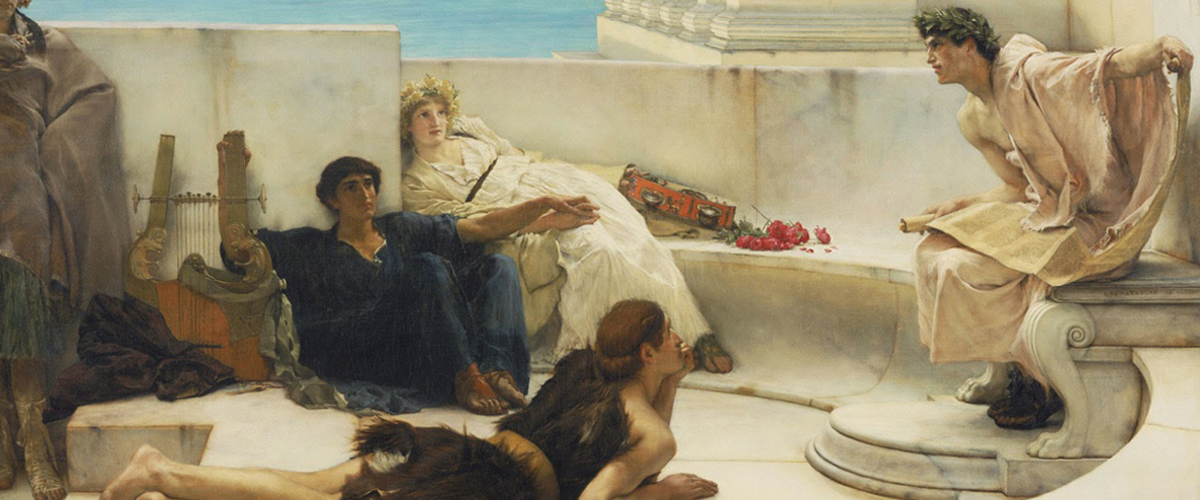

Art by Sophie Blackall from If You Come to Earth

But while we are born wakeful to wonder, our cultural conditioning and indoctrination — what we call our education — often schools us out of it. A century before scientists came to study the vitalizing psychology and physiology of enchantment, a century before our so-called liberal arts education had become the factory farming of the mind, Hesse laments:

Our universities fail to guide us down the easiest paths to wisdom… Rather than teaching a sense of awe, they teach the very opposite: counting and measuring over delight, sobriety over enchantment, a rigid hold on scattered individual parts over an affinity for the unified and whole. These are not schools of wisdom, after all, but schools of knowledge, though they take for granted that which they cannot teach — the capacity for experience, the capacity for being moved, the Goethean sense of wonderment.

Complement with Nietzsche on the true value of education and the pioneering neuroscientist Charles Scott Sherrington on our spiritual responsibility to wonder, then revisit Hesse on the wisdom of the inner voicesolitude and the courage to be yourself, and the day he discovered the meaning of life in a tree.

The 32 Most Iconic Poems in the English Language

Plus Some Bonus Poems, Because We Love You

Emily Temple March 7, 2019 (lithub.com)

Today is the anniversary of the publication of Robert Frost’s iconic poem “Stopping by Woods on a Snowy Evening,” a fact that spurred the Literary Hub office into a long conversation about their favorite poems, the most iconic poems written in English, and which poems we should all have already read (or at least be reading next). Turns out, despite frequent (false) claims that poetry is dead and/or irrelevant and/or boring, there are plenty of poems that have sunk deep into our collective consciousness as cultural icons. (What makes a poem iconic? For our purposes here, it’s primarily a matter of cultural ubiquity, though unimpeachable excellence helps any case.) So for those of you who were not present for our epic office argument, I have listed some of them here.

NB that I limited myself to one poem per poet—which means that the impetus for this list actually gets bumped for the widely quoted (and misunderstood) “The Road Not Taken,” but so it goes. I also excluded book-length poems, because they’re really a different form. Finally, despite the headline, I’m sure there are many, many iconic poems out there that I’ve missed—so feel free to extend this list in the comments. But for now, happy reading (and re-reading):

William Carlos Williams, “The Red Wheelbarrow

The most anthologized poem of the last 25 years for a reason. See also: “This is Just to Say,” which, among other things, has spawned a host of memes and parodies.

T. S. Eliot, “The Waste Land

Without a doubt one of the most important poems of the 20th century. “It has never lost its glamour,” Paul Muldoon observed. “It has never failed to be equal to both the fracture of its own era and what, alas, turned out to be the even greater fracture of the ongoing 20th century and now, it seems, the 21st century.” See also: “The Love Song of J. Alfred Prufrock.”

Robert Frost, “The Road Not Taken

Otherwise known as “the most misread poem in America.” See also: “Stopping by Woods on a Snowy Evening.” And “Birches.” All begin in delight and end in wisdom, as Frost taught us great poems should.

Gwendolyn Brooks, “We Real Cool

This blew my mind in high school, and I wasn’t the only one.

Elizabeth Bishop, “One Art

Bishop’s much loved and much discussed ode to loss, which Claudia Roth Pierpont called “a triumph of control, understatement, wit. Even of self-mockery, in the poetically pushed rhyme word “vaster,” and the ladylike, pinkies-up “shan’t.” An exceedingly rare mention of her mother—as a woman who once owned a watch. A continent standing in for losses larger than itself.”

emily dickinson complete poems

Emily Dickinson, “Because I could not stop for Death –

The truth is, there are lots of equally iconic Dickinson poems, so consider this a stand-in for them all. Though, as Jay Parini has noted, this poem is perfect, “one of Dickinson’s most compressed and chilling attempts to come to terms with mortality.”

The Collected Poems of Langston Hughes

Langston Hughes, “Harlem

One of the defining works of the Harlem Renaissance, by its greatest poet. It also, of course, gave inspiration and lent a title to another literary classic: Lorraine Hansberry’s A Raisin in the Sun.

Sylvia Plath, “Daddy

To be quite honest, my favorite Plath poem is “The Applicant.” But “Daddy” is still the most iconic, especially if you’ve ever heard her read it aloud.

Robert Hayden, “Middle Passage

The most famous poem, and a terribly beautiful one, by our country’s first African-American Poet Laureate (though the position was then called Consultant in Poetry to the Library of Congress). See also: “Those Winter Sundays, which despite what I wrote above may be equally as famous.”

Wallace Stevens, “Thirteen Ways of Looking at a Blackbird

This one takes the cake for the sheer number of “thirteen ways of looking at x” knockoffs that I’ve seen. But please see also: “The Emperor of Ice-Cream.”

howl

Allen Ginsberg, “Howl

With On the Road, the most enduring piece of literature from the mythologized Beat Generation, and of the two, the better one. Even the least literate of your friends would probably recognize the line “I saw the best minds of my generation destroyed by madness . . .”

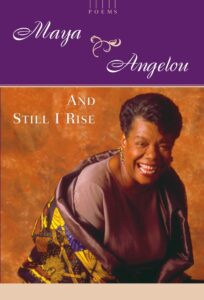
Maya Angelou, Still I Rise

Maya Angelou, “Still I Rise

So iconic, it was a Google Doodle.

Dylan Thomas, “Do Not Go Gentle into That Good Night” copy

Dylan Thomas, “Do Not Go Gentle into That Good Night

I mean, have you seen Interstellar? (Or Dangerous Minds or Independence Day?)

Samuel Taylor Coleridge, “Kubla Khan

Or Citizen Kane? (See also: “The Rime of the Ancient Mariner.”)

Percy Bysshe Shelley, "Ozymandias"

Percy Bysshe Shelley, “Ozymandias

. . . or Breaking Bad?

Edgar Allan Poe, “The Raven

We had some votes for “Annabel Lee,” on account of its earworminess, but among the many appearances and references of Poe in pop culture, “The Raven” is certainly the most common.

Louise Glück, “Mock Orange

One of those poems passed hand to hand between undergraduates who will grow up to become writers.

Paul Laurence Dunbar, “We Wear the Mask

Dunbar’s most famous poem, and arguably his best, which biographer Paul Revell described as “a moving cry from the heart of suffering. The poem anticipates, and presents in terms of passionate personal regret, the psychological analysis of the fact of blackness in Frantz Fanon’s Peau Noire, Masques Blancs, with a penetrating insight into the reality of the black man’s plight in America.”

e.e. cummings, “i carry your heart with me

As quoted at many, many weddings.

Marianne Moore, “Poetry

All else aside, the fact that it starts with hating poetry has made it a favorite among schoolchildren of all ages. See also: “The Fish.”

Rudyard Kipling, “If

According to someone in the Literary Hub office who would know, this poem is all over sports stadiums and locker rooms. Serena Williams is into it, which is proof enough for me.

Gertrude Stein, “Sacred Emily

Because a rose is a rose is a rose is a rose.

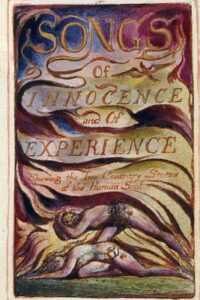
William Blake, “The Tyger

Tyger, tyger, burning bright . . . Blake famously wrote music to go along with his poems—the originals have been lost, but this verse has been widely interpreted by musicians as well as repeated to many sleepy children.

Robert Burns, "To a Mouse"

Robert Burns, “To a Mouse

As (further) immortalized by John Steinbeck.

Walt Whitman, “Song of Myself

The most famous poem from Whitman’s celebrated Leaves of Grass, and selected by Jay Parini as the best American poem of all time. “Whitman reinvents American poetry in this peerless self-performance,” Parini writes, “finding cadences that seem utterly his own yet somehow keyed to the energy and rhythms of a young nation waking to its own voice and vision. He calls to every poet after him, such as Ezra Pound, who notes in “A Pact” that Whitman “broke the new wood.””

Philip Larkin, “This Be The Verse

We know, we know, it’s all your parents’ fault.

William Shakespeare, “Sonnet 18” (“Shall I compare thee to a summer’s day?”)

Like Dickinson, we could have put several of Shakespeare’s sonnets in this slot. Most people only recognize the first couplets anyway.

Audre Lorde, “Power

A uniquely American poem, written in 1978, that should be outdated by now, but still is not.

Frank O’Hara, “Meditations in an Emergency

Courtesy Don Draper, circa season 2.

John McCrae, “In Flanders Fields

Probably the most iconic—and most quoted—poem from WWI. Particularly popular in Canada, where McCrae is from.

Lewis Carroll, “Jabberwocky

Still the most iconic nonsense poem ever written.

W. B. Yeats, “The Second Coming

Otherwise known as “the most thoroughly pillaged piece of literature in English.” Just ask our hero Joan Didion. Joan knows what’s up.

*

One more thing. The above list is too white and male and old, because our literary iconography is still too white and male and old. So, here are some other poems that we here at the Literary Hub office also consider iconic, though they are perhaps not as widely anthologized/quoted/referenced/used to amp up the corny drama in films as some of the above (yet).

Adrienne Rich, “Diving into the Wreck

One of my very favorites from Rich’s rich (sorry) oeuvre. I read it in college and have been quoting it ever since.

Patricia Lockwood, “Rape Joke

The poem that officially broke the internet in 2013.

Lucille Clifton, “Homage to My Hips

She’s just . . . so . . . damn . . . sexy. See also: “To a Dark Moses” and “won’t you celebrate with me,” because Clifton is the greatest.

Lucie Brock-Broido, “Am Moor

This happens to be my own personal favorite Brock-Broido poem, though almost any would do here.

Sappho, “The Anactoria Poem” (tr. Jim Powell)

I’m breaking my rule about the poems being written in English to include Sappho, whose work is uniquely appealing for being almost lost to us. The Anactoria poem is her most famous, though I have to say I also have a major soft spot for this fragment, translated by Anne Carson:

so
]

]
]
]
]

Go                     [
so we may see [
]
lady

of gold arms     [
]
]
doom
]

Kevin Young, “Errata

The greatest wedding poem that no one ever reads at their wedding.

Beauty Was the Case that They Gave Me mark leidner

Mark Leidner, “Romantic Comedies

For those who enjoy snorting their coffee while reading poetry.

Muriel Rukeyser, “The Book of the Dead

A long, legendary poem, written in 1938, about the illness of a group of miners in Gauley Bridge, West Virginia. “Coming hot on the heels of modernist long poem masterpieces like Eliot’s “The Wasteland” or Stein’s “Tender Buttons,” the poem’s deliberate lucidity isn’t just an aesthetic choice—it’s a political one,” Colleen Abel wrote in Ploughshares. “Rukeyser, from the beginning of “Book of the Dead,” seeks the reader’s participation in the journey to Gauley Bridge. The reader is implicated from the first section, “The Road,” in which Rukeyser calls outward to her audience: “These are roads you take when you think of your country.” The disaster Rukeyser is about to explore is a part of “our country” and the reader will have no choice but to confront it.”

Carolyn Forché, “The Colonel

What you have heard is true. This poem is unforgettable.

Rita Dove, “After Reading Mickey in the Night Kitchen for the Third Time Before Bed

Again, a thousand poems by Rita Dove would do; this is the one that sticks in my brain.

Nikki Giovanni, “Ego Tripping

I mean, “I am so hip even my errors are correct” should probably be your mantra. Watch Giovanni perform her poem here.

Terrance Hayes, “The Golden Shovel

Hayes’s homage to Gwendolyn Brooks is a masterpiece in its own right.

Adrienne Rich Allen Ginsberg Carolyn Forché classic literature Dylan Thomas Edgar Allan Poe Elizabeth Bishop Emily Dickinson Gwendolyn Brooks iconic poems Kevin Young Langston Hughes Louise Gluck Lucie Brock-Broido Lucille Clifton Marianne Moore Mark Leidner Maya Angelou Muriel Rukeyser Nikki Giovanni Patricia Lockwood Paul Laurence Dunbar poems poetry Rita Dove Robert Frost Robert Hayden Rudyard Kipling Samuel Taylor Coleridge Sappho Sylvia Plath T. S. Eliot Terrance Hayes Wallace Stevens William Carlos Williams

Emily Temple

Emily Temple

Emily Temple is the managing editor at Lit Hub. Her first novel, The Lightness, was published by William Morrow/HarperCollins in June 2020. You can buy it here.

Why Fathers and Their Babies Are Key to Humanity’s Survival 

 July 20, 2026 (menalive.com)

By  Jed Diamond

                No one forgets the birth of their first child. For me the blessed event occurred on November 21, 1969. I had done my best to coach my wife through the Lamaze breathing techniques that we had learned in our birthing classes. It was now time for her to move to the delivery room to complete the birth process and welcome our newborn child into the world.

                We were both ready for the final stage of the journey. The nurse turned to me with a smile saying,

                “OK, Mr. Diamond, your job is done now. You can go to the waiting room and we’ll let you know when your child arrives.”

                I felt a mixture of relief and disappointment. On the one hand we had done this far together and I wanted to be with my wife for the birth. On the other, I was afraid I might freak out and pass out. I didn’t want to screw things up.

                I kissed my wife and told her she would do fine. She attempted a smile but was overcome with the next contraction. As they wheeled her to the left towards the delivery room, I went the other direction. But as I started to go through the waiting room doors, something stopped me. I felt the calling of my soon-to-be born child saying,

                “I don’t want a waiting room father. Your place is here with us.”

                I turned around and walked back the other way and pushed through the doors into the delivery room. I didn’t ask permission and there was no question of my leaving, if asked. I didn’t care what the rules were, my child needed me, and I answered the call. It wasn’t long until our beautiful baby boy was born. As Jemal was handed to me, amid tears of relief and joy, I made a vow that I would be a different kind of father than my father was able to be for me and to do everything I could to create a world where fathers were fully involved with their children throughout their lives.

                After we brought him home from the hospital, I took three weeks off from work to spend time being the supportive parent for my wife and continue bonding with our son. The event of Jemal’s birth and the aftermath changed my life forever. A year after Jemal’s birth, my wife announced that she needed a break from 24/7 child rearing. She acknowledged that I was a great help, but she needed a break from being the primary caregiver. A girlfriend had invited her to go on a road trip, maybe for a few weeks, and asked if I could take a few weeks off from work again and be with Jemal.

                I quickly agreed, wanting to be a good, new-age, liberated father. But inside I was terrified. It was one thing to be the supportive parent knowing that I had the mother of our child to step in at any time. I believed that mothers had an inherent understanding of babies and knew what to do, a special something I felt men lacked. I felt I had learned a lot about taking care of our baby boy, but what did I know really. I was just a man. What would I do if he needed something that I couldn’t give him? We didn’t have mothers in the area that could help us out, but my wife assured me I could call her anytime if I needed advice.

                The first few days were scary, but Jemal and I figured things out together. I found I had abilities I didn’t know I had. We played together, father and son. I fed him, changed his diapers, slept with one ear open listening to any cries in the night. My wife phoned a few times and I told her honestly that things were going fine. We both missed her, but father and son were surviving and thriving.

                We did more than survive and thrive. We formed a bond together that has lasted through time. We’re connected in a way that most fathers and sons are not. I feel confident as a father and as a man that I never imagined I would feel.

                Jemal will be fifty-six in November. My wife and I now have six grown children, seventeen grandchildren, and four great grandchildren. I continue to love and learn. I recently heard about a new book, Father Time: A Natural History of Men and Babies by world renowned evolutionary anthropologist Sarah Blaffer Hrdy. It helped me understand my own experiences as a father and the importance of fathers throughout evolutionary history.

                I recently had the good fortune of interviewing Dr. Hrdy, which you can watch here.  After a full career studying the lives of mothers and writing iconic books including The Woman That Never Evolved, Mother Nature, she began to recognize the importance of fathering that had been mostly neglected by experts in Darwinian science and evolutionary psychology.

                “It has long seemed self-evident that women care for babies and men do other things,” says Dr. Hrdy. “Hasn’t it always been so? When evolutionary science came along, it rubber-stamped this venerable division of labor: mammalian males evolved to compete for status and mates, while females were purpose-built to gestate, suckle, and otherwise nurture the victors’ offspring.”

                Yet experiences Dr. Hrdy was having in her own family watched men nurture babies, led her explore the evolutionary roots of male nurture of young babies and has helped us recognize a much more expanded reality of what it means to be a man. What she discovered will forever change our views of manhood.

                I learned this more than fifty years ago when Jemal was born. More and more men have experienced this expanded reality.

                “Men caring for babies undergo the same neurological transformations, the same increase in prolactin levels and oxytocin-induced sensual pleasure as mothers do,”

                says Dr. Hrdy. I didn’t understand the biological changes I went through at the time, but that was certainly my experience as I spent significant time physically in touch with Jemal.

                “If their brains undergo shape-shifting similar to that in mothers, wouldn’t men’s psychological preferences change as well?” asks Dr. Hrdy. “Might men’s priorities come to more nearly resemble the more prosocial ones mothers are assumed to have? Might such men also be more likely to opt for safer and more sustainable courses of action?”

                I would take it another step further. Would men with this kind of changed brains, brains that are not only tuned to children, but to humans and other living things, be the kind of men who can join with women to create a healthier, more sustainable world? It doesn’t take experts to alert us to the reality that humanity is out of balance with the laws of nature and that we need to change our ways if we are going to survive and thrive as a species.

                Thomas Berry was a priest, a “geologian,” and a historian of religions. He spoke eloquently to our connection to the Earth and the consequences of our failure to remember we are one member in the community of life.

                “We never knew enough. Nor were we sufficiently intimate with all our cousins in the great family of the earth. Nor could we listen to the various creatures of the earth, each telling its own story. The time has now come, however, when we will listen or we will die.”

                At a time when mothers are feeling overwhelmed by trying to take care of infants and many are seeking child care from strangers or even looking to AI robots to raise our children, the answer may be to support more hands-on, and  hearts-connected fathers and their babies. What do you think?

                You can learn more about Dr. Hrdy and her work by visiting her website. You can watch my in-depth interview with her here.

                If you appreciate articles like these, I invite you to subscribe to my free weekly newsletter here.  

Author Image

Best Wishes,

Jed Diamond

Founder and VHS (Visionary Healer Scholar) of MenAlive

Pete Hegseth’s Crisis of Masculinity

The secretary of war’s obsession with testosterone reveals the anxieties he harbors about himself and the military he leads.

Nick Turse

July 25 2026 (TheIntercept.com)

On Wednesday at 11:07 p.m. ET, the president went on Truth Social to share an important piece of information with Americans. It wasn’t an update on the sinking U.S. economy, the failing forever war with Iran, a remembrance of the Americans recently killed in that conflict, rising gasoline prices, the more than 800 lawsuits against his administration, a cyclosporiasis outbreak, surging cases of measles, the problems with his Qatari-gifted Air Force One, or comment on any of the swirling crises that typify the day-to-day of Donald Trump’s America.

Instead, it was a retread of an Instagram post with a clip from an appearance of UFC CEO Dana White — who brought bloodsport to the White House lawn in June — on “The Pat McAfee Show.” It wasn’t, however, a clip from this week or this month or even about last month’s UFC Freedom 250 event. In fact, it wasn’t even from this year.

The headline on the post tells the story: “HOLY CRAP: Dana White says it best: TRUMP is the ‘ultimate American badass of all time.’” 

White did actually say that — but he said it back in July 2024. This desperation for two-year-old adulation would be funny if it wasn’t so sad. But the so-called leader of the free world isn’t the only one obsessed with being seen as an American badass. Trump’s Pentagon chief, Pete Hegseth, is on a mission to make America’s fighting men (and women) more macho by any means necessary. Unsurprisingly, it’s fast becoming a problem for all Americans.

– Nick Turse, editor of TomDispatch

If you haven’t yet, sign up to receive TomDispatch in your inbox here.

The Low-T Issue

Self-styled War Secretary Pete Hegseth has a problem with low testosterone. It’s left him suffering from what you might call an acute crisis of masculinity. And I’m pretty sure that he caught it from Teddy Roosevelt.

Bear with me. I’ll explain.

Last week, the Trump administration’s preening, strutting, wanna-be he-man announced a new mandatory annual screening for troops age 30 and older, including women, for testosterone deficiency. Troops under 30 can volunteer to be screened, and anyone with low hormone levels will have the option to receive testosterone replacement therapy.

“It’s about restoring and optimizing your natural capability,” said Hegseth, by ensuring “you have the biological foundation required to sustain the fight” on the “brutal and unrelenting” modern battlefield. Like all Hegseth initiatives, he linked it to “lethality” — now the animating feature of his life. He called topping off troops’ testosterone levels a “sacred duty.” 

Anyone who has observed Hegseth for more than 15 seconds in the last 15 years could tell you the man is riddled with deep insecurities. His quest to fully transition the Defense Department to what he calls “The High-T Department of War” is just the latest manifestation of nagging anxieties about himself and the wheel-spinning, never-winning military he leads. 

Poor Pete’s woes have been piling up since he headed off to college at Princeton, if not before. Hegseth acts like he was drafted against his will by the Ivy League and escaped it by joining the Army National Guard as an infantry officer in 2003. He fondly recalls guarding “Islamic assholes” at Guantánamo Bay, Cuba, alongside “hard-working, God-fearing, America-loving middle-class men” whom he contrasts with “millionaires at Princeton,” a school he derides whenever he can.

Stuffed in Hegseth’s Army-issue green duffle bag when he arrived at Gitmo was a sheet of plain white copy paper inside a black plastic frame with a quote from his hero, former President Teddy Roosevelt. This long love affair with TR has continued over the decades. Pete wrote a ridiculous 2016 book, “In the Arena,” based on the “timeless truths of Teddy Roosevelt’s iconic ‘Man in the Arena’ speech” from 1910. And he still references that speech to this day and routinely works Teddy into his public remarks whenever he can.

Last year, Hegseth wanted the Pentagon to cut ties with the Boy Scouts of America because, he believed, “the organization once endorsed by President Theodore Roosevelt” had strayed from their mission to “cultivate masculine values.” (He later bullied the Scouts into submission.) And just last month, he talked up TR to U.S. troops in Cuba — where Roosevelt fought during the Spanish-American War — using his hero as proof of America’s right to intervene “in the affairs of Latin American nations.”

No one more exemplified the anxieties of privileged men of his time than Teddy Roosevelt, who grew up in the swirl of post-Civil War America in which urbanization, industrialization, a new emphasis on “brainwork,” and new technologies led to a crippling novel condition dubbed neurasthenia: nervous exhaustion, or a deficiency of “nerve-force.” This affliction was “modern and originally American,” according to the then-most influential expert on the now-archaic medical diagnosis.

Rich, white Anglo-Saxon men like Teddy professed complete cultural, racial, and sexual superiority but grew extremely anxious it was being stolen from them. (Yes, you guessed it: Immigrants, radicals, and independent, unduly educated, or otherwise unruly “new” women were prime culprits.) Men were fast becoming feeble and feminized; only through manly endeavors like weightlifting, hiking, hunting, sports, horseback riding, and excursions into the wild could they counteract the debilitating effects of over-civilization. Roosevelt, for example, transformed himself from a frail, sickly weakling who was called a “sissy” by peers and “Jane-Dandy” by the press into a man’s man via boxing, shooting, wrestling, and travel out West, where he reinvented himself as a cowboy.

Related

As Teddy Roosevelt’s Statue Falls, Let’s Remember How Truly Dark His History Was

The scholar Yeonsik Jung summed up the neurasthenic age nicely, writing: “Channeled through the medical knowledge of neurology, it made American men’s racial, sexual, and spatial anxieties function to act out their racist, misogynist, nativist, and imperialist impulses which legitimized exclusionary political techniques toward the racial and sexual others such as the U.S. imperial expansion in the 1890s and 1900s.” These white American men had to win back, as another scholar put it, “the potency of their violent masculinity—their ability to out-savage the savage” on the American frontier before turning overseas to places like the PhilippinesHaiti, and Nicaragua. Roosevelt’s own expansionist imperialism and his campaign against “race suicide” were firmly rooted in this toxic ferment. When the United States initially failed to annex Hawaii after a group of missionaries and pineapple plantation interests took over and set up their own government in the 1890s, for example, Roosevelt called the reluctance “a crime against white civilization.”

The framed quote Hegseth stuffed into that Gitmo duffle, which he also took to the forever wars in Afghanistan and Iraq, are lines from “The Man in the Arena” speech:

Am I striving valiantly?

Is my face marred by dust and sweat and blood? Am I spending myself in a worthy cause?

Am I daring greatly?

Am I in the arena?

“Spending myself” is an intriguing phrase here that’s key to my diagnosis of Hegseth. I’m not a medical doctor, but long ago I studied the intersection of medicine and masculinity in the late 19th and early 20th century en route to my Ph.D. A great panic of the era surrounded what historians came to call the “spermatic economy,” the belief that a man’s semen was a finite reserve of vital energy — like money in a bank account — and “spending” this essential life force through masturbation or excessive sex would leave him depleted, leading to nervous exhaustion’s below-the-waist variant: sexual neurasthenia. (President Donald Trump, who espouses pseudoscientific claptrap about good and bad “genes” also reportedly believes humans are closed-loop systems that, like a battery, have a finite amount of energy.)

Such fin de siècle fears of debilitation led to “rejuvenation” cures like French physiologist Charles-Édouard Brown-Séquard injecting himself and others with crushed guinea pig testicles — launching the field of “organotherapy” — and Austrian physiologist Eugen Steinach’s surgical procedure, a partial vasectomy to restore vigor which found favor with patients from psychoanalysis founder and noted head case Sigmund Freud to William Butler Yeats, the Nobel Prize-winning Irish poet. (“And what rough beast, its hour come round at last, Slouches towards Bethlehem to be born?”)

Related

Hegseth Is Pushing Testosterone. The VA Has Already Struggled With the Treatment.

Hegseth is heir to this utter nuttery — obsessed as it was with limits on semen spending and banking one’s virility. His hysteria over the military becoming “effeminate” has led him to conclude that those who wish to “master the profession of arms” must have their testosterone tanks topped off. And he claims, without evidence, that pumping troops full of this hormone — which people of every sex and gender produce — will improve “combat readiness.” Hegseth also thinks his new policy will make troops “strong, resilient and capable.”

But while testosterone is tied to muscle mass, it isn’t linked with actual strength. A 2019 study found that men who received injected testosterone while engaged in intense exercise and a restricted diet — meant to mimic “strenuous military operations” — did not see gains in strength or endurance; a 2022 follow-up also found no increase in physical performance. Moreover, supplementing testosterone actually signals the body to shut down its own natural production, which can shrink the testicles and reduce one’s sperm count. (Paging Dr. Steinach!)

Hegseth believes you can measure manhood by testing testosterone, the same way he believes you can kill your way to victory on the battlefield.

Hegseth appears to believe more is better, advocating for a “high T” fighting force. But high levels of testosterone — which is currently classified as a controlled substance with potential for abuse — can lead to acne, balding, breast tissue growth, impaired ability of the heart to pump blood, infertility, erectile dysfunction, and increased risk of death.

Of course, it’s hard to say what’s normal if you’re testing millions of healthy people. Testosterone levels can change depending on when a patient is tested, whether they have recently eaten, exercised heavily, or are sick, among other factors, Dr. Alvin Matsumoto, a professor emeritus at the University of Washington School of Medicine, recently told The Intercept. For example, in about a third of men whose testosterone initially tests low, a second test produces a normal result. Tests also have high inter-lab variability. On that front, doctors usually assess testosterone levels only when symptoms of low T appear, and less than 6 percent of men between 30 and 79 actually have a deficiency.

We’re independent of corporate interests — and powered by members. Join us.

Become a member

Last week, a group of senators called out Hegseth for his bizarre obsession with troops’ testosterone, noting his department “provided no evidence that this sweeping new policy will improve force readiness or health, nor has it explained the scientific basis, costs, or risks associated with implementing it across the force.” They also pointed to “recent repeated efforts to redefine military culture around an exaggerated conception of masculinity.”

Related

Women in the Army Are More Likely to Be Killed by Fellow Soldiers Than Enemy Combatants

Exaggerated masculinity is an apt description for Hegseth. In his 2024 book, “The War on Warriors,” he bemoaned a plot to manufacture “soft men, and a weak military.” He describes an effort to make the armed forces “fatter,” “slower,” and “effeminate” by those “obsessed” with “neutering our military,” and delves into the dangers posed by “Pentagon pussies.”

After 18 months of crackpot policies and puerile posturing at the helm of the War Department, Hegseth’s hysteria has only grown. Like Roosevelt, Hegseth is forever struggling to display his manhood through physical exertion — posting videos of himself engaging in humiliating fitness challenges. Similarly, he’s been propping up America’s long-sagging martial prowess by beating up on the likes of Venezuela, attacking elementary school kids in Iran, blowing up unarmed boats packed with civilians in the Caribbean Sea, and threatening tiny Cuba, where his hero Teddy won fame for a Spanish-American War charge up San Juan Hill.

The Trillion Dollar War Machine,” by William D. Hartung and Ben Freeman Available on Bookshop.org

“Speak softly and carry a big stick” was Roosevelt’s foreign policy prescription. But from the war against the Houthis last year to the war on Iran today, Hegseth has found that his stick just doesn’t measure up. The resulting insecurity has led the emasculated War secretary to fire women and Black men from top leadership positions, block the promotion of women military officers, banish transgender service members, and denounce “fat generals and admirals” and “females” whom he believes “can’t meet the same combat arms physical standards as men.” He has now added low-T troops to the list of scapegoats for his department’s underperformance, instead of examining his failings as a leader.

Hegseth believes you can measure manhood by testing testosterone, the same way he believes you can kill your way to victory on the battlefield. It’s part of a mélange of flaccid fallacies and fantasies that seem to dominate the worldview of a man who paid $50,000 to a woman who accused him of raping her, whose former sister-in-law accused him of “abusive” behavior toward his second wife, and whose own mother once called out the fact that he “belittles, lies, cheats, sleeps around, and uses women for his own power and ego.” And as America’s wars go south, Hegseth has become ever more unhinged and his public tantrums more pronounced. “You have Trump derangement syndrome!” he snapped at Michigan Sen. Gary Peters this week, after failing to admit earlier claims about victory in the Iran war were premature. 

Hegseth is exactly where he wants to be — “in the arena” — even though it’s abundantly clear his crisis of masculinity is becoming a catastrophe for his department, the rest of America, and great swaths of the globe, from the Caribbean to Iran. All the testosterone in the world isn’t going to win America’s wars, achieve Hegseth’s dream of turning “soft men” hard, or transform “Pentagon pussies” into something more in line with his fantasies, much less cure the crushing insecurities swirling in the brain of America’s fragile war secretary and the deep deficiency that has long plagued him.

IT’S BEEN A DEVASTATING year for journalism — the worst in modern U.S. history.

We have a president with utter contempt for truth aggressively using the government’s full powers to dismantle the free press. Corporate news outlets have cowered, becoming accessories in Trump’s project to create a post-truth America. Right-wing billionaires have pounced, buying up media organizations and rebuilding the information environment to their liking.

In this most perilous moment for democracy, The Intercept is fighting back. But to do so effectively, we need to grow.

That’s where you come in. Will you help us expand our reporting capacity in time to hit the ground running in 2026?

We’re independent of corporate interests. Will you help us?

Donate

Contact the author:

Nick Tursenick.turse@theintercept.com@nickturseon X

Meditations On Moloch

Posted on July 30, 2014 by Scott Alexander (slatestarcodex.com)

I.

Allen Ginsberg’s famous poem on Moloch:

What sphinx of cement and aluminum bashed open their skulls and ate up their brains and imagination?

Moloch! Solitude! Filth! Ugliness! Ashcans and unobtainable dollars! Children screaming under the stairways! Boys sobbing in armies! Old men weeping in the parks!

Moloch! Moloch! Nightmare of Moloch! Moloch the loveless! Mental Moloch! Moloch the heavy judger of men!

Moloch the incomprehensible prison! Moloch the crossbone soulless jailhouse and Congress of sorrows! Moloch whose buildings are judgment! Moloch the vast stone of war! Moloch the stunned governments!

Moloch whose mind is pure machinery! Moloch whose blood is running money! Moloch whose fingers are ten armies! Moloch whose breast is a cannibal dynamo! Moloch whose ear is a smoking tomb!

Moloch whose eyes are a thousand blind windows! Moloch whose skyscrapers stand in the long streets like endless Jehovahs! Moloch whose factories dream and croak in the fog! Moloch whose smoke-stacks and antennae crown the cities!

Moloch whose love is endless oil and stone! Moloch whose soul is electricity and banks! Moloch whose poverty is the specter of genius! Moloch whose fate is a cloud of sexless hydrogen! Moloch whose name is the Mind!

Moloch in whom I sit lonely! Moloch in whom I dream Angels! Crazy in Moloch! Cocksucker in Moloch! Lacklove and manless in Moloch!

Moloch who entered my soul early! Moloch in whom I am a consciousness without a body! Moloch who frightened me out of my natural ecstasy! Moloch whom I abandon! Wake up in Moloch! Light streaming out of the sky!

Moloch! Moloch! Robot apartments! invisible suburbs! skeleton treasuries! blind capitals! demonic industries! spectral nations! invincible madhouses! granite cocks! monstrous bombs!

They broke their backs lifting Moloch to Heaven! Pavements, trees, radios, tons! lifting the city to Heaven which exists and is everywhere about us!

Visions! omens! hallucinations! miracles! ecstasies! gone down the American river!

Dreams! adorations! illuminations! religions! the whole boatload of sensitive bullshit!

Breakthroughs! over the river! flips and crucifixions! gone down the flood! Highs! Epiphanies! Despairs! Ten years’ animal screams and suicides! Minds! New loves! Mad generation! down on the rocks of Time!

Real holy laughter in the river! They saw it all! the wild eyes! the holy yells! They bade farewell! They jumped off the roof! to solitude! waving! carrying flowers! Down to the river! into the street!

What’s always impressed me about this poem is its conception of civilization as an individual entity. You can almost see him, with his fingers of armies and his skyscraper-window eyes.

A lot of the commentators say Moloch represents capitalism. This is definitely a piece of it, even a big piece. But it doesn’t quite fit. Capitalism, whose fate is a cloud of sexless hydrogen? Capitalism in whom I am a consciousness without a body? Capitalism, therefore granite cocks?

Moloch is introduced as the answer to a question – C. S. Lewis’ question in Hierarchy Of Philosophers – what does it? Earth could be fair, and all men glad and wise. Instead we have prisons, smokestacks, asylums. What sphinx of cement and aluminum breaks open their skulls and eats up their imagination?

And Ginsberg answers: Moloch does it.

There’s a passage in the Principia Discordia where Malaclypse complains to the Goddess about the evils of human society. “Everyone is hurting each other, the planet is rampant with injustices, whole societies plunder groups of their own people, mothers imprison sons, children perish while brothers war.”

The Goddess answers: “What is the matter with that, if it’s what you want to do?”

Malaclypse: “But nobody wants it! Everybody hates it!”

Goddess: “Oh. Well, then stop.”

The implicit question is – if everyone hates the current system, who perpetuates it? And Ginsberg answers: “Moloch”. It’s powerful not because it’s correct – nobody literally thinks an ancient Carthaginian demon causes everything – but because thinking of the system as an agent throws into relief the degree to which the system isn’t an agent.

Bostrom makes an offhanded reference of the possibility of a dictatorless dystopia, one that every single citizen including the leadership hates but which nevertheless endures unconquered. It’s easy enough to imagine such a state. Imagine a country with two rules: first, every person must spend eight hours a day giving themselves strong electric shocks. Second, if anyone fails to follow a rule (including this one), or speaks out against it, or fails to enforce it, all citizens must unite to kill that person. Suppose these rules were well-enough established by tradition that everyone expected them to be enforced.

So you shock yourself for eight hours a day, because you know if you don’t everyone else will kill you, because if they don’t, everyone else will kill them, and so on. Every single citizen hates the system, but for lack of a good coordination mechanism it endures. From a god’s-eye-view, we can optimize the system to “everyone agrees to stop doing this at once”, but no one within the system is able to effect the transition without great risk to themselves.

And okay, this example is kind of contrived. So let’s run through – let’s say ten – real world examples of similar multipolar traps to really hammer in how important this is.

1. The Prisoner’s Dilemma, as played by two very dumb libertarians who keep ending up on defect-defect. There’s a much better outcome available if they could figure out the coordination, but coordination is hard. From a god’s-eye-view, we can agree that cooperate-cooperate is a better outcome than defect-defect, but neither prisoner within the system can make it happen.

2. Dollar auctions. I wrote about this and even more convoluted versions of the same principle in Game Theory As A Dark Art. Using some weird auction rules, you can take advantage of poor coordination to make someone pay $10 for a one dollar bill. From a god’s-eye-view, clearly people should not pay $10 for a on-er. From within the system, each individual step taken might be rational.

(Ashcans and unobtainable dollars!)

3. The fish farming story from my Non-Libertarian FAQ 2.0:

As a thought experiment, let’s consider aquaculture (fish farming) in a lake. Imagine a lake with a thousand identical fish farms owned by a thousand competing companies. Each fish farm earns a profit of $1000/month. For a while, all is well.

But each fish farm produces waste, which fouls the water in the lake. Let’s say each fish farm produces enough pollution to lower productivity in the lake by $1/month.

A thousand fish farms produce enough waste to lower productivity by $1000/month, meaning none of the fish farms are making any money. Capitalism to the rescue: someone invents a complex filtering system that removes waste products. It costs $300/month to operate. All fish farms voluntarily install it, the pollution ends, and the fish farms are now making a profit of $700/month – still a respectable sum.

But one farmer (let’s call him Steve) gets tired of spending the money to operate his filter. Now one fish farm worth of waste is polluting the lake, lowering productivity by $1. Steve earns $999 profit, and everyone else earns $699 profit.

Everyone else sees Steve is much more profitable than they are, because he’s not spending the maintenance costs on his filter. They disconnect their filters too.

Once four hundred people disconnect their filters, Steve is earning $600/month – less than he would be if he and everyone else had kept their filters on! And the poor virtuous filter users are only making $300. Steve goes around to everyone, saying “Wait! We all need to make a voluntary pact to use filters! Otherwise, everyone’s productivity goes down.”

Everyone agrees with him, and they all sign the Filter Pact, except one person who is sort of a jerk. Let’s call him Mike. Now everyone is back using filters again, except Mike. Mike earns $999/month, and everyone else earns $699/month. Slowly, people start thinking they too should be getting big bucks like Mike, and disconnect their filter for $300 extra profit…

A self-interested person never has any incentive to use a filter. A self-interested person has some incentive to sign a pact to make everyone use a filter, but in many cases has a stronger incentive to wait for everyone else to sign such a pact but opt out himself. This can lead to an undesirable equilibrium in which no one will sign such a pact.

The more I think about it, the more I feel like this is the core of my objection to libertarianism, and that Non-Libertarian FAQ 3.0 will just be this one example copy-pasted two hundred times. From a god’s-eye-view, we can say that polluting the lake leads to bad consequences. From within the system, no individual can prevent the lake from being polluted, and buying a filter might not be such a good idea.

4. The Malthusian trap, at least at its extremely pure theoretical limits. Suppose you are one of the first rats introduced onto a pristine island. It is full of yummy plants and you live an idyllic life lounging about, eating, and composing great works of art (you’re one of those rats from The Rats of NIMH).

You live a long life, mate, and have a dozen children. All of them have a dozen children, and so on. In a couple generations, the island has ten thousand rats and has reached its carrying capacity. Now there’s not enough food and space to go around, and a certain percent of each new generation dies in order to keep the population steady at ten thousand.

A certain sect of rats abandons art in order to devote more of their time to scrounging for survival. Each generation, a bit less of this sect dies than members of the mainstream, until after a while, no rat composes any art at all, and any sect of rats who try to bring it back will go extinct within a few generations.

In fact, it’s not just art. Any sect at all that is leaner, meaner, and more survivalist than the mainstream will eventually take over. If one sect of rats altruistically decides to limit its offspring to two per couple in order to decrease overpopulation, that sect will die out, swarmed out of existence by its more numerous enemies. If one sect of rats starts practicing cannibalism, and finds it gives them an advantage over their fellows, it will eventually take over and reach fixation.

If some rat scientists predict that depletion of the island’s nut stores is accelerating at a dangerous rate and they will soon be exhausted completely, a few sects of rats might try to limit their nut consumption to a sustainable level. Those rats will be outcompeted by their more selfish cousins. Eventually the nuts will be exhausted, most of the rats will die off, and the cycle will begin again. Any sect of rats advocating some action to stop the cycle will be outcompeted by their cousins for whom advocating anything is a waste of time that could be used to compete and consume.

For a bunch of reasons evolution is not quite as Malthusian as the ideal case, but it provides the prototype example we can apply to other things to see the underlying mechanism. From a god’s-eye-view, it’s easy to say the rats should maintain a comfortably low population. From within the system, each individual rat will follow its genetic imperative and the island will end up in an endless boom-bust cycle.

5. Capitalism. Imagine a capitalist in a cutthroat industry. He employs workers in a sweatshop to sew garments, which he sells at minimal profit. Maybe he would like to pay his workers more, or give them nicer working conditions. But he can’t, because that would raise the price of his products and he would be outcompeted by his cheaper rivals and go bankrupt. Maybe many of his rivals are nice people who would like to pay their workers more, but unless they have some kind of ironclad guarantee that none of them are going to defect by undercutting their prices they can’t do it.

Like the rats, who gradually lose all values except sheer competition, so companies in an economic environment of sufficiently intense competition are forced to abandon all values except optimizing-for-profit or else be outcompeted by companies that optimized for profit better and so can sell the same service at a lower price.

(I’m not really sure how widely people appreciate the value of analogizing capitalism to evolution. Fit companies – defined as those that make the customer want to buy from them – survive, expand, and inspire future efforts, and unfit companies – defined as those no one wants to buy from – go bankrupt and die out along with their company DNA. The reasons Nature is red and tooth and claw are the same reasons the market is ruthless and exploitative)

From a god’s-eye-view, we can contrive a friendly industry where every company pays its workers a living wage. From within the system, there’s no way to enact it.

(Moloch whose love is endless oil and stone! Moloch whose blood is running money!)

6. The Two-Income Trap, as recently discussed on this blog. It theorized that sufficiently intense competition for suburban houses in good school districts meant that people had to throw away lots of other values – time at home with their children, financial security – to optimize for house-buying-ability or else be consigned to the ghetto.

From a god’s-eye-view, if everyone agrees not to take on a second job to help win their competition for nice houses, then everyone will get exactly as nice a house as they did before, but only have to work one job. From within the system, absent a government literally willing to ban second jobs, everyone who doesn’t get one will be left behind.

(Robot apartments! Invisible suburbs!)

7. Agriculture. Jared Diamond calls it the worst mistake in human history. Whether or not it was a mistake, it wasn’t an accident – agricultural civilizations simply outcompeted nomadic ones, inevitable and irresistably. Classic Malthusian trap. Maybe hunting-gathering was more enjoyable, higher life expectancy, and more conducive to human flourishing – but in a state of sufficiently intense competition between peoples, in which agriculture with all its disease and oppression and pestilence was the more competitive option, everyone will end up agriculturalists or go the way of the Comanche Indians.

From a god’s-eye-view, it’s easy to see everyone should keep the more enjoyable option and stay hunter-gatherers. From within the system, each individual tribe only faces the choice of going agricultural or inevitably dying.

8. Arms races. Large countries can spend anywhere from 5% to 30% of their budget on defense. In the absence of war – a condition which has mostly held for the past fifty years – all this does is sap money away from infrastructure, health, education, or economic growth. But any country that fails to spend enough money on defense risks being invaded by a neighboring country that did. Therefore, almost all countries try to spend some money on defense.

From a god’s-eye-view, the best solution is world peace and no country having an army at all. From within the system, no country can unilaterally enforce that, so their best option is to keep on throwing their money into missiles that lie in silos unused.

(Moloch the vast stone of war! Moloch whose fingers are ten armies!)

9. Cancer. The human body is supposed to be made up of cells living harmoniously and pooling their resources for the greater good of the organism. If a cell defects from this equilibrium by investing its resources into copying itself, it and its descendants will flourish, eventually outcompeting all the other cells and taking over the body – at which point it dies. Or the situation may repeat, with certain cancer cells defecting against the rest of the tumor, thus slowing down its growth and causing the tumor to stagnate.

From a god’s-eye-view, the best solution is all cells cooperating so that they don’t all die. From within the system, cancerous cells will proliferate and outcompete the other – so that only the existence of the immune system keeps the natural incentive to turn cancerous in check.

10. The “race to the bottom” describes a political situation where some jurisdictions lure businesses by promising lower taxes and fewer regulations. The end result is that either everyone optimizes for competitiveness – by having minimal tax rates and regulations – or they lose all of their business, revenue, and jobs to people who did (at which point they are pushed out and replaced by a government who will be more compliant).

But even though the last one has stolen the name, all these scenarios are in fact a race to the bottom. Once one agent learns how to become more competitive by sacrificing a common value, all its competitors must also sacrifice that value or be outcompeted and replaced by the less scrupulous. Therefore, the system is likely to end up with everyone once again equally competitive, but the sacrificed value is gone forever. From a god’s-eye-view, the competitors know they will all be worse off if they defect, but from within the system, given insufficient coordination it’s impossible to avoid.

Before we go on, there’s a slightly different form of multi-agent trap worth investigating. In this one, the competition is kept at bay by some outside force – usually social stigma. As a result, there’s not actually a race to the bottom – the system can continue functioning at a relatively high level – but it’s impossible to optimize and resources are consistently thrown away for no reason. Lest you get exhausted before we even begin, I’ll limit myself to four examples here.

11. Education. In my essay on reactionary philosophy, I talk about my frustration with education reform:

People ask why we can’t reform the education system. But right now students’ incentive is to go to the most prestigious college they can get into so employers will hire them – whether or not they learn anything. Employers’ incentive is to get students from the most prestigious college they can so that they can defend their decision to their boss if it goes wrong – whether or not the college provides value added. And colleges’ incentive is to do whatever it takes to get more prestige, as measured in US News and World Report rankings – whether or not it helps students. Does this lead to huge waste and poor education? Yes. Could the Education God notice this and make some Education Decrees that lead to a vastly more efficient system? Easily! But since there’s no Education God everybody is just going to follow their own incentives, which are only partly correlated with education or efficiency.

From a god’s eye view, it’s easy to say things like “Students should only go to college if they think they will get something out of it, and employers should hire applicants based on their competence and not on what college they went to”. From within the system, everyone’s already following their own incentives correctly, so unless the incentives change the system won’t either.

12. Science. Same essay:

The modern research community knows they aren’t producing the best science they could be. There’s lots of publication bias, statistics are done in a confusing and misleading way out of sheer inertia, and replications often happen very late or not at all. And sometimes someone will say something like “I can’t believe people are too dumb to fix Science. All we would have to do is require early registration of studies to avoid publication bias, turn this new and powerful statistical technique into the new standard, and accord higher status to scientists who do replication experiments. It would be really simple and it would vastly increase scientific progress. I must just be smarter than all existing scientists, since I’m able to think of this and they aren’t.”

And yeah. That would work for the Science God. He could just make a Science Decree that everyone has to use the right statistics, and make another Science Decree that everyone must accord replications higher status.

But things that work from a god’s-eye view don’t work from within the system. No individual scientist has an incentive to unilaterally switch to the new statistical technique for her own research, since it would make her research less likely to produce earth-shattering results and since it would just confuse all the other scientists. They just have an incentive to want everybody else to do it, at which point they would follow along. And no individual journal has an incentive to unilaterally switch to early registration and publishing negative results, since it would just mean their results are less interesting than that other journal who only publishes ground-breaking discoveries. From within the system, everyone is following their own incentives and will continue to do so.

13. Government corruption. I don’t know of anyone who really thinks, in a principled way, that corporate welfare is a good idea. But the government still manages to spend somewhere around (depending on how you calculate it) $100 billion dollars a year on it – which for example is three times the amount they spend on health care for the needy. Everyone familiar with the problem has come up with the same easy solution: stop giving so much corporate welfare. Why doesn’t it happen?

Government are competing against one another to get elected or promoted. And suppose part of optimizing for electability is optimizing campaign donations from corporations – or maybe it isn’t, but officials think it is. Officials who try to mess with corporate welfare may lose the support of corporations and be outcompeted by officials who promise to keep it intact.

So although from a god’s-eye-view everyone knows that eliminating corporate welfare is the best solution, each individual official’s personal incentives push her to maintain it.

14. Congress. Only 9% of Americans like it, suggesting a lower approval rating than cockroaches, head lice, or traffic jams. However, 62% of people who know who their own Congressional representative is approve of them. In theory, it should be really hard to have a democratically elected body that maintains a 9% approval rating for more than one election cycle. In practice, every representative’s incentive is to appeal to his or her constituency while throwing the rest of the country under the bus – something at which they apparently succeed.

From a god’s-eye-view, every Congressperson ought to think only of the good of the nation. From within the system, you do what gets you elected.

II.

A basic principle unites all of the multipolar traps above. In some competition optimizing for X, the opportunity arises to throw some other value under the bus for improved X. Those who take it prosper. Those who don’t take it die out. Eventually, everyone’s relative status is about the same as before, but everyone’s absolute status is worse than before. The process continues until all other values that can be traded off have been – in other words, until human ingenuity cannot possibly figure out a way to make things any worse.

In a sufficiently intense competition (1-10), everyone who doesn’t throw all their values under the bus dies out – think of the poor rats who wouldn’t stop making art. This is the infamous Malthusian trap, where everyone is reduced to “subsistence”.

In an insufficiently intense competition (11-14), all we see is a perverse failure to optimize – consider the journals which can’t switch to more reliable science, or the legislators who can’t get their act together and eliminate corporate welfare. It may not reduce people to subsistence, but there is a weird sense in which it takes away their free will.

Every two-bit author and philosopher has to write their own utopia. Most of them are legitimately pretty nice. In fact, it’s a pretty good bet that two utopias that are polar opposites both sound better than our own world.

It’s kind of embarrassing that random nobodies can think up states of affairs better than the one we actually live in. And in fact most of them can’t. A lot of utopias sweep the hard problems under the rug, or would fall apart in ten minutes if actually implemented.

But let me suggest a couple of “utopias” that don’t have this problem.

– The utopia where instead of the government paying lots of corporate welfare, the government doesn’t pay lots of corporate welfare.

– The utopia where every country’s military is 50% smaller than it is today, and the savings go into infrastructure spending.

– The utopia where all hospitals use the same electronic medical record system, or at least medical record systems that can talk to each other, so that doctors can look up what the doctor you saw last week in a different hospital decided instead of running all the same tests over again for $5000.

I don’t think there are too many people who oppose any of these utopias. If they’re not happening, it’s not because people don’t support them. It certainly isn’t because nobody’s thought of them, since I just thought of them right now and I don’t expect my “discovery” to be hailed as particularly novel or change the world.

Any human with above room temperature IQ can design a utopia. The reason our current system isn’t a utopia is that it wasn’t designed by humans. Just as you can look at an arid terrain and determine what shape a river will one day take by assuming water will obey gravity, so you can look at a civilization and determine what shape its institutions will one day take by assuming people will obey incentives.

But that means that just as the shapes of rivers are not designed for beauty or navigation, but rather an artifact of randomly determined terrain, so institutions will not be designed for prosperity or justice, but rather an artifact of randomly determined initial conditions.

Just as people can level terrain and build canals, so people can alter the incentive landscape in order to build better institutions. But they can only do so when they are incentivized to do so, which is not always. As a result, some pretty wild tributaries and rapids form in some very strange places.

I will now jump from boring game theory stuff to what might be the closest thing to a mystical experience I’ve ever had.

Like all good mystical experiences, it happened in Vegas. I was standing on top of one of their many tall buildings, looking down at the city below, all lit up in the dark. If you’ve never been to Vegas, it is really impressive. Skyscrapers and lights in every variety strange and beautiful all clustered together. And I had two thoughts, crystal clear:

It is glorious that we can create something like this.

It is shameful that we did.

Like, by what standard is building gigantic forty-story-high indoor replicas of Venice, Paris, Rome, Egypt, and Camelot side-by-side, filled with albino tigers, in the middle of the most inhospitable desert in North America, a remotely sane use of our civilization’s limited resources?

And it occurred to me that maybe there is no philosophy on Earth that would endorse the existence of Las Vegas. Even Objectivism, which is usually my go-to philosophy for justifying the excesses of capitalism, at least grounds it in the belief that capitalism improves people’s lives. Henry Ford was virtuous because he allowed lots of otherwise car-less people to obtain cars and so made them better off. What does Vegas do? Promise a bunch of shmucks free money and not give it to them.

Las Vegas doesn’t exist because of some decision to hedonically optimize civilization, it exists because of a quirk in dopaminergic reward circuits, plus the microstructure of an uneven regulatory environment, plus Schelling points. A rational central planner with a god’s-eye-view, contemplating these facts, might have thought “Hm, dopaminergic reward circuits have a quirk where certain tasks with slightly negative risk-benefit ratios get an emotional valence associated with slightly positive risk-benefit ratios, let’s see if we can educate people to beware of that.” People within the system, following the incentives created by these facts, think: “Let’s build a forty-story-high indoor replica of ancient Rome full of albino tigers in the middle of the desert, and so become slightly richer than people who didn’t!”

Just as the course of a river is latent in a terrain even before the first rain falls on it – so the existence of Caesar’s Palace was latent in neurobiology, economics, and regulatory regimes even before it existed. The entrepreneur who built it was just filling in the ghostly lines with real concrete.

So we have all this amazing technological and cognitive energy, the brilliance of the human species, wasted on reciting the lines written by poorly evolved cellular receptors and blind economics, like gods being ordered around by a moron.

Some people have mystical experiences and see God. There in Las Vegas, I saw Moloch.

(Moloch, whose mind is pure machinery! Moloch, whose blood is running money!

Moloch whose soul is electricity and banks! Moloch, whose skyscrapers stand in the long streets like endless Jehovahs!

Moloch! Moloch! Robot apartments! Invisible suburbs! Skeleton treasuries! Blind capitals! Demonic industries! Spectral nations!)

…granite cocks!

III.

The Apocrypha Discordia says:

Time flows like a river. Which is to say, downhill. We can tell this because everything is going downhill rapidly. It would seem prudent to be somewhere else when we reach the sea.

Let’s take this random gag 100% literally and see where it leads us.

We just analogized the flow of incentives to the flow of a river. The downhill trajectory is appropriate: the traps happen when you find an opportunity to trade off a useful value for greater competitiveness. Once everyone has it, the greater competitiveness brings you no joy – but the value is lost forever. Therefore, each step of the Poor Coordination Polka makes your life worse.

But not only have we not yet reached the sea, but we also seem to move uphill surprisingly often. Why do things not degenerate more and more until we are back at subsistence level? I can think of three bad reasons – excess resources, physical limitations, and utility maximization – plus one good reason – coordination.

1. Excess resources. The ocean depths are a horrible place with little light, few resources, and various horrible organisms dedicated to eating or parasitizing one another. But every so often, a whale carcass falls to the bottom of the sea. More food than the organisms that find it could ever possibly want. There’s a brief period of miraculous plenty, while the couple of creatures that first encounter the whale feed like kings. Eventually more animals discover the carcass, the faster-breeding animals in the carcass multiply, the whale is gradually consumed, and everyone sighs and goes back to living in a Malthusian death-trap.

(Slate Star Codex: Your source for macabre whale metaphors since June 2014)

It’s as if a group of those rats who had abandoned art and turned to cannibalism suddenly was blown away to a new empty island with a much higher carrying capacity, where they would once again have the breathing room to live in peace and create artistic masterpieces.

This is an age of whalefall, an age of excess carrying capacity, an age when we suddenly find ourselves with a thousand-mile head start on Malthus. As Hanson puts it, this is the dream time.

As long as resources aren’t scarce enough to lock us in a war of all against all, we can do silly non-optimal things – like art and music and philosophy and love – and not be outcompeted by merciless killing machines most of the time.

2. Physical limitations. Imagine a profit-maximizing slavemaster who decided to cut costs by not feeding his slaves or letting them sleep. He would soon find that his slaves’ productivity dropped off drastically, and that no amount of whipping them could restore it. Eventually after testing numerous strategies, he might find his slaves got the most work done when they were well-fed and well-rested and had at least a little bit of time to relax. Not because the slaves were voluntarily withholding their labor – we assume the fear of punishment is enough to make them work as hard as they can – but because the body has certain physical limitations that limit how mean you can get away with being. Thus, the “race to the bottom” stops somewhere short of the actual ethical bottom, when the physical limits are run into.

John Moes, a historian of slavery, goes further and writes about how the slavery we are most familiar with – that of the antebellum South – is a historical aberration and probably economically inefficient. In most past forms of slavery – especially those of the ancient world – it was common for slaves to be paid wages, treated well, and often given their freedom.

He argues that this was the result of rational economic calculation. You can incentivize slaves through the carrot or the stick, and the stick isn’t very good. You can’t watch slaves all the time, and it’s really hard to tell whether a slave is slacking off or not (or even whether, given a little more whipping, he might be able to work even harder). If you want your slaves to do anything more complicated than pick cotton, you run into some serious monitoring problems – how do you profit from an enslaved philosopher? Whip him really hard until he elucidates a theory of The Good that you can sell books about?

The ancient solution to the problem – perhaps an early inspiration to Fnargl – was to tell the slave to go do whatever he wanted and found most profitable, then split the profits with him. Sometimes the slave would work a job at your workshop and you would pay him wages based on how well he did. Other times the slave would go off and make his way in the world and send you some of what he earned. Still other times, you would set a price for the slave’s freedom, and the slave would go and work and eventually come up with the mone and free himself.

Moes goes even further and says that these systems were so profitable that there were constant smouldering attempts to try this sort of thing in the American South. The reason they stuck with the whips-and-chains method owed less to economic considerations and more to racist government officials cracking down on lucrative but not-exactly-white-supremacy-promoting attempts to free slaves and have them go into business.

So in this case, a race to the bottom where competing plantations become crueler and crueler to their slaves in order to maximize competitiveness is halted by the physical limitation of cruelty not helping after a certain point.

Or to give another example, one of the reasons we’re not currently in a Malthusian population explosion right now is that women can only have one baby per nine months. If those weird religious sects that demand their members have as many babies as possible could copy-paste themselves, we would be in really bad shape. As it is they can only do a small amount of damage per generation.

3. Utility maximization. We’ve been thinking in terms of preserving values versus winning competitions, and expecting optimizing for the latter to destroy the former.

But many of the most important competitions / optimization processes in modern civilization are optimizing for human values. You win at capitalism partly by satisfying customers’ values. You win at democracy partly by satisfying voters’ values.

Suppose there’s a coffee plantation somewhere in Ethiopia that employs Ethiopians to grow coffee beans that get sold to the United States. Maybe it’s locked in a life-and-death struggle with other coffee plantations and want to throw as many values under the bus as it can to pick up a slight advantage.

But it can’t sacrifice quality of coffee produced too much, or else the Americans won’t buy it. And it can’t sacrifice wages or working conditions too much, or else the Ethiopians won’t work there. And in fact, part of its competition-optimization process is finding the best ways to attract workers and customers that it can, as long as it doesn’t cost them too much money. So this is very promising.

But it’s important to remember exactly how fragile this beneficial equilibrium is.

Suppose the coffee plantations discover a toxic pesticide that will increase their yield but make their customers sick. But their customers don’t know about the pesticide, and the government hasn’t caught up to regulating it yet. Now there’s a tiny uncoupling between “selling to Americans” and “satisfying Americans’ values”, and so of course Americans’ values get thrown under the bus.

Or suppose that there’s a baby boom in Ethiopia and suddenly there are five workers competing for each job. Now the company can afford to lower wages and implement cruel working conditions down to whatever the physical limits are. As soon as there’s an uncoupling between “getting Ethiopians to work here” and “satisfying Ethiopian values”, it doesn’t look too good for Ethiopian values either.

Or suppose someone invents a robot that can pick coffee better and cheaper than a human. The company fires all its laborers and throws them onto the street to die. As soon as the utility of the Ethiopians is no longer necessary for profit, all pressure to maintain it disappears.

Or suppose that there is some important value that is neither a value of the employees or the customers. Maybe the coffee plantations are on the habitat of a rare tropical bird that environmentalist groups want to protect. Maybe they’re on the ancestral burial ground of a tribe different from the one the plantation is employing, and they want it respected in some way. Maybe coffee growing contributes to global warming somehow. As long as it’s not a value that will prevent the average American from buying from them or the average Ethiopian from working for them, under the bus it goes.

I know that “capitalists sometimes do bad things” isn’t exactly an original talking point. But I do want to stress how it’s not equivalent to “capitalists are greedy”. I mean, sometimes they are greedy. But other times they’re just in a sufficiently intense competition where anyone who doesn’t do it will be outcompeted and replaced by people who do. Business practices are set by Moloch, no one else has any choice in the matter.

(from my very little knowledge of Marx, he understands this very very well and people who summarize him as “capitalists are greedy” are doing him a disservice)

And as well understood as the capitalist example is, I think it is less well appreciated that democracy has the same problems. Yes, in theory it’s optimizing for voter happiness which correlates with good policymaking. But as soon as there’s the slightest disconnect between good policymaking and electability, good policymaking has to get thrown under the bus.

For example, ever-increasing prison terms are unfair to inmates and unfair to the society that has to pay for them. Politicans are unwilling to do anything about them because they don’t want to look “soft on crime”, and if a single inmate whom they helped release ever does anything bad (and statistically one of them will have to) it will be all over the airwaves as “Convict released by Congressman’s policies kills family of five, how can the Congressman even sleep at night let alone claim he deserves reelection?”. So even if decreasing prison populations would be good policy – and it is – it will be very difficult to implement.

(Moloch the incomprehensible prison! Moloch the crossbone soulless jailhouse and Congress of sorrows! Moloch whose buildings are judgment! Moloch the stunned governments!)

Turning “satisfying customers” and “satisfying citizens” into the outputs of optimization processes was one of civilization’s greatest advances and the reason why capitalist democracies have so outperformed other systems. But if we have bound Moloch as our servant, the bonds are not very strong, and we sometimes find that the tasks he has done for us move to his advantage rather than ours.

4. Coordination.

The opposite of a trap is a garden.

Things are easy to solve from a god’s-eye-view, so if everyone comes together into a superorganism, that superorganism can solve problems with ease and finesse. An intense competition between agents has turned into a garden, with a single gardener dictating where everything should go and removing elements that do not conform to the pattern.

As I pointed out in the Non-Libertarian FAQ, government can easily solve the pollution problem with fish farms. The best known solution to the Prisoners’ Dilemma is for the mob boss (playing the role of a governor) to threaten to shoot any prisoner who defects. The solution to companies polluting and harming workers is government regulations against such. Governments solve arm races within a country by maintaining a monopoly on the use of force, and it’s easy to see that if a truly effective world government ever arose, international military buildups would end pretty quickly.

The two active ingredients of government are laws plus violence – or more abstractly agreements plus enforcement mechanism. Many other things besides governments share these two active ingredients and so are able to act as coordination mechanisms to avoid traps.

For example, since students are competing against each other (directly if classes are graded on a curve, but always indirectly for college admissions, jobs, et cetera) there is intense pressure for individual students to cheat. The teacher and school play the role of a government by having rules (for example, against cheating) and the ability to punish students who break them.

But the emergent social structure of the students themselves is also a sort of government. If students shun and distrust cheaters, then there are rules (don’t cheat) and an enforcement mechanism (or else we will shun you).

Social codes, gentlemens’ agreements, industrial guilds, criminal organizations, traditions, friendships, schools, corporations, and religions are all coordinating institutions that keep us out of traps by changing our incentives.

Continue reading Meditations On Moloch

“Past is F*ing Prologue,” – The Origins of the Roger Stone-Donald Trump Relationship and the Ghost of Political Scandals Past

Peter Grant

Peter Grant

Jul 12, 2022 (Medium.com)

Roger Stone with former President Richard Nixon

“Past is fucking prologue,” — Stone’s Rule #4

This article is an excerpt from my book, While We Slept: Vladimir Putin, Donald Trump, and the Corruption of American Democracy, available here.

ROGER STONE AND THE JANUARY 6TH INSURRECTION

Convicted felon Roger Stone, one of America’s most infamous masters of the political dark arts and a longtime friend and advisor to former President Donald Trump, has come under renewed scrutiny for his promotion of the “Big Lie” that the 2020 election was stolen and for his activities in and around the January 6th insurrection.

Despite achieving prominence following the 2020 election, the idea that the election would be “rigged” against Trump was actually formulated and promulgated before the 2016 election.

The “Stop the Steal” rally that Trump addressed on January 6th immediately prior to the assault on the Capitol borrowed the phrase “Stop the Steal” from Stone, who had coined it as far back the 2016 Republican primaries.

In 2015, Stone facilitated Donald Trump’s first interview with Alex Jones of InfoWars. Jones, America’s most prominent conspiracy theorist, later introduced the idea that the 2016 election was going to be “rigged” against Trump.

Two days after Jones did so, Trump echoed the idea that the upcoming election would be “rigged” at a rally in Columbus, Ohio held on August 1st, 2016. Thus a seed was planted that would germinate for over five years. While Trump’s upset victory in 2016 obviated the need for the “Big Lie,” it was dusted off and put back into use after he lost the 2020 election.

Alex Jones interviewing Donald Trump on his program InforWars in December of 2015. The interview was facilitated by Roger Stone.

Stone is also linked to groups that were centrally involved in the storming of the U.S. Capitol, including the Proud Boys and the Oath Keepers.

Early in the Trump presidency, Stone was a central figure in the so-called “Russia investigation” conducted by the FBI and Special Counsel Robert Mueller.

At critical moments during the 2016 election, Stone was in touch with an online avatar operated by Russian military intelligence, the entity that hacked the Democratic National Committee and the Hillary Clinton Campaign and later provided the stolen emails to Wikileaks.

Shortly thereafter, Stone made public statements which suggested that he had prior, non-public knowledge that Wikileaks was in possession of Clinton campaign chairman John Podesta’s stolen emails.

Investigators have never been able to determine how Stone came into possession of this information. The investigation into Stone was obstructed and Trump later pardoned his old friend.

Stone lied under oath in testimony relating to these matters before Congress. He was subsequently indicted by Mueller’s prosecutors, with additional charges such as witness tampering to follow.

After being arrested and released on bail, Stone began interacting and coordinating with the now notorious right-wing group the Proud Boys, who occasionally served as his “body guards” during the various rallies and legal proceedings that followed.

Stone became friendly with Enrique “Ricky” Tarrio, the leader of the Proud Boys who is currently under indictment for seditious conspiracy.

According to the Washington Postthe FBI is investigating Stone and Alex Jones’ connections to the Proud Boys.

Roger Stone with Enrique “Ricky” Tarrio, the leader of the Proud Boys currently under indictment for seditious conspiracy related to the events of January 6th.

The far-right militia group the Oath Keepers, members of which are also currently under indictment for seditious conspiracy for storming the U.S. Capital, also have links to Roger Stone. During the protests in and around Washington, D.C. on January 5th and 6th, members of the Oath Keepers provided Roger Stone with security.

Oath Keeper Roberto Minuta, who is named in the indictment alongside Oath Keeper leader Elmer “Stewart” Rhodes, was seen with Stone outside the Willard hotel in Washington, D.C. on the morning of January 6th. Alex Jones was also staying in a suite at the Willard Hotel, where he interviewed former Trump National Security Advisor Michael Flynn, one of the lead cheerleaders of the “rigged” election canard.

In another suite was located the so-called “Command Center” where, at various times, Trump lawyers Rudy Giuliani and John Eastman, among others, plotted to overturn the results of the 2020 election in the lead up to, and during, the January 6th insurrection.

Roger Stone seen outside of the Willard Hotel Roberto Minuta (far left), a member of the Oath Keepers currently under indictment for seditious conspiracy.

The exact role Roger Stone played in the unprecedented events of the January 6th insurrection remains to be fully explained. The path that led him to January 6th involves decades worth of involvement in political scandals, corruption, and criminal election stunts.

Stone developed an early conviction that American elections are often determined by dirty tricks, criminal associations and subterfuge. An account of Stone’s life, and the story of the circumstances by which he met Donald Trump, paints a disturbing picture.

ROGER STONE, RICHARD NIXON, AND WATERGATE

Roger Stone was born in 1952 and grew up in Lewisboro, New York. Half Italian and half Hungarian, Stone’s mother wrote for a local newspaper and his father was a laborer who dug wells for a living.

Though as a child he had supported John F. Kennedy because he was Catholic and “had better hair than Nixon,” upon receiving a copy of Barry Goldwater’s book The Conscience of a Conservative, Stone became a staunch Republican at the age of 11.

“I read this book,” Stone told The Washington Post, “and I was completely transformed into a zealot.”

During Goldwater’s Presidential run, Stone rode his bike to the local campaign headquarters after school each day to lick envelopes and run errands. The 12 year-old Stone cried after Goldwater lost. However, his passion for politics remained undimmed. By age 13 Stone was taking the train into New York City to work weekends for William F. Buckley, Jr’s unsuccessful bid to become mayor.

Stone developed an early fascination with Richard Nixon and came to believe that he “had been fucked out of the presidency in 1960, thanks to Joe Kennedy and [his] mob friends.”

It is worth pausing for a moment to note how alleged acts of chicanery in the 1960 presidential election influenced Stone’s views on politics.

Another individual who believed the 1960 election had been stolen was Richard Nixon himself. Indeed, this belief influenced Nixon’s later sabotaging of President Lyndon Johnson’s peace negotiations in Vietnam during the 1968 election, as well as the activities and events the led to the Watergate scandal.

After Nixon’s 1960 loss, Stone penned a letter to the candidate encouraging him to run again. Nixon replied with a thank you note, telling Stone that he had no plans to run again but if he did, he would be in touch. Stone’s passion for Nixon would remain undimmed for the rest of his life, ultimately leading him to get a tattoo of the former President on his back.

Stone later moved to Washington, DC to attend George Washington University. At a time when the counterculture movement was in full steam, Stone joined the Young American’s for Freedom.

During Nixon’s 1972 re-election campaign, Stone invited Jeb Magruder, the deputy director of the Committee to Reelect the President (CREEP), to speak before the college’s Young Republican Club. “There are a bunch of hippie-type, leftwing, pinko degenerates that attend and harass him, but he handles it okay,” Stone recalled of the event.

Afterwards, Stone asked Magruder for a job and was hired. He dropped out of college and joined CREEP.

Jeb Magruder

Stone served as the assistant to the President of CREEP Bart Porter, who also ran the organizations notorious dirty tricks operations. During the day, the 19 year-old Stone worked as a scheduler for Nixon campaign surrogates. “By night, I’m trafficking in the black arts. Nixon’s people were obsessed with intelligence.”

Under orders from Porter, Stone arranged for a spy named Michael McMinoway, operating under the codename Sedan Chair II, to infiltrate the McGovern campaign.

Under the pseudonym Jason Rainier, Stone provided donations in the name of the Young Socialist to the campaign of Democrat Pete McCloskey and then forwarded the receipts to the newspaper. Stone’s experiences during the Nixon campaign would have an enduring influence on both his political ideology and his reputation as a “dirty trickster.”

It’s a reputation that far from run away from, he’s spent a lifetime cultivating.

“Roger likes the aura of having done something bad in the past,” said Stone friend David Keene in reference to his hijinks for CREEP during the Nixon reelection campaign. “You get the feeling that he’s sorry it was so minor. He likes to say, ‘Watch me, I’m a tough guy.’”

After Nixon won reelection in 1972, Stone got a job at the Office of Economic Opportunity, which was responsible for many of the programs initiated under Lyndon B. Johnson’s War on Poverty. As Stone describes it, H.R. “Bob” Halderman’s, “charge to us was to dismantle, replace, and fire everybody.”

A year later Halderman was embroiled in the raging Watergate scandal and was tried on counts of perjury, conspiracy and obstruction of justice. Stone had been renting a room from Bart Porter. On the evening of the Watergate break-in, Stone claims that Porter was out of town so he took urgent phone messages from a variety of individuals associated with the break-in, including G. Gordon Liddy, chief operative of the White House Plumbers unit.

Nixon went on to become the first and only President to resign from office to avoid being impeached and removed.

G. Gordon Liddy

Following Nixon’s fall from grace, Stone got a job in December 1973 as a junior staffer for Senator Robert Dole. However, six months after he began, Stone’s association with the “Ratfuckers” of the Nixon campaign was revealed during a Congressional hearing and he was forced to leave Dole’s staff.

In the immediate aftermath of Watergate, many Republicans wished to avoid the taint of scandal and Stone admits, “It was tough to get a job for a couple of years.”

ROGER STONE AND THE REAGAN REVOLUTION

Roger Stone with President Ronald Reagan.

In 1976, Stone served on Ronald Reagan’s first unsuccessful attempt to garner the Republican nomination as the campaigns Youth Director. A year later he formed the National Conservative Political Action Committee with fellow young Republicans Charles Black and Terry Dolan.

The Committee pioneered the practice of bundling campaign contributions in order to circumvent campaign finance limits on individual contributions. It served as a precursor to super Political Action Committees (PACs) that came to dominate politics. It was at this time that Stone worked beneath the legendary Republican pollster and negative campaign strategist Arthur Finkelstein, who had an enduring influence on Stone.

In the spring of 1977, Stone ran to be the chairman of the Young Republicans. A network of influential Republicans between the ages of 18–40, in the days of brokered conventions the Young Republicans was an influential organization. Stone’s candidacy was managed by a young, up-and-coming Republican operative named Paul Manafort.

Manafort later served as chairman of the 2016 Trump Campaign after Stone lobbied the candidate to hire him. Stone and Manafort had known each other from their days in the College Republicans. Manafort managed to convince Stone’s chief rival to run for treasurer instead of president with a promise of future support that he later broke.

Stone won after a campaign that Manafort would later describe as, “one of the great fuck jobs.”

Lobbyists and partners Paul Manafort, Roger Stone and Charles Black (left to right).

By the time Stone was elected Chairman of the Young Republicans, he was already working on Reagan’s 1980 presidential campaign. In this capacity, Stone was introduced to one of America’s most infamous lawyers and political fixers: Roy Cohn.

Stone’s meeting with Roy Cohn in 1979 was perhaps one of the most consequential of his life. Years later, whenever asked about who his heroes were, Stone listed Roy Cohn, Richard Nixon and the Duke of Windsor. It was an unconventional list, but revealing of the man’s taste and character.

ROY COHN AND THE BIRTH OF THE ROGER STONE-DONALD TRUMP POLITICAL ALLIANCE

Roger Stone standing with New York lawyer and political fixer Roy Cohn

Roy Cohn exploded into the American national consciousness as an infamous player in the Red Scare of the 1950s. With the drawing of the Iron Curtain, the onset of the Cold War and the discovery of significant Soviet intelligence infiltration of American political, military and scientific institutions, a sense of fear and in many cases near hysteria swept over the body politic. As is so often the case in moments such as these, reasonable fears can be seized upon by unscrupulous demagogues for their own political purposes.

Cohn was a child prodigy. He graduated from Columbia Law School at the age of 20 and through his family’s political connections landed a job at the US Attorney’s Office in Manhattan. His early cases involved the alleged Soviet spy Alger Hiss, and the infamous Rosenberg trial. The most controversial part of the trial came during sentencing. The Rosenbergs, accused of sharing nuclear secrets with the Soviets, were found guilty.

Cohn claimed that the judge presiding over the trial, Judge Irving Kaufman, owed his position to Cohn’s father, who was a judge based out of the Bronx. Cohn further claimed that he had Kaufman assigned to the case through his connections to the district court’s clerk office. Evidence suggests that Cohn engaged in inappropriate communications with Judge Kaufman at the time he was contemplating what sentences to impose. Cohn suggested the death penalty, and that’s what the Rosenbergs received.

The vast majority of individuals caught up in the Red Scare were innocent and many lives were needlessly destroyed. The demagoguery, hysteria and self-serving cynicism of the era found its personification in Wisconsin Senator Joseph McCarthy, giving rise to the epithet McCarthyism.

Cohn started working with Joe McCarthy as his chief counsel in 1953. McCarthy had built a national profile by making outlandish claims of Communist infiltration and subversion infecting nearly all walks of American life, from Hollywood to the State Department to the Pentagon. McCarthy and Cohn’s hunt for hidden Communists inordinately impacted members of the Jewish faith and homosexuals.

For Cohn to have played such a prominent role in the persecution of these communities was curious indeed as he was both Jewish and a closeted homosexual.

Infamous Red-baiting Wisconsin Senator Joseph McCarthy with his young chief counsel Roy Cohn.

McCarthy’s enemies found the opportunity to pounce when it came to the drafting into the military of G. David Schine, an unpaid “Chief Consultant” working with McCarthy and Cohn. After it became clear that Cohn was seeking preferential treatment for Schine, a scandal broke and culminated in the the Army-McCarthy Hearings.

The hearings led to McCarthy’s downfall and Cohn’s banishment from Washington. Cohn was outclassed and out-lawyered by the Chief Counsel of the US Army Joseph N. Welch, who in a confrontation with McCarthy uttered the phrase that marked the end of the McCarthy era, “At long last, have you no sense of decency?”

Cohn returned to New York where he became one of the city’s most influential power brokers. He developed a reputation as a “legal executioner.” His methods were relentless and unethical.

His professional and personal life were constantly under scrutiny, and yet he always seemed to get away with it. In the 1960’s, when his rival Robert Kennedy was Attorney General, Cohn was indicted four times but acquitted in each an every case. In the 1970’s he was charged with violating banking laws in Illinois and was again acquitted.

Cohn represented the most senior members of the American Mafia. He once boasted that he had gotten Irving Saypol, the the prosecutor of the Rosenberg case, his job as US Attorney. According to Cohn, Saypol’s appointment needed to be approved by Frank Costello, boss of the legendary Luciano crime family (later known as the Genovese crime family), one of the New York mafia’s infamous Five Families.

“In those days, nobody became U.S. Attorney in New York without the O.K. from the mob,” Cohn stated. “But Saypol would not have gotten the nod from Costello without me.”

Infamous and politically connected leader of the Genovese Crime Family Frank Costello.

Cohn’s connections to the FBI, he was a personal friend of J. Edgar Hoover’s, along with his network judges, prosecutors and district attorneys, made him an ideal lawyer for a wide range of mafioso. His clients included Genovese Crime Family underboss Anthony “Fat Tony” Salerno, Bonanno boss Carmine “Nino” Galante and numerous members of the Gambino crime family including Carmine Fatico, Aniello Dellacroce, Tommy and Joe Gambino, Angelo Ruggiero and a young and a then little known mobster by the name of John Gotti.

Federal anti-organized crime strike force members told Cohn biographer Nicholas von Hoffman that in the 70s, when wiretapping was increasingly becoming an issue, members of “The Commission,” the governing body of the American mafia, met in Roy’s office because attorney-client privilege made recordings in-admissible in court.

While at the top of his game as a political fixer and mafia attorney in New York, Roy Cohn met a brash young real estate developer by the name of Donald J. Trump.

Roy Cohn with a young Donald J. Trump at the opening of Trump Tower.

In 1973, the U.S. Justice Department sued the Trump Organization for housing discrimination against blacks. After a chance encounter at a Manhattan watering hole called Le Club in which Trump bemoaned the timidity of his lawyers, Cohn took Trump on as a client. In typical Cohn fashion, he countersued DOJ for $100 million. The case eventually settled.

Trump was enthralled with Cohn, who went on to play a pivotal role in Manhattan real estate career. Trump also developed a new appreciation for the benefits of having a consummate legal fixer that he took with him to the White House.

Roger Stone tells several variations of the story of how he first met Roy Cohn in 1979. In one version of events, Stone first met Cohn at a party held by Sheila Mosler, a socialite and vice chairman of the New York County Republican Committee.

In another, Roy Cohn’s name came up on a rolodex given to him by Michael Deaver, an advisor to Ronald Reagan. At the time, the 27-year old Stone was the political director of New York, New Jersey, and Connecticut for the Reagan Campaign.

Regardless of how initial contact was made, all the stories end up with Roger visiting Roy at his 68th Street townhouse in Manhattan.

Roger Stone with Ronald Reagan, whose campaign he served as the political director for New York, New Jersey, and Connecticut.

“When I got there, Roy was in his bathrobe, eating three strips of bacon burned crisp and both halves of a deviled egg,” Stone later recalled. He noticed a heavy set man sitting next to Cohn.

“Mr. Stone, I want you to meet Tony Salerno,” Cohn said, introducing the young Reagan staffer to the underboss of the Genovese crime family.

Anthony “Fat Tony” Salerno, Genovese Crime Family underboss and client of Roy Cohn’s.

“So Roy says we’re going with Reagan this time,” Salerno chimed in. Stone launched into his pitch for Reagan as Cohn and Fat Tony listened intently.

“You know, Tony, everything’s fixed.” Stone quoted Cohn as saying. “Everything can be handled.” Salerno mentioned the Supreme Court. Cohn continued. “Cost a few more dollars.”

“He started telling me how he was going to help me set up the Reagan Campaign,” Stone said of Cohn. “[E]verything from union endorsements to office space. He told me to ride down to the courthouse with him. He had a young lawyer with him, and it was clear that Roy knew nothing about the case he was going to argue. But he knew it didn’t matter. He used to say, ‘Don’t tell me the law. Tell me the judge.’ Roy knew how the world worked.”

Years later, Stone told the reporter Matt Labash that he suggested to Cohn that if they could get the candidate John B. Anderson to make a bid for the Presidency on behalf of New York’s Liberal Party, it would split the vote between Carter and Anderson and deliver the New York to Reagan.

“Let me look into it,” Roy replied. Shortly thereafter, Cohn told Stone, “You need to go see this lawyer… and see what his number is.”

“Roy, I don’t understand,” Stone replied.

“How much cash he wants, dumbfuck,” Cohn shouted.

Stone claims to have visited the lawyer and learned that his number was $125,000 cash. Thinking the number was outlandish, Roger returned to Cohn thinking with a number that high that was the end of it. Not according to Cohn, “That’s not the problem. How does he want it?”

“There’s a suitcase,” Stone explained to Labash. “I don’t look in the suitcase… I don’t even know what was in the suitcase… I take the suitcase to the law office. I drop it off. Two days later, they have a convention. Liberals decide they’re endorsing John Anderson for president. It’s a three-way race now in New York State. Reagan wins with 46 percent of the vote. I paid his law firm. Legal fees. I don’t know what he did for the money, but whatever it was, the Liberal party reached its right conclusion out of a matter of principle.”

Remarkably, neither Stone’s introduction to a crime boss, nor the alleged plot to split the liberal vote, was the most important consequence of his meeting with Roy Cohn. Cohn provided Stone with an introduction that would change the course of American history.

“You need to meet Donald and his father,” Cohn insisted. “They’d be perfect for this. Let me set up a meeting.”

Donald Trump and Roy Cohn.

“I went to go see him,” Stone recalled, “and Trump said, ‘How do you get Reagan to 270 electoral votes?’ He was very interested [in the mechanics] — a political junkie. Then he said, ‘O.K., we are in. Go see my father.”

Stone travelled to Fred Trump’s Avenue Z office in Coney Island. “True to his word, I got $200,000. The checks came in $1,000 denominations, the maximum donation you could give. All of these checks were written to ‘Reagan for President.’ It was not illegal — it was bundling. Check trading.”

The Trumps even arranged for Stone to open Reagan’s New York City campaign headquarters in a townhouse next to the 21 Club. It was the beginning of a fateful political alliance.

Roger Stone was hardly the only member of the Reagan Campaign that Cohn was connected to. According to notes taken by Cohn‘s switchboard operator, Reagan’s 1980 campaign manager, William Casey, “called Roy almost daily during [Reagan’s] 1st election.”

Casey was a Wall Street investor and a veteran of America’s World War II-era intelligence service the Office of Strategic Services (O.S.S.). Following the 1980 election, reporters and researchers alleged that Casey cut an “October Surprise” deal with the Iranians, who were holding American diplomatic personnel hostage, to wait until after the election to release them.

Nearly four decades later, Stone and another 1980 Reagan campaign alum, Paul Manafort, would be suspected of “colluding” with a foreign adversary to impact a domestic election.

Interestingly, Stone addressed the so-called “October Surprise” allegations in a book he co-authored with Saint John Hunt during the 2016 Republican primary attacking Jeb Bush and the Bush family in general.

Former OSS officer and Reagan Campaign manager, William Casey standing with Ronald Reagan. Casey, who later led the CIA during the Iran-Contra scandal, is alleged to have negotiated with the Iranians during the 1980 election to delay the release of American hostages until after the election in what became known as the “October Surprise.”

“The Reagan/Bush camp needed to cut a secret deal with the Iranians not to release the hostages before the election,” Stone and Hunt write in Jeb! And The Bush Crime Family: The Inside Story of an American Dynasty.

“As it turned out, the hostages were not released as Carter had promised, and partly as a result of the years-long standoff with the Iranians, Carter lost the election. On January 21st, 1981, the very day that Reagan and Bush were being sworn in, the hostages found themselves on a plane to freedom. Coincidence? The accusations that Reagan and Bush had somehow thwarted the Carter/Iranian deal to free the hostages by election time, thereby winning the election for [Reagan], were rampant. How much of a role did [Bush] play? That’s the million dollar question.”

Stone and Hunt later continue, “Political researcher Robert Morrow interviewed retired admiral Bobby Ray Inman in 2009 in Austin, Texas. Inman, who was involved in intelligence for over 25 years, told Morrow that he was convinced that the Reagan campaign made a deal with the Iranians not to release the American hostages until after the 1980 general election. Inman said he was completely convinced Reagan campaign chair William Casey was involved in such a deal, but he said he did not think G.H.W. Bush was involved because Casey hated Bush. Inman worked at high levels of the Office of Naval Intelligence and the Defense Intelligence Agency while Bush was CIA director in 1976 and they developed a close working relationship.”

“So, as with so many other “facts,” we come to our own conclusions. Do we believe that our candidate was honest and would never dream of co-opting a presidential deal for his own gain? No, I say.” A curious thing to say, seeing as Stone himself had worked on the campaign.

So it appears that just as be believed that Joseph Kennedy had used his connections to Organized Crime to steal the 1960 election, Roger Stone is just as convinced that Reagan’s campaign manager William Casey, who later became Reagan’s director of the CIA and became embroiled in the Iran-Contra scandal, had negotiated with enemies of the United States to engage in activities that would impact the outcome of a Presidential election.

Thirty six years later, Republican presidential candidate Donald Trump would find himself courting help from another American adversary, Vladimir Putin’s Russia, and Roger Stone was exactly where he wanted to be, at the very heart of the controversy.

Forty years later, decades of political corruption and lies would culminate in a violent assault on the very seat of American democracy.

The next article will cover Stone’s involvement in the 1981 New Jersey Governors race and lobbying work for Donald Trump.

You can find my collected writings here.

World Clap Day — August 16, 2026

Earth and planets

(worldclapday.com)

In Humanity We Clap.

Join the Clap

Be part of the biggest human moment in historyJoin the ClapI want to receive email updates about World Clap Day, including announcements and reminders. I can unsubscribe at any time.

or

Add to Google Calendar

Find Your Local Clap Time

Type your city to see when you should clap.

Examples: London, New York, Tokyo, Paris, Sydney, Mumbai, Lagos, Mexico City

Pacific time: 07:00 (7:00 AM), 16 August 2026

World Timezone Map

Wear the Movement

Every tote, shirt or cap helps more people discover World Clap Day.

World Clap Day Tote Bag

World Clap Day Tote Bag

World Clap Day T-ShirtWorld Clap Day Cap

View all World Clap Day Merch

Wall of Claps

The Wall of Claps is the permanent record of founding supporters. Every name is a clap. Every clap is a signal that we can unite.

August 16, 2026 · 10:00:00 AM New York (EDT) · Copyright © 2026 World Clap Day

We use essential cookies to operate this website and analytics cookies to understand how it’s used. You can accept or reject non-essential cookies.Accept AllReject Non-Essential

World Clap Day – A Global Moment of Unity

Our Mission

World Clap Day is a global event happening on August 16, 2026. At one exact coordinated moment, people all around the world will clap their hands for one second.

No politics. No religion. No agenda.

Just one simple, universal action done together.

It is a celebration of being alive. A reminder that beyond language, culture, or beliefs, we are human first.

For one second, the world moves as one.

The goal is not noise. The goal is unity.

Through the simplest action possible, we prove that billions of different people can synchronize, not because of tragedy or crisis, but simply to celebrate existence.

Our Vision

On August 16, 2026 all cities are invited.

In every country, people will meet in the main squares of their cities. Friends, families, strangers. Standing side by side.

This will be broadcast online and become real in the streets.

Before the synchronized clap, each city hosts its own celebration. Music. Food. Local artists. Conversations. A moment of community.

Then, at the exact coordinated second, everyone claps together. Not just imagining the world is connected, but knowing it is.

Large screens in the main squares broadcast the central live feed of the event. Cities see each other. Crowds see crowds. Continents see continents.

The synchronization becomes visible. Tangible. Undeniable.

And immediately after that one second, the silence breaks into a massive applause to celebrate humanity.
For what the world just proved it can do. A peaceful, voluntary, global coordination of joy.

This transforms the idea from a social media movement into a physical global gathering. From movement into experience.

August 16, 2026 · 10:00:00 AM New York (EDT) · Copyright © 2026 World Clap Day

We use essential cookies to operate this website and analytics cookies to understand how it’s used. You can accept or reject non-essential cookies.Accept AllReject Non-Essential

Our Mission – World Clap Day

Rumi on what’s comfortable

Rumi, by Iranian artist Hossein Behzad (1957)

“Run from what’s comfortable. Forget safety. Live where you fear to live. Destroy your reputation. Be notorious. I have tried prudent planning long enough. From now on I’ll be mad.”


~ Rumi

Jalāl al-Dīn Muḥammad Rūmī, commonly known as Rumi, was a Sufi mystic, poet, and founder of the Islamic brotherhood known as the Mevlevi Order. His family hailed from Balkh. Rumi is an influential figure in Sufism, and his thought and works loom large both in Persian literature and mystic poetry in general. Wikipedia

Born September 30, 1207, Balkh, Afghanistan

Died December 17, 1273 (age 66 years), Konya, Türkiye