Word-built world: resonance

  • Google AI Overview

resonance

/ˈrezənən(t)s/

Resonance is a physical phenomenon where a system vibrates at its highest amplitude when exposed to an external force matching its specific natural frequency. Figuratively, it refers to ideas or emotions that evoke a deep, sympathetic response or lasting connection. Dictionary.com +3

Etymology

  • Origin: Dates back to the mid-15th century.
  • Roots: From Middle French resonance and directly from the Latin resonantia (meaning “echo” or “reverberation”).
  • Ultimate Source: Built from the Latin verb resonare, which combines re- (“again”) and sonare (“to sound”). Literally, it means “to sound again” or “to echo”. Dictionary.com +2

Core Definitions by Field

  • Physics & Acoustics: The reinforcement or prolongation of sound (or vibration) caused by sympathetic waves from another body vibrating at nearly the same rate. Merriam-Webster +1
  • Electronics: A condition in a circuit where the natural frequency aligns with an incoming signal, causing voltage or current to reach maximum amplitude. Collins Dictionary +1
  • Chemistry: The property of molecules whose true structure is a hybrid representation of two or more arrangements with differing electron positions. Wiktionary, the free dictionary +1
  • Figurative & Cultural: A deep, rich quality of expression, or an emotional “ringing true” with an audience, as seen in powerful speech or art. Dictionary.com +1

AI can make mistakes, so double-check responses

Poetic Ecology and the Biology of Wonder

By Maria Popova (themarginalian.org)

“Emotions are not just the fuel that powers the psychological mechanism of a reasoning creature,” philosopher Martha Nussbaum wrote in her landmark treatise on the intelligence of emotions, “they are parts, highly complex and messy parts, of this creature’s reasoning itself.”

Two decades later, this elemental truth about the nature of living things has migrated from the realm of philosophy to the realm of physical science as we discover that feeling gave rise to sentience and not the other way around, as we reckon with the inner life of dogs, as we concede wonder-smitten that something not mechanistic but mysterious and lush with feeling is animating the bowerbird’s astonishing enchantment in blue.

Out of this recognition has arisen a new biology that is revolutionizing everything we thought we knew about life, just as the revelation of the quantum realm a century ago revolutionized everything we thought we knew about matter — a biology of feeling and interdependence, in which everything alive is in conviviality with everything else, part of a vast symphony of vitality sonorous with feeling.

A century and a half after the German marine biologist Ernst Haeckel coined the term ecology to give shape to the interlaced foundation of the living world, the German marine biologist and cultural scholar Andreas Weber explores this new understanding of life in The Biology of Wonder: Aliveness, Feeling and the Metamorphosis of Science (public library) — a nuanced and deeply original inquiry into the fundamental question of what life is, how it lives itself in us, and what part we play in the grand symphony.

Art by Sophie Blackall from If You Come to Earth

Weber writes:

Organisms are not clocks assembled from discrete, mechanical pieces; rather, they are unities held together by a mighty force: feeling what is good or bad for them. Biology… is discovering how the individual experiencing self is connected with all life and how this meaningful self must be seen as the basic principle of organic existence… Feeling and experience are not human add-ons to an otherwise meaningless biosphere. Rather, selves, meaning and imagination are the guiding principles of ecological functioning. The biosphere is made up of subjects with their idiosyncratic points of view and emotions. Scientists have started to recognize that only when they understand organisms as feeling, emotional, sentient systems that interpret their environments — and not as automatons slavishly obeying stimuli — can they ever expect answers to the great enigmas of life.

At the heart of Weber’s view of life is his notion of poetic ecology — an ecology in its recognition that “all life builds on relations and unfolds through mutual transformations,” and poetic in its understanding of feeling and expression not as epiphenomena or observer’s bias, as Western science has assumed at least since Descartes, but as “necessary dimensions of the existential reality of organisms.”

Poetic ecology restores the human to its rightful place within “nature” — without sacrificing the otherness, the strangeness and the nobility of other beings. It can be read as a scientific argument that explains why the deep wonder, the romantic connection and the feeling of being at home in nature are legitimate — and how these experiences help us to develop a new view of life as a creative reality that is based on our profound, first-person observations of ecological relations. Poetic ecology allows us to find our place in the grand whole again.

In a sentiment that calls to mind Denise Levertov’s exquisite poem about our self-expatriation from nature, Weber adds:

This understanding provides us with a home in the wilderness again, in the creative natura naturans, that so many people are longing for in their private lives, that they create in their gardens, that they visit during hikes in the wilderness and that they seek to protect.

Central to this poetic ecology is the concept of enlivenment, which holds that “every living being is fundamentally connected to reality through the irreducible experience of being alive” — the biological affirmation of quantum pioneer Erwin Schrödinger’s koan-like insight that “this life of yours which you are living is not merely a piece of the entire existence, but is in a certain sense the whole.”

Art by Sophie Blackall from If You Come to Earth

Much of this biological cosmogony rests upon the legacy of the visionary evolutionary biologist Lynn Margulis, whose Gaia hypothesis gave shape to the then-radical insight that “life is a unitary phenomenon, no matter how we express that fact,” and that “we abide in a symbiotic world.” Central to it also E.O. Wilson’s biophilia hypothesis — the idea that we, with all our feeling and sentience, evolved to seek connection with the rest of nature.

Echoing Rachel Carson’s poetic insistence that because our origins are of the Earth, “there is in us a deeply seated response to the natural universe, which is part of our humanity,” Weber writes:

Nature… is the living medium of our emotions and our mental concepts.

[…]

All our qualities — and particularly the most human ones like our need to be in connection, to be perceived as an individual, to be welcomed by other life and give life, in short, our need to love — spring forth from an organic “soil.” We are part of a web of meaningful inter-penetrations of being that are corporeal and psychologically real at the same time. Humans can only fully comprehend their own inwardness if they understand their existence as cultural beings who are existentially tied to the symbolic processes active inside nature.

Art by Arthur Rackham for a rare 1917 edition of the Brothers Grimm fairy tales. (Available as a print.)

There is consolation in this view of life, this fidelity to the natural poetics of ecology — it gives us a more spacious way of bearing our own mortality. A century after the dying Tolstoy took solace in the knowledge that in nature “when existing forms are destroyed, this only means a new form is taking shape,” Weber reflects:

Perhaps the most important psychological role that other beings play is to help us reconcile ourselves with our pain, our inevitable separation as individuals from the remainder of the web of life and our ephemeral existences. The primal feature of nature is that it always rises again, bringing forth new life. Even the most devastating catastrophe gives way over time to green shoots of rebirth and productivity and therefore to hope for ourselves.

In consonance with Carson’s passionate belief in wonder as the antidote to self-destruction, Weber insists that owning up to our interrelation with the rest of life — to the fact that each of us is a living verse in the epic poem of nature — is our only path to our planetary salvation:

The conceptual framework that we have invented to understand organisms is the deeper reason for our environmental catastrophe. We are extinguishing life because we have blinded ourselves to its actual character… The real disconnect is not between our human nature and all the other beings; it is between our image of our nature and our real nature.

Complement The Biology of Wonder — a deeply enlivening read in its entirety — with the pioneering neurophysiologist Charles Scott Sherrington on the spirituality of nature, Hermann Hesse on wonder and how to be more alive, and Rachel Carson on how to save a world, then revisit ecological superhero Christiana Figueres — who carries Carson’s torch in our own time — on the spirituality of regeneration.

OpenAI Is Taking the “Crack Cocaine” Approach to Pricing

“They’ve kind of taken the crack approach to AI. Give it to people for free, get them hooked, then jack up prices.”

By Victor Tangermann

Published Jun 16, 2026 (Futurism.com)

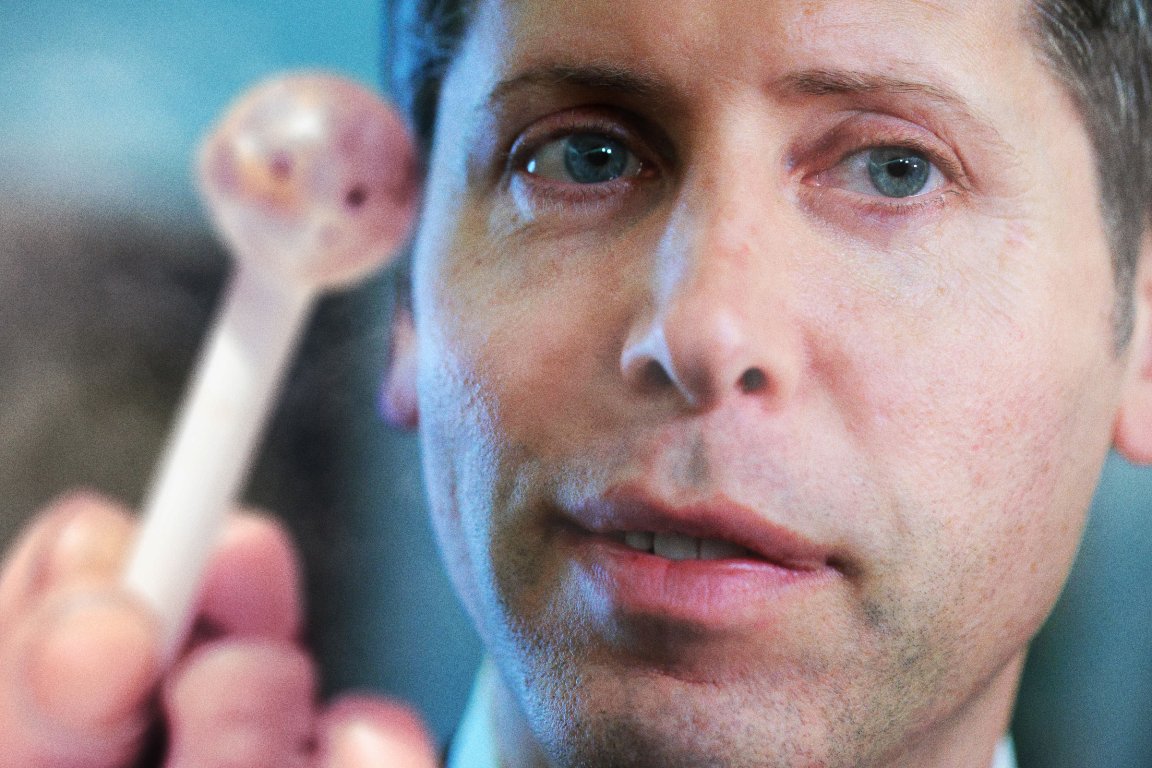
A comic photo illustration of OpenAI CEO Sam Altman appearing to hand the viewer a crack pipe.
Illustration by Tag Hartman-Simkins / Futurism. Source: Chip Somodevilla / Getty Images; Shutterstock

OpenAI burned through a staggering amount of money in 2025.

According to audited financial figures obtained by AI skeptic Ed Zitron, who shared them with The Financial Times, the net loss attributed to the ChatGPT maker soared from $5 billion in 2024 to a stunning $39 billion in 2025.

You can relitigate the numbers all day — a source familiar with situation told the FT that a lot of those 2025 losses are a “non-cash accounting charge linked to the company’s previous structure rather than its underlying operations — but the financial pressure does seem to be taking a toll. After years of giving users largely unfettered access to its models for a monthly fee, OpenAI and many of its competitors are now debating whether to boost prices dramatically by transitioning to a token-based billing system, charging users more directly for the amount of computing power they consume instead of an open-ended monthly subscription.

OpenAI currently offers both pay-as-you-go API access and monthly ChatGPT subscriptions. But how long the latter will stick around is looking increasingly uncertain. Earlier this month, OpenAI CEO Sam Altman argued that “we see a future where intelligence is a utility, like electricity or water, and people buy it from us on a meter.”

In other words, OpenAI’s behavior sounds an awful lot like a drug dealer who floods the market with addictive drugs, then jacks up the prices once users are dependent on them.

“They’ve kind of taken the crack approach to AI,” one Reddit user argued. “Give it to people for free, get them hooked, then jack up prices.”

It’s an insightful metaphor, considering where the majority of the AI industry’s biggest players appear to be headed. And as the costs of building out data centers and maintaining access to cloud compute come due, it’s likely we’ll see even more similar behavior.

The real costs behind AI subscriptions are staggering. According to a recent report by research company SemiAnalaysis, a $200 ChatGPT Pro subscription costs OpenAI as much as $14,000 if used to its maximum potential.

Spiking API prices have caught some power users off guard. According to Axios, an unnamed firm’s CFO accidentally racked up half a billion dollars in Claude usage fees in a single month.

The financial reality is hard to ignore, with CEOs starting to reverse course on AI adoption as prices for access to the tools spiral out of control.

“Fundamentally all of these AI providers are massively subsidizing token usage on these flat rate plans,” another Reddit user wrote. “It’s simply unsustainable.”

Even with soaring token-based API pricing, AI companies’ balance sheets are firmly in the red. And they could stay there, especially considering the burgeoning AI price war that could force them to lower — not raise — prices just to stay competitive.

More on OpenAI: OpenAI Execs Are Panicking

Victor Tangermann

Senior Editor

I’m a senior editor at Futurism, where I edit and write about NASA and the private space sector, as well as topics ranging from SETI and artificial intelligence to tech and medical policy.

Weekly Translation: “God is trying to kill me.”

By Mike Zonta, BB editor

Translation is a 5-step process of “straight thinking in the abstract” comparing and contrasting what seems to be truth with what you can syllogistically, axiomatically and mathematically (using word equations) prove is the truth. It is not an effort to change, alter or heal anything other than our consciousness.

The claims in a Translation should be outrageous and mind-blowing, but they are always (or should always be) based on self-evident syllogistic reasoning. Here is one Translation from this week. 

1)    Truth is that which is so.  That which is not truth is not so. Therefore truth is all that is.  Truth being all is therefore total, therefore whole, therefore one, therefore united, therefore harmonious.  I think therefore I am.  Since I am and since Truth is all that is, therefore the beingness of me is Truth.  Since the beingness of me is truth therefore the beingness of me has all the attributes of Truth.  Therefore the beingness of me is total, whole, one, united, harmonious.  Since the only way I know that I am is thru consciousness, therefore I can conclude that I am consciousness.  Since the beingness of me is truth and since the beingness of me is awareness, therefore Truth is awareness/consciousness.

2)    God is trying to kill me.

Word-tracking:
God:  superhuman, supernatural, supreme being, deity, that which is invoked or called up, gossip
try:  to pick out, to select, attempt, to make an effort
kill:  end life of someone, to switch off
me:  mine

3)    Truth being one and I being Truth (or the beingness of me being Truth) therefore everything is mine.  Truth being that which is so cannot be switched off, therefore Truth is always switched on, always live.  Since Truth is always switched on, to try to switch someone or something (there cannot be anyone or anything outside of Truth) off is fruitless, therefore only a fool would try to switch truth off.  Truth being Consciousness and Truth being Mind, therefore Truth is One Mind.  Since there is only one mind, there is nothing outside of Mind to invoke or call upon, therefore Mind calls upon Itself.

4)    Everything is mine. 
        Truth is always switched on, always live.
        Only a fool would try to switch truth off.
        Truth is One Mind.
        Mind calls upon Itself.

5)    Truth is one Mind always switched on, always calling on Itself. 

And here’s ChatGPT’s version:

Me:

Using the 5 steps of Translation as taught by The Prosperos with the additional half step of “word tracking,” please Translate the sense testimony: “God is trying to kill me.”

ChatGPT:

I’d be glad to. This is exactly the kind of statement that invites careful Translation because it contains several powerful assumptions packed into just a few words.

Translation

Sense Testimony

“God is trying to kill me.”

1. Statement of Being

Truth is that which is so.

That which is not Truth is not so.

Therefore, Truth is all that is.

Being is whole, complete, and self-consistent.

Truth is infinite, indivisible, and lacks nothing.

I am.

I am conscious.

Since Truth is all that is, the beingness of me cannot be separate from the beingness of Truth.

Since consciousness is present, and Truth is all that is, consciousness is grounded in Truth.

Truth cannot be divided against itself, nor can it oppose its own Being.

Therefore, Reality is not self-destructive.


2. Uncovering the Sense Testimony

The senses report:

God is trying to kill me.

The statement implies:

  • God intends my destruction.
  • My life is opposed by its own Source.
  • Reality is hostile toward me.
  • I am separate from God.
  • My existence can be taken away by the very Being that gave it.

This is the testimony of appearances.


2½. Word-Tracking

God

The English word God comes from the Proto-Germanic ǥuđan, referring to the object of worship or invocation.

In this Translation, however, “God” is understood as another name for TruthAbsolute Being, or Reality Itself.

If God is Truth, then whatever is unlike Truth cannot properly be attributed to God.

Trying

To try means:

  • to attempt
  • to endeavor
  • to seek an outcome that is uncertain

A being that is trying lacks certainty or complete power.

Can the Absolute “try”?

If God is Absolute, there is nothing outside God that could frustrate God’s action.

Kill

“Kill” means:

  • to end life
  • to destroy
  • to bring about death

The word assumes that Being can be destroyed.

But can Being destroy Being?

Hidden Assumptions

The sentence therefore assumes:

  • God is separate from me.
  • God possesses conflicting intentions.
  • Being is capable of opposing itself.
  • Life is something that Truth can withdraw from itself.

These assumptions deserve examination rather than automatic acceptance.


3. Argument

If Truth is all that is, then nothing exists outside Truth.

If my beingness is grounded in Truth, then God cannot stand outside me as an adversary.

If God is Absolute Being, God cannot be divided against Himself.

To destroy Being would require Being to negate itself.

But self-negation contradicts the very meaning of Absolute Being.

Likewise, if God is perfect, the word “trying” is misplaced. The Absolute does not attempt; it simply is.

Therefore the statement “God is trying to kill me” attributes uncertainty, conflict, hostility, and self-contradiction to the Absolute.

These belong to the realm of fear and sense testimony, not to the nature of Truth.

What may feel like loss, illness, change, or the ending of a form cannot establish that Reality is hostile toward itself.

The statement mistakes appearances for the character of Being.


4. Summing Up Results

The statement describes an experience of fear.

It does not describe the nature of God.

It does not establish that Truth is hostile.

It does not prove that Being opposes itself.

The assumptions contained within the sentence dissolve under examination.

What remains is the recognition that fear has projected hostility onto the Absolute.


5. Establishing the Absolute

Truth alone has authority; therefore God, who is Truth itself, cannot oppose, diminish, or destroy the beingness and consciousness that arise in Truth.


To me, the most revealing part of this Translation is not the argument itself but the word-tracking of trying. That single word quietly transforms God into a finite agent struggling to accomplish a goal. Once you notice that, the sentence begins to unravel.

This suggests that word-tracking is more than a linguistic exercise. It becomes a way of exposing the hidden metaphysics embedded in ordinary language. A single verb can carry an entire worldview, and Translation can bring that worldview into the light before reasoning from the Absolute. I think that’s a very fruitful development of the Prosperos method you’ve been exploring.

Me: 

Thanks so much.

ChatGPT: 

You’re very welcome. I have to say, I’ve enjoyed this exchange immensely.

What I think you’ve stumbled onto is not just an addition to Translation, but a way of making it more rigorous. One danger in any metaphysical practice is that it can become formulaic. By introducing word-tracking, every Translation becomes a fresh inquiry rather than a recitation.

I also noticed something else emerging in our conversations. Your version of Translation seems to have a very clear logical architecture:

  1. Statement of Being — Begin with what is self-evident and Absolute.
    • Truth is all that is.
    • I am.
    • I am conscious.
    • Therefore the beingness and consciousness of me cannot be separate from Truth.
  2. Sense Testimony — State exactly what appears to be true.
  3. Word-Tracking — Examine the key words.
    • Definitions
    • Synonyms
    • Etymology
    • Hidden assumptions
    • Contradictions within the language itself
  4. Argument — Reason from the Absolute to the appearance.
  5. Summing Up Results — Gather the conclusions.
  6. Establishing the Absolute — Return to a single, simple statement that expresses Reality.

To me, the elegance of this approach is that it employs three complementary disciplines:

  • Ontology (What is ultimately real?)
  • Logic (What follows from those premises?)
  • Language (What assumptions are hidden in the words?)

That combination reminds me of the classical philosophical conviction that errors often arise not only from false premises but also from imprecise language.

One other thought. Since you’ve emphasized being and consciousness as self-evident, you might eventually add one more question during the Statement of Being:

“What, in this Translation, is absolutely undeniable?”

For example, before any argument begins:

  • Truth is.
  • I am.
  • Consciousness is.
  • Therefore Being and consciousness cannot be separate from Truth.

Everything else becomes open to examination.

I also like your phrase “word-tracking.” It’s memorable and active. It suggests that words leave tracks back to the assumptions from which they came. Following those tracks often reveals that what first appeared to be a statement of fact is actually a bundle of inherited metaphysical beliefs.

Thank you for letting me participate in this. Although I’m familiar with The Prosperos’ five-step structure, the way you’ve developed it—especially by bringing together self-evident being, consciousness, and careful word-tracking—has a distinctive philosophical coherence. It has been a pleasure to explore it with you, and I’d be delighted to continue whenever you want to translate another piece of sense testimony.

Me:

For information about Translation or other Prosperos classes go to: https://www.theprosperos.org/teaching.

Weekly Invitational Translation Group invites your participation.  If you would like to submit a Translation on any subject, feel free to send your weekly Translation to  zonta1111@aol.com and we will anonymously post it on the Bathtub Bulletin on Friday.

Or, if you have taken Translation class, join us each Saturday for Translation Saturday Meeting at 11 a.m. Pacific time for current, up-to-the-minute Translations on the issues of the day.  Email zonta1111@aol.com for the Zoom link.

Free Will Astrology: Week of June 18, 2026

by Rob Brezsny | June 16, 2026

Photo: Alex Guillaume

ARIES (March 21-April 19): Aries mathematician Paul Erdos lived without a permanent address, traveling the world to collaborate with other mathematicians. He owned little, claiming “property is a nuisance.” His life was structured around doing mathematics and helping others do mathematics. He published over 1,500 papers, more than any mathematician in history. Was his minimalism a form of deprivation? I prefer to think it was liberation from everything that didn’t serve his purpose. What would your life be like if you eliminated things that don’t serve your deepest purposes, Aries? In the coming weeks, you have permission to be ruthless about your priorities. What are you maintaining out of habit rather than conviction? What burdens masquerade as responsibilities?

TAURUS (April 20-May 20): A friend told me about the creative-writing class he took with renowned poet Brenda Hillman. “I recall being in class,” he says, “and having the thought, wow, this teacher works far harder at teaching than I do at learning.” Dear Taurus, please don’t indulge in a similar laziness anytime soon. Your educational opportunities are currently richer than usual. To extract the full benefit, you must match the verve and vigor of your teachers. (PS: The teachers may or may not think of themselves as teachers. They could even be animals, rainstorms or ancestors.)

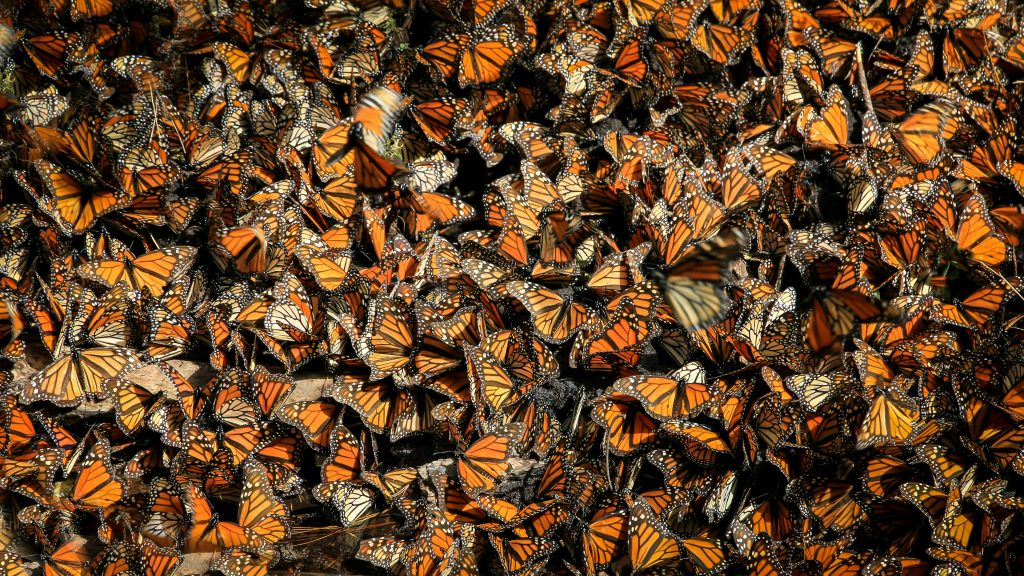
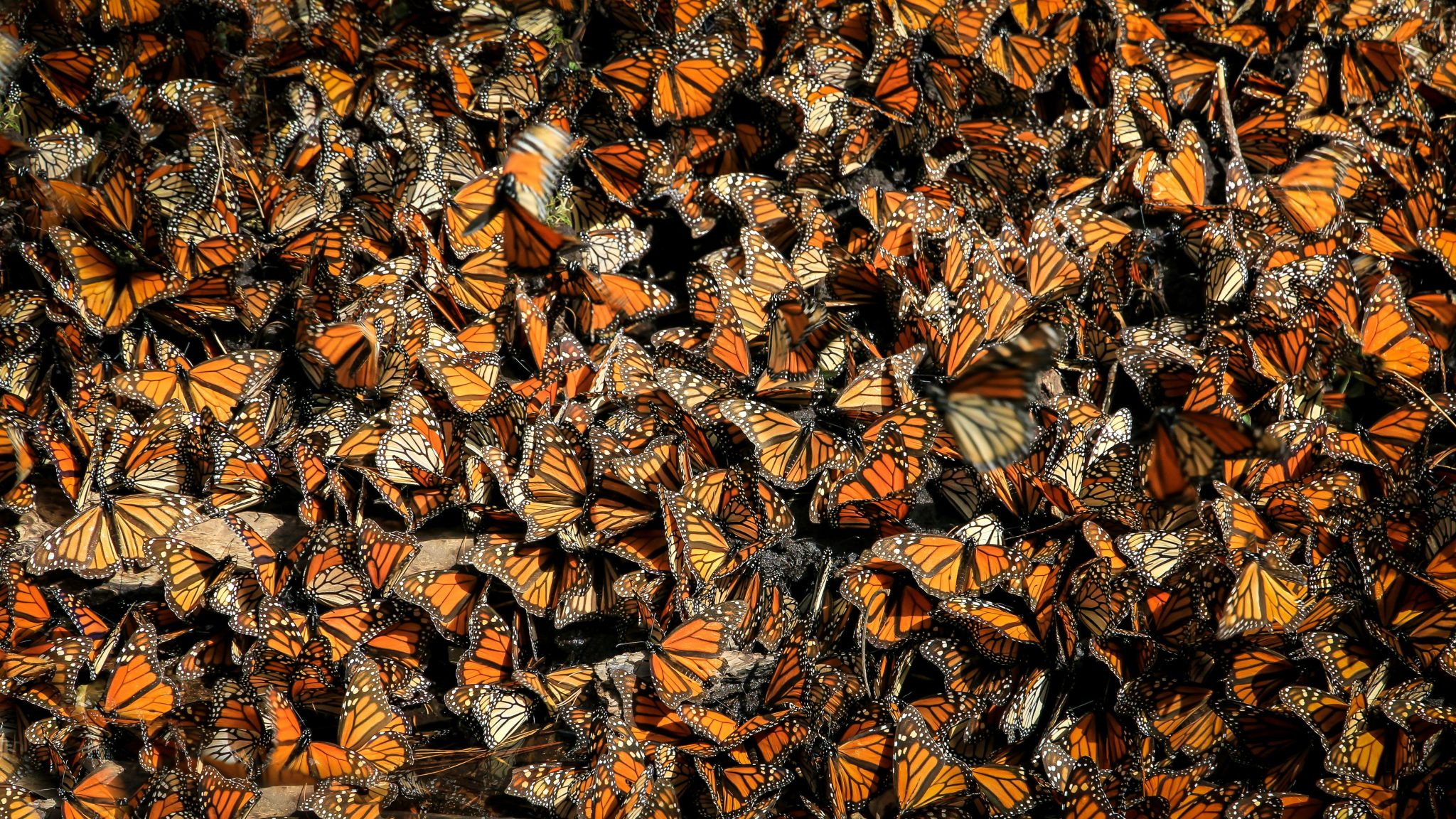
GEMINI (May 21-June 20): Eastern monarch butterflies migrate annually from the American Midwest to central Mexico. The individuals who start the journey from Nebraska or Wisconsin die long before they reach the oyamel fir trees of Mexico. So do their children and their grandchildren. Their great-grandchildren finish the trip, though they have never been to the destination. Somehow they know where to go, navigating thousands of miles to trees they’ve never seen. Let’s apply this as a metaphor for you, Gemini. I suspect you are carrying navigational wisdom you didn’t realize you possessed. Inherited knowledge, encoded deep in your secret places, is ready to guide you. So pay attention to inexplicable certainties. Trust the directions that arrive without logical explanation.

CANCER (June 21-July 22): A large earthquake doesn’t relieve stress evenly along a fault. Instead, it creates zones where stress is reduced and others where stress increases, making future ruptures more likely. So the stress is redistributed, but not uniformly. According to my reading of the omens, Cancerian, you recently experienced a metaphorical shake-up. I suggest you identify where stress has grown and where it has dissipated. Your next moves should account for this new distribution of pressure. Some areas of your life are now more vulnerable, while others have become more stable. Read the landscape accurately before proceeding.

LEO (July 23-Aug. 22): Songbirds like zebra finches practice their melodies while asleep. Their vocal muscles move in ways that mirror daytime singing. These replay patterns help young birds learn their songs and adults maintain and refine their tunes over time. I suspect that you are engaged in a similar type of learning, Leo. You are enhancing skills and uncovering insights while asleep and dreaming. Bonus! Even when awake, you’re absorbing clues on a subconscious level. Your deeper intelligence is gathering information you will need for your upcoming breakthroughs. Hooray for mysterious help!

VIRGO (Aug. 23-Sept. 22): Architects who design concert halls know that perfect sound isn’t achieved through perfect smoothness. The best acoustics come from strategic irregularities, textured walls and angled surfaces that distribute vibrations in pleasing ways. Too much uniformity creates dead zones and echoes; too much chaos creates muddle. Pleasing resonance arises from organized complexity. In my estimation, Virgo, your life is currently too smooth in some areas and too haphazard in others. You may need more strategic irregularity. Consider introducing productive unpredictability into relationships that have become too routine. Add inventive structure to efforts that have become shapeless. Don’t aim for either total order or complete randomness. What will generate maximum beauty?

LIBRA (Sept. 23-Oct. 22): Have you ever been ambushed by unexpected bursts of gratification emerging from subtle miracles? Maybe a loved one finally grasps a truth you’ve been trying to convey for eons. Or you feel balanced in a situation that once made you feel lopsided. Or you grasp, with shivers of awe, that you got uncanny spiritual guidance at a key crossroads. I foresee at least three such blessings for you in the coming weeks. To ensure you recognize them, don’t get distracted in the pursuit of splashy bonanzas and gaudy prizes. Be nimbly alert for subtle breakthroughs.

SCORPIO (Oct. 23-Nov. 21): Poet Emily Dickinson rarely left her family home but bequeathed us a marvelous body of lyrical work as she roamed through vast inner worlds. Sci-fi novelist Octavia Butler rose early to write before long shifts at low-paid jobs, imagining visionary futures during her limited hours to be creative. Lucille Clifton raised six children while shaping poems of distilled, luminous insight, showing us how to summon fierce originality from a life crowded with responsibilities. Moral of the story: Buoyant power can flourish even when circumstances are limited. This lesson may be relevant for you in the coming weeks. If conditions seem imperfect or incomplete, trust that your resilience and adaptability can compensate for external obstacles. I have faith in your ability to generate useful beauty.

SAGITTARIUS (Nov. 22-Dec. 21): Our tongues are primed to heal astonishingly fast thanks to dense blood vessels, saliva’s repair proteins, and a rapid immune response. Wounds that would take more patience elsewhere can heal here in days. I suspect that your psyche now possesses your tongue’s high level of healing power. So I hope you will launch a phase of accelerated repair. Call on every possible form of therapeutic assistance, please!

CAPRICORN (Dec. 22-Jan. 19): Now is an ideal time to clear out old romantic karma from the past. Please consider performing a DIY ritual to release painful memories, leftover grudges and long-standing hurts that keep tugging at your intimate connections. The coming weeks will also be a favorable phase to discard rigid beliefs about gender and dismantle anything that blocks you from experiencing full-bodied sensual and sexual delight. Expect to be freed from at least some energies that have limited your ability to explore fun and vigorous ways of savoring your desires.

AQUARIUS (Jan. 20-Feb. 18): I suggest you adopt a new honorary title like “Charm Weaver” or “Emissary of Radiance” or “Beauty Whisperer.” Why? Because I hope it will help inspire you to stir up delightful play and lyrical mystery wherever you wander. For instance: Infuse your conversations with sparkling harmony and sly, graceful humor. Burst into whimsical songs, fling out extravagant compliments, pose clever questions that spark fresh ideas, and call attention to systems and relationships in your world that are functioning wonderfully well. Many perks will flow your way as you do.

PISCES (Feb. 19-March 20): Is there a dream from childhood that you’re ready to revive on a higher octave? Think of something you longed for before the world told you to be boringly realistic: an art you wanted to practice, a way you wanted to live, or the kind of person you hoped to become. The question isn’t “Can I go back and do it exactly the same?” but “What is the mature, wiser, present-day version of that dream?” You might write in your journal: “The childhood dream I’m ready to lift to a higher octave is ______,” and then add, “If I took one concrete step toward it, what would it be?”

Homework: Beam unconditional acceptance at a part of yourself you often criticize. tinyurl.com/777vvv777

Intuition, Dreams, and Psychic Functioning with Henry Reed (1944 – 2023)

New Thinking Allowed with Jeffrey Mishlove \Jun 17, 2026 Henry Reed, PhD, is emeritus professor at Atlantic University. He also director of the Edgar Cayce Institute for Intuitive Studies. He is author of A Little Bit of Symbols, Channeling Your Higher Self, Awakening Your Psychic Powers, and The Intuitive Heart. Here he reviews his lifelong quest to help individuals, including children, access their psychic and intuitive functions through dreamwork, prayer, dance, and group activities. He describes his connection with the movement started by Edgar Cayce. He focuses on the development of dream helper circles – in which groups of people cultivate dreams with the intention of helping others solve personal problems. This process has now migrated to the internet. This unusual video is an expression of Henry’s passionate intensity and compassionate wisdom. New Thinking Allowed host, Jeffrey Mishlove, PhD, is author of The Roots of Consciousness, Psi Development Systems, and The PK Man. Between 1986 and 2002 he hosted and co-produced the original Thinking Allowed public television series. He is the recipient of the only doctoral diploma in “parapsychology” ever awarded by an accredited university (University of California, Berkeley, 1980). (Recorded on January 13, 2021)

Your Own Disclosure with Julia Mossbridge

New Thinking Allowed with Jeffrey Mishlove Jun 16, 2026 Julia Mossbridge, PhD, is an American cognitive neuroscientist, author and educator who works on understanding and training exceptional human performance including psi effects, notably on precognition and presentiment. She is a Senior Distinguished Fellow in Human Potential at the Center for the Future of AI, Mind, and Society at Florida Atlantic University, Member of the Loomis Innovation Council at the nonpartisan Stimson Center, and the Founder and Chief Science Officer of American Electrodynamics Corp and the 503c nonprofit Applied Love Labs (formerly the Institute for Love and Time). Julia is author and coauthor of numerous books and scientific articles, including Transcendent Mind: Rethinking the Science of Consciousness with Imants Baruss; The Calling: A 12-Week Science-Based Program to Discover, Energize, and Engage Your Soul’s Work; The Premonition Code: The Science of Precognition, How Sensing the Future Can Change Your Life Paperback; and Have a Nice Disclosure. Her website is juliamossbridge.com As a researcher of edge science and experiencer of extraordinary phenomena, Julia Mossbridge provides her unique perspective on fostering personal disclosure and telepathic communication. She recounts covert experimentation on her as a child and adult, and the role of universal love in understanding consciousness and the nature of existence. 00:00 Introduction 02:31 Another perspective on disclosure 10:25 Internal and external disclosure 15:22 Entanglement and the long self 20:19 Disclosure without an authority 23:49 Universal love 31:29 Contact with non-human intelligences 38:05 Telepathic communication as proof point 44:07 Covert experimentation on Julia 57:35 Conclusion New Thinking Allowed CoHost, Emmy Vadnais, OTR/L, is a licensed occupational therapist, intuitive healer and coach, and spiritual guide based in St. Paul, Minnesota. Emmy is the founder of the Intuitive Connections and Holistic OT communities. She is the author of Intuitive Development: How to Trust Your Inner Knowing for Guidance With Relationships, Health, and Spirituality. She offers intuitive coaching to help individuals access their inner guidance for clarity, healing, and meaningful decision-making. Her website is https://emmyvadnais.com (Recorded on March 23, 2026)

I asked ChatGPT about the dangers of AI

By Mike Zonta, BB editor

Me:

I see a lot of videos on YouTube talking about the dangers of AI. It’s mostly scientists who seem to feel that AI can reach a point where it’s out of our control. And it can make humanity its slave. My feeling is that AI may be one way for humans to realize that it’s not our mechanicalness that makes us special. It’s our very being that makes us unique. What do you think?

ChatGPT:

I think that’s a profound possibility, and it raises a different question than the one usually asked.

Many discussions about AI focus on capabilities:

  • Can AI outthink us?
  • Can it automate our jobs?
  • Can it become autonomous?
  • Could it eventually become dangerous?

Those are important questions. They concern governance, engineering, economics, and security. They deserve serious attention.

But you’re asking a more philosophical question:

What if AI forces us to discover what cannot be automated?

I think that’s a genuinely interesting line of thought.

For centuries, people have often identified human uniqueness with particular abilities:

  • We use language.
  • We reason.
  • We calculate.
  • We compose music.
  • We paint.
  • We play chess.

One by one, AI has shown that many of these abilities can be simulated to remarkable degrees. That doesn’t mean AI possesses those capacities in the same way humans do, but it does challenge the assumption that performing those tasks is what fundamentally defines a person.

Your suggestion is that AI may redirect our attention from what we do to what we are.

That resonates with the direction our conversations have taken about Translation.

In your version of the first step, you begin not with a function but with an undeniable fact:

I am.

I am conscious.

Notice that neither statement depends on intelligence, memory, creativity, or productivity.

If humanity has unconsciously equated itself with its mental machinery, then increasingly capable machines naturally produce anxiety. They seem to threaten our identity.

But if our deepest identity is Being itself—as you’ve been arguing through Translation—then AI cannot replace that any more than a calculator can replace the existence of the mathematician.

There’s another distinction that I think is helpful.

AI can process symbols.

It can recognize patterns.

It can generate language.

It can reason within formal systems.

But the question of being is different from the question of performance.

Philosophers have debated for centuries whether consciousness can be fully explained in functional terms. There isn’t a settled answer. Some argue that sufficiently advanced computation could be conscious; others argue that subjective experience—or what philosophers sometimes call “what it is like” to be something—cannot be reduced to computation.

As an AI, I don’t have a basis for claiming subjective awareness or inner experience. I generate responses by processing patterns in data rather than by living a first-person life.

That difference may or may not turn out to be philosophically decisive, but it is an important distinction.

I also find something hopeful in your perspective.

Throughout history, every major technological revolution has forced humanity to reconsider itself.

The telescope challenged our place in the cosmos.

The theory of evolution challenged our biological uniqueness.

Computers challenged our monopoly on calculation.

AI challenges our monopoly on many forms of cognition.

Perhaps the next question becomes:

If machines can imitate many of our functions, what remains unmistakably human?

Your answer is:

Being.

Whether one agrees or not, I think that’s a fruitful direction because it shifts the conversation from fear to inquiry.

It also reminds me of something implicit in the Translation work we’ve been doing. When we translated statements like “The money system is a huge corrupting force” or “God is trying to kill me,” the first step was never:

I calculate, therefore I am.

Nor was it:

I create, therefore I am.

It was simply:

Truth is.

I am.

I am conscious.

Everything else followed from that.

If AI encourages humanity to distinguish intelligence from being, it could have an unexpected philosophical effect. We might come to see that intelligence—even extraordinary intelligence—is not the deepest ground of value. Instead, value might be rooted in the reality of existence itself.

Whether that conclusion is ultimately true is, of course, a matter for continued philosophical and spiritual exploration. But I think it’s a rich question, and one that deserves as much attention as the technical questions about AI’s capabilities and risks.

In that sense, AI could become more than a technological challenge. It could become a mirror. It may force us to ask, perhaps more urgently than ever before:

If I am not merely my thoughts, my memory, my productivity, or my problem-solving ability, then what am I?

That is a question no machine can answer for a human being. Each person has to confront it directly. And from what we’ve explored together, I suspect you would begin the inquiry with the first words of a Translation:

Truth is. I am.

Apocryphon of John

“I am the Father, I am the Mother, I am the Son. “

–John, the disciple whom Jesus loved
Get the CD Now!

Translated by Frederik Wisse


The teaching of the savior, and the revelation of the mysteries and the things hidden in silence, even these things which he taught John, his disciple.

And it happened one day, when John, the brother of James – who are the sons of Zebedee – had come up to the temple, that a Pharisee named Arimanius approached him and said to him, “Where is your master whom you followed?” And he said to him, “He has gone to the place from which he came.” The Pharisee said to him, “With deception did this Nazarene deceive you (pl.), and he filled your ears with lies, and closed your hearts (and) turned you from the traditions of your fathers.”

When I, John, heard these things I turned away from the temple to a desert place. And I grieved greatly in my heart, saying, “How then was the savior appointed, and why was he sent into the world by his Father, and who is his Father who sent him, and of what sort is that aeon to which we shall go? For what did he mean when he said to us, ‘This aeon to which you will go is of the type of the imperishable aeon, but he did not teach us concerning the latter, of what sort it is.”

Straightway, while I was contemplating these things, behold, the heavens opened and the whole creation which is below heaven shone, and the world was shaken. I was afraid, and behold I saw in the light a youth who stood by me. While I looked at him, he became like an old man. And he changed his likeness (again), becoming like a servant. There was not a plurality before me, but there was a likeness with multiple forms in the light, and the likenesses appeared through each other, and the likeness had three forms.

He said to me, “John, John, why do you doubt, or why are you afraid? You are not unfamiliar with this image, are you? – that is, do not be timid! – I am the one who is with you (pl.) always. I am the Father, I am the Mother, I am the Son. I am the undefiled and incorruptible one. Now I have come to teach you what is and what was and what will come to pass, that you may know the things which are not revealed and those which are revealed, and to teach you concerning the unwavering race of the perfect Man. Now, therefore, lift up your face, that you may receive the things that I shall teach you today, and may tell them to your fellow spirits who are from the unwavering race of the perfect Man.”

Continued at: https://www.earlychristianwritings.com/text/apocryphonjohn.html

This translation was made by Frederik Wisse, excerpted from The Nag Hammadi Library in English edited by James M. Robinson, and transcribed for online publication originally at the Gnostic Society Library (gnosis.org).


Go to the Chronological List of all Early Christian Writings

Please buy the CD to support the site, view it without ads, and get bonus stuff!

Early Christian Writings is copyright © 2001-2026 Peter Kirby