Sep 12, 2026 (Thom.TV)
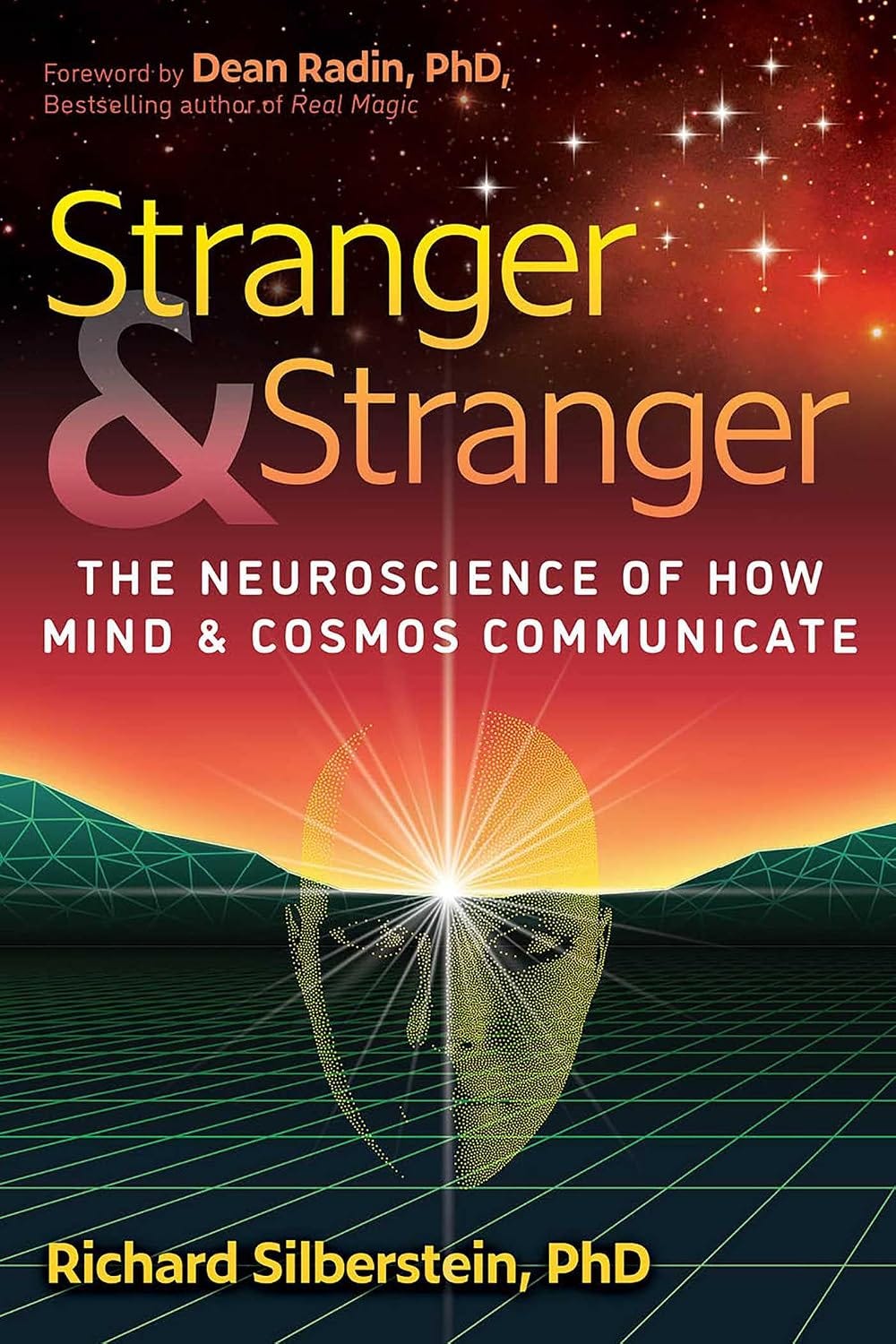
It’s not often that you encounter a book that can flip your entire view of the world on its side, which is why I’m taking a moment to share this incredible work by an old friend with you.
A physicist by training, Professor Richard Silberstein spent four decades as a working neuroscientist at Swinburne University in Melbourne, Australia. He was the Chairman of the Physics Department, founder of the Brain Sciences Institute, and the inventor of a brain imaging method (Steady State Topography) that’s now used to study everything from memory to ADHD. The author of more than 110 peer-reviewed published scientific papers, he is, by temperament and profession, a scientist and skeptic.
Those credentials — he’s literally among the world’s top brain scientists — is what makes his new book, Stranger and Stranger: The Neuroscience of How Mind and Cosmos Communicate (Park Street Press, out this October) so astonishing and life-changing.
He started out trying to make sense of one well-known stubborn anomaly, precognition (seeing the future), and ended up going down the rabbit hole that his book lays out in astonishing detail.
In the first half of the book, Richard takes us on a tour of the tens of thousands of replicated, solid, usually peer-reviewed science that suggests the existence of something parapsychologists call psi. They include:
— The Ganzfeld telepathy protocol, where a meta-analysis of 108 studies published between 1987 and 2010 produced odds against chance of roughly one in ten quadrillion that such a thing could be possible, yet it keeps getting reaffirmed over and over again.
— He digs into quantum random number generators that are influenced by human thought, the double-slit experiments run by Dean Radin’s team at the Institute of Noetic Sciences, and a body of presentiment studies in which people’s skin conductance rises a few seconds before a disturbing image appears on a screen, and, confounding all expectations and “rational” explanations, before the computer has even selected it.
— He revisits the CIA’s infamous remote viewing program (and its considerable and well-documented successes) and the 1995 evaluation in which statistician Jessica Utts and professional skeptic Ray Hyman, asked to assess the same data, ended up largely in agreement.
Silberstein’s own research also appears in the book and its mind-boggling. In 2024 he and a colleague published a study of identical twins placed in separate rooms, sensorily isolated from each other, as one viewed a series of random images while the other stared at a blank screen.
Changes in the “receiver” twin’s brain lined up with the moments the “sender” saw a “meaningful” picture and happened at a frequency that should have been four times in a hundred million trials. Even more fascinating, when these twins were, essentially, telepathically connected hroughout the experiment, the receiving twins reported feeling nothing at all. Whatever was going on, it was happening well below the threshold of human awareness.
It’s that observation that’s at the heart of Richard’s book’s most interesting argument, one that has massive implications for humanity, religion, politics, and science.
Silberstein proposes that our brains don’t so much “create” consciousness as connect to some vast universal source that our brains then filter. Evolution, he argues, built our nervous systems to prioritize necessities like food, sex, and survival, while it built elaborate inhibitory circuits to suppress everything else the universe is giving us access to but that our brains consider “not necessary.”
Recent studies he cites include patients with left frontal lobe damage, showing that they can affect random number generators in ways “normal” people can’t. Interestingly, when that same region of the brain is temporarily quieted by transcranial magnetic stimulation, normies can also influence random number generators.
Turn off the brain’s “gatekeeper,” in other words, and you let both creativity and the intelligence and experience of the universe, psi, leak through.
And then the book gets even stranger, as the title promises.
Silberstein shares the details of Michael Levin’s work at Tufts showing that bioelectric fields, not just genes, direct how animal (and, presumably, plant) bodies develop, including the now-famous tadpole grown with a working eye on its flank because of bioelectric stimulation.
He tells the stories of the heart transplant recipients who reported acquiring their donors’ tastes, from food to motorcycles.
He engages seriously, and with genuine intellectual courage, with Ian Stevenson’s decades of case files on children who describe past lives in detail.
And he posits that probable futures exists in a nested hierarchy of what he calls Temporal Causal Levels, shaped by consciousness itself through what he terms retrocausal loops.
While the science is amazing, the possible implications for society and politics are equally astonishing. Studies done by hardcore scientists working under the umbrella of the Global Consciousness Project found that when a certain threshold of people in a community regularly meditate, the crime rate and rate of general violence drops.
But what about the opposite? What happens when billionaires like Musk and Zuckerberg use their social media platform algorighms to feed hate, bigotry, fear, and rage directly into people’s minds? Whether they’re doing it to “increase engagement” to crank up time-spent-scrolling and advertisement exposure to make more billions, or to influence politics and political perspectives, the result could well be the same.
He argues that these billionaires have built a global machine for generating exactly the kind of massed, focused, hostile intent that his science finds actually affects the physical world around us as well as the minds of those around us.
Citing Peter Turchin’s work on Cleodynamics that charts cycles of political disintegration, Richard closes his book by calling for coordinated, large-scale group meditations focused on making a better and more peaceful world for us all.
This book will both astonish you and change how you view much of what we’re confronting today, from our psychology to our religion to our politics. Don’t miss it!
(Contributed by John Atwater, H.W.)