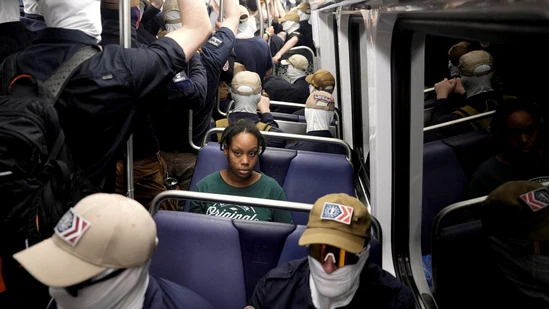
A commuter sits as members of the group Patriot Front ride the metro on the 250th anniversary of U.S. independence on the Fourth of July in Washington, D.C., U.S., July 4, 2026. REUTERS/Cheney Orr TPX IMAGES OF THE DAY (REUTERS)

French support for the American Revolution began well before the Declaration of Independence on July 4, 1776. King Louis XVI saw the rebellion in North America as an opportunity to weaken his British rival and avenge past defeats. FRANCE 24 looks back at how European colonial rivalry and Enlightenment ideals forged a decisive alliance between the nascent United States and its “oldest ally”.
Issued on: 03/07/2026 Modified: 04/07/2026 – France24.com
By: Barbara GABEL

On July 4, 1776, 13 British colonies in North America broke with the British Crown and declared their independence in a momentous act of rebellion that would change the course of history. As the United States celebrates its 250th birthday, FRANCE 24 looks back at France’s decisive – and often overlooked – role in the American Revolution.
Behind the fight for independence lies another story: that of a long-standing rivalry between Great Britain and France, the two great European powers at the time. When the Thirteen Colonies proclaimed their independence, they were still a long way from winning the war. Across the Atlantic, France watched the brewing rebellion with increasing interest.
For the young King Louis XVI, the dispute between American colonists and the British government represented an opportunity to exact revenge on France’s historic rival. Far from being a spontaneous show of support for a democratic revolution, France’s support was rooted in decades of conflict with its neighbour from across the Channel.
Read more 250 years of US independence: How France helped turn the tide of the Revolutionary War
France and Britain had been competing for control of North America, the Caribbean, the Indies and trade routes since the 17th century. The French monarchy had colonised territory spanning from the Gulf of Saint Lawrence in the north, in modern-day Canada, to the Gulf of Mexico in the south.
“France held nearly half the territory east of the Mississippi,” said Steven Ekovich, professor emeritus of politics and history at the American University of Paris. “For both monarchies, America was part of a much wider global conflict between the English and the French.”
The rivalry between the two powers did not prevent trade. As early as the 17th century, steady commerce developed between the British colonies of New England and the French West Indies. Timber, supplies, livestock, and construction materials all regularly crossed the Atlantic Ocean. These early economic ties between French and American colonists were well established before independence.
A break between the colonists and the mother country was unimaginable at this time. “The Americans were Englishmen in America above all, and they wished to remain so,” said Ekovich. The Thirteen Colonies and their 2.5 million inhabitants thus far did not consider themselves as citizens of a single nation.
New York: French air force soars over Statue of Liberty

The Seven Years’ War (1756 to 1763), pitting England and Prussia against France, Austria and Russia, changed everything. The global conflict fuelled by colonial rivalries ended with the Treaty of Paris, which forced France to cede several of its territories to the British: including Canada, part of Louisiana, parts of the West Indies, Senegal and most of its territory in India – except for a few trading posts such as Pondicherry and Chandernagore (now Chandannagar).
The French defeat was perceived as a national humiliation. The court in Versailles became obsessed with one idea: preventing England from becoming the dominant power. But Louis XVI, a pacifist at heart, remained cautious at first. His kingdom had emerged significantly weakened from the conflict and needed to rebuild its navy.
“France had only one objective on its mind: reclaiming its territory and undermining the English,” said Émilie Mitran, a historian specialising in the United States and the author of Des Américains en France,1776–1792 (Americans in France, 1776-1796). “If Britain lost part of its empire, it would be proper payback from the French point of view following its own humiliation of 1763.”
Britain was also under financial pressure after the Seven Years’ War, which had cost a colossal fortune. To compensate, it imposed new taxes on its colonies – specifically on sugar, tea and stamped papers through the infamous Stamp Act, which applied to all printed documents. Since the colonists had no representatives in the British Parliament, they refused to pay and angrily chanted, “No taxation without representation.”
France’s newly appointed foreign minister Charles Gravier, count of Vergennes, watched from the sidelines as tensions continued to simmer between the British Empire and the Thirteen Colonies. The friction evolved into the American War of Independence in the spring of 1775, with the first clashes between insurgents and British troops in Lexington, Massachusetts.
It was a historic opportunity for Vergennes. His plan was to exploit the crisis to the fullest while holding back from entering the conflict prematurely.
For an absolute monarchy like that in France, support for insurgents revolting against their king was a striking paradox. Louis XVI could not officially condone the rebellion. Yet unofficially, every British setback served French interests.
“It was initially a matter of political realism,” said Ekovich. “France wanted to use the Americans against its hereditary enemy. (…) French support was primarily driven by the logic of realpolitik.”
Enlightenment ideas also guided French supporters of the Thirteen Colonies. For decades, Parisian salons were the setting for philosophers like Montesquieu, Voltaire and Rousseau as they launched debates on liberty, the separation of powers and popular sovereignty. American leaders picked up these concepts while fighting for their independence.
Lafayette: France’s forgotten hero, America’s beloved patriot

“Two sets of logic coexisted from the beginning,” said Ekovich. “The king acts against Great Britain, while a portion of the French elite supports the Americans out of conviction.”
This duality was embodied by two figures: Louis XVI, who pursued a strategic objective, and the Marquis de Lafayette, a French aristocrat who later became the most famous French figure of the American War of Independence. The latter viewed the American struggle as a just cause driven by Enlightenment ideals.
Versailles opted for discretion before initiating any formal alliance. On May 2, 1776, Louis XVI authorised Vergennes to covertly send arms, ammunition and supplies to the insurgents through Pierre-Augustin Caron de Beaumarchais, who used a shell company known as Rodrigue Hortalez et Compagnie as a cover for the transactions.
“Beaumarchais became an irreplaceable secret agent for Louis XVI,” said Mitran. “He made it possible to fund the rebels as long as France refused to commit officially.”
France’s caution was based on several imperatives. “No one knew whether the insurgents would declare independence or if they could withstand British military might,” she said. “For France to commit prematurely meant running the risk of another financial and diplomatic disaster.”
The break between the British Crown and the Thirteen Colonies was finally sealed two months later with the adoption of the Declaration of Independence on July 4, 1776. The young nation’s name went from the “United Colonies” to the “United States of America”.
Fighting between Britain and the colonists continued. British troops captured New York in September 1776. For the representatives of the American colonies who had just declared their independence, finding reinforcements became urgent.
Eager to forge a bond with France, the American Congress dispatched a new diplomat named Benjamin Franklin to Paris. His mission was to persuade France to openly support the American rebels. Soon after arriving in France in December 1776, he became a celebrity.
“Benjamin Franklin captivated the French as much with his inventions as with his personality,” said Mitran. “He visited the salons, mastered their social codes and incarnated the new ideals arriving from America for the French.”
Despite the successful charm offensive, Vergennes remained cautious. He continued to wait for the right moment before transforming France’s covert support into an open alliance. That moment did not arrive until October 1777, when George Washington’s troops inflicted a decisive blow on the British at Saratoga, forcing 6,000 soldiers to surrender.
This military success finally convinced Versailles that the rebels could prevail. A few months later, France signed an alliance with the United States and officially entered the war against Great Britain – a decision that would profoundly alter the course of the conflict.
This article has been translated from the original in French. Click here to read Part I: How France helped turn the tide of the Revolutionary War
Johnathan Bi Jul 4, 2026 My lecture celebrating America’s 250th at the Chateau de Tocqueville: “Democracy with American Characteristics” Professor Aaron Herold tutored me as I was going through Democracy in America. His insights were critical to forming my own reading on Tocqueville and you can read more about them in his wonderful book: https://amzn.to/3Ssp7zt Subscribe to my newsletter if you want content updates, invitations to events, and to support my work: https://greatbooks.io Transcript: https://www.johnathanbi.com/p/transcr… Companion interviews:
Timestamps: 00:00 0. Introduction 01:31 1. Equality Hinders Greatness 01:31 1.1 Canada vs. America 11:04 1.2 Imperial Exams 18:20 1.3 Modern China 24:06 1.4 Why Equality Hinders Greatness 28:38 1.5 Tocqueville’s Project 36:53 2. Equality Hinders Freedom 37:38 2.1 Materialism 40:26 2.2 Individualism 44:15 2.3 Tyranny of the Majority 53:45 2.4 Totalitarianism 59:19 3. Bulwarks Against Equality 59:55 3.1 Religion and Family 1:03:21 3.2 Jury 1:06:08 3.3 Government 1:07:56 3.4 Administration 1:11:25 3.5 Associations and Press 1:12:47 3.6 Work 1:14:07 4. America Today 1:14:22 4.1 Soft Despotism 1:21:02 4.2 Industrial Aristocracy 1:29:06 4.3 Aristocracy and Freedom 1:33:07 4.4 Aristocracy and Greatness 1:35:33 5. Conclusion
New Thinking Allowed with Jeffrey Mishlove Streamed live 2 hours ago Ronnie Pontiac was the personal research assistant for Manly P. Hall at the Philosophical Research Society in Los Angeles. He is author of American Metaphysical Religion: Esoteric and Mystical Traditions of the New World and The Rosicrucian Counterculture: The Origins and Influence of the Invisible Society. He is coauthor with Tamra Lucid of The Magic of the Orphic Hymns: A New Translation for the Modern Mystic and The Unobstructed Way: A True Account of the Exploration of Life After Death. He is also a practitioner of astrology. For this Live Stream Event, Ronnie will draw upon astrology, history, and esoteric traditions to explore America’s founding and its astrological significance today.
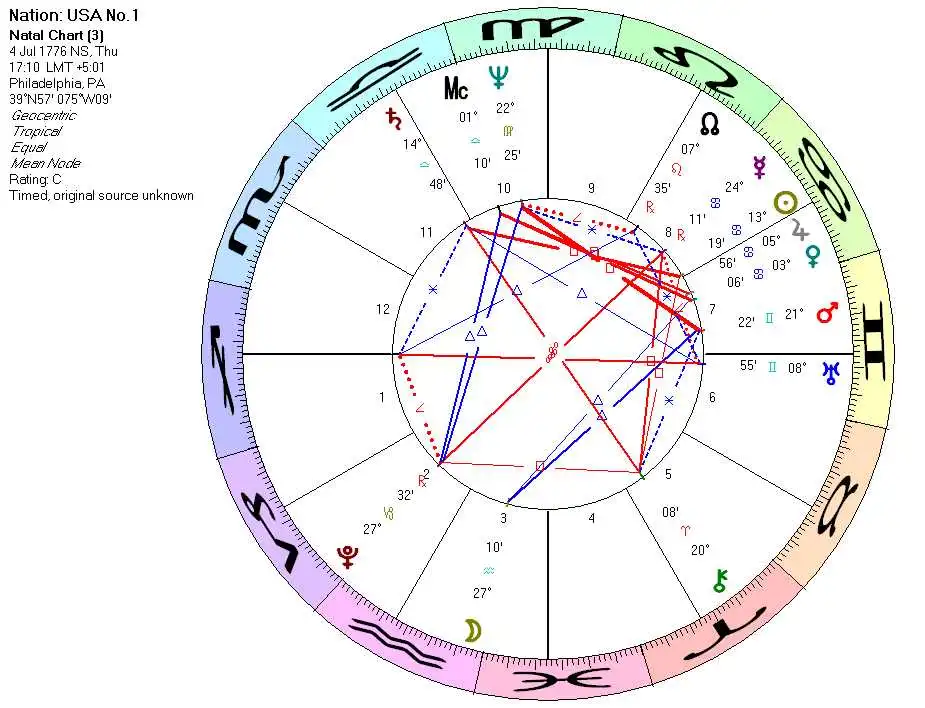
The Sibley Chart of the U.S.A.
The Onion Premiered 19 hours ago As the United States celebrates 250 years of American exceptionalism, The Onion looks back on the pivotal moments and enlightened fathers who gave birth to the greatest nation on Earth. Become an Onion member while it’s still optional: https://membership.theonion.com/?camp…
NYC Mayor’s Office Streamed live 16 hours ago Mayor Mamdani Delivers Delivers Address Marking America’s 250th Birthday July 3, 2026
Marianne Williamson Jul 3, 2026 This year should be a mindful, not a mindless celebration Subscribe to Marianne’s Substack: MarianneWilliamson.Susbtack.com
On the 250th, Kings Still Don’t Belong—Not in Name, Not in Spirit
by Don H. Doyle June 29, 2026 (zocalopublicsquare.org)

On the 250th anniversary of the Declaration of Independence, most Americans will celebrate the revolutionary manifesto as the culmination of a long-simmering rebellion against King George III. But until only a few months earlier, the colonists blamed Parliament for odious British measures they simply wanted to reform. Beginning January 10, 1776, all of that changed with the publication of a brief pamphlet, authored by an anonymous Englishman. That pamphlet, “Common Sense,” reframed the colonists’ dispute with Parliament over taxes and imperial authority into a radical revolution against King George III and against monarchy itself.
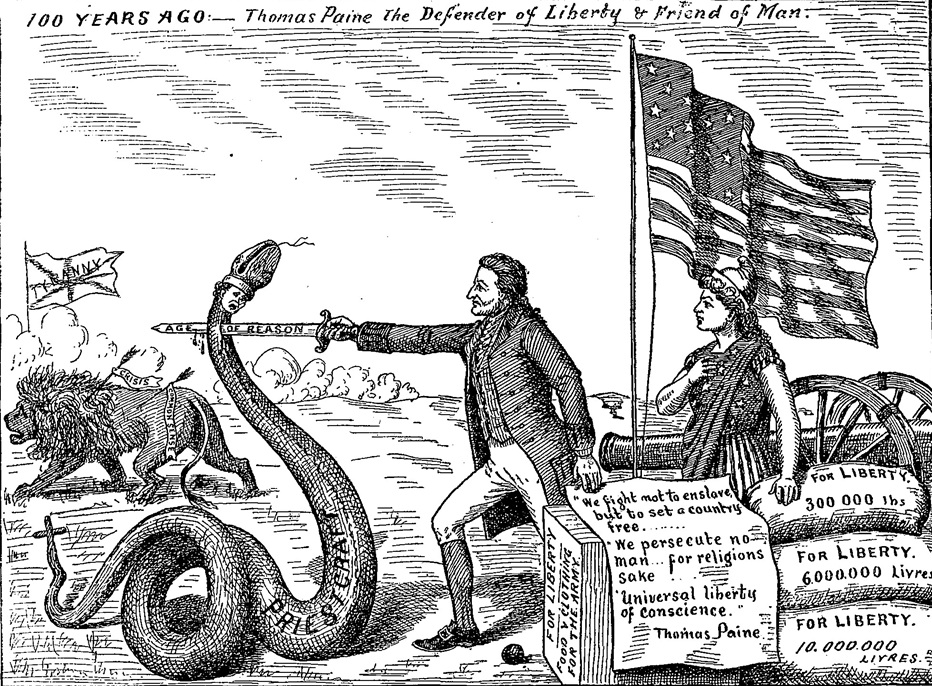
For fear of being hanged as a traitor, Thomas Paine did not reveal himself as the “Common Sense” author until three years later. Born in England in 1737 into a Quaker family, Paine had schooled himself in the Enlightenment philosophy of natural rights and the social contract. While working as a tax collector, he penned petitions for better pay and working conditions for his fellow excise officers, which cost him his job. In London, he met Benjamin Franklin, who urged him to take his polemical talents to America, and wrote the letter of introduction that secured Paine a job as an editor and author at The Pennsylvania Magazine.
Paine arrived in Philadelphia in November 1774. He found not a united country with a common enemy but a fractious group of divided colonies, religious sects, and ethnic groups quarreling with the British Parliament and one another. Americans had been haranguing Parliament to rescind the new tariffs, taxes, and commercial regulations it had imposed on the colonies after Britain’s successful war against the French, which ended in 1763.
Most Americans perceived King George III as their “common father” and protector of his distant colonial subjects, not least against the British soldiers and customs collectors Parliament had sicced upon them. Americans celebrated the anniversaries of the king’s birthday and coronation even as the Sons of Liberty were arousing anger against His Majesty’s Parliament. New Yorkers showed their royalist sympathies by raising an equestrian statue of the king on Manhattan’s Bowling Green in 1770. (Six years later, on July 9, 1776, an angry mob tore down the statue and purportedly melted it down into ammunition.)
Less than three months after the Minutemen gave battle to British soldiers at Lexington and Concord in April 1775, the Second Continental Congress sent the “Olive Branch Petition” to King George III. The delegates swore loyalty and denied any intention of separation, if only His Majesty would protect them from Parliament’s unjust laws. King George III coldly refused to acknowledge his subjects’ plea, declared the colonies to be in open rebellion, and sent more troops to enforce British rule.


With that, the colonists became resigned to war, but most remained uncertain if its goal was to be separation from Britain when, six months after King George III’s rejection of their olive branch, “Common Sense” appeared.
Paine saw beyond the quarrels over taxes, trade regulations, and colonial autonomy to envision a much grander conflict between the Old World’s anachronistic monarchical rule and the New World’s republican future. The main question he raised was not how King George III should rule the American colonies but why kings should rule at all.
Paine began by setting forth a careful argument assailing the absurdity and danger of hereditary power. Kings originated, as often as not, with the “principal ruffian of some restless gang … chief among plunderers,” he insisted. Likewise, the ridiculous notion that kingly wisdom and virtue would pass through bloodlines was mocked by nature itself, “by giving mankind an ass for a lion.” Monarchy had inflicted war, oppression, and misery everywhere, Paine argued. “Freedom hath been hunted round the globe. Asia, and Africa, have long expelled her—Europe regards her like a stranger, and England hath given her warning to depart.” By rejecting monarchical tyranny, he proposed, America would be the “asylum for mankind,” and a break with the past. “We have it in our power to begin the world over again,” he wrote.
These were heady aspirations, and Paine understood he was challenging deeply ingrained loyalties—or, as he put it, “a long habit of not thinking a thing wrong, gives it a superficial appearance of being right.” His was an appeal to common sense, which would eventually prevail, for “time makes more converts than reason.”
“Common Sense” was the first and most influential outright call for American independence, and for rebellion against the king. It spread like wildfire: In 25 editions, with some 150,000 copies sold in a population of just 2.5 million, it was read aloud to great effect in taverns and shops throughout the colonies.
The colonial leaders who met in Philadelphia in July 1776 had read the pamphlet, too. Samuel Adams urged fellow delegates to read it and noted that “Common Sense” “has fretted some folks here more than a little.” John Adams wrote to his wife Abigail that “all agree there is a great deal of good sense, delivered in a clear, simple, concise and nervous Style.”
Thomas Jefferson, like John Adams, was convinced independence was the path forward even before his friend and fellow signer, Thomas Nelson, sent him a copy of “Common Sense.” Looking back on the declaration, Jefferson insisted that he, as its primary author, expressed the American mind; he never explicitly credited Paine or “Common Sense.” Still, Paine had enormous influence in converting Americans to the cause of independence, and the many agreements between the two documents is clear. The declaration, like “Common Sense,” placed blame for a “long train of abuses” squarely on the king, not Parliament: “The history of the present King of Great Britain is a history of repeated injuries and usurpations, all having in direct object the establishment of an absolute Tyranny over these States.” This tyrant, it concluded, “is unfit to be the ruler of a free people.”
The revolution that followed embedded a deep and enduring distrust of concentrated power unaccountable to the people. The new nation’s federal and state governments featured deliberately weak executives. The Articles of Confederation, the nation’s first constitution, eliminated the office of chief executive altogether.
That changed after the Constitutional Convention of 1787 created a strong president. Still, a system of checks and balances limited presidential powers. There were some futile efforts to invest the office with the aura of monarchy. Alexander Hamilton proposed that the president be elected for life. John Adams suggested that the president be addressed as “His Highness.” Such pretenses were quickly rejected. The United States would have no kings. Not in name, not in spirit. Two hundred fifty years later, it feels like common sense.
Don H. Doyle is the author of The Cause of All Nations: An International History of the American Civil War and The Age of Reconstruction: How Lincoln’s New Birth of Freedom Remade the World. He is the McCausland Professor of History Emeritus at the University of South Carolina.
Primary editor: Sarah Rothbard | Secondary editor: Eryn Brown
Heather Cox Richardson Streamed live 6 hours ago In which I try to answer a different set of questions, today…. Topics covered in today’s Politics Chat: Declaration of Independence 250th anniversary, natural law and unalienable rights, consent of the governed, grievances against the King, dissolution of allegiance to the Crown, birth of a new nation.
(Image from Etsy.com)
6/3/26
Nearing our 250th Declaration of Independence celebration, some words/thoughts by some of our colonial Fighters for Independence/Constitutional-Founders & Framers that didn’t make it into our Constitution; *plus, the words of possibly the most forward thinking scientist; **and the words/thoughts of one retired (2006) Supreme Court judge (who died in 2023):
“Government is, or ought to be instituted for the common benefit, protection, and security of the people, nation, or community…when any government shall be found inadequate or contrary to these purposes, a majority of the community hath an indubitable, inalienable, and indefeasible right to reform, alter, or abolish it, in such manner as shall be judged most conducive to the public weal.” George Mason
“That there be prefixed to the Constitution a declaration, that all power is originallyvested in, and consequently derived from the people.” James Madison
“The means of defense against foreign danger, have been always the instrumentsof tyranny at home…the armed forces kept under the pretext of defending, have enslaved the people.” James Madison
“…this (new government under the Constitution) is likely to be well administered for a course of years; and as other forms have done before, the people, being incapable of any other mode, will become so corrupted as to need authoritarian rule, such that, this Government will end in Despotism!” Benjamin Franklin
“As Nations become more corrupt and vicious, they have more need for masters. Only a virtuous people are capable of Liberty.” Benjamin Franklin
*”The world will not be destroyed by those who do evil, but by those who watch them without doing anything.” Albert Einstein
(Pasoir.com)