
On the 250th, Kings Still Don’t Belong—Not in Name, Not in Spirit
by Don H. Doyle June 29, 2026 (zocalopublicsquare.org)

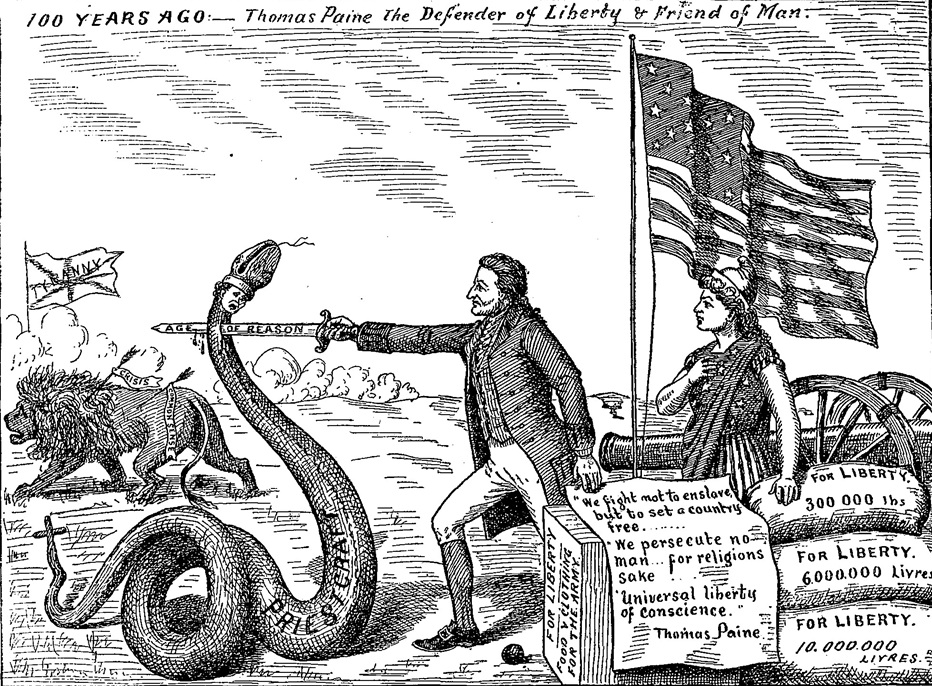
On the 250th anniversary of the Declaration of Independence, most Americans will celebrate the revolutionary manifesto as the culmination of a long-simmering rebellion against King George III. But until only a few months earlier, the colonists blamed Parliament for odious British measures they simply wanted to reform. Beginning January 10, 1776, all of that changed with the publication of a brief pamphlet, authored by an anonymous Englishman. That pamphlet, “Common Sense,” reframed the colonists’ dispute with Parliament over taxes and imperial authority into a radical revolution against King George III and against monarchy itself.
For fear of being hanged as a traitor, Thomas Paine did not reveal himself as the “Common Sense” author until three years later. Born in England in 1737 into a Quaker family, Paine had schooled himself in the Enlightenment philosophy of natural rights and the social contract. While working as a tax collector, he penned petitions for better pay and working conditions for his fellow excise officers, which cost him his job. In London, he met Benjamin Franklin, who urged him to take his polemical talents to America, and wrote the letter of introduction that secured Paine a job as an editor and author at The Pennsylvania Magazine.
Paine arrived in Philadelphia in November 1774. He found not a united country with a common enemy but a fractious group of divided colonies, religious sects, and ethnic groups quarreling with the British Parliament and one another. Americans had been haranguing Parliament to rescind the new tariffs, taxes, and commercial regulations it had imposed on the colonies after Britain’s successful war against the French, which ended in 1763.
Most Americans perceived King George III as their “common father” and protector of his distant colonial subjects, not least against the British soldiers and customs collectors Parliament had sicced upon them. Americans celebrated the anniversaries of the king’s birthday and coronation even as the Sons of Liberty were arousing anger against His Majesty’s Parliament. New Yorkers showed their royalist sympathies by raising an equestrian statue of the king on Manhattan’s Bowling Green in 1770. (Six years later, on July 9, 1776, an angry mob tore down the statue and purportedly melted it down into ammunition.)
Less than three months after the Minutemen gave battle to British soldiers at Lexington and Concord in April 1775, the Second Continental Congress sent the “Olive Branch Petition” to King George III. The delegates swore loyalty and denied any intention of separation, if only His Majesty would protect them from Parliament’s unjust laws. King George III coldly refused to acknowledge his subjects’ plea, declared the colonies to be in open rebellion, and sent more troops to enforce British rule.
You Might Also Like

Why Americans Still Eat Barbecue on July Fourth

How Charleston Celebrated Its Last July 4 Before the Civil War

The Quebec Battle That Opened the Door to America
With that, the colonists became resigned to war, but most remained uncertain if its goal was to be separation from Britain when, six months after King George III’s rejection of their olive branch, “Common Sense” appeared.
Paine saw beyond the quarrels over taxes, trade regulations, and colonial autonomy to envision a much grander conflict between the Old World’s anachronistic monarchical rule and the New World’s republican future. The main question he raised was not how King George III should rule the American colonies but why kings should rule at all.
Paine began by setting forth a careful argument assailing the absurdity and danger of hereditary power. Kings originated, as often as not, with the “principal ruffian of some restless gang … chief among plunderers,” he insisted. Likewise, the ridiculous notion that kingly wisdom and virtue would pass through bloodlines was mocked by nature itself, “by giving mankind an ass for a lion.” Monarchy had inflicted war, oppression, and misery everywhere, Paine argued. “Freedom hath been hunted round the globe. Asia, and Africa, have long expelled her—Europe regards her like a stranger, and England hath given her warning to depart.” By rejecting monarchical tyranny, he proposed, America would be the “asylum for mankind,” and a break with the past. “We have it in our power to begin the world over again,” he wrote.
These were heady aspirations, and Paine understood he was challenging deeply ingrained loyalties—or, as he put it, “a long habit of not thinking a thing wrong, gives it a superficial appearance of being right.” His was an appeal to common sense, which would eventually prevail, for “time makes more converts than reason.”
“Common Sense” was the first and most influential outright call for American independence, and for rebellion against the king. It spread like wildfire: In 25 editions, with some 150,000 copies sold in a population of just 2.5 million, it was read aloud to great effect in taverns and shops throughout the colonies.
The colonial leaders who met in Philadelphia in July 1776 had read the pamphlet, too. Samuel Adams urged fellow delegates to read it and noted that “Common Sense” “has fretted some folks here more than a little.” John Adams wrote to his wife Abigail that “all agree there is a great deal of good sense, delivered in a clear, simple, concise and nervous Style.”
Thomas Jefferson, like John Adams, was convinced independence was the path forward even before his friend and fellow signer, Thomas Nelson, sent him a copy of “Common Sense.” Looking back on the declaration, Jefferson insisted that he, as its primary author, expressed the American mind; he never explicitly credited Paine or “Common Sense.” Still, Paine had enormous influence in converting Americans to the cause of independence, and the many agreements between the two documents is clear. The declaration, like “Common Sense,” placed blame for a “long train of abuses” squarely on the king, not Parliament: “The history of the present King of Great Britain is a history of repeated injuries and usurpations, all having in direct object the establishment of an absolute Tyranny over these States.” This tyrant, it concluded, “is unfit to be the ruler of a free people.”
The revolution that followed embedded a deep and enduring distrust of concentrated power unaccountable to the people. The new nation’s federal and state governments featured deliberately weak executives. The Articles of Confederation, the nation’s first constitution, eliminated the office of chief executive altogether.
That changed after the Constitutional Convention of 1787 created a strong president. Still, a system of checks and balances limited presidential powers. There were some futile efforts to invest the office with the aura of monarchy. Alexander Hamilton proposed that the president be elected for life. John Adams suggested that the president be addressed as “His Highness.” Such pretenses were quickly rejected. The United States would have no kings. Not in name, not in spirit. Two hundred fifty years later, it feels like common sense.
Don H. Doyle is the author of The Cause of All Nations: An International History of the American Civil War and The Age of Reconstruction: How Lincoln’s New Birth of Freedom Remade the World. He is the McCausland Professor of History Emeritus at the University of South Carolina.
Primary editor: Sarah Rothbard | Secondary editor: Eryn Brown