A quarter of the world’s governments — from China, Iran, and Russia to smaller states like Rwanda and Turkey — are pursuing dissidents across the globe, using threats, intimidation, physical assault, and even murder to suppress dissent and maintain power. Democratic host states must not turn a blind eye. As Siena Anstis and Marcus Michaelsen write in our new issue, “The failure to provide consistent protection and meaningful accountability will, over time, erode the credibility of democratic institutions and the authority of the rule of law.”Read their article, “How to Combat Transnational Repression,” along with other Journal of Democracy essays examining the rising danger of transnational repression, free for a limited time.
Authoritarians actively threaten, intimidate, and murder exiles and opponents wherever they find them. While justice for victims is hard won, it is possible. Here is how democracies can push back.
By Siena Anstis and Marcus Michaelsen
The Journal of Democracy is published quarterly in January, April, July, and October. Subscribe now for full access to our archives.
Heated disagreements about sexuality and gender are everywhere these days. As an evolutionary-trained clinician who specializes in gender-specific medicine and men’s health, I have been helping individuals and couples improve their love lives for more than fifty years. I recently interviewed Dr. Nathan L. Lents about his latest book, The Sexual Evolution: How 500 Million Years of Sex, Gender, and Mating Shape Modern Relationships. I found the book to be enlightening, engaging, and downright fun to read.
I have often found resistance in some circles when I talk about the biological and evolutionary roots of who we are as males and females. Some people fear that differences will be used, as they have in the past, to restrict people’s freedom and to keep some locked into boxes that are rigid and unchanging. That does not have to be the case as Dr. Lents points out so effectively.
Joan Roughgarden, Professor emerita of biology at Stanford University, and author of Evolution’s Rainbow had this to say about The Sexual Evolution:
“A lot of people seem to think they know what science says when it comes to sex. Well, Nathan Lents has news for them. Read this book — it’s fascinating, charming, and eye-opening, with lovely ink drawings that bring the animals in its pages to life. It dispels misconceptions about life in the animal kingdom and our place in it, but most important, it shows clearly that nature’s beautiful sexual diversity extends to all living things — especially humans.”
“In just two generations, the sexual landscape has completely changed throughout most of the developed world, and so it is no surprise that many people find all of this terribly unsettling,” says Dr. Lents. “What is surprising to me however, is how little the biology and natural history of sex has factored into the public conversation. I assert that this moment of sexual turmoil is actually a rediscovery of the much more expansive relationship with sex that our ancestors once had and that other animals enjoy today.”
I grew up in southern California and spent endless hours wandering in nature. I was a biology major in college and found the world of plants and animals fascinating. As a marriage and family counselor I have found that my understanding of biology and evolution is invaluable in helping me support my client’s desire to have a wonderfully passionate sex and love life.
In a recent article, “This Truth About Males and Females Will Change Your View of Sex, Love, and Life Forever,” I described the work of my colleague, Michael Gurian, who has been reporting on male/female differences in brain function for decades. In a video blog, he shared the research that has been going on for more than 40 years and the evidence from a new study that shows brain differences, in utero, long before the effects of gender socialization.
If there was one thing Dr. Lents wanted people to take away from reading his book, it is the value of diversity in the lives of all living things.
He said that in the modern world, much of how we express our sexuality, and how we form our sexual relationships, stems from cultural constructions, not innate biological wiring. Even a cursory glimpse of the sex lives of other animals demolishes any notion that sexual activity is narrowly purposed toward procreation. Biologists have discovered an ever-expanding list of reasons that animals have sex with each other. Animals use sex for bonding, social cohesion and alliance building. They use sex deceptively, competitively and financially. They even have sex for the same reason that we most often do it: just for the fun of it.
Moreover, in no other species but humans is sex rigidly restricted by broad constructions such as heterosexuality and sexual monogamy, nor was it so restricted for most of the history of our own species. As humans explore this supposedly new sexual territory, we can look to our animal cousins for guidance on how to manage this minefield of social upheaval.
Not only will an understanding of our evolutionary diversity help improve our love lives, it may very well be the key to our survival. You don’t have to be a trained scientist to recognize that our human species is out of touch with the laws of nature. The burning hot temperatures we are experiencing all over the world is one reminder of the risk we are facing as humans continue to undermine our connections to the Gaia and all her diverse life forms.
As Thomas Berry warned us:
“We never knew enough. Nor were we sufficiently intimate with all our cousins in the great family of the earth. Nor could we listen to the various creatures of the earth each telling its own story. The time has now come, however, when we will listen or we will die.”
There is still time to listen and learn. If you would like to get more information about Nathan H. Lents, you can do so here: https://thehumanevolutionblog.com/. He told me he’s interested in hearing from people and he reads all emails people send.
An augur stands behind the covered Numa Pompilius at an auspicium ceremony to look at the sign from the birds on whether Numa was fit to be the future king of Rome. Engraving: Bernhard Rode, 1768-69
auspicate
PRONUNCIATION:
(AW-spi-kayt)
MEANING:
verb tr.: To begin an undertaking, especially with a ceremony intended to bring good luck.
ETYMOLOGY:
From Latin auspex (one who observes birds), from avis (bird) + -spex (watcher), from specere (to look). Earliest documented use: 1604.
NOTES:
Etymologically speaking, to auspicate is to birdwatch. In ancient Rome, an official called an auspex or augur looked for divine approval by observing birds: how they flew, called, or fed. Because, naturally, whether the birds pecked with gusto could decide whether an army marched, an election proceeded, or everyone went home kibitzing.
Professional bird-omen consultants are scarce today, but the market for the future remains crowded: tarot-card readers, palm readers, and other vendors of Delphic mumbo-jumbo are still ready to take your money and, in return, tell you what the universe allegedly meant to say.
Related words include auspices. and auspicious. The word inaugurate is also related: Latin inaugurare meant to take omens from birds, or to consecrate or install when the omens were favorable.
“The greatest burden a child must bear is the unlived life of the parent.”
–Carl Jung
Shadow Within Jung May 18, 2026 Talk to Yourself This Way and Your Life Will Heal | Carl Jung Your body has never been your enemy. It has been trying to speak to you for years. Carl Jung believed that emotional pain, repression, and unresolved trauma often express themselves through the body. In this video, you will discover how the way you speak to yourself can influence healing, self-awareness, and inner transformation. ????
New Thinking Allowed with Jeffrey Mishlove Jul 19, 2026 Edi Bilimoria, DPhil, FIMechE, CEng, is a Consultant Engineer and has been Project Manager and Head of Design for major projects such as the Channel Tunnel. He is a Trustee of the Scientific and Medical Network, Adviser to the Galileo Commission of the Network, a Trustee and a Council Member of the Francis Bacon Society, and was the Education Manager for the Theosophical Society in Australia. He is author of Mirages in Western Science Resolved by Occult Science, The Snake and the Rope: Problems in Western Science Resolved by Occult Science, his four volume work, Unfolding Consciousness: Exploring the Living Universe and Intelligent Powers in Nature and Humans, and Consciousness Came First: Revealing Evidence for Universal Intelligence and Mind Beyond the Brain. His website is edibilimoria.com. Edi illuminates ancient wisdom and eternal truths from Theosophy suggesting that consciousness is foundational to matter and not separate from it and that even the smallest particle of matter has spirit. By reassessing historical ideologies that have led to detrimental societal effects, we can think with our heart and feel with the brain to value our mental and spiritual well-being over mere physical existence. 00:00:00 Introduction 00:03:32 Worldview of matter foundational to mind 00:07:44 Science raised to metaphysics 00:20:06 Creative and intuitive inspiration 00:39:00 Theosophy: wisdom as possessed by the gods 00:45:35 Uniting with our source 00:54:48 AI and consciousness 01:03:16 Self-awareness and reflection 01:09:21 Primacy of the heart and overuse of intellect 01:22:52 Conclusion New Thinking Allowed CoHost, Emmy Vadnais, OTR/L, is a licensed occupational therapist, intuitive healer and coach, and spiritual guide based in St. Paul, Minnesota. Emmy is the founder of the Intuitive Connections and Holistic OT communities. She is the author of Intuitive Development: How to Trust Your Inner Knowing for Guidance With Relationships, Health, and Spirituality. She offers intuitive coaching to help individuals access their inner guidance for clarity, healing, and meaningful decision-making. Her website is https://emmyvadnais.com (Recorded on May 1, 2026)
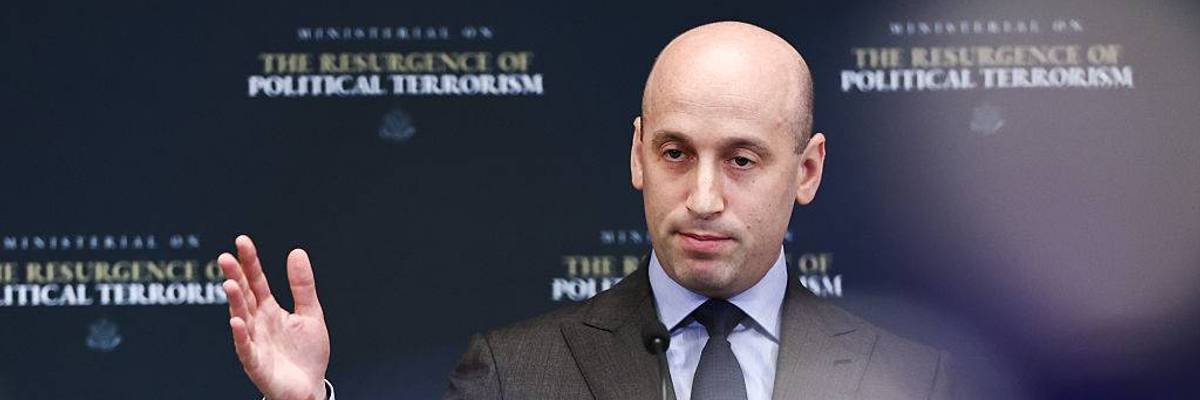
White House Deputy Chief of Staff Stephen Miller addresses the audience at the Ministerial on the Resurgence of Political Terrorism at the State Department on July 16, 2026 in Washington, DC.
(Photo by Finn Gomez/Getty Images)
“If you’re not alarmed you’re not paying attention.”
Trump administration officials on Thursday hyped up plans to carry out mass political arrests and prosecutions of people whom it deemed far-left terrorists.
In a speech given at the US State Department, Stephen Miller, President Donald Trump’s deputy chief of staff, described left-wing political violence as a “fatal cancer to civilization,” and boasted of plans to use state power to suppress people whom he called “political terrorists.”
Miller said that the administration would be carrying out this operation under the guidance of National Security Presidential Memorandum-7 (NSPM-7), a directive signed by Trump in September that demanded a “national strategy to investigate and disrupt networks, entities, and organizations that foment political violence so that law enforcement can intervene in criminal conspiracies before they result in violent political acts.”
Miller bragged that “for the first time in American history,” NSPM-7 would direct “all of our law enforcement and intelligence agencies to work together to disrupt, identify, defund, de-bank, arrest, prosecute these political terrorists that are operating within our country.”
Santa Monica Goebbels is doing his weird and creepy gyrations while delivering a speech smearing Democrats as violent radicals pic.twitter.com/PaeDcD55jw
Miller said that the mass arrest of left-wing radicals was necessary to prevent them from carrying out mass arrests of their own.
“Inevitably, left to its course, it always becomes a gulag,” said Miller. “It always becomes the mass imprisonment of political enemies, the stripping of their rights and freedoms, inflicting immense pain, humiliation, suffering, in order to establish complete and total control, control through psychological and physical and actual terror.”
The social media account of independent progressive publication The Tennessee Holler expressed alarm at Miller’s speech.
“Fascism is here,” The Tennessee Holler wrote. “If you’re not alarmed you’re not paying attention. ‘Left-wing political terrorism’ will mean those who oppose the regime—while actual right-wingextremism is allowed to grow and thrive. We are very far off the cliff, folks.”
Secretary of State Marco Rubio, who also spoke of the event, noted last year that his department “designated four violent far-left extremist groups as foreign terrorist organizations, and there will be more designations soon.”
Secretary of State Rubio says there will be more terrorist designations of left-wing groups "soon." pic.twitter.com/RmZjBgQXas
The administration’s declaration of war against left-wing political violence comes despite decades of research showing that political violence is more commonly carried out by right-wing groups.
A report published last year by the Center for Strategic and International Studies found that, while left-wing political violence has grown since Trump’s first election in 2016, it “remains much lower than historical levels of violence carried out by right-wing and jihadist attackers.”
The report also noted that violence carried out by left-wing individuals or groups was “remarkably less lethal” than violence carried out by right-wing or jihadist individuals or groups.
Our work is licensed under Creative Commons (CC BY-NC-ND 3.0). Feel free to republish and share widely.
In 1990, the year Queer Nation published the manifesto that Mr. Vines quotes in his essay, I was one of that group’s members. I was 19. That same year, the Boy Scouts of America expelled me for being gay, and two years later, I sued.
The case took eight years to reach the Supreme Court, which in 2000 ruled in favor of the Boy Scouts. My Lambda Legal attorney at the time, Evan Wolfson, went on to become a leader in the marriage equality movement that Mr. Vines credits with changing his life.
In his essay, Mr. Vines presents queer confrontation and mainstream acceptance as opposing forces. My life tells a different story. The welcome I found among queer radicals gave me the courage to fight for a place in the most wholesome institution in America. The people in the streets and the people in the courtrooms were the same movement. Often the same people.
I am 55. I survived the AIDS crisis and buried many friends. I have been queer all my life, in the streets and in the courtroom, and I never found those two fights as far apart as Mr. Vines suggests.
James Dale New York
To the Editor:
Matthew Vines’s guest essay left me with one overriding thought: He’s looking in the wrong direction.
I’ve lived through the fight for marriage equality. The L.G.B.T.Q. community did not win those rights by being polished, restrained or always in agreement. People marched, protested, challenged unjust laws, came out publicly and refused to hide. Some were criticized for being too loud or too radical. History has a way of changing those judgments.
The danger, to me, is a political movement that opposed our equality long before most Americans had ever heard the word “queer.” It is also a movement that keeps finding new groups to target: immigrants, religious minorities, transgender people, people of color and anyone else who does not fit its vision of America.
That is why I struggle with Mr. Vines’s conclusion. Dividing our community into the acceptable and the unacceptable will not change the minds of people who have spent decades trying to roll back our rights. Those coming for us would do so regardless of how polished and restrained our community tried to be.
Garrick Spears Canaan, N.Y.
To the Editor:
I grew up just south of Matthew Vines in a small town in Oklahoma. I intimately understand the comfort he found in the marriage equality messaging of the 2010s. As an associate legal director at the Human Rights Campaign, I wrote some of it.
We earned legal protections by arguing unthreatening sameness. It would be easy to attribute falling levels of public support to the abandonment of a streamlined gay narrative. But the language we use to describe our community is not the problem. We have hit the limits of legal equality while navigating fraying democratic institutions. The MAGA agenda has made L.G.B.T.Q. lives the villain in an old, predictable, antidemocratic story.
A healthy democracy depends on protecting individuality and expression. It does not prescribe a single vision for living, but rather a set of tools to live differently while thriving together. L.G.B.T.Q. people are beautifully and inescapably different. Queer lives are good for democracy. Our stubborn existence and demand for equal dignity are daily forms of democratic resistance.
Robin Maril Portland, Ore. The writer is an assistant professor at Willamette University College of Law and the author of “A Queer Guide to Saving American Democracy.”
To the Editor:
I recognize the shame behind Matthew Vines’s essay. It is devastating to be gay (or lesbian or queer) in a homophobic religious community. Yet Mr. Vines misses the profound connection between queer politics and robust Christianity.
Queer politics is, indeed, anti-normative. But the point is not rebellion for its own sake. Decades of queer scholarship and activism have understood the critique of social norms as a way of exposing systems (like gender and the tax code) that make some lives more livable than others. Questioning those norms allows us to be advocates for the people they harm.
Queer politics, like Christ’s teaching, reminds us that our responsibility is not to those with power, but to those who lack it — all those whom the community rejects. Both call us to support those who have less than we do — those facing violence, homelessness, the withholding of medical care or death. Queer politics asks this; gay identity does not.
Queer politics asks more of us than acceptance for ourselves. It asks us to stand with those who remain excluded. That is not a departure from Christian ethics but a reminder of them.
Shannon Brennan Milwaukee The writer is an associate professor of English at Carthage College and an associate editor at Edith Wharton Review.
To the Editor:
I am heterosexual, which seems to mean that Matthew Vines is worried I don’t like him. He avoids calling himself queer as a gay man because he finds the term too “adversarial” toward straight people. Indeed, in Mr. Vines’s eyes, offending heterosexual people — or simply confusing them — appears to be the worst mistake available to a gay person who likes having rights.
I was struck by how limiting Mr. Vines’s ideas are. He certainly did not choose to be gay, but in fretting that gay people will make straight homophobes too mad to stop being homophobic, he has certainly chosen to be fearful. If there is a solution to homophobia, it is not to enforce “clarity and moderation” in the ways that human beings are allowed to identify; it is to enlist straight allies to defend the human right to be fluid and radical.
Griffin Larson-Erf Skokie, Ill.
To the Editor:
I owe a debt of gratitude for Matthew Vines articulating not only the differences between being gay and being queer, but also for reminding us, especially those who might have forgotten the fact, that being gay “is every bit as dignified and human as being straight.”
Like Mr. Vines, I consider myself to be gay and not queer. What’s more, I often bristle when I’m lumped into what often seems like an amorphous mass of nonheteronormative identities.
Admittedly — and now somewhat ashamedly — never having had a desire to be married, I selfishly considered the issues surrounding same-sex marriage as no concern of mine. With the far right’s onslaught against all manner of human rights, the urgency to fight for L.G.B.T.Q. rights is palpable. I’m left thinking that perhaps it’s time to be a lot more vociferously queer than I’d have ever considered before.
(Rev.) Shaun S. Brown San Diego
Corrected on
July 18, 2026:
Because of an editing error, an earlier version of the letter by Robin Maril misstated her affiliation. She is a former associate legal director at the Human Rights Campaign, not at the United Nations Human Rights Council.
We acknowledge mistakes in our reporting with corrections. If you spot an error, please let us know at corrections@nytimes.com.Learn more.
A version of this article appears in print on July 19, 2026, Section SR, Page 11 of the New York edition with the headline: Parsing ‘Gay’ and ‘Queer’
“Paulist Press deserves credit for adding this new dimension to interfaith dialogue.” The Jewish Spectator The Book of Enlightenment edited and translated, with an introduction by Daniel Chanan Matt, preface by Arthur Green So this story of Torah is the garment of Torah. Whoever thinks that the garment is the real Torah and not something else―may his spirit deflate! Zohar (c. 1280-1286) Zohar―”the book of Splendor, Radiance, Enlightenment”―has fascinated readers from its first appearance in thirteenth-century Spain until today. It is the major text of Kabbalah, the Jewish mystical tradition. To assure the acceptance of his work within the Jewish community, a Spanish scholar named Moses de Leon claimed that Zohar was an ancient work of the school of the famous Rabbi Shim’on son of Yohai. It was not until our own century that critical scholarship demonstrated that the book’s author was Moses de Leon himself. His mosaic of Scripture, Midrash, medieval homily, fiction, and fantasy presents what Professor Daniel Matt describes as “a challenge to the normal workings of consciousness [that] dares one to examine one’s assumptions about tradition, God, and self.”
Books can be attributed to “Anonymous” for several reasons:
* They are officially published under that name * They are traditional stories not attributed to a specific author * They are religious texts not generally attributed to a specific author
Books whose authorship is merely uncertain should be attributed to Unknown.


 How to Combat Transnational Repression