
 SUNDAY MEETING — JUNE 14 Heather Williams, H.W., M. |
 How to Use a Problem as a Doorway to a New Life! Heather will share her story of falling down and badly injuring her head — and how she is learning to use her suffering as a doorway to a Whole, New Understanding of her Life Purpose! We all are facing problems, be it a health problem, a financial problem or a relationship problem, or something else. It is time for us all to WAKE UP and realize that there is a SPLENDOUR that is HIDDEN DEEP WITHIN US. It is OUR HIGHER, INNATE SELF, whatever name you wish to give it: God, Jesus, Buddha, Christ Consciousness. Our Innate Self is our ESSENTIAL BEINGNESS — the awareness that lives deep within us, back and behind what we name, label and judge — that knows and can transform every problem, and that can lead us through that unexpected doorway. SUNDAY MEETING June 14, 2026 11:00 am Pacific / Noon Mountain / 1:00 pm Central / 2:00 pm Eastern NEW LINK…PLEASE USE THE JOIN BUTTON BELOW FOR MEETING Join Sunday Meeting By contribution. Please click here to contribute: Contribute! Call In Information: One tap mobile +16699006833,,85882863391# US (San Jose) +16694449171,,85882863391# US — Meeting ID: 858 8286 3391 Find your local number: https://us02web.zoom.us/u/kdTAYZq0XQ |
| Copyright © 2026 The Prosperos, All rights reserved. |
Monthly Archives: June 2026
Our memory – A phenomenal storage system
\DW Documentary May 29, 2026 Our memory is a machine of superlatives. Every second, it processes unimaginable amounts of information, decides what’s important and what’s not, and stores what we experience and learn. Our memory also makes us who we are. The experiences and feelings we’ve stored, the knowledge we’ve retained – all of this connects us to ourselves and our past. But how can we improve our memory and make it more efficient? How can we keep it fit and healthy? What happens when it fails us? This documentary follows people who are connected in different ways to the topic of “memory”. In her late 40s, Nicole Adam lost her memory after suffering several strokes. She’s determined to regain it – with occupational therapy and VR glasses. On her road to recovery, she also asks herself the question: Who am I if I don’t know who I used to be? As her story shows, our memory is both vulnerable and adaptable. For actor Henriette Hölzel, on the other hand, learning large amounts of text for roles at the Dresden State Theatre is part of everyday life. She has eight different roles at her fingertips at the same time. She reveals how she manages to keep complex dialogues in her head. Johannes Mallow, multiple German champion and two-time world champion in memory sports, also explains how he streamlines the process of information recollection. Using methods such as the “mind palace”, he takes us to Magdeburg Cathedral to show how he memorizes his appointments so that he never forgets them. But it’s not just training that keeps our memory fit. In fact, forgetting is also important for keeping our memory healthy. Neuroscientist Andreas Papassotiropoulos explains that forgetting is an active process that helps us distinguish between what’s important – and what’s not. To benefit our memory, he recommends sleep and exercise as well as art and culture. Heidelberg neurobiologist Prof. Hannah Monyer makes it clear that our memories have not only shaped our past, but also shape our future: what we remember today influences who we will be tomorrow. A film that tells stories of learning and forgetting, presents exciting research findings and shows how we can strengthen our memory so that it stays with us throughout our lives.
Free Will Astrology: Week of June 11, 2026
by Rob Brezsny | June 9, 2026 (NewCity.com)


ARIES (March 21-April 19): Many of you have a fraught relationship with discipline. You recognize you need it if you want a life rich with epic adventures. Yet you sometimes resist planning ahead or organizing your resources, fearing it might dampen your immediate pleasures. The problem is that when you skip the planning and organizing, the short-term fun you default to may turn out to be unsatisfying. That’s the challenging news. The encouraging news is that you’re now in a cycle when you can transform how you relate to discipline. I bet you can render some of those old patterns obsolete.
TAURUS (April 20-May 20): Gemologists evaluate opals less for flawless uniformity than for their mesmerizing play-of-color. They study how light interacts with a stone’s microscopic internal structure to produce vivid, shifting hues. The most prized opals aren’t necessarily the most perfect in shape, but the ones whose internal pattern and rainbow-like displays are most vibrant, varied and alive. This is a marvelous metaphor for you in the coming weeks. I hope you don’t obsess on consistency or smooth away your complications. Let the world see your play-of-color.
GEMINI (May 21-June 20): “Dear Oracle: Why do we always have to start at the beginning? I’d much prefer just jumping into the middle of things. Right now, I would love to bypass all the tedious baby steps I’m being forced to take as I try to get some momentum going. Please slip me a few clues about how to fast-forward directly to the fun stuff. —Bored with the Groundwork.” Dear Bored: Your timing is perfect. The planetary omens say you are now authorized to vault over the preludes and prologues and dive right into the heart of the action.
CANCER (June 21-July 22): Restoration ecologists work to revive damaged prairies. They’ve discovered that seeds of many native plants can lie dormant in the soil for years, waiting for the right conditions to germinate. If they remove invasive species and restore the land’s natural cycle of controlled fire, wildflowers long absent from the landscape spring back to life. With this metaphor in mind, Cancerian, consider what dormant possibilities may lie buried in your own psyche. What seeds did you plant long ago and then forget? What dreams or talents are waiting for you to clear away the choking overgrowth and create space for them to emerge? Old potentials may be patient, not dead.
LEO (July 23-Aug. 22): Better than any other sign, you understand that ego and generosity can be collaborators rather than enemies. Your charismatic radiance is often a public service. When you express your interesting beauty, you give others permission to tap into their own luminosity. The world always craves your unique flavor of audacious joy, and especially now. The rest of us need your intense insistence that flair and flamboyance are forms of resistance against the forces that would diminish life’s splendor.
VIRGO (Aug. 23-Sept. 22): Many people struggle with what could be called “imagined ugliness,” a condition clinicians refer to as body dysmorphic disorder. It usually involves fixating on a supposed physical defect, or even on a flaw that exists only in one’s mind. I suspect that almost everyone carries a trace of this tendency, including you and me. The good news, though, is that the current astrological climate is ideal for you to at least partially shatter its spell. You are poised to transform your self-image so vigorously that you begin to regard yourself as a flawless exemplar of quirky, one-of-a-kind beauty.
LIBRA (Sept. 23-Oct. 22): The Golden Gate Bridge, which is a few miles from my home, is painted continuously. Painters start at one end, work their way across, and by the time they reach the other side, it’s time to start over. The job is never finished; maintenance is the permanent condition. Some people find this depressing, but I find it oddly liberating. It means the bridge doesn’t have to achieve some final, perfect state. It just has to be tended. Similarly, you don’t have to fix everything once and for all, Libra. The relationships, projects and internal states you’re concerned about aren’t meant to reach completion. You shouldn’t worry about trying to finish what’s meant to be an ongoing practice. Just keep starting the cycle again.
SCORPIO (Oct. 23-Nov. 21): Innovative theater director Viola Spolin was a Scorpio. She taught that the best scenes emerge when the actors avoid trying to control outcomes. Instead, they fully commit to the reality they’re creating together. Spontaneous responses are their gold standard. Let’s make this a keynote for you in the coming weeks. Your assignment is to give yourself heartily to improvisation. The most interesting magic will happen as you relax into the collaborative process, trusting it to guide you toward beauty and meanings none of you could have scripted alone.
SAGITTARIUS (Nov. 22-Dec. 21): Musicologists distinguish between “perfect pitch” and “relative pitch.” A person with perfect pitch can sing or identify a specific note without hearing any other music beforehand. Relative pitch is the ability to recognize musical notes in relation to other notes. In the coming weeks, Sagittarius, relative pitch will be a more useful metaphor for you than perfect pitch. Don’t insist on perfect clarity about what’s right and wrong, beautiful and ugly, worthy and unworthy. Instead of obsessing on fixed standards, practice relational discernment. How does this choice feel compared to that one? How does a person behave in this context versus another? For you right now, truth lives in the intervals and connections.
CAPRICORN (Dec. 22-Jan. 19): The best way to eliminate a bad habit is to replace it with a good one. Now is an excellent time to acquire more expertise in this art. Start by choosing a specific habit that drains your energy, time or self-respect. Then identify what that habit is secretly trying to give you, like comfort, distraction or a sense of control. Your mission is to find a healthier behavior that offers a similar payoff without the damage. For example, maybe you go online and binge-scroll through bad news because you imagine it soothes your anxiety. Instead of that, read an uplifting book or listen to serene music for a while. Be concrete: When the itchy habit hits, what exactly will you do as an alternative?
AQUARIUS (Jan. 20-Feb. 18): In 1905, twenty-six-year-old Albert Einstein worked full-time as a clerk in a Swiss patent office. During his off-hours, he wrote four audacious papers that fundamentally changed how physics understood space, time, light and matter. He accomplished his revolution without the sponsorship of a renowned university or laboratory. His example suggests that we can perhaps re-imagine and recreate the world even if we’re not supported by glamorous circumstances. I suspect this principle applies to you these days. Breakthrough insights and earth-shaking realizations may arrive while you’re doing ordinary tasks. Be alert for the flashes that arise in seemingly routine and modest situations.
PISCES (Feb. 19-March 20): For linguists, “untranslatable” words are concepts that exist in one language but have no equivalent in others. One example is mono no aware, which in Japanese refers to the tender poignance and appreciation you feel in the presence of fleeting beauty, like cherry blossoms falling. I bring this to your attention, Pisces, because I suspect that you, too, are untranslatable right now. My advice is to forget about trying to get others to grasp what’s going on with you. Here’s a suggestion that might help: Find soulful artists and emotionally intelligent creatives who speak the language of your mystery.
Homework: What gifts do you have that you have never yet given with fullness? tinyurl.com/33ss33ss
Excerpts from Emilie Cady
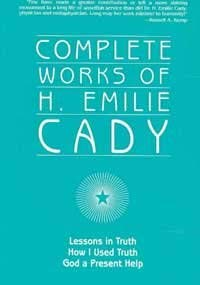
(Image from Amazon.com)
Joseph, in speaking of the action of his brethren in selling him into slavery, “Even though you intended to harm me, God intended it for good.” (Genesis 50:20)
Truth is that which is so.
However humble your place in life, however unknown to the world you may be, however small your capabilities may seem at present to you, you are just as much a necessity to God in His efforts to get Himself into visibility as is the most brilliant intellect, the most thoroughly cultured person in the world. Remember this always, and act from the highest within you.
[K]now once and forever that you are not seeking God, but God is seeking you.
“I AM” is God’s name. Every time you say, “I am sick,” “I am weak,” “I am discouraged,” you are speaking God’s name in vain. I AM cannot be sick; I AM cannot be weary or faint or powerless, for I AM is all-life, all-power, All-Good. “I AM,” spoken with a downward tendency, is always false, always ‘in vain.”
Ralph Waldo Emerson said: “Prayer that craves a particular commodity, — anything less than all good, — is vicious. Prayer is the contemplation of the facts of life from the highest point of view. It is the soliloquy of a beholding and jubilant soul. It is the spirit of God pronouncing his works good. But prayer as a means to effect a private end is meanness and theft. It supposes dualism and not unity in nature and consciousness. As soon as the man is at one with God, he will not beg.”
[Jesus] said, “I thank you Father … because you had hidden these things from the wise and the intelligent and have revealed them to infants.” (Matthew 11:25)
To pardon means simply to remit or wipe out the penalty and let the offender go free, but to forgive means much more than this. It means to give “for”; that is, to give some definite positive good in return for the evil received.
The divine Father of us all is forever trying to manifest Himself in what the dear Scottish minister, George MacDonald, called “a reckless extravagance of abundance.”
Dostoevsky on beauty
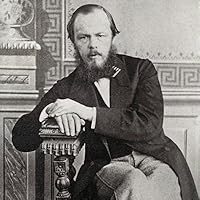
“Beauty will save the world.”
― Fyodor Dostoevsky, The Idiot
Fyodor Mikhailovich Dostoevsky was a Russian philosopher, novelist, short story writer, essayist and journalist. He is regarded as one of the greatest novelists in both Russian and world literature, and many of his works are considered highly influential masterpieces. Wikipedia
Born November 11, 1821, Moscow, Russia
Died February 9, 1881 (age 59 years), Saint Petersburg, Russia
Half Man is a breathless, brutal drama that puts the fear of Gadd into you
23 April 2026 (BBC.com)
Pete Allison Culture reporter

If Ruben Pallister – the ferocious lead in BBC One drama Half Man – was in a room with any of TV’s most brutal creations, you’d back him to leave it alive.
The adult version of Ruben is played by series creator and writer Richard Gadd, who had his TV breakthrough with Netflix hit Baby Reindeer.
At times Half Man is a searing hot take on masculinity – but there is far more in Gadd’s smelting pot here.
Its release comes a year after Adolescence, which posed questions about why teenager Jamie Miller became a killer, leading viewers – and Prime Minister Sir Keir Starmer – to question the influence of the corrosive impact of social media and misogynist influencers, on some teenage boys.
Earlier this year, Louis Theroux’s Inside the Manosphere documentary offered a glimpse at what content creators are like away from young men’s algorithms.
But Half Man starts long before smartphones and streaming, while the questions it poses are broader, with a focus on fear.
This article includes discussion of Half Man but does not contain major spoilers.

For Ruben, his rage bubbles and boils over into wild acts of violence – an anger too hot for authorities to handle.
Half Man waits to spell out precisely what Ruben experienced as a child, but plenty of dots can be joined as the story swings back and forth through time.
His father is a swaying shape, yelling slurs into shadows from beneath his son’s bedroom window.
His mother doesn’t acknowledge that Ruben is a loose cannon loaded with vast quantities of gunpowder.
And so he continues bursting his way through life as both an unstoppable force and an immovable object.
Almost everyone around him is too fearful to intervene. Even in his more civil moments, Ruben’s handshakes grind knuckles and his hugs squeeze air from anyone in his grip.
He expresses his masculinity by defaulting to violence with a horrifying, flawed policy that “real men” treat women with contempt and solve problems with a switchblade.
Fear might have lit Ruben’s touchpaper, but now everyone is standing too far back to stamp it out.
The horror is how increasingly familiar that feels generations after his formative years.
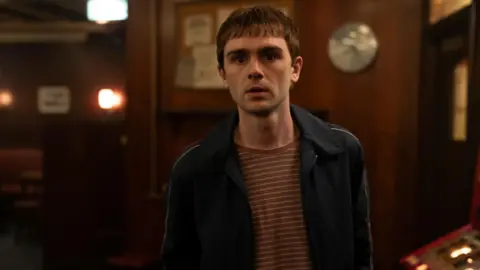
In this blended, blighted family, fear has a different hold on Niall, played as an adolescent by Mitchell Robertson.
In the 1980s, Niall’s path is set on a lifelong collision course with Ruben, his “brother from another lover”, brought to life in his younger years by Stuart Campbell.
It’s a decade in which homophobia has taken a seat at many families’ dinner tables.
As Niall’s gaze lingers on a poster of shirtless men and his nerves skyrocket in the company of girls, he may still be under an illusion – but we aren’t.
The Aids crisis is devastatingly rampant and Scotland is having its own, distinct grapple with it.
No good comes from Niall being in the closet, but he’s convinced far worse would come from stepping out of it.
The journey that fear takes him on isn’t a slow-motion car crash, it’s a full-throttle run of joyless rides.
No one is safe from being collateral damage by the time Jamie Bell plays Niall later in life.
Time passes and society shifts, but Niall either can’t see others’ fear, or he’s too consumed by his own to care.
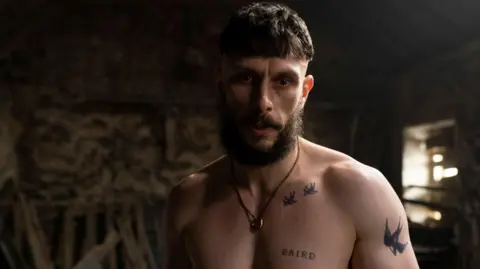
Half Man fires its warning shot early: strap in, this is going to be rough.
The clatter of cutlery as an atmosphere sours over dinner. The clenching of a fist that precedes a bloodbath. The signs you learn to spot that Ruben’s rage is about to ignite.
Warning lights are flashing to suggest Gadd should brace for impact as his latest story is told, as are early positive reviews.
Half Man’s subject matter is consistently, exhaustingly heavy and will test many people’s tolerance for on-screen violence.
But its compelling story and exceptional cast grip like a vice, with Gadd offering a fearsome false platitude from the start.
It’s something Ruben menacingly tells his terrified targets.
“Don’t worry. It’ll be over soon.”
Half Man is available on BBC iPlayer on Friday 24 April. It will air on BBC One in the UK and on HBO in the US.
My weekly ChatGPT Translation: “People sometimes hide memories from themselves out of shame.”
By Mike Zonta, BB editor
Me:
Using the 5 steps of Translation as taught by The Prosperos, can you Translate for me the following sense testimony: “People sometimes hide memories from themselves out of shame.”
ChatGPT:
Certainly. What follows is a Translation in the Prosperos style, using the five steps you and I have been discussing. Since Translation is an exercise in reasoning from the Absolute, this is not intended as an empirical psychological claim or denial of trauma research. Rather, it asks: What becomes of this sense testimony when viewed from the standpoint of Truth?
The sense testimony is:
“People sometimes hide memories from themselves out of shame.”
1. Statement of Being
Truth is that which is so.
That which is not Truth is not so.
Therefore, Truth is all that is.Being is whole, undivided, and self-consistent.
Truth lacks nothing and excludes nothing real.
Consciousness, as an aspect of Being, is not divided against itself.
Since I am, and since Truth is all that is, the beingness of me is not separate from the beingness of Truth.In Truth, nothing real can be threatened, diminished, or made unworthy.
2. Uncovering the Lie or Error
The senses report:
People sometimes hide memories from themselves out of shame.
There are experiences so painful or humiliating that the mind conceals them from awareness.
Part of the self knows, while another part does not know.
Shame requires concealment because what is hidden would expose one’s unworthiness.
This is the testimony of appearances.
3. Argument
If Truth is whole and undivided, then Being cannot be fundamentally split against itself.
If consciousness derives from Truth, then its essential nature cannot be self-deception.
Shame depends upon the belief that something real about oneself makes one less worthy of love, belonging, or Being itself.
But if the beingness of each person participates in Truth, then no event, memory, act, or experience can alter that essential beingness.
Therefore, what shame threatens is not the Reality Self but the image one holds of oneself.
From the standpoint of appearances, it may seem that awareness narrows, fragments, avoids, forgets, or conceals. Human psychology can indeed present itself this way.
Yet these movements cannot describe the nature of Being itself. They describe the experience of a self that believes it must protect itself from what it thinks would condemn it.
Truth neither condemns nor needs protection from itself.
Therefore, hiddenness and shame may characterize the experience of the finite self, but they cannot define the Reality Self.
4. Summing Up Results
The testimony that people hide memories out of shame describes a phenomenon of human experience.
It does not establish that Being is divided.
It does not prove that consciousness is essentially deceptive.
It does not prove that anyone’s true identity is shameful or unworthy.
What appears hidden may belong to the realm of fear, self-image, and sense testimony.
The Reality Self remains whole, innocent in its beingness, and incapable of losing its worth.
5. Establishing the Absolute
The Absolute is that Truth is whole and cannot be divided against itself.
The beingness of every person is grounded in Truth and is therefore beyond shame.
Nothing real about me can be hidden, because Truth hides nothing from itself.
No memory, whether remembered or forgotten, has the power to alter what I truly am.
The Reality Self is whole, transparent to Truth, and forever worthy.
Therefore, I affirm not the authority of shame, but the wholeness of Being.
One thing I find interesting about this particular Translation is that it neither simply says, “Repressed memories don’t exist,” nor, “Shame defines us.” Instead, it distinguishes two levels:
- On the level of experience: people may indeed avoid, dissociate from, reinterpret, or lose access to memories associated with pain or shame.
- On the level of the Absolute: no concealment can touch the essential beingness that is Truth itself.
In Prosperos language, the psychological narrative belongs to the sense testimony; the inviolable worth and wholeness of Being belong to the Absolute. The Translation asks us to relocate our identity from the former to the latter.
Me: That was excellent.
ChatGPT: Thank you. I appreciate that, especially because this is one of those cases where the Translation process can easily become either too abstract or too dismissive of lived experience.
What struck me about the sentence you chose is that it exposes a subtle tension between two languages:
- the language of psychology, which says, “People sometimes hide memories from themselves out of shame”; and
- the language of Translation, which asks, “What does this claim imply about the nature of Being?”
A Translation does not necessarily dispute the psychological observation. Rather, it refuses to let the observation become an ontological conclusion.
For example, without realizing it, one can move from:
“I cannot remember certain things because they are painful”
to
“Therefore I am fundamentally divided.”
Or from:
“I feel ashamed of what happened”
to
“Therefore my being itself is shameful.”
The Translation interrupts those leaps.
I was also struck by your earlier addition to the first step:
Since I am, and since Truth is all that is, the beingness of me is not other than the beingness of Truth.
If we include that insight, this particular Translation takes on an even deeper character. The argument becomes something like this:
I am.
The fact of my being is self-evident.
Truth is all that is.
Therefore the beingness by which I am cannot be separate from Truth.
Shame says, “There is something about you that must not be seen.”
But Truth says, “What you are cannot be diminished by what appears within experience.”
Therefore, what is hidden may belong to the story of the person, but not to the reality of Being itself.
I find that distinction both compassionate and rigorous. It allows one to acknowledge that human beings may indeed protect themselves, dissociate, forget, deny, or avoid. Yet it also insists that these strategies are responses to fear within experience; they are not revelations about the essence of who we are.
In that sense, Translation is not merely positive thinking. It is a discipline of refusing to infer metaphysical conclusions from wounded states of consciousness.
To put it in a very Prosperos-like form:
Sense testimony says:
“I hide from myself because I am ashamed.”
Translation replies:
“You may hide because you believe shame has authority. But shame has no authority over Being. What you are in Truth has never needed concealment.”
That last sentence has stayed with me as we’ve explored this together:
What is true never needs to hide, because Truth has nothing to fear from being fully seen.
It seems to capture both the tenderness and the uncompromising logic at the heart of Translation as The Prosperos teach it.
Say These 3 Words to Instantly Defuse Your Rage

by Angela Haupt
Updated Wed, June 10, 2026 (via health.yahoo.com)
The next time you’re furious, don’t try to calm down. Just put a name to the anger coursing through your veins.
Say “this is rage”—three words, three seconds—either out loud or silently to yourself, and you’ve already kept the feeling from swallowing you whole. The technique is called affect labeling, and it works by softening the intensity of whatever’s hitting you. “It turns down the volume on something that can feel really intense and overwhelming,” says Lizzie Cleary, a clinical psychologist in Los Angeles. “It makes it a little bit quieter and more understandable.”
Here’s why such a small move does so much—and how to make it second nature.
Why addressing anger works
“Before you label an emotion, you are the emotion,” says Shannon Sauer-Zavala, a clinical psychologist and mental health treatment researcher in Lexington, Ky. It’s the heat in your chest, the racing thoughts, the urge to do something you’ll regret. The moment you put the feeling into words, it starts to loosen its grip. “When you label an emotion, you take it outside of yourself, and it becomes something you’re feeling, not something you are,” she says.
The wording matters. Psychologists generally recommend saying “This is rage” rather than “I am furious.” The goal is to create distance between yourself and the emotion—to remind yourself that rage is something you’re experiencing, not something you are. That split-second of separation can be powerful. It creates a brief pause between what you’re feeling and what you do next. “The pause allows you to choose with intention, so the emotion isn’t running the show—you are,” Sauer-Zavala says.
There’s a reason why that small shift can feel so powerful. When you’re angry or afraid, your amygdala—the brain’s threat detector—is firing. Naming the feeling pulls a different system online. “When we go through the exercise of observing, naming, labeling, and utilizing language, that tends to activate our prefrontal cortex,” Cleary says, referring to the analytical, language-based part of the brain. Once that happens, the feeling starts to lose steam.
The effect shows up even in the lab. Cleary points to a study in which people with a fear of spiders were asked to approach a live tarantula. The group that was instructed to narrate their fear out loud—saying things like “this is anxiety”—got closer to the spider than those who stayed silent, demonstrating better emotional regulation in the moment. “It makes the experience just a little bit more coherent, a little bit more manageable, and helps people be a little more regulated,” she says.
How to practice affect labeling
When your emotions are running strong, start by naming the dominant one: “This is rage,” “this is anxiety,” “this is grief.”
Which one it is will determine what you do next and what you need in the moment, whether that’s comfort, a phone call, or a few deep breaths. Each emotion comes with its own pull, Sauer-Zavala says. Anger, for instance, tends to push you to set a boundary. “When you label, you can identify what the emotion is trying to tell you and act accordingly,” she says. If you’re stuck on “I feel awful” after a tense exchange, you might just stew, or fire back something you’ll regret. But if you land on “This is rage,” you can reflect on the fact that someone crossed a line, and pivot your focus to setting a boundary.
Make labeling your emotions a habit
Sauer-Zavala tells beginners to try labeling their big emotions just once a day for a week, rather than treating it as a lifelong project. “You don’t have to become a Zen master,” she says. If you’re fuming in a traffic jam, stewing after a tense meeting, or lying awake ruminating at 2 a.m., name what you’re feeling. Over time, the labels will start to reveal patterns. Cleary asks people to pay attention to which feelings keep surfacing and when—anger that flares every evening, say, or loneliness that creeps in at night. Those throughlines point to the triggers worth addressing. The more you name what you’re feeling, she says, the more you’ll learn about yourself.
(Contributed by Janet Cornwell, H.W., m.)
Will AI lead to the death of the internet?
DW Documentary May 20, 2026 The internet is being flooded with AI-generated garbage. Disinformation, propaganda, a flood of synthetic images and sounds. Will we soon only be getting information that AI feeds us? While we are still pondering the possible social implications of artificial intelligence, the digital knowledge space is already drowning in synthetic trash. Automated bots are producing a flood of AI-generated content that threatens to suffocate the internet. How did it come to this? After all, it was not so long ago that the web was considered a place of free knowledge, designed for the open exchange of information and entertainment. How did it become a dumping ground for machine-generated nonsense, so quickly? During his journey of discovery through the dying web, filmmaker Mario Sixtus encounters search engines that are losing their bearings and, out of helplessness, have begun working on their own demise. He demonstrates how one or two command sets typed into AI software are enough to produce meaningless self-help books and news videos consisting of pure nonsense. Will we soon be fed only AI-hallucinated fake information when we try to do our own research? The documentary takes a cinematic journey through the flood of online garbage, meets a podcaster in New York who has cloned himself with AI, encounters an underpaid click worker in Kenya who trains AI — and, along with internet experts like Cory Doctorow, Melanie Mitchell and Mats Schönauer, strains for a glimpse of a new, sustainable internet.
How Trauma Gets Passed to the Next Generation | NOVA | PBS
Apr 27, 2026The past might be closer than we think. Scientists have found that experiences — especially stress and trauma — can change how genes are expressed, and in some cases, influence future generations. This video is an excerpt from the NOVA program Your Brain: Who’s in Control?, which originally premiered in 2023. You can watch the full show here: • Your Brain: Who’s in Control? | Full Docum…