
Asaf from OldNewMethod.com
September
The Emotional Function as Given by Nature
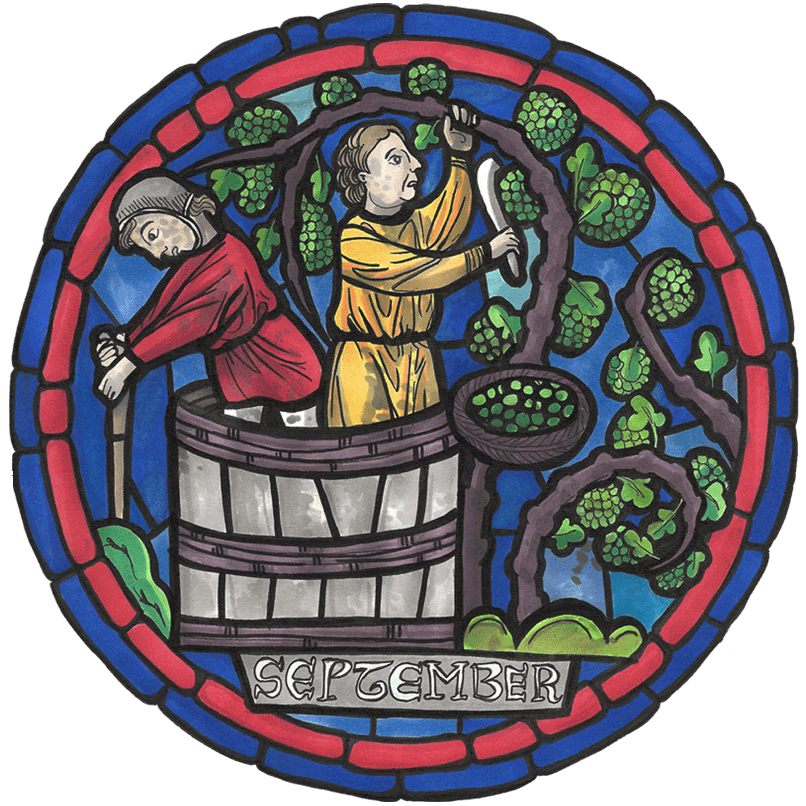
September brings our third and last harvest, the harvest of grapes. Grapes symbolize the emotional function by which we experience emotions towards people, places, objects or events. This function empowers us with the ability to feel people’s moods, perceive the motive behind their actions, and in general blend into social situations. The complete spectrum of our emotions extends even wider than this, reaching to potentially transformative emotions that alter the way we see ourselves and the world around us, such as empathy, compassion, and remorse of conscience. This broad spectrum is reflected in the journey a grape undergoes to become wine. It is a journey of many stages that ultimately transforms the grape’s nature into an altogether superior end product. As we shall see, the highest reach of our emotional function is likewise superhuman.
Since the development of our Essence is typically arrested early in life, the emotional function—the function of Essence—is usually atrophied. We only take advantage of its basic emotional output of comradery, humor, and gossip, and rarely benefit from its higher and transformative range. In effect, we have in our possession an instrument of great force yet spend our days fiddling only with its most basic parts. It is as if we used our smartphone only to check the time and our car only to store our belongings. This is a serious waste of potential as well as an objective limitation to inner farming, because the only power that can overrule the instinctive inertia discussed in May and the mechanical momentum discussed in June is emotion.
When we try to study the different qualities of our emotions we stumble upon an underlying attitude that makes their observation particularly difficult. Their very arising sweeps us away. They come with a deep conviction that glues us to them and blinds us to their manifestations. This abandonment of our sense of self in the face of our emotions is called identification and it is here that our labor of September must begin. To be clear, the tendency to identify with any of our functions—whether physical, mental, or emotional—makes self-observation challenging. We are accustomed to calling all our impulses ‘I’ and associate their manifestation with our entirety. Nevertheless, identification exacts its strongest force on our emotional world, particularly in our dealings with others.
As a rule, our undeveloped emotional function distorts our perception of the world by placing ourselves at its center. Everything is about us, everyone is ignoring or conspiring against us, everyone should be considering or acknowledging us. Misled by this bias, we take everything personally and experience difficult emotions about things that need not stimulate any emotions in us whatsoever. “Why did they not think about me? Why did they look at me that way? What will happen if I am proven wrong? If I make a fool of myself? What if I am considered irresponsible?” Our struggle with identification reveals that these habitual considerations are the default state of our emotional function. We cycle through them endlessly. When we do succeed in obtaining this supposedly important validation from our environment, our emotional function quickly works itself into new doubts and concerns. It proves to be a state in search of an object, which means that we can only break free from these emotional considerations by severing the state of identification.
Any action that goes against the need for social validation achieves this: making a public comment we know to be incorrect; restraining our smartness and letting others take credit for coming up with a helpful solution; staying put when a traffic light turns green until the driver behind us honks; dropping our cup at the cafe to make us seem clumsy or careless. Or in short, any deliberate action that paints us as fools and sabotages our need for social validation.
If executed correctly, the effect is instantaneous. A space between ‘I’ and ‘my emotions’ opens up all of a sudden, sparking a brief out-of-body experience. All of a sudden we can observe in real time what was previously invisible to us. But this successful execution depends on the attitude behind our effort. We are playing the fool to sever identification. We are aiming to wedge a crack between our emotions and our budding ability to observe. The moment we lose sight of this, our vanity takes credit for having gone against our habitual reactions, and distorts our original aim. We break free of identification only to rebuild it elsewhere. The practitioner will have to bear this in mind and understand that some of their experiments will succeed, and others will fail. Moreover, the somewhat dramatic examples given above will not always be necessary. We will not always have to employ these extreme measures to sever identification with our emotions. As we gain expertise in inner farming, we will gradually learn more subtle ways of harvesting the same yield.
Harvest involves discrimination. Not all crops are of equal value. Some grape clusters may make fine wine while others need to be discarded lest they detract from our final product. The same applies to our emotions. We must study their different qualities and flavors, and ultimately choose some over others. For this, we must learn to struggle with identification. The farmer who can observe their feelings as they arise in real time—who can see ‘joy,’ ‘expectation,’ ‘disappointment,’ or ‘apprehension’ and resist the urge to call them ‘I’—is positioned favorably before the September harvest. Now can they attempt to fulfill the transformative potential of their emotional function.
 ABOUT THE SCHOOL Our projects are undertaken with the understanding that a school must give back. It must harness the talent and resources of its members to form an expression that can outlast them.Learn more about the School of the Old New Method |
 WATCH AN INTRODUCTORY WORKSHOP Learn more about the Old New Method – Watch recordings of our online gatherings that introduce the knowledge and practical methods we use.Available through purchase. View Workshops  ABOUT THE FOUNDER I had no structural foundation at my disposal, no institution, no location, no following — only the conviction that these truths were pertinent to contemporary seekers… Drawing inspiration from the agricultural metaphor embedded in ancient wisdom, I arranged the central concepts into twelve monthly labors, creating a yearly cycle of symbolic cultivation tasks… Soon, a hundred people committed to practicing this cyclical teaching on a regular basis. This was the beginning of my school.” Read the full autobiographical note by Asaf Braverman  ABOUT THE TEACHING Nature develops us only up to a certain point and then leaves us unfinished, just as it creates wheat but not bread, milk but not butter, grapes but not wine…Learn more about our teaching Copyright © 2026 School of the Old New Method All rights reserved |
