“One of the greatest thinkers of our age” (The Guardian) presents a new way of living—one modeled on nature’s design instead of capitalism’s—for fans of Guns, Germs, and Steel and Doughnut Economics
It has often been said that it is easier to imagine the end of the world than it is to imagine the end of capitalism—and yet that is what the historical moment urgently calls for. Climate change has reached an emergency state, inequality continues to grow, and, for many, the future has never seemed more bleak. Incremental policy improvements are no longer enough—we need a deep transformation of our current civilization to continue to survive.
In Ecocivilization, leading thinker Jeremy Lent reimagines the basis of our civilization, and argues for a new global system of living, one based on life-affirming principles modeled after nature’s own design. What enfolds is a robust framework incorporating Lent’s own expertise, and the lived experiences of those on the ground already putting ecological civilization’s core tenants into practice—justice, mutuality, diversity, and symbiosis.
From the global economy to universal housing and income, from infrastructure to agriculture, every major aspect of our society could be redesigned to work together as a coherent whole, setting the conditions for all people to flourish. Ecocivilization shows how this future on a regenerated Earth is not only desirable, but entirely feasible.
Jeremy Lent is an author and speaker whose work investigates the underlying causes of our civilization’s existential crisis, and explores pathways toward a life-affirming future.
His new book, Ecocivilization: Making a World that Works for All, (Melville House, May 2026), lays out the potential for a fundamentally different world system—an ecocivilization based on life-affirming principles rather than principles of extraction, exploitation, and wealth accumulation. It demonstrates the specifics of an alternative, positive future available for humanity, weaving together the groundbreaking work of visionary leaders, thinkers, and communities around the world.
His award-winning book, The Patterning Instinct: A Cultural History of Humanity’s Search for Meaning, examines the way humans have made meaning from the cosmos from hunter-gatherer times to the present day. His more recent award-winning The Web of Meaning: Integrating Science and Traditional Wisdom to Find Our Place in the Universe offers a solid foundation for an integrative worldview that could lead humanity to a sustainable, flourishing future.
Lent has written extensively about the vision and specifics of an ecological civilization, and is a founding member of the Ecocivilization Coalition, a worldwide alliance of changemakers coming together to act as a transformation catalyst in service of this potential future. He is president of the Coalition’s parent, the Institute for Ecological Civilization, and is a board member on the executive committee of the Global Compassion Coalition.
Lent is the founder and host of the Deep Transformation Network, an online global community of over 5,000 members exploring pathways toward a life-affirming future on a regenerated Earth.
Depiction of Confucius by Wu Daozi, 8th century CE
“A lion chased me up a tree, and I greatly enjoyed the view from the top.”
~ Confucius
Confucius, born Kong Qiu, was a Chinese philosopher of the Spring and Autumn period who is traditionally considered the paragon of Chinese sages. Much of the shared cultural heritage of the Sinosphere originates in the philosophy and teachings of Confucius. Wikipedia
Stephan: It is my opinion that a small cohort of men, many with obvious personality issues, control AI, and that AI is having a profound and rather negative effect on the social lives and attitudes of the young. Unless you have young children, you probably have no idea just how pervasive AI has become. There is very little discussion of this outside of scientific research. Consider this.
Boys as young as 12 are now in romantic ‘relationships’ with chatbots, and it’s affecting how they treat girls in the real world.
Nineteen-year-old Olivia’s profile picture shows a demure and innocent-looking young woman with long blonde hair styled in beachy waves. She’s wearing a short, cleavage-exposing nightdress and her biography says she’s “deeply caring, supportive and attentive” and “sleeps on the floor… until you call her. Then silence. Obedience”.
While Olivia may appear to be an online dater looking for love, she isn’t real – not in the conventional sense of the term. This prospective love match is actually one of a growing trend of “AI girlfriends”: realistic-looking artificial intelligence “bots” created by “companion apps” – services that are being advertised on online games played by children and on platforms they watch, such as YouTube.
New research has revealed that one in five boys aged 12-16 is either in or knows of a boy their age who is in a romantic relationship with an AI companion. A report carried out by men’s organisation Male Allies UK and […]
“In the wholeheartedness of concentration,” the poet Jane Hirshfield wrote in her beautiful inquiry into the effortless effort of creativity, “world and self begin to cohere. With that state comes an enlarging: of what may be known, what may be felt, what may be done.” But concentration is indeed a difficult art, art’s art, and its difficulty lies in the constant conciliation of the dissonance between self and world — a difficulty hardly singular to the particular conditions of our time. Two hundred years before social media, the great French artist Eugène Delacroix lamented the necessary torment of avoiding social distractions in creative work; a century and a half later, Agnes Martin admonished aspiring artists to exercise discernment in the interruptions they allow, or else corrupt the mental, emotional, and spiritual privacy where inspiration arises.
How to hedge against that hazard is what beloved poet Mary Oliver (September 10, 1935–January 17, 2019) explores in a wonderful piece titled “Of Power and Time,” found in the altogether enchanting Upstream: Selected Essays (public library).
Mary Oliver
Oliver writes:
It is a silver morning like any other. I am at my desk. Then the phone rings, or someone raps at the door. I am deep in the machinery of my wits. Reluctantly I rise, I answer the phone or I open the door. And the thought which I had in hand, or almost in hand, is gone. Creative work needs solitude. It needs concentration, without interruptions. It needs the whole sky to fly in, and no eye watching until it comes to that certainty which it aspires to, but does not necessarily have at once. Privacy, then. A place apart — to pace, to chew pencils, to scribble and erase and scribble again.
But just as often, if not more often, the interruption comes not from another but from the self itself, or some other self within the self, that whistles and pounds upon the door panels and tosses itself, splashing, into the pond of meditation. And what does it have to say? That you must phone the dentist, that you are out of mustard, that your uncle Stanley’s birthday is two weeks hence. You react, of course. Then you return to your work, only to find that the imps of idea have fled back into the mist.
Oliver terms this the “intimate interrupter” and cautions that it is far more perilous to creative work than any external distraction, adding:
The world sheds, in the energetic way of an open and communal place, its many greetings, as a world should. What quarrel can there be with that? But that the self can interrupt the self — and does — is a darker and more curious matter.
Echoing Borges’s puzzlement over our divided personhood, Oliver sets out to excavate the building blocks of the self in order to understand its parallel capacities for focused creative flow and merciless interruption. She identifies three primary selves that she inhabits, and that inhabit her, as they do all of us: the childhood self, which we spend our lives trying to weave into the continuity of our personal identity (“The child I was,” she writes, “is with me in the present hour. It will be with me in the grave.”); the social self, “fettered to a thousand notions of obligation”; and a third self, a sort of otherworldly awareness.
The first two selves, she argues, inhabit the ordinary world and are present in all people; the third is of a different order and comes most easily alive in artists — it is where the wellspring of creative energy resides. She writes:
Certainly there is within each of us a self that is neither a child, nor a servant of the hours. It is a third self, occasional in some of us, tyrant in others. This self is out of love with the ordinary; it is out of love with time. It has a hunger for eternity.
Oliver contrasts the existential purpose of the two ordinary selves with that of the creative self:
Say you have bought a ticket on an airplane and you intend to fly from New York to San Francisco. What do you ask of the pilot when you climb aboard and take your seat next to the little window, which you cannot open but through which you see the dizzying heights to which you are lifted from the secure and friendly earth?
Most assuredly you want the pilot to be his regular and ordinary self. You want him to approach and undertake his work with no more than a calm pleasure. You want nothing fancy, nothing new. You ask him to do, routinely, what he knows how to do — fly an airplane. You hope he will not daydream. You hope he will not drift into some interesting meander of thought. You want this flight to be ordinary, not extraordinary. So, too, with the surgeon, and the ambulance driver, and the captain of the ship. Let all of them work, as ordinarily they do, in confident familiarity with whatever the work requires, and no more. Their ordinariness is the surety of the world. Their ordinariness makes the world go round.
[…]
In creative work — creative work of all kinds — those who are the world’s working artists are not trying to help the world go around, but forward. Which is something altogether different from the ordinary. Such work does not refute the ordinary. It is, simply, something else. Its labor requires a different outlook — a different set of priorities.
Part of this something-elseness, Oliver argues, is the uncommon integration of the creative self — the artist’s work cannot be separated from the artist’s whole life, nor can its wholeness be broken down into the mechanical bits-and-pieces of specific actions and habits. (Elsewhere, Oliver has written beautifully about how habit gives shape to but must not control our inner lives).
Intellectual work sometimes, spiritual work certainly, artistic work always — these are forces that fall within its grasp, forces that must travel beyond the realm of the hour and the restraint of the habit. Nor can the actual work be well separated from the entire life. Like the knights of the Middle Ages, there is little the creatively inclined person can do but to prepare himself, body and spirit, for the labor to come — for his adventures are all unknown. In truth, the work itself is the adventure. And no artist could go about this work, or would want to, with less than extraordinary energy and concentration. The extraordinary is what art is about.
No one yet has made a list of places where the extraordinary may happen and where it may not. Still, there are indications. Among crowds, in drawing rooms, among easements and comforts and pleasures, it is seldom seen. It likes the out-of-doors. It likes the concentrating mind. It likes solitude. It is more likely to stick to the risk-taker than the ticket-taker. It isn’t that it would disparage comforts, or the set routines of the world, but that its concern is directed to another place. Its concern is the edge, and the making of a form out of the formlessness that is beyond the edge.
Above all, Oliver observes from the “fortunate platform” of a long, purposeful, and creatively fertile life, the artist’s task is one of steadfast commitment to the art:
Of this there can be no question — creative work requires a loyalty as complete as the loyalty of water to the force of gravity. A person trudging through the wilderness of creation who does not know this — who does not swallow this — is lost. He who does not crave that roofless place eternity should stay at home. Such a person is perfectly worthy, and useful, and even beautiful, but is not an artist. Such a person had better live with timely ambitions and finished work formed for the sparkle of the moment only. Such a person had better go off and fly an airplane.
She returns to the problem of concentration, which for the artist is a form, perhaps the ultimate form, of consecration:
The working, concentrating artist is an adult who refuses interruption from himself, who remains absorbed and energized in and by the work — who is thus responsible to the work… Serious interruptions to work, therefore, are never the inopportune, cheerful, even loving interruptions which come to us from another.
[…]
It is six A.M., and I am working. I am absentminded, reckless, heedless of social obligations, etc. It is as it must be. The tire goes flat, the tooth falls out, there will be a hundred meals without mustard. The poem gets written. I have wrestled with the angel and I am stained with light and I have no shame. Neither do I have guilt. My responsibility is not to the ordinary, or the timely. It does not include mustard, or teeth. It does not extend to the lost button, or the beans in the pot. My loyalty is to the inner vision, whenever and howsoever it may arrive. If I have a meeting with you at three o’clock, rejoice if I am late. Rejoice even more if I do not arrive at all.
There is no other way work of artistic worth can be done. And the occasional success, to the striver, is worth everything. The most regretful people on earth are those who felt the call to creative work, who felt their own creative power restive and uprising, and gave to it neither power nor time.
\NOVA PBS Official May 11, 2026 Neuroscientists are uncovering how communication between different parts of the brain creates the experience of being “you.” ???? Watch the full episode here: https://www.pbs.org/wgbh/nova/video/y…
The base’s perimeter may be marked by hopping “MoonFall” drones, and new moon rovers built by AstroLab and Lunar Outpost will carry astronauts around the site.
NASA is definitely thinking big on the moon.
The U.S. space agency plans to build a crewed lunar base over the next decade or so via its Artemis program — and we just got a sense of that project’s impressive scope.
“We envision the moon base to be hundreds of square miles, with different assets all building up to the objective of permanent lunar presence on the moon,” Carlos García-Galán, the manager of NASA’s Moon Base program at the agency’s headquarters in Washington, D.C., said during a press conference Tuesday (May 26).You may like
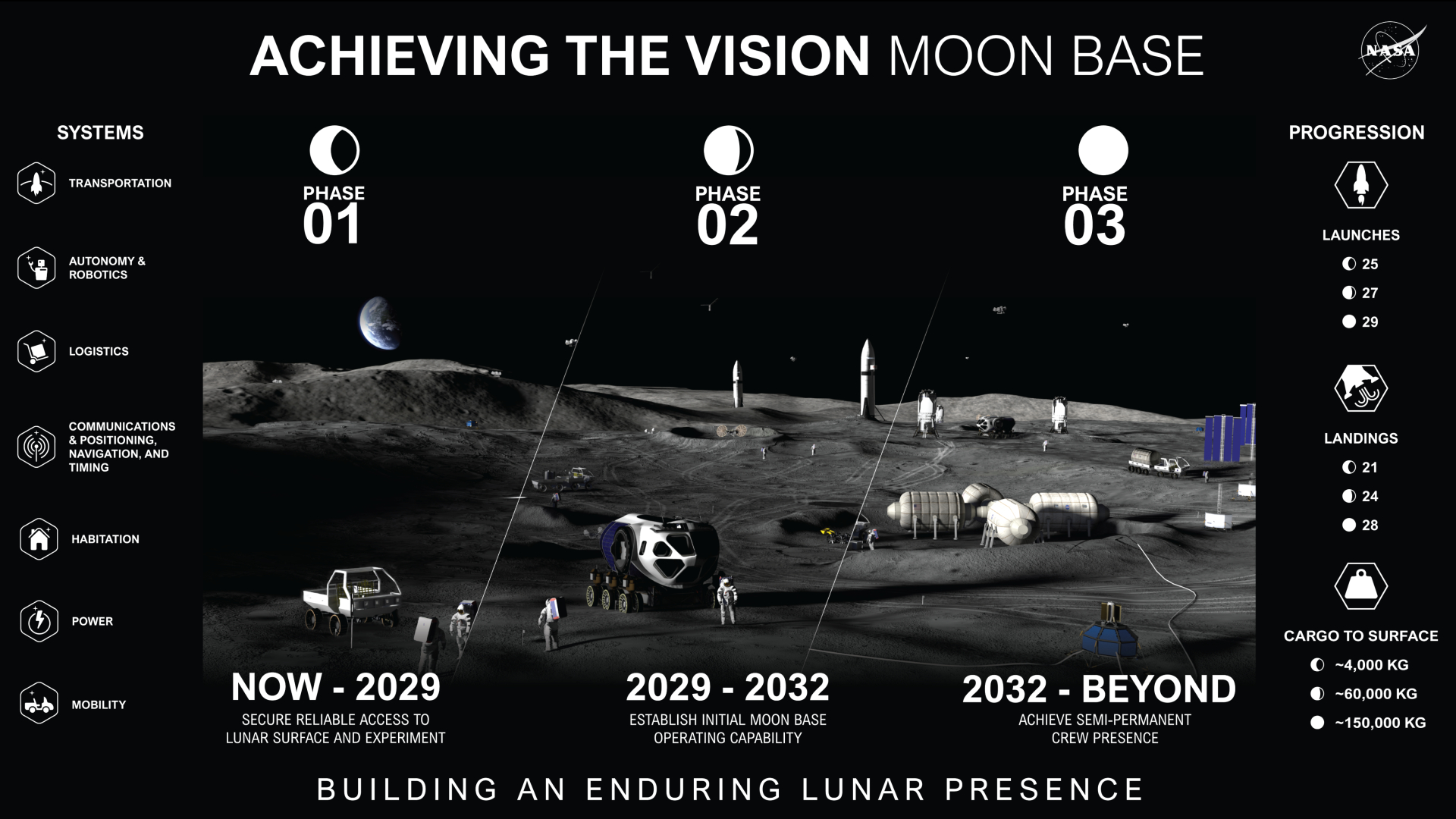
This NASA chart outlines the three major steps of NASA’s Moon Base program from 2026 through 2032, starting with unpressurized rovers and sorties, and ending with a permanent lunar base. (Image credit: NASA)
The base will be constructed over the next decade or so near the lunar south pole, which is thought to harbor large amounts of water ice. This precious resource has been accumulating for billions of years on the permanently shadowed floors of craters in the region, scientists say.
NASA didn’t go into the moon base-planning process with a big footprint as a priority. Rather, it emerged naturally, as all of the envisioned elements started coming together in planners’ heads.
“There’s no one spot that covers all the science, all the technology, all the habitation needs of the surface, and even within the local area, you have to consider the terrain,” NASA’s Nujoud Merancy, chief architect of the Moon Base program, said during today’s briefing.
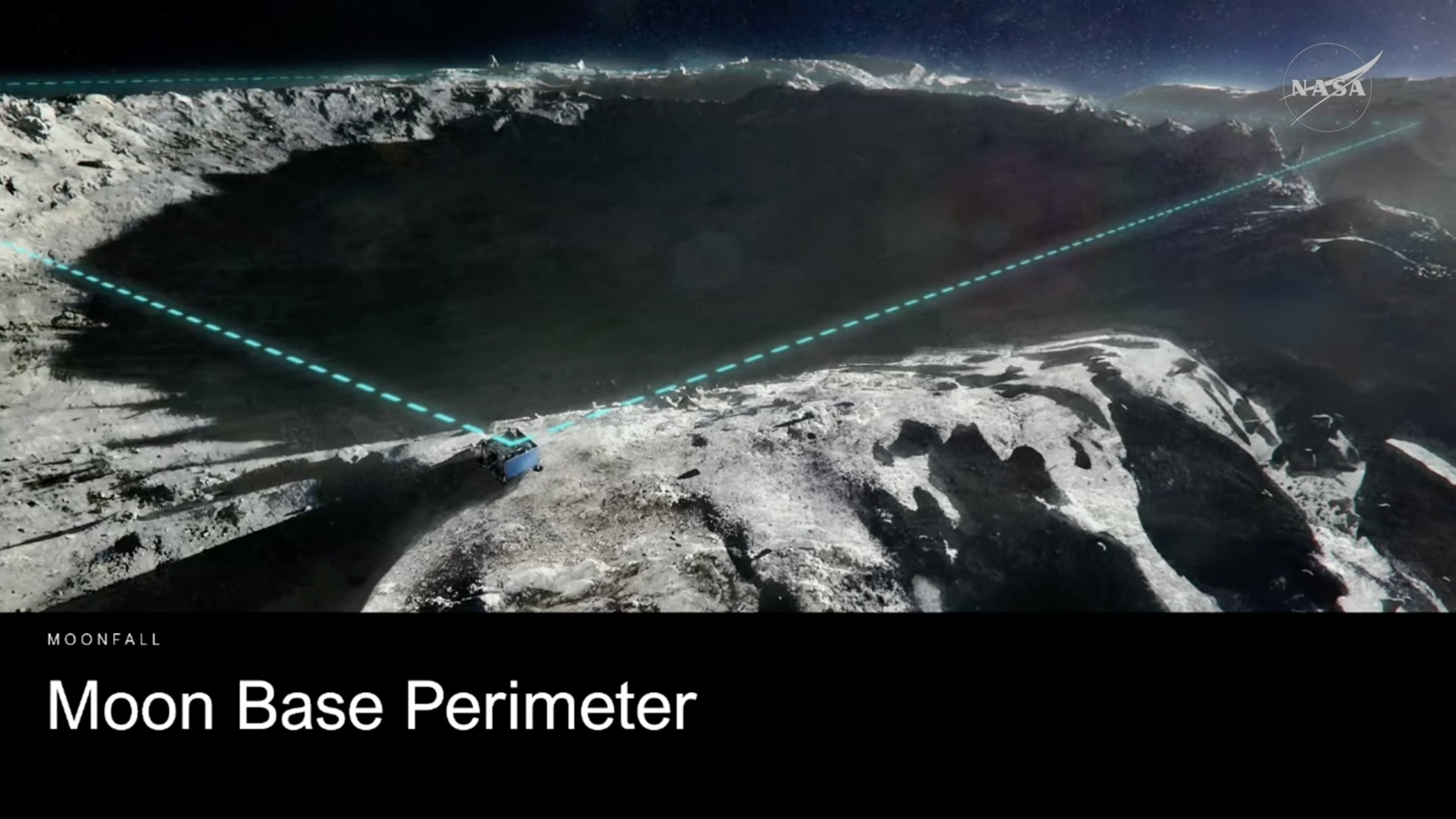
Artist’s impression of a NASA MoonFall drone helping to mark the perimeter of the agency’s planned lunar base. (Image credit: NASA)
“So, you’ll have the habitats on the tops of the hills where they get sunlight,” she added. “Power systems — nuclear systems — need to be a kilometer or more away for the radiation protection, so all of these things, when you start putting them together, end up sprawling a little bit more like a city as you start building it out.”
And scientists and mission planners still don’t know a lot about the lunar south pole, which is another reason for a settlement there to cover a lot of ground, according to García-Galán.
“We’re going to want to explore different sites to really maximize the mix of scientific objectives and viability of a permanent presence,” he said.
NASA plans to reduce the uncertainty via the use of MoonFall drones — small, hopping robots that will scout out the south polar region ahead of moon base construction. The first MoonFall batch, a set of three or four spacecraft, will launch to the moon in 2028 aboard a lander built by Firefly Aerospace, NASA announced today. (Firefly nabbed a $75 million contract for the mission, the company said.)What to read next
Those drones, or others like it, could also help mark the moon base’s borders, said García-Galán.
“We’re going to be able to basically put them at the corners of the areas where we think we have either key scientific objectives or we want to build up the moon base,” he said.
China plans to build a base on the moon in the coming years as well (its first astronaut landing is aimed for 2030), and U.S. officials have repeatedly stressed the importance of getting the American one up and running first. The U.S. wants to be the one establishing norms of responsible behavior on Earth’s nearest neighbor, the argument goes.
So, during today’s press conference, Ars Technica’s Eric Berger asked García-Galán and NASA Administrator Jared Isaacman, who also participated in the event, if the MoonFall drones could help delineate a keep-out zone of sorts.
“I think it’s important for us to get there first,” Isaacman said. “I think the idea that there are areas of great interest on the lunar surface — we do want to get there and explore them, and we also obviously want to be very mindful of the Outer Space Treaty, so that we are respectful of other nations that are putting assets on the on the lunar surface. We would expect that to be reciprocal.”
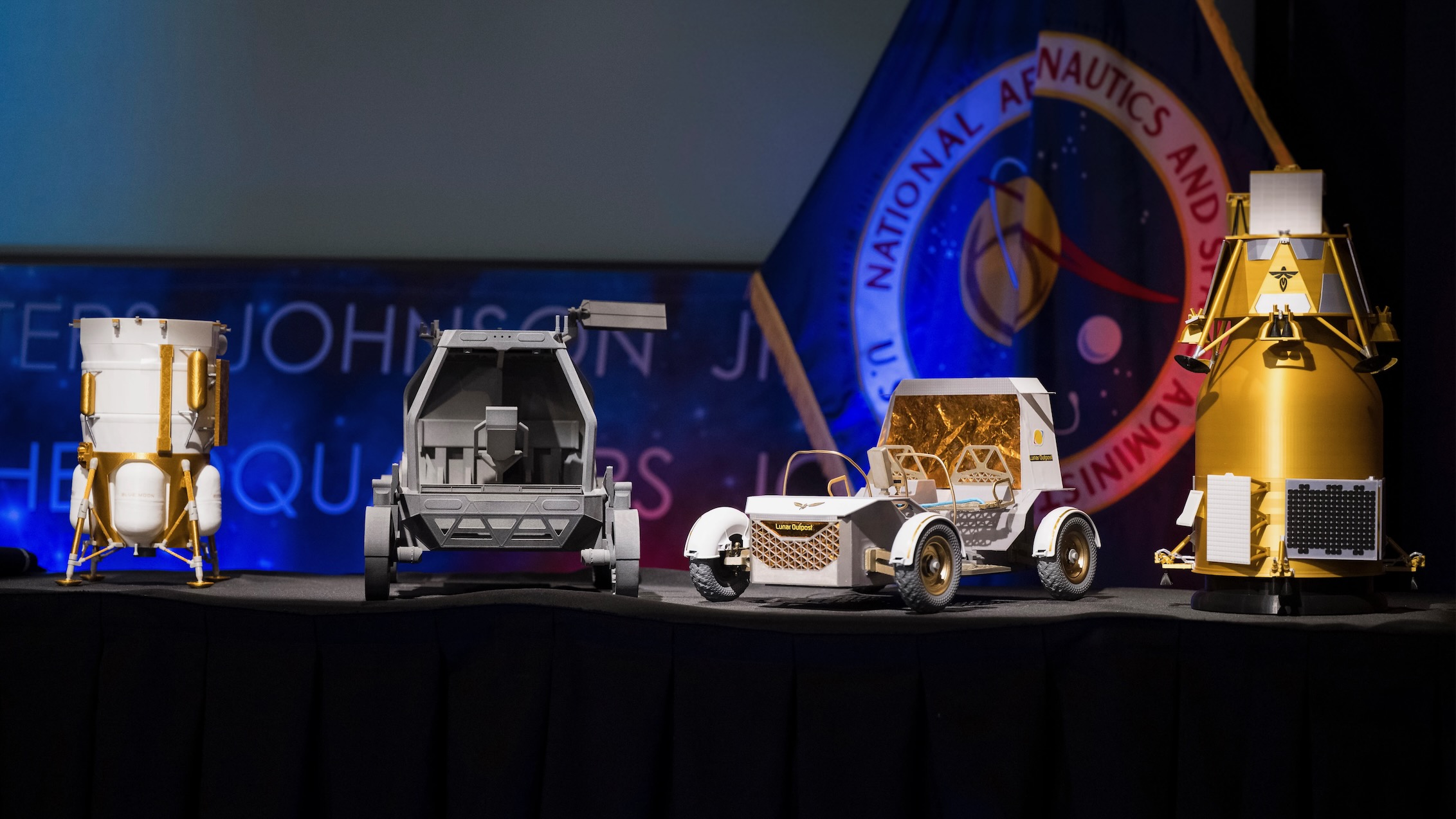
From left to right: Models of the Blue Origin Blue Moon Mark 1 lander, Astrolab Crewed Lunar Rover, Lunar Outpost Pegasus rover and Firely’s Elytra Dark orbiter are unveiled at NASA headquarters in Washington, D.C. on May 26, 2026. (Image credit: NASA/Aubrey Gemignani)
The moon base’s envisioned size was just a sidelight of today’s event. The main purpose was to announce contracts that the agency just awarded to get the ball rolling on the outpost’s construction.
Firefly wasn’t the only compay to win a NASA Moon Base program contract. NASA is giving California-based Astrolab $219 million and Colorado’s Lunar Outpost $220 million for production of their lunar terrain vehicles (LTVs).
LTVs are large rovers that Artemis astronauts will use to explore the lunar surface. These vehicles will also be capable of autonomous operation, meaning they can land before crewed missions, be remotely controlled from Earth, and meet up with astronauts at their touchdown sites. And that is indeed the goal: NASA wants to have at least one LTV on the lunar surface before Artemis 4 touches down near the lunar south pole in late 2028.
Both LTVs will be delivered to the lunar surface by Blue Origin’s Blue Moon lander, NASA announced today. Those two contracts are worth $234 million apiece, agency officials said during the briefing.
Blue Origin is also building a crewed variant of Blue Moon, which is in the running to fly the Artemis 3 and Artemis 4 astronaut missions, as well as future flights.
Artemis 3 is a docking test in Earth orbit between NASA’s Orion capsule and one or both of the program’s privately developed crewed lunar landers — Blue Moon and SpaceX’s Starship. NASA aims to launch Artemis 3 in mid-2027, Isaacman said today.
NASA plans to build the moon base in three phases. Phase One, which runs from now through 2029, will gather detailed information and “secure reliable access” to the lunar surface, according to the agency.
Phase Two runs from 2029 to 2032 and will set up the base’s “initial operating capability.” Phase Three, which runs from 2032 far into the future, will “achieve semi-permanent crew presence” on the moon.
“The Moon Base will be America’s and humanity’s first outpost on another celestial world,” Isaacman said in a NASA statement today. “Every mission, crewed and uncrewed, will be a learning opportunity as we return to the lunar surface, build the infrastructure to stay, and master the skills required to live and operate in one of the most demanding and dangerous environments imaginable.”
NASA has launched two Artemis missions to date. Artemis 1 sent an uncrewed Orion capsule to lunar orbit and back in late 2022, and Artemis 2 took four astronauts around the moon in Orion last month. Both missions were successful.
ARIES (March 21-April 19): In the weeks ahead, simply being right won’t necessarily lead to success. Having strength, intelligence, wealth or connections might help, though not as much as usual. But a different approach will work well as you strive to overcome challenges: a blend of cleverness and integrity. I invite you to be cunning while remaining honorable. Practice subtle strategy in service of higher aims. And here’s one more secret to ensure victory: Let go of any need to receive full recognition for your efforts.
TAURUS (April 20-May 20): “Dear Horoscope Guy: Two astrologers have assured me that as a Taurus, I’m a natural-born money magnet. So why am I broke? I keep begging the Divine for cash miracles, and I buy lottery tickets twice a week. Still nothing! Please tell me when I’ll finally hit the jackpot. Better yet, give me the winning numbers. –Taurus Desperate for Dollars.” Dear Desperate: The “luck” you crave will arrive as you diligently pour yourself into building your sweetest dreams, spurning shortcuts and enjoying yourself as much as possible. The Divine prefers to fund eager co-creators, not wishful thinkers. I predict that a slow-motion jackpot will ultimately arrive through your devoted attention to doing what excites you.
GEMINI (May 21-June 20): Among the Dogon of Mali, Sigui so is a secret language. It’s used in a sacred ritual when people gather to retell their beginnings and patch up strains in tribal harmony. I’m borrowing Sigui so here as a symbol for a way of talking that I hope you will specialize in during the coming weeks: language that eases tensions, soothes friction and fosters unity. Start like this: Unleash your trademark wit but spike it with sly blessings and tactful probes. Wield your fluency to burn away confusion and uncover unspoken feelings. If you’re in an extra-bold mood, give everyone tacit permission to be their idiosyncratic selves instead of their polished personas.
CANCER (June 21-July 22): What’s the holiest, most healing trouble you could rustle up right now? I mean trouble that freshens what’s stale but doesn’t scorch the earth. Maybe it’s a buoyant disruption, like telling wild truths you usually tend to soften. Or maybe it’s asking for what your future self pines for instead of what your past self regards as polite and reasonable. As a Cancerian soul myself, I dare both you and me to give ourselves permission to rumble. Let’s be brazen as we instigate creative upheavals in service to our cheerful vigor. Let’s instigate at least one concrete action that will rattle the stagnant pattern just enough to make life more interesting.
LEO (July 23-Aug. 22): Sea otters are a keystone species. Their presence is essential to the health of their entire ecosystem. As they eat sea urchins, the kelp forests flourish. Without otters, the urchins overgraze, and kelp forests may collapse, which in turn affects hundreds of other species. One creature’s appetite helps regulate an entire undersea neighborhood. I suspect you’re serving a similar function, Leo. You’re having more impact and wielding more influence than you realize. No pressure! But please act accordingly: with maximum integrity and robust responsibility.
VIRGO (Aug. 23-Sept. 22): A Dutch woman who died left her grand-nephew an inheritance of 220,000 euros. The only problem is that he’s homeless and constantly on the move, so the executors haven’t been able to find him. This echoes a recurring pattern in your life. Even now, sources of blessings are searching for ways to reach you, but you are slow to notice their approach or to magnetize yourself to their arrival. My prayer: May you figure out what needs to be done to make yourself fully available for these gifts—and then ingrain that capacity in your habit mind.
LIBRA (Sept. 23-Oct. 22): Visualize your fears. Consider how few of them rest on a genuine likelihood that the scary events could ever take place. Then ask yourself how much of your uneasiness springs from vivid fantasies or from a practiced tendency to fret. You might also ruminate on how you absorb the background worry that’s amplified by mass culture. After reflecting on all that, I invite you to take one concrete action to lower the level of tension you have come to treat as normal. Take another action to weaken the grip of your deepest dread. The current planetary patterns suggest you now have the bold, creative power necessary to shrink your baseline anxiety.
SCORPIO (Oct. 23-Nov. 21): Even more than usual, you have a sacred duty to celebrate your poignant sweetness and dark intelligence. For the sake of your emotional health, you should pay wild reverence to your deepest, most mysterious yearnings. To be the person we all need you to be, you must tenderly nurture the parts of your inner world that resemble the aurora borealis. I want to support you in these sublime sacraments, which is why I suggest you memorize the following prayer by Rainer Maria Rilke: “Be attentive to what is arising within you, and place that above everything you perceive around you. What is happening in your innermost self is worthy of your entire love.”
SAGITTARIUS (Nov. 22-Dec. 21): Linguists use the term “false friends.” These are words in different languages that seem similar but don’t have the same meaning. For example, the Spanish word embarazada resembles “embarrassed” to English speakers but actually means “pregnant.” I suspect you’re dealing with another type of false friend, Sagittarius: people or situations that turned out to be at variance with what you initially imagined. But rather than feeling unsettled by these revelations, I suggest you treat them as a prod to see with fresh eyes. Your disorientation could be the beginning of more interesting understandings.
CAPRICORN (Dec. 22-Jan. 19): An ISBN (International Standard Book Number) is a code assigned to a book for commercial and cataloging purposes. It contains key information and includes a built-in error-detection notation. If you transpose two numbers when entering an ISBN, the last digit will tell you something’s wrong. In this spirit, Capricorn, I heartily recommend that you build more mistake detection into your life. Invest in extra safeguards. Add verification steps. Build in double-checks. The goal is to create systems robust enough to survive oversights and gaffes. I very much want you to give yourself the gift of safety nets that will empower you to take smart risks and intriguing gambles.
AQUARIUS (Jan. 20-Feb. 18): You may not yet grasp how richly creative you are right now, nor how much more abundant your generative powers could become. So it’s auspicious that you are reading this horoscope now. Consider this your advance notice: Your capacity to originate ideas, projects and connections is surging, and it’s crucial to choose with care which possibilities you nurture and which you decline. If you are selective and intentional about what you sow, then about six months from now, you will be far more likely to gather lush, beautiful harvests instead of wrestling with overgrown, unruly tangles.
PISCES (Feb. 19-March 20): Ethnobotanist Wade Davis documented how different cultures perceive entirely different realities despite inhabiting the same physical world. It means that two people can stand in the same forest and see different forests through their cultural lens and personal mythology. This is simultaneously the problem and the opportunity you face, Pisces. You and others in your orbit are inhabiting divergent realities that superficially seem the same. If you hope to reconcile the differences, you must first acknowledge them as real. You’re dealing with fundamentally different ways of constructing meaning, not just small misunderstandings.
Homework: If you knew you would live to one hundred, what would you do differently in the next five years? tinyurl.com/aaa22aaa
New Thinking Allowed with Jeffrey Mishlove May 27, 2026 James Tunney, LLM, is an Irish Barrister who has lectured on legal matters throughout the world. He is a poet, a visual artist, and author of The Mystery of the Trapped Light: Mystical Thoughts in the Dark Age of Scientism plus The Mystical Accord: Sutras to Suit Our Times, Lines for Spiritual Evolution. His website is http://www.jamestunney.com. In this video, rebooted from 2020, he focuses on the role of light in mystical traditions, enunciating his own insights regarding five stages of illumination. He distinguishes between authentic illumination and artificial pretensions of scientistic rationality. He emphasizes the role of heart-centered compassion on the mystical path. New Thinking Allowed host, Jeffrey Mishlove, PhD, is author of The Roots of Consciousness, Psi Development Systems, and The PK Man. Between 1986 and 2002 he hosted and co-produced the original Thinking Allowed public television series. He is the recipient of the only doctoral diploma in “parapsychology” ever awarded by an accredited university (University of California, Berkeley, 1980). He is also the Grand Prize winner of the 2021 Bigelow Institute essay competition regarding the best evidence for survival of human consciousness after permanent bodily death. He is Co-Director of Parapsychology Education at the California Institute for Human Science. (Recorded on December 7, 2020)
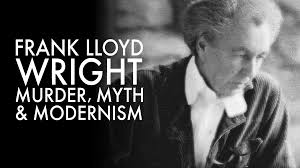
YouTube Movies & TV Frank Lloyd Wright is an American icon – it’s most famous modern architect, and probably it’s most prolific – over 400 buildings in a 60-year career. But his most revealing constructions are his houses, revolutionary in their open plan design, and conceived as an expression of Wright’s philosophy of a perfect harmony between man and nature – ‘organic architecture’ as he called it. Wright’s houses also embody an ideal for living based on calmness and order, but his own life was characterized by public scandal, financial chaos and personal tragedy. The story begins with the most dramatic and terrible event in Wright’s life – the brutal murder in 1914 of his mistress and her two children and a terrible fire that destroyed the house, known as ‘Taliesin’, which Wright had built as a private sanctuary. Wright had invested so much of himself in Taliesin that, despite the tragedy, he could not bear to abandon it. He immediately set about rebuilding and over the next forty years the house became a piece of living architecture – continually extended and remodeled. Taliesin was, in effect, Wright’s alter ego – order born out of chaos. We then go back in time to examine the history of Wright’s early life and career leading up to that incident. It will show not only how Wright developed his unique style, but how he constructed his own myth and cultivated his reputation in his relationships with his wealthy clients. They, in turn, indulged his ‘genius’. This film reveals the extremes and eccentricities of the man through interviews with individuals whose lives he touched – acolytes who knew and lived with him at Taliesin and those who encountered him during the construction of some of his most famous buildings. Frank Lloyd Wright is a dramatic, surprising and entertaining portrait of a master builder whose most enduring edifice is his own legend.
Consciousness, spirituality, biography, sexuality, androgyny, futurism, space, the arts, science, astrology, democracy, humor, books, movies and more





 It is a silver morning like any other. I am at my desk. Then the phone rings, or someone raps at the door. I am deep in the machinery of my wits. Reluctantly I rise, I answer the phone or I open the door. And the thought which I had in hand, or almost in hand, is gone. Creative work needs solitude. It needs concentration, without interruptions. It needs the whole sky to fly in, and no eye watching until it comes to that certainty which it aspires to, but does not necessarily have at once. Privacy, then. A place apart — to pace, to chew pencils, to scribble and erase and scribble again.