The historical French leader has captivated imaginations around the globe for centuries as the subject of books, films, songs and poems. As a new biopic directed by Ridley Scott is set to further embellish Napoléon Bonaparte’s legend, the reality of his legacy is more complicated.
In France, Bonaparte goes by two nicknames: “the Eagle” among those who laud him as a military genius and force for modernisation throughout Europe, and “the Ogre” by those who see him as a warmongering megalomaniac with a callous disregard for human suffering.
Napoléon’s stratospheric rise to power is legendary. Bonaparte was born in 1769 into an unwealthy family on the island of Corsica, and trained in a military academy on mainland France. He was 20 years old when the French Revolution began in 1789 – within three years, France had overthrown its monarch and declared itself a republic.
After the revolution, Bonaparte continued a steady rise through the military ranks, leading armies in Italy, Egypt and Syria as a major general before returning to his homeland in 1799.
France was in the grips of economic and political chaos, and Bonaparte played a role in overthrowing its five-person governing committee, the Directory, which was replaced with a three-member Consulate.
Napoléon took the role of first consul, making him France’s leading political figure – a position he consolidated by declaring himself Consul for Life in 1802 and Emperor in 1804, at the age of 35.
“Napoléon shouldn’t be seen in black and white but rather in shades of grey. His rule over France had some very positive aspects, most notably in terms of modernising administration,” historian and writer Charles-Éloi Vial told FRANCE 24.
Under Napoléon’s rule many staples of French administration which still endure today were introduced, such as upper-level secondary schools (or lycées), the baccalaureate school exam system, the Legion of Honour distinction for military and civilian merit, a reorganisation of governmental legal advisory body the Council of State (Conseil d’État) and even the French rubbish collection system.
The most influential of his administrative successes was introducing the Civil Code legal system in 1804, then called the Napoléonic Code.
For the first time, the code introduced a single set of clearly written and understandable national – rather than provincial – laws to France, legally defining the status of people, property and acquisition of property, and standardising legal procedures.
The code went on to be adopted in many countries in Europe occupied by Napoléon’s armies, marking the end of feudalism and the foundation of legal systems across most of continental Europe, and beyond.
“To this day, you can see the traces of Napoléon’s Civil Code in so many countries – many European nations, Japan, South Korea, Chile and so on – that you could even describe it as a universal code,” Thierry Lentz, a historian and director of the Fondation Napoléon told FRANCE 24.
The legacy of many of the administrative structures that Bonaparte introduced across Europe have endured. “His imprint is everywhere, every day,” said Michael Broers emeritus professor of Western European History at the University of Oxford, and historical consultant on Ridley Scott’s “Napoleon”.
“Every time you buy and sell a house, or use the law, when you go to school or university, when you see [French police] the gendarmerie or [Italian police] the Carabinieri… the way all that is structured is the Napoléonic system.”
‘Warmonger’
However, Napoléon is perhaps best known as an expert military strategist and leader. Some of the most instantly recognisable imagery of Napoléon depicts him on the battle field in full military dress, including his iconic bicorne hat.
As a leader, Napoléon quickly racked up exception battlefield wins using successful strategies such as quickly moving his army, rapid attacks, and disconnecting enemy units. “He was great military leader. I defy anybody to find a greater military victory than [the battle of] Austerlitz,” said Broers.
As a result, France’s empire grew rapidly, and by mid-1812 most of Europe had either been incorporated into France, was under Napoléon’s control or was allied with the French leader.
But military advances came at a human cost. An estimated 800,000 – 1 million French soldiers and 2 million opposition soldiers losing their lives in the Napoleonic wars.
Although a skilled military leader, Bonaparte’s ambition ramped up the death toll especially towards the end of his reign.
From 1808 onwards, “You can see his ambition carried him away,” said Vial. “In the Peninsular War in Spain – and especially in Russia – it was clear that Napoléon was waging war for an idea of glory. The stakes got higher and higher, the death toll mounted and the battles became even more blood-soaked.”
“He was a warmonger and a warlord,” added Broers. “For the better part of 10 years, he was at war.”
‘Enlightened despot’
Another label given to Napoléon is that of “enlightened despot”. As much as he was a man of his time in terms of introducing civil rights such as access to education and systemised legal processes, during his rule there was no tolerance for opposition.
Hard-won political and civil liberties that came as a result of the Revolution were quashed, press freedoms were restricted, troublesome parliamentary institutions were closed and opponents were heavily surveyed by State police, if not exiled.
Napoléon also oversaw reforms that pushed back social progress. As part of a plan to dominate the global sugar cane trade Bonaparte in 1802 reintroduced slavery in France’s overseas territoriesincluding modern-day Haiti, French Guiana and Guadeloupe, where it had been abolished since 1794.
He also introduced new laws that gave women less rights than children in some cases.
Under Napoléonic laws it became harder for women to obtain divorces and all property owned or inherited by a woman was entirely controlled by her husband or father.
If would be a mistake though, Broers says, to call Bonaparte a misogynist. He was in favour of girls receiving some education and set up a small number of schools for them.
He also trusted women close to him with “enormous responsibility”, Broers added, such as asking his sisters to rule over regions of Italy.
Legacy
After a failed invasion of Russia, Napoléon’s forces were defeated by a coalition of allies and he was exiled to the Mediterranean island of Elba in 1814.
A bid for a return to power resulted in another defeat at Waterloo in 1815, after which the British exiled Napoléon on the remote Island of St Helena, where he died in 1821.
His remains were brought back to France 20 years later and placed in a grandiose tomb under the dome at Les Invalides in Paris.
Daily newsletterReceive essential international news every morningSubscribe
Yet, despite the scale of his legend, there are few other public monuments to the man who is arguably France’s most famous figure. In Paris there are just two roads named after Napoléon: Rue Bonaparte and Quai de la Corse [The Corsican’s Quay].
Public reckoning with Napoléon’s complicated legacy has been ongoing, especially since the 200th anniversary of his birth in 1969, “which was a landmark in the shift from a public image of Napoléon as just an ingenious force of nature to a much more nuanced understanding of his character”, says Vial.
French President Emmanuel Macron described event’s to mark the 200th anniversary of Napoléon’s death in 2021 as a “commemoration” rather than a celebration.
“Napoléon left an indelible mark on the public sphere of Europe … but even experts don’t agree about what kind of person he was,” said Broer.
He credits actor, Joaquin Phoenix, who plays Bonaparte in the Ridley Scott biopic, with summarising it best: “He said it in an interview recently ‘everyone has their own Napoléon,’ and I couldn’t agree more.”
Useful Idiots • Nov 24, 2023 • Useful Idiots Full EpisodesFor $5 a month, become a Useful Idiot! Get extended interviews, Thursday Throwdowns, and chat live with Katie and Aaron in the Absurd Arena at www.usefulidiotspodcast.com
We are just ten days until Thanksgiving Day in the United States, which makes it a fine time to slaughter some sacred cows along with the turkeys and debunk several Thanksgiving myths that have become entrenched in our popular culture. I want to be clear that I am talking about Thanksgiving in the United States; our Canadian cousins celebrated their Thanksgiving more than a month ago. I don’t know anything about the holiday there, but I imagine it partly involves giving thanks that they don’t live in America, something they would never say out loud because they’re far too polite.
The basic story we’ve heard since we were kids is that in 1620 the Pilgrims bravely sailed to the New World seeking a better life and religious freedom, ultimately landing at Plymouth Rock. Life was difficult that first year, and it was only through the kindness of the local Native Americans that they survived. To celebrate this successful new alliance, in 1621 the Pilgrims and Native Americans shared a big Thanksgiving feast of turkey, mashed potatoes, cranberry sauce, and pie, and we’ve celebrated it ever since.
It is true that there were English settlers and Native Americans present at that first Thanksgiving. Beyond that (to paraphrase Luke Skywalker’s awesome line in The Last Jedi), every word I just wrote was wrong. The most glaring error is what we call the settlers themselves; the Pilgrims were not called Pilgrims at all, but rather either Saints or Separatists. It wasn’t until the celebration of the Plymouth colony’s 200th anniversary in 1820 that Daniel Webster called them the “Pilgrim Fathers,” and the name stuck. Also, those Separatist Saints already had religious freedom in Holland, so that wasn’t their main reason for leaving (it was more likely an inability to learn how to speak Dutch).
Furthermore, what we commemorate today as the first Thanksgiving wasn’t a particularly special event at all, as harvest festivals were celebrated every year already and strictly speaking it wasn’t even a “thanksgiving.” For the Christian English settlers, a “thanksgiving” was a day of prayer and reflection, not feasting, and they never would have invited the non-believing Natives to such a thanksgiving. It’s also important to note that thanksgivings actually occurred numerous times throughout the year, while the harvest festival occurred only once a year.
As for the menu, it bore little resemblance to what we enjoy on the fourth Thursday of November every year. Some of the foods they would not have served include apples, pears, potatoes, corn on the cob, or cranberries. There may or may not have been turkey, which was not new to the English. The meat dishes would have likely included venison, ham, waterfowl, clams, and lobster; non-meat items included fruit, berries, squash, and pumpkin (though not in pie form). Personally, I think we should get rid of the turkey and bring back lobster. Lobster…yum.
It’s also a myth that we’ve celebrated Thanksgiving ever since that first one at Plymouth; we haven’t. As I’ve already mentioned, it wasn’t seen as anything special or out of the ordinary to the Plymouth colonists, and it wasn’t a national holiday in the United States until 1863, more than 240 years after that first celebration. It was then, in the middle of the Civil War, that President Abraham Lincoln declared an annual Day of Thanksgiving that was only later tied to the event in 1621.
Sadly, the budding friendship between the Native Americans and English settlers lasted about as long as your typical post-Thanksgiving meal nap. Things turned sour very quickly, as they often would in our dealings with Native Americans throughout our history. Though Natives like Tisquantum, better known to history as Squanto, helped the settlers by translating for them, establishing trade with his tribe, teaching them how to how to smoke (and thus preserve) the local meats and fish, and how to plant beans, squash, and corn, the English settlers typically saw the Native tribes only as an impediment to their expansion (unlike the French settlers, who quickly developed strong alliances with the local tribes). The main thing the English settlers gave the Native Americans in return for their help was whiskey and smallpox.
There is one last interesting tidbit that isn’t a myth but is usually left out of the historical narrative. The town of Plymouth, Massachusetts, is famous today because the Pilgrims landed there, but that wasn’t their intended destination. They were actually trying to get to Virginia and missed it by roughly 600 miles. That’s not nearly as bad as Christopher Columbus’s navigational error, but it’s embarrassing enough that we don’t mention it.
I realize that none of these myths in any way lessen the importance of taking one day a year to consider and be thankful for our many blessings, but getting history wrong does nothing to help that. Feast away next Thursday but toss out those romanticized illusions about the Pilgrims the same as you do your sister-in-law’s horrible three-bean casserole. And be sure to cheer for the Dallas Cowboys, the one true Thanksgiving tradition we can all get behind.
If you enjoyed this story, you can support my writing directly by leaving a tip below using the small (and kind of weird) hand icon (you tip waiters and bartenders, so why not writers?).
Writer, bookseller, would-be roadie for the E Street Band. My ultimate goal is to make books as popular in Texas as high school football…it may take a while.
SUDBURY, MA—Their forks clattering to the table mere moments after the 16-year-old’s sudden announcement, Thanksgiving guests at the Ross family dinner reportedly froze in disbelief Thursday after teenage son Ryan informed them of the genocide of Native Americans. “No, no, it can’t be! Not my precious holiday!” said mother Alexandra Ross, 47, one of several dumbfounded family members who at first listened in rapt amazement to the high school junior’s statement that the first Thanksgiving was nothing like what was taught in schools before breaking the silence by spitting out their mashed potatoes and turkey into their napkins and screaming at the top of their lungs. “This changes everything! Everything! What were we doing here gathered with your grandmother on a terrible day like this? Oh God, burn the tablecloth! Burn the little pilgrim figurine! Burn it all down!” At press time, family patriarch Jim Ross had proclaimed that he “couldn’t stand the horrible truth” before grabbing the carving knife and slitting his own throat from ear to ear in front of his stunned teenage son.
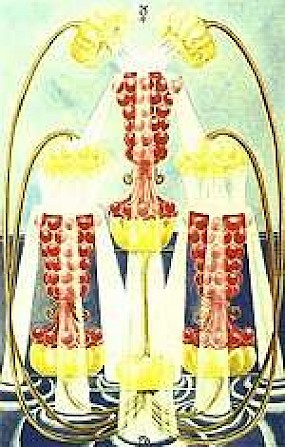
The Lord of Abundance is a warm and joyous card, which indicates a rare and precious type of love – a love which, once experienced, reminds us of the richness of shared emotion and commitment.
It is also a card which refers to the wellspring of fertility, whether spiritual or material. Here we see the first seeds sown of a bright and bountiful harvest. Accordingly, the card will sometimes come up to indicate high days of celebration – like weddings or other intimate celebrations of love.
The emotional quality represented by this card is deep and unusual – indicating the love felt not only by lovers, but also the love between close friends, or family. These relationships are gifts, which need to be cared for with great respect and gratitude.
The Lord of Abundance offers one word of warning – this type of love cannot be created, nor engineered. When it occurs in our lives we are lucky and blessed. Some people spend a lifetime looking for such depth of emotion. And sometimes, people try to pretend it exists where it does not. So when you raise this card in a reading be aware that you are fortunate indeed!
Historically, some of the most effective purveyors of therapeutic or self-help spirituality in modern life harbor little-seen ties to mystical and occult movements.
Among such figures, the most consequential in shaping a persuasive, globally popular mental-therapeutic spirituality were Bill Wilson (1895–1971) and Bob Smith (1879–1950), cofounders of Alcoholics Anonymous (AA).
Nearly a century ago, AA arose, and continues, as the primary vehicle of practical mysticism in modern life, with spiritual sources as widespread as they are, in many cases, esoteric.
Astradition records, the Vermont-born men, Wilson and Smith, first met in May 1935 in Akron, Ohio. Bill was a newly sober alcoholic traveling on business from New York. Alone at a hotel, he was desperate for a drink. He thumbed through a local church directory seeking a minister who could help him find another drunk to talk to. Bill had the idea that if he could locate another alcoholic to speak with, and to help, it might ease his pangs for booze.
On that day, Bill found his way to Bob Smith, an area physician who had waged his own long and losing battle with alcohol. Both men had spent years vainly sampling different techniques and treatments. When they met in Akron, however, each discovered that capacity to stop drinking grew in proportion to his ability to counsel the other. Wilson and Smith’s friendship burgeoned into the founding of Alcoholics Anonymous and the modern twelve-step movement.
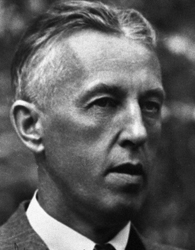
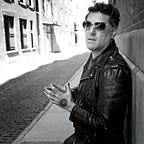
A young Bill. (Wikipedia)
Bill and Bob appeared as all-American as their names. In their looks, dress, and politics, both men were as conservative as an old-fashioned banker, which, in fact, Wilson was.
But each was also a spiritual adventurer, committed to exploring the terrain of metaphysical experience, from Spiritualism and mediumship to positive-mind and Eastern metaphysics, in search of a workable solution to addiction. Together, they wove Christian, Swedenborgian, Jungian, Jamesian, Christian Science, mediumistic, and New Thought (positive-mind) themes into the twelve steps of Alcoholics Anonymous, fostering perhaps the most explicitly therapeutic metaphysical movement in history.
Seen in a certain light, Alcoholics Anonymous had its earliest beginnings with Bill Wilson’s marriage in January 1918 to his wife and intellectual partner, Lois Burnham (1891–1988).
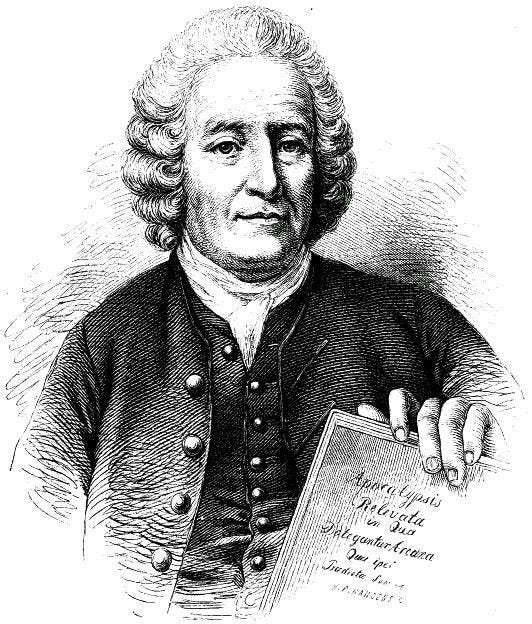
Lois came from an old-line family with roots in Lancaster, Pennsylvania, and Brooklyn, New York. The Burnhams had a deep commitment to the Swedenborgian Church, the congregation founded on the mystical philosophy of 18th century scientist-seeker Emanuel Swedenborg (1688–1772). The Swedish mage taught of an unseen spirit world whose forces and phenomena mirror our own, with thought the connecting tissue between the two.
Lois’s paternal grandfather was among the nation’s first Swedenborgian ministers. She and Bill were married at the Church of the Neighbor, a Swedenborgian congregation in Brooklyn. (Source notes appear at the end of this article.)
A late-19th century drawing of Swedenborg. (Wikimedia Commons)
After that church’s closing, Lois attended the New York New Church, a Swedenborgian congregation on Manhattan’s East Side. Dating back to 1816, this congregation included Henry James Sr., the father of William and Henry James, and Helen Keller. It continues today. Lois proved reticent about publicly expressing her Swedenborgian commitments: she wished to avoid any appearance of religious favoritism within AA.
Asked shortly before her death in 1988 whether Swedenborgianism had influenced the twelve steps, Lois replied that no particular faith should be singled out. “If there was a connection,” Lois said, “I wouldn’t tell you anyway, for that very reason.”
The Swedenborgian commitment that ran through Lois’s family appears to have impacted Bill, especially when his binge drinking drove him toward spiritual solutions. A key tenet of Swedenborgianism, later reflected in AA literature, is that the individual functions as a vessel for higher energies. Swedenborg described a “Divine influx” suffusing the material world. Popular early 20th century New Thought author Ralph Waldo Trine called it a “divine inflow.”
This notion appears to have helped Bill define his personal “awakening experience.” In December 1934, Bill was laid up in Towns Hospital in Manhattan, a tony, private sanitarium where he frequently retreated to recover from benders. He was trapped in a cycle of binge drinking, drying out, and drinking again. Bill was in agony over his inability to control the alcoholism that was driving him toward death, which he knew would arrive either from a drinking-related accident, illness, or indigence.
“Lying there in conflict,” Bill wrote, “I dropped into the blackest depression I had ever known. Momentarily my prideful obstinacy was crushed. I cried out, ‘Now I’m ready to do anything . . .’ ” What happened next completely reordered his life:
Though I certainly didn’t really expect anything, I did make this frantic appeal: “If there be a God, will He show Himself!” The result was instant, electric, beyond description. The place seemed to light up, blinding white. I knew only ecstasy and seemed on a mountain. A great wind blew, enveloping and penetrating me. To me, it was not of air, but of Spirit. Blazing, there came the tremendous thought “You are a free man.”
Bill encountered something like the “Divine influx.” His experience of religious awakening was confirmed for him several days later during a visit by his friend Ebby Thacher. Ebby was involved with a Christian evangelical fellowship called the Oxford Group. He handed Bill a book that became his closest companion and source of insight: The Varieties of Religious Experience, the 1902 classicof comparative religion by American philosopher and psychologist William James.
“I devoured it,” Wilson recalled. In James’s case studies, Wilson recognized his own epiphanic episode. The philosopher had termed it a “conversion experience.” The realization of a higher power, James wrote, often struck a believer with such clarity and power that it objectively altered the circumstances of outer life. Bill’s conversion experience had done so for him; he never drank again.
There is speculation that Bill’s episode was produced or abetted by belladonna, a onetime botanical treatment for alcoholism known to induce hallucinations. Bill was untroubled by the prospect. In the late 1950s, he experimented under medical supervision with LSD, which he believed could induce rather than substitute for spiritual experience.
Inthe years immediately following his “white light” realization, Bill codified his awakening into the first three steps of the twelve-step program. The opening three steps reflected a kind of blueprint for a Jamesian conversion experience. They were written in such a way that the word alcohol could be replaced by any other compulsory fixation, such as anger, drugs, or gambling:
We admitted we were powerless over alcohol — that our lives had become unmanageable.
Came to believe that a Power greater than ourselves could restore us to sanity.
Made a decision to turn our will and our lives over to the care and direction of God as we understood Him.
Working as chief writer, Bill published the twelve steps in 1939 in what became known as the “Big Book,” Alcoholics Anonymous.
Although James’s work remained central to Bill, many other influences shaped his book. Bill tore through spiritual literature, reading and rereading Christian Science founder Mary Baker Eddy’s 1879 Science and Health, alongside New Thought books such as Emmet Fox’s 1934 The Sermon on the Mount, an interpretation of Christ’s oration as a mental-manifestation philosophy. He also read Christian inspirational works, such as Scottish evangelist Henry Drummond’s 1890 meditation on the transformative power of love, The Greatest Thing in the World.
Intime, AA’s written and spoken principles altered the lexicon of American life, giving rise to expressions such as “easy does it,” “one day at a time,” “first things first,” and “let go and let God.” Most significantly, its literature popularized an ecumenical term for God: Higher Power.
This phrase appeared in the group’s core principle that the alcoholic’s “defense must come from a Higher Power,” as Bill wrote in the “Big Book.” But Wilson and Smith also insisted that twelve-steppers must form their own conception of God “as we understood Him,” as the third step went. “Higher Power” neatly captured the radical ecumenism they were after. (I sometimes tell twelve-steppers today that if that term smacks too heavily of Abrahamic or monotheistic religiosity for their outlook, try substituting Greater Force.)
Higher Power probably entered AA’s lexicon through Ralph Waldo Trine’s 1897 New Thought bestseller, In Tune with the Infinite, a favorite of Bob Smith’s. Trine repeatedly used the term, with particular reference to alcohol: “In the degree that we come into the realization of the higher powers of the mind and spirit . . . there also falls away the desire for the heavier, grosser, less valuable kinds of food and drink, such as the flesh of animals, alcoholic drinks . . .” (Emphasis mine.)
Bill’s companion Ebby Thacher also brought him to two additional philosophies that deeply impacted AA’s development: the teachings of a popular evangelical fellowship called the Oxford Group and the metaphysical outlook of psychologist Carl Jung. In a sense, all of these early influences — William James, the Oxford Group, and Jung — reflected vastly different thought systems. But their unifying kernel was the principle that the sensitive, searching mind could bring a seeker to the experience of a Higher Power.
The Oxford Group, initially launched as First Century Christian Fellowship, was an enterprising and profoundly influential religious lay movement in the first half of the 20th century. Its teachings brilliantly distilled therapeutic and self-help principles from within traditional Christianity. So redubbed in 1929 because of its large contingent from Oxford University, the Oxford Group devised a protocol of steps and principles intended to awaken modern people to the healing qualities of God in a manner similar to that experienced by first-century Christians. The steps included radical honesty, stringent moral self-examination, confession, making restitution, daily meditation or “quiet time,” and opening oneself to awakening or conversion experiences. Much of this was later reflected in the twelve steps.
To facilitate its program, Oxford’s organizers pioneered the use of group meetings or “house parties.” These took place in an encounter-group atmosphere of confession, shared testimonies, and joint prayer. Mutual help and peer therapy were central to Oxford’s program, and gave rise to a similar structure in AA.
Yet for some Oxford members, eventually including Bill and Lois Wilson, the group-meeting atmosphere could deteriorate into a brow-beating, accusatory climate in which members were singled out for not sufficiently sharing intimacies or detailing moral failings. Oxford’s internal culture demanded a gung-ho approach — converts were often coached to go “maximum” in their commitment.
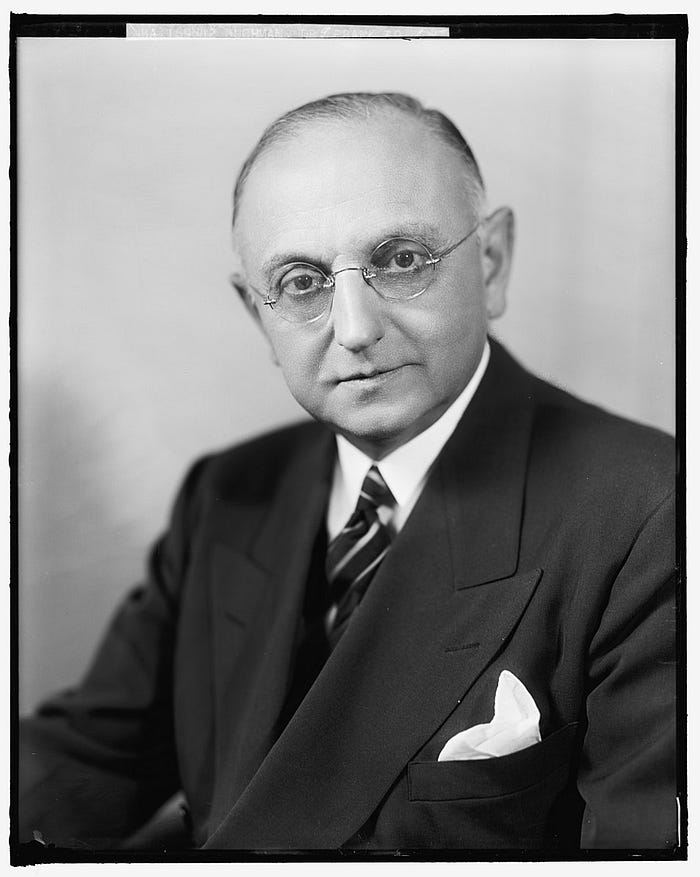
This gung-ho style emanated from the group’s founder, Frank Buchman, an American Lutheran minister who initiated its meetings in the early 1920s. Buchman was the organization’s greatest asset — and gravest failing.
Buchman circa 1945. (Wikimedia Commons)
Ashrewd and impassioned organizer, Frank Buchman built the group through a strategy of recruiting “key people.” Such a figure might be a celebrity, banker, or, on a college campus, captain of the football team. A key person, in turn, attracted social admirers, sycophants, and aspirants into the fold.
Buchman often organized his Oxford meetings at posh hotels or homes of well-to-do members — again making the group attractive by its sheen of success. Mary Baker Eddy devised a similar strategy in building her Christian Science churches, schools, and reading rooms in high-tone neighborhoods. Even the Oxford Group’s informal use of the august university’s name — which it was later asked to discontinue — lent it an air of respectability and upward mobility. (By the late 1930s, the group gradually adopted the name Moral Re-Armament.)
In 1936, Buchman upset all of his carefully laid plans. The Lutheran minister ignited an international uproar when he apparently set his sights on attracting a unique key person: Adolf Hitler. During the 1930s, Buchman traveled to Germany, where he met with Heinrich Himmler, whose wife was reportedly in sympathy with the Oxford Group. Buchman vocally praised Hitler as a bulwark against atheistic Communism. “. . . think what it would mean to the world,” he told a reporter for the New York World-Telegram in an interview published August 26, 1936, “if Hitler surrendered to the control of God. Or Mussolini. Or any dictator. Through such a man God could control a nation overnight and solve every last, bewildering problem.” Similar statements had come from Glenn Clark, an inventive Presbyterian lay leader also active in New Thought. (Bob Smith attended retreats organized by Clark and praised him as one of his favorite authors.)
But Oxford’s founder went further still, uttering his most notorious words: “I thank heaven for a man like Adolf Hitler, who built a front line of defense against the anti-Christ of Communism.”
While Bill wanted to save drunks, Frank Buchman wanted to save “drunken nations.” Buchman’s maximalist worldview held no appeal for Bill and Lois, who, after distancing themselves for some months following Buchman’s announcement, pulled away from Oxford entirely by 1937. By the end of the decade most of AA’s groups had ceased all cooperation with Oxford, increasingly called Moral Re-Armament (MRA). Around that time the Buchman organization also lost some of its most thoughtful ministers and organizers, including the Reverend Sam Shoemaker, an Episcopal priest at New York’s Calvary Church, who was a major influence on Bill.
Yet Bill’s friend Ebby had also introduced him to another, very different stream of ideas: the psycho-spirituality of Carl Jung. Bill said the psychologist’s role was “like no other” in AA’s founding.
At the same time, Bill also praised William James as “a founder of Alcoholics Anonymous.” Bill may have eagerly emphasized AA’s debt to respected figures like Jung and James as a means of exorcising the shadows of Frank Buchman. Yet all of these influences could not be easily separated out, one from the other. Ebby himself was first recruited to Oxford by a former patient of Jung’s, a Rhode Island businessman named Rowland Hazard. Rowland’s experiences, in turn, brought Jung’s influence into AA.
Around 1931, Rowland visited the Swiss psychologist to seek help with his alcoholism. He reported leaving the doctor’s care feeling cured, but suffered a relapse a few weeks later. Rowland returned desperate, pleading to know what could be done. Jung leveled with the American: He had never once witnessed a patient recover from alcoholism.
“I can do nothing for you,” the psychologist concluded.
Rowland begged, surely there must be something?
Well, Jung replied, there may be one possibility: “Occasionally, Rowland, alcoholics have recovered through spiritual experiences, better known as religious conversions.” Jung went on: “All you can do is place yourself in a religious atmosphere of your own choosing” — here was the AA principle of pursuing God as we understood Him — and “admit your personal powerlessness to go on living. If under such conditions you seek with all your might, you may then find . . .”
Jung’s prescription matched what Bill had experienced at Towns Hospital. For Bill, it served as further confirmation of the urgency of a spiritual response to addiction.
Years later, Bill finally wrote to Jung, on January 23, 1961, in the last months of the psychologist’s life. Bill wanted to tell him how his counsel to Rowland had impacted the AA program. He also reported that “many AAs report a great variety of psychic phenomena, the cumulative weight of which is very considerable.”
To Bill’s delight, Jung replied with a long letter on January 30. The psychologist vividly recalled Rowland and what he had told him. Jung repeated to Bill his formula for overcoming alcoholism: spiritus contra spiritum. Jung’s Latin phrase could be roughly translated as: Higher Spirit over lower spirits, or alcohol.
It was the twelve steps in a nutshell.
Following Bill’s death in 1971, AA found compatibility with the dawning New Age movement of radically ecumenical and therapeutic spirituality, some of it supernatural in nature or at least perception. Indeed, the 1960s and ’70s saw the emergence of a newly popularized mediumistic or “channeled” literature from higher intelligences such as Seth, Ramtha, the “Source” of early 20th century medical clairvoyant Edgar Cayce, and even the figure of Christ in A Course in Miracles.
The last of these was a profound and enduring lesson series, channeled beginning in 1965 by Columbia University research psychologist Helen Schucman. A concordance of tone and values existed between the work of psychic Edgar Cayce (1877–1945) and A Course in Miracles. In fact, Cayce’s devotees and the Course’s wide array of readers discovered that they had a lot in common; members of both cultures blended seamlessly, attending many of the same seminars, growth centers, and New Thought churches.
Likewise, congruency emerged during Bill’s lifetime between Cayce’s world and followers of the twelve steps — extending to Bill himself. Starting in the 1970s, twelve-steppers of various stripes became a familiar presence at Cayce conferences and events. Cayce’s universalistic religious message dovetailed with the purposefully flexible references to a Higher Power in the “Big Book,” Alcoholics Anonymous. Indeed, Bill, Lois, and Bob, along with other early AAs were deeply versed in mystical and mediumistic teachings, extending to Cayce — and even the Wilsons’ at-home Ouija board sessions and private seances.
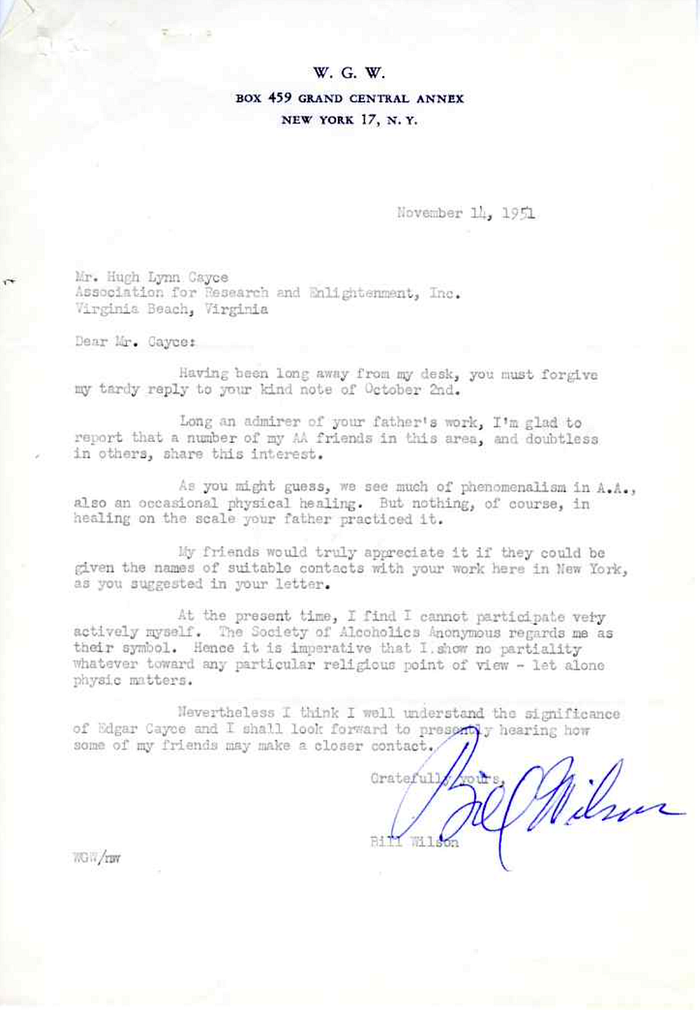
In recently discovered correspondence, Bill wrote to the psychic’s son and custodian Hugh Lynn Cayce, on November 14, 1951: “Long an admirer of your father’s work, I’m glad to report that a number of my A.A. friends in this area [New York City], and doubtless in others, share this interest.”
He went on to comment revealingly about contacts that Hugh Lynn had previously proposed between the Cayce organization and AA:
As you might guess, we have seen much of phenomenalism in A.A., also an occasional physical healing. But nothing, of course, in healing on the scale your father practiced it . . . At the present time, I find I cannot participate very actively myself. The Society of Alcoholics Anonymous regards me as their symbol. Hence it is imperative that I show no partiality whatever toward any particular religious point of view—let alone physic [sic] matters. Nevertheless I think I well understand the significance of Edgar Cayce and I shall look forward to presently hearing how some of my friends may make a closer contact.
Bill Wilson’s 1951 letter.
All three works—the Cayce readings, A Course in Miracles, and Alcoholics Anonymous—demonstrated a shared sense of religious liberalism, an encouragement that all individuals seek their own conception of a Higher Power, and a permeability intended to accommodate the broadest expression of religious outlooks and backgrounds.
Although no vast religion of mental therapeutics ever appeared on the American scene, Alcoholics Anonymous, through its blending of ideas from Swedenborg, James, Oxford, Jung, Cayce, and New Thought, created a home for what James called the “religion of healthy-mindedness.”
There exist myriad controversies over whether the AA program works. Clinicians have long noted the difficulty of studying the program: do its many dropouts constitute failures — or, in fact, is the program trackable only through those who remain for perpetuity?
Ebby Thacher, the man who ignited Bill Wilson’s interest in spiritual self-help, repeatedly relapsed into drunkenness. After meeting Bill, Ebby spent much of his remaining life in a battle with alcohol, often ill and destitute. When Ebby died in 1966, he was sober but living as a dependent at a recovery center in upstate New York. Bill regularly sent him checks to keep him going.
Not that Bill’s legs were always strong. Although he remained sober, Bill continually struggled with depression, chain-smoking, and extra-marital affairs. But he did attain his life’s goal: until his death in 1971, he never drank again.
Why did one man remain sober and another fall down?
Bill’s wife, Lois, in a passage from her 1979 memoir, Lois Remembers, explained, in an understated manner, the difference she detected in the two men. In so doing, Lois also illuminated a mystery, perhaps even the mystery, of human nature:
After those first two years . . . why did Ebby get drunk? It was he who gave Bill the philosophy that kept him sober. Why didn’t it keep Ebby sober? He was sincere, I’m sure. Perhaps it was a difference in the degree of wanting sobriety. Bill wanted it with his whole soul. Ebby may have wanted it simply to keep out of trouble.
I dislike the term “soul” because it generally goes undefined, although Lois probably used it here as a figure of speech, like heart. In any case, I prefer psyche, which I see as a compact of thought and emotion. If one warrants, as I do, that the psyche possesses extra-physical capacities — as evidenced, for example, in academic psychical research — then then it follows that the two terms, soul and psyche, are, if not synonymous, then not at odds.
Language aside, let’s revisit Lois’s statement: Bill wanted it with his whole soul. Could that be the key? Within the parameters of physical possibility, you receive what you “want with your whole soul” (or psyche) — whether inner truth, personal accomplishment, relationships, whatever it is. Barring some great countervailing force, and for either ill or good, the thing that you desire above all else is, in some measure, what you receive.
Do you doubt that? Let me turn to a series of dialogues that 20th century spiritual teacher Jiddu Krishnamurti conducted with a group of young students in India, reproduced in the 1964 book Think on These Things. The teacher spoke of the pull of conformity and the need to develop a sense of inner freedom and direction.
A boy asked: “How can we put into practice what you are telling us?” Krishnamurti replied that if you want something badly enough, you know exactly what to do.
“When you meet a cobra on the road,” the teacher said, “you don’t ask ‘What am I to do?’ You understand very well the danger of a cobra and you stay away from it.” Krishnamurti noted:
You hear something which you think is right and you want to carry it out in your everyday life; so there is a gap between what you think and what you do, is there not? You think one thing, and you are doing something else. But you want to put into practice what you think, so there is this gap between action and thought; and then you ask how to bridge the gap, how to link your thinking to your action.
Now, when you want to do something very much, you do it, don’t you? When you want to go and play cricket, or do some other thing in which you are really interested, you find ways and means of doing it; you never ask how to put it into practice. You do it because you are eager, because your whole being, your mind and heart are in it.
What if someone doesn’t possess an impassioned drive? This may be the meaning behind Revelation 3:16, which condemns those who are lukewarm: “So then because thou art lukewarm, and neither cold nor hot, I will spit thee out of my mouth.” The hesitators, the undecided, those who cannot commit to a path—they receive nothing.
Life honors no halfway measures. This, ultimately, was Bill’s discovery — on which stands the modern twelve-step movement.
Notes on Sources
A vast literature exists on the founding of Alcoholics Anonymous. It is a tribute to the integrity that Bill Wilson brought to AA that “approved literature” issued by the AA General Service Conference, rather than displaying the intellectual vacuity of most official publications, is surprisingly open about Wilson and Smith’s spiritual experiments, including their forays into Spiritualism, seances, mysticism, and Bill’s experiments with LSD. In her biography, My Name Is Bill (Washington Square Press, 2004), Susan Cheever ably notes elements of Bill’s life that are absent from official literature, such as his depression and marital infidelity.
Key AA-approved literature includes Pass It On: The Story of Bill Wilson and How the AA Message Reached the World (Alcoholics Anonymous World Services, 1984), and Dr. Bob and the Good Oldtimers (Alcoholics Anonymous World Services, 1980).
Also helpful is the pamphlet “Three Talks to Medical Societies” by Bill W. (Alcoholics Anonymous World Services, undated), from which I quote Bill on his awakening experience from a 1958 address to the New York Medical Society on Alcoholism. This talk contains Bill’s remark that he “devoured” the work of William James. Bill called James an AA founder in Bill W.: My First 40 Years (Hazelden, 2000). Bill references Jung’s influence in his letter of January 23, 1961. On Bill’s experience at Towns Hospital, also see “An Alcoholic’s Savior: God, Belladonna or Both?” by Howard Markel, M.D., New York Times, April 19, 2010.
I have benefited from Lois Wilson’s recollections in Lois Remembers (Al-Anon Family Group Headquarters, 1979), which is helpful on the Wilsons’ split with the Oxford Group. Lois also notes that New Thought leaders Emma Curtis Hopkins’ family farm, High Watch, became an AA-based treatment center in 1940, a topic deserving further attention. Also helpful on Lois’s upbringing in the Swedenborgian Church is Wings & Roots: The New Age and Emanuel Swedenborg in Dialog by Wilma Wake (J. Appleseed & Co., 1999), from which Lois is quoted.
The Oxford Group and, more particularly, Frank Buchman remain a source of controversy. An important critique of Buchman and Oxford appears in Tom Driberg’s The Mystery of Moral Re-Armament (Secker and Warburg, 1964), which reprinted the 1936 New York World-Telegram piece containing Buchman’s infamous quotes. Important as his book was, Driberg, a British Labour MP, was deeply critical of the Oxford Movement. Any writer or researcher approaching Buchman’s life and Oxford’s influence on AA must cast a broader net. The works of Dick B., a historian who has doggedly catalogued the spiritual roots of AA, are a helpful window on Oxford’s influence and its innovative spiritual program. Dick B.’s works include Dr. Bob and His Library (Paradise Research Publications, 1992, 1994, 1998); The Books Early AAs Read for Spiritual Growth (Paradise Research Publications, 1993, 1998); and the comprehensive Turning Point: A History of Early AA’s Spiritual Roots and Successes (Paradise Research Publications, 1997), from which I quote Bill’s recollections of the encounter between Rowland Hazard and Carl Jung. Also helpful on the Oxford Group is Charles Braden’s These Also Believe (1949).
Additional sources on the history of AA include New Wine: The Spiritual Roots of the Twelve Step Miracle by Mel B. (Hazelden, 1991); Not-God: A History of Alcoholics Anonymous by Ernest Kurtz (Hazelden, 1979, 1991); AA: The Way It Began by Bill Pittman (Glen Abbey Books, 1988); AA’s Godparents: Carl Jung, Emmet Fox, Jack Alexander by Igor I. Sikorsky Jr. (CompCare Publishers, 1990); and Ebby: The Man Who Sponsored Bill W. by Mel B. (Hazelden, 1998). I benefited from the reissued 1939 first edition of Alcoholics Anonymous, published by Anonymous Press, and the fourth edition of the “Big Book” published by AA.
An archivist at the Edgar Cayce Foundation in Virginia Beach, VA, graciously sent me the recently catalogued letter that Bill Wilson wrote to Edgar Cayce’s son, Hugh Lynn Cayce, on November 14, 1951.
Lois Wilson is further quoted from Lois Remembers (1979). Jiddu Krishnamurti is quoted from Think on These Things (Harper & Row, 1964).
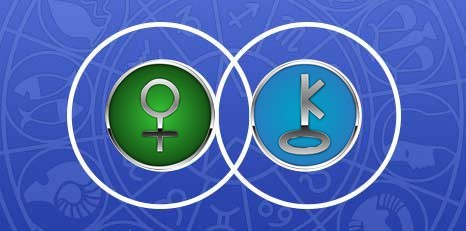
On November 22nd-23rd, 2023, Venus in Libra is opposite Chiron in Aries.
Chiron in Aries is our identity wound. Venus is how we relate to the world, especially in the context of our 1-on-1 relationships.
Venus opposite Chiron in Aries will expose the tension between our identity wound (“Who am I?” “Do I have the right to be here?”) and our desire to be liked and appreciated by others (Venus in Libra).
Venus Opposite Chiron – Face To Face With The Wound
Every time we are in a relationship – any kind of relationship – there is a subtle battle between authentically preserving our identity, and adapting to others, so they can ‘like’ us or at least accept us.
When we relate, we are in a constant negotiation between our need for connection and a fear of losing ourselves.
The opposition is a very interesting aspect. The opposition is like a Full Moon – the 2 planets are at the maximum distance from each other.
Because of the 180 angle, they have maximum visibility.
They look each other in the eyes.
This creates a situation where we are fully aware of the energies at play, yet a resolution is (or seems) impossible.
Venus Opposite Chiron – Projection
This intense dynamic leads to a psychological phenomenon that psychologists call “projection”.
Projection happens when we place our own unconscious traits or emotions onto others.
With Chiron in Aries opposite Venus in Libra, we feel a simultaneous need to connect with others and be accepted for who we are, AND a fear of being rejected because we’ve shown ‘too much’ or because we’ve shown something that is (or we think it is) undesirable.
To deal with the tension of the opposition, we often gravitate towards one of the 2 scenarios.
1. We identify with Chiron in Aries.
We feel split, conflicted, and unloved – and look for a partner who can fill that void and make us feel whole again.
2. We identify with the Venus in Libra people-pleaser.
We’re so wired to prioritize other people’s feelings that we don’t even know who we are, let alone what we want. In an overcompensation attempt, we attract a Chiron in Aries type of partner whose ‘madness’ and search for individuality will help us recognize our own identity.
When this relationship dynamic can get activated, and if this wounding dynamic is not recognized, we can get trapped into toxic or abusive relationships that don’t, or only superficially tap into Chiron’s healing potential.
Thankfully, the Venus-Chiron opposition is supported by Mercury in Sagittarius, which applies a trine to Chiron and a sextile to Venus.
There IS a way to navigate this dynamic and find a silver lining. By bringing awareness to the wounding patterns that arise during this opposition, we can consciously engage in open communication (thanks to Mercury) about our vulnerabilities and fears.
When we are unconscious of the Venus-Chiron dynamic, we attract people, and engage in relating patterns that keep us trapped in the wound, without a clear path to healing.
When instead we work with the opposition’s energy consciously, we get to the root causes of our wounds, and heal.
Unconscious ways of dealing with a Chiron-Venus wound involve being attracted, and attracting people to people who trigger a victim-perpetrator, or narcissist-empath relating dynamic.
Conscious ways of dealing with a Chiron-Venus wound include therapy, doing self-reflection, or having a constructive and open discussion about our emotional needs and vulnerabilities.
Venus Opposite Chiron – The Path To Healing
How do we know the difference?
If you feel triggered (for good or for bad), magnetically drawn, or inexplicably compelled toward someone or something, then probably there are unconscious dynamics at play.
If instead you feel vulnerable, yet empowered to address and understand these feelings, then you are likely approaching the situation consciously.
Chiron opposite Venus and trine Mercury is an invitation to explore the wounded parts of ourselves with curiosity and kindness, while cultivating authentic connections both with ourselves and others.
Pay attention to any feelings, relating patterns or insights that emerge these days. Pay attention to all upcoming Chiron transits. Do the Chiron work.
The Venus-Chiron opposition is just a teaser – and an opportunity to get a taste of Chiron’s healing potential.
But there’s something much bigger coming.
When the North Node will eventually conjunct Chiron (in February 2024) we will have a unique opportunity to “break the cycle”, re-write unhealthy conditioning, and become the person we are meant to be.
Join The Age Of Aquarius Community
If you’d like to have this type of discussions and find a support group with people who ‘get’ you, join the Age Of Aquarius Community with the Thanksgiving offer:
Just weeks before the management shakeup at OpenAI rocked Silicon Valley and made international news, the company’s cofounder and chief scientist Ilya Sutskever explored the transformative potential of artificial general intelligence (AGI), highlighting how it could surpass human intelligence and profoundly transform every aspect of life. Hear his take on the promises and perils of AGI — and his optimistic case for how unprecedented collaboration will ensure its safe and beneficia…SHOW MORE
About the speaker
Ilya Sutskever
Cofounder and Chief Scientist, OpenAI
Ilya Sutskever leads research at OpenAI and is one of the architects behind the GPT models.
AJ+ • Nov 28, 2014 Thanksgiving is a National Day of Mourning for some, Native Americans of New England have been hosting an annual protest in Plymouth, Mass. since 1970. While there are several different stories describing the first Thanksgiving, according to the protestors, in 1637, Governor John Winthrop hosted the first Thanksgiving to celebrate the return of soldiers who had massacred 700 native people. The protests are intended to highlight the myth that Native Americans and pilgrims lived together peacefully.
“I am grateful, not in order that my neighbour, provoked by the earlier act of kindness, may be more ready to benefit me, but simply in order that I may perform a most pleasant and beautiful act,” Seneca wrote two millennia ago as he contemplated gratitude and what it means to be a generous human being.
It is only from such a place of gratefulness that we can perform beautiful acts — from a place of absolute, ravishing appreciation for the sheer wonder of being alive at all, each of us an improbable and temporary triumph over the staggering odds of nonbeing and nothingness inking the ledger of spacetime. But because we are human, because we are batted about by the violent immediacies of everyday life, such gratitude eludes us as a continuous state of being. We access it only at moments, only when the trance of busyness lifts and the blackout curtain of daily demands parts to let the radiance in, those delicious moments when we find ourselves awash in nonspecific gladness, grateful not to this person, grateful not for this turn of events, but grateful at life — a diffuse gratitude that irradiates every aspect and atom of the world, however small, however unremarkable, however coated with the dull patina of habit. In those moments, everything sings, everything shimmers. In those moments, we are most alive.
Former U.S. Poet Laureate Billy Collins shines a playful sidewise gleam on this realest and most serious wellspring of gratitude in his 1998 poem “As If to Demonstrate an Eclipse,” found in his poetry collection Nine Horses (public library) and brought to life afresh, with a corona of radiance and a perfectly calibrated performance partway between wink and wonderment, by constant comedian and sometime StarTalk Radio co-host Chuck Nice at the third annual Universe in Verse, prefaced by his funny and poignant meditation on the personal gravity of gratitude and why being grateful is “one of the most powerful things that any one person can do.” Please enjoy:
AS IF TO DEMONSTRATE AN ECLIPSE by Billy Collins
I pick an orange from a wicker basket and place it on the table to represent the sun. Then down at the other end a blue and white marble becomes the earth and nearby I lay the little moon of an aspirin.
I get a glass from a cabinet, open a bottle of wine, then I sit in a ladder-back chair, a benevolent god presiding over a miniature creation myth,
and I begin to sing a homemade canticle of thanks for this perfect little arrangement, for not making the earth too hot or cold not making it spin too fast or slow
so that the grove of orange trees and the owl become possible, not to mention the rolling wave, the play of clouds, geese in flight, and the Z of lightning on a dark lake.
Then I fill my glass again and give thanks for the trout, the oak, and the yellow feather,
singing the room full of shadows, as sun and earth and moon circle one another in their impeccable orbits and I get more and more cockeyed with gratitude.







 AS IF TO DEMONSTRATE AN ECLIPSE