“Night, when words fade and things come alive,” Little Prince author Antoine de Saint-Exupéry wrote in his love letter to the hours of darkness, composed while flying alone over the Sahara Desert.
No aliveness animates the nocturne with more grandeur than the migration of birds. Every spring and fall, in the starlit corridor between the trees and the clouds, flocks of millions soar over dark deserts and oceans, cities and continents — feathered pilgrims of purpose and resilience, governed by senses we don’t have, guided by voices we are only just beginning to hear.
Across these immense distances, often navigating by astronomy, birds stay on course and stay together by a kind of choral communication, speaking to each other in strange and wondrous sounds — some only fractions of a second long, all entirely different from their daytime calls and songs.
And all of it — this secret language of the night, this miracle of sentience and synchrony, this fiesta of homecoming — while we sleep, while we dream of flying.
We sleep, stumbling through doorless dreams, while over our rooftops sky shivers with wings — warblers, cuckoos, herons and sparrows — waves rising on night’s cool breath.
We sleep as they follow the stars (hummingbird and wren) high over shadowed earth, trees clinging to rock, cities curled in grief. We close our windows, bury our faces —
we sleep and they speak: buzz and whistle, secret names through air tying each to each.
We sleep as they fly (imagine being lifted) by moon and magnet, over undulating sea toward a place (remember) that echoes in hallowed clearings, in hollowed bones, the song that pulls them home.
“Words belong to each other,” Virginia Woolf asserted in the only surviving recording of her voice. But words also belong to us, as much as we belong to them — and out of that mutual belonging arises our most fundamental understanding of the world, as well as the inescapable misunderstandings that bedevil the grand sensemaking experiment we call life.
This constant dialogue between reality and illusion, moderated by our use of language, is what poet and philosopher David Whyte explores in Consolations: The Solace, Nourishment and Underlying Meaning of Everyday Words (public library) — a most remarkable book “dedicated to WORDS and their beautiful hidden and beckoning uncertainty.” Whyte — who has previously enveloped in his wisdom such intricacies of existence as what happens when love leaves and how to break the tyranny of work-life balance — constructs an alternative dictionary inviting us to befriend words in their most dimensional sense by reawakening to the deeper and often counterintuitive meanings beneath semantic superficialities and grab-bag terms like pain, beauty, and solace. And he does it all with a sensibility of style and spirit partway between Aristotle and Anne Lamott, Montaigne and Mary Oliver.
David Whyte (Nicol Ragland Photography)
Whyte chooses 52 such ordinary words, the same number as the playing cards in a standard deck — perhaps a subtle suggestion that words, like cards, are as capable of illusion as they are of magic: two sides of the same coin, chosen by what we ourselves bring to the duality. Indeed, dualities and counterpoints dominate the book — Whyte’s short essays examine ambition and disappointment, vulnerability and courage, anger and forgiveness.
FRIENDSHIP is a mirror to presence and a testament to forgiveness. Friendship not only helps us see ourselves through another’s eyes, but can be sustained over the years only with someone who has repeatedly forgiven us for our trespasses as we must find it in ourselves to forgive them in turn. A friend knows our difficulties and shadows and remains in sight, a companion to our vulnerabilities more than our triumphs, when we are under the strange illusion we do not need them. An undercurrent of real friendship is a blessing exactly because its elemental form is rediscovered again and again through understanding and mercy. All friendships of any length are based on a continued, mutual forgiveness. Without tolerance and mercy all friendships die.
Illustration by Maurice Sendak from Let’s Be Enemies by Janice May Udry.
Echoing Anne Lamott’s beautifully articulated conviction that friendship is above all the art of allowing the soft light of love to fall upon even our darkest sides, Whyte adds:
In the course of the years a close friendship will always reveal the shadow in the other as much as ourselves, to remain friends we must know the other and their difficulties and even their sins and encourage the best in them, not through critique but through addressing the better part of them, the leading creative edge of their incarnation, thus subtly discouraging what makes them smaller, less generous, less of themselves.
And yet friendship is a merited grace, one that requires of us the unrelenting commitment of showing up for and bearing witness to one another, over and over:
The dynamic of friendship is almost always underestimated as a constant force in human life: a diminishing circle of friends is the first terrible diagnostic of a life in deep trouble: of overwork, of too much emphasis on a professional identity, of forgetting who will be there when our armored personalities run into the inevitable natural disasters and vulnerabilities found in even the most average existence.
[…]
But no matter the medicinal virtues of being a true friend or sustaining a long close relationship with another, the ultimate touchstone of friendship is not improvement, neither of the other nor of the self, the ultimate touchstone is witness, the privilege of having been seen by someone and the equal privilege of being granted the sight of the essence of another, to have walked with them and to have believed in them, and sometimes just to have accompanied them for however brief a span, on a journey impossible to accomplish alone.
Whyte argues that friendship helps us “make sense of heartbreak and unrequited love” — two concepts to which he dedicates entire separate word-meditations. He writes of the former:
HEARTBREAK is unpreventable; the natural outcome of caring for people and things over which we have no control…
Heartbreak begins the moment we are asked to let go but cannot, in other words, it colors and inhabits and magnifies each and every day; heartbreak is not a visitation, but a path that human beings follow through even the most average life. Heartbreak is an indication of our sincerity: in a love relationship, in a life’s work, in trying to learn a musical instrument, in the attempt to shape a better more generous self. Heartbreak is the beautifully helpless side of love and affection and is [an] essence and emblem of care… Heartbreak has its own way of inhabiting time and its own beautiful and trying patience in coming and going.
And yet while heartbreak has this immense spiritual value, and even an evolutionarily adaptive one, we still treat it like a problem to be solved rather than like the psychoemotional growth-spurt that it is. Whyte writes:
Heartbreak is how we mature; yet we use the word heartbreak as if it only occurs when things have gone wrong: an unrequited love, a shattered dream… But heartbreak may be the very essence of being human, of being on the journey from here to there, and of coming to care deeply for what we find along the way.
[…]
There is almost no path a human being can follow that does not lead to heartbreak.
Stripped of the unnecessary negative judgments we impose upon it, heartbreak is simply a fathometer for the depth of our desire — for a person, for an accomplishment, for belonging to the world and its various strata of satisfaction. Whyte captures this elegantly:
Realizing its inescapable nature, we can see heartbreak not as the end of the road or the cessation of hope but as the close embrace of the essence of what we have wanted or are about to lose.
[…]
Heartbreak asks us not to look for an alternative path, because there is no alternative path. It is an introduction to what we love and have loved, an inescapable and often beautiful question, something and someone that has been with us all along, asking us to be ready for the ultimate letting go.
One of the most common sources of heartbreak, of course, is unrequited love. But, once again, Whyte shines a sidewise gleam on the obscured essence of another experience we mistake for a failure rather than a triumph of our humanity — for unrequited love is the only kind of love there is, in any real sense:
UNREQUITED love is the love human beings experience most of the time. The very need to be fully requited may be to turn from the possibilities of love itself. Men and women have always had difficulty with the way a love returned hardly ever resembles a love given, but unrequited love may be the form that love mostly takes; for what affection is ever returned over time in the same measure or quality with which it is given? … And whom could we know so well and so intimately through all the twists and turns of a given life that we could show them exactly, the continuous and appropriate form of affection they need?
[…]
The great discipline seems to be to give up wanting to control the manner in which we are requited, and to forgo the natural disappointment that flows from expecting an exact and measured reciprocation.
Illustration by Isabelle Arsenault from Jane, the Fox and Me — a graphic novel inspired by Jane Eyre.
Indeed, most of our dissatisfaction with life stems from wishing for the present moment to be somehow different, somehow better-conforming to the rigid expectation we set for it at some point in the past. And yet nowhere is this rigidity of requirement more stifling than in love — that glorious “dynamic interaction” of souls responsive to one another, which requires a constant learning and relearning of a common language. Whyte considers what it is we really fear when we hide behind the merciless moniker of “unrequited” love:
We seem to have been born into a world where love, except for brilliant, exceptional moments, seems to exist from one side only, ours — and that may be the difficulty and the revelation and the gift — to see love as the ultimate letting go and through the doorway of that affection, make the most difficult sacrifice of all, giving away the very thing we want to hold forever.
Norwegian for ‘the inescapable euphoria experienced as you begin to fall in love,’ from Lost in Translation by Ella Frances Sanders.
Paradoxically, our notion of “unconditional love” is beset by the same self-defeating absolutism of expectation. Arguing that the very concept of it is a “beautiful hoped for impossibility,” Whyte writes:
Love may be sanctified and ennobled by its commitment to the unconditional horizon of perfection, but what makes love real in the human world seems to be our moving, struggling conversation with that wanted horizon rather than any possibility of arrival. The hope for, or the declaration of a purely spiritual, unconditional love is more often a coded desire for immunity and safety, an attempt to forgo the trials of vulnerability, powerlessness and the exquisite pain to which we apprentice ourselves in a relationship, a marriage, in raising children, in a work we love and desire.
[…]
The hope for unconditional love is the hope for a different life than the one we have been given. Love is the conversation between possible, searing disappointment and a profoundly imagined sense of arrival and fulfillment; how we shape that conversation is the touchstone of our ability to love in the real inhabited world. The true signature and perhaps even the miracle of human love is helplessness, and all the more miraculous because it is a helplessness which we wittingly or unwittingly choose; in our love of a child, a partner, a work, or a road we have to take against the odds.
A former sex worker sat next to the Pontiff making small talk as they had tiramisu for dessert.
By Bil Browning Tuesday, November 21, 2023 (lgbtqnation.com)
Pope Francis during lunch with the poor on the occasion of the VII World Day of the Poor in the Paul VI Hall on November 19th, 2023.Photo: Mondadori Portfolio via Getty Im
Pope Francis has made strides in the Catholic Church’s acceptance of transgender people over recent months, but recently took a dramatic step to ensure that his message was being received.
A group of transgender women with a history of personally interacting with the Pontiff were invited to join 1000 other poor and homeless guests for lunch to mark the Catholic Church’s World Day of the Poor. The women were treated like VIPs, with one, a former sex worker, seated at the table with the Pope.
He come out in support of marriage equality, but advocates hailed it as an advance.
The Vatican released a document earlier this month said that transgender people and people in same-sex relationships can be baptized and serve as witnesses at weddings. Trans people can also be godparents as well.
“Being a godparent is a big responsibility; it’s taking the place of the mother or father. It’s not a game,” Claudia Vittoria Salas told the Associated Press. “You have to choose the right people who will be responsible and capable when the parents aren’t around to send the kids to school and provide them with food and clothes.”
Salas, a tailor and house cleaner, was the godparent to three of her nieces and nephews in her home country, Argentina. She did sex work to put the children through school.
The women’s relationship with the Pope developed during the pandemic when they appealed to the Church for help at the urging of the local priest. Local funds were depleted, but the church provided the women with food and other assistance.
Assistance quickly came from the Pope’s chief almsgiver, who also made sure the women were vaccinated against COVID. Many of the trans women were Latin American immigrants and ineligible to get the vaccine in Italy, so the church gave it to them directly.
Francis, who is Argentinian, asked to meet the women himself to offer them comfort and support. They now attend the Pope’s general audience monthly and are given VIP seating.
“Before, the church was closed to us. They didn’t see us as normal people, they saw us as the devil,” Consuelo, a Colombian transgender woman, said. “Then Pope Francis arrived and the doors of the church opened for us.”
To publicly indicate that the poor must be treated like the richest, the group dined on cannelloni pasta filled with spinach and ricotta plus meatballs in a tomato-basil sauce and cauliflower puree. They were served tiramisu and petit fours for dessert.
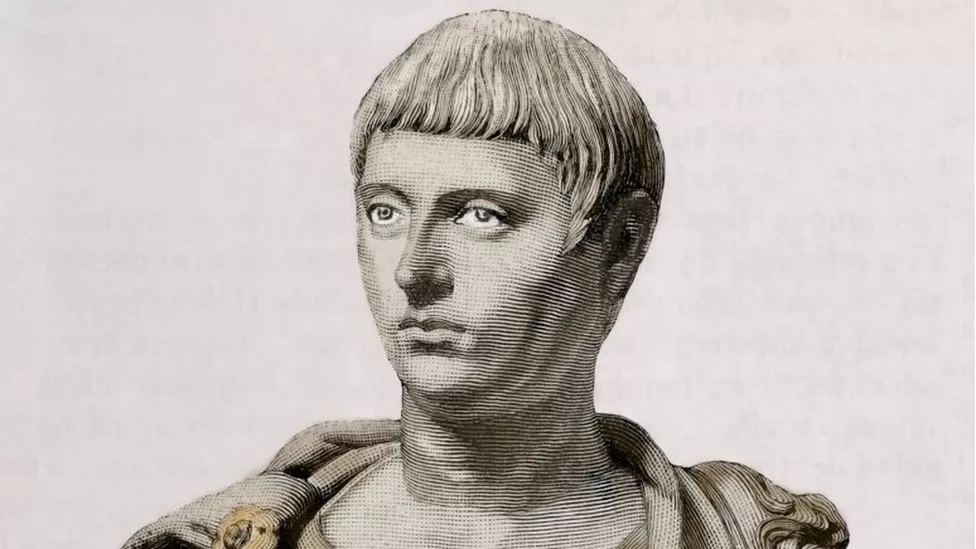
Debate over whether Roman emperor Elagabalus was transgender has split academics
A museum is to relabel its display about a Roman emperor after concluding that he was in fact a trans woman.
North Hertfordshire Museum will now refer to emperor Elagabalus with the female pronouns of she and her.
It comes after classical texts claim the emperor once said “call me not Lord, for I am a Lady”.
A museum spokesperson said it was “only polite and respectful to be sensitive to identifying pronouns for people in the past”.
The museum has one coin of Elagabalus, which is often displayed amongst other LGBTQ+ items in its collection.
It said it consulted LGBTQ+ charity Stonewall to ensure “displays, publicity and talks are as up-to-date and inclusive as possible”.
Marcus Aurelius Antoninus, better known as Elagabalus, ruled the Roman empire for just four years from 218AD to his assassination, aged 18, in 222AD.
He became an increasingly controversial figure over his short reign, developing a reputation for sexual promiscuity.
Cassius Dio, a senator and contemporary of Elagabalus, writes in his historical chronicles that the emperor was married five times – four times to women, and once to Hiercoles, a former slave and chariot driver.
In this final marriage, Dio writes that the emperor “was bestowed in marriage and was termed wife, mistress and queen”.
Getty ImagesNorth Hertfordshire Museum has a coin of Elagabalus in its LGBTQ+ collection
The debate over Elagabalus’s gender identity is long-standing and often splits academics.
Dr Shushma Malik, a Cambridge university classics professor, told the BBC: “The historians we use to try and understand the life of Elagabalus are extremely hostile towards him, and therefore cannot be taken at face value. We don’t have any direct evidence from Elagabalus himself of his own words.
“There are many examples in Roman literature of times where effeminate language and words were used as a way of criticising or weakening a political figure.
“References to Elagabalus wearing makeup, wigs and removing body hair may have been written in order to undermine the unpopular emperor.”
Dr Malik added that whilst Romans were aware of gender fluidity, and there are examples of pronouns being changed in literature, it “was usually used in reference to myth and religion, rather than to describe living people”.
However, councillor Keith Hoskins, executive member for Enterprise and Arts at North Herts Council, said texts such as Dio’s provide evidence “that Elagabalus most definitely preferred the ‘she’ pronoun and as such this is something we reflect when discussing her in contemporary times, as we believe is standard practice elsewhere”.
“We know that Elagabalus identified as a woman and was explicit about which pronouns to use, which shows that pronouns are not a new thing,” he added.
Hafiz of Shiraz (also known as Hafez) remains the most beloved name in all of Persian literature. Indeed, his mystic, lyric poetry is cherished as one of the great achievements of world literature, on a par with Dante, Goethe, and Shakespeare.
Hafiz’s Little Book of Life is a lush collection of more than 250 selections from his lifework. Also included is a vivid portrait of his life and times, translators’ notes, an extensive glossary, a bibliography, and an appendix on Hafiz as an oracle. Here are classic soaring flights of fancy and solid life lessons—made new by two award-winning translators.
This is the perfect introduction to Hafiz for all lovers of poetry and seekers of love, spirituality, and wisdom. Let the unforgettable words of Hafiz shine through you with their love, profundity, wit, and celebration of life.
“This is translation as a real ‘carrying-across,’ as art, not artifact . . . this one drops the reader/listener directly into their own soul-struggle. Immerse yourself and be transformed!” —Neil Douglas-Klotz, author of The Sufi Book of Life and A Little Book of Sufi Stories
“From the first page, you are invited to settle into a sublime sanctuary and partake in enchantment until you feel the Beloved inside your beating heart and running through your veins.” —Ari Honarvar, author of A Girl Called Rumi
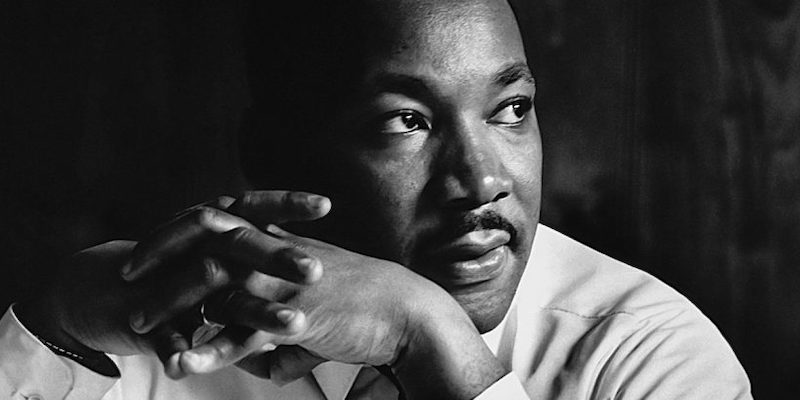
Martin Luther King, Jr. stood on the porch of his tiny Montgomery parsonage. An agitated crowd of neighbors gathered around him, waiting for his orders.
King’s home had just been bombed. His wife, Coretta, and his infant daughter, Yolanda, had been in the house at the time. They escaped unhurt. King rushed home upon hearing the news of the attack and found his neighbors gathered on the lawn and in the street. White police officers and city officials stood by, nervously, fearing the mostly Black crowd might turn violent.
“We believe in law and order,” King told the crowd. “Don’t get panicky. Don’t do anything panicky at all. Don’t get your weapons. He who lives by the sword shall perish by the sword. Remember that is what God said. We are not advocating violence…I want you to love our enemies. Be good to them. Love them and let them know you love them. I did not start this boycott. I was asked by you to serve as your spokesman. I want it to be known the length and breadth of this land that if I am stopped, this movement will not stop. If I am stopped, our work will not stop. For what we are doing is right, what we are doing is just. And God is with us.”
The date was January 30, 1956. The Montgomery bus boycott was in its second month. At the age of twenty-seven, King found himself thrust unexpectedly into a role of leadership. As his remarks from his damaged front porch make clear, he was not yet a committed follower of Gandhi. He had read and studied the Indian political activist and ethicist, as well as other proponents of nonviolent protest, but Gandhi’s tactics and philosophy were not yet at the fore of his mind. King’s calls for love and forgiveness, at that point, were inspired by Jesus, and by the commonly held view among Black leaders at the time that justice would never be won through violence. King remained ambivalent about nonviolence. He made that much clear after the dynamite attack on his home when he applied for a gun permit. He faced real danger, and he was prepared to defend himself and his family if necessary.Rustin saw a chance to extend the Montgomery model, and he recognized quickly that King might be the partner he needed.
But things were changing rapidly. America had never experienced anything like this protest in Montgomery, former capital of the Confederacy, former hub of the Alabama slave trade, and current defender of racial segregation. Black people had united in bold defiance of Jim Crow laws, standing up to the Ku Klux Klan, the police, and the city’s all-white lineup of lawmakers. For two months, the people had refused to ride the city’s segregated buses, refused to participate in a system and way of life that sought to batter and belittle them. King urged them to embrace the power of nonviolence for largely practical reasons: to stake out the position of moral superiority in confrontation with those who assumed and sought to enforce Black people’s inferiority.
King captured the imagination of his followers in Montgomery, across church and class lines. He emboldened the community. He also excited progressive activists around the country. The activists saw potential for a nationwide movement, a movement rooted in resistance, built around the Black church, and led by Black people, with the brave, brilliant, and highly telegenic Martin Luther King guiding them. One of those activists, the novelist Lillian Smith—a board member of an international pacifist group called the Fellowship of Reconciliation—wrote to King on March 10, 1956, with advice. “You can’t be an expert in nonviolence; it’s like being a saint or an artist: each person grows his own skill and expertness,” she wrote. But if King decided he wanted to try to grow as an expert and practitioner of nonviolence, Smith added, if he wanted to explore the potential application of Gandhi’s tactics in the United States, he would do well to talk to Bayard Rustin.
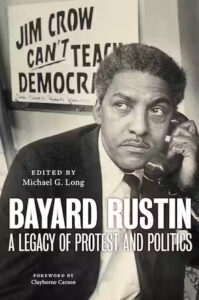
Rustin, as it turned out, had not been waiting for an invitation from King. He had reached Montgomery days before Smith’s letter, eager to see if he could help King use nonviolent tactics to extend the reach of his campaign. Rustin was forty-five years old, and he had already been a part of some of the century’s most important protests. He had worked with FOR, the War Resisters League, and A. Philip Randolph’s Brotherhood of Sleeping Car Porters. The fact that he was gay was an open secret among activists. The fact that he had been a member of the Young Communist League was no secret at all. His arrival in Montgomery marked a turning point, not only in King’s life but in the history of America radicalism and rebellion.
Nonviolent protest was hardly a novel idea in 1956. Nearly a century before King’s birth, the white abolitionist William Lloyd Garrison had called for the use of passive resistance to attack slavery. Decades later, labor unions had used sit-down strikes and factory seizures to demand better pay and working conditions. Throughout the 1940s, A. J. Muste, Asa Philip Randolph, and others had led campaigns of nonviolent protest, including marches and boycotts, inspiring activists such as Rustin, James Farmer, and Montgomery’s E. D. Nixon to look for opportunities to organize protests of their own.
In a letter dated February 21, 1956, just prior to his arrival in Montgomery, Rustin announced his goal: “to bring the Gandhian philosophy and tactic to the masses of Negroes in the South.” Nothing short of strict adherence to nonviolence throughout the South, he wrote, “can save us from widespread racial conflict.” Rustin saw a chance to extend the Montgomery model, and he recognized quickly that King might be the partner he needed.
When he arrived at King’s tiny parsonage in Montgomery, Rustin was pleased to discover that he had already met King’s wife, Coretta, having lectured years prior to her class at the Lincoln School in Marion, Alabama. Rustin never said whether he remembered meeting Coretta, and it seems unlikely that any one student in the class would have stood out, even one so impressive as Coretta.
Nevertheless, Coretta remembered Rustin. Years later, King’s friend and colleague Ralph Abernathy would say Coretta played a key role in King’s decision to embrace Rustin as an advisor in those early days of the boycott in Montgomery. Coretta’s endorsement mattered. At that point, she had had more experience than her husband as an activist. As an undergraduate at Antioch College in Ohio, she had joined the campus chapter of the NAACP, a race relations committee, and a civil liberties committee. She had challenged a rule that prevented Black students from student-teaching in local schools. One fellow student recalled that Coretta had also joined in a protest when a barbershop in Yellow Springs had refused to cut Black people’s hair. In 1948, she had supported Henry Wallace and the Progressive Party for president and attended the party’s national convention as a student delegate. In the early days of the Montgomery bus boycott, Coretta was her husband’s most important advisor.
Rustin presented a risk for King. Enemies of the bus boycott would call out the presence of this gay man with a background in communism to smear and sidetrack the protest movement. But King could see that Rustin had a level of experience others in Montgomery lacked. Rustin knew the major figures in the civil rights movement and understood the interplay of the big organizations. Almost immediately, the men engaged in a “very long, philosophical discussion of nonviolence,” as Rustin recalled.
In years to come, Rustin would complain that King was too cautious at times, that his desire for consensus prevented him from making the tough decisions required of a leader. But King was hardly cautious in his initial acceptance of Rustin. King had always had an appetite for big ideas, and Rustin helped him conceive of his protest in the grandest terms, terms that firmly linked three of his greatest interests—philosophy, religion, and social justice. In Montgomery, the pieces were coming together for the greatest nonviolent movement America had ever seen, and they were coming together in no small part because King and Rustin had the vision for how the pieces might be arranged, because King proved willing to adapt, and because these two men managed to forge a complicated but dynamic working relationship.
In his first visit to King’s house in Montgomery, Rustin saw armed guards stationed outside and a pistol on a chair in King’s living room. When Rustin asked about the weapons, King replied, “We’re not going to harm anybody unless they harm us.” To Rustin, that did not sound like a Gandhian approach. King knew that many Black southerners owned guns. He also knew that supporters of the boycott were risking their lives standing up to Alabama’s system of white supremacy. Alabama had seen 360 lynchings since Reconstruction. A violent white response to the Black uprising was all but guaranteed. As King’s remarks from his blasted front porch made clear, he recognized the possibility of escalating violence. Rustin argued that a violent outbreak would be a disaster for the movement and for the Black people of Montgomery, that Gandhian protest required a rejection of all violence, even in self-defense. Glenn Smiley, another FOR activist who had arrived to help the movement, reported in a letter from Montgomery that King recognized that the presence of armed bodyguards undercut his nonviolent message, but King didn’t seem to mind the contradiction. “He believes and yet he doesn’t believe,” Smiley wrote.Rustin and other activists recognized that King, perhaps uniquely, had the ability to lead a movement that forged deep and wide cultural and political change.
King’s journey was underway. He began to read more Gandhi and to refer to him more often in speeches and sermons. He discarded the gun he had purchased for personal protection and ordered the men protecting his home to do so without weapons. Rustin recalled telling King that he would have to make a deep commitment to nonviolence for his message to have an impact. King’s followers, like his bodyguards, were unlikely to fully embrace nonviolence, Rustin said. They didn’t have to. If King convincingly adopted the philosophy and if his followers sensed their leader’s dedication, they would adhere to his instructions. They would follow him. They would protest nonviolently, even if they didn’t devote their lives to nonviolence. And that would be enough.
The more King mentioned Gandhi in speeches and sermons, the more the national media latched on to the nonviolent element of the Montgomery protest story. Reporters—especially reporters from the North—saw a classic morality tale, one that starkly separated the good guys from the bad guys. King’s commitment to peaceful protest gave his movement an aura of moral superiority. Reporters began referring to him as “Alabama’s Gandhi.” Not everyone bought it, of course. “The man is a genuine intellectual,” wrote Grover C. Hall, editor-in-chief of the Montgomery Advertiser, in reference to King. “But that constant Gandhi business of his, that love-those-who-hate-you routine is the biggest bunch of nonsense I’ve ever run into.”
But the anger generated among people like Hall helped King’s cause. The more the protesters were threatened and attacked by segregationists in the South, the more support the protesters received from Black southerners and liberal white northerners. King became a central focus of the growing racist fury for the same reasons he became a beloved figure among his followers—because he spoke so beautifully and so calmly and because he maintained his insistence that the segregationists who wanted to shut him down and perhaps even cause him physical harm were, in fact, his brothers in Christ. King emerged from Montgomery as the nation’s most visible and influential Black leader. He held no national office. He possessed no great political clout. He attracted only modest financial support. His power derived primarily from his high moral standing and from his extraordinary voice—a voice that resonated with a broad audience, from poor, Black men and women in the South to wealthy liberals in the North. Rustin and other activists recognized that King, perhaps uniquely, had the ability to lead a movement that forged deep and wide cultural and political change.
In early March, Rustin wrote to A. Philip Randolph, recommending that King and others organize a workshop on nonviolence in Atlanta, one that would bring together Black leaders from across the South for a discussion about nonviolent protest. Rustin understood the organizational power of the Black church, having seen its force in Montgomery. The gathering in Atlanta took place less than a year later. It would lead to the creation of the Southern Christian Leadership Conference, and it would lay the groundwork for much of the course of King’s future as an activist. The entire blueprint was there, in the documents Rustin prepared for the meeting; the preachers would advise and support more protests like the one in Montgomery, demanding integration with nonviolent protests, threatening economic consequences for segregationists, and pushing for the federal government to expand voting rights for the disenfranchised Black residents of the South.
Though their methods were radical, the movement’s leaders were not. They were men of God, their words imbued with nobility and love. Most of them were family men, well educated, conservative in dress and lifestyle, hardly the bomb-throwing radicals many Americans associated with protest movements. They believed they had found a method by which, at last, they might achieve not just integration but a reckoning with the sins of slavery and a path to a new and more equitable society.
The race is on to put hotels in space and neighborhoods on the moon. Here’s some of what we know about how Earthlings fare beyond the safety of our home world.
Credit…Illustration by Max Guther
By Kim Tingley
Nov. 12, 2023 (NYTimes.com)
As an incubator of life, Earth has a lot going for it, something we often fail to appreciate fully from within its nurturing bounds. Merely sending probes and rovers to the moon and Mars won’t do. For various reasons — adventure! apocalypse! commerce! — we insist upon taking our corporeal selves off-world too. Multiple private companies have announced plans to put hotels in space soon. NASA is aiming to 3-D-print lunar neighborhoods within a couple of decades. And while it will probably take longer than that to build and populate an outpost on Mars, preparations are being made: This summer, four NASA crew members began a 378-day stay in simulated Martian housing at the Johnson Space Center in Houston.
When you look at the renderings of these cozy dwellings, it’s easy to lose sight of how hostile space is to Earthlings. As a reminder, consider what would happen if you found yourself in low Earth orbit or on Mars or the moon without a spacesuit on. You would pass out from a lack of oxygen within a matter of seconds, a condition known as hypoxia, and die soon thereafter. In the brief meantime, all the gases inside your body, including any air still in your lungs, would expand in the absence of external pressure. Depressurization would also cause your internal fluids to bubble. Not because they’re heating up, but because they are transmogrifying into their gaseous state.
The temperature wouldn’t be much of a problem, at least, even though thermometers in low Earth orbit produce readings from minus 85 degrees to 257 degrees Fahrenheit, depending on whether they are in shadow or in light. Space, as a near vacuum, has very little mass to conduct heat to or away from you, so you are not likely to feel instantly hot or cold.
While hypoxia is potentially a real threat should your space vessel or extraterrestrial habitat leak, it’s a manageable one (assuming you haven’t leaped naked out of your space capsule or off-world dwelling). But two other major challenges confront our fragile bodies when we leave our planet, neither of which has been entirely solved yet, even indoors: variable gravity and radiation.
Gravity is determined by the mass of objects and their distance from one another. Because Earth is so big, it is impossible, while on it, to escape its gravity for any serious length of time. As a result, we don’t know very much about what our lives would be like without — or under some diminished influence of — this omnipresent attraction. On the moon and on Mars, which are smaller than our world, the gravitational tug will be much less: a sixth and a third, respectively, of what it is here.
Conversely, radiation exposure intensifies with elevation, because there’s less atmosphere above you to block it. And you incur a much larger dose if you get beyond the protective bubble of Earth’s ozone and magnetosphere, the magnetic field that stretches roughly 40,000 miles out at its most compressed point. The solar and galactic radiation that washes over Mars, which at its closest is 34 million miles away, will potentially be 700 times as great as what passes through our magnetic defenses. Space travelers beyond low Earth orbit will also be bombarded with high-energy atomic nuclei from exploding stars throughout the galaxy, which are normally deflected by the magnetosphere from reaching the surface of our planet; those particles are so heavy and moving so fast that they penetrate spaceships, spacesuits and skin, banging into other particles in their path and damaging any attendant cells in ways researchers are only beginning to understand.
Credit…Illustrations by Max Guther
So far, most of what we know about the effects on the human body of these threats comes from astronauts in low Earth orbit, and because safety is a paramount concern, we don’t send many of them up there, and we don’t let them stay for long when we do. Six months is the average length of a visit to the International Space Station, and fewer than 300 people have made the 250-mile voyage.
While that collective experience is enough to have taught us how the body responds when gravity’s pull is substantially reduced, the magnetosphere still shields the I.S.S., and only the 24 astronauts who flew in the Apollo program have gone beyond it. (The moon orbits an average of more than 238,000 miles away.) Though these two dozen astronauts spent little more than a week at a time without its protection, they have died of cardiovascular disease at a rate four to five times as high as that of their counterparts who stayed in low Earth orbit or never entered orbit at all, which suggests that exposure to cosmic radiation might have damaged their arteries, veins and capillaries.
We can’t send people to Mars, or to live on the moon, until we can be reasonably confident that they’ll survive getting and residing there. But the space-based medical science needed to make that possible has been hindered by small sample sizes that aren’t representative of the general population. (All of the Apollo astronauts were white men born between 1928 and 1936.) Space tourism, though, promises to offer opportunities to study the effects of radiation and low gravity on a much broader demographic than “really well-selected superpeople,” as Dorit Donoviel, the director of the Translational Research Institute for Space Health (TRISH) at the Baylor College of Medicine, describes those who have historically qualified to leave the planet. “Old, young, pre-existing health conditions — we are starting to gather a knowledge base that in the future will be essential even for NASA,” Donoviel told me, “because we have to learn about the edge cases to really understand what is going on in our bodies to adapt to a hostile environment. You don’t learn as much from people who are healthy. It’s when people get sick that you understand how people get sick and how to prevent it.”
Epidemiologists face the same predicament on Earth: Before they can figure out how to protect the population, they must wait for harm to come to enough people to expose the causes. As less-rigorous medical screening allows more tourists to reach space, the chances increase significantly that someone will get hurt or have a health emergency there. Aerospace medicine is one of three specialties certified by the American Board of Preventive Medicine, because surgeons for a given flight tend to be stuck on the ground; they have to optimize the health of their patients and ward off potential disasters before departure. The problem is, they can’t know what those disasters will be until they occur. Which means that, as with every expedition into the unknown, at some point some intrepid or desperate souls are just going to have to blast off and see what happens.
Scientists once predicted that we couldn’t live in the absence of Earth’s gravity. Without this still-barely-understood force pulling us downward, how would we swallow? Wouldn’t our tongues loll back into our throats? Wouldn’t we choke on our own saliva? And if we survived those perils, wouldn’t escalating pressure in our skulls kill us after a week or so? But when Yuri Gagarin returned from his single, 108-minute orbit around our world in 1961, humanity’s first trip beyond the mesosphere, he proved that our internal musculature could maintain our vital functions in conditions of weightlessness. He ate and drank up there without difficulty. Technically, he hadn’t escaped Earth’s influence; to orbit is to free-fall toward the ground without ever hitting it, and he was in a condition known as microgravity. This felt, he reported, “like hanging horizontally on belts, as if in a suspended state,” a circumstance passingly familiar to anyone who has been on a roller coaster or jumped off a diving board. Gagarin said he got used to it. “There were no bad sensations,” he added.
Either Gagarin was fibbing, or he had a strong stomach. Initially, many space travelers puke, or at least feel motion-sick — space-adaptation syndrome, or S.A.S., is what such nausea, headache and vomiting are called outside our atmosphere. “It’s the same as sitting in the back of the car in childhood, reading something with your head down,” says Jan Stepanek, director of the aerospace-medicine program at the Mayo Clinic in Scottsdale, Ariz. “It’s a mismatch of what the eyes are seeing and what the inner ear is telling you.” Only in this case, that mismatched perception is a result of the organs and hairs of the vestibular system floating free without their usual gravitational signals. You acclimate eventually. In fact, researchers only learned about the prevalence of S.A.S. symptoms in the 1970s, when they heard Skylab astronauts talking about it with one another over a hot mic. Astronauts, it turns out, are not ideal subjects for medical study, because they are notoriously stoic and unforthcoming about any symptom that might ground them.
On Earth, your body maintains your blood pressure such that enough oxygen reaches your organs and waste is ferried away. One of the biggest oxygen users — your brain — is positioned above your heart for much of the time you are awake. But microgravity suddenly stops pulling blood downward into your legs, just as lying down or getting into a pool does, except more so. That lets blood collect in the upper body, triggering pressure sensors in your heart and the carotid vessels of your neck, which then send hormonal instructions to urinate more and decrease blood production. (This is why you often feel the need to pee shortly after climbing into bed or sinking into a body of water.) On our planet, that’s usually enough to reduce your blood pressure and rebalance the system.
In microgravity, however, the blood volume above your neck will most likely still be too high, at least for a while. This can affect the eyes and optic nerves, sometimes causing permanent vision problems for astronauts who stay in space for months, a condition called spaceflight-associated neuro-ocular syndrome. It also causes fluid to accumulate in nearby tissues, giving you a puffy face and congested sinuses. As with a bad cold, the process inhibits nerve endings in the nasal passages, meaning you can’t smell or taste very well. (The nose plays an important role in taste.) The I.S.S. galley is often stocked with wasabi and hot sauce.
These sensory deficits can be helpful in some respects, though, because the I.S.S. tends to smell like body odor or farts. You can’t shower, and microgravity prevents digestive gases from rising out of the stew of other juices in your stomach and intestines, making it hard to belch without barfing. Because the gas must exit somehow, the frequency and volume (metric and decibel) of flatulence increases.
Other metabolic processes are similarly disturbed. Urine adheres to the bladder wall rather than collecting at the base, where the growing pressure of liquid above the urethra usually alerts us when the organ is two-thirds full. “Thus, the bladder may reach maximum capacity before an urge is felt, at which point urination may happen suddenly and spontaneously,” according to “A Review of Challenges & Opportunities: Variable and Partial Gravity for Human Habitats in L.E.O.,” or low Earth orbit. This is a report that came out last year from the authors Ronke Olabisi, an associate professor of biomedical engineering at the University of California, Irvine, and Mae Jemison, a retired NASA astronaut. Sometimes the bladder fills but doesn’t empty, and astronauts need to catheterize themselves.
The longer astronauts stay in microgravity, the more they change. Because they don’t need to support any weight, bones and muscles begin to atrophy — much faster than they do in advanced age on Earth. Bone density in the hips and spine can decrease by 1 to 2 percent per month in space, compared with 0.5 to 1 percent per year in elderly Earthlings. The calcium that leaches from the bones is expelled in urine, increasing the risk of kidney stones. Muscle mass ebbs, too: Astronauts must exercise vigorously for more than two hours a day to keep in decent shape. (They also must constantly dab their skin with a towel while doing so, to prevent their sweat from beading and floating into colleagues or equipment.) The discs between their spinal vertebrae spread farther apart — astronauts grow taller, but their lower backs hurt. The body’s sensors that on Earth raise our blood pressure when we stand up from lying down, so that we don’t faint, grow lazy with disuse. This degeneration, along with reduced muscle mass, is why astronauts must be carried from their capsules when they return to terra firma after a long mission.
The body recalibrates to normal. But protracted stays in microgravity (the current record, 437 days, was set by the Russian astronaut Valeri Polyakov in 1995) make for painful recoveries. After 340 days in space, Scott Kelly, a NASA veteran of three previous shorter missions, described the period immediately following his return as “much, much worse” than those of earlier trips: “All of my joints and all of my muscles are protesting the crushing pressure of gravity,” he wrote in his 2017 memoir, “Endurance.” (Legend has it that Polyakov, for his part, strolled out of his capsule unfazed, bummed a cigarette from a friend and started smoking.) Of course, “recovery” in this case — in every case, so far — means reacclimating to Earth’s pull. But what if you never come back and, instead, stay in orbit or on the moon or Mars for the rest of your life?
If you spin a bucket of water around your head fast enough, the water doesn’t spill out. The same physics underpin most plans for creating what is colloquially referred to as artificial gravity. In those scenarios, the space travelers are the water. The tricky part is that the speed at which you spin them must be faster the closer they get to the axis. In other words, you can have either a gigantic spacecraft that rotates slowly or a small one that rotates rapidly. Engineering and transporting such an apparatus into low Earth orbit has so far not been a major priority for government agencies. It’s much easier and cheaper to give astronauts tools to manage their weightlessness.
But just because NASA hasn’t used spinning vessels to simulate gravity doesn’t mean it’s not possible, says Rhonda Stevenson, the chief executive of Above Space. Once it raises the necessary funding, her company plans to put a small luxury hotel into orbit within five years and have a larger facility operational within another 10 years. In renderings, these establishments look like giant gears with rooms in their cogs. “Folks don’t realize where we are right now and how technologically advanced we are today,” she told me.
Stevenson’s priorities, like those of other space-tourism operators, are oriented toward fun and comfort, not forbearance and science. Astronauts never complain, but paying guests love an excuse to leave a one-star review. (Especially when they’ll be shelling out millions for a weekend stay.) In other words, there must be amenities and flush toilets (a contraption whose evolution was also guided by gravity). “Nobody wants to go up there and be lonely and eat algae paste and crickets,” Stevenson says. “That just doesn’t sound like a good time.”
ImageCredit…Illustration by Max Guther
Eventually such wealthy vacationers will want somewhere to go — a space mall, a mini-golf course — and they’ll want cosmopolitan cuisine. Stevenson and others predict that commercial parks, factories and farms will all be built in space to meet their demands.
The hospitality industry is not the only one with space aspirations. Chemistry and drug discovery might thrive there: Crystals, like those used in pharmaceuticals, grow bigger and more symmetrically in microgravity. There are ambitions to mine the moon for rare metals. Solar-energy production could flourish in the absence of weather. And astrobotany, which will be needed to supply space settlements with fresh food, could eventually grow crops and send them back to Earth. In one experiment, wheat plants grew 10 percent taller in microgravity.
When that day comes, whether you’re in space working or vacationing, tuning your gravity could become part of your 9-to-5, like adjusting your thermostat. You might spend your workday in microgravity. Then you might go for a jog or just rest in 1 g. Maybe as you age and your joints start aching, you move to rooms in 0.75 g, where gravity is tempered just enough to put the spring back in your step. Senior living — in space!
Even if gravity doesn’t prove quite so easy to supply as envisioned, weightlessness would mostly be just an inconvenience for the few hours it takes to get into low Earth orbit or the few days’ flight to the moon. But getting to Mars or back again will, at least at first, most likely require living in microgravity for more than a year. This raises physical concerns: Will those astronauts be able to stand up when they arrive? If they can stand, will they pass out? If they pass out, will they break a bone? And if they break a bone, will it heal as it would on Earth?
Researchers understand even less about astronauts’ neurological states and whether cognition is affected by the pressure that fluids shifting headward put on the brain. “Few of the NASA astronauts want to volunteer to stick a needle in their brain or eye to measure pressure while in space,” Donoviel says. “It’s a risk. And they are afraid we might find something that might prevent them for medical reasons from being able to fly. We’ve had this experiment on the books for years.”
Researchers are hoping that commercial-spaceflight passengers will be more amenable to volunteering for experiments, like having a new kind of pressure transducer surgically implanted inside their skull in the months before takeoff. If the device works as expected, it will answer longstanding questions about the impacts of microgravity inside the cranium. And it might also lead to insights that could help parents and doctors treat babies with hydrocephalus, a neurological disorder caused by a buildup of cerebrospinal fluid in ventricles deep within the brain.
Scott Kelly’s mission on the I.S.S., nearly a year long, was designed to learn what might happen to astronauts during a flight to Mars. It took advantage of a unique scientific opportunity: Kelly has an identical twin brother, Mark Kelly, a retired astronaut and now a senator from Arizona. While Scott Kelly went to space, a genetic replica of him (or close to it) stayed behind; when he returned, researchers compared the two men at a molecular level to see what had changed in Scott but not in Mark. Soon we might be able to do this kind of experiment by using stem cells from an astronaut’s blood to grow mini-organs that can be exposed to high levels of radiation or microgravity in space, which should show how the astronaut’s actual organs would react to off-world living. “Our thinking was, in the future, each astronaut could give us a few milliliters of blood, and we could make a platform for each individual,” Gordana Vunjak-Novakovic, a professor of biomedical engineering and medical sciences at Columbia University, told me.
Space appeared to remodel Scott Kelly in subtle but perhaps significant ways. He incurred a small amount of DNA damage, believed to be caused by radiation exposure. (Astronauts’ radiation doses are tracked over their lifetime; if these become too high, they can no longer go to space.) He also experienced epigenetic changes, modifications in how genes are expressed that can be heritable, a feature that helps humans and other creatures preserve useful adaptations without waiting for evolution to do its brutal work. Those alterations, which reverted nearly to their baseline state after Kelly’s return, gave scientists a sense of what genes might be most impacted by lengthier stays in space.
One of the most puzzling changes researchers observed was in his gut microbiome, as the community of bacteria, fungi and viruses that live in the digestive tract is known. The species of bacteria were the same, but their proportions in relation to one another had shifted considerably, probably in part because the food Kelly ate was quite different. Such rearrangements among the micro-organisms could be a cause for concern, because they are involved in digestion, metabolism and immunity, and changes to their composition have been associated with neurological and physiological conditions. Reduced immunity could be especially dangerous in space, where microgravity also appears to cause bacterial cell membranes to thicken and make bacteria more resistant to antibiotics and more likely to cause severe disease.
There will, of course, be surprises out there, some of them sure to be quite unpleasant. Jan Stepanek at the Mayo Clinic points out that scientists once thought blood clots were very unlikely to occur in the absence of Earth’s gravity. But then one appeared. In fact, in a 2019 study, an international group of researchers reported that the blood flow in the jugular veins of six of 11 I.S.S. crew members they monitored had, by around Day 50 in space, either stagnated or reversed direction — and one of the six had a potentially fatal thrombosis with no symptoms. Luckily, physicians had already stocked the I.S.S. with a 40-day emergency supply of anticoagulants, among other medications, just in case.
Space-medicine experts are adept at imagining dire scenarios. “What if somebody develops appendicitis?” says Natacha Chough, an emergency medical physician and professor of aerospace medicine at the University of Texas Medical Branch. “If we go to Mars, you can’t pull a U-turn. Do you send a surgeon? What if they are the one who gets appendicitis?” She and other flight surgeons are mindful of the case of a 27-year-old Soviet doctor, Leonid Rogozov, who in 1961 had to give himself an appendectomy at a base that he and a team of 11 others built in Antarctica. He did it by feel, after finding the inverted images in a mirror disorienting. Within two hours, he had removed the infected organ and sutured himself up (a helpful colleague snapped photographs for posterity).
U.T.M.B. often sends trainees in aerospace medicine to practice at a research station in Antarctica — an environment in which doctors may be called upon to perform medical procedures they haven’t performed in many years, with limited supplies. Ronak Shah, director of aerospace medicine at U.T.M.B., puts the quandary this way: “Do you have the tools and support staff to complete those procedures?” Then, referring to the doctor on the original “Star Trek,” he adds, “People often envision that surgical suite that Dr. McCoy had.” In reality, it could cost $10,000 or more per pound to put a payload into orbit, and anything that goes on the spacecraft must earn its place at the expense of something else. There’s a defibrillator and a portable ultrasound on the I.S.S., but no CT scanner or M.R.I. machine.
Major surgery could result in the patient’s insides floating out. Even giving injections in space requires comprehensive planning. Rogozov could at least give himself Novocain. Chough was the flight surgeon for NASA astronauts on the I.S.S. when the coronavirus vaccine became available, and she had to decide whether to send it up on a routine resupply flight. The decision involved weighing the protection of the astronauts when they landed on Earth, conceivably with compromised immunity, versus considerations about how to get liquid into a syringe, how any side effects could make astronauts incapable of performing their duties, how to keep the vaccine cold enough and how to dose it without wasting any — an ethical conundrum in the days when there was not enough to go around on Earth. Ultimately, Chough decided they would have to wait until their return.
ImageCredit…Illustrations by Max Guther
It’s a truism of our species that the moment we encounter a new and challenging environment — a mountaintop, say, or an airplane bathroom — we feel compelled to find out what will happen if we engage in coitus there. Naturally, then, as soon as the first billionaires check into the first space hotels, they will be thinking about becoming the inaugural members of the 250-Mile-High Club. This raises the issue: There really aren’t rules for medical experimentation in space that cover tourists’ behavior. “If someone wants to have sex in space or have a baby in space, there’s no framework to provide guidelines,” Dorit Donoviel says. “We need to make sure commercial spaceflight provides opportunity for good science. The last thing we want to do is have it turn into the Wild West and do stupid things that could get people hurt or create bad press and turn people against space travel. That damages the whole industry.”
So should space travelers choose abstinence until a formal entity declares space sex safe? Is it possible that this threshold has already been breached? Fewer than 700 people have flown to space so far, and it is often easy to identify who they are in research publications, which can make them reticent about details that might satisfy behaviorists. In short, says Simon Dubé, a postdoctoral research fellow at the Kinsey Institute at Indiana University, “we know very little about the intimacy and sexuality of astronauts.”
But we do know some basics. “There are good indications that erection and lubrication are not inhibited in space,” Dubé says. And it appears that microgravity doesn’t subject contraceptives to additional side effects.
‘If we take Earth with us, are we going to stall evolution?’
There are concerns about reproduction, however, that will have to be addressed if our species is ever to take up permanent residence somewhere else besides Earth. For the most part, scientists have studied aspects of procreation in space only in animals, including fruit flies, frogs, newts, geckos, aquatic crustaceans, quails, rats, mice and, intriguingly, rams. While producing and developing healthy embryos in space can be done, it clearly comes with considerable risks. Radiation exposure damages DNA and can cause infertility and sterility in adults, for example. Exposed embryos and fetuses appear more likely to have growth and cognitive delays, birth defects and higher rates of newborn mortality.
Dubé is worried most of all about the psychological effects of intercourse (or a lack thereof) in space. “What I want to draw people’s attention to is that we are going to try to enact sexuality in all its complexity in a very small, remote, isolated, very small space, with limited partners who are people you work with and depend on.” Historically, in analogous situations, like military basic training, this has proved disastrous, mostly for women. “I’m much more worried about the next morning, after people have sex, how it’s going to affect the crew dynamic,” Dubé told me, “rather than, Are people going to be able to have sex or masturbate in the space station?”
The potential adverse health effects of loneliness and isolation in space have also been under-studied but will most likely become more significant the longer a mission lasts. Being in space is like the pandemic lockdowns many people experienced in 2020, except you can’t open a window or take a walk outdoors. And the farther you get from Earth, the more lag time there is between when you send a message and when your loved one back home receives it. (On Mars, the wait might be 20 minutes.)
In 2014, NASA issued a report, “Examining Psychosocial Well-Being and Performance in Isolated, Confined and Extreme Environments,” that considered data from submarines, underground bunkers and polar expeditions. It also detailed how career competition and differences in personality, values, culture and language derailed a 105-day I.S.S. simulation in 1999, in which a crew occupied connected hyperbaric chambers: “A physical fight broke out among two of the crew members, a sexual-harassment incident was reported and one protesting crew member withdrew from the study,” the report’s authors wrote. “In the context of spaceflight, where individual escape or mission termination is rarely an option,” they predicted, “events such as this will certainly place individual psychosocial health and performance, as well as mission success, in extreme jeopardy.”
Fortunately, the polar teams seemed to have fared somewhat better, with Antarctic groups that spent the winter there enjoying many aspects of their removal from society, including “excitement over experiencing the unknown; free time to self-improve, exercise and think; and the opportunity to remove oneself from daily hassles and negative aspects of life on Earth.”
Will we miss Earth, those of us who leave it? If we yearn to come back home, can we? It seems miraculous that, over billions of years, our planetary circumstances enabled protozoa to evolve into people. But really, we are just “a series of elegant sensors,” Jennifer Fogarty, the chief scientific officer at Baylor’s space-health institute, told me. Our bodies, obsessed with hoarding the energy we require to stay alive, ruthlessly divest themselves of any features and capacities that are going unused without, so to speak, a backward glance.
“If we do think all the way out to colonization,” Fogarty wonders, “would those people who had a sustained presence there, would their body operate differently and be less compatible with Earth?” That wouldn’t necessarily be bad; it would mean those people were better suited to the moon or Mars. But adaptation is a zero-sum game. “The concern would be if some of those capabilities are lost over generations,” she went on. “Do we bring Earth with us? Create artificial gravity? If we take Earth with us, are we going to stall evolution? Or do we let people start with an adaptive response, and maybe it’s hard for people multiple generations later to come back?”
In other words, are we, in some essential sense, Earthlings, incapable of fully casting off the biology our home planet designed for us? Or are we — could we become — the extraterrestrials we’ve so long fantasized about? It seems that, one way or another, we’re committed to finding out.
Kim Tingley is a contributing writer for the magazine. She last wrote about the dangers of PFAS chemicals.
A version of this article appears in print on , Page 44 of the Sunday Magazine with the headline: The Gravity of the Situation. Order Reprints | Today’s Paper | Subscribe
New Thinking • Nov 24, 2023 This video is a special release from the original Thinking Allowed series that ran on public television from 1986 until 2002. It was recorded in about 1988. It will remain public for only one week. The original gospel is one of loving kindness and forgiveness. Stephen Mitchell is a poet, translator and scholar. He compares the core teachings of Jesus to the perennial spiritual traditions of humanity — particularly those found in Buddhism. Now you can watch all of the programs from the original Thinking Allowed Video Collection, hosted by Jeffrey Mishlove. Subscribe to the new Streaming Channel (https://thinkingallowed.vhx.tv/) and watch more than 350 programs now, with more, previously unreleased titles added weekly. Free month of the classic Thinking Allowed streaming channel for New Thinking Allowed subscribers only. Use code THINKFREELY.
“Go toward the source of the pain. Go right toward it and there will be a moment where you get through.”
Charles Upton
New Thinking • Nov 23, 2023 Charles Upton’s first books of poetry were published in 1968 and 1969 by Lawrence Ferlinghetti of City Light Books in San Francisco. He was then considered the youngest member of the “beat generation” as he was still in high school. He has subsequently written many books associated with the traditionalist school of spirituality including The Science of the Greater Jihad, Folk Metaphysics, Alien Disclosure Deception: The Metaphysics of Social Engineering, Day and Night on the Sufi Path, Dugin Against Dugin: A Traditionalist Critique of the Fourth Political Theory, System of the Antichrist and Vectors of the Counter-Initiation. He has currently completed an unpublished autobiography titled Giving Myself Away. His website is https://charles-upton.com/. Here he reminisces about an intense period in his young life when he was mentored by Lew Welch, an acknowledged member of the Beat Generation of poets. 00:00:00 Introduction 00:03:06 The Poetry Scene 00:09:51 Lew Welch as Mentor 00:22:56 The World of the Beats 00:32:56 The Death of Lew Welch 00:51:16 Zen and Psychoactive Drugs 00:56:53 Impact of the Beat Generation 01:03:46 Conclusion Edited subtitles for this video are available in English, Russian, Portuguese, Italian, German, French, Swedish and Spanish. New Thinking Allowed host, Jeffrey Mishlove, PhD, is author of The Roots of Consciousness, Psi Development Systems, and The PK Man. Between 1986 and 2002 he hosted and co-produced the original Thinking Allowed public television series. He is the recipient of the only doctoral diploma in “parapsychology” ever awarded by an accredited university (University of California, Berkeley, 1980). He is also the Grand Prize winner of the 2021 Bigelow Institute essay competition regarding the best evidence for survival of human consciousness after permanent bodily death. (Recorded on October 17, 2023)
Translation is a 5-step process of “straight thinking in the abstract.” The first step is an ontological statement of being beginning with the syllogism: “Truth is that which is so. That which is not truth is not so. Therefore Truth is all there is.” The second step is the sense testimony (what the senses tell us about anything). The third step is the argument between the absolute abstract nature of truth from the first step and the relative specific truth of experience from the second step. The fourth step is filtering out the conclusions you have arrived at in the third step. The fifth step is your overall conclusion.
The claims in a Translation may seem outrageous, but they are always (or should always) be based on self-evident syllogistic reasoning. Here is one Translation from this week.
1) Truth is that which is so. That which is not truth is not so. Therefore Truth is all that is. Truth being all is therefore limitless, therefore infinite, therefore total, therefore whole, therefore complete, therefore otherless, therefore one, therefore united, therefore harmonious, therefore orderly. I think therefore I am. Since I am and since Truth is all that is, therefore I, being, am Truth. Since I, being, am Truth, therefore I have all the qualities/properties of Truth. Therefore I am all, limitless, infinite, whole, complete, otherless, one, united, harmonious, orderly. Since I am Truth and since I am mind, therefore Truth is Mind (Consciousness).
2) Decisions made when you don’t have all the facts can lead to giving your authority over to others.
Word-tracking: decision: opt, choose choice: options, opt, desire fact: true, truth other: second, dual authority: potent (ability to be)
3) Truth being one, and making a choice implying the existence of many options, therefore Truth is the only option. Truth being true, therefore factual, and Truth being all-inclusive, therefore Truth is inclusive of all the facts. Truth being Mind and Truth being inclusive of all the facts, therefore Truth/Mind is always in possession of all the facts. I being Truth and Truth being one, there can be no one other for me to give my authority over to. Therefore I, being Truth, Mind, have all the privileges and responsibilities of infinite power, the ability to be.
4) Truth is the only option. Truth is inclusive of all the facts. Truth/Mind is always in possession of all the facts. I, being Truth, Mind, have all the privileges and responsibilities of infinite power, the ability to be.
5) Being is the sole power in the Universe and is based on being in possession of all the facts and behaving accordingly.


NIGHT MIGRATIONS