

Monthly Archives: October 2023
Rumi on the secret of the world

DEI (Diversity, equity and inclusion)
(Contributions for this column are from AAUW’s DEI Committee)
What’s the relationship between dimensions of diversity and identity?
Identity is a combination of characteristics, attributes, experiences or behaviors that make us each who we are. Many of these dimensions of diversity give meaning to our identity: For example, “I am a parent, I am a doctor, I am from New York.” All of these are elements of an individual’s identity.
Identity evolves over one’s lifetime, but it always dictates how we see ourselves and how others see us. When you meet someone new or see someone for the first time, what do you notice? How does that shape your interactions?
Author Jane Elsea lists the nine most important things people in our society tend to notice in others, in order of importance:
- Skin Color
- Gender
- Age
- Appearance
- Facial expressions
- Eye contact
- Movement
- Personal space
- Touch
Dealing with diversity can be daunting. It will help to keep in mind the Seven Underlying Principles of Diversity:
- Diversity is an inside job, meaning that diversity is not about “them.” Rather, it is about each person coming to terms with his or her attitudes, beliefs and experiences about others and gaining comfort with difference.
- Diversity goes beyond race and gender. The diversity tent is big enough to include everyone — young and old, homeless and affluent, immigrant and native, white and black, rural and urban, gang member and corporate professional.
- No one is the target of blame for current or past inequities. All human beings have been socialized to behave in certain ways, and all of us are at times both perpetrators and victims of discrimination and stereotypes. The idea is to move forward in creating more opportunities.
- Human beings are ethnocentric, seeing the world through their own narrow view and judging the world by their familiar yardstick. This is not bad in itself, but it can be a source of conflict if we do not accommodate and value other ways of being.
- The human species resists change. This makes the constant adaptation required by diversity difficult for people already overwhelmed by staggering transitions in today’s communities and organizations.
- Human beings find comfort in likeness. We have a tendency to seek the company of those most similar to us in a variety of ways… age, gender and ethnicity being just several of many.
- It is difficult for people to share power. History shows that we rarely do it voluntarily. Understanding this past can help clarify why there is sometimes a backlash associated with diversity efforts from people who believe they will lose in this experience.
All of these truisms about the human species do not make people mean-spirited or cruel. It just makes us human. Nevertheless, these realities make dealing with diversity a challenge.
The beauty of diversity — and the thing that makes it so powerful — is learning to appreciate it and creating an environment where it can grow and thrive. Diversity can be a great source of strength. Our aim is to create an environment where we can explore our differences in a safe and respectful way that helps each person understand their value and celebrates what diversity brings to AAUW.
(Contributed by Sara Walker, H.W.)
Weekly Invitational Translation Group
Translation is a 5-step process of “straight thinking in the abstract.” The first step is an ontological statement of being beginning with the syllogism: “Truth is that which is so. That which is not truth is not so. Therefore Truth is all there is.” The second step is the sense testimony (what the senses tell us about anything). The third step is the argument between the absolute abstract nature of truth from the first step and the relative specific truth of experience from the second step. The fourth step is filtering out the conclusions you have arrived at in the third step. The fifth step is your overall conclusion.
The claims in a Translation may seem outrageous, but they are always (or should always) be based on self-evident syllogistic reasoning. Here is one Translation from this week.
1) Truth is that which is so. That which is not truth is not so. Therefore Truth is all that is. Truth being all is therefore total, therefore complete, therefore full, therefore entire, therefore safe. I think therefore I am. Since I am and since Truth is all that is, therefore I am Truth. Therefore I, being, am total, complete, full, entire, safe. I being mind and I being Truth, therefore Truth is Mind (Consciousness).
2) Sometimes children have to lie in order to survive in their families
Word-tracking:
children: dependents
lie: deceive, ensnare, to fool
family: hierarchy, patriarchy, matriarchy
hierarchy: sacred rule rule by God
sacred: holy, wholly unimpaired, deity, God
3) Truth being all that is is therefore whole, therefore unimpaired. Therefore Truth is sacred. Truth being one, cannot have dependents or children. That would make Truth plural instead of singular. Therefore Truth is independent OR Truth is the singularity. Truth being the singularity, there is no Supreme Being, outside authority, no Father Superior or Mother Superior in Truth, therefore Truth is God. And there is no God but Truth. Since Truth is all that is and since Truth is God, therefore God is all that is. Since God is all that is, the perception that one needs to lie (be un-Godly) to survive is based on the lie that the survival of Truth is in question. Therefore the only obligation of Truth is to perceive Itself and to speak Itself. Truth being all, therefore limitless, therefore infinite, therefore eternal, the survival of Truth, the survival of being is not in question. Therefore survival is a given.
4) Truth is sacred.
Truth is independent OR Truth is the singularity.
Truth is God
God is all that is.
The only obligation of Truth is to perceive Itself and to speak Itself.
5) Truth is the Singularity, perceiving Itself and speaking Itself without beginning, without end.
For information about Translation or other Prosperos classes go to: https://www.theprosperos.org/teaching
Book: “Jewish Space Lasers: The Rothschilds and 200 Years of Conspiracy Theories”

Jewish Space Lasers: The Rothschilds and 200 Years of Conspiracy Theories
Mike Rothschild
With the current rise of antisemitism, this important book looks at how one Jewish family —the Rothschilds—became a lightning rod for the conspiracy theories of the last two centuries, and how those theories are still very much alive today.
In 2018, Congresswoman Marjorie Taylor Greene took to social media to share her suspicions that the California wildfires were started by “space solar generators” that were funded by powerful, mysterious backers. Instantly, thousands of people rallied around her, blaming the fires on “Jewish space lasers” and, ultimately, the Rothschild family.
For more than 200 years, the name “Rothschild” has been synonymous with two things: great wealth, and conspiracy theories about what they’re “really doing” with it. Almost from the moment Mayer Amschel Rothschild and his sons emerged from the Jewish ghetto of Frankfurt to revolutionize the banking world, the Rothschild family has been the target of myths, hoaxes, bizarre accusations, and constant, virulent antisemitism. Over the years, they have been blamed for everything from the sinking of the Titanic to the Great Depression and even for the COVID-19 pandemic.
Jewish Space Lasers is a deeply researched dive into the history of the conspiracy industry around the Rothschild family–from the “pamphlet wars” of Paris in the 1840s to the dankest pits of the internet today. Journalist and conspiracy theory expert Mike Rothschild, who isn’t related to the family, sorts out myth from reality to find the truth about these conspiracy theories and their spreaders. Who were the Rothschilds? Who are they today? Do they really own $500 trillion and every central bank, in addition to “controlling the British money supply”? Is any of this actually true? And why, even as their wealth and influence have waned, do they continue to drive conspiracies and hoaxes?
About the author
Mike Rothschild
Mike Rothschild is a journalist focused on the intersections between internet culture and politics as seen through the dark glass of conspiracy theories. He has specialized in an investigation of the QAnon conspiracy cult since its inception in 2018, and is one of the first journalists to reveal its connections to past conspiracy theories and scams. Rothschild’s expertise has led to his becoming a leading commentator on the subject for The New York Times, The Washington Post, NPR, CNN, MSNBC, the BBC, and elsewhere.
(Goodreads.com)
Putin says Russia tasked ‘with building a new world’, calls out US ‘arrogance’

Russian President Vladimir Putin delivers a speech at the 20th Annual Meeting of the Valdai Discussion Club in Sochi, Russia, October 5, 2023. © Sputnik via Reuters
October 5, 2023 (france24.com)
President Vladimir Putin said Russia is tasked “with building a new world” on Thursday and reiterated his position that Russia did not start the war in Ukraine but launched what it calls a “special military operation” to try to stop it.
In his yearly speech to the Valdai Discussion Club, being held in Sochi, Putin said “[Russia is] tasked, essentially, with building a new world,” adding the West was aiming for global “hegemony”.
He said the conflict was not therefore imperial or territorial but about the global order, and that the US, which had lost its hegemonic power and always needed an enemy, had lost touch with reality and grown arrogant.
“All the time, we hear ‘You must’, ‘You have to’, ‘We’re seriously warning you’. Who are you anyway? What right do you have to warn anyone? Maybe it’s time you yourself got rid of your arrogance, stopped behaving that way towards the world,” Putin said about the US.
Putin said Russia saw all civilisations as equal and was ready for “constructive cooperation” while the West, having forgotten the meaning of compromise, saw any country that opposed it as an enemy. He listed China, India and Arab nations as examples.
Putin also said the Russian economy was undergoing structural changes and, although it faced some challenges, had overcome all its problems connected to Western sanctions.
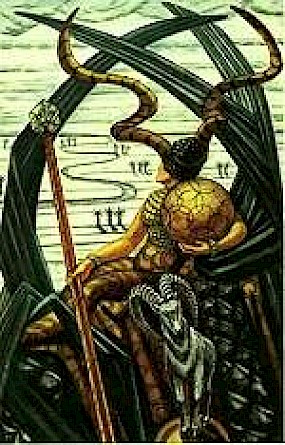
Tarot Card for October 6: The Queen of Disks
The Queen of Disks
As the Queen of the Suit most connected to the home environment, families, materiality and fecundity, the woman represented by the Queen of Disks will most likely be a person whose attention centres upon the family environment. Here, she will excel, gaining a great deal of pleasure from providing a secure haven where she and others can feel cosseted and cared for.
In modern times the qualities for which this Queen stands have tended to be devalued and downgraded (‘I’m only a housewife’). This causes difficulties for the woman who feels most fulfilled expending her energies in a home situation, working with her family and a close circle of friends.
Yet the contribution that this sort of work makes to the lives of anyone who comes into contact with it cannot be underestimated. We all want to feel welcome and warm in our own homes. We want to feel nurtured and secure. So perhaps it’s time to re-instate the Queen of Disks to her rightful place – Regent to the Empress, and important to everybody. Furthermore, maybe we need to invoke our own caring qualities more readily so that we all pour our unique energies into our domestic surroundings.
If the Queen of Disks is ill-dignified in a reading, she will generally have lost sight of her position – or, perhaps, is being taken for granted by others. At that point the weaker side of her personality will show through. She may become dependent and clingy, believing herself to be unable to stand alone. She might manipulate by adopting a passive victim’s role.
Though usually the type of woman indicated by the Queen of Disks is a gentle soul, when angered she can become a fierce enemy, particularly where she sees injustice done to her family and friends. She’s loyal and willing to help, rooted in the practical aspects of life.
Her concept of spirituality centres on the nourishing aspects of her personality – she is therefor a facilitator, quietly assisting others on their journey, though often her contribution will go unnoticed.
She is often interested in, and involved with, the healing arts, being a willing and generous healer. When she is ambitious it is usually for others, again in her facilitator role. She maintains a strong link with Nature, loving plants, trees and animals.
(via angelpaths.com and Alan Blackman)
“This one joke is enough to give you all the life lessons you need” – Sadhguru
Sadhguru-The Mystic Aug 17, 2023 “Best joke to teach you about life ” – Sadhguru
(Courtesy of Steve Hines)
Spiritual Awakenings Are Changing FAST! Here’s How.
Christina Lopes, DPT, MPH Oct 3, 2023 Discover the 5 main ways in which spiritual awakenings are changing in this new energy so you can make sense of what’s happening to you.
(Contributed by Hed Henry, H.W.)
Liberating Ourselves from the Wealth Supremacy Myth
By David Korten | October 4, 2023 (Tikkun.org)
Review of Wealth Supremacy: How the Extractive Economy and the Biased Rules of Capitalism Drive Today’s Crises, Marjorie Kelly, Berrett-Koehler Publishers, 2023.

Kelly’s book appears at a moment of human awakening to the most successful and devastating financial scam in human history. It exposes ambiguities in our language that scammers have used to gain our acceptance of the idea that growing our money economy should be our defining global priority – a priority that primarily increases the financial assets of the world’s already richest people. It then provides essential guidance for restoring economic sanity by changing our shared story regarding the purpose of the economy. That, in turn, can enable us to advance a transition to equitable cooperative worker/community ownership.
My association with and admiration for author Marjorie Kelly goes back to her days as the editor of Business Ethics magazine, which she founded in 1987. Her first book, The Divine Right of Capital: Dethroning the Corporate Aristocracy (2003) has my ringing endorsement on the front cover, “We have found our Thomas Paine for the new millennium.”
Kelly, a previous contributor to Tikkun, is one of the important thinkers of our time. This, her latest book, is a seminal contribution to pushing our thinking and understanding ever deeper into how big money is driving humans to self-extinction. Her distinctive experience deepens her insight into the deceptions that lull us into submission and what we must do to address them.
Early in Wealth Supremacy, Kelly introduces us to a deeply troubling statistic. In the 1950s, the days of the once strong U.S. middle class, financial assets in the United States were roughly equal to GDP (Gross Domestic Product). She notes that now, by conservative estimates, U.S. financial assets are five times U.S. GDP. This financialization of the economy has allowed financial assets to grow far faster than actual productivity. And what is worse, these assets are very unequally distributed.
According to the U.S. Federal Reserve, in mid-2023 the richest 0.1 percent owned 12.8 percent. The poorest 50 percent of the U.S. population owned only 2.5 percent of total U.S. financial assets. This devastating inequality is by no means unique to the United States. It is global.
Tikkun needs your support to bring the kind of analyses and information we provide.
Click Here to make a tax-deductible contribution.
Kelly is telling us that rather than being devoted to providing a good life for the world’s people, the global economy is now structured and managed primarily to grow the financial assets and power of those who already have financial assets and power far beyond any conceivable need or societal benefit.
Kelly points out that the current massive economic misdirection has been legitimated by two basic fallacies promoted by advocates of elite interests.
1. Wealth Supremacy: The fallacy that persons with significant financial assets are “worth” more and have contributed more than others.
2. Capital Bias: The fallacy that profit (including profit further enriching the already obscenely rich) is inherently good and should always grow. Costs of labor, an expense, should be minimized.
Kelly observes that public acceptance of these fallacies has led us to allow global financiers to control the global economy and game the system to grow their financial assets without requiring them to produce anything of real value. Their scams are facilitated by the ambiguity of the words “wealth” and “capital”.
We routinely refer to money—a mere number—as wealth and capital. In fact, money is just a token of exchange that we use to obtain things of real value—including clean water, food, shelter, and much else—on which our lives depend. These tokens give status and power to those individuals who possess them. They contribute nothing in themselves to the well-being of society.
Of course, any nation with its own currency can easily print and distribute more money. That, however, will only result in inflation unless there is a corresponding increase in the goods and services produced and offered for sale.
The distorting growth of financial assets about which Kelly writes mostly enriches individuals who have no real need of more money. But they can use those assets to consolidate the power of the corporate monopolies they control and suppress wages while increasing the prices of consumer goods. All of this contributes to further increasing their profits and financial assets—the primary but rarely mentioned source of most current global inflation.
The fallacies grounded in ambiguities of language support an endless variety of financial scams that grow the financial assets of financial fraudsters while suppressing wages and growing the debts of working people. Many such scams are so complex that they are difficult to recognize, resist, and prohibit. Many involve various forms of counterfeiting financial assets, the most obvious of which would be cryptocurrencies. But the scams also include financial derivatives, hedge funds, private equity firms, predatory lenders, and more. Authors fill books with examples of these scams, as for example, These are the Plunderers: How Private Equity Runs—and Wrecks—America, by Gretchen Morgenson and Joshua Rosner.
It likely never occurs to many who profit from these scams that they are engaged in immoral activity with devastating consequences for people and the living Earth. Many will insist that they have done nothing wrong because their actions are legal. Just because a scam is legal, however, doesn’t mean it isn’t a scam. Anything that contributes to reducing billions of people to lives of desperation and early death surely should be illegal. And legal reform is surely appropriate.
But, as Kelly argues, piecemeal legal reforms will ultimately be futile.
I have for years tried to sort out the details of how the various financial scams work so that I might help to explain and expose them to facilitate legal reforms. In reading Wealth Supremacy, I realized that Kelly is telling us that such piecemeal reforms are futile. The world of money is a world of illusion with numbers that appear and disappear like phantoms in the night. For every new law, the scammers will find ways around it.
Kelly calls us to look beyond incremental legal reforms. Better we focus our attention on exposing the fallacies of the currently dominant story that lead us to accept the scams as legitimate. Then attack the underlying structural defects through system transformation.
This brings us to the defining theme of Part III of Wealth Supremacy. In Part III, Kelly discusses pathways to equitable worker/community ownership that can secure a meaningful life for all people with no extremes of wealth and poverty. Kelly’s point is simple. The purpose of any responsible business is to serve the people of the community in which it does business. Such a purpose is a far cry from exploiting workers, customers, small investors, and Earth to extract as much profit as possible to grow the fortunes of aspiring and actual billionaires.
Ownership is the critical variable. It must be equitably shared and reside in and work for the well-being of the community in which a business operates. Call it economic democracy, an essential foundation of the political democracy to which we aspire and to which Tikkun readers have long been committed. An economy will work for the people only if ownership resides in people who care about and are dedicated to the well-being of their families and neighbors.
Kelly appropriately begins with the ownership of financial institutions. She reminds us of the days following WWII when our banks were small and local. Many of us back then relied for our financial needs on credit unions that we and our neighbors owned and managed to support affordable local housing and local businesses owned by local people to meet local needs. Such financial institutions are a model for a viable human future.
Those were the days of my growing up. My dad was a local businessman who regularly asserted that “If you are not in business to serve your customers [our neighbors], you have no business being in business.” He meant it and he practiced it. He loved making a profit, but his greatest love was meeting the needs of his customers and providing his employees with good, secure family-wage jobs.
My Dad’s sense of the purpose of his business is an extraordinary contrast to the current prevailing sense of the purpose of business. That purpose of ever-expanding profits to grow and maximize returns to major shareholders and top executives means that we can allow—even celebrate—such atrocities as billionaires enriching themselves by firing thousands of people with a sweep of their hand. In the immortal words of Gandhi, “The world has enough for everyone’s need, but not everyone’s greed.”
Mentally healthy humans will go to great lengths to avoid inflicting pain on others, even to the extent of extreme self-sacrifice. Those who take pleasure in inflicting pain on others to grow personal financial assets are exceptions to the norm. Such individuals are properly confined to institutions dedicated to providing them with needed healing. They are the last people we want heading our most powerful institutions.A viable human future depends on a transformation from the imperial civilizations that have shaped human societies for some 5,000 years to the ecological civilization it is now within our means to create together. It will require the efforts of billions of people who care for the well-being of living Earth and all its people and other living beings. The barriers are daunting. Wealth Supremacy by Marjorie Kelly is an essential guide to making the deep institutional transformation necessary to create an economy that works for all.
ABOUT DAVID KORTEN
Dr. David Korten is the author of Change the Story, Change the Future: A Living Economy for a Living Earth; Agenda for a New Economy: From Phantom Wealth to Real Wealth; The Post-Corporate World: Life After Capitalism; and the international best sellers When Corporations Rule the World; and The Great Turning: From Empire to Earth Community. He is board chair of YES! Magazine, president of the Living Economies Forum, a board member of Toward Ecological Civilization, a full member of the Club of Rome, and an associate fellow of the Institute for Policy Studies. He earned MBA and PhD degrees from Stanford University Graduate School of Business and served on the faculty of the Harvard Business School.