
Monthly Archives: October 2023

Polish Poet and Nobel Laureate Wisława Szymborska on the Creative Power of Uncertainty
By Maria Popova (themarginalian.org)

“Attempt what is not certain. Certainty may or may not come later. It may then be a valuable delusion,” the great painter Richard Diebenkorn counseled in his ten rules for beginning creative projects. “One doesn’t arrive — in words or in art — by necessarily knowing where one is going,” the artist Ann Hamilton wrote a generation later in her magnificent meditation on the generative power of not-knowing. “In every work of art something appears that does not previously exist, and so, by default, you work from what you know to what you don’t know.”
What is true of art is even truer of life, for a human life is the greatest work of art there is. (In my own life, looking back on my ten most important learnings from the first ten years of The Marginalian [formerly Brain Pickings], I placed the practice of the small, mighty phrase “I don’t know” at the very top.) But to live with the untrammeled openendedness of such fertile not-knowing is no easy task in a world where certitudes are hoarded as the bargaining chips for status and achievement — a world bedeviled, as Rebecca Solnit memorably put it, by “a desire to make certain what is uncertain, to know what is unknowable, to turn the flight across the sky into the roast upon the plate.”
That difficult feat of insurgency is what the great Polish poet Wisława Szymborska (July 2, 1923–February 1, 2012) explored in 1996 when she was awarded the Nobel Prize in Literature for capturing the transcendent fragility of the human experience in masterpieces like “Life-While-You-Wait” and “Possibilities.”

In her acceptance speech, later included in Nobel Lectures: From the Literature Laureates, 1986 to 2006 (public library) — which also gave us the spectacular speech on the power of language Toni Morrison delivered after becoming the first African American woman to win the Nobel Prize — Szymborska considers why artists are so reluctant to answer questions about what inspiration is and where it comes from:
It’s not that they’ve never known the blessing of this inner impulse. It’s just not easy to explain something to someone else that you don’t understand yourself.
Noting that she, too, tends to be rattled by the question, she offers her wieldiest answer:

Art by Salvador Dalí from a rare edition of Alice’s Adventures in Wonderland
In a sentiment of chilling prescience today, as we witness tyrants drunk on certainty drain the world of its essential inspiration, Szymborska considers the destructive counterpoint to this generative not-knowing:
This is why I value that little phrase “I don’t know” so highly. It’s small, but it flies on mighty wings. It expands our lives to include the spaces within us as well as those outer expanses in which our tiny Earth hangs suspended. If Isaac Newton had never said to himself “I don’t know,” the apples in his little orchard might have dropped to the ground like hailstones and at best he would have stooped to pick them up and gobble them with gusto. Had my compatriot Marie Sklodowska-Curie never said to herself “I don’t know”, she probably would have wound up teaching chemistry at some private high school for young ladies from good families, and would have ended her days performing this otherwise perfectly respectable job. But she kept on saying “I don’t know,” and these words led her, not just once but twice, to Stockholm, where restless, questing spirits are occasionally rewarded with the Nobel Prize.
Such surrender to not-knowing, Szymborska argues as she steps out into the cosmic perspective, is the seedbed of our capacity for astonishment, which in turn gives meaning to our existence:
But “astonishing” is an epithet concealing a logical trap. We’re astonished, after all, by things that deviate from some well-known and universally acknowledged norm, from an obviousness we’ve grown accustomed to. Now the point is, there is no such obvious world. Our astonishment exists per se and isn’t based on comparison with something else.
Granted, in daily speech, where we don’t stop to consider every word, we all use phrases like “the ordinary world,” “ordinary life,” “the ordinary course of events” … But in the language of poetry, where every word is weighed, nothing is usual or normal. Not a single stone and not a single cloud above it. Not a single day and not a single night after it. And above all, not a single existence, not anyone’s existence in this world.
Twenty years before she received the Nobel Prize, Szymborska explored how our contracting compulsion for knowing can lead us astray in her sublime 1976 poem “Utopia,” found in her Map: Collected and Last Poems (public library):
Island where all becomes clear.
Solid ground beneath your feet.
The only roads are those that offer access.
Bushes bend beneath the weight of proofs.
The Tree of Valid Supposition grows here
with branches disentangled since time immemorial.The Tree of Understanding, dazzlingly straight and simple,
sprouts by the spring called Now I Get It.The thicker the woods, the vaster the vista:
the Valley of Obviously.If any doubts arise, the wind dispels them instantly.
Echoes stir unsummoned
and eagerly explain all the secrets of the worlds.On the right a cave where Meaning lies.
On the left the Lake of Deep Conviction.
Truth breaks from the bottom and bobs to the surface.Unshakable Confidence towers over the valley.
Its peak offers an excellent view of the Essence of Things.For all its charms, the island is uninhabited,
and the faint footprints scattered on its beaches
turn without exception to the sea.As if all you can do here is leave
and plunge, never to return, into the depths.Into unfathomable life.
Purely for the fun of it, I found myself drawing Szymborska’s poetic island in a map inspired by Thomas More’s Utopia:

Complement with astrophysicist Marcelo Gleiser on how to live with mystery in the age of knowledge, then revisit Szymborska on why we read, our cosmic solitude, how artists humanize our history, and the importance of being scared.
Free Will Astrology: Week of October 5, 2023
BY ROB BREZSNY | OCTOBER 3, 2023

ARIES (March 21-April 19): I’ve been doing interviews in support of my new book “Astrology Is Real: Revelations from My Life as an Oracle.” Now and then, I’m asked this question: “Do you actually believe all that mystical woo-woo you write about?” I respond diplomatically, though inwardly I’m screaming, “How profoundly hypocritical I would be if I did not believe in the ‘mystical woo-woo’ I have spent my adult life studying and teaching!” But here’s my polite answer: I love and revere the venerable spiritual philosophies that some demean as “mystical woo-woo.” I see it as my job to translate those subtle ideas into well-grounded, practical suggestions that my readers can use to enhance their lives. Everything I just said is the prelude for your assignment, Aries: Work with extra focus to actuate your high ideals and deep values in the ordinary events of your daily life. As the American idioms advise: Walk your talk and practice what you preach.
TAURUS (April 20-May 20): I’m happy to see the expanding use of service animals. Initially, there were guide dogs to assist humans with imperfect vision. Later, there came mobility animals for those who need aid in moving around and hearing animals for those who can’t detect ringing doorbells. In recent years, emotional support animals have provided comfort for people who benefit from mental health assistance. I foresee a future in which all of us feel free and eager to call on the nurturing of companion animals. You may already have such friends, Taurus. If so, I urge you to express extra appreciation for them in the coming weeks. Ripen your relationship. And if not, now is an excellent time to explore the boost you can get from loving animals.
GEMINI (May 21-June 20): Gemini author Chuck Klosterman jokes, “I eat sugared cereal almost exclusively. This is because I’m the opposite of a ‘no-nonsense’ guy. I’m an ‘all-nonsense’ guy.” The coming weeks will be a constructive and liberating time for you to experiment with being an all-nonsense person, dear Gemini. How? Start by temporarily suspending any deep attachment you have to being a serious, hyper-rational adult doing staid, weighty adult things. Be mischievously committed to playing a lot and having maximum fun. Dancing sex! Ice cream uproars! Renegade fantasies! Laughter orgies! Joke romps! Giddy brainstorms and euphoric heartstorms!
CANCER (June 21-July 22): Cancerian comedian Gilda Radner said, “I base most of my fashion taste on what doesn’t itch.” Let’s use that as a prime metaphor for you in the coming weeks. According to my reading of the astrological omens, you will be wise to opt for what feels good over what merely looks good. You will make the right choices if you are committed to loving yourself more than trying to figure out how to get others to love you. Celebrate highly functional beauty, dear Cancerian. Exult in the clear intuitions that arise as you circumvent self-consciousness and revel in festive self-love.
LEO (July 23-Aug. 22): The amazingly creative Leo singer-songwriter Tori Amos gives this testimony: “All creators go through a period where they’re dry and don’t know how to get back to the creative source. Where is that waterfall? At a certain point, you say, ‘I’ll take a rivulet.’” Her testimony is true for all of us in our quest to find what we want and need. Of course, we would prefer to have permanent, unwavering access to the waterfall. But that’s not realistic. Besides, sometimes the rivulet is sufficient. And if we follow the rivulet, it may eventually lead to the waterfall.
VIRGO (Aug. 23-Sept. 22): Do you perform experiments on yourself? I do on myself. I formulate hypotheses about what might be healthy for me, then carry out tests to gather evidence about whether they are. A recent one was: Do I feel my best if I eat five small meals per day or three bigger ones? Another: Is my sleep most rejuvenating if I go to bed at 10pm and wake up at 7am or if I sleep from midnight to 9am? I recommend you engage in such experiments in the coming weeks. Your body has many clues and revelations it wants to offer you.
LIBRA (Sept. 23-Oct. 22): Take a few deep, slow breaths. Let your mind be a blue sky where a few high clouds float. Hum your favorite melody. Relax as if you have all the time in the world to be whoever you want to be. Fantasize that you have slipped into a phase of your cycle when you are free to act as calm and unhurried as you like. Imagine you have access to resources in your secret core that will make you stable and solid and secure. Now read this Mary Oliver poem aloud: “You do not have to be good. You do not have to walk on your knees for a hundred miles through the desert, repenting. You only have to let the soft animal of your body love what it loves.”
SCORPIO (Oct. 23-Nov. 21): An Oklahoma woman named Mary Clamser used a wheelchair from age nineteen to forty-two because multiple sclerosis made it hard to use her legs. Then a miracle happened. During a thunderstorm, she was hit by lightning. The blast not only didn’t kill her; it cured the multiple sclerosis. Over the subsequent months, she recovered her ability to walk. Now I’m not saying I hope you will be hit by a literal bolt of healing lightning, Scorpio, nor do I predict any such thing. But I suspect a comparable event or situation that may initially seem unsettling could ultimately bring you blessings.
SAGITTARIUS (Nov. 22-Dec. 21): What are your favorite mind-altering substances? Coffee, tea, chocolate, sugar or tobacco? Alcohol, pot, cocaine or opioids? Psilocybin, ayahuasca, LSD or MDMA? Others? All the above? Whatever they are, the coming weeks will be a favorable time to re-evaluate your relationship with them. Consider whether they are sometimes more hurtful than helpful, or vice versa; and whether the original reasons that led you to them are still true; and how your connection with them affects your close relationships. Ask other questions, too! PS: I don’t know what the answers are. My goal is simply to inspire you to take an inventory.
CAPRICORN (Dec. 22-Jan. 19): In his book “Meditations for Miserable People Who Want to Stay That Way,” Dan Goodman says, “It’s not that I have nothing to give, but rather that no one wants what I have.” If you have ever been tempted to entertain dour fantasies like that, I predict you will be purged of them in the coming weeks and months. Maybe more than ever before, your influence will be sought by others. Your viewpoints will be asked for. Your gifts will be desired, and your input will be invited. I trust you won’t feel overwhelmed!
AQUARIUS (Jan. 20-Feb. 18): William James (1842–1910) was a paragon of reason and logic. So influential were his books about philosophy and psychology that he is regarded as a leading thinker of the nineteenth and twentieth centuries. On the other hand, he was eager to explore the possibilities of supernatural phenomena like telepathy. He even consulted a trance medium named Leonora Piper. James said, “If you wish to upset the law that all crows are black, it is enough if you prove that one crow is white. My white crow is Mrs. Piper.” I bring this to your attention, Aquarius, because I suspect you will soon discover a white crow of your own. As a result, long-standing beliefs may come into question; a certainty could become ambiguous; an incontrovertible truth may be shaken. This is a good thing!
PISCES (Feb. 19-March 20): If we hope to cure our wounds, we must cultivate a focused desire to be healed. A second essential is to be ingenious in gathering the resources we need to get healed. Here’s the third requirement: We must be bold and brave enough to scramble up out of our sense of defeat as we claim our right to be vigorous and whole again. I wish all these powers for you in the coming weeks.
Homework: What if you could heal a past trauma? How would you start? Newsletter.FreeWillAstrology.com
Tarot Card for October 5: The Nine of Wands
The Nine of Wands
When we reach deep inside ourselves, with a heart that is unafraid and accepting, we will discover new depths of strength and power. These deep reaches of wisdom, which lay dormant with in the subconscious until we are brave enough to search them out, will bring balance and equilibrium. And from new centredness will arise an unshakeable trust in ourselves that will carry us forward through life.
It’s true that when we travel deep inside ourselves, we will also find material that we might prefer to leave unacknowledged – but the Nine of Wands, Lord of Strength, reminds us that in being true to ourselves we release energies that will help us to deal with whatever we find within. And after all, whatever lies inside our own subconscious is, for better or for worse, a part of us.
When the Nine of Wands turns up in a reading, we can be re-assured that we have what it takes to get by. Even in times of stress and difficulty, inner strength will rise up to guide us forward toward our goals. And in the process we shall learn more about ourselves and our abilities, gaining a new all-round perspective which brings security and self-confidence.
This card tells us to trust ourselves. We have everything we need. There is no necessity to analyse nor question. And absolutely no excuse to give in to doubt!
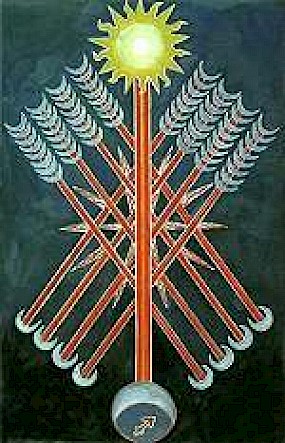
(via angelpaths.com and Alan Blackman)
Gretel Ehrlich on nature


Tarot Card for October 4: The Princess of Disks
The Princess of Disks
A young woman indicated by the Princess of Disks would be a quiet, reserved person – sometimes shy. She will be practical and capable, though rarely seeking the limelight. I used to know a stage manager who always came up as a Princess of Disks – she loved the glitz of the theatre as long as she could stay behind the scenes – having, of course, created them first!
She’s a gentle person who, like the Queen of Disks, is much concerned with domestic matters, and with Nature and growth. As a result, sometimes when this card comes up we may be looking at somebody who is expecting a child. The Princess of Cups often represents conception, the Princess of Disks shows the pregnancy and the Ace of Wands will then indicate the birth.
The Princess of Disks woman is a reliable and diligent person, trustworthy and hard-working. She is faithful by nature, and deals badly with conflict. She likes life to unfolds in an ordered fashion. In fact, she contemplates life very thoroughly, being sensitive to the needs of others, and sympathetic to their feelings.
Despite her quiet exterior, she has a huge resource of strength and support to offer to those who need it. She is also an excellent practical manager with marked proficiency in dealing with money and accounting. This will, however, generally be expressed in the home environment where she is at her most content.
When the card comes up to indicate a period in somebody’s life, rather than the person herself, we will be looking at a young woman on the threshold – of life, marriage, motherhood, though rarely on the threshold of some major career ambition. That step would be more readily indicated by the Princess of Wands.
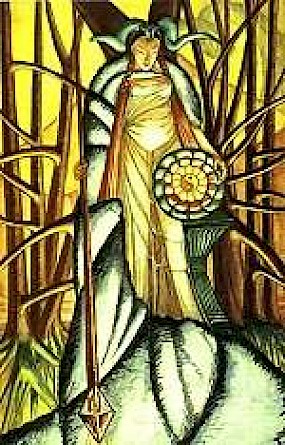
(via angelpaths.com and Alan Blackman)
Astrologer’s Shocking Prediction for 2024 (w/ Cam White)
Bad Faith Premiered Oct 2, 2023 A little departure from our normal fare: astrologist Cam White joins with his predictions for 2024, and what the stars tell us about Trump’s appeal, Vivek Ramaswamy’s authentic self, and Kamala Harris’s future. Subscribe to Bad Faith on YouTube to access our full video library. Find Bad Faith with Briahna Joy Gray on Twitter (@badfaithpod) and Instagram (@badfaithpod). Theme by Nick Thorburn (@nickfromislands)
Albert Ellis: A Guide to Rational Living
“Masturbation is good and delicious, but musterbation is evil and pernicious.”
–Albert Ellis
ThinkingAllowedTV Aug 21, 2010 Great news!! Now watch every title and guest in the Thinking Allowed Collection, complete and commercial free. More than 350 programs now streaming. Visit http://thinkingallowed.vhx.tv Start today. Cancel any time. Use promo code THINKNOW for a 50% discount on your first month. NOTE: This is an excerpt from the full 90-minute DVD. http://www.thinkingallowed.com/2aelli… Working to change your personal philosophy is a valid therapeutic technique — one which can lead to genuine growth. Behavior, emotion and cognition, says Albert Ellis, are all interrelated. He tells us how to recognize irrational belief patterns based on “musts” and “shoulds.” He then presents methods for self-analysis and therapy. Dr. Ellis discusses and demonstrates the modeling approach, the use of humor, the use of cognitive homework, unconditional acceptance of clients, the use of strong language and dealing with low frustration tolerance. In a moving manner, he also describes the application of these principles in his own life experience. (A DVD program in two parts) Born in 1913, Albert Ellis, Ph.D., was one of the most influential figures in the history of psychology. He is author of over 600 academic papers and more than 50 books including A Guide to Rational Living, How to Live with a Neurotic, Humanistic Psychotherapy, The Art and Science of Love and Sex Without Guilt. Dr. Ellis is considered the grandfather of cognitive behavior therapy, the founder of Rational-Emotive Therapy (RET) and one of the architects of the sexual revolution.
John D. Rockefeller Killed Natural Medicine & Started Big Pharma
The Jimmy Dore Show Sep 24, 2023 Notorious robber baron John D. Rockefeller became a billionaire on the strength of the monopolistic power of Standard Oil. But what most don’t know is that Rockefeller subsequently leveraged his money and power to create the pharmaceutical industry as part of a plan to replace traditional “natural” remedies with petroleum-based products. Guest host Craig “Pasta” Jardula and Americans’ Comedian Kurt Metzger discuss this surprising origin of Big Pharma, as well as the American Medical Association.
(Courtesy of Steve Hines)
Frederick Hoffman’s Race Traits: The Origins of Statistical Based Bias Towards Black People
The legacy of racism pervades the financial system to this day — African-Americans are still discriminated against on the basis of a long-disproven methodology.

Aug 31, 2020 (Medium.com)

In May 1896, Frederick L. Hoffman, a statistician at the Prudential Life Insurance Company, published a 330-page article in the prestigious Publications of the American Economic Association intended to prove — with statistical reliability — that the American Negro was uninsurable. Race Traits and Tendencies of the American Negro was a compilation of statistics, eugenic theory, observation, and speculation, solicited by the Prudential in response to a wave of state legislation banning discrimination against African Americans. In the report, Hoffman wrote, “Given the same conditions of life for two races, the one of Aryan descent will prove the superior, solely on account of its ancient inheritance of virtue and transmitted qualities which are determining factors in the struggle for race supremacy.” He also presented statistics about prisoners’ races with the crimes they were convicted of, writing, “The colored male…only too often leads the life of a vagrant,” and that the Black race had a “greater tendency to crime and pauperism than the whites.” This pivotal text — which was presented as a scientific study — used the language of white supremacy and explicitly stated that violence and crime are within the nature of Black people.
The reception fulfilled Hoffman’s hopes for the piece and the positive reviews confirmed that he had achieved exactly what he set out to do. “Only by means of a thorough analysis of all the data that make up the history of the colored race in this country can the true nature of the so-called ‘Negro problem’ be understood,” pronounced Hoffman in the early pages of Race Traits. “Being of foreign birth, a German, I was fortunately free from a personal bias which might have made an impartial treatment on this subject difficult.” Yet despite its glowing reception, the statistician’s work would prove to be neither as fact-based nor as neutral as its author claimed.
“The central fact deducible from the results of this investigation into the traits and tendencies of the colored population of this country,” surmised Hoffman, “is plainly and emphatically the powerful influence of race in the struggle for life.” For him, as for many authors, the race question collapsed into a simple tautology: Negroes died because they were inferior, and they were inferior because they died. “It is not in the conditions of life, but in the race traits and tendencies that we find the causes of excessive mortality,” he resolved, a statement that summarizes both the central tenet of his text and the piece’s most glaring logical fallacy.
That language and Hoffman’s findings did not go unchallenged. In an 1897 review of the text, W.E.B. Du Bois wrote, “Criminal statistics raise the whole question as to how far black and white malefactors are subjected to different standards of justice.” He also wrote, “When the younger generation came on the stage with exaggerated but laudable hopes of ‘rising,’ and found that a dogged Anglo-Saxon prejudice had shut nearly every avenue of advancement in their faces, the energies of many undoubtedly found an outlet in crime.” Du Bois made two points that we’re still grappling with more than 120 years later: the different ways in which Black and white Americans are treated by our justice system, and the relationship between crime and the threat of poverty due to systemic racism.
Howard University mathematician Kelly Miller joined Du Bois in critiquing Hoffman’s mishandling and misapplication of data. Perhaps no charge was more critical than Du Bois’ observation that Hoffman had failed to stratify his findings. “The careful statistician will immediately see that, while all these different sets of figures give data interesting in themselves, they must be used with great care in comparison, because they relate to different classes of people and to widely different conditions of life,” Du Bois warned. Stratifying by social or economic status would have shown that black mortality rates differed enormously based on environmental factors. Du Bois pointed out that the health outcomes of African Americans were entirely comparable to those of immigrant groups with similar economic resources. (In his review of Race Traits, Du Bois pointed out that at 32.61, the death rate of blacks in the United States was slightly lower than that of white citizens in Munich, Germany.)
Hoffman received the distinct social, philosophical, and political mores of the society in which he lived; that he could and did transmit them in the writing of Race Traits goes without saying. Whether he was consciously racist when he authored his first major work is a matter for debate, but it is clear that he did not break from the predominant racial ideology of his time.

Historian, Librarian, and Archivist