
(patricia@evolutionarycollective.com)
Monthly Archives: October 2023
How to Own Your Weakness: Alan Watts on the Confucian Concept of Jen and the Dangers of Self-Righteousness
By Maria Popova (themarginalian.org)

A great tragedy of our time, this epoch of self-righteousness, is the zeal with which people would rather feel right than understand — the situation, the context, the motives and vulnerabilities behind the actions, the basic fact of the other.
Growling beneath it all is an aversion to our own imperfections — we would rather look away and toward the faults of others than fully step into our own shadow and embrace it with light. In so segregating our own nature, we abdicate our wholeness and cease being fully human.
How to rehumanize ourselves by owning our shadow is what Alan Watts (January 6, 1915–November 16, 1973) examines in some wonderful passages from Tao: The Watercourse Way (public library) — his final book, which he never fully finished before death took him one late-autumn day; it was posthumously published with the help of his friend Al Chung-liang Huang.
Alan Watts, early 1970s. (Photograph courtesy of Everett Collection)
Watts writes:
At the head of all virtues Confucius put not righteousness (i), but human-heartedness (jen), which is not so much benevolence, as often translated, but being fully and honestly human.
[…]
A true human is not a model of righteousness, a prig or a prude, but recognizes that some failings are as necessary to genuine human nature as salt to stew.
A generation before Parker Palmer urged in his magnificent commencement address that you “take everything that’s bright and beautiful in you and introduce it to the shadow side of yourself” so that “the shadow’s power is put in service of the good,” Watts adds:
[…]
Trust in human nature is acceptance of the good-and-bad of it, and it is hard to trust those who do not admit their own weakness.

Art by Andrea Dezsö from a special edition of the Brothers Grimm fairy tales.
(It is worth nothing that Tao: The Watercourse Way was itself a way of admitting, and remedying, a human weakness on the scale of society — a decade before Ursula K. Le Guin so brilliantly unsexed the universal pronoun, Watts becomes the first to propose, in a footnote, that the Confucian word jen, which is ungendered in Chinese but has traditionally been translated into English as “man-heartedness,” instead be translated as “human-heartedness” and that all instances of “man” as the universal pronoun be replaced with “human.”)
Complement with Joan Didion on learning not to mistake self-righteousness for morality and the psychologist turned pioneering artist Anne Truitt on the cure for our chronic self-righteousness, then revisit Watts on love and the only real antidote to fear, happiness and how to live with presence, the art of learning not to think in terms of gain or loss, and the salve for our existential loneliness.
Energy production: Romania among world’s greenest economies

22 August 2023 (romania-insider.com)
According to a graph created by the platform Ourworldindata.org and quoted by Ziarul Financiar, as of the year 2022, over 62% of the energy produced in Romania came from emission-free sources, namely nuclear and renewable sources.
The percentage is similar to that reported by the National Energy Regulatory Authority (ANRE) and puts Romania among the world’s greenest economies, in the select company of Nordic countries, Canada, or Austria, ZF noted.
This year, Romania could achieve an even higher percentage of green energy as a share of total consumption, thanks to new installations estimated to come online and a decrease in electricity demand.
In April of this year, Romania reached a CO2-free energy production of around 80% of the total. The rise of green energy occurred with the phasing out of coal and a reduction in energy consumption. This occasion marked Romania’s return to being an energy exporter after years of energy imports.
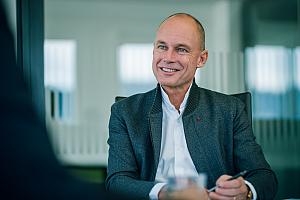
25 May 2023
(Photo source: Andrey Popov | Dreamstime.com)
On Writing

“Writing is a process of self-discovery. If you are honest, you are forced to confront the part of yourself that you always have a tendency to run away from.”
–AUGUST WILSON
August Wilson (April 27, 1945 – October 2, 2005) was an American playwright. He has been referred to as the “theater’s poet of Black America”. He is best known for a series of 10 plays, collectively called The Pittsburgh Cycle, which chronicle the experiences and heritage of the African-American community in the 20th century. Wikipedia

“How do I write? Expand, expand, cut, cut, expand, expand, cut, cut. Do not trust spontaneous first drafts. You can always write more fully. The beautiful feeling after writing a poem is on the whole better even than after sex, and that’s saying a lot.”
–ANNE SEXTON
Anne Sexton (November 9, 1928 – October 4, 1974) was an American poet known for her highly personal, confessional verse. She won the Pulitzer Prize for poetry in 1967 for her book Live or Die. Wikipedia
Leaving Gurdjieff
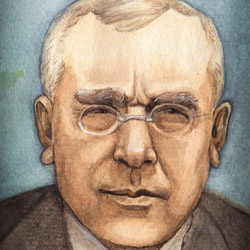
PETER OUSPENSKY
20TH CENTURY MATHEMATICIAN & PHILOSOPHER

INTRODUCING PETER OUSPENSKY
Piotr Demianovich Ouspensky (March 4, 1878–October 2, 1947) was a Russian philosopher who rejected the science and psychology of his time under the strong suspicion that there had to exist superior systems of thought. In his youth, he studied mysticism and esotericism and traveled extensively in search of ancient wisdom, sensing that past ages knew more than his present one. “I felt that there was a dead wall everywhere,” he commented in one of his early biographical notes. “I used to say at that time that professors were killing science in the same way as priests were killing religion.”
When Ouspensky met George Gurdjieff and was introduced to the Fourth Way in 1915, he realized that the barrier towards knowledge lay in oneself; one couldn’t find the truth without simultaneously laboring to live the truth. Real knowledge could only come with sufficient preparation for receiving it. Ouspensky spent the rest of his life laboring to make the Fourth Way principles his own and to share them with like-minded people. In so doing, he became an agent of truth for his age, carrying the wisdom of the pre-World War era into the middle of the twentieth century.
OUSPENSKY’S EARLY YEARS
Ouspensky was born in Moscow in 1878 in a middle class household that was fond of the arts. In his autobiographical accounts he describes himself as atypical, a disinterest in behaving like other children, and an early inclination towards more mature topics like the natural sciences. His lucid memory of these very early years extended to even before the age of two:
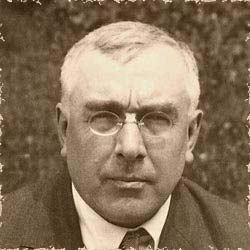
Peter Ouspensky
[MAURICE NICOLL] But I am sure that you remember your life far better than I remember mine, and that your life has had more meaning.
[OUSPENSKY] Yes, but not quite in the way you mean. I have noticed how much you have forgotten. In my case, as a child I did not play with toys. I was less under imagination. I saw what life was like at a very early stage. i
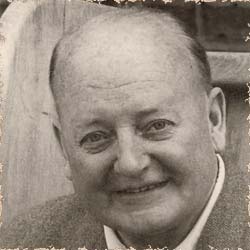
Maurice Nicoll
These precocious qualities appear to have crystallized in his youth both a steadfast dissatisfaction with the schooling system and, later in his adolescence, an unwavering sense of disapproval towards the academic and scientific establishment. The impulse to take personal ownership of his studies began to be apparent as early as the age six, with Ouspensky choosing to be self-taught in the sciences instead of pursuing formal education, with a particular fascination with the theory of the fourth dimension.
Behind this impulse, however, lay the more indelible mark left on his psyche in repeated experiences of déjà vu between Ouspensky and his younger sister, then five and three years of age, in which he recounts how they were able to remember small events before them having yet occurred.

[OUSPENSKY] How can you speak to mother, grandmother, about former lives even when you learn to talk? They will lock you up. I remembered very well. I was very lonely. I had to wait for sister to be born and then to learn to speak, three, four years perhaps, before I had someone to talk to.
Then it used to happen often like this: she used to look out of window and tell me about people she saw. There was very good combination in our street, policeman first, then postman, like that. She used to know who would come round corner because she remembered.
She would say (only we used our own baby language), “Now there will be policeman.” I say, “And now will come tax collector,” and he came. When we did this often I said to her, “Shall we tell mother, grandmother?” And little sister would say, “What use to tell mother, grandmother? They don’t know, they don’t understand anything.” Just think, I was five, she was three. ii
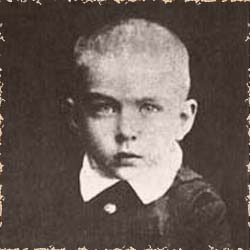
Ouspensky in Childhood
These experiences undoubtedly contributed to the very early conviction in the young Ouspensky of the existence of a veiled reality behind which stood a much different world with radically different meanings towards life than what was ordinarily understood by the adults around him. It was the inherent seed in him that expressed itself in later years of studies and personal development, and never in fact ceased.

OUSPENSKY’S SEARCH
The theory that we live and repeat the same life over and over again represented to the young Ouspensky a living truth, and was inextricably linked and energized by his fascination with higher dimensions. By the age of 27, he wrote a novel titled A Strange Life of Osokin which encapsulated his understanding of the laws governing eternal recurrence and the possibility of change.
Two years later, Ouspensky discovered Theosophy and was introduced to the many branches of esotericism, with entirely new approaches to the pursuit of higher realities. His study of Theosophical literature drew him into psychology, personal experiments, and exotic travels, all of which was conveyed in a series of publications and lectures on topics including the Tarot and Yoga, attracting a considerable audience.
[OUSPENSKY] I discovered the idea of esotericism, found a possible angle for the study of religion and mysticism, and received a new impetus for the study of “higher dimensions”. iii
Ouspensky’s acclaim reached new heights with the publication of Tertium Organum, hailed as a masterpiece in addressing the problem of higher dimensions, and established the now 34 year old as a preeminent philosopher. However, these worldly achievements always appeared to be of secondary interest to him, as the deeper yearning ingrained in his character since childhood made it impossible to settle for the commonplace. Throughout his life, Ouspensky would constantly insist on reaching for nothing short of direct access to the miraculous.
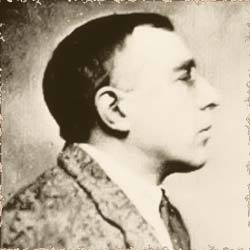
Ouspensky in 1912
Ouspensky’s literary success did not blind him to the fact that experiencing higher dimensions was altogether superior to writing a bestseller on them. He resolved to seek out the miraculous in actual practice, by coming in direct contact with schools that possessed knowledge and practical methods. And so his search continued.
[OUSPENSKY] When I went away I already knew I was going to look for a school or schools. I had arrived at this long ago. I realized that personal, individual efforts were insufficient and that it was necessary to come into touch with the real and living thought which must be in existence somewhere but with which we had lost contact. This I understood; but the idea of schools itself changed very much during my travels and in one way became simpler and more concrete and in another way became more cold and distant. I want to say that schools lost much of their fairy-tale character. iv
MEETING GURDJIEFF
From 1913 to 1914, Ouspensky traveled in search of a school, the majority of this time devoted to India, and while he was successful in obtaining a better understanding of the types of schools that existed, he remained no closer to discovering one suitable to his search. He had planned to continue his search in the Middle East when the trip was cut short by the outbreak of the First World War, requiring him to return home.
Soon after his return to a politically-turbulent Russia, Ouspensky organized lectures to share what he had discovered in India with the aim of gathering like-minded people who were interested in his spiritual pursuits. At one such lecture, held in Moscow, he was approached by two of Gurdjieff’s pupils, who informed him of a group engaged in occult investigations and experiments. They invited him to meet their teacher. While Ouspensky had a poor first impression about the prospect and responded with disinterest, he agreed to the meeting after some insistence by one of the pupils.
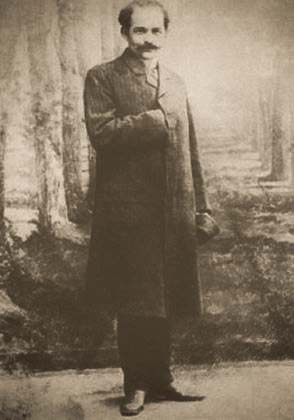
Gurdjieff (1908-1910?)
[OUSPENSKY] In the spring of 1915 I met in Moscow a strange man who had a kind of philosophical school. This was George I. Gurdjieff. He and his ideas produced a very great impression on me. Very soon I realized that he had found many things for which I had been looking in India. I realized that I had met with a completely new system of thought surpassing all I knew before. This system threw quite a new light on psychology and explained what I could not understand before in esoteric ideas and ‘school principles’. iii
[OUSPENSKY] In his explanations I felt the assurance of a specialist, a very fine analysis of facts, and a system which I could not grasp, but the presence of which I already felt because Gurdjieff’s explanations made me think not only of the facts under discussion, but also of many other things I had observed or conjectured. iv
[OUSPENSKY] I saw without hesitation that in the domain [psychology] which I knew better than any other and in which I was really able to distinguish the old from the new, the known from the unknown, Gurdjieff knew more than all European science taken as a whole. v
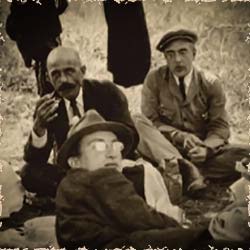
Gurdjieff and Ouspensky Circa 1915
Ouspensky immediately recognized in Gurdjieff the quality of teacher and school that had eluded him throughout all his personal study and seeking abroad. He soon helped form the early St. Petersburg group that Gurdjieff would regularly travel to from Moscow, and became a member of Gurdjieff’s inner circle for several years, playing a key role in establishing the school from the Russian Revolution up until the formation of the institute at Fontainebleau.
Ouspensky’s recollection of this period has been meticulously documented in his book In Search of the Miraculous: Fragments of an Unknown Teaching, published posthumously, and widely held to serve as a masterful introduction to the teachings of Gurdjieff.
MEETING THE MIRACULOUS
Ouspensky’s life is forever altered in the summer of 1916 when he finds himself immersed in a week of miracles. Among a small group of Gurdjieff’s closest pupils in a country house in Finland, his inner work intensifies to an inflection point. The combination of personal and group exercises cultivates in him a heightened state of emotional tension, leading up to the shock of engaging in telepathic conversations with Gurdjieff.
[OUSPENSKY] It all started with my beginning to hear his thoughts. We were sitting in a small room with a carpetless wooden floor as it happens in country houses. I sat opposite G., and Dr. S. and Z. at either side. G. spoke of our “features,” of our inability to see or to speak the truth. His words perturbed me very much. And suddenly I noticed that among the words which he was saying to us all there were “thoughts” which were intended for me. I caught one of these thoughts and replied to it, speaking aloud in the ordinary way. G. nodded to me and stopped speaking. There was a fairly long pause. He sat still saying nothing. After a while I heard his voice inside me as it were in the chest near the heart. He put a definite question to me. I looked at him; he was sitting and smiling. His question provoked in me a very strong emotion. But I answered him in the affirmative.iv
It dawns on Ouspensky that this state of unusual tension is the key to all higher perception, and that higher phenomena is impossible to investigate without this strange emotion as the precondition. The subjective yet extraordinary discovery is the answer to his search for the miraculous, contextualizing Gurdjieff’s teaching up until this point as having prepared the ground for it.
[OUSPENSKY] There is something in phenomena of a higher order which requires a particular emotional state for their observation and study. And this excludes any possibility of “properly conducted” laboratory experiments and observations.iv
[OUSPENSKY] This state, which is emotional, is exactly what we do not understand, that is, we do not understand that it is indispensable and that facts are not possible without it.iv
[OUSPENSKY] It is necessary to create a certain particular energy or point (using it in the ordinary sense), and that can be created only at a moment of very serious emotional stress. All the work before that is only preparation of the method.vi
The miracles do not end in Finland but continue for weeks afterwards, in which Ouspensky encounters “sleeping people” traveling past him on the street, a higher perception that he observes lasts as long as he himself does not fall asleep. While these facts of a higher order are of immeasurable value to him, the unusual tension that accompanies the experience is constant and often challenging to endure.
[OUSPENSKY] How can this be got rid of? I cannot bear it any more.
[GURDJIEFF] Do you want to go to sleep?
[OUSPENSKY] Certainly not.
[GURDJIEFF] Then what are you asking about? This is what you wanted, make use of it. You are not asleep at this moment! iv
LEAVING GURDJIEFF
In the following summer of 1917, Gurdjieff gathers 13 of his students in a small house on the fringes of Essentuki, a city at the base of the Caucasus mountains in Russia. The group undergoes six-weeks of an exhausting program, night and day, that Ouspensky recounts as deeply significant in his understanding of the knowledge and practical methods of Gurdjieff’s teaching.
Then, abruptly, in connection to an incident involving one of his senior students, Gurdjieff announces that the group is disbanded and all work abandoned.
[OUSPENSKY] And suddenly everything changed. For a reason that seemed to me to be accidental and which was the result of friction between certain members of our small group, Gurdjieff announced that he was dispersing the whole group and stopping all work.iv
[OUSPENSKY] All this surprised me very much. I considered the moment most inappropriate for “acting,” and if what Gurdjieff said was serious, then why had the whole business been started? During this period nothing new had appeared in us. And if Gurdjieff had started work with us such as we were, then why was he stopping it now?iv
The degree of shock, confusion, and disappointment naturally have a dramatic effect on the group, but with Ouspensky it also plants a seed of disillusionment towards Gurdjieff, compelling him from that moment to begin drawing a distinction between the teacher and the teaching.
[OUSPENSKY] And I have to confess that my confidence in Gurdjieff began to waver from this moment. What the matter was and what particularly provoked me is difficult for me to define even now. But the fact is that from this moment there began to take place in me a separation between Gurdjieff himself and his ideas. Until then I had not separated them.iv
The rift continues to widen as Ouspensky refuses two invitations to join Gurdjieff in Tiflis in 1919 and participate in the initial debut of his ‘Institute for the Harmonious Development of Man’. Ouspensky is unimpressed by the nature of its establishment.
[OUSPENSKY] Gurdjieff was obviously obliged to give some sort of outward form to his work having regard to outward conditions, [but] I was not very enthusiastic about the program of the Institute for the Harmonious Development of Man… whose outward form was somewhat in the nature of a caricature. iv
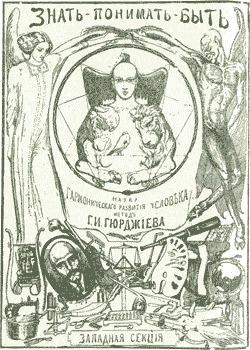
Prospectus of the Institute for the Harmonious Development of Man (Circa 1919)
The break is not immediate but gradually marked through a series of events in Constantinople, London, and Paris. Ouspensky repeatedly makes efforts to resume work with his former teacher, only to come back to the same realization of its impossibility. Once Gurdjieff establishes the Château du Prieuré in France, and following his near-fatal car accident in 1924, Ouspensky severs ties with him completely.
[OUSPENSKY] I have asked you to come because I must tell you that I have decided to break off all relations with Mr. Gurdjieff. This means that you have to choose. Either you can go and work with him, or you can work with me: but if you remain with me, you must give an undertaking [understanding] that you will not communicate in any way with Mr. Gurdjieff.vii
[OUSPENSKY] When I met Gurdjieff I began to work with him on the basis of certain principles which I could understand and accept. He said: ‘First of all you must not believe anything, and second you must not do anything you don’t understand.’ I accepted him because of that. Then after two or three years, I saw him going against these principles. He demanded from people to accept what they did not believe and to do what they did not understand. Why this happened I don’t pretend to offer any theory. v
[OUSPENSKY] Question: Has it ever crossed your mind to regret having ever met Gurdjieff?
Ouspensky: Never. Why? I got very much from him. I am always very grateful to myself that after the first evening I asked him when I could see him next time. If I had not, we would not be sitting here now.
Question: But you wrote two very brilliant books.
Ouspensky: They were only books. I wanted more. I wanted something for myself. v
To be continued…
SOURCES
- Psychological Commentaries by Maurice Nicoll
- Conversation of Ouspensky with Gerald Palmer (1946)
- Autobiographical Note
- In Search of the Miraculous by Peter Deminaovich Ouspensky
- P. D. Ouspensky Memorial Collection, Sterling Memorial Library, Yale University
- A Further Record by Peter Deminaovich Ouspensky
- Witness by John Godolphin Bennett
IN 2022/3, BEPERIOD WILL BE CREATING A FULL-LENGTH DOCUMENTARY ON GEORGE GURDJIEFF
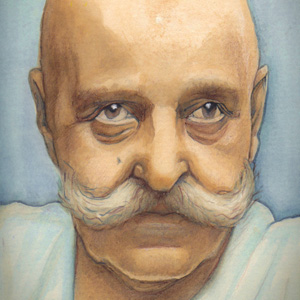
Part I:
Gurdjieff
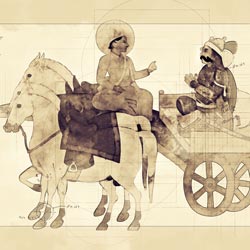
Part II:
Teaching
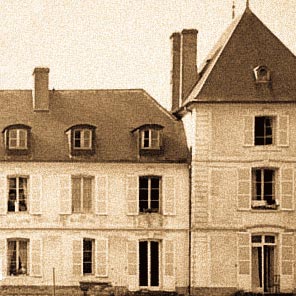
Part III:
School
Part IV:
Initiation
Part V:
Fourth Way
(ggurdjieff.com)
Rupert Spira: The one can have no boundaries

“Having nothing in itself other than itself, the one cannot have a boundary because a boundary would distinguish what it is from what it is not. If there was something that it is not, then that something would be other than the one, in which case the one would not be one.“
–Rupert Spira
Rupert Spira (born March 13, 1960) is an English spiritual teacher, philosopher and author of the Direct Path based in Oxford, UK. Wikipedia
(newsletter@rupertspira.com)
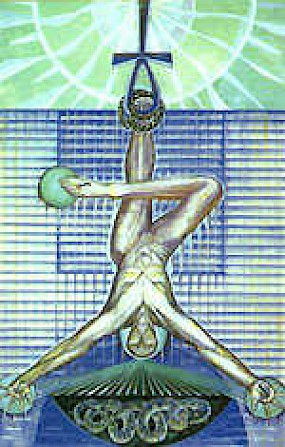
Tarot Card for October 2: The Hanged Man
The Hanged Man
The Hanged Man is numbered twelve and is depicted as a figure, usually male, hanging upside down from a tree or branch. He often has his hands behind his back, as though tied (though as you can see the Thoth interpretation moves away from this aspect of apparent helpnessness). Usually one leg is tucked behind the other to form a triangle shape. Strangely though, he tends to look quite happy and content with his situation.
Not a very popular card, the Hanged Man deals with sacrifice, delays and waiting – and also being bogged down and helplessness. We sacrifice every time we make a choice – reading this web page means you have sacrificed reading the alternatives. Since sacrifice can mean giving up one thing of value for another thing of equal or greater value, this card can easily be seen as representing the natural and normal function of disposing of something that no longer suits its purpose as well as its replacement will.
The Hanged Man is totally vulnerable, his attitude is “whatever will be, will be”. He accepts everything that happens with equanimity and courage – he is, after all, simply giving in to his destiny. He can sometimes represent the person who has waited too long, who is perhaps scared to change. We should endure with strength and inner peace, but also be courageous enough to take action when destiny calls.
(via angelpaths.com and Alan Blackman)
Can We Harvest Zero-Point Energy? with Garret Moddel
New Thinking Oct 1, 2023 Garret Moddel, PhD, is Professor Emeritus of Photonics and Quantum Engineering at the University of Colorado. For more technical information regarding Professor Moddel’s work on harvesting Zero-Point Energy, see https://journalofscientificexploratio… The Society for Scientific Exploration can be reached at https://www.scientificexploration.org/ Here he describes Zero-Point Energy (ZPE) as a consequence of Heisenberg’s Uncertainty Principle. He discusses a unique approach to harvesting this enormous resource that he has successfully tested in his laboratory. 00:00 Introduction 01:38 Zero-Point Energy 06:48 Harvesting principles 09:39 Casimir cavity 14:10 Moddel’s device 21:09 Investment potential 33:40 Arthur C. Clarke 39:11 The promise of ZPE 47:01 Arthur M. Young 48:47 Conclusion
Jack Keroac on walking on water

“Walking on water wasn’t built in a day.”
― Jack Keroac
Jean-Louis Lebris de Kérouac, known as Jack Kerouac (March 12, 1922 – October 21, 1969), was an American novelist and poet who, alongside William S. Burroughs and Allen Ginsberg, was a pioneer of the Beat Generation. Of French-Canadian ancestry, Kerouac was raised in a French-speaking home in Lowell, Massachusetts. Wikipedia
The Power of Connection
By Suzanne Deakins, H.W., M.
If you spent time with Thane in the morning, you will remember the time he spent going through newspapers. In that browsing he was not interested in what ads were selling, the interest was in what was consciousness saying. Self-observation is also about observing how you connect to the whole systems of life that are presenting themselves in our awareness.
Our tendency is to departmentalize systems and our observations. Trying to understand what is happening in our world and consciousness we separate challenges from their relationship to the whole system. Rational and critical thinking demands we look at whole systems. Translation is about taking the fragments we are dealing with and returning them to the wholeness of Truth. Connecting the parts to the whole as whole.
It is our disconnection thinking from our wholeness causes us to label actions as bad or good. Many native religions believe this disconnection from the whole is the causer of illness and evil actions. Their rites are meant to merge this disconnection to the wholeness of Truth. Translation brings us to a deeper realization of our connection to the wholeness as Truth.
When you see a piece of art, poetry, writing, music, or advertising that moves you or brings you out of a daily rut of thinking, you have witnessed a creative work that has touched the very core of wholeness, as Truth. When we fragment these things, they can appear as evil or bad. The whole is not bad or evil, but we see parts of it in this way.
The recent AT&T ads are saying these types of things. “A single moment, enabled by connectivity may be all that it takes to change a life, launch a business, or change a story. “ And another; “ The power to connect is the power to change.”
I am connected to The Prosperos not because of Thane, but because I hear the Truth, felt the Truth, and for the first time in my life I became connected to all life and knew life was beautiful, good, and Truth.
Thane, Perry Dickey, Billye, and a few other Mentors answered every email they received. They connected to everyone they could. Thane answered every email and sometimes even called. If you did not connect as a Mentor during Thane’s life, you found yourself on the red carpet.
We are the power to change, the power to reawaken. WE CAN CHANGE OUR STORY.
Love is adapting and adjusting to another person’s communication style. Connection is seeking out the interest that helps emotional engagement. Love and Connection together is taking that what’s on the surface and intending to engage at a deeper level – Joy Abdullah, Feb 15, 2021
© 2023 Suzanne Deakins