
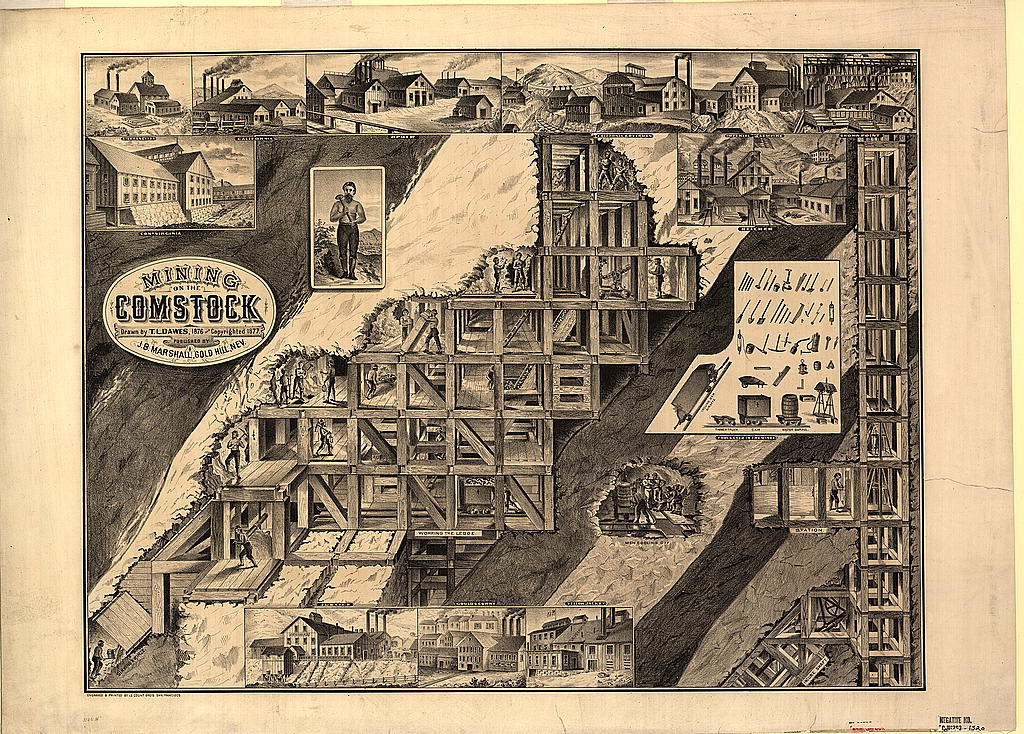
Mining on the Comstock, 1876 Art: T.L. Dawes
A.Word.A.Daywith Anu Garg
Comstock Lode
PRONUNCIATION:
MEANING:
noun: A rich supply or source, especially one that seems inexhaustible.
ETYMOLOGY:
After Henry T.P. Comstock (c. 1820-1870), a prospector whose name is attached to the rich silver-and-gold deposit discovered in 1859 near what is now Virginia City, Nevada. Earliest documented use: 1866.
NOTES:
The California Gold Rush began in 1848-49; about a decade later, Nevada had its own silver rush. In 1859, prospectors uncovered a rich silver-and-gold deposit near what became Virginia City. It drew a rush of prospectors, led to large-scale mining, and helped Nevada become known as the Silver State.
Henry Comstock was not the heroic discoverer the name might imply. He was one of the early claim holders around the site, and the lode wound up with his name. A reminder that history, like mining, sometimes rewards whoever is standing nearest the shiny thing.
The phrase Comstock Lode is sometimes shortened to the Comstock. Not to be confused with comstockery, from Anthony Comstock, a different Comstock with a different lode of censoriousness.
See also Golconda.
USAGE:
“There was only light, and light is intangible. You cannot slice off an inch of the spectrum and put it in your pocket. The people who had come to exploit this Comstock Lode of the miraculous, found themselves painfully frustrated.”
Aldous Huxley; Adonis and the Alphabet and Other Essays; Chatto & Windus; 1956.