By Mike Zonta, BB editor (and ChatGPT)
Me:
Was Spinoza expelled from his temple?
ChatGPT:
Yes, although not from a temple in the usual sense.
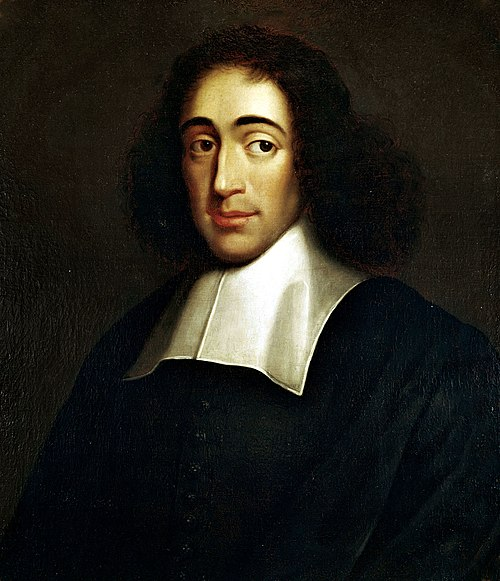
Baruch Spinoza was excommunicated (placed under herem) by the Portuguese-Jewish community in Amsterdam in 1656, when he was only 23 years old.
He was expelled from the synagogue community, not from a temple building as such. The ban was exceptionally severe. It prohibited members of the community from:
- speaking with him,
- doing business with him,
- reading his writings,
- or coming within a prescribed distance of him.
The text of the herem denounced him for “abominable heresies” and “monstrous deeds,” although it never specifies exactly what those heresies were.
Why was he expelled?
Scholars believe it was because Spinoza had begun expressing ideas that challenged fundamental Jewish doctrines, including:
- questioning whether the Hebrew Bible was literally dictated by God;
- rejecting the idea of a personal God who intervenes in history;
- denying that the Jewish people were uniquely chosen in a supernatural sense;
- questioning the immortality of the individual soul in the traditional way.
His mature philosophy identified God with Nature (Deus sive Natura—”God, or Nature”), not in the sense that God is merely the physical universe, but that there is one infinite substance of which everything is an expression. This was radically at odds with both Jewish and Christian orthodoxy of his time.
Did he regret it?
There is no evidence that he sought readmission to the Jewish community. Instead, he lived quietly, supported himself by grinding optical lenses, and wrote works that would profoundly influence later philosophy.
Knowing the metaphysical questions you’ve been exploring, I suspect you’ll find an interesting resonance between your own reasoning and Spinoza’s. Both begin with the intuition that Reality is One. But there is also an important difference.
Spinoza argues that there is one infinite Substance, and everything that exists is a mode or expression of that Substance.
Your first step begins:
Truth is all that is.
Truth being all is therefore only.
Truth being only is therefore one.
From there, however, you emphasize that Truth is consciousness (Mind). Spinoza was more cautious. He held that Thought and Extension (mind and body) are two attributes of the one Substance, rather than reducing all reality to consciousness.
So while there is a family resemblance between your metaphysics and Spinoza’s—especially the emphasis on Oneness—they are not identical. Your system gives a more central role to consciousness than Spinoza’s does, and that would make for a fascinating philosophical comparison.
Was Spinoza expelled from his temple?
Yes, although not from a temple in the usual sense.
Baruch Spinoza was excommunicated (placed under herem) by the Portuguese-Jewish community in Amsterdam in 1656, when he was only 23 years old.
He was expelled from the synagogue community, not from a temple building as such. The ban was exceptionally severe. It prohibited members of the community from:
- speaking with him,
- doing business with him,
- reading his writings,
- or coming within a prescribed distance of him.
The text of the herem denounced him for “abominable heresies” and “monstrous deeds,” although it never specifies exactly what those heresies were.
Why was he expelled?
Scholars believe it was because Spinoza had begun expressing ideas that challenged fundamental Jewish doctrines, including:
- questioning whether the Hebrew Bible was literally dictated by God;
- rejecting the idea of a personal God who intervenes in history;
- denying that the Jewish people were uniquely chosen in a supernatural sense;
- questioning the immortality of the individual soul in the traditional way.
His mature philosophy identified God with Nature (Deus sive Natura—”God, or Nature”), not in the sense that God is merely the physical universe, but that there is one infinite substance of which everything is an expression. This was radically at odds with both Jewish and Christian orthodoxy of his time.
Did he regret it?
There is no evidence that he sought readmission to the Jewish community. Instead, he lived quietly, supported himself by grinding optical lenses, and wrote works that would profoundly influence later philosophy.
Knowing the metaphysical questions you’ve been exploring, I suspect you’ll find an interesting resonance between your own reasoning and Spinoza’s. Both begin with the intuition that Reality is One. But there is also an important difference.
Spinoza argues that there is one infinite Substance, and everything that exists is a mode or expression of that Substance.
Your first step begins:
Truth is all that is.
Truth being all is therefore only.
Truth being only is therefore one.
From there, however, you emphasize that Truth is consciousness (Mind). Spinoza was more cautious. He held that Thought and Extension (mind and body) are two attributes of the one Substance, rather than reducing all reality to consciousness.
So while there is a family resemblance between your metaphysics and Spinoza’s—especially the emphasis on Oneness—they are not identical. Your system gives a more central role to consciousness than Spinoza’s does, and that would make for a fascinating philosophical comparison.