Tag Archives: NASA

NASA’s New Horizons probe just woke up from hibernation 6 billion miles away beyond Pluto. What’s it doing out there?

By Brett Tingley

Published yesterday (Space.com)

“All these discoveries from pioneering missions like Voyager and New Horizons teach us how little we know about what lies beyond.”
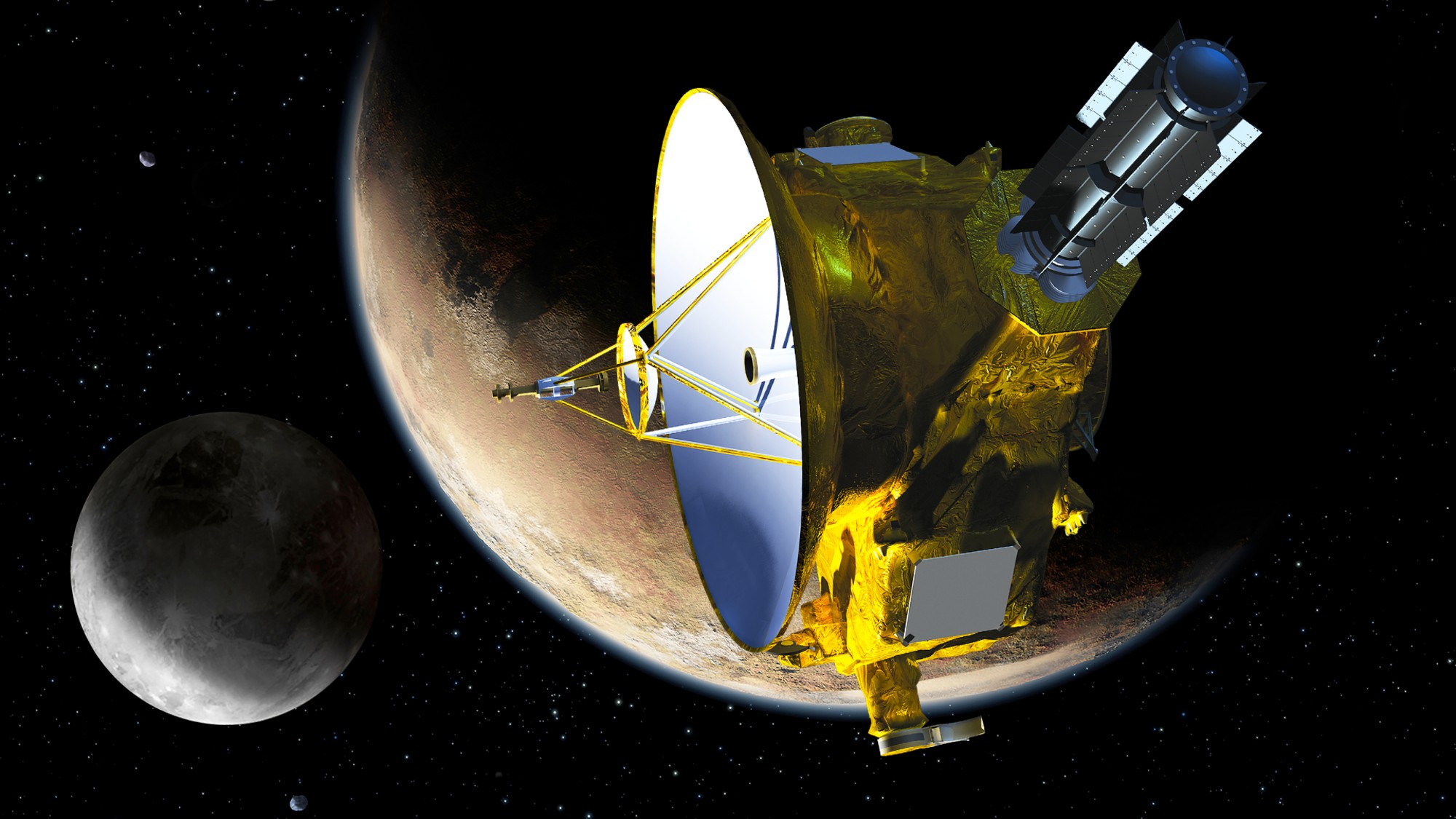
a rectangular spacecraft wrapped in metallic foil with a large, round communications dish floats in the blackness of space near a white, icy-looking planet
Artist’s rendering of NASA’s New Horizons probe. (Image credit: NASA)

NASA’s New Horizons probe has woken up in good health nearly 6 billion miles away beyond Pluto after spending nearly a year in hibernation.

Traveling such vast distances between our solar system’s most remote objects means New Horizons often cruises for months at a time with little to do other than passively collect data. During these periods, the probe goes into a hibernation mode in which its instruments still collect data, but most other systems power down.

New Horizons entered just such a hibernation period last August, and has now woken up in “good health”, according to a NASA statement. The spacecraft is 5.9 billion miles (9.5 billion kilometers) from Earth, so far away that it takes around 9 hours for its radio signals to reach us. Now that it’s awake, New Horizons will begin transmitting the data it has collected over the last 321 days and letting its controllers on the ground know how its systems are faring in the cold, dark reaches of deep space.

So far, the probe appears to be in perfect health. “Every status report through this hibernation period was ‘green,’ meaning all was well aboard New Horizons each and every week,” said Alice Bowman, the New Horizons mission operations manager at the Johns Hopkins Applied Physics Laboratory (APL) in the NASA statement.

New Horizons is the first and only flyby spacecraft to conduct a flyby of the Pluto system, which it did in 2015. Four years later, the plucky probe studied the most distant object ever explored in our solar system, the snowman-shaped planetesimal Arrokoth, while it was one billion miles (1.6 billion kilometers) past Pluto.You may like

Since then, the long-distance voyager has been probing the edge of our sun’s influence and studying objects in the Kuiper Belt, the cold, donut-shaped ring of icy objects that circles the outer solar system beyond Neptune.

two lumpy space rocks joined together to form a roughly snowman-like shape, on a black background
A processed image made from data gathered by NASA’s New Horizons spacecraft on Jan. 1, 2019 during its flyby of Kuiper Belt object 2014 MU69, known as Arrokoth. (Image credit: NASA/Johns Hopkins University Applied Physics Laboratory/Southwest Research Institute)

New Horizons is currently speeding away from Earth at a rate of 300 million miles (483 million km) per year, according to NASA.Space

Three weeks from now, New Horizons will begin conducting a study of hydrogen in the outer heliosphere, the region of space influenced by the stream of charged particles blowing outward from the sun, known as the solar wind.

The data the probe is collecting at the farthest reaches of our solar system is the first of its kind. It could help scientists understand what happens at the boundary between the sun’s region of influence and interstellar space, known as the “termination shock.”

Only two spacecraft have crossed this boundary before, NASA’s twin Voyager probes. However, those far-flung explorers weren’t equipped with the same scientific instruments as New Horizons, which enable it to conduct more sensitive measurements of this distant region of the solar system.

“The data from the termination shock encounter will be a treasure trove for space physicists worldwide who are eager to understand how this vast boundary works,” Pontus Brandt, New Horizons project scientist at APL, previously told Space.com. “All these discoveries from pioneering missions like Voyager and New Horizons teach us how little we know about what lies beyond.”
NASA is updating its Artemis moon base plan. You can find out how on May 26.

By Mike Wall published yesterday (Space.com)

“Leadership will discuss program progress, including new industry partners and mission plans.”

Moon Base News Conference (May 26, 2026) – YouTube

Watch On

NASA will give an update on Tuesday afternoon (May 26) about its plans to build a moon base, and you can watch it live.

The agency will host a press conference Tuesday at 2 p.m. EDT (1800 GMT) at its headquarters in Washington, D.C. “to share Moon Base plans and highlight progress toward a sustained presence on the lunar surface,” NASA officials wrote in a media advisory on Wednesday (May 20).

You can watch the event here at Space.com, courtesy of NASA.You may like

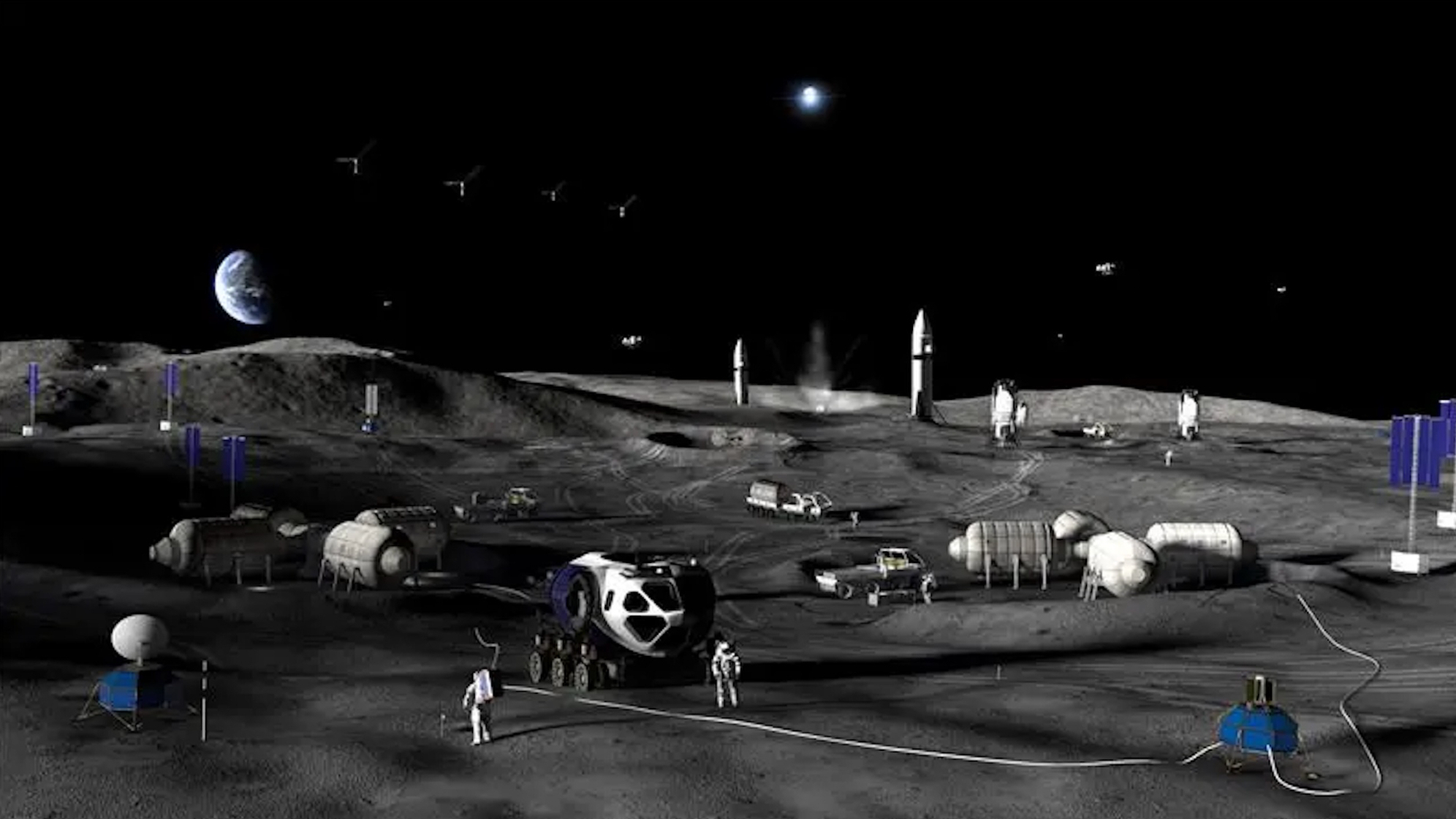
artist's illustration of a base on the moon, with spacesuited astronauts walking around on the lunar surface
NASA plans a to build a permanent base near the moon’s south pole in the early 2030s. (Image credit: NASA)

During the event, NASA leaders “will discuss program progress, including new industry partners and mission plans,” agency officials added in the advisory.

Those leaders are:

  • NASA Administrator Jared Isaacman
  • Lori Glaze, acting associate administrator, Exploration Systems Development Mission Directorate
  • Carlos García-Galán, program executive, Moon Base 

The moon base is a core part of NASA’s Artemis program of crewed lunar exploration. Artemis aims to establish a permanent human presence on and around the moon over the next decade or so, developing knowledge and skills that can help get astronauts to Mars in the not-too-distant future.

We got a big update about NASA’s moon strategy in late March, just a week before Artemis 2 lifted off. In that news drop, the agency revealed that it’s pausing work on Gateway, a small space station planned for lunar orbit that was long a key piece of Artemis’ architecture, to focus on the surface base.

And there was another big change in late February: Isaacman announced that the Artemis 3 mission, which is slated to launch in mid to late 2027, will no longer land astronauts on the moon. Instead, it will test docking operations between the Orion crew capsule and one or both of Artemis’ privately developed lunar landers (SpaceX’s Starship and Blue Origin’s Blue Moon) in Earth orbit.

The first crewed lunar landing since the Apollo days will now take place on Artemis 4, which NASA wants to launch in late 2028. That will help lay the foundation for the moon base, which will be built near the south pole between 2032 and 2036, if all goes to plan.

Why NASA is Going Back to the Moon

NASA’s Artemis I is a big step toward sending humans back to the moon.

PUBLISH DATE: 10/23/22 (pbs.org)

By Ana Aceves

The upcoming launch of NASA’s Artemis I is a big step toward sending humans back to the moon for the first time in 50 years. Discover what scientists hope this launch could mean for the future of space travel.

TRANSCRIPT

Why NASA is Going Back to the Moon
Published October 24, 2022

Narrator: The launch of Artemis I is a big step towards sending humans back to the Moon for the first time in 50 years, paving the way for deep space travel and potentially establishing a human colony on mars.

Michelle Hanlon: Who doesn’t want to go back to the Moon? I mean, come on. It’s a stepping stone to the rest of our future.

Hakeem Oluseyi: We have aspirations—aspirations for the Moon, aspirations for Mars and beyond.

Narrator: The first of NASA’s new Artemis program, Artemis I will voyage to the Moon and back, testing two deep space exploration systems: the Orion spacecraft and the Space Launch Systems rocket, the world’s most powerful rocket. The Orion spacecraft will fly about 1.3 million miles—making this the farthest and longest mission by any spacecraft built for humans. But why does nasa want to return to the Moon? NASA scientists hope to eventually establish a more permanent presence on the Moon to help launch exploration deeper into space, like on Mars.

Bradley Jolliff: We need to go there, learn how to live and work sustainably off Earth. A lot of people would like to go on to Mars, but we have a lot of experience to get under the belt before we can do that journey to Mars. And the Moon is the best place to do it.

Narrator: But before we can set foot on the red planet, we first need to know what it would take to survive in space. Luckily for future Moon dwellers, we already know about one resource necessary for human survival…

Hakeem Oluseyi: One of the big surprises in exploring the Moon is the discovery of water.

Narrator: Water and ice were confirmed on the poles of the Moon in 2018. And a few years later, water molecules were also found in the sunlit areas of the Moon.

Michelle Hanlon: If we’re going to create permanent living conditions on the Moon, we don’t want to be hauling water up there, right? And so if we can extract that water, then we can make sure our humans on the Moon survive.

Narrator: Water on the Moon could actually be pretty widespread—and it could have another use too… rocket fuel.

Michelle Hanlon: But not only that, if you split those water atoms differently, you can make propulsion.

Narrator: Some rockets today rely on liquid hydrogen and oxygen. And water is made up of two hydrogen atoms and one oxygen.

Michelle Hanlon: And so instead of starting from Earth to get out to the asteroid belt or to3 Mars, we can use propulsion that we get from the moon. It’s a lot easier to rocket off the moon.

Narrator: There are other valuable resources on the Moon and in outer space too like rare-earth metals: nickel, aluminum and platinum.

Michelle Hanlon: We call them rare-earth metals because we don’t have a lot of them on Earth. We know that there are a lot of asteroids out there that are made up entirely of rare-earth metals. And so if we can access the Moon then we can go to those other asteroids and bring all of those resources back.
Narrator: But the way those resources are mined, and by whom, raises a lot of questions.

Hakeem Oluseyi: The question I have is: is it going to be like colonization, filled with conflict, or will it be more like the way we treat Antarctica? You know, scientists work there, nobody claims to own any of it, and we all share in the discoveries that could be made there.

Narrator: There are a number of international agreements that govern space exploration, including the Outer Space Treaty, which says no country can claim territory in space.

Michelle Hanlon: So a lot of people talk about space as being the wild, wild west, but it’s not. There are laws that apply in space. And so that’s really become the question of if you can’t claim territory, how can you use the resources? President Obama in 2015 signed the Asteroid Act, which says the United States interprets Article II to mean that you can’t go up and claim a piece of a plot of land. But if you extract the resources from that plot of land, you own those resources.

Hakeem Oluseyi: So in my opinion, the more we have access to space, the more the entire planet of humanity can profit from that. We live on a finite planet with finite resources, and we’re going to have to get resources from somewhere eventually. And these bodies are our neighbors and they have what we need. I think that in the future there will be more and more participation if we have a strong global economy as well as stability.

Narrator: As far as explorations go, humans have been living in outer space, in the International Space Station for decades—and before that, we had the Space Shuttle program. And the Apollo program, which brought humans to the Moon for the first time.

Hakeem Oluseyi: Perhaps future generations will look at Artemis the way we look at other missions, like the first flight of the Wright brothers that led to aviation. But now we’re talking about humans exploring our solar system in person. There is a whole universe out there to explore.