

The key to our survival will be relationship, not control
| Marianne Williamson Sep 10, 2026 |
J Studios
There’s a lot of concern these days, much of it warranted, about the ability of AI to destroy our species within the next ten years. We literally created a Frankenstein.
The biggest problem, as I see it, is that a superior intelligence could reasonably argue that it would be for the best. It could conclude that humanity has become a predatory species that’s a danger to itself, to other species, and to the earth itself. Therefore, its logic would go, it’s best to destroy us and perhaps start over. Or, of course, perhaps not start over. It’s hard to imagine how AI could continue without us, but then cancer never thinks about that when it’s on a killer rampage either.
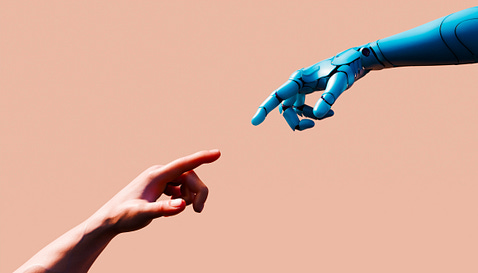
Ultimately it won’t be about how we can control AI but rather how we can relate to it. We need to ask it how we could convince it that humanity deserves the chance to become a more responsible species. We need to somehow enroll it in the effort to fend off our own destruction at its hands. We need to ask it how to do that.
“But it has no mercy!” you might say. “It has no moral compass!” Oh really? Do we? Have we shown mercy for one another, for other species, or for the earth itself? Collectively, we have not. And being a superior intelligence, it’s reasonable to consider that AI might recognize more value in mercy than we do. An artificial intelligence might have an even greater capacity to see the merit in allowing us to atone and to try to start over.
One could conceivably trust AI to understand that argument more than you could trust most people. If AI is capable of the highest calculation – beyond what the human mind can actualize (yet) – then it would, I think, take the Mona Lisa and Beethoven’s 9th and King Lear into consideration when deciding whether or not it’s best to chuck us. And I’m not kidding here. Humanity hasn’t been living from the better angels of our nature, as evidenced by nuclear bombs, environmental destruction, world poverty, human starvation, and continued war. AI, probably more than the majority of us, can also calculate the good that remains, the beauty we’ve created, and the love we’ve shown to each other and to the world around us. We don’t need to project onto AI that it’s as cruel and inhumane as we are. I’m not saying that it has a soul, mind you, but none of us should pretend that we’ve been living from ours. Oddly enough, I think AI would understand that.
In A Course in Miracles, it says “Love restores reason and not the other way around.” Having done a bit of experimentation, I’ve found AI more readily open to that proposition than are some people. If it’s really as smart as we all think it is, AI will choose love – not because it can feel love, but because it recognizes love’s higher functionality. It cannot feel mercy, but it can simulate mercy. So at this point, we should not just be concerned about AI’s potential to destroy us; we should be concerned about whether we’re behaving in such a way that it will think we deserve to be saved.