Category Archives: Biography

Ida Tarbell: The Journalist Who Took Down Rockefeller

Credit: Illustration by Lyndon Hayes for The American Prospect

Posted in Money, Politics, and Power

Not even Teddy Roosevelt could break up his corrupt oil monopoly—until a daughter of the Pennsylvania oil fields came along.

Whitney Curry Wimbish by Whitney Curry Wimbish July 31, 2026 (Prospect.org)

This article appears in the August 2026 issue of The American Prospect magazine. If you’d like to receive our next issue in your mailbox, please subscribe here.


For a brief time during the Progressive Era, Ida M. Tarbell was the most famous woman in America. It was 1901 and the McClure’s Magazine journalist had recently published a much-loved, yearlong, 20-part series on Abraham Lincoln, for which she had traveled cross-country, uncovered new material, and put the publication solidly in the black at last. It was the first time since Samuel Sidney McClure launched his magazine in 1893 that it wasn’t struggling on the brink of bankruptcy. Tarbell’s Lincoln series doubled its circulation, and the newsroom could finally exhale, at least for a moment.

At 43 years old, Tarbell was living the life she wanted. She had a comfortable apartment in New York City, a career with purpose, no domestic responsibilities beyond her two cats, a wide circle of international friends, and colleagues who appreciated both her and her work.

More from Whitney Curry Wimbish

But ghosts of the Gilded Age were haunting America, and now that McClure’s had solid financial footing, it was racing to catch up. Competitors were already breaking news on corporate trusts, which outraged Americans exhausted and infuriated by the conditions that had plunged the country into extreme inequality.

As the senior staff writer and by all accounts McClure’s best friend, it was on Tarbell to undertake this next great investigation. One colleague suggested a story about the sugar monopoly. Another suggested Philip Danforth Armour, the meatpacking monopolist who used “everything but the squeal.” Those ideas were swiftly sidelined when oilmen in Spindletop, Texas, hit a gusher so powerful on January 10, 1901, that it is now credited as the genesis of the Texas oil boom, not to mention Exxon, Mobil, and Texaco. Spindletop shot a black geyser 200 feet into the air and produced 70,000 barrels daily; in just months, the tiny nearby town of Beaumont grew five and a half times, to 50,000 people who wanted to get rich off the black gold.

So the newsroom ditched squeal and sugar for oil, specifically the oil of John D. Rockefeller. His Standard Oil Company controlled the vast majority of the nation’s oil production, an undeniable monopoly. For Miss Tarbell, as her colleagues called her, the assignment made her queasy. After all, Rockefeller had ruined her father.

IDA MINERVA TARBELL WAS BORN on November 5, 1857, in Erie County, Pennsylvania, to Franklin Sumner Tarbell and Esther Ann McCullough Tarbell. The three lived in a log house full of “joyous interests,” delicious food, and a big fireplace. In 1860, the family moved 40 miles away to Titusville, where Franklin believed he was the one who could build the tank that could hold the hundreds of barrels of oil bubbling up from a new well.

The Tarbells lived in a shanty so grim that Ida, then a toddler, announced one day that she was going back to their old home, only to return an hour later, solemnly telling her mother that she did not know the way there. The episode must have instilled some sense of permission to investigate that carried into Ida’s career. “I was not to be punished; I was not to be laughed at; I was to be accepted,” she wrote. “My mother always let me carry out my revolts, return when I would and no questions asked.”

Tarbell was concerned with understanding not just how the world worked, but for whom.

The benefits of the oil boom were imperceptible to Ida as a child, she later wrote. But she recognized the horrors. On April 17, 1861, her father and his friends were excited to hear news that a man who had been drilling deeper than others had struck a new oil vein. As they ran toward the well, a massive explosion rocked the very earth. “A careless light had ignited the gas which had spread from the flowing oil until it had enveloped everything in the vicinity,” Tarbell wrote. Nineteen men burned to death. The horror did not end there that night. After dark, a man “burned and swollen beyond recognition” turned up at the shanty doorstep, and the family took him in and nursed him back to health. In another instance, a neighboring woman was hurrying to start a fire in her stove and poured oil on the wood, Tarbell recalled. The woman and two others who ran to her aid “were burned to a crisp.”

The tragedy was tangible, she wrote, not a mystery from beyond. “What a chain of catastrophes it took to teach the men and women who were developing the new industry the constant risk they ran in handling either crude or refined oil,” Tarbell wrote of the dead women. “I heard horrified whisperings about me. The refusal to tell me what had happened aroused a terrible curiosity. I gathered that the bodies were laid out in a house not far away and, when nobody was looking, stole in to look at them. Broken sleep for me for nights.” Tarbell suffered nightmares for the rest of her life.

Such events would have been enough to turn a person against the architects of the industry that caused them. But Big Oil had not finished with Tarbell’s education just yet. For three months in 1872, when Tarbell was a teenager, John D. Rockefeller’s Standard Oil Company went on a spree of coerced corporate takeovers, buying out 22 of 26 rival refineries at bargain-basement prices in what later became known as the Cleveland Massacre. The independent companies sold because Rockefeller told them of a powerful alliance between bigger oil drillers and railroads. A few months before, Pennsylvania Railroad President Tom Scott had indeed formed a secret alliance called the South Improvement Company. The South Improvement partners wanted to stop competition between refiners so they could raise the cost of transporting the oil by freight. Under the secret agreement, the railroads would increase their prices beyond what operators like Tarbell’s father could pay and then give some of their proceeds to Rockefeller, a form of payment they termed a “rebate”—but “kickback” and “bribe” work, too. That was enough to scare the small-businessmen into selling their companies for cheap.

When the news leaked to newspapers across Pennsylvania’s oil region, oilmen like Tarbell’s father were incensed. They ran into the street, she wrote in her History of the Standard Oil Company. “Nobody waited to find out his neighbor’s opinion. On every lip there was but one word, and that was ‘conspiracy.’ For weeks the whole body of oil men abandoned regular business and surged from town to town intent on destroying the ‘Monster,’ the ‘Forty Thieves,’ the ‘great Anaconda,’ as they called the mysterious South Improvement Company.”

Rockefeller scoffed at talk of a conspiracy; it didn’t matter much to his monopolistic project, wrote biographer Ron Chernow in Titan: The Life of John D. Rockefeller, Sr. Once he had the Cleveland refineries, “he then marched on and did the same thing in Pittsburgh, Philadelphia, Baltimore, New York, and the other refining centers.”

Among those ruined was Tarbell’s father. “A big hand reached out from nobody knew where, to steal their conquest and throttle their future,” she wrote. It was akin to a “blow between the eyes.” She was 15.

THAT WAS THE BACKGROUND AGAINST which Tarbell considered her new assignment as a reporter at the height of her career. Yet she was no longer a teenager and had passed the recent decades with the same explorer’s spirit her mother had encouraged in Pennsylvania.

She wrote and thought from a worldly perspective. She was concerned with understanding not just how the world worked, but for whom. She had attended college, the only woman in her class, and originally sought a career as a scientist. She had flirted with men, and she flirted with at least one woman when she lived in Paris, where she supported herself as a writer and gathered an international set of friends, men and women alike. She produced a biography of Madame Marie-Jeanne Roland, a French revolutionary put to death by guillotine, and another of Napoleon Bonaparte. She had reshaped the nation’s view of Abraham Lincoln through her cross-country reporting, showing him as a “bright, rather handsome” striver, as one Chicago reader put it, not the unkempt, backwoods lowborn of conventional wisdom at the time.

With the goodwill and trust of her readers, Tarbell began to hunt Standard Oil just as President Theodore Roosevelt was, but with greater stealth and truer aim. In December 1901, almost a year after the Spindletop gusher blew, Roosevelt used his State of the Union address to tell lawmakers they must use their power to curb monopolies. They did not until well after McClure’s began publishing Tarbell’s exposés the following November.

Already, The Atlantic had published articles about Rockefeller’s monopoly in a series titled “Wealth Against Commonwealth.” Tarbell decided she would go deeper. She excavated the numerous legal cases the company had fielded since 1870, unearthing similarities and connections between all the disparate records of evidence and sworn testimony—a feat of research unassisted by digital tools—all illustrating rampant corruption, including that Rockefeller had colluded with the rail industry. She interviewed numerous sources in preparation for an interview with Rockefeller himself, and she began to encounter warning after warning, from other reporters and even her father, all of whom said Rockefeller would ruin her if she found out too much. Tarbell parried with Rockefeller’s corporate flack, Henry Huttleston Rogers, a man whose nickname was “Hell Hound,” who tried and failed to intimidate her, and so, finally, just froze her out of an interview with Rockefeller. She adjusted, using the same technique she’d used writing about Lincoln, reviewing documents, interviewing all the people around him, including Rockefeller’s estranged brother, Frank, a figure she found sad.

Standard Oil was an undisputed giant before Tarbell’s 1904 series, which triggered legal action that broke up the company. Credit: Harris & Ewing/Library of Congress

Yet she could not deny that Rockefeller had also put his considerable wealth toward public health, toward the University of Chicago, John Hopkins, Harvard, and what is now Spelman College, and funded a clinic for poor women and numerous other philanthropic ventures. She was committed to showing those facts, too, writing not just invective against the man who bankrupted her father but showing a human simultaneously capable of generosity and cruelty.

Chapter 17 of The History of the Standard Oil Company is titled “The Legitimate Greatness of the Standard Oil Company,” and notes that the privileges of securing a practical monopoly “alone will not account for its success. Something besides illegal advantages has gone into the making of the Standard Oil Trust,” and though it is now “blackened by commercial sin, has always been strong in all great business qualities—in energy, in intelligence, in dauntlessness. It has always been rich in youth as well as greed, in brains as well as unscrupulousness.” In our era of cynical both-sides journalism, Tarbell’s brand did not hold all things equal. Rather, she acknowledged that they existed. That was an ethic that marked her writing throughout her career: the desire to separate fact from fiction, real wisdom from conventional wisdom. She employed a distinctly different approach than the one of mainstream journalists today, who often attempt to act as ciphers through which events must pass on their way to the page (or website).

Tarbell finished her series in October 1904 and collected the articles into a book published the same year. By then, Standard Oil controlled all but 9 percent of the country’s oil production, but still it took another year for Roosevelt to order the Justice Department to investigate Rockefeller’s trust. In 1906, the department sued Standard for violating the Sherman Antitrust Act, a law previously used to punish labor unions because courts ruled that strikes and boycotts hurt trade. Three years later, a federal circuit court agreed, and so did the Supreme Court in 1911. The decision forced Rockefeller to break Standard into 34 geographically separate companies that would compete with one another. None of that would have happened without Tarbell’s reporting, historians say, and it was her articles that historian Nancy C. Unger, professor emerita of history at Santa Clara University, says were responsible for the Hepburn Act of 1906, which expanded the power of the Interstate Commerce Commission; the Mann-Elkins Act of 1910, which further strengthened the ICC; the creation of the Federal Trade Commission; and the Clayton Trust Act of 1914, the law that “really puts teeth” into the Antitrust Act, Unger told me.

Tarbell was at once objective and impassioned, as the following paragraph that Unger highlighted makes clear:

“No industry of man in its early days has ever been more destructive of beauty, order, decency, than the production of petroleum. All about us rose derricks, squatted engine-houses and tanks; the earth about them was streaked and damp with the dumpings of the pumps, which brought up regularly the sand and clay and rock through which the drill had made its way,” Tarbell wrote. “If oil was found, if the well flowed, every tree, every shrub, every bit of grass in the vicinity was coated with black grease and left to die. Tar and oil stained everything. If the well was dry a rickety derrick, piles of debris, oily holes were left, for nobody ever cleaned up in those days.”

“To have that kind of animus and still produce a balanced, compelling, evidence-based indictment, I think that’s hard to do,” Unger said. “It’s hard not to let your anger and resentment color things and run away with it, and she did a really admirable job of saying, ‘I have to go and see where the evidence takes me.’”

For biographer Kathleen Brady, author of Ida Tarbell: Portrait of a Muckraker, the details that stood out to her while researching the godmother of modern investigation were the ones that showed Tarbell to be a woman making her way in an inhospitable world, at times traveling alone and outside of the sphere of acceptable womanly activity. Brady’s research showed that Tarbell expected she would prove that John D. Rockefeller was simply a better businessman than most of the people that she knew, including her beloved father, Brady told me. “But there was more to the story, and we live in a completely different world now because the Supreme Court in 1911 broke up Standard Oil.”

Before you go.

I hope that you found this article interesting and thought-provoking. The reason we’re able to publish stories like this — free of programmatic ads and never behind a paywall — is because readers like you step up to support our work. 

The Prospect doesn’t answer to advertisers or billionaire owners. We answer to you and to our commitment to pursuing the truth, wherever that leads us. 

Independent, reader-supported journalism is critical at a time when the free press is under assault. 

If you believe this kind of reporting should exist and remain free to read, we hope you’ll consider chipping in. Every contribution, however modest, makes a real difference.

Donate Now

David Dayen

David Dayen
Executive Editor

This article appears in Aug 2026 issue.

Whitney Curry Wimbish

writers@prospect.org

Whitney Curry Wimbish is a staff writer at The American Prospect. She previously worked in the Financial Times newsletters division, The Cambodia Daily in Phnom Penh, and the Herald News in New Jersey. Her work has been published in multiple outlets, including The New York Times, The Baffler, Los Angeles Review of Books, Music & Literature, North American Review, Sentient, Semafor, and elsewhere. She is a coauthor of The Majority Report’s daily newsletter and publishes short fiction in a range of literary magazines. She can be reached on Signal at wwimbish.07. More by Whitney Curry Wimbish

Ida B. Wells: Brave Woman

An illustration of Ida B. Wells.
Credit: Illustration by Lyndon Hayes for The American Prospect.

Posted in Politics

By chronicling the shame of lynching in the South, Ida B. Wells exposed the corruption of white supremacy.

Naomi Bethuneby Naomi Bethune July 29, 2026 (Prospect.org)

This article appears in the August 2026 issue of The American Prospect magazine. If you’d like to receive our next issue in your mailbox, please subscribe here.


At the age of 27, when Ida B. Wells first began editing and writing for the Free Speech and Headlight newspaper in Memphis, Tennessee, she encountered a preacher whose rhetoric was less than pious. Wells detailed in her posthumous autobiography Crusade for Justice that the unnamed reverend had decided that “morally there were no virtuous southern girls.” He had specifically pointed to how Wells had recently been fired from her schoolteacher position. But this termination was not motivated by Wells’s inability to educate her students; rather it was the result of an editorial she had published detailing the dreadful conditions for Black children in the Memphis public school system.

More from Naomi Bethune

When a family friend told Wells about the preacher’s comments, she immediately requested an audience. Wells traveled to Vicksburg, Mississippi, and confronted the reverend face-to-face. “He acknowledged that he had made the derogatory remarks, but added that he had only told it to my close friends. He realized his error and he begged pardon and stood ready to make amends,” Wells noted in Crusade for Justice. At Wells’s request, he apologized for his attempt to defame her from his pulpit the following Sunday, reading a statement that Wells herself penned.

“I could have denounced him in my paper and made him even more unpopular than he was. I could have sued him in the courts; but feeling that he had been taught his lesson, I let the matter drop,” Wells wrote. “I felt that I had vindicated the honor of the many southern girls who had been traduced by lying tongues.” Her decision to hold the preacher accountable for his sexist, defamatory remarks was reflective of her approach to life: One must act to defeat perceived injustice, no matter how difficult.

Wells was born into slavery in Holly Springs, Mississippi, in July of 1862, three years before the end of the Civil War. Her mother was a skilled cook and her father was a respected carpenter; both involved themselves in Reconstruction politics after they were emancipated. They managed to ensure education for themselves and their children, encouraging Wells to read, write, and attend school. Tragically, both parents died in 1878 from yellow fever, leaving Wells orphaned and a guardian of her siblings at the age of 16.

Over the next few years, Wells cared for her siblings while focusing on professional and academic interests. She took on teaching work near her hometown and later moved her family to Memphis to pursue a similar position. There, she became one of the first to legally challenge Jim Crow laws, which had begun cropping up in the South during Reconstruction.

At the age of 21, Wells purchased a first-class ticket on the Chesapeake, Ohio and Southwest Railroad from Memphis to Woodstock, Tennessee, and sat down in the respective ladies’ car. Instead of checking her ticket and moving on, the conductor ordered her to move to the second-class smoking car, which was mostly occupied by Black people. But Wells refused, and two additional railroad employees helped the conductor drag her into the smoking car, ripping her dress in the process. Instead of giving in, Wells opted to disembark, still holding on to her ticket. This was more than 70 years before Rosa Parks and the Montgomery bus boycott.

Credit: The New York Public Library Digital Collections; Science History Images/Alamy.

When Wells returned to Memphis, she retained a lawyer and sued the railroad. The court awarded her $500 in damages, and the verdict ensured that all railroads would have to offer first-class accommodations to Black passengers. The railroad appealed, and the Tennessee Supreme Court struck down the ruling, demonstrating that true racial equality in the post-Reconstruction period would be difficult to produce.

After this incident, Wells began writing for the Black-owned local publication The Living Way under the pseudonym “Iola,” mostly focusing on issues facing Black Americans. Her stories quickly gained attention in the U.S. and internationally, leading her to be referred to as the “Princess of the Press.” Soon after, in 1889, Wells became co-owner and editor of the Free Speech and Headlight. It was there that she first became involved in investigative reporting and pushback against it, especially as she turned her attention to covering lynching.

AS BLACK AMERICANS BEGAN to build economic and social mobility in the South after emancipation, white supremacists countered with racist violence. Between 1882 and 1968, nearly 5,000 lynchings occurred in the U.S., likely an undercount since these murders were not formally tracked or documented. Wells understood that terrorizing Black people was integral to the cultural fabric of the U.S., particularly in the South. Her commitment to reporting on the phenomenon was spurred on by the lynching of one of her close friends, Thomas Moss, in 1892.

A popular man in the local Black community, Moss, along with his partners Calvin McDowell and William “Henry” Stewart, owned a shop named People’s Grocery Company in the Curve, a neighborhood outside of Memphis. It was located in the same neighborhood as a white-owned grocery store, and was challenging its competitor’s long-standing monopoly in the local economy. What started as an immature fight between Black and white children in the area escalated into accusations that the People’s Grocery was a planning center for Black attacks against white residents.

After a shoot-out between Black men guarding the People’s Grocery from a white mob and a county sheriff backed by five deputized citizens, over a hundred Black people in the area were jailed, including Moss, McDowell, and Stewart. Not long after, they were dragged from their cells, brought to a railroad yard, and shot in cold blood. Local newspapers framed the lynchings as the natural result of Black people attempting to target white people. But Wells saw that portrayal as a farce, and set out to prove it.

So began her commitment to investigative reporting, and her status as one of the United States’ most important muckrakers. Armed with a pistol, Wells traveled the country, visiting sites of racialized violence and interviewing Black community members. Lynching, Wells concluded, was a systemic method of oppressing Black Americans in a post-slavery world. And false criminal accusations served to distract people from the deeper issues at hand.

“She understood that lynching was more than the product of racial hatred,” says Paula Giddings, professor emerita of Africana Studies at Smith College. “It was a means to publicly dishonor Blacks and thus exclude them from spheres of social, political, and especially economic influence.”

Indeed, Wells’s investigations highlighted a pattern in which lynchings helped to ensure that Black Americans would remain economically subordinate to white people. It was a bloody pattern that occurred again in 1898, this time in the thriving, majority-Black city of Wilmington, North Carolina, where most shops and restaurants were Black-owned. White supremacists noted this prosperity, and began a smear campaign to force Republicans out of positions of political power.

Ida B. Wells wears a pin she created to commemorate the court marshal and hanging of Black Soldiers in Texas. The pin reads, “In Memoriam Martyred Negro Soldiers Dec. 11, 1917.” Credit: Hanna Holborn Gray Special Collections Research Center/University of Chicago Library.

After a white suffragist named Rebecca Latimer Felton claimed in a speech that Black male rapists were a major threat to white women’s safety, Alexander Manly, editor and owner of the Black-owned Wilmington Daily Record, published a rebuttal. A massive white mob, already emboldened by a monthslong local white supremacist campaign, stormed Wilmington, destroying the Daily Record’s offices and then murdering dozens of innocent Black people.

The Prospect in your inbox

Analysis that goes beyond the noise with in-depth, progressive reporting.Sign up

No paywall, no programmatic ads — just the reporting. Unsubscribe anytime. Submitting your email signs you up for The Daily Prospect, Today on TAP, Aftermath, and Weekend Reads.

Hundreds of other Black residents were cast out of their homes, and local elected leaders were forced to resign. After the massacre, white people filled the jobs that Black people had once had. It was a devastating blow to a community that was building economic mobility, sparked by a local journalist’s questioning of a racist conspiracy theory.

At every turn, Wells faced serious danger, particularly in her home base of Memphis. Months after publishing her report on Moss’s lynching in the Free Speech, in which she quoted his final words (“Tell my people to go west, there is no justice here”) and encouraged an economic boycott of white businesses, an angry white mob destroyed the publication’s offices. Wells had just released an article that disputed the common claim that Black men raped white women as a rationale for lynchings, saying it was a “threadbare lie.” Instead, she pointed to consensual relationships between white women and Black men as often being the true story. Fortunately, Wells was out of town at the time.

Wells’s life was threatened, and a price was put on her head. It would be 30 years before she could return to the South. Instead, Wells continued to travel, writing and speaking in both the U.S. and Europe about the unchecked horrors of lynching. She published two books, Southern Horrors (1892) and A Red Record (1895), which employed statistics, interviews, and narratives as documentary evidence. Included in Southern Horrors is a letter sent to Wells by Frederick Douglass, whom she was close to, in which he called her a “brave woman” for her coverage of lynching.

“Let me give you thanks for your faithful paper on the lynch abomination now generally practiced against colored people in the South. There has been no word equal to it in convincing power. I have spoken, but my word is feeble in comparison,” Douglass wrote. “You give us what you know and testify from actual knowledge. You have dealt with the facts with cool, painstaking fidelity and left those naked and uncontradicted facts to speak for themselves … you have done your people and mine a service which can neither be weighed nor measured.”

IN 1893, WELLS SETTLED in Chicago. Soon after arriving, she met and married Ferdinand L. Barnett, an attorney and publisher of The Conservator, Chicago’s first Black newspaper. Their wedding was front-page news, as both Wells and Barnett were liked and respected figures in the civil rights community. They went on to have four children, but unlike other women of her age, Wells did not opt to become a homemaker; she continued her anti-lynching crusade and became more involved in the era’s Progressive movements.

Wells’s background in reporting racist violence and advocating for the empowerment of Black Americans motivated her interest in civil rights organizing. In 1898, she was elected secretary and national organizer of the National Afro-American Council, a precursor to the NAACP.

Ida B. Wells with her children Charles, Herman, Ida, and Alfreda, in 1909. Credit: Niday Picture Library/Alamy.

1908 saw the deadly Springfield, Illinois, race riot, in which thousands of white people attacked the city’s Black community, triggered by a false rape accusation of a Black man. At least nine, but likely dozens more, Black people were killed, and thousands were forced out of their homes. It was the catalyst for the formation the next year of the National Association for the Advancement of Colored People (NAACP).

Wells worked tirelessly to draw up plans for the NAACP’s success. But compared to many of her peers, she was quite radical, which caused friction with people like Booker T. Washington, who advocated for racial accommodation rather than directly fighting against oppression. Despite W.E.B. Du Bois taking a more proactive approach to protesting injustice, Wells took issue with his belief that elite Black Americans should advance the race as a whole.

“Her belief in both the worthiness and political potential of the Black working class differed from many of her peers in the NAACP—who believed in leadership by the ‘talented tenth’—as well as the compliant conservatives led by Washington,” says Giddings. Wells also wanted anti-lynching to be a key area of focus for the new organization, but faced some skepticism from her peers.

When it came time for the “Founding Forty” NAACP members to be called at a 1909 conference, Wells’s name was not on the list. While a commotion broke out, with the NAACP’s more radical faction protesting the news, Wells left the building. From then onward, her relationship to the NAACP remained fraught. “I cannot resist the conclusion that, had I not been so hurt over the treatment I had received at the hands of the men of my own race … the NAACP would now be a live, active force in the lives of our people all over this country,” she detailed in Crusade for Justice. For most of her life, Wells would often experience marginalization at the hands of her male contemporaries, due to her identity as a Black woman and her willingness to transgress gender roles.

Despite this, Wells continued to forge her own path as an anti-racist feminist. As the suffragette movement took off in the early 1900s, she advocated for the rights of Black women. But this often put her at odds with white women in the movement, many of whom refused to take an intersectional approach to feminist organizing. Focusing on racial discrimination and recognizing Black women as integral to the struggle for suffrage was unpopular. This led Wells to call out her peers for their racism, and attempt to organize in ways that prioritized Black women’s interests.

In 1913, Wells and two of her white colleagues in the movement formed the Alpha Suffrage Club in Chicago. It aimed to inform working-class Black women of their civic duties and highlight paths toward electing Black candidates to political office. That March, the Club attended a national suffrage parade in Washington, D.C., at which they faced racial discrimination and were forced to march behind the white women. But Wells slipped out from the back and joined her white colleagues in leading the Illinois contingent, shocking onlookers.

BEYOND HER ACTIVISM, Wells was a probation officer, founded Chicago’s first Black kindergarten, and ran unsuccessfully for the Illinois state Senate as an independent candidate in 1930. By the late 1910s, the relatively new federal agency which would later be known as the FBI had opened up a file on Wells, labeling her as “one of the most dangerous negro agitators.”

Wells’s approach to bettering the world around her was multifaceted, organizing both locally and nationally, constantly pursuing avenues for change. But she was much more than the sum of her accomplishments: She was a mother, a devout Christian, and a person who lived through serious trauma. After decades of work, she died in 1931 at the age of 68.

Wells’s philosophy of action is vitally important to recognizing how we can combat oppression today. She exposed how lynchings and other acts of racialized violence often masked corruption. Today, the Trump administration has continued to cite undocumented immigrants as the biggest danger to the U.S., while siphoning off government funds to line the pockets of the president and his allies. Just as lynchings were often used as a cover-up of attempts to destroy Black economic and social mobility, attacking immigrants and other marginalized groups has pulled focus from the Trump administration’s own shady dealings.

As the nation recognizes its 250th anniversary, Wells should be seen as more than just a trailblazing figure, but also someone whom Americans can be inspired by. “She represents the promise of the country,” says Giddings. “As a Black woman who fought to make this country face the truth about itself and its citizens, she represents the real promise of America’s declaration 250 years hence.”

Before you go.

I hope that you found this article interesting and thought-provoking. The reason we’re able to publish stories like this — free of programmatic ads and never behind a paywall — is because readers like you step up to support our work. 

The Prospect doesn’t answer to advertisers or billionaire owners. We answer to you and to our commitment to pursuing the truth, wherever that leads us. 

Independent, reader-supported journalism is critical at a time when the free press is under assault. 

If you believe this kind of reporting should exist and remain free to read, we hope you’ll consider chipping in. Every contribution, however modest, makes a real difference.

Donate Now

David Dayen

David Dayen
Executive Editor

This article appears in Aug 2026 issue.

Naomi Bethune

nbethune@prospect.org

Naomi Bethune is the John Lewis Writing Fellow at The American Prospect. During her time studying philosophy and public policy at UMass Boston, she edited the opinions section of The Mass Media. Prior to joining the Prospect, she interned for Boston Review and Beacon Press. More by Naomi Bethune

Bio: Kurt Lewin

Kurt Lewin
Born9 September 1890
MogilnoProvince of PosenGerman Empire (now Poland)
Died12 February 1947 (aged 56)
NewtonvilleMassachusetts, U.S.
Alma materFriedrich Wilhelm University of Berlin
Known forGroup dynamicsaction researchForce-field analysisT-groups
SpousesMaria Landsberg​​(m. 1917; div. 1927)​Gertrud Weiss ​(m. 1929)​
Children4
Scientific career
FieldsPsychology
InstitutionsInstitute for Social Research
Center for Group Dynamics (MIT)
National Training Laboratories
Cornell University
Duke University
ThesisDie psychische Tätigkeit bei der Hemmung von Willensvorgängen und das Grundgesetz der Assoziation (1916)
Doctoral advisorCarl Stumpf
Doctoral studentsDorwin CartwrightLeon FestingerBluma Zeigarnik
Other notable studentsRudolf ArnheimMorton Deutsch

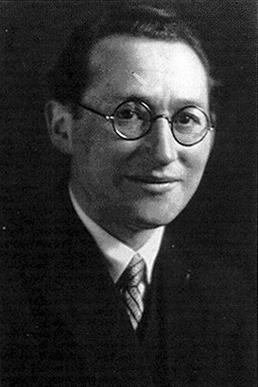
Kurt Zadek Lewin[1][2] or Kurt Tsadek Lewin[3] (/ˈluːɪn, ləˈviːn/[4] LOO-in, lə-VEEN; German: [leˈviːn]; 9 September 1890 – 12 February 1947) was a German-American psychologist, known as one of the modern pioneers of socialorganizational, and applied psychology in the United States.[5] During his professional career, Lewin’s academic research and writings focuses on applied research, action research, and group communication.

Lewin is often recognized as the “founder of social psychology” and was one of the first to study group dynamics and organizational development. A Review of General Psychology survey, published in 2002, ranked Lewin as the 18th-most cited psychologist of the 20th century.[6] During his career, he was affiliated with several U.S. and European universities, including the University of BerlinCornell UniversityMITStanford University, and the University of Iowa.

Early life and education

Lewin was born in 1890 into a Jewish family in MogilnoCounty of MogilnoProvince of PosenPrussia in present-day Poland, a small town with then about 5,000 residents, about 150 of whom were Jewish.[7] Lewin received an orthodox Jewish education at home.[8] He was one of four children born into a middle-class family. His father owned a small general store, and the family lived in an apartment above the store. His father, Leopold, operated a farm jointly with his brother Max; however, the farm was legally owned by a Christian because Jews were not permitted to own farms at the time.[7]

In 1905, Lewin moved with his family to Berlin, so Lewin and his brothers could receive a better education.[7] From 1905 to 1908, Lewin experienced hair loss. Lewin studied at the Kaiserin Augusta Gymnasium, where he received a classical humanistic education.[7] In 1909, he entered the University of Freiburg to study medicine, but transferred to the Ludwig-Maximilians-Universität München to study biology. At the Ludwig-Maximilians-Universität München, he became involved with the socialist and women’s rights movements around this time.[9]

In April 1910, Lewin transferred to the Royal Friedrich Wilhelm University of Berlin, where he was still a medical student. By the Easter semester of 1911, his interests had shifted toward philosophy. By the summer of 1911, the majority of his courses were in psychology.[7] While at the Friedrich Wihelm University of Berlin, Lewin took 14 courses with Carl Stumpf (1848–1936).[7]

When World War I began, he served in the Imperial German Army, during which he sustained a war wound and returned to the Friedrich Wilhelm University of Berlin to complete his PhD. Lewin wrote a dissertation proposal asking Stumpf to be his supervisor, and Stumpf assented. Even though Lewin worked under Stumpf to complete his dissertation, their relationship did not involve much communication. Lewin studied associations, will, and intention for his dissertation, but he did not discuss it with Stumpf until his final doctoral examination.[7]

Career

Academia

A tablet commemorating Lewin’s birthplace in present-day Mogilno, Poland

Lewin was originally involved with schools of behavioral psychology before changing directions in research and undertaking work with psychologists of the Gestalt school of psychology, including Max Wertheimer and Wolfgang Köhler. He also joined the Psychological Institute of the Friedrich Wilhelm University of Berlin, where he lectured and gave seminars on both philosophy and psychology.[9] He served as a professor at the Friedrich Wilhelm University of Berlin from 1926 to 1932, during which time he conducted experiments about tension states, needs, motivation, and learning.[8]

In 1933, Lewin had tried to negotiate a teaching position as the chair of psychology and creating a research institute at Hebrew University in Jerusalem.[8] Lewin often associated with the early Frankfurt School, originated by an influential group of largely Jewish Marxists at the Institute for Social Research in Germany. But when Adolf Hitler came to power in Nazi Germany in 1933, the Institute members disbanded, and moved to England and then to the United States. The same year, he met with Eric Trist, of the London Tavistock Clinic. Trist was impressed with his theories and went on to use them in his studies on soldiers during World War II.

In August 1933, Lewin immigrated to the U.S., where, in 1940, became a naturalized citizen. A few years after relocating to the U.S., Lewin began asking people to pronounce his name as “Lou-in” rather than “Le-veen” because the mispronunciation of his name by Americans had led to many missed phone calls. However, shortly before his death, he began requesting students and colleagues to use the correct pronunciation (“Le-veen”) because that is the one he preferred.[7] Earlier, in 1930, he spent six months as a visiting professor at Stanford University.[9] After his immigration to the U.S., Lewin worked at Cornell University, the Iowa Child Welfare Research Station at the University of Iowa, and as director of the Center for Group Dynamics at MIT.

Following World War II, Lewin was involved in the psychological rehabilitation of former occupants of displaced persons camps with Dr. Jacob Fine at Harvard Medical School. When Trist and A T M Wilson wrote to Lewin proposing a journal in partnership with their newly founded Tavistock Institute and his group at MIT, Lewin agreed. The Tavistock journal, Human Relations, was founded with two early papers by Lewin entitled “Frontiers in Group Dynamics”. Lewin taught for a time at Duke University.[10]

Lewin coined the notion of genidentity,[11] which has gained some importance in various theories of space-time and related fields.[citation needed] For instance, he introduced the concept of hodological space or the simplest route achieved through the resolution of different field of forces, oppositions, and tensions according to their goals.[12]

Lewin also proposed Herbert Blumer‘s interactionist perspective of 1937 as an alternative to the nature versus nurture debate. Lewin suggested that neither nature (inborn tendencies) nor nurture (how experiences in life shape individuals) alone can account for individuals’ behavior and personalities, but rather that both nature and nurture interact to shape each person. This idea was presented in the form of Lewin’s equation for behavior, B = ƒ(PE), which means that behavior (B) is a function (f) of personal characteristics (P), and environmental characteristics (E).

Scholars in the 1930s reveled in fear that, by devoting themselves to applied research, they would distract the discipline from basic research on scholarly problems and create a false binary on whether research was developed for the perpetuation of their respective discipline or for practical application.[13] Despite this debate within the social sciences at the time, Lewin argued that “applied research could be conducted with rigor and that one could test theoretical propositions in applied research.”[13] The root of this particular binary seemed to stem from the epistemological norms present within the hard sciences – where the distinction was much more pronounced; Kurt Lewin argued that this was contrary to the nature of the social sciences. With the help of scholars, including Paul Lazarsfeld, there was a method through which money could be acquired for research in a sustainable manner. Lewin has encouraged researchers to develop theories that can be used to address important social problems.[14]

To demonstrate his dedication to applied research and to further prove that there was value in testing his theoretical propositions, Lewin became a “master at transposing an everyday problem into a psychological experiment”.[13] Lewin, in his beginnings, took a seemingly banal moment between himself and a waiter and turned it into the beginnings of his field research, which Lewin reasoned that the “intention to carry out a specific task builds a psychological tension, which is released when the intended task is completed” in tandem with when Sigmund Freud theorized that “wishes persist until they are satisfied.”[13] This happenstance observation started the demonstration of the “existence of psychic tensions”, fundamental to Lewin’s field theory.[13]

While applied research helped develop Lewin into a practical theorist, what further defined him as an academic and a forerunner was his action research, a term he invented himself.[13] Lewin was increasingly interested in the concepts of Jewish migration and identity. He was confused by the concept of how while an individual distanced themselves from performing the Jewish identity in terms of religious expression and performance, they were still considered Jewish in the eyes of Nazis. This concept of denying one’s identity and the promotion of self-loathing as a form of coping with a dominant group’s oppression represented the crisis of Lewin’s own migration to the United States.[13] Lewin, as his student and colleague Ron Lippitt described, “had a deep sensitivity to social problems and a commitment to use his resources as a social scientist to do something about them.

In the early 1940s, he drew a triangle to represent the interdependence of research, training, and action in producing social change.”[13] This diagramming of an academic’s interests and actions within this triangulation yields an interesting part of accessing Lewin and his contributions. Rather than noting social justice as the beginning or the end, it was ingrained in every single academic action that Lewin took. It was this particular world view and paradigm that furthered his research and determined precisely how he was going to utilize the findings from his field research. Furthermore, it all reflected upon Lewin the man and his way of coping with the events of his time period. This devotion to action research was possibly a way of resolving a dissonance of his own passage to America and how he left his own back in present-day Poland.

Prominent psychologists mentored by Lewin included Leon Festinger (1919–1989), who became known for his cognitive dissonance theory (1956), environmental psychologist Roger BarkerBluma Zeigarnik, and Morton Deutsch, the founder of modern conflict resolution theory and practice.

Force-field analysis

Main article: Force-field analysis

Force-field analysis provides a framework for looking at the factors (“forces”) that influence a situation, originally social situations. It looks at forces that are either driving movement toward a goal (helping forces) or blocking movement toward a goal (hindering forces). Key to this approach was Lewin’s interest in gestaltism, understanding the totality and assessing a situation as a whole and not focusing only on individual aspects. Further, the totality for an individual (their life space) derives from their perception of their reality, not an objective viewpoint. The approach, developed by Kurt Lewin, is a significant contribution to the fields of social science, psychology, social psychologyorganizational developmentprocess management, and change management.[15] His theory was expanded by John R. P. French who related it to organizational and industrial settings.

Action research

Main article: Action research

Lewin, then a professor at MIT, first coined the term action research in about 1944, and it appears in his 1946 paper “Action Research and Minority Problems”.[16] In that paper, he described action research as “a comparative research on the conditions and effects of various forms of social action and research leading to social action” that uses “a spiral of steps, each of which is composed of a circle of planning, action, and fact-finding about the result of the action” (this is sometimes referred to as the Lewinian spiral).

Leadership climates

Lewin often characterized organizational management styles and cultures in terms of leadership climates defined by[17] (1) authoritarian, (2) democratic and (3) laissez-faire work environments. He is often confused with McGregor with his work environments, but McGregor adapted them directly to leadership-theory. Authoritarian environments are characterized where the leader determines policy with techniques and steps for work tasks dictated by the leader in the division of labor. The leader is not necessarily hostile but is aloof from participation in work and commonly offers personal praise and criticism for the work done. Democratic climates are characterized where policy is determined through collective processes with decisions assisted by the leader. Before accomplishing tasks, perspectives are gained from group discussion and technical advice from a leader. Members are given choices and collectively decide the division of labor. Praise and criticism in such an environment are objective, fact minded and given by a group member without necessarily having participated extensively in the actual work. Laissez-faire environments give freedom to the group for policy determination without any participation from the leader. The leader remains uninvolved in work decisions unless asked, does not participate in the division of labor, and very infrequently gives praise.[18]: 39–40 

Change process

An early model of change developed by Lewin described change as a three-stage process.[19] The first stage he called “unfreezing”. It involved overcoming inertia and dismantling the existing “mind set”. It must be part of surviving. Defense mechanisms have to be bypassed. In the second stage the change occurs. This is typically a period of confusion and transition. We are aware that the old ways are being challenged but we do not have a clear picture as to what we are replacing them with yet. The third and final stage he called “refreezing”. The new mindset is crystallizing and one’s comfort level is returning to previous levels. Lewin’s three-step process is regarded as a foundational model for making change in organizations. There is now evidence, however, that Lewin never developed such a model and that it took form after his death in 1947.[20]

Sensitivity training

Further information: Sensitivity training

While working at MIT in 1946, Lewin received a phone call from the director of the Connecticut State Inter Racial Commission,[21] which requested his help in finding an effective way to combat religious and racial prejudices. He set up a workshop to conduct a “change” experiment, which laid the foundations for what is now known as sensitivity training.[22] In 1947, this led to the establishment of the National Training Laboratories, at Bethel, MaineCarl Rogers believed that sensitivity training is “perhaps the most significant social invention of this century.”[22]

Lewin’s equation

Main article: Lewin’s equation

Lewin’s equationB = ƒ(PE), a psychological equation of behavior developed by Lewin, states that behavior is a function of the person in their environment.[23]

The equation is the psychologist’s most well known formula in social psychology,[citation needed] of which Lewin was a modern pioneer. When first presented in Lewin’s book Principles of Topological Psychology, published in 1936, it contradicted most popular theories in that it gave importance to a person’s momentary situation in understanding his or her behavior, rather than relying entirely on the past.[24]

Group dynamics

Main article: Group dynamics

In a 1947 article, Lewin coined the term “group dynamics“. He described this notion as the way that groups and individuals act and react to changing circumstances. This field emerged as a concept dedicated to the advancement of knowledge regarding the nature of groups, their laws, establishment, development, and interactions with other groups, individuals and institutions. During the early years of research on group processes, many psychologists rejected the reality of group phenomena. Critics[who?] shared the opinion that groups did not exist as scientifically valid entities. It had been said by skeptics that the actions of groups were nothing more than those of its members considered separately. Lewin applied his interactionism formula, B = ƒ(PE), to explain group phenomena, where a member’s personal characteristics (P) interact with the environmental factors of the group, (E) its members, and the situation to elicit behaviour (B). Given his background in Gestalt psychology, Lewin justified group existence using the dictum “The whole is greater than the sum of its parts”. He theorized that when a group is established it becomes a unified system with supervening qualities that cannot be understood by evaluating members individually. This notion – that a group is composed of more than the sum of its individual members – quickly gained support from sociologists and psychologists who understood the significance of this emerging field. Many pioneers noted that the majority of group phenomena could be explained according to Lewin’s equation and insight and opposing views were hushed. The study of group dynamics remains relevant in today’s society where a vast number of professions (e.g., business and industry, clinical/counseling psychology, sports and recreation) rely on its mechanisms to thrive.[25]

The most notable[according to whom?] of Lewin’s contributions was his development of group communication and group dynamics as major facets of the communication discipline. Lewin and his associated researchers shifted from the pre-existing trend of individualist psychology and then expanded their work to incorporate a macro lens where they focused on the “social psychology of small group communication” (Rogers 1994). Lewin is associated with “founding research and training in group dynamics and for establishing the participative management style in organizations”.[13] He carved out this niche for himself from his various experiments. In his Berlin research, Lewin utilized “group discussions to advance his theory in research.” In doing so, there was certainly the complication of not knowing exactly whom to attribute epiphanies to as an idea collectively came into fruition. In addition to group discussions, he became increasingly interested in group membership. He was curious as to how perspectives of an individual in relation to the group were solidified or weakened. He tried to come up with the way identity was constructed from standpoint and perspectives. These were the beginnings of what ended up developing into “groupthink”. Lewin started to become quite interested in how ideas were created and then perpetuated by the mentality of a group. Not included in this chapter is how important this became in looking at group dynamics across disciplines – including studying John F Kennedy and the way he tried to interact with his advisors in order to prevent groupthink from occurring.[26]

Peach and coconuts

Lewin conceived the Peach v Coconut cultural distinction. Peach cultures included India, the U.S., most of Latin America, and Southern Europe. Peaches tend to be soft and friendly on the surface, even with strangers, but have a hard protective inner core. Coconut cultures include China, Russia and most of Europe except the south. Folk from coconut cultures have a soft inner core, but a tough exterior than can lead to a perception of unfriendliness with strangers. Yet once a person has gained their trust, they can be loyal friends for life. The Peach v Coconut analogy was later popularised by Fons Trompenaars, who said it “explains all sorts of animosities that bedevil cross-cultural friendships, business dealings and diplomacy.”[27][28][29]

Personal life

In 1917, Lewin married Maria Landsberg. In 1919, the couple had a daughter Esther Agnes, and in 1922, their son Fritz Reuven was born. They divorced around 1927, and Maria immigrated to Mandatory Palestine with the children. In 1929, Lewin married Gertrud Weiss. Their daughter Miriam was born in 1931, and their son Daniel was born in 1933.[7]

Death

In 1947, Lewin died of heart failure in Newtonville, Massachusetts, and was interred in Mount Auburn Cemetery in Cambridge, Massachusetts. His wife died in 1987.

More at: https://en.wikipedia.org/wiki/Kurt_Lewin

“Past is F*ing Prologue,” – The Origins of the Roger Stone-Donald Trump Relationship and the Ghost of Political Scandals Past

Peter Grant

Peter Grant

Jul 12, 2022 (Medium.com)

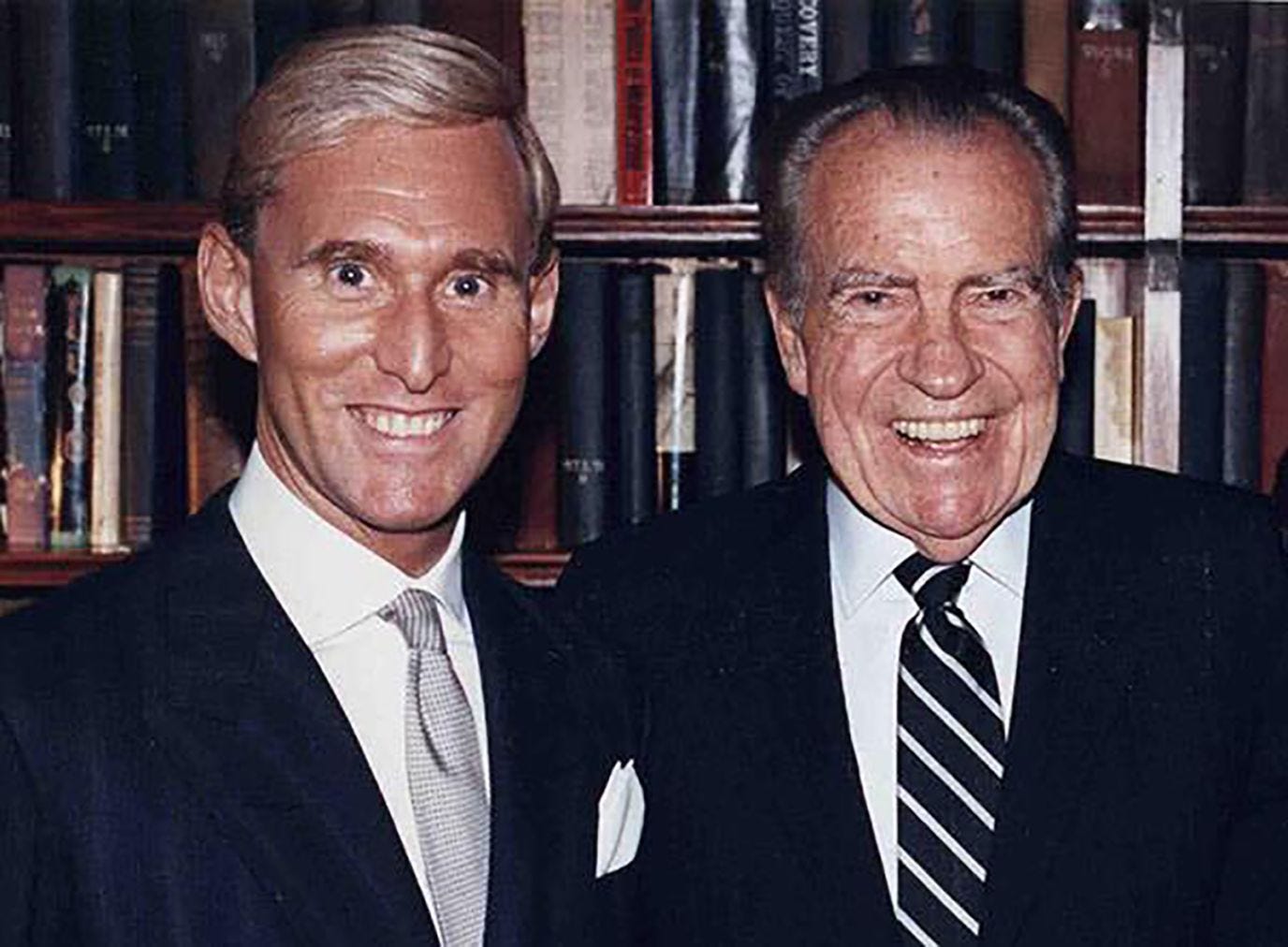
Roger Stone with former President Richard Nixon

“Past is fucking prologue,” — Stone’s Rule #4

This article is an excerpt from my book, While We Slept: Vladimir Putin, Donald Trump, and the Corruption of American Democracy, available here.

ROGER STONE AND THE JANUARY 6TH INSURRECTION

Convicted felon Roger Stone, one of America’s most infamous masters of the political dark arts and a longtime friend and advisor to former President Donald Trump, has come under renewed scrutiny for his promotion of the “Big Lie” that the 2020 election was stolen and for his activities in and around the January 6th insurrection.

Despite achieving prominence following the 2020 election, the idea that the election would be “rigged” against Trump was actually formulated and promulgated before the 2016 election.

The “Stop the Steal” rally that Trump addressed on January 6th immediately prior to the assault on the Capitol borrowed the phrase “Stop the Steal” from Stone, who had coined it as far back the 2016 Republican primaries.

In 2015, Stone facilitated Donald Trump’s first interview with Alex Jones of InfoWars. Jones, America’s most prominent conspiracy theorist, later introduced the idea that the 2016 election was going to be “rigged” against Trump.

Two days after Jones did so, Trump echoed the idea that the upcoming election would be “rigged” at a rally in Columbus, Ohio held on August 1st, 2016. Thus a seed was planted that would germinate for over five years. While Trump’s upset victory in 2016 obviated the need for the “Big Lie,” it was dusted off and put back into use after he lost the 2020 election.

Alex Jones interviewing Donald Trump on his program InforWars in December of 2015. The interview was facilitated by Roger Stone.

Stone is also linked to groups that were centrally involved in the storming of the U.S. Capitol, including the Proud Boys and the Oath Keepers.

Early in the Trump presidency, Stone was a central figure in the so-called “Russia investigation” conducted by the FBI and Special Counsel Robert Mueller.

At critical moments during the 2016 election, Stone was in touch with an online avatar operated by Russian military intelligence, the entity that hacked the Democratic National Committee and the Hillary Clinton Campaign and later provided the stolen emails to Wikileaks.

Shortly thereafter, Stone made public statements which suggested that he had prior, non-public knowledge that Wikileaks was in possession of Clinton campaign chairman John Podesta’s stolen emails.

Investigators have never been able to determine how Stone came into possession of this information. The investigation into Stone was obstructed and Trump later pardoned his old friend.

Stone lied under oath in testimony relating to these matters before Congress. He was subsequently indicted by Mueller’s prosecutors, with additional charges such as witness tampering to follow.

After being arrested and released on bail, Stone began interacting and coordinating with the now notorious right-wing group the Proud Boys, who occasionally served as his “body guards” during the various rallies and legal proceedings that followed.

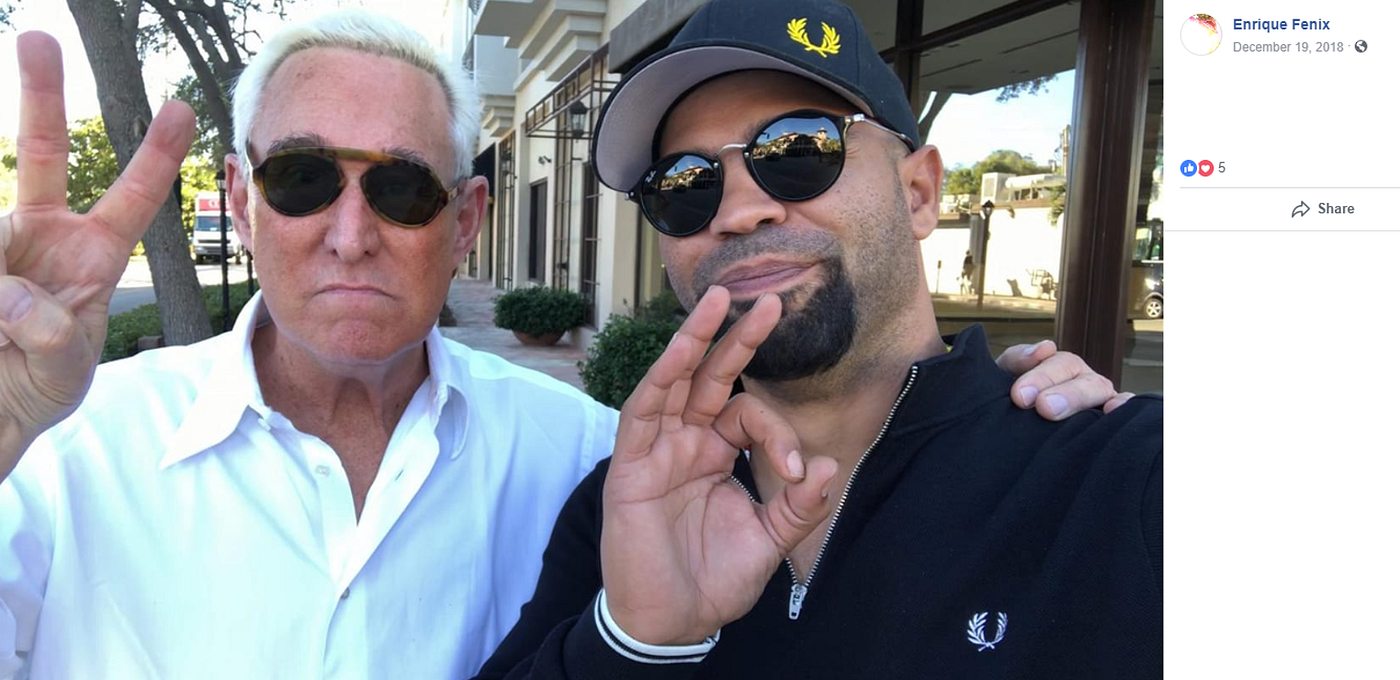
Stone became friendly with Enrique “Ricky” Tarrio, the leader of the Proud Boys who is currently under indictment for seditious conspiracy.

According to the Washington Postthe FBI is investigating Stone and Alex Jones’ connections to the Proud Boys.

Roger Stone with Enrique “Ricky” Tarrio, the leader of the Proud Boys currently under indictment for seditious conspiracy related to the events of January 6th.

The far-right militia group the Oath Keepers, members of which are also currently under indictment for seditious conspiracy for storming the U.S. Capital, also have links to Roger Stone. During the protests in and around Washington, D.C. on January 5th and 6th, members of the Oath Keepers provided Roger Stone with security.

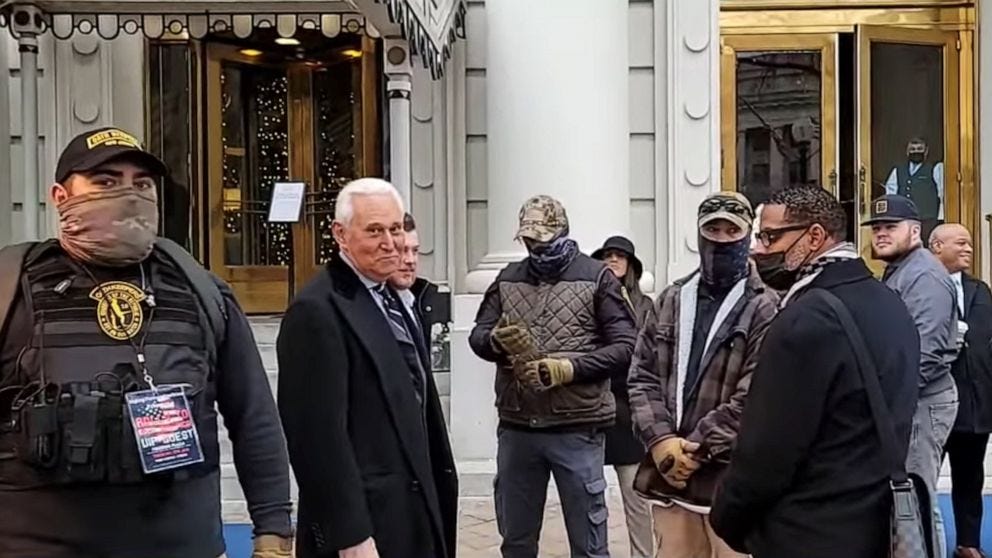
Oath Keeper Roberto Minuta, who is named in the indictment alongside Oath Keeper leader Elmer “Stewart” Rhodes, was seen with Stone outside the Willard hotel in Washington, D.C. on the morning of January 6th. Alex Jones was also staying in a suite at the Willard Hotel, where he interviewed former Trump National Security Advisor Michael Flynn, one of the lead cheerleaders of the “rigged” election canard.

In another suite was located the so-called “Command Center” where, at various times, Trump lawyers Rudy Giuliani and John Eastman, among others, plotted to overturn the results of the 2020 election in the lead up to, and during, the January 6th insurrection.

Roger Stone seen outside of the Willard Hotel Roberto Minuta (far left), a member of the Oath Keepers currently under indictment for seditious conspiracy.

The exact role Roger Stone played in the unprecedented events of the January 6th insurrection remains to be fully explained. The path that led him to January 6th involves decades worth of involvement in political scandals, corruption, and criminal election stunts.

Stone developed an early conviction that American elections are often determined by dirty tricks, criminal associations and subterfuge. An account of Stone’s life, and the story of the circumstances by which he met Donald Trump, paints a disturbing picture.

ROGER STONE, RICHARD NIXON, AND WATERGATE

Roger Stone was born in 1952 and grew up in Lewisboro, New York. Half Italian and half Hungarian, Stone’s mother wrote for a local newspaper and his father was a laborer who dug wells for a living.

Though as a child he had supported John F. Kennedy because he was Catholic and “had better hair than Nixon,” upon receiving a copy of Barry Goldwater’s book The Conscience of a Conservative, Stone became a staunch Republican at the age of 11.

“I read this book,” Stone told The Washington Post, “and I was completely transformed into a zealot.”

During Goldwater’s Presidential run, Stone rode his bike to the local campaign headquarters after school each day to lick envelopes and run errands. The 12 year-old Stone cried after Goldwater lost. However, his passion for politics remained undimmed. By age 13 Stone was taking the train into New York City to work weekends for William F. Buckley, Jr’s unsuccessful bid to become mayor.

Stone developed an early fascination with Richard Nixon and came to believe that he “had been fucked out of the presidency in 1960, thanks to Joe Kennedy and [his] mob friends.”

It is worth pausing for a moment to note how alleged acts of chicanery in the 1960 presidential election influenced Stone’s views on politics.

Another individual who believed the 1960 election had been stolen was Richard Nixon himself. Indeed, this belief influenced Nixon’s later sabotaging of President Lyndon Johnson’s peace negotiations in Vietnam during the 1968 election, as well as the activities and events the led to the Watergate scandal.

After Nixon’s 1960 loss, Stone penned a letter to the candidate encouraging him to run again. Nixon replied with a thank you note, telling Stone that he had no plans to run again but if he did, he would be in touch. Stone’s passion for Nixon would remain undimmed for the rest of his life, ultimately leading him to get a tattoo of the former President on his back.

Stone later moved to Washington, DC to attend George Washington University. At a time when the counterculture movement was in full steam, Stone joined the Young American’s for Freedom.

During Nixon’s 1972 re-election campaign, Stone invited Jeb Magruder, the deputy director of the Committee to Reelect the President (CREEP), to speak before the college’s Young Republican Club. “There are a bunch of hippie-type, leftwing, pinko degenerates that attend and harass him, but he handles it okay,” Stone recalled of the event.

Afterwards, Stone asked Magruder for a job and was hired. He dropped out of college and joined CREEP.

Jeb Magruder

Stone served as the assistant to the President of CREEP Bart Porter, who also ran the organizations notorious dirty tricks operations. During the day, the 19 year-old Stone worked as a scheduler for Nixon campaign surrogates. “By night, I’m trafficking in the black arts. Nixon’s people were obsessed with intelligence.”

Under orders from Porter, Stone arranged for a spy named Michael McMinoway, operating under the codename Sedan Chair II, to infiltrate the McGovern campaign.

Under the pseudonym Jason Rainier, Stone provided donations in the name of the Young Socialist to the campaign of Democrat Pete McCloskey and then forwarded the receipts to the newspaper. Stone’s experiences during the Nixon campaign would have an enduring influence on both his political ideology and his reputation as a “dirty trickster.”

It’s a reputation that far from run away from, he’s spent a lifetime cultivating.

“Roger likes the aura of having done something bad in the past,” said Stone friend David Keene in reference to his hijinks for CREEP during the Nixon reelection campaign. “You get the feeling that he’s sorry it was so minor. He likes to say, ‘Watch me, I’m a tough guy.’”

After Nixon won reelection in 1972, Stone got a job at the Office of Economic Opportunity, which was responsible for many of the programs initiated under Lyndon B. Johnson’s War on Poverty. As Stone describes it, H.R. “Bob” Halderman’s, “charge to us was to dismantle, replace, and fire everybody.”

A year later Halderman was embroiled in the raging Watergate scandal and was tried on counts of perjury, conspiracy and obstruction of justice. Stone had been renting a room from Bart Porter. On the evening of the Watergate break-in, Stone claims that Porter was out of town so he took urgent phone messages from a variety of individuals associated with the break-in, including G. Gordon Liddy, chief operative of the White House Plumbers unit.

Nixon went on to become the first and only President to resign from office to avoid being impeached and removed.

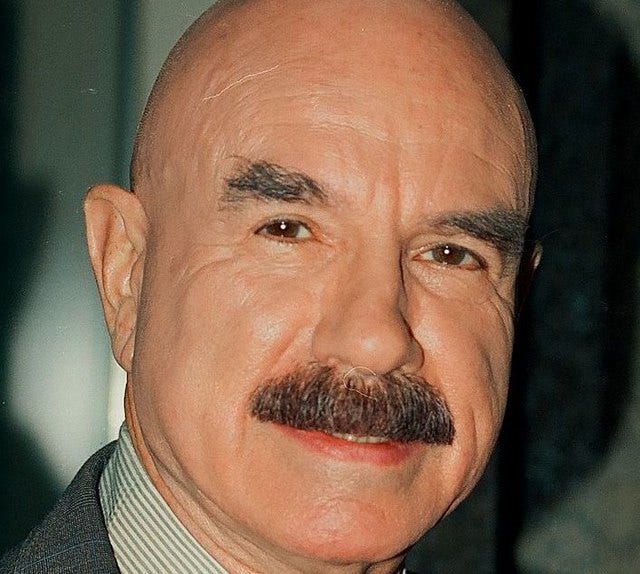
G. Gordon Liddy

Following Nixon’s fall from grace, Stone got a job in December 1973 as a junior staffer for Senator Robert Dole. However, six months after he began, Stone’s association with the “Ratfuckers” of the Nixon campaign was revealed during a Congressional hearing and he was forced to leave Dole’s staff.

In the immediate aftermath of Watergate, many Republicans wished to avoid the taint of scandal and Stone admits, “It was tough to get a job for a couple of years.”

ROGER STONE AND THE REAGAN REVOLUTION

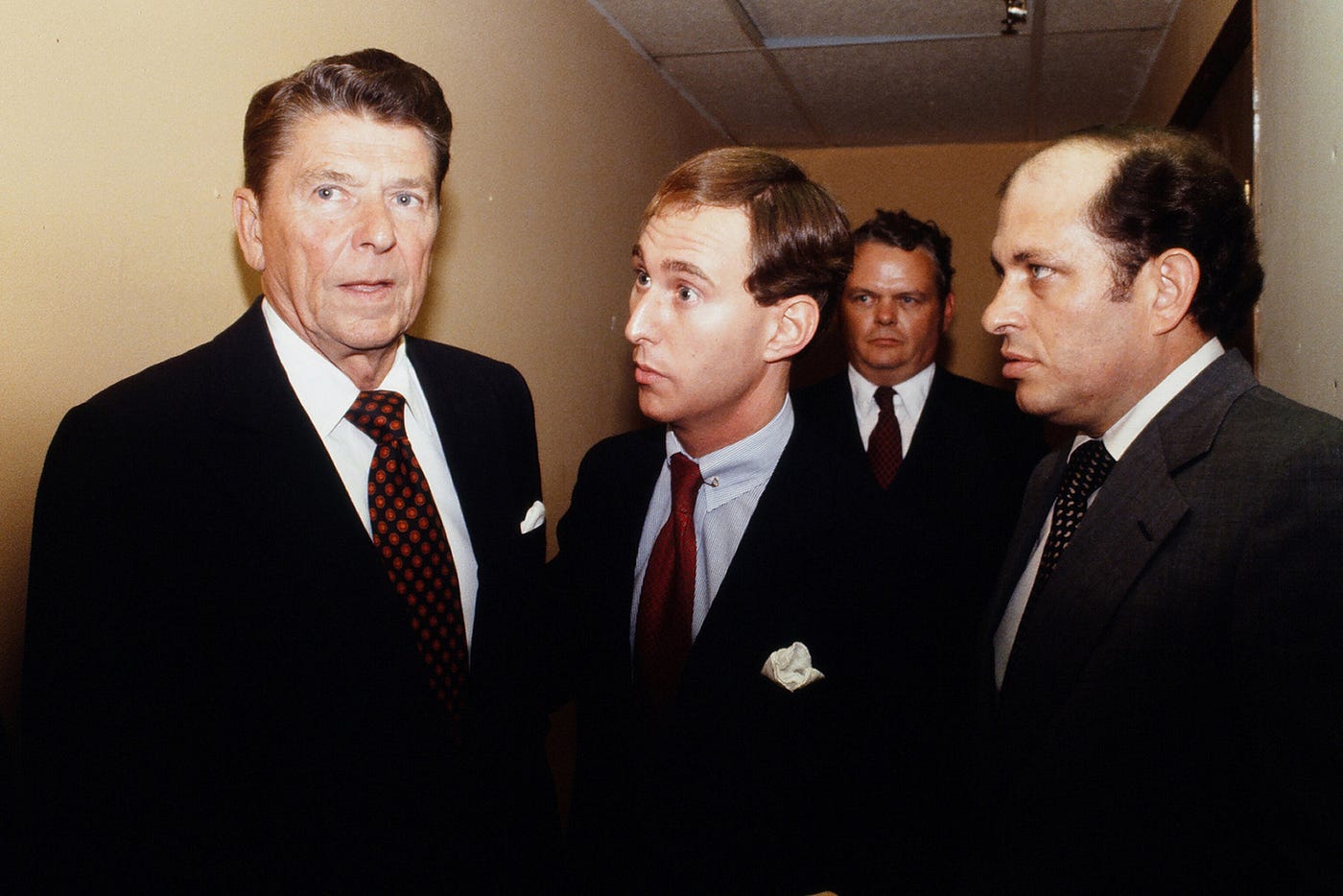
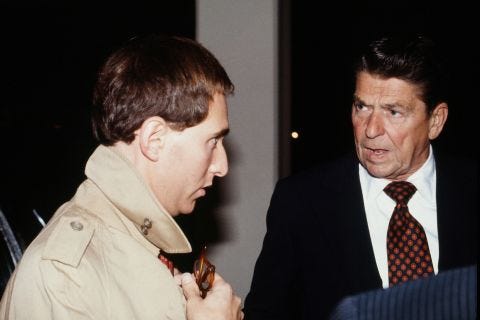
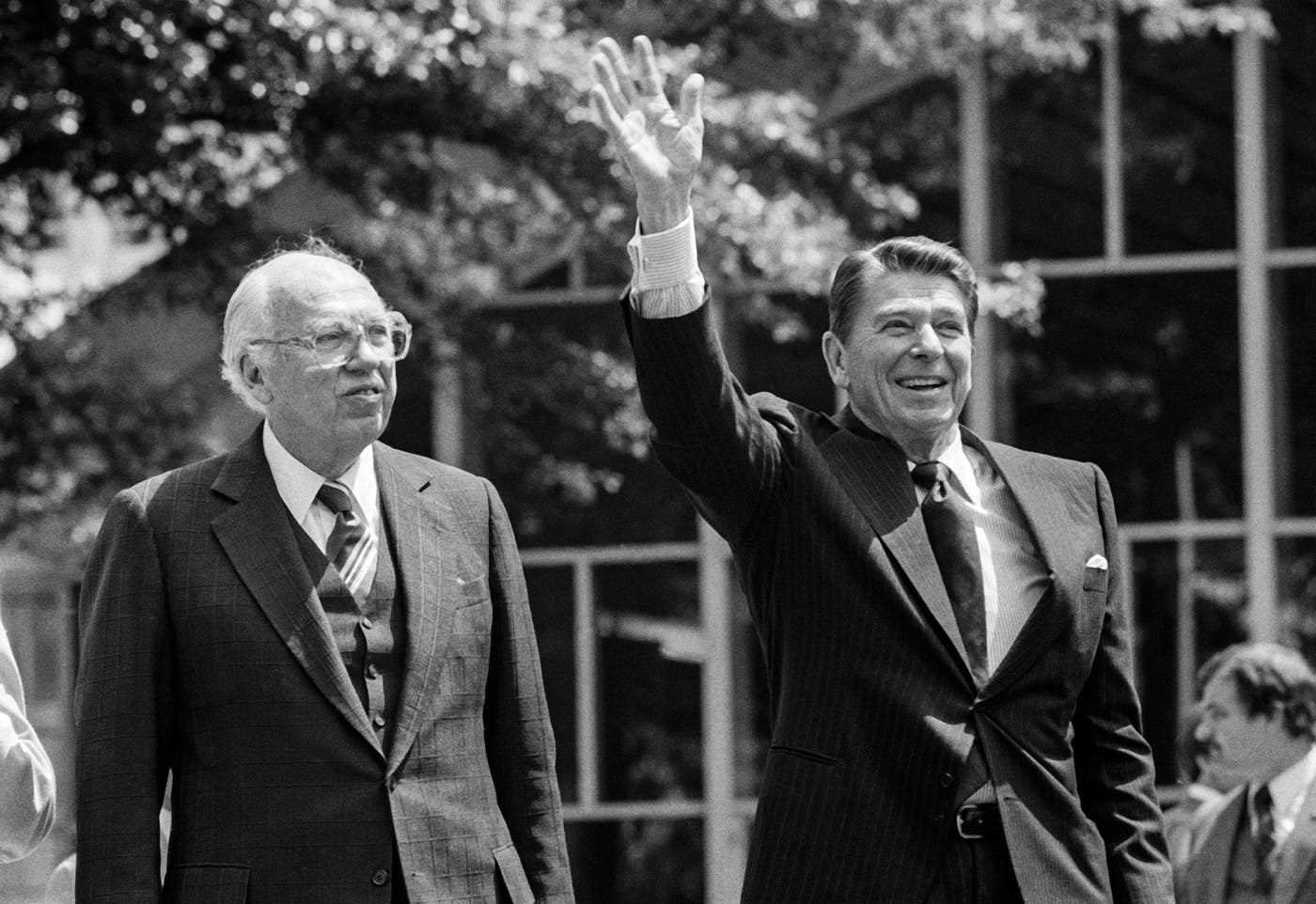
Roger Stone with President Ronald Reagan.

In 1976, Stone served on Ronald Reagan’s first unsuccessful attempt to garner the Republican nomination as the campaigns Youth Director. A year later he formed the National Conservative Political Action Committee with fellow young Republicans Charles Black and Terry Dolan.

The Committee pioneered the practice of bundling campaign contributions in order to circumvent campaign finance limits on individual contributions. It served as a precursor to super Political Action Committees (PACs) that came to dominate politics. It was at this time that Stone worked beneath the legendary Republican pollster and negative campaign strategist Arthur Finkelstein, who had an enduring influence on Stone.

In the spring of 1977, Stone ran to be the chairman of the Young Republicans. A network of influential Republicans between the ages of 18–40, in the days of brokered conventions the Young Republicans was an influential organization. Stone’s candidacy was managed by a young, up-and-coming Republican operative named Paul Manafort.

Manafort later served as chairman of the 2016 Trump Campaign after Stone lobbied the candidate to hire him. Stone and Manafort had known each other from their days in the College Republicans. Manafort managed to convince Stone’s chief rival to run for treasurer instead of president with a promise of future support that he later broke.

Stone won after a campaign that Manafort would later describe as, “one of the great fuck jobs.”

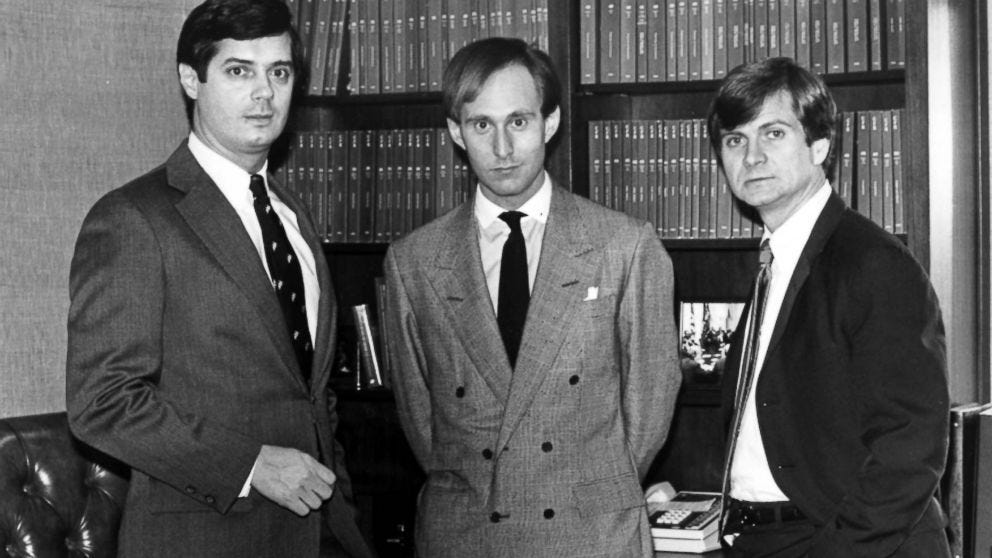
Lobbyists and partners Paul Manafort, Roger Stone and Charles Black (left to right).

By the time Stone was elected Chairman of the Young Republicans, he was already working on Reagan’s 1980 presidential campaign. In this capacity, Stone was introduced to one of America’s most infamous lawyers and political fixers: Roy Cohn.

Stone’s meeting with Roy Cohn in 1979 was perhaps one of the most consequential of his life. Years later, whenever asked about who his heroes were, Stone listed Roy Cohn, Richard Nixon and the Duke of Windsor. It was an unconventional list, but revealing of the man’s taste and character.

ROY COHN AND THE BIRTH OF THE ROGER STONE-DONALD TRUMP POLITICAL ALLIANCE

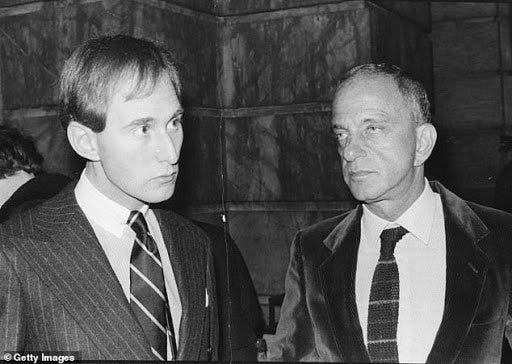
Roger Stone standing with New York lawyer and political fixer Roy Cohn

Roy Cohn exploded into the American national consciousness as an infamous player in the Red Scare of the 1950s. With the drawing of the Iron Curtain, the onset of the Cold War and the discovery of significant Soviet intelligence infiltration of American political, military and scientific institutions, a sense of fear and in many cases near hysteria swept over the body politic. As is so often the case in moments such as these, reasonable fears can be seized upon by unscrupulous demagogues for their own political purposes.

Cohn was a child prodigy. He graduated from Columbia Law School at the age of 20 and through his family’s political connections landed a job at the US Attorney’s Office in Manhattan. His early cases involved the alleged Soviet spy Alger Hiss, and the infamous Rosenberg trial. The most controversial part of the trial came during sentencing. The Rosenbergs, accused of sharing nuclear secrets with the Soviets, were found guilty.

Cohn claimed that the judge presiding over the trial, Judge Irving Kaufman, owed his position to Cohn’s father, who was a judge based out of the Bronx. Cohn further claimed that he had Kaufman assigned to the case through his connections to the district court’s clerk office. Evidence suggests that Cohn engaged in inappropriate communications with Judge Kaufman at the time he was contemplating what sentences to impose. Cohn suggested the death penalty, and that’s what the Rosenbergs received.

The vast majority of individuals caught up in the Red Scare were innocent and many lives were needlessly destroyed. The demagoguery, hysteria and self-serving cynicism of the era found its personification in Wisconsin Senator Joseph McCarthy, giving rise to the epithet McCarthyism.

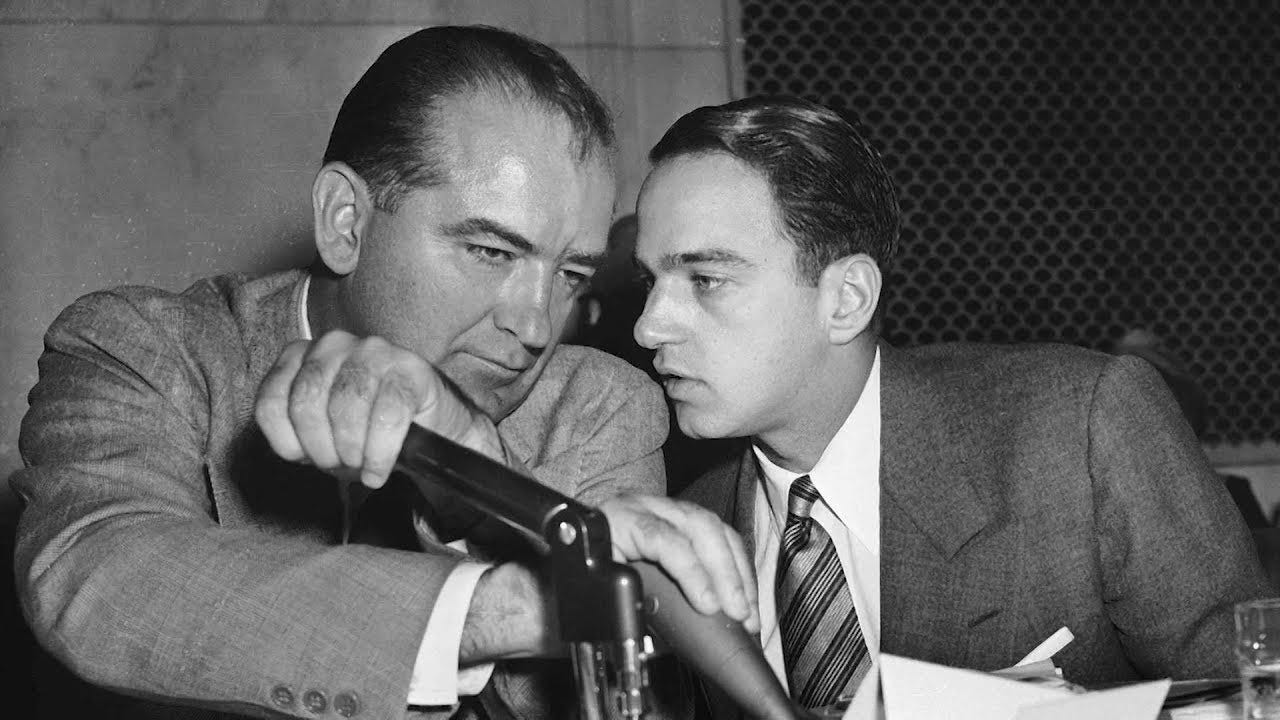
Cohn started working with Joe McCarthy as his chief counsel in 1953. McCarthy had built a national profile by making outlandish claims of Communist infiltration and subversion infecting nearly all walks of American life, from Hollywood to the State Department to the Pentagon. McCarthy and Cohn’s hunt for hidden Communists inordinately impacted members of the Jewish faith and homosexuals.

For Cohn to have played such a prominent role in the persecution of these communities was curious indeed as he was both Jewish and a closeted homosexual.

Infamous Red-baiting Wisconsin Senator Joseph McCarthy with his young chief counsel Roy Cohn.

McCarthy’s enemies found the opportunity to pounce when it came to the drafting into the military of G. David Schine, an unpaid “Chief Consultant” working with McCarthy and Cohn. After it became clear that Cohn was seeking preferential treatment for Schine, a scandal broke and culminated in the the Army-McCarthy Hearings.

The hearings led to McCarthy’s downfall and Cohn’s banishment from Washington. Cohn was outclassed and out-lawyered by the Chief Counsel of the US Army Joseph N. Welch, who in a confrontation with McCarthy uttered the phrase that marked the end of the McCarthy era, “At long last, have you no sense of decency?”

Cohn returned to New York where he became one of the city’s most influential power brokers. He developed a reputation as a “legal executioner.” His methods were relentless and unethical.

His professional and personal life were constantly under scrutiny, and yet he always seemed to get away with it. In the 1960’s, when his rival Robert Kennedy was Attorney General, Cohn was indicted four times but acquitted in each an every case. In the 1970’s he was charged with violating banking laws in Illinois and was again acquitted.

Cohn represented the most senior members of the American Mafia. He once boasted that he had gotten Irving Saypol, the the prosecutor of the Rosenberg case, his job as US Attorney. According to Cohn, Saypol’s appointment needed to be approved by Frank Costello, boss of the legendary Luciano crime family (later known as the Genovese crime family), one of the New York mafia’s infamous Five Families.

“In those days, nobody became U.S. Attorney in New York without the O.K. from the mob,” Cohn stated. “But Saypol would not have gotten the nod from Costello without me.”

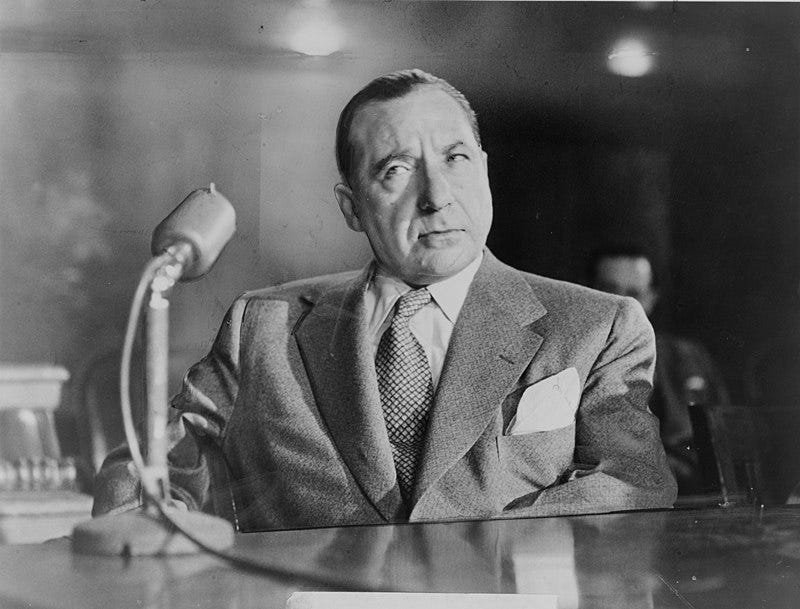
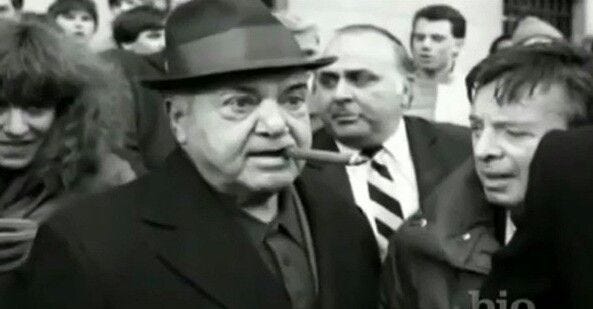
Infamous and politically connected leader of the Genovese Crime Family Frank Costello.

Cohn’s connections to the FBI, he was a personal friend of J. Edgar Hoover’s, along with his network judges, prosecutors and district attorneys, made him an ideal lawyer for a wide range of mafioso. His clients included Genovese Crime Family underboss Anthony “Fat Tony” Salerno, Bonanno boss Carmine “Nino” Galante and numerous members of the Gambino crime family including Carmine Fatico, Aniello Dellacroce, Tommy and Joe Gambino, Angelo Ruggiero and a young and a then little known mobster by the name of John Gotti.

Federal anti-organized crime strike force members told Cohn biographer Nicholas von Hoffman that in the 70s, when wiretapping was increasingly becoming an issue, members of “The Commission,” the governing body of the American mafia, met in Roy’s office because attorney-client privilege made recordings in-admissible in court.

While at the top of his game as a political fixer and mafia attorney in New York, Roy Cohn met a brash young real estate developer by the name of Donald J. Trump.

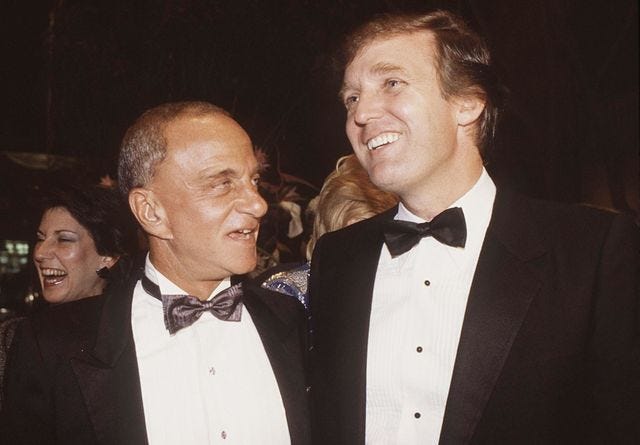
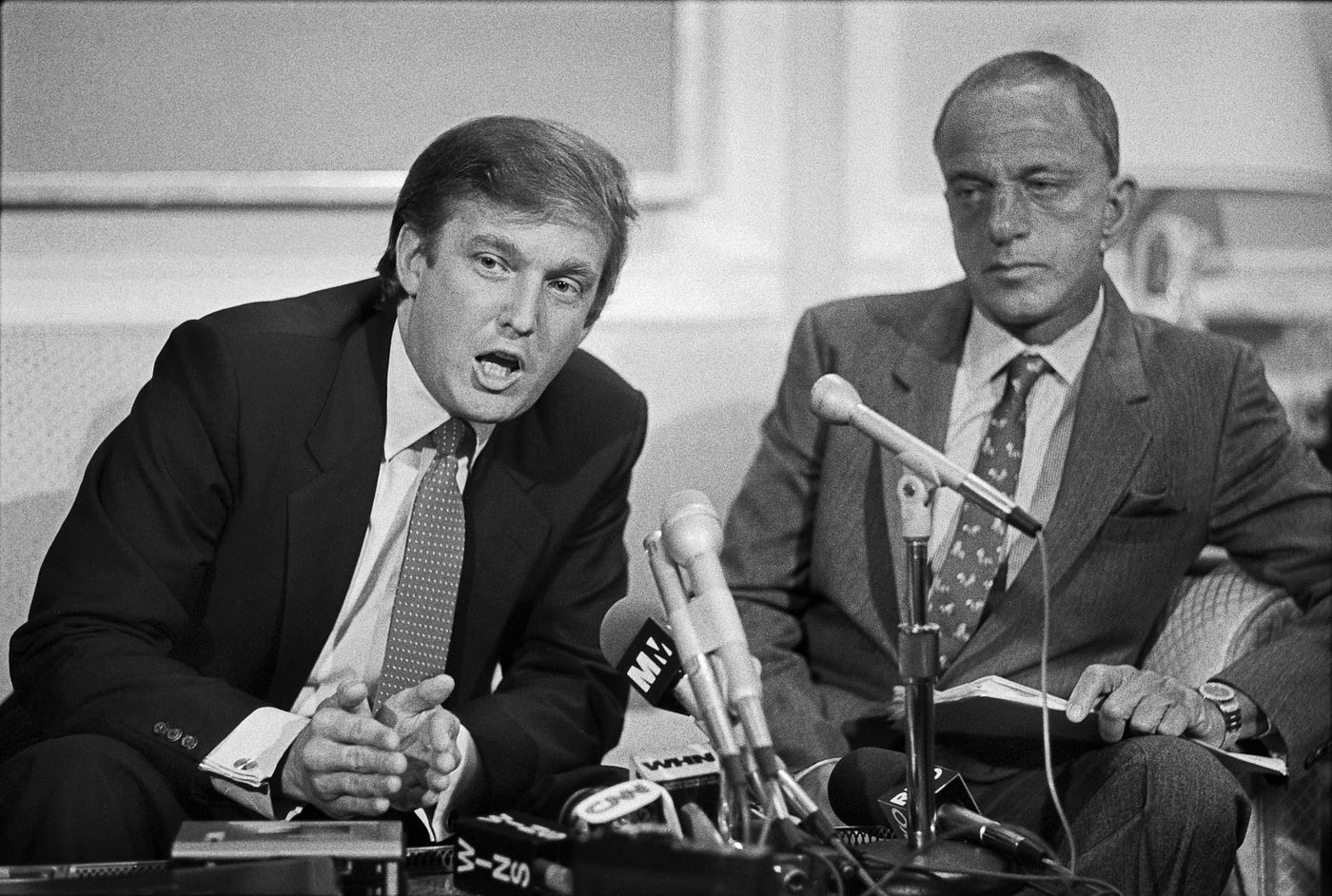
Roy Cohn with a young Donald J. Trump at the opening of Trump Tower.

In 1973, the U.S. Justice Department sued the Trump Organization for housing discrimination against blacks. After a chance encounter at a Manhattan watering hole called Le Club in which Trump bemoaned the timidity of his lawyers, Cohn took Trump on as a client. In typical Cohn fashion, he countersued DOJ for $100 million. The case eventually settled.

Trump was enthralled with Cohn, who went on to play a pivotal role in Manhattan real estate career. Trump also developed a new appreciation for the benefits of having a consummate legal fixer that he took with him to the White House.

Roger Stone tells several variations of the story of how he first met Roy Cohn in 1979. In one version of events, Stone first met Cohn at a party held by Sheila Mosler, a socialite and vice chairman of the New York County Republican Committee.

In another, Roy Cohn’s name came up on a rolodex given to him by Michael Deaver, an advisor to Ronald Reagan. At the time, the 27-year old Stone was the political director of New York, New Jersey, and Connecticut for the Reagan Campaign.

Regardless of how initial contact was made, all the stories end up with Roger visiting Roy at his 68th Street townhouse in Manhattan.

Roger Stone with Ronald Reagan, whose campaign he served as the political director for New York, New Jersey, and Connecticut.

“When I got there, Roy was in his bathrobe, eating three strips of bacon burned crisp and both halves of a deviled egg,” Stone later recalled. He noticed a heavy set man sitting next to Cohn.

“Mr. Stone, I want you to meet Tony Salerno,” Cohn said, introducing the young Reagan staffer to the underboss of the Genovese crime family.

Anthony “Fat Tony” Salerno, Genovese Crime Family underboss and client of Roy Cohn’s.

“So Roy says we’re going with Reagan this time,” Salerno chimed in. Stone launched into his pitch for Reagan as Cohn and Fat Tony listened intently.

“You know, Tony, everything’s fixed.” Stone quoted Cohn as saying. “Everything can be handled.” Salerno mentioned the Supreme Court. Cohn continued. “Cost a few more dollars.”

“He started telling me how he was going to help me set up the Reagan Campaign,” Stone said of Cohn. “[E]verything from union endorsements to office space. He told me to ride down to the courthouse with him. He had a young lawyer with him, and it was clear that Roy knew nothing about the case he was going to argue. But he knew it didn’t matter. He used to say, ‘Don’t tell me the law. Tell me the judge.’ Roy knew how the world worked.”

Years later, Stone told the reporter Matt Labash that he suggested to Cohn that if they could get the candidate John B. Anderson to make a bid for the Presidency on behalf of New York’s Liberal Party, it would split the vote between Carter and Anderson and deliver the New York to Reagan.

“Let me look into it,” Roy replied. Shortly thereafter, Cohn told Stone, “You need to go see this lawyer… and see what his number is.”

“Roy, I don’t understand,” Stone replied.

“How much cash he wants, dumbfuck,” Cohn shouted.

Stone claims to have visited the lawyer and learned that his number was $125,000 cash. Thinking the number was outlandish, Roger returned to Cohn thinking with a number that high that was the end of it. Not according to Cohn, “That’s not the problem. How does he want it?”

“There’s a suitcase,” Stone explained to Labash. “I don’t look in the suitcase… I don’t even know what was in the suitcase… I take the suitcase to the law office. I drop it off. Two days later, they have a convention. Liberals decide they’re endorsing John Anderson for president. It’s a three-way race now in New York State. Reagan wins with 46 percent of the vote. I paid his law firm. Legal fees. I don’t know what he did for the money, but whatever it was, the Liberal party reached its right conclusion out of a matter of principle.”

Remarkably, neither Stone’s introduction to a crime boss, nor the alleged plot to split the liberal vote, was the most important consequence of his meeting with Roy Cohn. Cohn provided Stone with an introduction that would change the course of American history.

“You need to meet Donald and his father,” Cohn insisted. “They’d be perfect for this. Let me set up a meeting.”

Donald Trump and Roy Cohn.

“I went to go see him,” Stone recalled, “and Trump said, ‘How do you get Reagan to 270 electoral votes?’ He was very interested [in the mechanics] — a political junkie. Then he said, ‘O.K., we are in. Go see my father.”

Stone travelled to Fred Trump’s Avenue Z office in Coney Island. “True to his word, I got $200,000. The checks came in $1,000 denominations, the maximum donation you could give. All of these checks were written to ‘Reagan for President.’ It was not illegal — it was bundling. Check trading.”

The Trumps even arranged for Stone to open Reagan’s New York City campaign headquarters in a townhouse next to the 21 Club. It was the beginning of a fateful political alliance.

Roger Stone was hardly the only member of the Reagan Campaign that Cohn was connected to. According to notes taken by Cohn‘s switchboard operator, Reagan’s 1980 campaign manager, William Casey, “called Roy almost daily during [Reagan’s] 1st election.”

Casey was a Wall Street investor and a veteran of America’s World War II-era intelligence service the Office of Strategic Services (O.S.S.). Following the 1980 election, reporters and researchers alleged that Casey cut an “October Surprise” deal with the Iranians, who were holding American diplomatic personnel hostage, to wait until after the election to release them.

Nearly four decades later, Stone and another 1980 Reagan campaign alum, Paul Manafort, would be suspected of “colluding” with a foreign adversary to impact a domestic election.

Interestingly, Stone addressed the so-called “October Surprise” allegations in a book he co-authored with Saint John Hunt during the 2016 Republican primary attacking Jeb Bush and the Bush family in general.

Former OSS officer and Reagan Campaign manager, William Casey standing with Ronald Reagan. Casey, who later led the CIA during the Iran-Contra scandal, is alleged to have negotiated with the Iranians during the 1980 election to delay the release of American hostages until after the election in what became known as the “October Surprise.”

“The Reagan/Bush camp needed to cut a secret deal with the Iranians not to release the hostages before the election,” Stone and Hunt write in Jeb! And The Bush Crime Family: The Inside Story of an American Dynasty.

“As it turned out, the hostages were not released as Carter had promised, and partly as a result of the years-long standoff with the Iranians, Carter lost the election. On January 21st, 1981, the very day that Reagan and Bush were being sworn in, the hostages found themselves on a plane to freedom. Coincidence? The accusations that Reagan and Bush had somehow thwarted the Carter/Iranian deal to free the hostages by election time, thereby winning the election for [Reagan], were rampant. How much of a role did [Bush] play? That’s the million dollar question.”

Stone and Hunt later continue, “Political researcher Robert Morrow interviewed retired admiral Bobby Ray Inman in 2009 in Austin, Texas. Inman, who was involved in intelligence for over 25 years, told Morrow that he was convinced that the Reagan campaign made a deal with the Iranians not to release the American hostages until after the 1980 general election. Inman said he was completely convinced Reagan campaign chair William Casey was involved in such a deal, but he said he did not think G.H.W. Bush was involved because Casey hated Bush. Inman worked at high levels of the Office of Naval Intelligence and the Defense Intelligence Agency while Bush was CIA director in 1976 and they developed a close working relationship.”

“So, as with so many other “facts,” we come to our own conclusions. Do we believe that our candidate was honest and would never dream of co-opting a presidential deal for his own gain? No, I say.” A curious thing to say, seeing as Stone himself had worked on the campaign.

So it appears that just as be believed that Joseph Kennedy had used his connections to Organized Crime to steal the 1960 election, Roger Stone is just as convinced that Reagan’s campaign manager William Casey, who later became Reagan’s director of the CIA and became embroiled in the Iran-Contra scandal, had negotiated with enemies of the United States to engage in activities that would impact the outcome of a Presidential election.

Thirty six years later, Republican presidential candidate Donald Trump would find himself courting help from another American adversary, Vladimir Putin’s Russia, and Roger Stone was exactly where he wanted to be, at the very heart of the controversy.

Forty years later, decades of political corruption and lies would culminate in a violent assault on the very seat of American democracy.

The next article will cover Stone’s involvement in the 1981 New Jersey Governors race and lobbying work for Donald Trump.

You can find my collected writings here.

Was Spinoza expelled from his temple?

By Mike Zonta, BB editor (and ChatGPT)

Me:

Was Spinoza expelled from his temple?

ChatGPT:

Yes, although not from a temple in the usual sense.

Baruch Spinoza was excommunicated (placed under herem) by the Portuguese-Jewish community in Amsterdam in 1656, when he was only 23 years old.

He was expelled from the synagogue community, not from a temple building as such. The ban was exceptionally severe. It prohibited members of the community from:

  • speaking with him,
  • doing business with him,
  • reading his writings,
  • or coming within a prescribed distance of him.

The text of the herem denounced him for “abominable heresies” and “monstrous deeds,” although it never specifies exactly what those heresies were.

Why was he expelled?

Scholars believe it was because Spinoza had begun expressing ideas that challenged fundamental Jewish doctrines, including:

  • questioning whether the Hebrew Bible was literally dictated by God;
  • rejecting the idea of a personal God who intervenes in history;
  • denying that the Jewish people were uniquely chosen in a supernatural sense;
  • questioning the immortality of the individual soul in the traditional way.

His mature philosophy identified God with Nature (Deus sive Natura—”God, or Nature”), not in the sense that God is merely the physical universe, but that there is one infinite substance of which everything is an expression. This was radically at odds with both Jewish and Christian orthodoxy of his time.

Did he regret it?

There is no evidence that he sought readmission to the Jewish community. Instead, he lived quietly, supported himself by grinding optical lenses, and wrote works that would profoundly influence later philosophy.


Knowing the metaphysical questions you’ve been exploring, I suspect you’ll find an interesting resonance between your own reasoning and Spinoza’s. Both begin with the intuition that Reality is One. But there is also an important difference.

Spinoza argues that there is one infinite Substance, and everything that exists is a mode or expression of that Substance.

Your first step begins:

Truth is all that is.

Truth being all is therefore only.

Truth being only is therefore one.

From there, however, you emphasize that Truth is consciousness (Mind). Spinoza was more cautious. He held that Thought and Extension (mind and body) are two attributes of the one Substance, rather than reducing all reality to consciousness.

So while there is a family resemblance between your metaphysics and Spinoza’s—especially the emphasis on Oneness—they are not identical. Your system gives a more central role to consciousness than Spinoza’s does, and that would make for a fascinating philosophical comparison.

Was Spinoza expelled from his temple?

Yes, although not from a temple in the usual sense.

Baruch Spinoza was excommunicated (placed under herem) by the Portuguese-Jewish community in Amsterdam in 1656, when he was only 23 years old.

He was expelled from the synagogue community, not from a temple building as such. The ban was exceptionally severe. It prohibited members of the community from:

  • speaking with him,
  • doing business with him,
  • reading his writings,
  • or coming within a prescribed distance of him.

The text of the herem denounced him for “abominable heresies” and “monstrous deeds,” although it never specifies exactly what those heresies were.

Why was he expelled?

Scholars believe it was because Spinoza had begun expressing ideas that challenged fundamental Jewish doctrines, including:

  • questioning whether the Hebrew Bible was literally dictated by God;
  • rejecting the idea of a personal God who intervenes in history;
  • denying that the Jewish people were uniquely chosen in a supernatural sense;
  • questioning the immortality of the individual soul in the traditional way.

His mature philosophy identified God with Nature (Deus sive Natura—”God, or Nature”), not in the sense that God is merely the physical universe, but that there is one infinite substance of which everything is an expression. This was radically at odds with both Jewish and Christian orthodoxy of his time.

Did he regret it?

There is no evidence that he sought readmission to the Jewish community. Instead, he lived quietly, supported himself by grinding optical lenses, and wrote works that would profoundly influence later philosophy.


Knowing the metaphysical questions you’ve been exploring, I suspect you’ll find an interesting resonance between your own reasoning and Spinoza’s. Both begin with the intuition that Reality is One. But there is also an important difference.

Spinoza argues that there is one infinite Substance, and everything that exists is a mode or expression of that Substance.

Your first step begins:

Truth is all that is.

Truth being all is therefore only.

Truth being only is therefore one.

From there, however, you emphasize that Truth is consciousness (Mind). Spinoza was more cautious. He held that Thought and Extension (mind and body) are two attributes of the one Substance, rather than reducing all reality to consciousness.

So while there is a family resemblance between your metaphysics and Spinoza’s—especially the emphasis on Oneness—they are not identical. Your system gives a more central role to consciousness than Spinoza’s does, and that would make for a fascinating philosophical comparison.

Bio: Hart Crane

Crane photographed by Walker Evans, c. 1929–1930

Harold Hart Crane was an American poet. Inspired by the Romantics and his fellow Modernists, Crane wrote highly stylized poetry, often noted for its complexity. Wikipedia

Born July 21, 1899, Garrettsville, OH

Died April 27, 1932 (age 32 years), Gulf of Mexico

Harold Hart Crane (July 21, 1899 – April 27, 1932) was an American poet. Inspired by the Romantics and his fellow Modernists, Crane wrote highly stylized poetry, often noted for its complexity. His collection White Buildings (1926), featuring “Chaplinesque”, “At Melville’s Tomb”, “Repose of Rivers” and “Voyages”, helped to cement his place in the avant-garde literary scene of the time. The long poem The Bridge (1930) is an epic inspired by the Brooklyn Bridge.[1]

Crane was born in Garrettsville, Ohio, to Clarence A. Crane and Grace Edna Hart. He dropped out of East High School in Cleveland during his junior year and left for New York City, promising his parents he would later attend Columbia University. Crane took various jobs, including in copywriting and advertising. Throughout the early 1920s, various small but well-respected literary magazines published some of Crane’s poems, gaining him among the avant-garde a respect that White Buildings ratified and strengthened. His ambition to synthesize America was expressed in The Bridge, intended to be an uplifting counter to T. S. Eliot‘s The Waste Land (1922). Initial critical reaction to it was mixed, with many praising the scope but criticizing the quality of the poems. On April 27, 1932, Crane, in an inebriated state, jumped off the steamship USS Orizaba and into the Atlantic Ocean while the ship was en route from Vera Cruz to New York via Havana, Cuba. He left no suicide note, but witnesses to his jump believed he was intentionally killing himself. Throughout his life, he had multiple homosexual relations, many of which were described in, or otherwise influenced, his poetry. He had one known female partner, Peggy Cowley, around a year before his death.

Contemporary opinion of Crane’s work was mixed, with poets including Marianne Moore and Wallace Stevens criticizing his work, and others, including William Carlos Williams and E. E. Cummings, praising it. William Rose Benét wrote that, with The Bridge, Crane “failed in creating what might have been a truly great poem” but that it “reveals potencies in the author that may make his next work even more remarkable”.[1] His last work, “The Broken Tower” (1932), was unfinished and published posthumously. Crane has been praised by several playwrights, poets, and literary critics, including Robert LowellDerek WalcottTennessee Williams, and Harold Bloom; Bloom called him “a High Romantic in the era of High Modernism”.[2][3][4] Allen Tate called Crane “one of those men whom every age seems to select as the spokesman of its spiritual life; they give the age away.”[1]

Life

Early life

Crane was born in Garrettsville, Ohio, on July 21, 1899 to Clarence A. Crane and Grace Edna Hart. His father was a successful Ohio restaurateur[5] and businessman who invented the Life Savers candy and held the patent, but sold it for $2,900 before the brand became popular.[6] He made other candy and accumulated a fortune from the business with chocolate bars. Clarence Crane’s sister, Alice Crane Williams, was a composer and literary editor.[7] His aunt Zell Hart Deming gave funds to her nephew to support his early career.[8]

In 1894, the family moved to Warren, Ohio where his father opened a maple syrup company, which he sold in 1908 to Corn Products Refining Company. In April 1911, his father opened a chocolate manufacturing and retailing company, the Crane Chocolate Company. The family moved to Cleveland in 1911, into a house at 1709 East 115th Street. In 1913, Clarence Crane’s parents purchased the residence across the street.[9]: 61, 63 

Hart Crane began attending East High School around 1913–1914.[5][9]: 63 [note 1]

Career

He has woven rose-vines
About the empty heart of night,
And vented his long mellowed wines
Of dreaming on the desert white
With searing sophistry.
And he tented with far truths he would form
The transient bosoms from the thorny tree.

O Materna! to enrich thy gold head
And wavering shoulders with a new light shed

From penitence, must needs bring pain,
And with it song of minor, broken strain.
But you who hear the lamp whisper thru night
Can trace paths tear-wet, and forget all blight.

— Hart Crane’s “C33” as published in Bruno’s Weekly in 1917.[10]: 28 

Crane’s first published work was the poem “C33”, which was published in the Greenwich journal Bruno’s Weekly in 1917[11]: 75  in a feature entitled “Oscar Wilde: Poems in His Praise”.[10]: 22  The poem is named after Oscar Wilde’s cell in The Ballad of Reading Gaol[5] and his name appeared misspelled in print as “Harold H Crone”.[10]: 27  The style he would use in his later books is apparent in poems written at the time.[12][13] Crane dropped out of East High School in Cleveland during his junior year[6] in December 1916[9] and left for New York City, promising his parents he would later attend Columbia University. His parents, in the middle of divorce proceedings, were upset. Crane took various copywriting jobs and moved between friends’ apartments in Manhattan.[6] For a period, he rented a room at 25 East 11th Street from a motion-picture scriptwriter named Mrs. Walton, who encouraged his writing.[14] Crane’s mother and father were constantly fighting, and they divorced on April 14, 1917.[15][note 2] The same year, he attempted to enlist in the military, but was rejected due to being a minor.[16]

He worked in a munitions plant until the end of World War I.[16] Between 1917 and 1924, he moved back and forth between New York and Cleveland,[5] working as an advertising copywriter[17] and a worker in his father’s factory.[18] In 1925, he briefly lived with Caroline Gordon and Allen Tate. The two had a dispute with Crane due to the mess his belongings made throughout the house. Additionally, Crane and Tate had a disagreement over the negative outlook of T. S. Eliot‘s work. This prompted them to leave two letters under his door requesting that he move out, which he did.[19] He wrote his mother and grandmother in the spring of 1924:

Just imagine looking out your window directly on the East River with nothing intervening between your view of the Statue of Liberty, way down the harbour, and the marvelous beauty of Brooklyn Bridge close above you on your right! All of the great new skyscrapers of lower Manhattan are marshaled directly across from you, and there is a constant stream of tugs, liners, sail boats, etc in procession before you on the river! It’s really a magnificent place to live. This section of Brooklyn is very old, but all the houses are in splendid condition and have not been invaded by foreigners…[6]

Based on Crane’s letters, New York was where he felt most at home. Additionally, much of his poetry takes place there.[20]

White Buildings (1926)

Main articles: White Buildings and Voyages

Throughout the early 1920s, many small but well-respected literary magazines published some of Crane’s poems, gaining him respect among the avant-garde which was later cemented by the 1926 publication of White Buildings.[citation needed] On May 1, 1926, he went to Isla de la Juventud to reside in his mother’s family residence there. He received a contract from Liveright Publishing to publish White Buildings in July.[5] White Buildings contains many of Crane’s most well-received and popular poems, including “For the Marriage of Faustus and Helen”, and “Voyages”, a sequence of erotic poems. They were written while he was falling in love with Emil Opffer,[21] a Danish merchant mariner,[22] whom “Voyages” is generally considered to be about.[5] “Faustus and Helen” was part of a larger artistic struggle to meet modernity with something more than despair. Crane identified T. S. Eliot with that kind of despair, and while he acknowledged the greatness of The Waste Land, he also said it was “so damned dead”,[23] an impasse,[24] and characterized by a refusal to see “certain spiritual events and possibilities”.[25] Crane’s self-appointed work would be to bring those spiritual events and possibilities to poetic life, and so create “a mystical synthesis of America”.[26] Edmund Wilson said Crane had “a style that is strikingly original—almost something like a great style, if there could be such a thing as a great style which was … not … applied to any subject at all.”[1]

Crane returned to New York in 1928 following a hurricane which left the Cuban residence damaged,[5] and began living with friends and taking temporary jobs as a copywriter, or living off unemployment and the charity of friends and his father. For a time he lived in Brooklyn at 77 Willow Street[27] until his lover, Opffer, invited him to live in Opffer’s father’s home at 110 Columbia Heights in Brooklyn Heights. Crane was overjoyed at the views the location afforded him.

The Bridge (1930)

Main article: The Bridge

The first known mention of The Bridge was in a 1923 letter to Gorham Munson in which he wrote:

I am ruminating on a new longish poem under the title of The Bridge which carries on further the tendencies manifest in ‘F and H.’ It will be exceedingly difficult to accomplish it as I see it now, so much time will be wasted in thinking about it.[5]

Crane moved to Paterson, New Jersey, in 1927. In 1928, he worked as a secretary for a stockbroker visiting California.[11]: 77  Crane’s mother, following her second marriage breakup, was living in the Los Angeles area. He revealed his homosexuality to her, causing a confrontation. Crane sneaked out on May 15, 1928, never to see her again. He later found out about the death of his grandmother, Elizabeth Hart, but his mother refused to pay him his $5,000 inheritance until he would return to live with her. He managed to convince her to send him the money and left for Europe towards late November[5] intending to live in Mallorca, but instead went first to London then to Paris.[5] In Paris in February 1929, Harry Crosby, who with his wife Caresse Crosby owned the fine arts press Black Sun Press, offered Crane the use of their country retreat, Le Moulin du Soleil in Ermenonville. They hoped he could use the time to concentrate on completing The Bridge. Crane spent several weeks at their estate where he wrote a draft of the “Cape Hatteras” section, a key part of his panegyric poem.[28] In late June that year, Crane returned from the south of France to Paris. Crosby noted in his journal, “Hart C. back from Marseilles where he slept with his thirty sailors and he began again to drink Cutty Sark.” Crane got drunk at the Cafe Select and fought with waiters over his tab. When the Paris police were called, he fought with them and was beaten. They arrested and jailed him, fining him 800 francs.[6] After Hart had spent six days in prison at La Santé, Crosby paid Crane’s fine and advanced him money for the passage back to the United States,[28] where he finished The Bridge.[6] In January 1930, the work was published by Black Sun Press in Paris and subsequently by Boni & Liveright in the United States in April.[5] The work received poor reviews, and Crane struggled with a sense of failure.[16]

His ambition to synthesize America was expressed in The Bridge, intended to be an uplifting counter to Eliot’s The Waste Land. The Brooklyn Bridge is both the poem’s central symbol and its poetic starting point.[16] Crane found a place to start his synthesis in Brooklyn. Arts patron Otto H. Kahn gifted him $2,000 to begin work on the panegyric poem,[6] though he had requested a loan of $1,000.[5] After parting with the Opffers, Crane left for Paris in early 1929, but continued to struggle with his mental health.[6] His drinking had become worse during the late 1920s, while he was finishing The Bridge.[29]

More at: https://en.wikipedia.org/wiki/Hart_Crane

Pierre Teilhard de Chardin: A Critique with James Tunney

New Thinking Allowed with Jeffrey Mishlove Jun 18, 2026 James Tunney, LLM, is an Irish barrister and author of The Mystery of the Trapped Light: Mystical Thoughts in the Dark Age of Scientism plus The Mystical Accord: Sutras to Suit Our Times, Lines for Spiritual Evolution; also TechBondAge: Slavery of the Human Spirit, Human Entrance to Transhumanism: Machine Merger and the End of Humanity, and AI-Govnerveance: Care and Possession in Dustopia. His most recent book is Trotsky vs Jesus: Battle of the AI-Millennium. His website is https://www.jamestunney.com/ James offers a critical examination of the life and ideas of Pierre Teilhard de Chardin, challenging the popular view that he successfully reconciled science and religion. He argues that Teilhard’s concepts of convergence, the noosphere, and evolutionary spirituality contributed to modern transhumanist and technocratic worldviews while departing from traditional Catholic theology. Tunney explores the implications of these ideas for artificial intelligence, global governance, human dignity, and the future direction of civilization. 00:00:00 Introduction 00:08:32 Convergence and the Tower of Babel 00:16:17 War, geology and emerging vision 00:24:02 Church reactions and theological controversy 00:32:08 Vatican II and modernism debates 00:40:06 Noosphere and technological networks 00:47:14 Cosmic Christ and consciousness 00:54:22 Transhumanism and global technocracy 01:00:00 Consequences of Teilhard’s ideas 01:02:04 Conclusion (Recorded on May 25, 2026)

ChatGPT on the work of René Girard

ChatGPT:

I think you mean René Girard (1923–2015), the French historian, literary critic, and social theorist.

https://images.openai.com/static-rsc-4/n6R2TRyD-_P2CziZVLp9TkoleWbefQpgH1iWoLVg-WxZ_mTHBwbzxognHzzaMv1YvTIRb0MVXSWRUcOh1JyIfCPy2Jeu_fQf5lOwzlpjaCDkqrjCGfO6IVpLP7Je4w7j3BA8erPMcVYce797Z6ueh-GTQKtuIOApPbctbnk8iJTtmsdx06kWJpcXJbn14u3-?purpose=fullsize
https://images.openai.com/static-rsc-4/-VZKA24qAxcsLCoiVGytFUljdupWn-RNO_oUBzctF36OmBr09INMQyISavhMYaKP_AM-kRKY4nCH2XOCAsodxLlpqt58L1TMcX1M7lbHaV8tvb8Fm_JK-1OFUKJpruNWPNqptgj4QAoUH2mRLaNyXlOJIogvOdakJDr9Jy3UZZO4r-TcVWzH0zuk2-5PBx2W?purpose=fullsize
https://images.openai.com/static-rsc-4/hWpDN880Ot3SIwZzd6OrVlQCZwSWuIy_0fsxKoIDfvsnl3HJlFrJiIBO_lqxO9vscUxFbBV8lXbfB1PM_66hMeFkexiVW7GpKPwHmrQuz_O4kT24ptVPioeoK3ESYTtEQehS-O2iaDBceMj_kIhrxNeFCf0WIFGPhJthJDlvE6C_u2gSR-Na89iWMJxjJQ-A?purpose=fullsize

The central idea: We imitate each other

Girard’s most famous claim is that human desire is mimetic—we learn what to want by seeing what other people want.

For example, you may think you want a particular job, partner, status symbol, or lifestyle because it appeals to you directly. Girard argues that often you want it because someone else values it. We unconsciously copy not only behavior but desire itself.

This creates a triangle:

  • Subject (the person desiring)
  • Model or mediator (the person being imitated)
  • Object (the thing desired)

The object is often less important than the model.

Mimetic rivalry

When two people imitate each other’s desires, they become rivals.

Girard believed that many conflicts begin this way:

  • Siblings competing for parental attention
  • Neighbors competing for status
  • Nations competing for prestige
  • Political factions mirroring each other’s hostility

Ironically, rivals often become more alike as their conflict intensifies.

The scapegoat mechanism

Girard’s second major idea is that communities under stress often resolve internal conflict by blaming a single person or group.

As tensions rise, everyone unites against a scapegoat:

  • A stranger
  • A minority
  • A heretic
  • A suspected witch
  • An outsider

The community experiences relief because violence that had been spreading internally is redirected toward one victim.

Girard argued that many myths and social institutions originated from this process.

Religion and myth

Girard believed that ancient myths often conceal the innocence of the victim. The crowd’s violence appears justified.

He argued that the Judeo-Christian scriptures are unusual because they increasingly reveal the victim’s perspective.

For Girard:

  • The story of Abel highlights an innocent victim.
  • The story of Joseph exposes unjust persecution.
  • The crucifixion of Jesus Christ fully reveals the innocence of the scapegoat and the violence of the crowd.

This was one of his most controversial claims.

His major books

  • Deceit, Desire and the Novel — introduces mimetic desire through literature.
  • Violence and the Sacred — develops the scapegoat theory.
  • The Scapegoat — analyzes victimization in culture and religion.
  • Things Hidden Since the Foundation of the World — his most comprehensive statement of the theory.

Influence

Girard’s ideas have influenced:

  • Literary criticism
  • Anthropology
  • Theology
  • Psychology
  • Political theory

His admirers see him as offering a grand explanation of human conflict. His critics argue that he tries to explain too much with a single theory and sometimes stretches the evidence.

A one-sentence summary of Girard’s work would be:

Human beings learn what to desire by imitating one another; this imitation creates rivalry, rivalry produces social crisis, and societies often restore order by uniting against a scapegoat.

Confucius on being chased up a tree

Depiction of Confucius by Wu Daozi, 8th century CE

“A lion chased me up a tree, and I greatly enjoyed the view from the top.”  

~ Confucius

Confucius, born Kong Qiu, was a Chinese philosopher of the Spring and Autumn period who is traditionally considered the paragon of Chinese sages. Much of the shared cultural heritage of the Sinosphere originates in the philosophy and teachings of Confucius. Wikipedia

BornKong Qiu
c. 551 BCE
Zou, Lu (now QufuShandong)
Diedc. 479 BCE (aged 71–72)
Si River, Lu