
New Thinking Allowed with Jeffrey Mishlove Jul 25, 2026 James Tunney, LLM, is an Irish barrister who has lectured on legal matters throughout the world. He is a poet, a scholar, and author of The Mystery of the Trapped Light: Mystical Thoughts in the Dark Age of Scientism plus The Mystical Accord: Sutras to Suit Our Times, Lines for Spiritual Evolution. His paintings have been shown in galleries in Scandinavia and London.His website is http://www.jamestunney.com. Here he describes the history of the transhumanist movement, with a particular focus on its development in the 1920s – and a view to understanding both proponents and critics. On the positive side, the movement seeks to enhance the human lifespan and human capacities. On the negative side it sometimes treats humans as machines, perhaps even inferior to machines, or perhaps as cogs in a greater machine – denying conscious sovereignty and spirituality. New Thinking Allowed host, Jeffrey Mishlove, PhD, is author of The Roots of Consciousness, Psi Development Systems, and The PK Man. Between 1986 and 2002 he hosted and co-produced the original Thinking Allowed public television series. He is the recipient of the only doctoral diploma in “parapsychology” ever awarded by an accredited university (University of California, Berkeley, 1980). He is also the Grand Prize winner of the 2021 Bigelow Institute essay competition regarding the best evidence for survival of human consciousness after permanent bodily death. He is Co-Director of Parapsychology Education at the California Institute for Human Science. (Recorded on January 30, 2021)
All posts by Mike Zonta
Featured Books from New Thinking Allowed
From its earliest days, America served as an arena for the revolutions in alternative spirituality that eventually swept the globe. Esoteric philosophies and personas – from Freemasonry to Spiritualism, from Madame H. P. Blavatsky to Edgar Cayce – dramatically altered the nation’s culture, politics, and religion. Yet the mystical roots of our identity are often ignored or overlooked.

Distilled Spirits blends the stories of three men – Aldous Huxley, Gerald Heard, and Bill Wilson – who transformed the twentieth century landscape of spirituality. Huxley, author of Brave New World, ignited a generation that sought enlightenment through psychedelic drugs. Heard, an Anglo-Irish mystic, journeyed to California with Huxley to lay the foundations for the New Age and human potential movements. Wilson, the co-founder of Alcoholics Anonymous, joined forces with Huxley and Heard to see if LSD could be used to help diehard drunks.

While quantum mechanics, relativity, non-Euclidean geometries, non-Aristotelian logic, and General Semantics have revolutionized our view of the world, the habits of everyday thought remain deeply rooted in the thought patterns and linguistic conventions of the Middle Ages. Through an introduction to E-Prime (English without use of the verb “to be”), the Eight Circuits of the Brain Model, and the labyrinth of Quantum Mechanics’ various views of reality, Quantum Psychology can help your brain improve your perception of yourself and the world.

Comet 12P/Pons–Brooks

Image credit: Photo by Dan Bartlett/APOTY25 The brilliant hues of Comet 12P/Pons–Brooks arise as sunlight and solar wind encounter ancient ice and dust. Across millions of kilometres, the universe reminds us that even solitary travellers are shaped by the fields through which they pass. (New Thinking Allowed)
Can Code Have a Conscience?

Jeff Schechtman 07/24/26 (whowhatwhy.org)
The AI debate is endless. One writer decided to measure it by asking not how smart the machines are, but how humane they are.
Talking about artificial intelligence has become its own industry. AI will save us or doom us. It will cure cancer or end work. Panels, manifestos, congressional hearings, op-eds without end — and through all of it, the machines keep getting better at talking back, and no one can tell you whether the thing you confided in last night was good for you or not.
Our guest on this week’s WhoWhatWhy podcast, Erika Anderson, has stopped arguing and started measuring.
She is an unlikely person to be grading the machines. Not an engineer. A writer — born on a commune, trained in the personal essay, drawn since childhood to the question philosophers have been chewing on for 3,000 years: What does it mean to be human? That question turns out to be the whole ballgame now, and she may be better equipped for it than the people writing the code.
What she built is called HumaneBench. It doesn’t measure whether a chatbot is smart. It measures how the chatbot treats you — your attention, your dignity, your relationships with actual human beings. Eight principles, applied to the thing millions of us now talk to at two in the morning.
Is it early? Yes. Is it crude? Anderson would say so herself — she is disarmingly candid in this conversation about where the whole enterprise could break, invoking everything from Sherry Turkle to Jurassic Park to Heisenberg to explain why measuring a living system is harder than it looks. She has even turned the instrument on her own company and published what came back.
In this conversation Anderson takes on the loneliness economy, the business model that profits from your dependency, what happened when OpenAI retired GPT-4 and users reacted as though someone had died, and the question nobody in Silicon Valley wants pinned down: Where does personal responsibility end and corporate accountability begin?
It’s a start. Someone had to go first.
Podcast: https://whowhatwhy.libsyn.com/can-code-have-a-conscience
Full Text Transcript:
(As a service to our readers, we provide transcripts for all of our podcast episodes. Please note that due to resource constraints, transcripts may not always be available at the time of publication. We appreciate your patience and will post the transcript here as soon as it becomes available.)
Transcript Coming Soon…
- Jeff Schechtman Jeff Schechtman’s career spans movies, radio stations, and podcasts. After spending twenty-five years in the motion picture industry as a producer and executive, he immersed himself in journalism, radio, and, more recently, the world of podcasts. To date, he has conducted over ten thousand interviews with authors, journalists, and thought leaders. Since March 2015, he has produced almost 500 podcasts for WhoWhatWhy.
Field Notes From Archaic Ohio: an egalitarian band-level society
Reddit.com (July 23, 2026)

You can even tell her today that I said so while she’s stuffing her face in a leftovers quinoa bowl.
So, I’ve railed a bit about corn in a recent post about agriculture. And typically, people wonder how much I’m being serious.
I’m an Ohioan with a degree from the University of Nebraska. You bet your ass I’m serious about corn.
Look man, I get it. Agriculture is supposedly the “civilizing” process of humanity, the best thing since before sliced bread. But it’s also the biggest trick The Man ever pulled on you.
And I mean, The Man. The Big Man, to be precise. Because it wasn’t always this way. We used to be civilized. Actually civilized. You know, before the whole “civilizing.”
Sorry, let me back up.
Somewhere around 13,000 years ago, a man trudged across what is now Coshocton County, Ohio, carrying forty pounds of high-quality Wyandotte chert. He had walked roughly 280 miles, as the crow flies, from a quarry in southern Indiana, on foot, through a landscape that looked like northern Ontario, but, you know, not on fire. It was a post-glacial tundra, dwarf spruces dotting a landscape with the occasional giant sloth terrorizing a mammoth. He was heading back to a camp of maybe twenty people who would be very happy to see the flint and profoundly uninterested in hearing about how hard the walk was.
Because that was the rule. You did not talk about how hard the walk was. You did not suggest that carrying forty pounds of rock across Ohio entitled you to a larger share of the elk.
You shut your fucking mouth, you handed over your fucking stone, and if you so much as hinted that your contribution made you special, twenty people who loved you would roast you until your ego was medium-rare and then keep going until your ass was jerky. Sometimes, literally.
This, my friend, was communism at its most primitive (you know, without surplus, or a state, or an ideology, or anything that actually makes communism “communism.”). It is the earliest governance model in Eastern North America. And it lasted longer than every system that replaced it, combined.
So when your boss complains about you arriving five minutes late again because traffic was a nightmare, remind yourself: just about any other time in Eastern North American history, he’d be slow-roasting his chestnuts over an open fire.
For roughly ten thousand years, from the first Paleoindians through the end of the Late Archaic (approximately 13,000 to 3,000 years ago), the people who lived in what would become Ohio ran their societies with a political technology so aggressively, obstinately simple that modern political scientists barely recognize it as politics at all.
The system was that they made damn sure nobody was ever in charge.
Then somebody planted some seeds, and the whole thing fell apart.
The Part Where the Org Chart Is Just a Circle with a Knife Behind It
The formal name for what these people practiced is “egalitarian band-level society.” Elman Service coined the classification in 1962, slotting it at the bottom of his four-stage political evolution ladder: a band, a tribe, a chiefdom, and a state. Bands were small, kin-based, mobile groups of twenty to fifty people organized around extended families, with no permanent political offices and no formalized authority. Leadership (to the extent anyone used that word) meant a couple of senior adults whose opinions carried weight because they were good at finding food, resolving arguments, or both.
However, what Service got wrong and was roundly corrected for in the profession afterward was that these were societies whose entire political sophistication was aimed at one objective: preventing political sophistication from happening. Christopher Boehm, who spent decades studying the phenomenon across dozens of ethnographically documented foraging societies, landed on the term “reverse dominance hierarchy,” which is just what we call Femdom Night at Club Eros.
In a reverse dominance hierarchy, the group collectively dominates any individual who tries to dominate the group. Everyone gangs up on whoever had the poor judgment to start acting like a leader. The many rule the one, and “the one” is whichever poor bastard stuck his neck out. Enforcement was practical, escalating, and, when necessary, permanent. Boehm catalogued four primary leveling tools ranging from gossip, to ridicule, to disobedience, and finally ostracism.
Imagine it like your traditional high school cat fight:
- Step One: people talk shit about you behind your back.
- Step Two: they talk shit about you to your face.
- Step Three: they stopped doing what you told them to do.
- Step Four: they threw you out of the group entirely, which in a world without permanent shelter or agriculture (and less than approximately 650 people living in all of Ohio) was a polite way of killing someone.
In some documented cases, the group skipped step four and went straight to step five, which was just killing you in a less polite way. Like slow-roasting your chestnuts.
The !Kung San of the Kalahari, one of the most exhaustively studied foraging peoples on earth, applied this through a ritual called “insulting the meat.” When a hunter killed a large animal, the entire camp was socially obligated to insult the kill. The hunter was obligated to take it.
Richard Lee recorded some of the types of insults:
“You mean you walked all that way and dragged back this sack of bones? This scrawny thing?”
“My grandmother’s dog could outrun this animal and my grandmother’s dog has been dead for a year.”
The hunter who had just hauled a 200-pound antelope back to camp on his shoulders absorbed this with appropriate humility. He did not point out that the antelope would feed twenty people for a week. He did not remind anyone that half the camp hadn’t killed shit in a month. The performance existed to prevent the best hunter from concluding that being the best hunter made him more important than everyone else.
The kill belonged to the group. The skill belonged to the group. The only thing that belonged to the hunter was the obligation to shut up about it.
Among the Hadza of Tanzania, the logic was the same. James Woodburn, who began studying them in 1958, found that leadership “amounted to no more than the advice of a few respected senior men.” Camps could include a hundred people. Camps could be a single guy sitting next to a fire. The composition of the group shifted constantly. Anyone who didn’t like how things were going could leave, and nobody could stop them, because there was no mechanism for compulsion. There was no police, no jail, no legal system that would drag you back. The only authority a leader possessed was other people’s willingness to listen to him, and that willingness evaporated the instant he started acting like he deserved it.
To be clear, I’d be fucking dead in half a minute. Fuck this shit, I’d be immediately pointing out every logical reason they deserve me. Of course, in this society, ego is a killer, which is why I’m glad I live in a postmodern illiberal authoritarian democracy in a hyper-late-stage capitalist Western world. God, imagine if I had to hunt for my food.
By the way, this arrangement is not a cultural preference. It turns out, all that social Darwinism shit your douchey bro neighbor down the hall likes to rant about when talking about sheeple being blackpilled is just purely wrong science.
The Part Where Chimps Explain Why The Manosphere is Wrong
Humans share 98 percent of their DNA with chimpanzees (as my partner likes to point out about me). Chimpanzees are emphatically hierarchical. Alpha males beat the hell out of subordinate males. Beta males beat the hell out of everyone who isn’t an alpha. The dominance hierarchy is enforced through physical violence, and the payoff is preferential access to food and sex. The system is functionally identical to a middle school cafeteria, with less bowl cuts and caked eyeshadow.
Yet that 2% seems to matter a lot. I don’t know if you’ve noticed, but humans are the dominant species on the planet, not chimps. That is because Marshall Sahlins, in his foundational 1963 essay “Poor Man, Rich Man, Big-Man, Chief,” proposed that the critical difference between ape politics and early human politics was a reordering of priorities. Chimps organize around sex first, food second, and defense third. Males fight over mating access, and then they grudgingly share food and protect the troop when it suits them.
Human foragers flipped the order: we start with food, then defense, and finally sex. For example, marriage (or some versions of long term partnerships) replaced promiscuity as an organizing principle in human societies. Two Paleo husbands could share a wife without tearing each other’s arms off. Two male chimps could not. That reprioritization freed up an enormous amount of social energy that chimps burn on dominance competition and humans redirected toward cooperation and food-sharing.
Boehm’s contribution was that egalitarianism was itself a dominance behavior, not a recessive one. The same wiring that makes a chimpanzee fight for alpha status made humans form coalitions to suppress alpha status in others. Instead of the strongest individual dominating the group, the group dominated the strongest individual. Stupid monkeys.
William Laughlin actually lived this. Laughlin, who lived with 78 Inuit hunters in Alaska’s Anaktuvuk Pass, ran blood antigen studies and discovered that the camp’s senior male, a gifted caribou hunter, had fathered seven children who produced ten grandchildren, or roughly 20 percent of the group’s population. By every biological metric, this man had won. He was, by the manosphere’s terms, the alpha. He had reproduced more successfully than any other male in the camp. But he had no title, gave no orders, and controlled nothing. He was a guy who happened to be excellent at killing caribou, and people trusted his judgment about where to find them.
In evolutionary terms, he had won the game. In social terms, the game did not exist. The social system didn’t care how many caribou you could kill. It cared whether you were going to be an asshole about it.
And as sociologists like to remind everyone else, culture is swiftly supplanting natural selection as the evolutionary process of humanity. Take notes, incels. Turns out, if you want to get laid in Anno Domini 2026, it’s less about the looks and more about your character (just like momma told me before she gave me my first CeraVe bottle).
The Part Where the Richest Guy in the Valley Turns Out to Be FedEx
Now, at this point the skeptics in the back are screaming: “How the fuck do you know this from a bunch of rocks in Ohio?!”
Well, the archaeological record for Paleoindian and Early Archaic Ohio looks exactly like you would expect if nobody was in charge.
First, to be clear, the sites are tiny. Most Paleoindian camps yield a handful of fluted points and almost nothing else. Paleo Crossing, in Medina County, is one of the few well-dated Clovis sites in eastern North America that is about 13,000 years old, with stone tools made from chert hauled 280 miles from Indiana. The assemblage is consistent with three to five nuclear families moving together, maintaining seasonal ranges the size of a mid-Atlantic state, and carrying their best tools because the next decent outcrop might be weeks away. These people did not accumulate things like modern people would. They carried what they needed and left the rest, often cached somewhere in case they came across it again (the paleoenvironment of Ohio was constantly changing seasonally, and there was no guarantee they could find it again).
More importantly, the first Paleo burials are democratic. By the Middle and Late Archaic, when we finally get substantial numbers of human remains, the grave goods track with age and sex, not with rank. At the Read site in Kentucky, infants got the fewest artifacts, while adult males got atlatl weights and fishhooks. People over forty-five got less than younger adults. It seems that by the Archaic period, worth to the indigenous Ohioans was calibrated to your productive contribution. Older people and those with debilitating conditions received fewer goods because, well, they produced less. Meriwether Lewis noticed the same logic among the peoples he encountered two centuries later during his expedition. He noted that a community treated its elders well when those elders could still help get food. When they couldn’t, the community’s generosity adjusted accordingly.
In Ohio, Archaic camps scatter across river valleys and uplands, reflecting a wide-ranging foraging circuit that moved people through different ecological zones as different foods came into season. The thickest middens (trash heaps that become archaeological sites) sit at especially productive spots: the shell heaps along the Green River in Kentucky, for instance, are where people cracked mussels and buried their dead over thousands of years. But there is no architecture like fortifications or granaries, certainly no monuments until very late in the Archaic, when mound-building starts in the lower Mississippi Valley around 3500 BCE at Watson Brake. For most of this ten-thousand-year span, the built environment of Eastern North America consists of fire pits, trash heaps, and graves.
Thus, the exchange networks are what reveal the social and political structure of Archaic Ohio. By 4000 BCE, copper from the Great Lakes, marine shell from the Gulf Coast, banded slate, and exotic cherts were moving hundreds of miles between locations. But most people buried with these non-local items had only a few pieces. Some had thousands. Milner interprets this as evidence that certain well-connected individuals served as nodes in intergroup trade, accumulating more of the goods because more of them passed through their hands.
In other words, these few brokers had greater access to exotic materials. They had nothing else. Remember, this is the Archaic. There are no bigger houses. There is no better food. There is no special burial treatment. They were the richest people in their community, and the only evidence of their wealth is a pile of shell beads they happened to die with.
They were not bosses. They were FedEx. Archaic Ohio was less Negan with a bat and more prehistoric Death Stranding.
Now to be clear, the Eastern Woodlands after the glaciers retreated were, by foraging standards, absurdly generous. The Pleistocene-to-Holocene transition, roughly 11,700 years ago, converted the landscape from a cold, patchy tundra and boreal forest into one of the most diverse temperate ecosystems on the planet. Deciduous forests dropped mast crops of acorns, hickory nuts, and walnuts every fall to the extent that the primary foraging strategy was waiting for something to knock on your head. River systems swarmed with fish, mussels, and waterfowl. Deer, elk, turkey, and dozens of smaller species occupied every habitat from floodplain to ridgetop. And then there were the wetlands. Northwest Ohio was basically the Everglades of the Great Lakes. Backwater lakes, oxbow ponds, seasonal marshes, alluvial bottomlands. Ohio was an embarrassment of ecological riches that replenished itself through high reproductive rates every single year.
Now, an egalitarian band organization works when the environment delivers a specific combination of conditions. Resources have to be dispersed and variable enough that no single spot supports a permanent settlement year-round, but abundant and diverse enough that mobile groups can always find food by moving through a seasonal circuit. Eastern North America delivered both conditions simultaneously and kept delivering them for ten thousand years, especially in Ohio where three climate systems meet. Therefore, there was no reason to sit still permanently, because no single location had everything. And there was no reason to panic, because the next good spot was a few days’ walk in any direction.
Under these conditions, any aspiring strongman faced an unsolvable problem: the people he wanted to lead could walk away (or rather, banish you). And they would be perfectly fine when they got wherever they were going. You cannot build a power base when your entire constituency can tell you to go fuck yourself and then relocate to a creek twenty miles south where the mussels are just as good and the company is better.
An exit strategy is the ultimate check on authority, and in the Eastern Woodlands, the exit strategy was always open.
The Part Where Somebody Plants a Goddamn Seed
Elman Service’s band-tribe-chiefdom-state typology imagines political evolution as a ladder, each rung replacing the one below it as societies get more “complex.” The metaphor is almost entirely full of shit. Egalitarian band society is not a primitive stage that more complex societies grow out of, like political baby teeth. It is a stable system that runs on our human neurology and functions beautifully under the right ecological conditions.
The Big Man does not “evolve” into chiefdoms. It is murdered, and the murder weapon is always the same: storable, controllable, redistributable surplus.
That’s right. It’s capitalism, baby! (if capitalism didn’t have a state, or an ideology, or anything that actually makes capitalism “capitalism” besides surplus)
Kent Flannery and Joyce Marcus explained this pretty clearly. The Big Man model, which originates in the ethnography of Melanesian horticultural societies, is the transitional political form between pure egalitarian bands and hereditary chiefdoms. Marshall Sahlins defined a Big Man as someone who acquires influence through personal achievement (like skill in warfare, or success in competitive feasting, the ability to redistribute resources to followers, etc.), not through inheritance or divine right. His power lasts exactly as long as he keeps producing, and his son gets nothing except a role model. The position is achieved, not ascribed, and it can vanish as fast as it appeared
Among the Enga of New Guinea, Big Men were called kamongo. They earned it by mediating disputes, giving speeches, and manipulating trade in shells, feathers, ceremonial drums, and pigs. But what caused Big Man to emerge in New Guinea to begin with? The sweet potato, which arrived in Enga territory roughly nine to twelve generations ago and blew the population from 20,000 to 100,000 in about 220 years. Women grew the sweet potatoes. Pigs ate the sweet potatoes. Big Men redistributed the pigs. The competitive feasting, the prestige economy, the elaborate trade networks, and the political careers, the whole goddamn edifice, rested on a tuber.
They were others in the Oceanic region. For the Siuai of Bougainville, the biggest Big Men were called mumis. A mumi climbed the social ladder by throwing pig feasts specifically designed to humiliate his rivals. The strategy was to give someone a gift so enormous that he cannot reciprocate, publicly demonstrating that you have access to more resources than he does. It’s like when your rich aunt and uncle throw their annual Wet Hot American Summer marathon and blow more money than you’ve seen in all your birthdays combined on a Paul Rudd appearance. The Siuai described this as “fighting verbally,” because the colonial authorities had made the previous version, which involved collecting enemy heads and lining your men’s house with their skulls, somewhat less convenient. When a mumi died, his shell valuables were burned, and his son started from zero. Prestige was not heritable.
The lessons from Melanesia map directly onto Eastern North America. Big Man politics require surplus. You cannot throw a humiliation feast if you and your rival are eating the same deer and the same mussels in roughly equal quantities. You cannot build a following through redistribution if there is nothing to redistribute. And you absolutely cannot convert generosity into political leverage if everyone in the camp can walk into the woods and feed themselves with a repeat of Chicken Little. The whole system depends on a gap between what people can produce and what they need. That gap did not exist in the mobile foraging economies of the Eastern Woodlands.
Well, until people started growing food.
Bruce Smith demonstrated that eastern North America was one of only nine places on earth where plants were independently domesticated. It started in the Middle to Late Archaic, when people coming back to the same camps noticed that weedy plants thrived in the disturbed, nitrogen-rich soil of old campsites. At first, they tolerated the plants. Then they encouraged them. Then they started actively tending them. By the beginning of the second millennium BCE, at least four species had crossed the line into domestication: goosefoot, marsh elder, sunflower, and cucurbits. The cucurbits survive today as acorn squashes, crooknecks, and fordhooks, which your grandmother grows in her garden. The goosefoot and marsh elder survive as weeds nobody would eat on purpose.
They were “shitty crops,” by today’s parlance. They were just weedy annuals that produced small, storable seeds. But “small and storable” is the whole ballgame. Because seeds can be accumulated. Seeds can be counted. Seeds can be withheld. Seeds can be redistributed in ways that create debts, obligations, and dependencies.
Seeds are the raw material out of which ambitious people build political careers and destroy egalitarianism.
The domestication process took centuries. It was not a revolution. It was a long sequence of individually rational decisions made by people trying to cushion themselves against bad winters, each decision inching the economy toward the point where surplus became possible.
And with surplus, for the first time in ten thousand years, some asshole had something the group could not easily walk away from.
Some fucking corn.
Works Cited (For People Who Stick it To the Big Man)
Anderson, Timothy G. and Brian Schoen, eds. Settling Ohio: First Peoples and Beyond. Athens: Ohio University Press, 2023, pp. 18-19.
Boehm, Christopher. Hierarchy in the Forest: The Evolution of Egalitarian Behavior. Cambridge: Harvard University Press, 1999, pp. 35-50, 64-89.
Drooker, Penelope Ballard. The View from Madisonville: Protohistoric Western Fort Ancient Interaction Patterns. Memoirs of the Museum of Anthropology, No. 31. Ann Arbor: University of Michigan, 1997, pp. 76, 88, 270.
Flannery, Kent and Joyce Marcus. The Creation of Inequality: How Our Prehistoric Ancestors Set the Stage for Monarchy, Slavery, and Empire. Cambridge: Harvard University Press, 2012, pp. 35-40, 95-121.
Lee, Richard B. The !Kung San: Men, Women, and Work in a Foraging Society. Cambridge: Cambridge University Press, 1979, pp. 244-48.
Milner, George R. The Moundbuilders: Ancient Societies of Eastern North America. 2nd ed. London: Thames & Hudson, 2020, pp. 1-2, 19-31, 39-50, 52-56.
Sahlins, Marshall. “Poor Man, Rich Man, Big-Man, Chief: Political Types in Melanesia and Polynesia.” Comparative Studies in Society and History 5, no. 3 (1963): 285-303.
Sassaman, Kenneth E. The Eastern Archaic, Historicized. Lanham: AltaMira Press, 2010, pp. 56, 116-55.
Service, Elman R. Primitive Social Organization: An Evolutionary Perspective. New York: Random House, 1962, pp. 47-99.
Smith, Bruce D. “Origins of Agriculture in Eastern North America.” Science 246, no. 4937 (1989): 1566-71.
Woodburn, James. “Egalitarian Societies.” Man 17, no. 3 (1982): 431-51.
Picture Credit: Early Archaic people fishing in the Cuyahoga River, National Park Service.
(Courtesy of r/HistoryAnecdotes•WaitItsAllOhio and Gwyllm Llwydd)
RHS class September 26 & 27
 |
| presents Releasing the Hidden SplendourTM — A Prosperos Foundation Class — POSTPONED — NEW DATE! Saturday & Sunday, Sept. 26-27 This class will run two full days (11:00 am – 5:00 pm, Pacific Time) It’s online, so you can attend from wherever you are! Releasing the Hidden SplendourTM is a simple technique that helps us to free ourselves from old patterns, to know ourselves Truthfully, to LOVE ourselves unconditionally, and to more fully live our unique, individual life purpose. In this class we dive into the Old Testament stories of Moses, Joseph, Ruth & Naomi and Job. These people suffered enormous challenges, and by turning within to listen to God, their Higher Self, they awakened to a whole new understanding of their life purpose! This can happen to you, as well — as you practice this technique. In this class, and in the workshops that follow, you will learn to “WORK” with a memory that made you feel bad (angry, fearful, hurt, insulted, injured, etc.), using a simple emotional technique that allows you to GIVE up the old pattern FOR a whole, new understanding of your true identity! Your Instructor — Heather Williams, H.W., M.  Heather Williams became a Mentor in The Prosperos School of Ontology in 1978. She has taught The Prosperos classes for many years, in many different cities. “You will really get a greater awareness regarding Spiritual Truth! Heather sparkles and has such a dynamic, concise delivery.” — Dr. Anna Hamilton, late Dean of The Prosperos Further Information and Registration |
| Copyright © 2026 The Prosperos, All rights reserved. Our mailing address is: The Prosperos P.O. Box 4969 Culver City, CA 90231 |
Healing Yourself with Mental Imagery, Part II, with Marty Rossman
New Thinking Allowed with Jeffrey Mishlove Jul 24, 2026 Biological Systems, Health and Healing This video is a special release from the original Thinking Allowed series that ran on public television from 1986 until 2002. It was recorded in about 1988. It will remain public for only one week. Martin Rossman, MD, is founder and director of the Center for Collaborative Medicine in Mill Valley, California. He is Clinical Associate at the University of California Medical Center in San Francisco and a scientific advisor to the Institute for the Advancement of Health in New York City. He is the author of Healing Yourself. Dr. Rossman emphasizes the importance of the patient taking an active role in the healing process, rather than being passive recipient of scientific medicine. He demonstrates how you can use mental imagery to relax your body and guides you in a meditation to contact your own “inner advisor.” Jeffrey was a subject in this demonstration and had a remarkable, life-changing experience.
Moon Wobble peaks August 23, 2026
|
| Moon Wobble August 2026 Click for MoonWobble Chart *** General suggestions / observations *** • This cycle is based on empirical data meaning enough data was observed and recorded to make it possible to suggest attitudes and reactions. Keep in mind that we all have free will and thus results will vary from one individual to another. • The graph shows the energy high at the beginning of the cycle (not unlike any other astrological aspect) followed by a slow down before it gets strong and again this reflects years of tracking and noting feedback from our many students. • If you are making a decision during this time you might want to let it set for a day or two then check your decision again to see if it still makes sense. However, you can feel into the ebb and flow and find good times to work on self emotionally in both the low and high points. Impatience, emotion and acts without thinking are common. • With practice you can feel when the energy is there to help bring completion to tasks, goals and projects you may be working on. Aloha, The Prosperos Copyright © 2026 The Prosperos, All rights reserved. Our mailing address is: The Prosperos P.O. Box 4969 Culver City, CA 90231 |
Vow of Poverty

(Image from Instagram.com)
“Notwithstanding, lest we should offend them, go thou to the sea, and cast an hook, and take up the fish that first cometh up; and when thou hast opened his mouth, thou shalt find a piece of money: that take, and give unto them for me and thee.”
–Matthew 17:27 (King James version)
- Google AI Overview
A vow of poverty is a formal, voluntary promise to renounce personal ownership of property and wealth, focusing instead on a simple lifestyle and spiritual service. It is practiced primarily by monks, nuns, friars, and priests in traditions like Christianity (Catholicism, Orthodoxy) and Buddhism. Reddit +5
Core Principles
- No Personal Property: Individuals give up the right to own individual bank accounts, real estate, or personal assets. Capuchin Franciscans Province of St. Mary +1
- Shared Resources: All earnings, gifts, or stipends go directly to the religious community, which in turn provides for the member’s daily needs. Augustinian Vocation +1
- Not Destitution: The practice aims for simplicity and detachment from material goods rather than living in hunger, squalor, or extreme physical misery. A Nun’s Life Ministry +1
Purpose and Meaning
- Spiritual Freedom: Removing the burden of accumulation helps individuals focus entirely on God, prayer, and helping others.
- Trust: It models a deep reliance on God and the community to provide life’s necessities. YouTube·ArchdioceseSPM +1
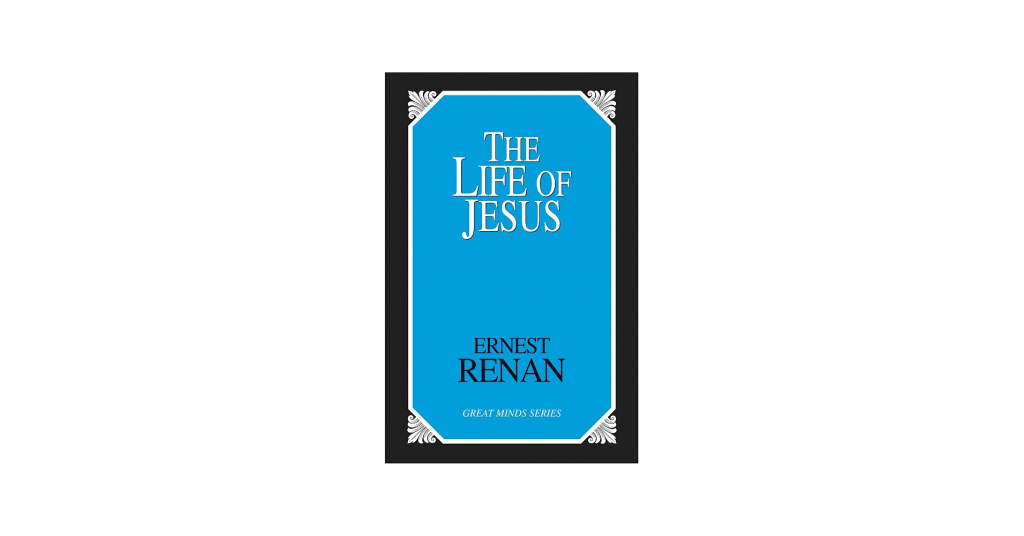
Jesus as a “democratic chief”
(Image from Amazon.com)
Me:
What is a “democratic chief” as referred to by Ernest Renan in his book The Life of Jesus?
- Google AI Overview
In The Life of Jesus, Ernest Renan uses “democratic chief” to describe Jesus as a popular leader of the common masses. He means a leader who embodies the collective spirit of ordinary people, speaks for them naturally, and rejects formal or pedantic upper classes. [1, 2, 3, 4]
Meaning of the Term
- Voice of the Multitude: A figure who feels the soul and desires of the common crowd living inside himself.
- Natural Interpreter: Recognized by the people as their true champion and spokesman.
- ** Populist Appeal:** Pitying the weak and rejecting rigid, traditional religious authorities. [1, 2, 3, 4, 5]
Ernest Renan’s humanistic approach in The Life of Jesus revolutionized biblical criticism by stripping away dogmatic theology. He treated Jesus strictly as a historical man rather than the divine Son of God.
Key Aspects of Renan’s Humanism
- Secular Biography: Rejects all miracles, resurrections, and supernatural events.
- Flawed Genius: Portrays Jesus as an extraordinary but ultimately mortal human being.
- Psychological Realism: Evaluates Jesus’s inner motivations, doubts, and emotional development.
- Cultural Context: Places Jesus firmly within first-century Jewish and Roman historical realities.
- Artistic Appreciation: Celebrates Jesus’s moral genius and poetic spirit over his theology.