
New Thinking Allowed with Jeffrey Mishlove • Nov 15, 2022 Reinerio Hernandez, JD, MCP, is currently the Director of the Consciousness and Contact Research Institute (CCRI). He is editor of several anthologies including Beyond UFOs, and the first two volumes of A Greater Reality. He is author of The Mind of God: A Spiritual-Virtual Reality Model of Consciousness & The Contact Modalities. Here he emphasizes his core argument that there is a unity behind UFO encounters, near-death experiences, out-of-body experiences, entheogenic experiences, mystical experiences, apports, materializations and other events associated with high-strangeness. He refers to these as “contact modalities.” Although he admits that he cannot specify the precise workings of that unity, he attributes it to “the mind of God.” He maintains that consciousness is fundamental and that what we perceive as the physical world is, in effect, a virtual realty, or a projection from a higher spiritual reality. He suggests that the best metaphor for this projection is to think in terms of Russian nesting dolls. New Thinking Allowed host, Jeffrey Mishlove, PhD, is author of The Roots of Consciousness, Psi Development Systems, and The PK Man. Between 1986 and 2002 he hosted and co-produced the original Thinking Allowed public television series. He is the recipient of the only doctoral diploma in “parapsychology” ever awarded by an accredited university (University of California, Berkeley, 1980). He is also the Grand Prize winner of the 2021 Bigelow Institute essay competition regarding the best evidence for survival of human consciousness after permanent bodily death. (Recorded on October 23, 2022)
All posts by Mike Zonta
Tarot Card for November 16: The Empress
The Empress
The Empress is numbered three and symbolises one half of a perfect polarity – the Emperor being the other side of the balance. From the purity of the High Priestess we move naturally onwards to the Empress’ sense of bounty and fertility. She represents the Mother Goddess, fulfilling her part in the eternal cycle of creation.
The Empress holds the power to steadily and determinedly rebuild, renew, nurture and nourish. She has an unquenchable and generous courage, responding instantly when she sees a need to defend. Her realm is built of love, fertility and warmth. When the Empress holds us we are once again in the sure safety of the infant at its mother’s breast.
She also represents unconditional love – making no demands and setting no conditions. If we allow her love to flow through us then we too can become a pure spring through which the Universe flows. Only our fears stand between us and the Goddess.

(via angelpaths.com and Alan Blackman)
A New Moral Compass: Caring for Evolution Itself
BY CRAIG HAMILTON | DEC 3, 2020 | 6 COMMENTS (craighamiltonglobal.com)

Question:
When I’m awake to what you call “the evolutionary impulse,”I find that I care deeply for many things: the environment, the awakening of humanity, social justice, animal rights, and so on. I take responsibility to live lightly on the planet. I donate time and money to the causes that I value. I’ve dedicated my life to being an ambassador for these things and my resources are finite. Would you say that this is, in a sense, what evolutionary morality looks like?
Answer:
This is a great question, and one that I think about all the time. In order to answer it, I need to make an important distinction around how you framed your question. You said, “When I’m awake to the evolutionary impulse I care for . . .”, and then you listed a variety of causes: the environment, social justice, animal rights, humanity awakening, etc.
It’s important to understand that as a person who is awake to this impulse of evolution, you might care about all the things you mentioned and many, many more. But I would guess that you don’t care about them because you’re awake to the Evolutionary Self.
In fact, you probably cared about those causes before you ever encountered the evolutionary impulse. And they would be, most likely, part of your value set independent of your connection to it.
The set of values that you laid out—things like a care for the environment, animal welfare, even spiritual awakening—are native to a general worldview that’s been defined as “worldcentric.” This worldview isn’t a spiritual awakening; it’s more of a psychological or cultural level of development based on what we value. When our values become worldcentric, we start to care about the whole world, as opposed to something smaller like our tribe or clan or even our nation.
We still care about those smaller entities, but our primary orientation is to the health of the whole planet, and everything on it. We identify as citizens of the human family and the planet as a whole more than as Americans, or Swedes, or caucasians, or Californians.
Not everyone on the planet has reached this worldcentric stage of development. In fact, most humans are still more “ethnocentric” and identified primarily with their family, their tribe, their race or their nation. But there are a growing number of us who see ourselves as global citizens. We care about social justice. We care about human rights, animal rights, and the environment. We care about the entire web of life that we’re a part of.
When we reach a worldcentric level of perspective and values, being a decent, caring person means that we care about some combination of these issues. But just because we’re awake to our role as a world citizen, doesn’t mean we’re necessarily awake in a spiritual sense. There are plenty of good people at the worldcentric level of development who aren’t enlightened or even interested in spirituality.
The shift that I’m pointing to when I’m talking about awakening to the impulse of evolutionis something altogether different. When we awaken to the evolutionary impulse as our self, we start to leave behind our personal perspective on things and begin to let in the truly transpersonal, or universal dimension of consciousness that is evolution itself. We start to become conscious vessels for the evolutionary impulse to act through us.
The real question, then, is what happens to our values? When we awaken to the evolutionary impulse,as us, or what I sometimes refer to as “the Evolutionary Self” what do we care about? What is our moral compass?
At this point, we are still a worldcentric person with all the worldcentric values: the environment, human rights, etc. We still care about all that. But we also start to care about something else—something very specific.
As the Evolutionary Self, we begin to care intensely about the evolution of consciousness. We start to become sensitive to consciousness itself, in ourselves and in the people around us. We start to become sensitive to this new dimension of our experience: what’s happening at the level of consciousness.
Another way of looking at this shift is that we’re tuned in to just how awake are those we come into contact with. How lost in ego is everyone around me? Are they awake to something higher? How awake am I? How much am I still embedded in my ego and the habitual patterns of the past? To what degree am I awake to something larger?
This kind of sensitivity to consciousness naturally gives birth to a particular kind of care. There’s this overwhelming and immediate care for higher evolution. It’s a care for the further evolution of consciousness. And that’s something that only we can do.
We become concerned about humanity waking up beyond ego. And I’m not talking about wanting to wake humanity up so that we can solve the many problems of the world, although it includes that. We’re primarily interested in awakening for its own sake. It’s as if God is trying to become manifest on earth, and we’re focused on facilitating and supporting that manifestation in any way we can. There’s a higher order principle at work that’s trying to come into form, but it needs us to be able to do so.
Of course, this kind of higher evolution would most likely give us the perspective to be able to solve most of our problems. But that’s not why it’s important. It’s important for its own sake. It’s important because heaven is trying to come down to earth. It’s important because divinity is trying to come into human form. It’s important because love needs vessels. Love needs to be expressed so that it can become known.
It’s a very deep thing. There’s something profound that needs to become known in order to really exist. In order for its potential to be realized, it must be known, discovered, expressed, and embodied. When you awaken to this, you begin to care about that dimension—in yourself, in others, and in all of humanity.
This evolutionary awakening then begins to infuse all aspects of who we are, and it adds a certain fire to our worldcentric values. As we transcend ego and start to live from a deeper center, we’re going to be more committed, more passionate about everything. And we’re going to be more effective. We’re going to be more willing to fight for all the things we believe in, to stand for them, to not compromise, and to push further out to the edge than ever before.
(Contributed by Sarah Flynn)
The helpful delusion
Evidence is growing that mental illness is more than dysfunction, with enormous implications for treatment
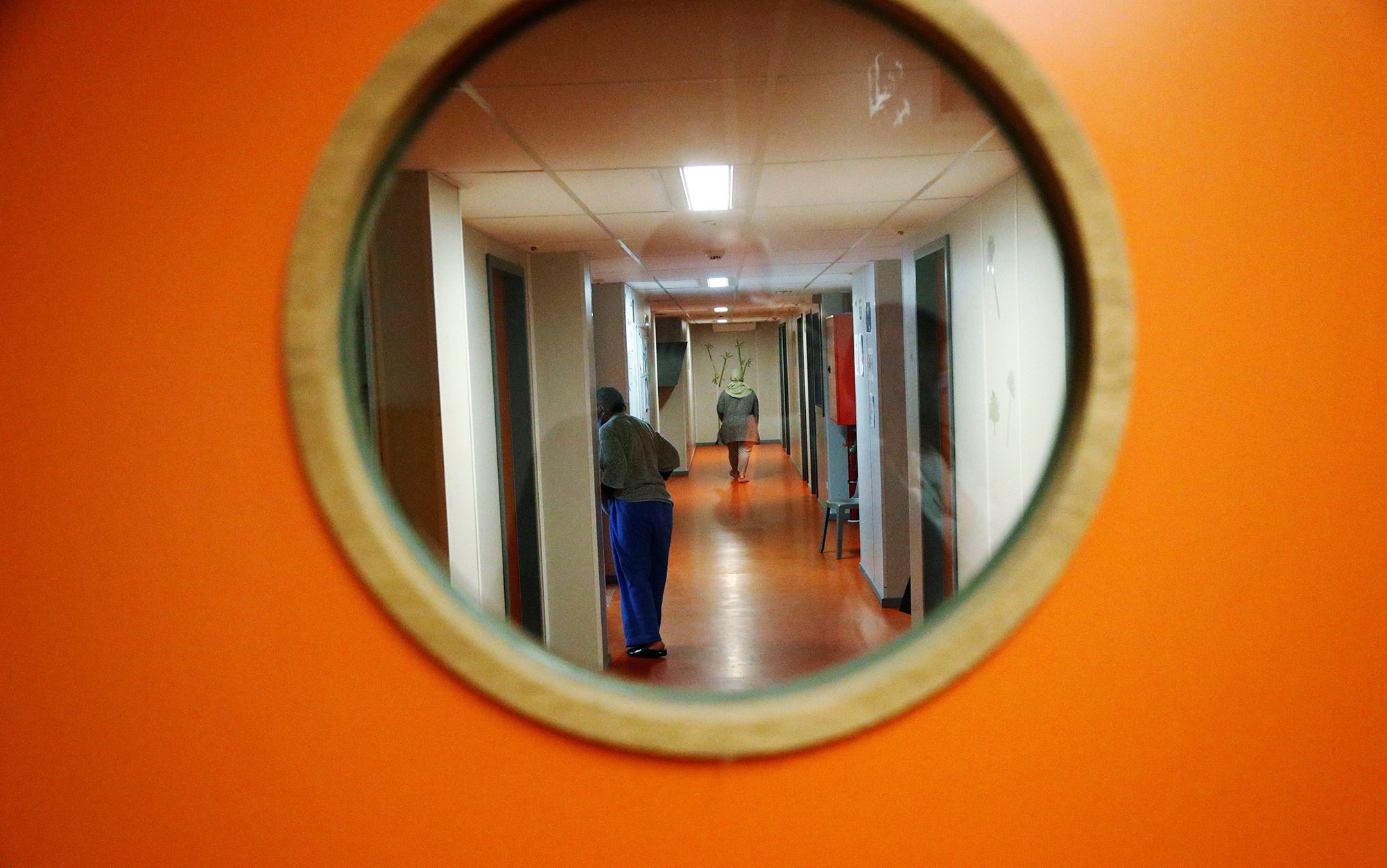
The Titeca psychiatric hospital in Brussels, Belgium, 14 April 2020. Photo by Francois Lenoir/Reuters
Justin Garson is professor of philosophy at Hunter College and the Graduate Center, City University of New York. His latest book is Madness: A Philosophical Exploration (2022). He also writes for Psychology Today on different paradigms of mental illness.
Edited by Christian Jarrett
14 November 2022 (aeon.co)
Please support our work
Most people thought my dad lived alone. He didn’t. He lived with God and the French actress Catherine Deneuve. They were outside of him but somehow projected their voices into his mind.
Throughout my teens and 20s, the four of us would have conversations over coffee and cigarettes. Catherine was always kind to me. One day before a job interview, she said I looked quite handsome and my prospects were good. She never meant to harm my dad, but she did get him into trouble once in a while.
One night, around two in the morning, she played a joke on him. She said she’d flown from Paris to Washington, DC in the flesh, and was hiding in his apartment building. She was tired of projecting her voice into his head, she explained, and wanted to see him in person. Upon hearing this, he jumped out of bed naked and ran through the narrow hallways of his apartment complex in Dupont Circle screaming: ‘Catherine! Catherine! Where are you?’ She would taunt: ‘I’m just around the corner!’ He must have seemed like a real maniac. That night ended with another hospitalisation. These stays always followed the same script. First, the doctors would give him drugs that stopped him from hearing God and Catherine. Then they would watch him for a few days. Then they would reprimand him for getting off the antipsychotic medications, and threaten routine blood tests to ensure his compliance. Then they’d let him go. To them, ‘bipolar disorder’, ‘schizoaffective disorder’ and ‘schizophrenia’ were names of diseases, akin to ‘cancer’, ‘diabetes’ or ‘fibromyalgia’. They weren’t portals into strange, exhilarating and sometimes frightening new worlds.
In 1991, shortly after starting college, I visited my dad in his studio apartment and then had a revelation that continues to shape my academic career today. Sitting on his bed and holding a cigarette thoughtfully, he said: ‘Justin, I know God and Catherine aren’t real. I know they’re not really talking to me. I just have a strong imagination. But I don’t know what I would do without them. I have nothing. I don’t have family nearby. I don’t have a job. I don’t have a girlfriend. I don’t have money other than the pension. They’re all that keep me company.’
It dawned on me then that God and Catherine might not have been byproducts of a diseased brain. They may have had a function, or purpose. I began to wonder if the psychiatrists who looked after my dad were too quick to slap the ‘disorder’ label on his experiences. What if some of the things people describe as mental disorders are purposeful, not pathological?
Sign up to our newsletter
Updates on everything new at Aeon.
DailyWeeklySubscribe
See our newsletter privacy policy here.
Ididn’t think much more about these questions until 10 years later when, as a grad student in philosophy, I stumbled upon the book Why We Get Sick: The New Science of Darwinian Medicine (1994) by Randolph Nesse, a physician, and George C Williams, an evolutionary biologist. They argued that real progress in medicine won’t happen until we look at health and disease in terms of the big picture of evolution. When we do that, conditions that we’ve long considered to be diseases can turn out to be adaptations. That is, we can see them as shaped by natural selection because of an advantage they gave to our ancestors. They’re functional, not dysfunctional.
Think about fever. From ancient Greek times through to the Middle Ages, many doctors ‘knew’ fever was a disease – a ‘heat contrary to nature’ as Galen put it. The only question was how to destroy it before it destroys you. But then in the 18th century, the German chemist Georg Stahl advanced a brilliant insight that is universally accepted today. Rather than being a disease, what if fever is actually the body’s healing response to infection?
Seeing fever as functional, not dysfunctional, didn’t mean you stopped treating it. Rather, it transformed the character of treatment. Fever was no longer the thing you’re trying to attack, to stifle, to pummel with medications. Instead, you recognise that the fever has a role to play in the healing process. The purpose of medicine is to comfort the patient and curb fever’s excessive manifestations.
Depression can be the brain’s evolved signal that something in a person’s life needs to change
In their book, Nesse and Williams advanced the hypothesis that some mental disorders, such as depression, also have an evolved function, just as fever evolved to fight infection, or calluses evolved to protect the skin from friction. But what could possibly be the evolved function of depression? From extremely low moods, to lack of sleep, to chronic feelings of worthlessness or guilt, all the way to thoughts of, or attempts at, suicide, depression seems to fall clearly on the dysfunction side of the fence.
In later work, Nesse argued that depression is sometimes the brain’s evolved signal that something in a person’s life needs to change, such as a harmful relationship, an unrealistic career plan or a goal that needs to be re-evaluated. What that means in practice is that it’s not always best to bombard depression with medication. Sometimes, it’s better to figure out what depression is trying to say. The theory that depression is an evolved signal doesn’t ignore the fact that depression often has a tragic outcome. Nesse and Williams’s core point was that we can no longer take the dysfunction paradigm as the silent default when treating depression.
I wondered if anyone else grasped how subversive this book was to contemporary psychiatry’s disease mentality. I also wondered if anyone else in history had advocated a similar point of view. Of course, before Charles Darwin, doctors wouldn’t have had the language and concepts of evolutionary biology to express their ideas. Instead of saying that depression is an evolved adaptation, they might have expressed themselves in other ways.
The first name that came to my mind was Sigmund Freud. To me, his most important idea wasn’t the Oedipus complex (which nobody believes in anyway), infant sexuality, or the death drive. Rather, it was the idea, which drove his life’s work, that each form of what he called ‘madness’ has a special function, just like fever or calluses.
Specifically, he saw that its goal is to help us satisfy unconscious wishes – but in a disguised form. According to him, a young woman’s compulsive need to arrange and rearrange the pillows on her bed lets her symbolically fulfil her unconscious wish to sleep with her father, but in such a way that she never becomes aware of its real meaning. Freud was adamant that, often enough, the conditions we label ‘pathologies’ are actually the expression of an unconscious goal. Early psychoanalysts such as Frieda Fromm-Reichmann and Harry Stack Sullivan attempted to apply this perspective to treating schizophrenia.
Don’t get me wrong. Freud was mistaken about a lot of things (including about the pillow-arranging woman who likely had no such unconscious wishes, but was probably using compulsions to try to contain her anxiety). My point is that Freud insisted that mental disorders as diverse as hysteria, compulsive behaviour and delusions were purposeful, not pathological.
I kept digging through the annals of psychiatry, rifling through old books and articles to find others who’d had a similar insight. Take Philippe Pinel, the head of the Bicêtre and Salpêtrière mental asylums in Paris during the French Revolution. Historians remember Pinel as someone who helped introduce the ‘moral treatment of the insane’ to France, but they often overlook his other radical ideas, such as that some intense episodes of manic psychosis, which he called accès de Manie, had a healing power – after such episodes, he observed, chronic patients were often ready to be discharged.
Some delusions are actually coping mechanisms that help to shield the mind from traumatic experiences
The conclusion Pinel drew? These attacks had a ‘salutary’ and favourable impact. He even had the audacity to compare himself with Stahl. These psychotic episodes are like fever: it’s not the thing that makes you sick, but the thing that stops you from getting sicker. Pinel used sarcasm and humour to ridicule his medical colleagues who tried to stifle psychotic episodes with drugs, bleeding, purging and vomiting: ‘I ask now if all physicians who seek to cure similar attacks, do not deserve to be put in the place of the madman himself?’
Another theorist I encountered was the German Johann Christian August Heinroth, who worked around the same time as Pinel. He was the first chair of psychiatry in Europe. In his 1818 textbook, he argued that some delusions are actually coping mechanisms that help to shield the mind from painful or traumatic experiences. In the best of cases, he thought, the delusions would abate of their own after achieving their healing end. That same year, the pessimistic philosopher Arthur Schopenhauer, in his magnum opus The World as Will and Representation (1818), made a similar point.
My explorations led me further back, to 17th- and 18th-century thinkers such as Robert Burton and George Cheyne. Steeped in a religious worldview, they saw madness and melancholy as God’s response to our sinful choices. But God’s ultimate goal wasn’t punishment: it was reformation. Cheyne, for example, thought that excessive drinking leads to melancholy – but melancholy is how God gets us to stop drinking. Similar to Nesse, Burton thought that depression was a ‘designed signal’ that something in a person’s life needs to change. These thinkers form a chain that stretches back to the time of Hippocrates.
As I did this research, a vision began to unfold before me. What if you could tell the story of psychiatry, from the ancient Greek doctors to today’s geneticists and neuroscientists, in terms of a profound schism? This schism isn’t the one we often read about, between proponents of a more psychoanalytic ‘mind’ versus more biological ‘brain’ point of view. It’s a clash between those who see purpose in madness – I call it ‘madness-as-strategy’ – and others who see only pathology and disease, or ‘madness-as-dysfunction’. And what if this historic battle is coming to a head today?
Colleagues have been sceptical about the way I’ve assembled such diverse figures under the single madness-as-strategy category. It’s true that when you zoom into the details of their theories and worldviews, there’s tremendous divergence, even contradiction. But I see the crucial common thread that unites them as more important. By recognising that something always put in the ‘dysfunction’ category actually belongs in the ‘function’ category, Burton, Stahl, Pinel, Heinroth, Freud and Nesse all made a gestalt switch of momentous proportions – unlocking fundamentally new forms of research, classification and treatment. And perhaps now the tide is finally turning in favour of their side of the debate.
In the nearly 30 years since the publication of Why We Get Sick, the field of Darwinian medicine has exploded. Today, there are numerous textbooks, university courses and scholarly articles on the topic. Evolutionary psychiatry in particular is witnessing a flurry of interest. In the past eight years, three textbooks on the subject have been published, each drawing on hundreds of scholarly articles. It feels to me as if we’re on the verge of a deep-rooted paradigm shift in psychiatry.
Evolutionary psychiatry doesn’t insist that all mental disorders have evolved functions. For instance, Lewy body dementia, which affected the actor Robin Williams, can lead to depression and personality change, which can be traced to a build-up of misfolded proteins in the brain. But the evolutionary approach has revealed at least three ways that various mental health ‘disorders’ might actually be functional: some represent evolved responses to current crises; others, evolved responses to past crises; and still others, evolved cognitive styles. The real value of thinking of mental illness in terms of function isn’t to destroy the dysfunction paradigm, but to show why it can no longer serve as the default starting point for all psychiatric thinking and practice.
Depression is probably the best candidate for the first type of function – an adaptation to a current crisis; nature’s attempt to show us that something in our lives isn’t working out, and to motivate us to make the right changes. When the issue that depression is trying to shed light on isn’t obvious to us, therapy can be extremely valuable to help us see where the problem lies. Sometimes, we might be so sunk into our depression that we need medication to lift us out of it for long enough to be able to address the root problem. There’s no contradiction between seeing depression as functional and seeing a role for medication.
Emerging evidence suggests that dyslexia is actually a distinct cognitive style in its own right
Other mental disorders aren’t evolved responses to a current problem, but to a past problem. Borderline personality disorder (BPD) is a plausible example. BPD is associated with a cluster of personality traits including mistrust of others, hypervigilance to rejection, fragile interpersonal relationships and impulsiveness.
Although some have described BPD as involving a brain dysfunction, such as a frontal lobe deficit, a widely accepted viewpoint is that BPD traits are coherent responses to adverse childhood experiences, such as abuse, neglect and trauma. In fact, 80 per cent of people diagnosed with BPD report such adverse experiences. The evolutionary psychiatrist Martin Brüne recently sought to make sense of BPD traits as an evolved adaptation to such adverse experiences, or as a kind of exaggerated, maladaptive version of such an adaptation.
Of course, to say that BPD traits are an adaptive response to an early, adverse experience doesn’t mean those traits continue to be advantageous through life. In fact, they can stand in the way of developing long-lasting and meaningful relationships. The point is that the evolutionary perspective can inform approaches to treatment. A goal of therapy could be to help people see why they adopted those strategies early in life, and why those strategies might be limiting their possibilities today.
A third trend in evolutionary psychiatry is to see certain disorders, such as dyslexia, as evolved cognitive styles, rather than dysfunctions. The conventional biomedical perspective sees dyslexia as a disorder of reading and writing that stems from a brain dysfunction that hurts our ability to match sounds and shapes. However, emerging evidence from archaeology, neuroscience and cognitive psychology suggests that dyslexia is actually a distinct cognitive style in its own right, with its own strengths and benefits.
Consistent with the evolutionary perspective, people with dyslexia often have a ‘big picture’ grasp of their environment. For example, they’re quicker to notice when a work of art represents an impossible figure, such as M C Escher’s Waterfall (1961). They also excel at ‘divergent thinking’, the ability to come up with multiple solutions to the same problem. This perhaps explains why, according to one study, roughly one third of American entrepreneurs have dyslexia. Early communities may have found people with dyslexia to be a real asset, as they needed to rely on big-picture thinking and problem-solving abilities in order to survive and thrive. If the evolutionary psychiatrists are right, we need to change our educational systems to allow people with dyslexia to exercise their cognitive gifts, rather than stifle them.
Sceptics might wonder if there are limits to the evolutionary approach to mental health. For instance, how might it help us think about psychotic delusions? Are they not a perfect example of something ‘going wrong’ in the mind? It’s hard to see anything positive or functional in having the conviction that a celebrity is in love with you, that you’ve been charged with a secretive mission of geopolitical significance, or that you’re the second coming of Christ. Surely, delusions are severely dysfunctional?
In fact, groundbreaking research is starting to suggest a more expansive picture of delusions that’s also in keeping with evolutionary psychiatry. For instance, a survey of the content of delusions, led by the psychiatrist and philosopher Rosa Ritunnano found that there’s a category of delusions that can be best understood as the mind’s attempt to find meaning in the face of a crisis, such as a relationship breakup or financial worries. Ritunnano’s theoretical convictions are mirrored in her clinical work, where she helps clients explore how their delusions might guide them through the challenges of life.
Similarly, the clinical psychologist Louise Isham and her colleagues recently studied grandiose delusions – of the kind experienced by the mathematician John Nash, who believed he was conducting secret government work, as depicted in the movie A Beautiful Mind (2001) – and found that the greater the grandiosity of delusional beliefs, the more they tended to give people a sense of meaning in life. Isham suggests that it’s precisely this sense of meaning that might explain why people can hold on to these delusions for so long.
He became convinced that the FBI had wiretapped his phone, which was not entirely improbable
Reading about the work of Ritunnano, Isham and others, I couldn’t help thinking back to that conversation with my dad. I wondered if these contemporary researchers had pinpointed, precisely, what my dad’s doctors were simply unable to see. Was it possible that his voices, and the strange beliefs he formed about them – that a celebrity was in love with him, that God had given him a world-changing mission – infused his life with a powerful sense of purpose?
It wouldn’t be a stretch. My dad was an extremely ambitious person. The son of Lithuanian Jewish immigrants, he completed a Master’s thesis in English, and then received his law degree from Harvard Law School. In 1967, he co-authored an article that helped to open US-China trade relations, and went on to become an international tax lawyer for the US government, working under Richard Nixon. During this time, he became convinced that the FBI had wiretapped his phone, which was not entirely improbable. The pressure he experienced culminated in a series of psychotic episodes. Although he was able to continue in his position for another decade, similar episodes in the mid-1980s made it impossible for him to continue working, hence the flimsy government pension and the studio apartment. From the perspective of his previous accomplishments, by the time of the chat I had with him in his apartment, he practically had ‘nothing’ – but for God and Catherine.
I must tread carefully here. To say that some delusions give us a sense of meaning in life is far from saying that the capacity for delusions evolved, by natural selection, for that very reason. By definition, natural selection selects traits only on the basis of whether they give us, or our close relations, a reproductive edge. While it’s possible to see delusions as psychologically useful in some ways, that doesn’t mean they’re biologically adaptive – though some cognitive neuroscientists have made that argument (they propose that delusions can help us make sense of unusual perceptual experiences, and thereby help us continue functioning in the world).
Even if the capacity for delusions didn’t evolve by natural selection, seeing their psychological benefits has an important treatment implication. It’s the same lesson that Stahl taught us regarding fever. Trying to attack the delusion head-on might do far more harm than good. Rather, you want to help the person find alternative, and less harmful, ways of achieving the same goal of having a meaningful life.
In fact, some support groups, such as the Hearing Voices Network and Open Minded Online aim to provide people with the tools they need to manage their voices more constructively, rather than seeing them as the symptom of a disease to be medicated. Newer approaches to healing, such as the Open Dialogue model, emphasise the role of family and extended support networks in helping people during psychotic episodes, and seek to minimise the need for hospitalisation and antipsychotic medications.
The implications of the madness-as-strategy perspective don’t stop with treatment. After talking with scientists like Ritunnano, I began to think about the messages often sent by the prevailing madness-as-dysfunction view to people who’ve been diagnosed with serious mental disorders. What if many of the dysfunction-based terms and phrases that are in common use, for instance among social workers and on educational YouTube videos – such as ‘chemical imbalance’, ‘brain circuit disorder’, ‘depression is like diabetes’ – end up harming the very people they’re meant to serve?
Unfortunately, contrary to the hopes of the National Alliance on Mental Illness and others who’ve described mental illnesses as diseases, recent research does not support the claim that madness-as-dysfunction explanations of mental illness reduce stigma. According to some studies, they actually increase it in some ways. That’s because biological explanations (such as the chemical imbalance view) encourage people to think of mental health problems as permanent, and that the person so affected might be dangerous and unpredictable, and that we should distance ourselves from them. It also leads service users to be more pessimistic about treatment outcomes.
In contrast, there’s preliminary new evidence that seeing depression as a functional signal that something in life isn’t working out might lead to better treatment outcomes and reduced stigma. One researcher who studies this is the clinical psychologist Hans Schroder. Several years ago, Schroder decided to introduce the evolutionary psychiatry account of depression to his patients. What if their depression is ‘trying to tell them something’? Afterwards, he noticed that things started to change. Some became more enthusiastic about therapy. Some felt, for the first time in their lives, a glimmer of hope. They stopped seeing their depression as an irreversible brain defect, and started seeing it as a coherent response to a crisis.
Our casual use of disease language isn’t just scientifically dubious. It may be immoral
In subsequent research, involving people with experience of depression watching videos that espoused either the chemical-imbalance view of depression or the depression-as-signal view, Schroder confirmed his earlier observations in the clinic. Patients who watched the ‘signal’ video scored significantly higher than the other group on three measures of wellbeing: they felt less helpless about their depression; they felt that their condition gave them more useful insights; and they felt less stigma about it.
To me, this shows the long-running schism in psychiatry between seeing mental problems as dysfunctional or functional is more than a long-running intellectual debate – it’s of profound ethical importance too. Our casual use of disease language isn’t just scientifically dubious. It may be immoral.
Looking back, I wonder what my dad would have thought about these contrasting paradigms and the rise of evolutionary psychiatry. Unfortunately, we never got to talk deeply about them. In the 1990s, my dad started having problems moving his limbs correctly. Movement disorders are a well-known side-effect of the antipsychotic drug he was on, chlorpromazine.
At first, he struggled with fine motor control. A simple attempt to tie his shoelaces, or feed a dollar into a vending machine, could release a frenzy of curses. Over time, his gross motor control started to suffer, too. He couldn’t move for long distances, like at an airport, without a wheelchair.
Eventually, his doctors switched him to one of the newer (‘second generation’) antipsychotic drugs, which are supposedly more benign. But, by then, it was too late to reverse the motor damage. The newer drug, clozapine, had its own nasty side effects, such as painful ankle swelling and severe constipation.
By the early 2000s, my dad’s motor problems affected his ability to swallow normally. His brain couldn’t control his epiglottis – the thin tissue that stops food and water from going into your lungs. This may have been what doctors now call antipsychotic-induced dysphagia. Drinking a glass of water could send him to the emergency room. After several bouts of pneumonia, he died in 2005, right about when I started my philosophy dissertation on the concept of mental disorder.
I sometimes wonder if my academic work would have changed anything for him. I imagine what might have happened if he’d known about organisations like the Hearing Voices Network, or the Open Dialogue model, and had a chance to learn about better ways of engaging with his voices. I think about what might have changed if he’d had a therapist who was willing to consider that his hallucinations and delusions had a hidden function, and crafted a gentler treatment plan for him. Sometimes I think I’m still trying to speak with him, screaming across the abyss, telling him nothing was wrong with his mind.
Mental health Psychiatry and psychotherapy Illness and disease
(Courtesy of Gwyllm Llwydd)
Gandhi on the still small voice within

“The only tyrant I accept in this world is the ‘still small voice’ within me. And even though I have to face the prospect of being a minority of one, I humbly believe I have the courage to be in such a hopeless minority.”
[“The Essential Gandhi,” 2002]
Mohandas Karamchand Gandhi (October 2, 1869 – January 30, 1948) was an Indian lawyer, anti-colonial nationalist and political ethicist who employed nonviolent resistance to lead the successful campaign for India’s independence from British rule, and to later inspire movements for civil rights and freedom across the world. Wikipedia,
Synesthesia — sense testimony mixes it up
From Wikipedia, the free encyclopedia
| Synesthesia | |
|---|---|
| How someone with synesthesia might perceive certain letters and numbers. Most synesthetes see characters just as others do (in whichever color actually displayed) but may simultaneously perceive colors as associated with or evoked by each one. | |
| Specialty | Psychology, Psychiatry, Neurology |

Synesthesia (American English) or synaesthesia (British English) is a perceptual phenomenon in which stimulation of one sensory or cognitive pathway leads to involuntary experiences in a second sensory or cognitive pathway.[1][2][3][4] People who report a lifelong history of such experiences are known as synesthetes. Awareness of synesthetic perceptions varies from person to person.[5] In one common form of synesthesia, known as grapheme–color synesthesia or color–graphemic synesthesia, letters or numbers are perceived as inherently colored.[6][7] In spatial-sequence, or number form synesthesia, numbers, months of the year, or days of the week elicit precise locations in space (e.g., 1980 may be “farther away” than 1990), or may appear as a three-dimensional map (clockwise or counterclockwise).[8][9] Synesthetic associations can occur in any combination and any number of senses or cognitive pathways.[10]
Little is known about how synesthesia develops. It has been suggested that synesthesia develops during childhood when children are intensively engaged with abstract concepts for the first time.[11] This hypothesis – referred to as semantic vacuum hypothesis – could explain why the most common forms of synesthesia are grapheme–color, spatial sequence, and number form. These are usually the first abstract concepts that educational systems require children to learn.
Difficulties have been recognized in adequately defining synesthesia.[12][13] Many different phenomena have been included in the term synesthesia, and in many cases the terminology seems to be inaccurate. A more accurate but less common term may be ideasthesia.[citation needed]
The earliest recorded case of synesthesia is attributed to the Oxford University academic and philosopher John Locke, who, in 1690, made a report about a blind man who said he experienced the color scarlet when he heard the sound of a trumpet.[14] However, there is disagreement as to whether Locke described an actual instance of synesthesia or was using a metaphor.[15] The first medical account came from German physician Georg Tobias Ludwig Sachs in 1812.[15][16][17] The term is from the Ancient Greek σύν syn, ‘together’, and αἴσθησις aisthēsis, ‘sensation‘.[14]
Types
There are two overall forms of synesthesia:
- projective synesthesia: seeing colors, forms, or shapes when stimulated (the widely understood version of synesthesia)
- associative synesthesia: feeling a very strong and involuntary connection between the stimulus and the sense that it triggers
For example, in chromesthesia (sound to color), a projector may hear a trumpet, and see an orange triangle in space, while an associator might hear a trumpet, and think very strongly that it sounds “orange”.[citation needed]
Synesthesia can occur between nearly any two senses or perceptual modes, and at least one synesthete, Solomon Shereshevsky, experienced synesthesia that linked all five senses.[18] Types of synesthesia are indicated by using the notation x → y, where x is the “inducer” or trigger experience, and y is the “concurrent” or additional experience. For example, perceiving letters and numbers (collectively called graphemes) as colored would be indicated as grapheme-color synesthesia. Similarly, when synesthetes see colors and movement as a result of hearing musical tones, it would be indicated as tone → (color, movement) synesthesia.
While nearly every logically possible combination of experiences can occur, several types are more common than others.
Grapheme–color synesthesia
Main article: Grapheme–color synesthesia
From the 2009 non-fiction book Wednesday Is Indigo Blue.[3] Note the numbers 1-12 form an upside-down clock face.
In one of the most common forms of synesthesia, individual letters of the alphabet and numbers (collectively referred to as “graphemes”) are “shaded” or “tinged” with a color. While different individuals usually do not report the same colors for all letters and numbers, studies with large numbers of synesthetes find some commonalities across letters (e.g., A is likely to be red).[19]
Chromesthesia
Main article: Chromesthesia
Another common form of synesthesia is the association of sounds with colors. For some, everyday sounds can trigger seeing colors. For others, colors are triggered when musical notes or keys are being played. People with synesthesia related to music may also have perfect pitch because their ability to see and hear colors aids them in identifying notes or keys.[20]
The colors triggered by certain sounds, and any other synesthetic visual experiences, are referred to as photisms.
According to Richard Cytowic,[3] chromesthesia is “something like fireworks”: voice, music, and assorted environmental sounds such as clattering dishes or dog barks trigger color and firework shapes that arise, move around, and then fade when the sound ends. Sound often changes the perceived hue, brightness, scintillation, and directional movement. Some individuals see music on a “screen” in front of their faces. For Deni Simon, music produces waving lines “like oscilloscope configurations – lines moving in color, often metallic with height, width, and, most importantly, depth. My favorite music has lines that extend horizontally beyond the ‘screen’ area.”
Individuals rarely agree on what color a given sound is. Composers Franz Liszt and Nikolai Rimsky-Korsakov famously disagreed on the colors of musical keys.
Spatial sequence synesthesia
Those with spatial sequence synesthesia (SSS) tend to see ordinal sequences as points in space. People with SSS may have superior memories; in one study, they were able to recall past events and memories far better and in far greater detail than those without the condition. They can also see months or dates in the space around them, but most synesthetes “see” these sequences in their mind’s eye. Some people see time like a clock above and around them.[21][22][23]
Number form
Main article: Number form
A number form from one of Francis Galton’s subjects (1881).[8] Note how the first 4 digits roughly correspond to their positions on a clock face.
A number form is a mental map of numbers that automatically and involuntarily appear whenever someone who experiences number-forms synesthesia thinks of numbers. These numbers might appear in different locations and the mapping changes and varies between individuals. Number forms were first documented and named in 1881 by Francis Galton in “The Visions of Sane Persons”.[24]
Auditory–tactile synesthesia
In auditory–tactile synesthesia, certain sounds can induce sensations in parts of the body. For example, someone with auditory–tactile synesthesia may experience that hearing a specific word or sound feels like touch in one specific part of the body or may experience that certain sounds can create a sensation in the skin without being touched (not to be confused with the milder general reaction known as frisson, which affects approximately 50% of the population). It is one of the least common forms of synesthesia.[25]
Ordinal linguistic personification
Main article: Ordinal linguistic personification
Ordinal-linguistic personification (OLP, or personification) is a form of synesthesia in which ordered sequences, such as ordinal numbers, week-day names, months, and alphabetical letters are associated with personalities or genders (Simner & Hubbard 2006). Although this form of synesthesia was documented as early as the 1890s,[26][27] researchers have, until recently, paid little attention to it (see History of synesthesia research). This form of synesthesia was named “OLP” in the contemporary literature by Julia Simner and colleagues[28] although it is now also widely recognised by the term “sequence-personality” synesthesia. Ordinal linguistic personification normally co-occurs with other forms of synesthesia such as grapheme–color synesthesia.
Misophonia
Main article: Misophonia
Misophonia is a neurological disorder in which negative experiences (anger, fright, hatred, disgust) are triggered by specific sounds. Cytowic suggests that misophonia is related to, or perhaps a variety of, synesthesia.[1] Edelstein and her colleagues have compared misophonia to synesthesia in terms of connectivity between different brain regions as well as specific symptoms.[1] They formed the hypothesis that “a pathological distortion of connections between the auditory cortex and limbic structures could cause a form of sound-emotion synesthesia.”[29] Studies suggest that individuals with misophonia have a normal hearing sensitivity level but the limbic system and autonomic nervous system are constantly in a “heightened state of arousal” where abnormal reactions to sounds will be more prevalent.[30]
Newer studies suggest that depending on its severity, misophonia could be associated with lower cognitive control when individuals are exposed to certain associations and triggers.[31]
It is unclear what causes misophonia. Some scientists believe it could be genetic, others believe it to be present with other additional conditions however there is not enough evidence to conclude what causes it.[32] There are no current treatments for the condition but could be managed with different types of coping strategies.[32] These strategies vary from person to person, some have reported the avoidance of certain situations that could trigger the reaction: mimicking the sounds, cancelling out the sounds by using different methods like earplugs, music, internal dialog and many other tactics. Most misophonics use these to “overwrite” these sounds produced by others.[33]
Mirror-touch synesthesia
Main article: Mirror-touch synesthesia
This is a form of synesthesia where individuals feel the same sensation that another person feels (such as touch). For instance, when such a synesthete observes someone being tapped on their shoulder, the synesthete involuntarily feels a tap on their own shoulder as well. People with this type of synesthesia have been shown to have higher empathy levels compared to the general population. This may be related to the so-called mirror neurons present in the motor areas of the brain, which have also been linked to empathy.[34]
Lexical–gustatory synesthesia
Main article: Lexical–gustatory synesthesia
This is another form of synesthesia where certain tastes are experienced when hearing words. For example, the word basketball might taste like waffles. The documentary ‘Derek Tastes of Earwax’ gets its name from this phenomenon, in references to pub owner James Wannerton who experiences this particular sensation whenever he hears the name spoken.[35][36] It is estimated that 0.2% of the synesthesia population has this form of synesthesia, making it the rarest form.[37]
Kinesthetic synesthesia
Kinesthetic synesthesia is one of the rarest documented forms of synesthesia in the world.[38] This form of synesthesia is a combination of various different types of synesthesia. Features appear similar to auditory–tactile synesthesia but sensations are not isolated to individual numbers or letters but complex systems of relationships. The result is the ability to memorize and model complex relationships between numerous variables by feeling physical sensations around the kinesthetic movement of related variables. Reports include feeling sensations in the hands or feet, coupled with visualizations of shapes or objects when analyzing mathematical equations, physical systems, or music. In another case, a person described seeing interactions between physical shapes causing sensations in the feet when solving a math problem. Generally, those with this type of synesthesia can memorize and visualize complicated systems, and with a high degree of accuracy, predict the results of changes to the system. Examples include predicting the results of computer simulations in subjects such as quantum mechanics or fluid dynamics when results are not naturally intuitive.[19][39]
Other forms
Other forms of synesthesia have been reported, but little has been done to analyze them scientifically. There are at least 80 types of synesthesia.[38]
In August 2017 a research article in the journal Social Neuroscience reviewed studies with fMRI to determine if persons who experience autonomous sensory meridian response are experiencing a form of synesthesia. While a determination has not yet been made, there is anecdotal evidence that this may be the case, based on significant and consistent differences from the control group, in terms of functional connectivity within neural pathways. It is unclear whether this will lead to ASMR being included as a form of existing synesthesia, or if a new type will be considered.[40]
Signs and symptoms
Some synesthetes often report that they were unaware their experiences were unusual until they realized other people did not have them, while others report feeling as if they had been keeping a secret their entire lives.[41] The automatic and ineffable nature of a synesthetic experience means that the pairing may not seem out of the ordinary. This involuntary and consistent nature helps define synesthesia as a real experience. Most synesthetes report that their experiences are pleasant or neutral, although, in rare cases, synesthetes report that their experiences can lead to a degree of sensory overload.[19]
Though often stereotyped in the popular media as a medical condition or neurological aberration, many synesthetes themselves do not perceive their synesthetic experiences as a handicap. On the contrary, some report it as a gift – an additional “hidden” sense – something they would not want to miss. Most synesthetes become aware of their distinctive mode of perception in their childhood. Some have learned how to apply their ability in daily life and work. Synesthetes have used their abilities in memorization of names and telephone numbers, mental arithmetic, and more complex creative activities like producing visual art, music, and theater.[41]
Despite the commonalities which permit the definition of the broad phenomenon of synesthesia, individual experiences vary in numerous ways. This variability was first noticed early in synesthesia research.[42] Some synesthetes report that vowels are more strongly colored, while for others consonants are more strongly colored.[19] Self-reports, interviews, and autobiographical notes by synesthetes demonstrate a great degree of variety in types of synesthesia, the intensity of synesthetic perceptions, awareness of the perceptual discrepancies between synesthetes and non-synesthetes, and the ways synesthesia is used in work, creative processes, and daily life.[41][43]
Synesthetes are very likely to participate in creative activities.[39] It has been suggested that individual development of perceptual and cognitive skills, in addition to one’s cultural environment, produces the variety in awareness and practical use of synesthetic phenomena.[5][43] Synesthesia may also give a memory advantage. In one study, conducted by Julia Simner of the University of Edinburgh, it was found that spatial sequence synesthetes have a built-in and automatic mnemonic reference. Whereas a non-synesthete will need to create a mnemonic device to remember a sequence (like dates in a diary), a synesthete can simply reference their spatial visualizations.[44]
Looking at Life without Words — Zen Lesson
PERENNIAL 83
“You cannot understand life as long as you try to grasp it.”
Neuroscientists often describe our brains as categorization or prediction machines. Bart de Langhe and Philip Fernbach write in an article titled The Dangers of Categorical Thinking that categorization comes so naturally to us that we often see categories where none exist. That warps our view of the world and harms our ability to make sound decisions.
What are words exactly? The writer Alan Watts stressed that we have forgotten that thoughts and words are conventions and that it is fatal to take conventions too seriously.
“Once we slap a label on something,” observed the theologian Anthony de Mello, “our understanding stops.” In his book Awareness, de Mello asked, How can you understand something you disapprove of or approve of, for that matter? We must observe without the desire to change what is.
In the classic Zen Mind, Beginner’s Mind, Shunryu Suzuki explained the problem of labels and the concept of emptiness. Suzuki wrote,
“We ‘empty’ ideas of big or small, good or bad from our experience, because the measurement that we use is usually based on the self. When we say good or bad, the scale is yourself. Each person has a scale that is different… How we empty that part is to practice zazen and become more accustomed to accepting things as it is without any idea of big or small, good or bad.”
In his book, The Wisdom of Insecurity, Watts put it this way, “To look at life without words is not to lose the ability to form words — to think, remember, and plan. To be silent is not to lose your tongue. On the contrary, only through silence can one discover something new to talk about.”
Take a few moments to contemplate this passage from the Tao Te Ching (traditionally attributed to the Chinese philosopher Lao Tzu):
“When people see things as beautiful, ugliness is created. When people see things as good, evil is created.
Being and non-being produce each other. Difficult and easy complement each other. Long and short define each other. High and low oppose each other. Fore and aft follow each other.”
Seeing the world beyond words brings us closer to perceiving reality and taking in life’s wonder. Suzuki explained that emptying water from a cup does not mean drinking it. “To empty” means to have a direct, pure experience without relying on the form or color of being. So our experience is “empty” of our preconceived ideas, our idea of being, and our idea of big or small.
There’s a famous quote from Lao Tzu that says, “To attain knowledge add things every day. To attain wisdom, remove things every day.” One thing we can remove (or at least loosen our grip on) is the attachment to words.
You cannot understand life and its mysteries as long as you try to grasp it, just as you cannot walk off with a river in a bucket. “If you try to capture running water in a bucket,” suggested Watts, “it is clear that you do not understand it and will always be disappointed, for the water does not run in the bucket.”
I’ve Been Swedish Death Cleaning for Two Years, and I’m Feeling So Alive
As my house empties of objects, it fills with delight.
A few months ago, I took a break from my daily routine of purging my house of unwanted things to write about the process. So many people have written so many words on the topic of decluttering that adding more words to that sphere seemed a little like, well, clutter. But I did it anyway, and now I’m now doing it again. This is the update.
My project, which like many others’ began in the early days of pandemic confinement, was partly inspired by the Swedish concept of death cleaning, which suggests we consider the fate of our belongings after our demise.
Why I’m Swedish Death Cleaning in Middle-Age
The Vikings were buried with their stuff. Their descendants have a better idea.
I suspect the only way to finish the process of death cleaning is to actually die. I haven’t done that yet, so my work continues. But I’ve made unbelievable progress:
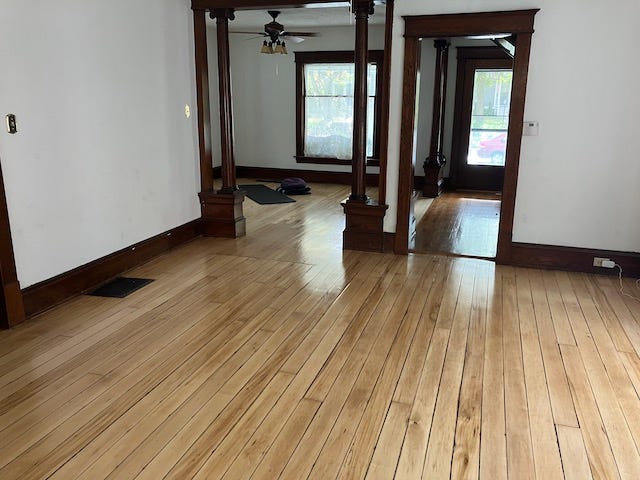
Just kidding! We had to move everything out earlier this month for floor refinishing, which was a major impetus for shedding stuff. My goal was to eliminate all unnecessary or unwanted possessions prior to the floor project so that those things only needed to be moved out and not back in. But as items — mostly books — return from the basement, I’ve found a few more things I can part with forever.
Ok, I’ve found four books so far. Out of — oh, who’s counting. I love books. As a former neighbor once said about her collection of primitive art, “we all have our sicknesses.”
Let’s talk about books.
One of the best-known guides on decluttering is Marie Kondo’s The Life Changing Magic of Tidying Up. My daughter-in-law is a long-time fan, so several years ago, I followed her recommendation to read it. Actually, I listened to it on a long car ride during which my daughter, who was the intended target, was a captive audience. I hoped it would inspire her to clean her room. It did not.
For the benefit of those who aren’t familiar with the KonMari method, it’s basically a process of decluttering by category. Clothes are first. You round them up from wherever they might be in the house, dump them in a big pile, then go through them item by item and keep those that spark joy. The rest leave for donation or maybe selling on Poshmark. Ms. Kondo does not specify what to do if nothing sparks joy and you are naked at the end.
I can’t think of a single item of clothing that sparks joy for me. Ok, maybe one. Years ago, I bought a fleece at the Michigan Fiber Festival and spun it into yarn and then knit it into a beautiful cabled sweater. And I do at least like many of the other things I’ve knitted.
While I had some concerns about the first category, Ms. Kondo totally lost me on the second, which is books. She stated — in her book, how ironic! — that no one should have more than 100 books. I don’t know what else she said because at that point I stopped listening.
Books are my weakness.
Nearly all of my books spark joy. I’m learning to share that joy with others by releasing some of them into the wild, primarily by stocking the Little Free Library in the park near my house. When I visit it to add another book, I’m pleased to see previous contributions have been re-homed and, hopefully, are delighting other readers.

Still, I will never prune my book collection to 100. Heck, even 1,000 books seems like a deprivation of which I’m not capable. But when we moved bookcases for the floor project, I was dismayed to see the floor beneath some of them was sagging, so I knew I had to lighten the load. I made a pile of my husband’s books that I didn’t think he needed anymore and suggested he say goodbye to them. That was the easy part. I also pruned about twice as many of my own, which was much more difficult.
Now, although we still have far more books than any decluttering minimalist authority says we should, those that remain are our best-loved friends, and the no-longer-sagging shelves promise pleasures to remember, repeat, or experience for the first time.
Furniture can be easy come, easy go.
Despite having purchased very few items of furniture during our 33-year marriage, our house has always seemed stuffed. We have not been great at saying no to things people want to give us.
Eventually, to paraphrase the eternal wisdom of Elizabeth Bennet, I realized it is our house and the bestowers of the excess furnishings will never know we passed them on, so I helped many of those items find new homes.

That fussy-patterned, broken-leg loveseat was one of two a departing neighbor 20 years ago believed would look perfect in our house. Removing them brought lightness to the room and more space to roll out my yoga mat.
Not all furniture gifts have been removed. A sleeper sofa bestowed on us by another departing neighbor remains because it is useful, as does the 1940s-era china cupboard that came with our first house. We acquired much furniture with that house as a result of the sellers being unable to clear it out prior to our move-in date. It was an estate sale and the previous occupants had not engaged in death cleaning. We were eager to move in, so we agreed to take care of the leftovers.
Despite the gifts and the general excesses of living in modern America, our house has never been particularly cluttered. It has long been overdue, however, for a refresh.
Sometimes pictures are better than words.
Before:
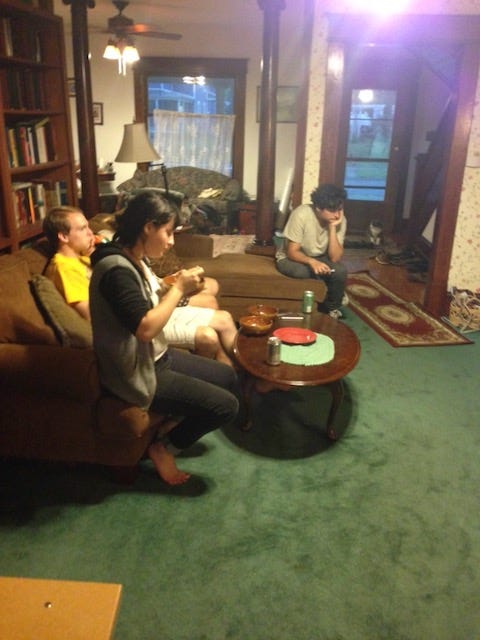
Same room, from a slightly different angle (books and teenagers in previous photo have relocated), after:
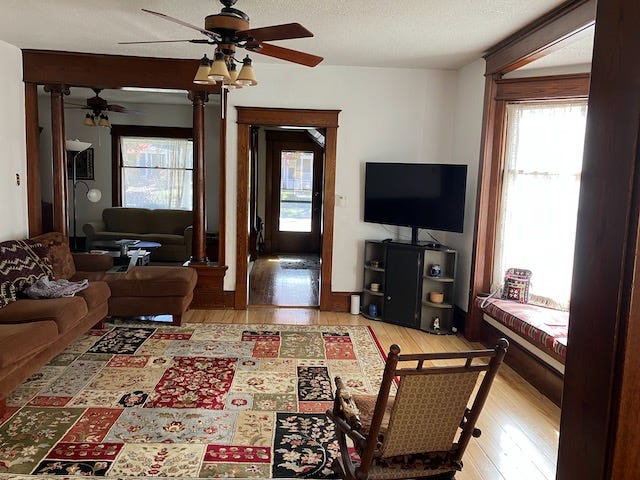
I’m not sure about that rug, which also was gifted to us. Maybe it ties the room together (nod to the Dude), or maybe not.
I joyfully anticipate welcoming my Thanksgiving guests, including some of those in the “before” photo, to this lighter and brighter space.
Disclaimer: decluttering is not the point of life.
Among the unfinished purging projects are boxes of memorabilia in the basement. Recently, I sorted some ancient newspaper clippings from my early journalism career. One story was a profile of the founder of a local river conservation organization. I remembered the interview at her home, which was a declutterer’s nightmare: stacks of papers and files on every surface, books nearly tumbling out of overfilled shelves, heaps of dishes and food items jumbled on the counters of the kitchen, all patrolled by a three-legged cat.
Despite the apparent disorder, the subject of my interview had an absolute mastery of her domain, and it suited her perfectly. I remember her reaching deep into one of those stacks with precision to procure a single piece of paper she wanted to show me. I also remember her warmth, and the tea she served from one of many lovely pots in that welcoming jumble of a kitchen. Sadly for the world, she has passed on, probably without doing any death cleaning. She had no time for that as she saved a beautiful river. She will always be one of my she-roes.
Incidentally, I scanned the clipping into my cloud documents, where I can find it using the magic of file search.
My husband, who possibly fears I may accidentally purge him from the house, read aloud to me the “Dust If You Must” poem, which, after listing various things more pleasurable than cleaning, concludes:
Dust if you must, but bear in mind,
Old age will come and it’s not kind.
And when you go (and go you must)
You, yourself, will make more dust. — Rose Milligan, 1998
The Beatles – I’m Only Sleeping
The Beatles Premiered Nov 1, 2022
London-based animator Em Cooper captures the hazy daze of slipping from wakefulness to slumber in a new music video for The Beatles’ “I’m Only Sleeping.” The short animation stitches together 1,300 oil paintings on celluloid that swirl and twist from one scene of euphoric stupor to the next. “We used to listen to this song on a tape in the car when I was a child,” Cooper told Creative Boom, “and the song itself evokes such a mesmerising, languid, dreamy state. In a way, my job was only to follow its lead with a paintbrush in my hand.”
Originally released in 1966 and now part of the new Revolver: Special Edition album, the harmonic track remains relevant and subversive for its soporific, unhurried approach to modern life, which Cooper echoes in her laborious process of hand-painting every frame.–
(Courtesy of Gwyllm Llwydd)
Equanimity
| Equanimity |
 A baker in a little country town bought the butter he used from a nearby farmer. One day he suspected that the bricks of butter were not full pounds, and for several days he weighed them. A baker in a little country town bought the butter he used from a nearby farmer. One day he suspected that the bricks of butter were not full pounds, and for several days he weighed them.He was right. They were short weight, and he had the farmer arrested. At the trial the judge said to the farmer, “I presume you have scales?” “No, your honor,” said the farmer. “Then how do you manage to weigh the butter you sell?” inquired the judge. The farmer replied, “That’s easily explained, your honor. I have balances and for a weight I use a one-pound loaf I buy from the baker.” Unknown Author |