
As my house empties of objects, it fills with delight.
A few months ago, I took a break from my daily routine of purging my house of unwanted things to write about the process. So many people have written so many words on the topic of decluttering that adding more words to that sphere seemed a little like, well, clutter. But I did it anyway, and now I’m now doing it again. This is the update.
My project, which like many others’ began in the early days of pandemic confinement, was partly inspired by the Swedish concept of death cleaning, which suggests we consider the fate of our belongings after our demise.
Why I’m Swedish Death Cleaning in Middle-Age
The Vikings were buried with their stuff. Their descendants have a better idea.
I suspect the only way to finish the process of death cleaning is to actually die. I haven’t done that yet, so my work continues. But I’ve made unbelievable progress:
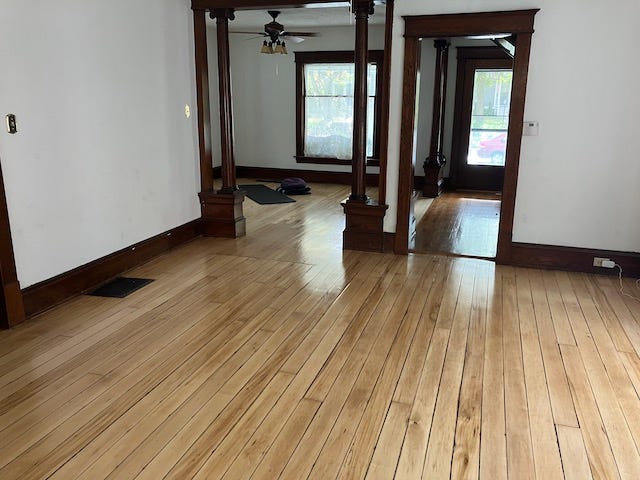
Just kidding! We had to move everything out earlier this month for floor refinishing, which was a major impetus for shedding stuff. My goal was to eliminate all unnecessary or unwanted possessions prior to the floor project so that those things only needed to be moved out and not back in. But as items — mostly books — return from the basement, I’ve found a few more things I can part with forever.
Ok, I’ve found four books so far. Out of — oh, who’s counting. I love books. As a former neighbor once said about her collection of primitive art, “we all have our sicknesses.”
Let’s talk about books.
One of the best-known guides on decluttering is Marie Kondo’s The Life Changing Magic of Tidying Up. My daughter-in-law is a long-time fan, so several years ago, I followed her recommendation to read it. Actually, I listened to it on a long car ride during which my daughter, who was the intended target, was a captive audience. I hoped it would inspire her to clean her room. It did not.
For the benefit of those who aren’t familiar with the KonMari method, it’s basically a process of decluttering by category. Clothes are first. You round them up from wherever they might be in the house, dump them in a big pile, then go through them item by item and keep those that spark joy. The rest leave for donation or maybe selling on Poshmark. Ms. Kondo does not specify what to do if nothing sparks joy and you are naked at the end.
I can’t think of a single item of clothing that sparks joy for me. Ok, maybe one. Years ago, I bought a fleece at the Michigan Fiber Festival and spun it into yarn and then knit it into a beautiful cabled sweater. And I do at least like many of the other things I’ve knitted.
While I had some concerns about the first category, Ms. Kondo totally lost me on the second, which is books. She stated — in her book, how ironic! — that no one should have more than 100 books. I don’t know what else she said because at that point I stopped listening.
Books are my weakness.
Nearly all of my books spark joy. I’m learning to share that joy with others by releasing some of them into the wild, primarily by stocking the Little Free Library in the park near my house. When I visit it to add another book, I’m pleased to see previous contributions have been re-homed and, hopefully, are delighting other readers.
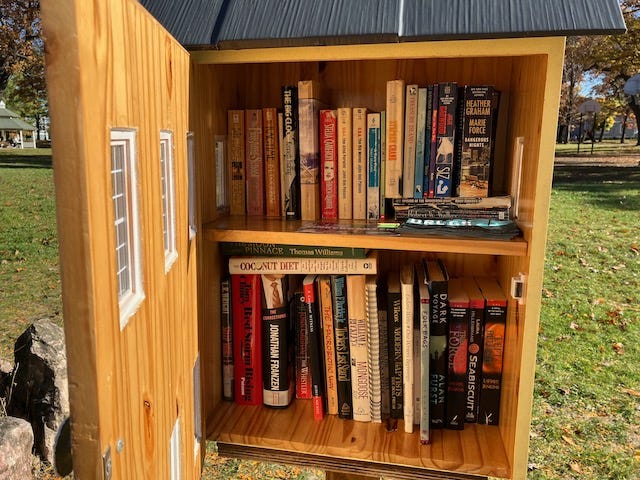
Still, I will never prune my book collection to 100. Heck, even 1,000 books seems like a deprivation of which I’m not capable. But when we moved bookcases for the floor project, I was dismayed to see the floor beneath some of them was sagging, so I knew I had to lighten the load. I made a pile of my husband’s books that I didn’t think he needed anymore and suggested he say goodbye to them. That was the easy part. I also pruned about twice as many of my own, which was much more difficult.
Now, although we still have far more books than any decluttering minimalist authority says we should, those that remain are our best-loved friends, and the no-longer-sagging shelves promise pleasures to remember, repeat, or experience for the first time.
Furniture can be easy come, easy go.
Despite having purchased very few items of furniture during our 33-year marriage, our house has always seemed stuffed. We have not been great at saying no to things people want to give us.
Eventually, to paraphrase the eternal wisdom of Elizabeth Bennet, I realized it is our house and the bestowers of the excess furnishings will never know we passed them on, so I helped many of those items find new homes.
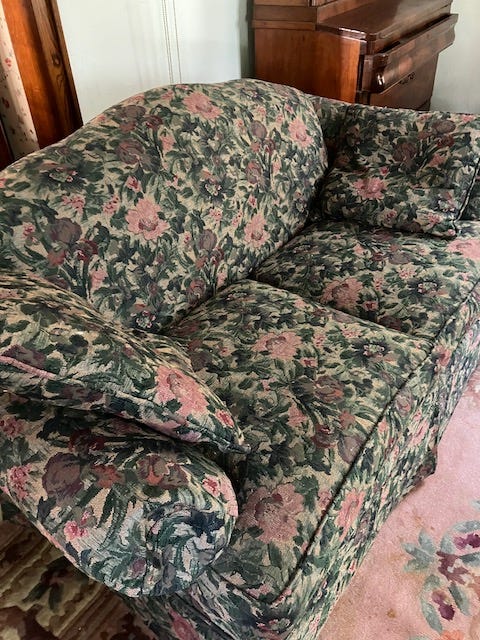
That fussy-patterned, broken-leg loveseat was one of two a departing neighbor 20 years ago believed would look perfect in our house. Removing them brought lightness to the room and more space to roll out my yoga mat.
Not all furniture gifts have been removed. A sleeper sofa bestowed on us by another departing neighbor remains because it is useful, as does the 1940s-era china cupboard that came with our first house. We acquired much furniture with that house as a result of the sellers being unable to clear it out prior to our move-in date. It was an estate sale and the previous occupants had not engaged in death cleaning. We were eager to move in, so we agreed to take care of the leftovers.
Despite the gifts and the general excesses of living in modern America, our house has never been particularly cluttered. It has long been overdue, however, for a refresh.
Sometimes pictures are better than words.
Before:
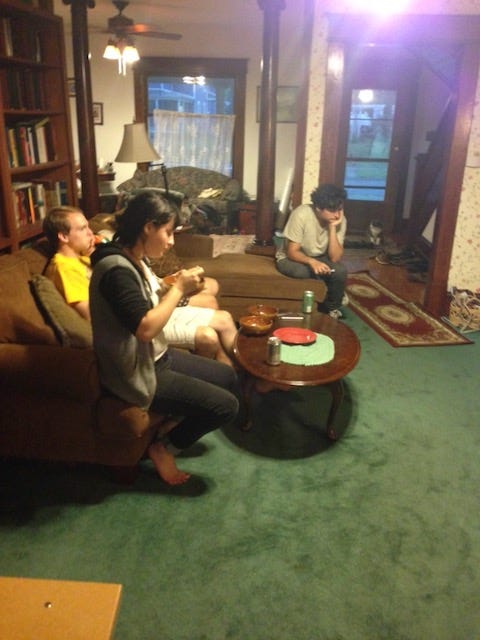
Same room, from a slightly different angle (books and teenagers in previous photo have relocated), after:
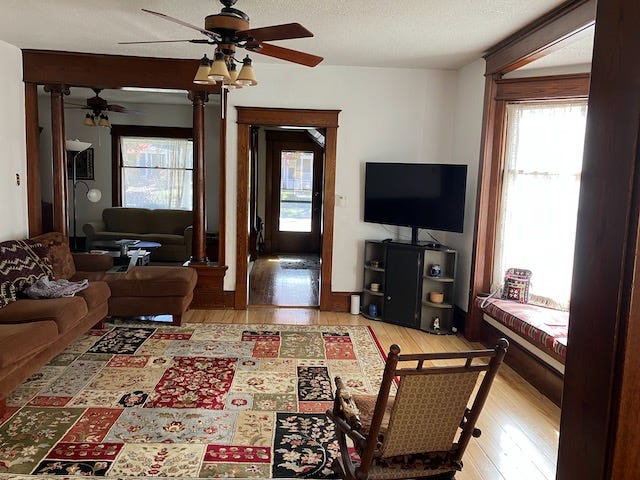
I’m not sure about that rug, which also was gifted to us. Maybe it ties the room together (nod to the Dude), or maybe not.
I joyfully anticipate welcoming my Thanksgiving guests, including some of those in the “before” photo, to this lighter and brighter space.
Disclaimer: decluttering is not the point of life.
Among the unfinished purging projects are boxes of memorabilia in the basement. Recently, I sorted some ancient newspaper clippings from my early journalism career. One story was a profile of the founder of a local river conservation organization. I remembered the interview at her home, which was a declutterer’s nightmare: stacks of papers and files on every surface, books nearly tumbling out of overfilled shelves, heaps of dishes and food items jumbled on the counters of the kitchen, all patrolled by a three-legged cat.
Despite the apparent disorder, the subject of my interview had an absolute mastery of her domain, and it suited her perfectly. I remember her reaching deep into one of those stacks with precision to procure a single piece of paper she wanted to show me. I also remember her warmth, and the tea she served from one of many lovely pots in that welcoming jumble of a kitchen. Sadly for the world, she has passed on, probably without doing any death cleaning. She had no time for that as she saved a beautiful river. She will always be one of my she-roes.
Incidentally, I scanned the clipping into my cloud documents, where I can find it using the magic of file search.
My husband, who possibly fears I may accidentally purge him from the house, read aloud to me the “Dust If You Must” poem, which, after listing various things more pleasurable than cleaning, concludes:
Dust if you must, but bear in mind,
Old age will come and it’s not kind.
And when you go (and go you must)
You, yourself, will make more dust. — Rose Milligan, 1998