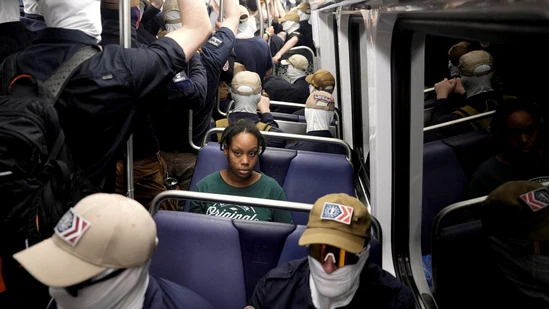
A commuter sits as members of the group Patriot Front ride the metro on the 250th anniversary of U.S. independence on the Fourth of July in Washington, D.C., U.S., July 4, 2026. REUTERS/Cheney Orr TPX IMAGES OF THE DAY (REUTERS)

New Thinking Allowed with Jeffrey Mishlove Jul 4, 2026 This video is a special release from the original Thinking Allowed series that ran on public television from 1986 until 2002. It was recorded in about 1988. It will remain public for only one week. Ram Dass’ own path has led him to look for God in every person and situation. Following this path, his life of service has included working with refugees, with the blind, and with the dying. In this moving, two-part program, he examines the delicate state of awareness in which one acts compassionately for social change while also accepting the world exactly as it is. Ram Dass (a.k.a. Richard Alpert, PhD) is a spiritual teacher and author of Be Here Now, The Only Dance There Is, The Psychedelic Experience (coauthored with Ralph Metzner and Timothy Leary), Grist for the Mill (coauthored with Stephen Levine), Journey of Awakening, Miracle of Love and How Can I Help?
Johnathan Bi Mar 11, 2025 Interview with Michael Wooldridge I made this video as a fellow of the Cosmos Institute, a 501c3 academy for philosopher-builders. Read the Cosmos Institute Substack ► https://bit.ly/3XK5T7k Subscribe to the Cosmos Institute on YouTube ► @cosmosinstituteaixhf Follow Cosmos’ founder and my friend Brendan McCord on X ► https://bit.ly/3Y9pFLb You can read the full transcript here: https://open.substack.com/pub/johnath… Companion Interviews:
Further Reading:
Timestamps 00:00 0. Introduction 02:45 1. The Singularity Is Bullshit 14:28 2. Alan Turing 25:55 2.1 Alan Turing: The Turing Test 32:22 3. The Golden Age 39:29 4. The First AI Winter 41:25 5. Expert Systems 51:35 6. Behavioral AI 57:08 7. Agent-Based AI & Multi-Agent Systems 1:05:45 8. Machine Learning 1:08:18 9. LLMsJohnathan Bi discusses the long history of artificial intelligence research and development with AI pioneer Michael Wooldridge. They examine past hype cycles, overlooked technological paradigms, and practical strategies for regulating AI applications rather than general mathematical principles.
The “Hollywood Ten,” often confused as “Hollywood Seven,” were a group of prominent industry professionals cited for contempt of Congress in 1947 after refusing to testify about their alleged Communist Party ties before the House Un-American Activities Committee (HUAC). They were subsequently blacklisted from working in the entertainment industry. [1, 2]
The Hollywood Blacklist and the Red Scare
In October 1947, HUAC launched hearings into alleged communist influence in the American film industry. When 10 prominent writers and directors (Alvah Bessie, Herbert Biberman, Lester Cole, Edward Dmytryk, Ring Lardner Jr., John Howard Lawson, Albert Maltz, Samuel Ornitz, Adrian Scott, and Dalton Trumbo) refused to answer the committee’s questions about their political affiliations, they were sentenced to prison and effectively blacklisted by studio executives. [1, 2, 3, 4, 5]
This purge was a cornerstone of the broader Red Scare and McCarthyism era, which terrorized the entertainment industry through the 1950s. Studio bosses surrendered to pressure, and individuals were often denied employment based on vague accusations or for having exercised their First Amendment rights. The blacklist was actively enforced by private publications like Red Channels, which targeted actors and writers for suspected progressive political sympathies. [1, 2, 3, 4, 5]
The blacklist’s chokehold on Hollywood only began to crumble in 1960 when prominent figures like Kirk Douglas and Otto Preminger openly credited blacklisted writers like Dalton Trumbo. [1]
For a deep dive into the historical exhibits and the lasting legacy of the Hollywood blacklist:
By ChatGPT and Mike Zonta, BB editor
Pluto permanently entered Aquarius on November 19, 2024, and will remain there until March 8, 2043. [1, 2]
Because of its retrograde, Pluto did “dip” its toes into the sign for shorter, preview periods prior to the permanent shift: [1, 2, 3, 4]
And did November 19, 2024 mark the entry of ChatGPT into the general marketplace?
No, that date does not mark the entry of ChatGPT into the general marketplace.
ChatGPT was released to the public on November 30, 2022. This was nearly two years before Pluto permanently entered Aquarius. [1]
However, during ChatGPT’s launch in late 2022, Pluto was in the final degrees of Capricorn, right on the edge of transitioning into Aquarius. Astrologers often point to the timing of the AI boom as the “preview” energy of Pluto in Aquarius, which is traditionally associated with technology, innovation, and collective shifts.
Timeline of AI Breakthroughs and Pluto’s Transitions
Here is the timeline mapping major AI milestones against Pluto’s shift from Capricorn (structure, corporations) to Aquarius (technology, networks, collective future).
The Late Capricorn Era: Foundation Building
The First Aquarius Previews: The AI Explosion
The Back-and-Forth: Regulation vs. Innovation
♒ The Permanent Aquarius Era: The New Normal
Historical parallels
The last time Pluto transited Aquarius was from 1778 to 1798. This 20-year period completely reshaped global power, human rights, and technology, offering powerful parallels to today’s digital revolution.
⚙️ The Industrial Revolution vs. The AI Revolution
⚡ Power to the People: Decentralization
Aquarius rules the collective, networks, and the democratization of power. Pluto rules control, destruction, and transformation.
Scientific Breakthroughs & The Invisible World
Aquarius is an air sign, associated with the intellect, the invisible forces of nature (electricity, data), and the sky.
Human Rights and the Social Contract
When Pluto is in Aquarius, society is forced to re-examine how it treats its citizens.
Amrit Sandhu ???????? and Rick Levine Astrologer Jun 14, 2026 Inspired Evolution Podcast ????????Rick Levine reveals 4 major shifts — some 6,000 years in the making — all hitting at once, this July. The last time the sky aligned like this, human civilization itself was just being born: cities, writing, and metal first appeared. Now Saturn and Neptune are meeting at zero degrees Aries again for the first time in ~6,000 years, and Rick explains why our old myths, structures, and shared sense of reality are collapsing in real time. This astrological transition coincides with a rapid acceleration in technology, artificial intelligence, and disclosure surrounding extraterrestrial life — challenging our baseline understanding of what it means to be human. Levine discusses the intense information “flooding” designed to overwhelm public awareness, and offers a grounded way to navigate this collective “time vertigo.” Delving into the legacy of Johannes Kepler, harmonic aspects, and his own “quantum astrology,” he bridges ancient esoteric wisdom with modern physics — including a striking take on fate and free will. Ultimately, this conversation is a strategic roadmap for the mid-2020s: a call to embrace your personal cycles and step into an evolved state of awareness, rather than giving in to fear.

(Image from mairahorta.com)
“Here is a river flowing now very fast. It is so great and swift that there are those who will be afraid, who will try to hold on to the shore… Know the river has its destination. The elders say we must let go of the shore, push off into the middle of the river, and keep our heads above water.
“And I say, see who is there with you. This is your new family.”
–compiled by Margaret Wheatley and Rick Levine
Be Here Now Network Jun 17, 2026 Jack Kornfield – Heart Wisdom Help us celebrate 10 years of Be Here Now Network and support the next chapter of Ram Dass Here and Now. Gifts are matched dollar for dollar through June 30. Learn more and give at: BHNN 10th Birthday Fundraiser: https://beherenownetwork.com/10years Beginning with reflections on global crises and personal difficulty, Jack reminds us that while suffering is inevitable, how we respond is what shapes our lives. This time on Heart Wisdom, Jack Kornfield explores: *Responding to difficulty without becoming overwhelmed *Living in the present moment instead of fear-based thinking *The power of intention and deep listening *Becoming an “island of peace” in chaotic times *Trusting uncertainty and the mystery of life This episode was originally filmed for the April 2026 Spirit Rock Meditation Center Monday Night Talk and Guided Meditation. “In difficulty, the mind goes into survival—trying to protect and fix. Thank it, let it soften, and return to the present. As Ram Dass reminds us—you can be here now.” –Jack Kornfield About Jack Kornfield: Jack Kornfield trained as a Buddhist monk in the monasteries of Thailand, India, and Burma, studying as a monk under the Buddhist master Ven. Ajahn Chah, as well as the Ven. Mahasi Sayadaw. He has taught meditation internationally since 1974 and is one of the key teachers to introduce Buddhist mindfulness practice to the West. Jack co-founded the Insight Meditation Society in Barre, Massachusetts, with fellow meditation teachers Sharon Salzberg and Joseph Goldstein and the Spirit Rock Center in Woodacre, California. His books have been translated into 20 languages and sold more than a million copies. Jack is currently offering a wonderful array of transformational online courses diving into crucial topics like Mindfulness Meditation Fundamentals, Walking the Eightfold Path, Opening the Heart of Forgiveness, Living Beautifully, Transforming Your Life Through Powerful Stories, and so much more. Sign up for an All Access Pass to explore Jack’s entire course library. If you would like a year’s worth of online meetups with Jack and fellow community, join The Year of Awakening: A Monthly Journey with Jack Kornfield.
(Contributed by Zoë Robinson, H.W., M.)
| Christopher Armitage Jul 5, 2026 |

U.S. President Donald Trump sits at his desk, behind a hat that reads “America is back” at the White House in Washington, D.C., on February 3, 2026. Evelyn Hockstein/Reuters
Eighteen states have turned their complete voter files over to the Trump Justice Department, including the driver’s license numbers and Social Security numbers of every registered voter in them. That count comes from Protect Democracy, which names all eighteen; Texas, Florida, and Ohio are among them. Together those eighteen states have 148 US House seats, 36 US Senate seats, and 184 electoral college votes, roughly two thirds of what it takes to control the House, the Senate, and the presidency. The question in the headline has an answer, and it is fewer than eighteen.
Since early 2025, the Trump administration has been trying to take control of voter rolls, mail ballots, and registration rules away from the states and hand it to the federal executive branch.
A March 2025 executive order demanded changes to state voting procedures and ordered federal election money withheld from states that refused. Courts blocked parts of it, and on June 24, 2026, a federal judge permanently barred key provisions. The Justice Department demanded voter registration data from all 50 states and the District of Columbia, including driver’s license numbers and Social Security numbers. The Department of Homeland Security rebuilt a database called SAVE so states could submit their voter rolls to it for citizenship checks.
A second executive order, issued March 31, 2026, ordered federal agencies to build lists of United States citizens and send them to the states before every election, ordered the Postal Service to create a list of approved mail voters, and told the Postal Service to refuse to deliver ballots from anyone not on that list.
DHS has also written new grant conditions, obtained by CNN and expected to go out to the states, that would make states change their election procedures and run their full voter rolls through SAVE to receive homeland security grants from a program worth more than one billion dollars this fiscal year. States that refuse would lose 20 percent of the money. As of this writing DHS has not formally announced the conditions. Maine Secretary of State Shenna Bellows said that cutting the funds of refusing states “endangers American lives and democracy itself.”
Most states said no. The Justice Department answered with 31 federal lawsuits against 30 states plus Washington DC to force the data handover, and so far no court, trial or appellate, has ruled in the department’s favor. On June 22, a federal judge ruled that the rebuilt SAVE system broke three federal laws: the Privacy Act, the Social Security Act, and the Administrative Procedure Act. That judge, Sparkle Sooknanan, wrote that the federal government had “knowingly trampled on the privacy rights of American citizens.” Two days later, the Sixth Circuit became the first appeals court to rule on the data lawsuits, upholding the dismissal of the case against Michigan. And on June 25, a federal judge in Boston blocked the core of the mail voting order for the November 2026 election in a lawsuit brought by 23 Democratic-led states and DC. The judge, Indira Talwani, wrote that “The Constitution does not grant the President any specific powers over elections.”
News stories about these rulings count the states that refused and the rulings the administration lost. Every one of those stories is accurate. They still measure the wrong thing, because a count of refusing states only means something if each state’s choice stays inside that state’s borders. It does not, for two reasons.
The first reason: once voter data leaves a state, the federal government keeps it, and every new state adds to the same federal database. That database works as soon as one state hands over its records, no matter how many others refuse.
Twelve of the eighteen had handed over complete files, driver’s license and Social Security numbers included, by early April; the other six complied partly or later. Texas alone accounts for a large share of the affected voters: it signed an agreement with DHS in March 2025 and ran its more than 18 million registered voters through SAVE. Separately, the DHS agency that handles citizenship began building a registry that combines its own records with data from the Social Security Administration and the State Department.
The Justice Department also asked states to sign a confidential agreement along with the data handover. Under its reported terms, a state that signs agrees to remove any voter the department flags as ineligible within 45 days. Two states signed: Alaska and Texas. Mississippi, South Dakota, and Tennessee handed over their rolls but refused to sign. A state that signs has given the federal executive branch ongoing control of its voter roll.
A court ruling issued after a transfer does not bring the data back. On May 12, 2026, the Office of Legal Counsel issued a written opinion saying federal law lets the Attorney General force states to produce their voter lists and share them with DHS. Losing individual court cases does not erase that opinion.
The second reason is geography. Control of the House and Senate will be decided in a small number of competitive districts and states, and several cooperating states hold those races, including Texas, Ohio, Florida, Iowa, and North Carolina. At least 25 states have run their rolls through SAVE since April 2025, 60 million registrations in a year, plus another 7.4 million from North Carolina, where Republicans control the state election board.
The court wins protect mostly the governments that sued. The June 25 injunction covers the 23 suing states and DC, and the administration told the courts this week that it is moving ahead with the system in the remaining states. Postmaster General David Steiner told the Senate on June 24 that under the proposed rule the Postal Service would refuse to deliver mail ballots in states that do not send their voter lists to the federal government. A voter in Houston or Columbus gets nothing from the injunction, because that voter’s state government joined the federal programs instead of fighting them. One ruling reaches further: in a separate case brought by the NAACP, U.S. District Judge Emmet Sullivan found the plan to deliver ballots only to preapproved voters broke a 2021 agreement with the Postal Service, and his ruling applies nationwide. That ruling protects ballot delivery. It does not touch the data collection, the purge agreements, or the state purge laws. So the court protection concentrates in states whose governments already refused to cooperate. In the cooperating states that hold the races deciding control of Congress, only the ballot delivery ruling applies.
The 60 million registration checks flagged about 24,000 possible noncitizens, and officials also flagged several hundred thousand registrations of people who may have died. Those totals only show how many people the government has flagged so far. It can flag as many as it chooses, and no one has to prove a flagged voter is ineligible before the registration is canceled; the voter has to prove they are eligible. That arrangement is a devastatingly powerful voter disenfranchisement tool.
In Texas, flagged voters got a letter, and if the county heard nothing within 30 days, the registration was canceled; some who did answer turned out to be citizens. A new Ohio law makes local election boards promptly cancel the registrations of people the secretary of state flags as noncitizens in checks he must run at least monthly. That secretary, Frank LaRose, defends the law on the ground that flagged voters can “immediately restore their registration status” by showing proof of citizenship.
The system also discourages people from registering at all, separate from the cancellations. A federal official confirmed that people flagged by SAVE are referred to DHS for possible criminal investigation, and the judge who reviewed the system wrote that a centralized federal database like this would discourage registration because citizens could fear misuse of their personal information. In races decided by hundreds or a few thousand votes, losing voters from only one side, and mostly from one party, can change the result even when the national numbers stay small.
The administration has also arranged its litigation so that losing in court still produces something useful. After losing the voter data cases in California, Michigan, and Oregon, the Justice Department filed emergency appeals warning that the security and sanctity of elections in those states would be questioned without quick rulings, and its filings say that without a final court decision there is “no other process to ensure a fair election in 2026.”
Stated plainly, months before the election, the department put into official court documents the claim that results in refusing states should be treated as doubtful. If a state cooperates, the government gets its data and a purge process. If a state refuses, the government gets a written reason to challenge that state’s results in November. Either way, the administration gains something it can use. David Becker, executive director of the Center for Election Innovation and Research and a former Justice Department voting section attorney, said of the department’s conduct, “There’s so much lawyering from the DOJ here that is raising ethical questions.”
The same approach is underway with the mail voting order. Within a week of the June 25 injunction, the administration appealed to the First Circuit, asked the district judge to lift her order by July 6, and warned in its filings that the injunction will make it impossible for the Postal Service to build the new ballot delivery system before November even if the administration wins the appeal. Those filings put in writing, ahead of time, a federal reason to call November mail ballots compromised.
The effort does not stop at voter rolls. The FBI has seized ballots from the 2020 election in Fulton County, Georgia, and the Arizona Senate complied with a federal grand jury subpoena for records from its Maricopa County audit. The department wants records from Wayne County, Michigan, about the 2024 election, and the names of every person who worked as an election worker in Fulton County in 2020. The March 2026 order tells the Justice Department to make investigating and prosecuting election officials a priority when those officials give ballots to people the federal government considers ineligible.
Collecting the names of individual election workers and threatening officials with prosecution discourages people from doing that work whether or not charges are ever filed.
President Trump is also pressing Congress to pass the SAVE America Act, which would make people show citizenship papers to register, limit mail voting to reasons such as illness, disability, military deployment, and travel, and make states submit their voter rolls to DHS and remove anyone the system flags. In March he said of the bill, “It will guarantee the midterms.”
Between June 22 and June 29, federal courts ruled the SAVE overhaul unlawful, permanently barred parts of the 2025 executive order, upheld the dismissal of the Michigan data case on appeal, blocked the mail voting order for 23 states and DC, and upheld Mississippi’s ballot deadline law at the Supreme Court. Those rulings stop specific legal mechanisms.
They do not bring back data already handed over, automatically restore wrongly canceled registrations, reassure naturalized citizens who now connect registering with a federal investigation, protect election workers whose names have been demanded, erase the department’s written claims that elections in refusing states cannot be presumed fair, or stop the grant conditions waiting to go out.
So, how many states is enough? To steal an election, the infrastructure needs only three things: enough voter data, cooperation from states that hold the competitive races, and an official reason to dispute the results everywhere else. Texas alone supplied the first two: 18 million records handed over, a signature on the 45 day removal agreement, citizens with canceled registrations, and competitive House seats inside its borders. The Justice Department’s own court filings supplied the third. The answer is one, and it has already happened.
Want to do something about it? Well it’s our job at the Existentialist Republic to address exactly the issue this article outlines and then hand people tools to make change because when the federal government and a large fraction of states have abandoned fairness, freedom, and democracy, we need a plan.
Just so you know, it’s 10 people like yourself, 10 activists per article who subscribe by clicking the button below, that fund all of this. All 3 free books, all 12 booklets, the 4 pieces of model legislation, and the 20-40 articles per month.
Don’t let this be the reason you miss a meal or are late on rent.
But if this helps you and you can become a subscriber, you’re one of the 10 that makes it all possible.
At the bottom of this article you will find resources that are all available as physical items for purchase, as well as free downloadable PDFs for everything.
My latest book, titled “The American Reformation,” covers the constitutional strategies for redress, and is based off my working paper titled “The Taxonomy of State Response to Federal Authoritarian Capture.”
Another book that may be of use is “Toppling Tyrants: A Field Guide to Restoring American Democracy.”
There are also the short booklets such as “Soft Secession” and “Grab Them By EARR: How to get politicians to do what you want.”
You can also find our four pieces of model legislation, which are the Fiscal Sovereignty and Election Protection Act, the Bribe Is a Bribe Act, the Child Sex Trafficking Investigation and Accountability Act, and the Corporate Welfare Accountability Act. If you want to see the 125-page academic working paper behind these laws, you can read Oppositional Federalism on SSRN.
All that and more can be found at the bottom of this article.
Not a day goes by without our being called upon to help one another —at home, at work, on the street, on the phone…. We do what we can. Yet so much comes up to complicate this natural response: “Will I have what it takes?” “How much is enough?” “How can I deal with suffering?” “And what really helps, anyway?”

Here is a book involving alien contact, ancient Egyptian religion, and an interesting metaphysical premise — consistent with the mystical teachings of every age — that we are connected intimately with the whole universe. This is material that fascinated the late parapsychologist Andrija Puharich, and has been discussion previously on New Thinking Allowed.

The extraordinary mystic Neville Goddard (1905-1972) is one of today’s most influential metaphysical voices — and spiritual writer Mitch Horowitz is widely acknowledged as the leading interpreter of the teacher’s ideas and life story. Now, in an unparalleled effort, Mitch combs through Neville’s extensive body of work to distill the master’s most practical and effective methods and techniques for operating the creative powers of your mind.
