Astrology Of June 2026 – Chiron In Taurus, Jupiter In Leo

(Astrobutterfly.com)

June 2026 features 2 dramatic ingresses: Chiron completes its 8-year journey through Aries and enters Taurus, and Jupiter makes its annual ingress, entering Leo.

These are very important transits that will completely shift our priorities and overall direction. Things are shifting at a fundamental level.

Another highlight of the month is the much-anticipated Venus-Jupiter conjunction in Cancer on June 9th. This is a beautiful emotional culmination before Venus and Jupiter shift into Leo in the 2nd part of June. 

Mercury goes retrograde at the end of the month at the exact degree of the Venus-Jupiter conjunction. There’s more to the story!

But let’s take a look at the most important transits of the month:

chiron enters taurus, jupiter enters Leo

June 9th, 2026 – Venus Conjunct Jupiter

June 9th, 2026, Venus is conjunct Jupiter at 25° Cancer.

Everyone is getting excited about this conjunction, and for good reasons. Venus and Jupiter are the 2 ‘benefics’ and their conjunctions are classically considered the luckiest and most joyful.

What makes this special is the sign it occurs. Jupiter is exalted in Cancer, so this conjunction is even more potent – even more flooded with abundance and emotional truth. 

This is a time to rewrite our relationship to what matters – to be guided not only by what we believe is right, but also by what feels true. This distinction might sound like empty words, but let’s sit with it a bit. 

We can become convinced we know what’s good for us when, in reality, much of our worldview is built on assumptions, expectations, and stories we inherited from family, culture, or the world around us. We adopt them so early that they start to feel like our own.

Venus conjunct Jupiter in Cancer invites us to reconnect with a more personal source of knowing.

Like a river instinctively finding its way to the sea, there is a part of us that already knows what matters. The task is not to figure it out, but to trust it – and then align our life with it.

June 15th, 2026 – New Moon In Gemini

On June 15th, 2026, we have a New Moon at 24° Gemini. Apart from a loose square to Neptune, this lunation is pretty much unaspected.

This is also the first New Moon in Gemini with Uranus in the sign. Once the realization dawns that things may not be the way we thought they were, a space opens up.

Because this New Moon is largely unaspected, there is no strong planetary storyline filling that space or telling us what to do with it.

This blank, unwritten space can feel disorienting, but there’s something about the ‘not knowing’ that paradoxically triggers the ‘deeper knowing’ inside of us – beyond society narratives and ‘that’s just how things are’ assumptions.

The New Moon in Gemini invites us to consciously seed that space with a genuinely new possibility.

June 19th, 2026 – Chiron Enters Taurus

On June 19th, 2026, Chiron enters Taurus. Chiron changing signs is one of the most important astrological events of the year. 

Chiron has spent 8 years in Aries, digging into and healing the rawest themes of identity and self-expression. The process that began in 2018 has not been easy, but it has been necessary. Our relationship to ourselves will never go back to the way it was before.

The same process now begins with Chiron in Taurus. Taurus (together with Aries) are the 2 signs where Chiron – with its otherwise very eccentric orbit – spends the most time. 

There is something about the relationship between identity – the abstract “who am I” (Aries) – and the embodiment of that identity (Taurus) that Chiron has to work on with its sharpest skills. 

This is not a wound that heals overnight. It will take 8 years. But at the end of it, the core Taurus themes – like feeling safe in this world, feeling that we matter, manifesting, giving and receiving – will have received the healing they so deeply need. 

We tend to see the Taurus types of dysfunction as an unhealthy relationship with our body or money – but that’s just the tip of the iceberg, what shows on the surface when something has been long unrooted. 

But it goes much deeper than that. The good news is that if there’s a planetary archetype that has the tools, the patience and the empathetic understanding to guide this healing, that is Chiron.

Whether you were born with Chiron in Taurus (and you’ll have your Chiron return), have planets in Taurus, or simply an area of your life ruled by Taurus – and we all do, that’s our Taurus house – Chiron in Taurus will open a new chapter of healing and integration.

June 21st, 2026 – Sun Enters Cancer

Happy Solstice and happy b-day, Cancers! On June 21st, 2026, the Sun enters Cancer

Solstices and equinoxes are the 4 turning points of the year, when the balance between light and darkness changes direction. We call them seasons, but they are really transitions into a different psychological and energetic atmosphere.

Each turning point introduces the qualities of one of the 4 elements. The Libra equinox brings air. The Capricorn solstice, earth. The Aries equinox, fire. 

With Cancer, we enter the season of water – a season of intuition, feelings, belonging, and leaning into what feels right.

June 28th, 2026 – Mars Enters Gemini

On June 28th, 2026, Mars enters Gemini and that’s going to be an immediate change in pace! 

After grazing, ruminating and gathering the resources needed in Taurus, Mars is leaving the familiar ground to step into the Territory, Gemini’s field of information, exchange, and discovery.

Uranus, for the first time in Gemini since almost 8 decades, will awaken Mars to something that it has never experienced before.

In Gemini, Mars will discover new ways of working with information, data, thoughts, and ideas – operating less on autopilot and with more awareness of what is actually happening.

June 29th, 2026 – Full Moon In Capricorn

On June 29th (or June 30th), we have a Full Moon at 8° Capricorn

The Full Moon is separating from a square to Neptune and applying to square Saturn in Aries. Now that a dream or a possibility has been awakened, the Capricorn question becomes: how do we make it real?

The answer may not be obvious, and the road ahead may not be easy. Yet Capricorn is less interested in obstacles and more in solutions. This is a Full Moon to stress-test what matters, separate wishful thinking from commitment, and take responsibility for the next step. 

A detailed Full Moon report will follow closer to the date.

June 30th, 2026 – Mercury Goes Retrograde

On June 30th, 2026, Mercury goes retrograde at 26° Cancer, for a 3-week journey into our emotional memory. 

Why do we react the way we do? Why do certain situations affect us more than others? Mercury retrograde in Cancer traces our feelings back to their source, helping us understand the emotional logic underneath our choices and actions.

Mercury turns retrograde at the degree of the Venus-Jupiter conjunction earlier this month.

Whatever that conjunction has awakened or promised, Mercury retrograde in Cancer will initiate the necessary emotional processing to bring it fully into consciousness.

Mercury goes direct on July 24th at 16° Cancer. If you have planets or angles between 16°-26° Cancer, you will be especially influenced by this retrograde.

June 30th, 2026 – Jupiter Enters Leo

On June 30th, 2026, Jupiter leaves Cancer and enters Leo.

Jupiter spends approx 1 year in a sign, so when it changes signs, there’s an immediate change in the atmosphere. Jupiter is the largest planet in our solar system, so these shifts are always noticeable.

At a collective level, the atmosphere shifts from Cancer – emotional, protective, inward – to Leo: bold, brave, straightforward. 

At a personal level, Jupiter moves away from one sector of your life and begins expanding another. At the time of the ingress, pay attention to what comes up for you – especially how your interests shift, how you become drawn to a certain topic, or a particular area of your life comes into focus.

During its 1-year stay in Leo, Jupiter will form supportive aspects with Neptune and Saturn in Aries – however, the very first aspect it makes will be a square to Chiron (at 0° Taurus). 

So the first encounter with the bold, confidence-driven energy of Leo will also – paradoxically – trigger deeper, forgotten wounds around security and trusting our instincts.

A detailed report of the Jupiter-Chiron square will follow closer to the date.
June Astrology Forecast 2026

The Astrology Podcast Jun 2, 2026 Monthly Astrology Forecasts A deep dive into the astrology forecast for June 2026, with astrologers Chris Brennan and Leisa Schaim. We spend the first hour talking about the astrology behind news and events that happened since our last forecast, and then in the second hour we get into the astrology of June. The month opens with one of the most auspicious planetary alignments of the year: a Venus-Jupiter conjunction in Cancer that remains active for the first two weeks. Venus-Jupiter conjunctions are excellent for relationships, marriages, and partnerships, as well as peacekeeping efforts and the confirmation of good things. In the middle of the month, there is a distinct tone shift when Venus enters Leo and begins opposing Pluto. This aspect can bring up issues related to power, manipulation, and control within the context of partnerships and relationships. At the same time, Mercury enters its shadow period, slowing down and preparing to station retrograde, while Mars moves within a 10-degree orb of a volatile conjunction with Uranus. The latter part of the month takes an unexpected and explosive turn, especially once Mars officially enters Gemini and the conjunction with Uranus tightens. On the final day of the month, Jupiter enters Leo, beginning a one-year transit through that sign. However, this transit starts with an opposition to Pluto that will culminate in July, highlighting themes involving the manipulation of truth and attempts to control knowledge. Simultaneously, Mercury stations retrograde just before it can reach a conjunction with Jupiter, effectively revoking and delaying a beneficent alignment just as the much more malefic Mars-Uranus configuration is forming. This is episode 538 of The Astrology Podcast.

Alternative Medicine Under the Microscope with Stacy Gomes

New Thinking Allowed with Jeffrey Mishlove Jun 2, 2026 Biological Systems, Health and Healing Dr. Stacy L. Gomes, EdD, MEd, is Provost at the California Institute for Human Science. Prior to joining CIHS, she served as Vice President of Academic Affairs at Pacific College of Health Sciences. Dr. Gomes is also the co-author, with Leena S. Guptha, DO, MBA, PhD, of Who’s on Your Board: Six Steps to Curating Your Personal Board of Directors, a book about intentionally identifying and cultivating the mentors, advisors, supporters, and truth-tellers who help guide personal and professional growth. In this conversation, Dr. Gomes discusses higher education, integrative health, online learning, student success, artificial intelligence, mentorship, and the importance of consciously choosing who influences our lives. 00:00:00 Introduction 00:07:10 Alternative medicine under the microscope 00:09:54 Ensuring students get what they paid for 00:12:37 Teaching acupuncture and skill-based applied topics online 00:15:15 Advice for teachers: be clear about what you are teaching 00:23:31 Higher education is not for everyone 00:34:33 Mentoring the next generation of leaders 00:55:51 Why students are struggling to write 00:57:16 When AI can write better and faster than accomplished authors 01:23:10 Who is on your personal board? Dr. Debra Lynne Katz is the founder and director of the International School of Clairvoyance, where she has trained students in clairvoyance, remote viewing, intuitive development, and energy healing since 2005. Dr. Katz is the author of several books, including You Are Psychic: The Art of Clairvoyant Reading and Healing, Extraordinary Psychic, The Complete Clairvoyant, Freeing the Genie Within, and Associative Remote Viewing: The Art & Science of Predicting Outcomes for Sports, Financials, Elections, and the Lottery. She is a former President of the International Remote Viewing Association. She has also served as an instructor at the California Institute for Human Science. For a complete, updated list with links to all of our videos, see https://newthinkingallowed.com/Listin….


Zadie Smith on the Courage to Be More Than Yourself

By Maria Popova (themarginalian.org)

Every act of learning is an act of intellectual appropriation, incorporating someone else’s knowledge into your own mental library. Every act of empathy is an act of emotional appropriation, modeling the reality of another into your own in order to fathom it. I have appropriated the English language — not my native — in order to write these words.

The tyranny of our time is that, because the hero of the modern myth is the victim, our catalogue of ways to be wounded has swelled to untenable proportions. The arsenal of possible offenses is so immense that we are left in a state of paralyzing hyper-vigilance, ever on the defensive, ever trying to preempt grievance and avoid indictment. Because it is hard to create from a defensive place, no region of life has suffered more by this than our arts — trembling before the whip of cultural appropriation, artists are left with narrower and narrower parameters of permission for whom and what they can imagine. We seem to have forgotten that the word empathy itself is just a little over a century old, invented by Rilke and Rodin to describe the imaginative act of projecting yourself into a work of art that represents something other than yourself. We seem to have forgotten that, at its best, art is not a mirror but a kaleidoscope, casting on the walls of our own lives a thousand hues of experience we never could have lived. As a little girl in the mountains of Bulgaria in the early 1990s, I would have never known what it is like to be a little boy in the prairies of North America in the early 1900s had I not read a German woman’s novel about a Lakota father and son. You may never know what it is like to be the long-suffering wife of a Siberian serf, but you have Dostoyevsky.

Troubled by this tyrannical paralysis, Zadie Smith offers an antidote of uncommon potency and poignancy in one of the essays collected in Dead and Alive (public library), anchored in a recognition of the absurdity of turning identities into warfare given how mutable the self is, how inconstant, how tessellated a thing to begin with. She writes:

I’ve always been aware of being an inconsistent personality. Of having a lot of contradictory voices knocking around my head. As a kid, I was ashamed of it. Other people seemed to feel strongly about themselves, to know exactly who they were. I was never like that. I could never shake the suspicion that everything about me was the consequence of a series of improbable accidents — not least of which was the 400-trillion-to-one accident of my birth. As I saw it, even my strongest feelings and convictions might easily be otherwise, had I been the child of the next family down the hall, or the child of another century, another country, another God.

Art from An Almanac of Birds: Divinations for Uncertain Days. (Available as a print and as stationery cards, benefitting the Audubon Society.)

An epoch after Walt Whitman — a person utterly unlike her by all the unchosen variables we mistake for personhood — celebrated his contradictory multitudes, she considers the making of her own, borrowed from the lives of others, real and imagined:

I rarely entered a friend’s home without wondering what it might be like to never leave. That is, what it would be like to be Polish or Ghanaian or Irish or Bengali, to be richer or poorer, to say these prayers or hold those politics. I was an equal-opportunity voyeur. I wanted to know what it was like to be everybody. Above all, I wondered what it would be like to believe the sorts of things I didn’t believe… And what I did in life, I did with books. I lived in them and felt them live in me. I felt I was Jane Eyre and Celie and Mr Biswas and David Copperfield. Our autobiographical coordinates rarely matched. I’d never had a friend die of consumption or been raped by my father or lived in Trinidad or the Deep South or the nineteenth century. But I’d been sad and lost, sometimes desperate, often confused. It was on the basis of such flimsy emotional clues that I found myself feeling with these imaginary strangers: feeling with them, for them, alongside them and through them, extrapolating from my own emotions, which, though strikingly minor when compared to the high dramas of fiction, still bore some relation to them, as all human feelings do. The voices of characters joined the ranks of all the other voices inside me, serving to make the idea of my “own voice” indistinct. Or maybe it’s better to say: I’ve never believed myself to have a voice entirely separate from the many voices I hear, read, and internalize every day.

Art by Beatrice Alemagna from A Velocity of Being: Letters to a Young Reader.

But if the purpose of art is to offer us, in Iris Murdoch’s perfect phrase, “an occasion for unselfing,” then it is not a defect but a natural advantage for an artist to have so unbounded a self, to be so indiscriminately curious about the interiority of other lives, about even the remotest reaches of possible experience. She offers an alternative to our culture’s antagonistic model of interpersonal curiosity:

What would our debates about fiction look like, I sometimes wonder, if our preferred verbal container for the phenomenon of writing about others was not “cultural appropriation” but rather “interpersonal voyeurism” or “profound other-fascination” or even “cross-epidermal reanimation”? Our discussions would still be vibrant, perhaps even still furious — but I’m certain they would not be the same. Aren’t we a little too passive in the face of inherited concepts? We allow them to think for us, and to stand as place markers when we can’t be bothered to think… I do believe a writer’s task is to think for herself, although this task, to me, signifies not a fixed state but a continual process: thinking things afresh, each time, in each new situation. This requires not a little mental flexibility. No piety of the culture… should or ever can be entirely fixed in place or protected from the currents of history. There is always the potential for radical change.

Art by Rockwell Kent for a rare 1937 edition of Leaves of Grass. (Available as a print and more.)

Invoking Whitman’s timeless exhortation to “re-examine all you have been told at school or church or in any book [and] dismiss whatever insults your own soul,” she adds:

Full disclosure: what insults my soul is the idea — popular in the culture just now, and presented in widely variant degrees of complexity — that we can and should write only about people who are fundamentally “like” us: racially, sexually, genetically, nationally, politically, personally. That only an intimate authorial autobiographical connection with a character can be the rightful basis of a fiction. I do not believe that. I could not have written a single one of my books if I did.

What a lovely reminder that art’s invitation to imagine what it is like to be another is precisely what allows us to discover the doom and glory of who we are and what we are. What a lovely insistence that far greater than the courage to be yourself is the courage to be more-than-yourself, the courage to remember that but a thin veil woven of chance events stretching all the way back to the Big Bang falls between you and not-you, a veil we have found a way of parting — literature — in order to allay the fundamental loneliness, isolation, and plain tedium of the self.

Swimming and the Meaning of Life

By Maria Popova (themarginalian.org)

One of my earliest and most vivid childhood memories is of swimming in a cool pool bounded by boulders in the middle of a river in the mountains of Bulgaria, the late-afternoon sun casting komorebi on the water through the rustling leaves. I can still hear the feeling-tone in my body, the strange and lovely simultaneity of absolute presence and absolute peace. I didn’t yet know the word for transcendence.

Not long after that, I began swimming competitively in a chlorinated Olympic pool, investing long hours in perfecting my stroke and bettering my lap times. Those four years became a hard initiation into a culture that prizes productivity above presence. At eleven, I was beginning to see how the moment we incline action toward achievement, we drain the activity of joy; how anything we approach transactionally will never yield transcendence. I stopped swimming abruptly, disaffected and worn out. It would take me a quarter century to return to the water — it was only when I was drowning in the 800-page manuscript of my first book that I began swimming daily in the open ocean to think through the edits, to feel myself in the womb of the world while trying to birth something bigger than myself.

This spiritual dimension of swimming in wild nature comes vividly alive in Roger Deakin’s delicious book Waterlog: A Swimmer’s Journey Through Britain (public library).

Illustration by Margaret C. Cook for a rare 1913 edition of Walt Whitman’s Leaves of Grass. (Available as a print.)

“Such indelible swims are like dreams, and have the same profound effect on the mind and spirit,” he writes of the transcendences he discovered when, suffused with sadness at the end of a long love, he began swimming in rivers, scribbling in his notebook:

All water, river, sea, pond, lake, holds memory and the space to think.

Our profound response to water appears to be our evolutionary inheritance — we came out of the ocean, of course, but never fully. Drawing on marine biologist Sir Alister Hardy’s aquatic theory of human evolution, later deepened by evolutionary historian Elaine Morgan in her classic The Descent of Woman, Deakin writes:

We spent ten million years of the Pliocene era of world drought evolving into uprightness as semi-aquatic waders and swimmers in the sea shallows and on the beaches of Africa. We went through a sea change to become what we are, and our subsequent life on dry land is a relatively recent, short-lived affair. Apart from the proboscis monkey of Borneo, we are the only primate that regularly takes to the water for the sheer joy of it. We are also singularly hairless like dolphins and, alone amongst the primates, have a layer of subcutaneous fat analagous to the whale’s blubber, ideal for keeping warm in the water.

Hardy had arrived as his theory by way of a single, startling insight — that the vestigial hairs on our bodies are arranged in a pattern completely unique among apes; that when a human swims through a water tunnel, the hydrodynamic lines representing the trajectory of water flow map exactly onto the lines drawn by the pattern of body hairs. In consonance with Rachel Carson’s recognition that because “our origins are of the earth… there is in us a deeply seated response to the natural universe, which is part of our humanity,” Swimming appears to be our most direct way of contacting our creaturely belonging with the world. Deakin writes:

When you swim, you feel your body for what it mostly is — water — and it begins to move with the water around it… The swimmer experiences the terror and the bliss of being born. So swimming is a rite of passage, a crossing of boundaries: the line of the shore, the bank of the river, the edge of the pool, the surface itself. When you enter the water, something like metamorphosis happens. Leaving behind the land, you go through the looking-glass surface and enter a new world, in which survival, not ambition or desire, is the dominant aim… You are in nature, part and parcel of it, in a far more complete and intense way than on dry land, and your sense of the present is overwhelming.

Art by Monika Vaicenavičienė from What Is a River?

That bewildering sense of aliveness comes aglow in the book’s final pages as Deakin reflects on how absurd the lengths he goes to for a transcendent swim may seem from the outside, yet how to him it is “always an entirely serious enterprise, if at times surrealist,” and one that always leaves him “enriched.”

I turned off down a timeless sandy avenue of oaks, potholed by rabbits, to a distant farmhouse on a promontory jutting into the wide Blyth marshes… I cycled by the woods where George Orwell made love to Eleanor Jaques, his neighbour when he lived at Southwold, and into the village past the ruined church where he used to sit and read. I passed the house of Freddy the fisherman (“The Sole Plaice for Some Fin Special”). It was a quarter past six, and the sun, which already shared the sky with the blushing new moon, was beginning to go down. I hurried out over the little wooden bridge where they hold the annual crabbing contest in summer, and printed faint tyre-tracks across the last two hundred yards of cracked saltpan desert mud on Walberswick marsh. Scaling the sand-dunes, I ran down the deserted beach, flung off my clothes and waded into the surf. I felt the sweetness of tired limbs and fell headlong into the waves, striking towards the horizon that appeared intermittently beyond the breakers. I had left my rucksack and clothes beside a beautiful pebble starfish on the beach, another echo of the Scilly Maze. Perhaps I had at last swum my way through it. When I reached the relative calm of unbroken swell, I looked back towards the shore. A crimson mist lay over the sea as a red-hot sun dropped over the pantiled roofs behind the sand-dunes. The sea-fret shaded to a deep purple along the curve of the bay where Dunwich should have been, and obscured the giant puffball of Sizewell B. One of the beauties of this flat land of Suffolk is that when you’re swimming off the shore and the waves come up, it subsides from view and you could be miles out in the North Sea. An orange sickle of new moon hung above the chimneys in a deep mauve sky. Autumn bonfires glowed in the mist and floated white smoke-rings above it. The beach shone in the gathering dusk as the tide fell and the sea grew less perturbed. I turned and swam on into the quiet waves.

Such homilies on presence are also an act of resistance, of reclamation, of revolutionary rapture against the tyrannies of our present:

Most of us live in a world where more and more places and things are signposted, labelled, and officially “interpreted.” There is something about all this that is turning the reality of things into virtual reality. It is the reason why walking, cycling and swimming will always be subversive activities. They allow us to regain a sense of what is old and wild… by getting off the beaten track and breaking free of the official version of things… [to access] that part of our world which, like darkness, mist, woods or high mountains, still retains most mystery.

Complement Waterlog with Bill Hayes on swimming as the poetry of the body and artist Lisa Congdon’s illustrated celebration of the joy of swimming, then revisit Robert Macfarlane’s superb reckoning with the aliveness of rivers.

Truth, Fact, and the Patterning of Reality: Virginia Woolf on How We Come to Know the World

By Maria Popova (themarginalian.org)

The great myth is that truth is an emergent property of fact, that it bubbles up from the bottom of reality once the mind attains enough fathoms of factuality. But objective reality — all those things like gravity and light and the fossil of the Archaeopteryx that exist whether or not we believe in them — is pocked with myriad subjective realities, each lensed through the particular qualia of the perceiver, each a function not of the mind alone but of the entire organism and the whole of its lived experience, embodied and enacted by the total creature. What we call truth, and how we arrive at it, has more to do with that tessellated totality than with the mind’s rational analysis of reality.

Virginia Woolf (January 25, 1882–March 28, 1941) explores this with her characteristic rigor of thought and passion for language in a wonderful essay about the Ancient Greeks later included in The Common Reader (public library) — the classic collection that also gave us Woolf on how to hear your soul.

Virginia Woolf

With an eye to “the indomitable honesty, the courage, the love of truth” that made Socrates such a timeless fulcrum of wisdom (which, I suppose, is the ultimate use of the truth), and in fiery defiance of Descartes, she insists that we arrive at the truth — about the world, about ourselves, about the substance life is made of — with more than the mind:

What matters is not so much the end we reach as our manner of reaching it… Truth is various; truth comes to us in different disguises; it is not with the intellect alone that we perceive it… Truth is to be pursued with all our faculties. Are we to rule out the amusements, the tendernesses, the frivolities of friendship because we love truth? Will truth be quicker found because we stop our ears to music and drink no wine, and sleep instead of talking through the long winter’s night? It is not to the cloistered disciplinarian mortifying himself in solitude that we are to turn, but to the well-sunned nature, the man who practises the art of living to the best advantage, so that nothing is stunted but some things are permanently more valuable than others.

The great paradox is that truth — the truth — is at once multifarious and unitary, something Woolf captures in her altogether exquisite meditation on creativity as the antipode to the “non-being” that slips over reality like cotton wool, at the end of which she writes:

Behind the cotton wool is hidden a pattern… The whole world is a work of art [and] we are parts of the work of art. Hamlet or a Beethoven quartet is the truth about this vast mass that we call the world. But there is no Shakespeare, there is no Beethoven; certainly and emphatically there is no God; we are the words; we are the music; we are the thing itself.

AI Company Paying Random People $2,000 Per Month to Crank the Hog

“Time to go pro.”

By Victor Tangermann

Published May 31, 2026 (Futurism.com)

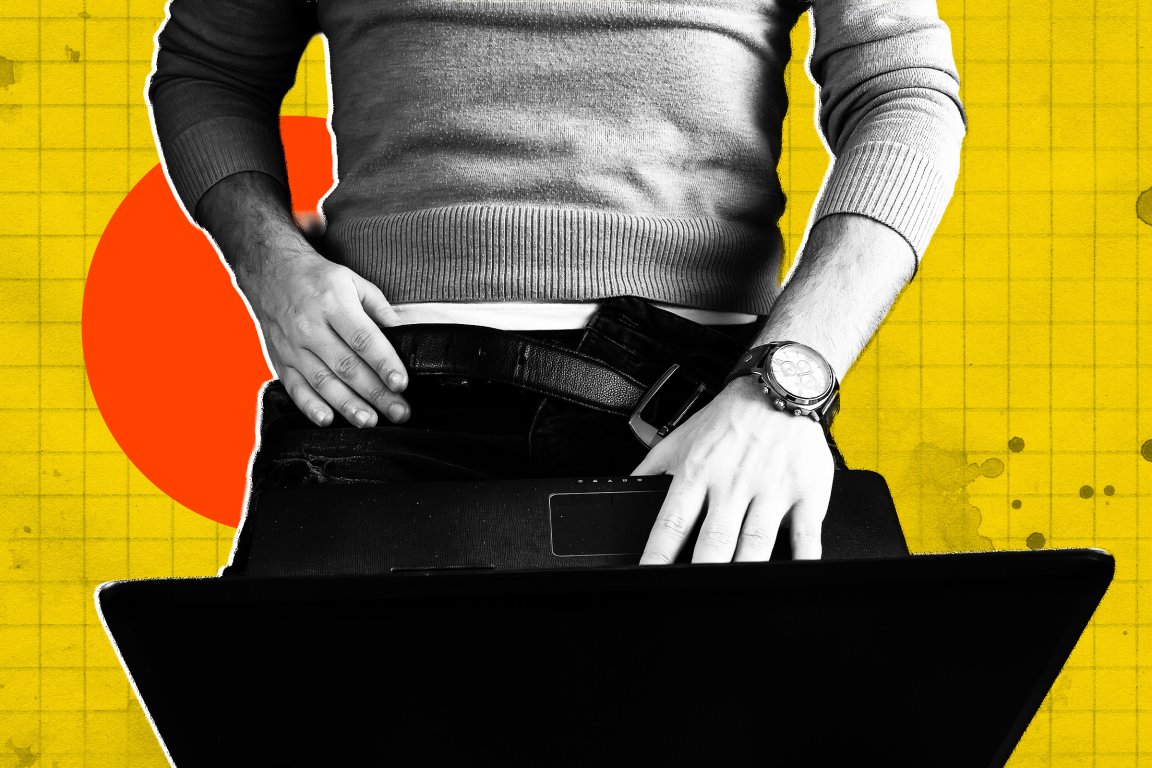
A man reclines with a computer on his lap and one hand pulling at his belt.
Illustration by Tag Hartman-Simkins / Futurism. Source: Shutterstock

AI companies have long relied on armies of data labelers, whose job it is to annotate, tag and classify text, images and videos to train AI models.

It’s not exactly a flashy occupation, with some saying they’re forced to watch privacy-invading footage. Others argue they’re being forced to dig their own graves by training models capable of doing their old jobs.

Other job opportunities in the space could prove more pleasurable. As Business Insider reports, a chatbot companion startup called Joi AI, which offers a NSFW character AI chat service, is hiring ten “mast**bation consultants,” according to a job listing the company posted on social media.

Best of all, chosen candidates will be paid $2,000 a month — not bad for cranking the hog to audio erotica.

These consultants are being asked to spend four weeks writing about their intimate experience while testing the company’s audio feature. Anyone can apply.

Unsurprisingly, Joi AI was quickly drowning in applications, with the company’s head of brand, Julie Levin, telling BI that the company had received over 100,000 applications in a matter of days.

“What are we supposed to do with 100,000 applications?” Levin said. “I should probably call them ‘winners,’ because it’s such a competition.”

It’s an unusual AI gig that will involve chosen candidates delivering weekly reports after completing “daily audio-guided sessions.”

“We expect people to learn something about how mast**bation affects their life in a good way or a bad way,” Levin told BI. “We wanted them to reflect on that.”

Chances are that not everybody signing up was sincerely meaning to help the company fine-tune its new audio feature. In a recent tweet, the company reflected on the types of “cover letter openings” it had received, which ranged from “this is my calling,” to “I’ve been training for this my whole life.” Other openings included “my therapist said I needed a hobby,” and “I applied on behalf of my husband.”

“Time to go pro,” one X user joked. “Ready to contribute extensive data, repeatedly, for science.”

The reality, of course, is that companies offering NSFW chatbot companionship have long been shrouded in controversy, from men creating AI girlfriends and verbally abusing them to teenagers falling in love with their new large language model-powered partners.

Experts also warn that a huge proportion of those with AI companions appear to be more depressed and lonely than those who don’t. Other research has found that people hooked on AI chatbots are more likely to experience profound breaks with reality and higher levels of psychological distress.

More on AI chatbots: Certain Chatbots Vastly Worse For AI Psychosis, Study Finds

Victor Tangermann

Senior Editor

I’m a senior editor at Futurism, where I edit and write about NASA and the private space sector, as well as topics ranging from SETI and artificial intelligence to tech and medical policy.